What Makes Each Pair Different

1Seven Pairs, Seven Characters
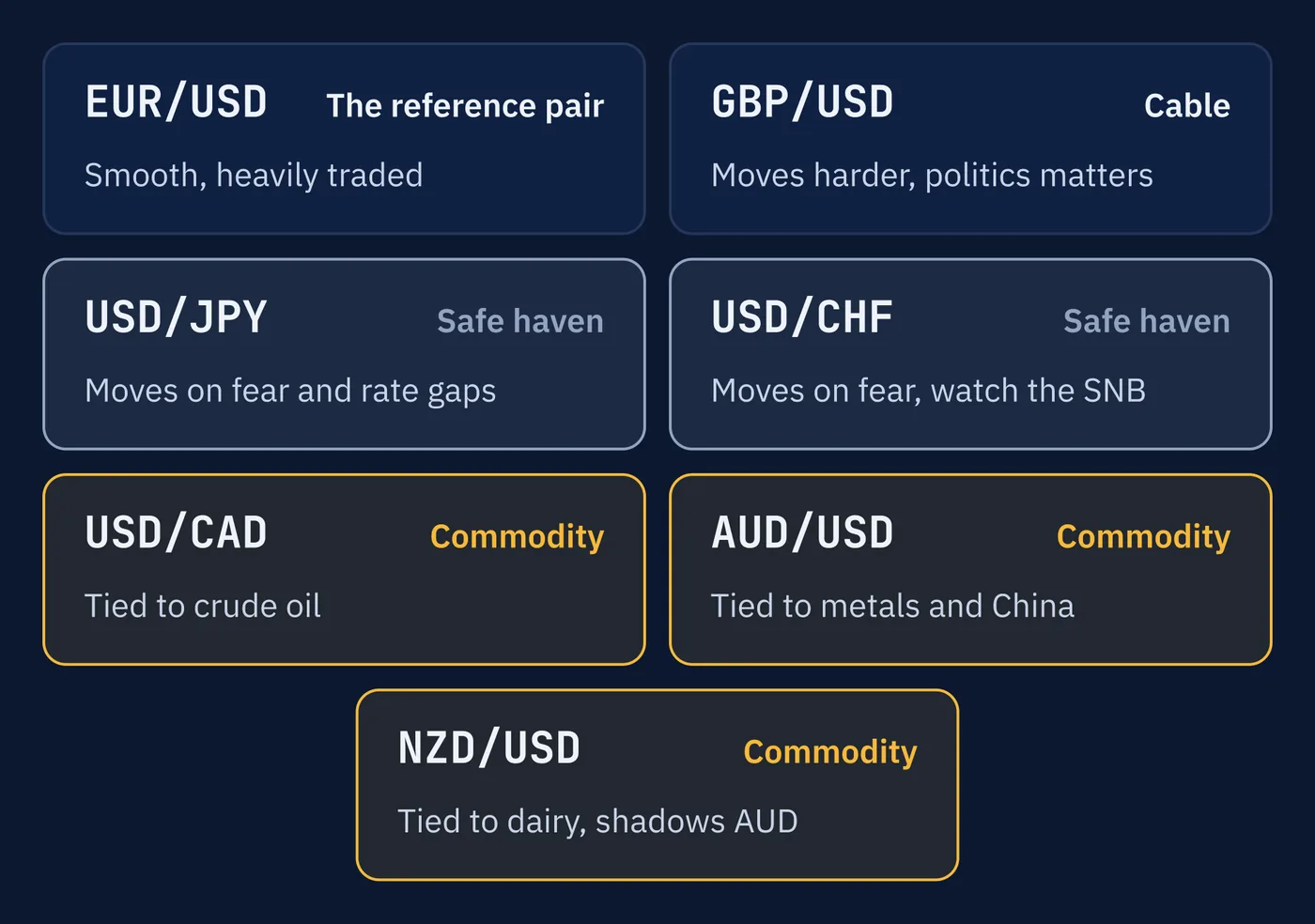
The seven majors all contain the dollar. That makes them relatives, not twins.
Each pair has a second currency, and that currency comes from a real country with a real economy. Some of those countries sell oil. Some sell iron ore. Some are places investors run to when they are frightened.
Those differences are not decoration. They decide what moves each pair, how far it tends to travel in a day, and which headlines matter to it.
A trader watching USD/CAD and a trader watching USD/JPY are following two different worlds. Both hold a dollar position. Beyond that, they have little in common.
2EUR/USD: The Reference Pair
EUR/USD is the most traded currency pair on earth. It accounts for roughly twenty-two to twenty-three percent of all daily currency trading, which is more than any other pair by a wide margin.
That volume has consequences you can feel. The pricing is the tightest available anywhere. The movement is smoother and less jumpy than any other major. There are more people analyzing it than any other price in the world.
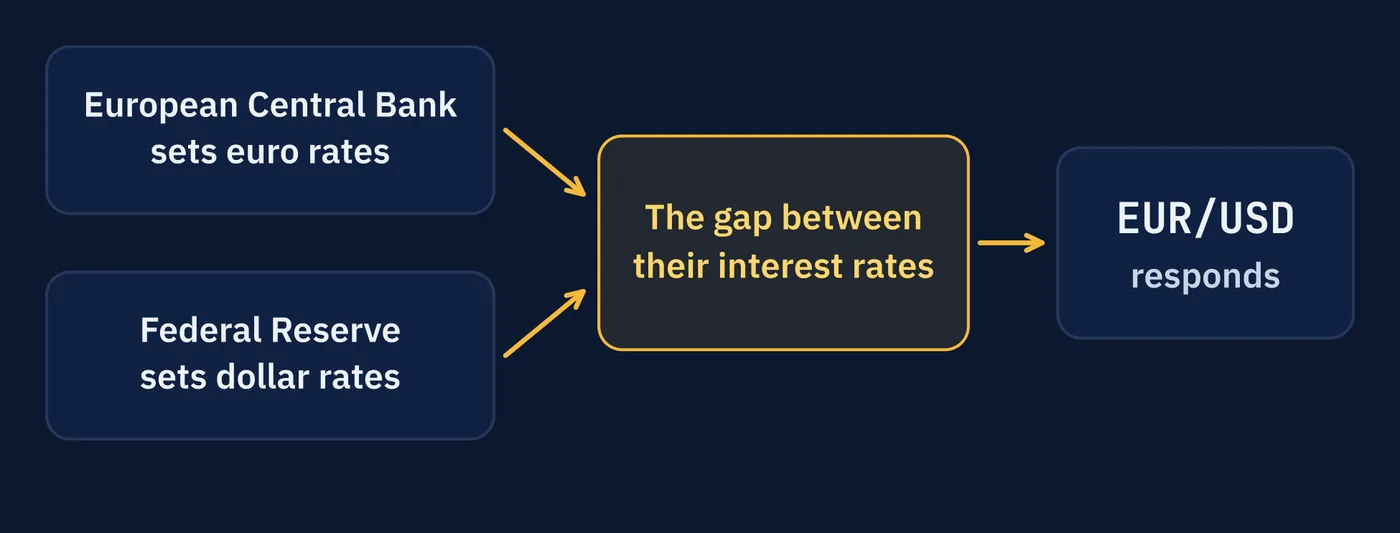
What drives it is the gap between two institutions: the European Central Bank and the Federal Reserve. When one is raising interest rates while the other holds steady or cuts, this pair responds.
For a beginner it is the sensible place to start, and the reason is simple. It is the best behaved of the seven, and the two institutions moving it are the most heavily reported in the world. You will never struggle to find someone explaining what the Fed just did.
3GBP/USD: Cable
Sterling against the dollar. On paper it looks like a close cousin of EUR/USD, since both are European currencies against the dollar. In practice it behaves differently.
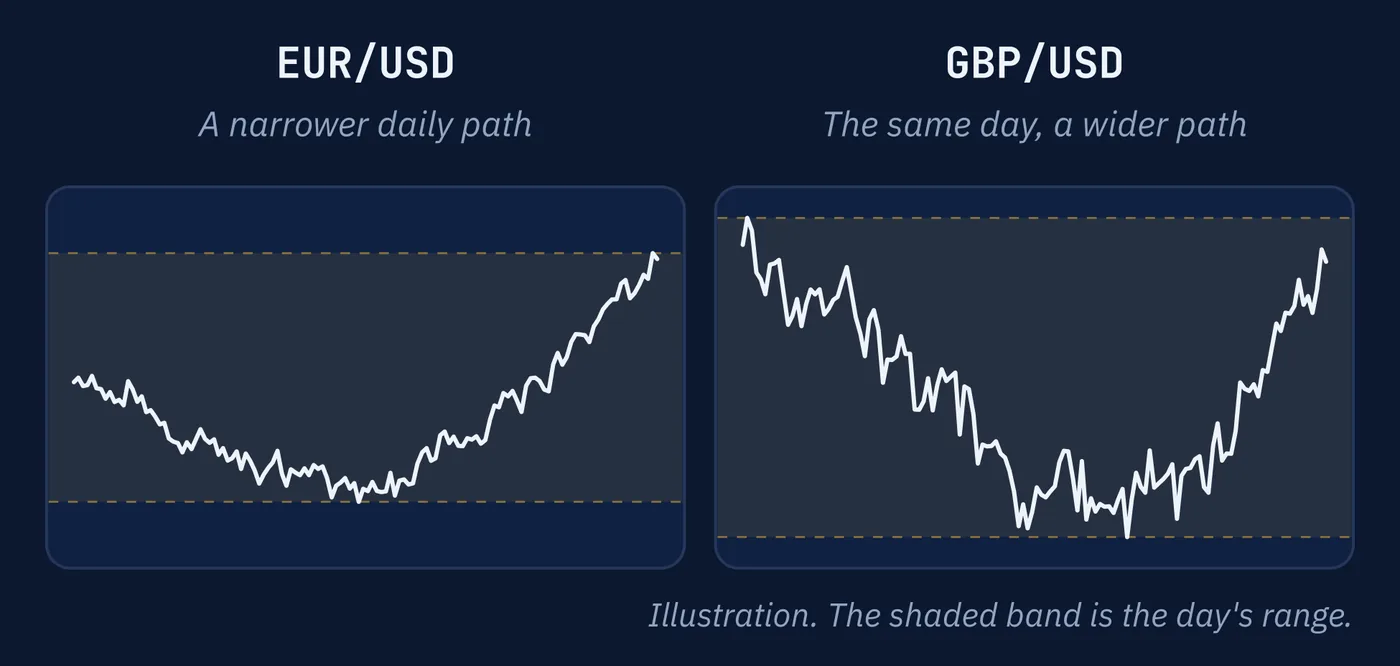
GBP/USD travels further in an average day. It reacts more sharply to news. Under similar conditions it will often move noticeably more than EUR/USD does.
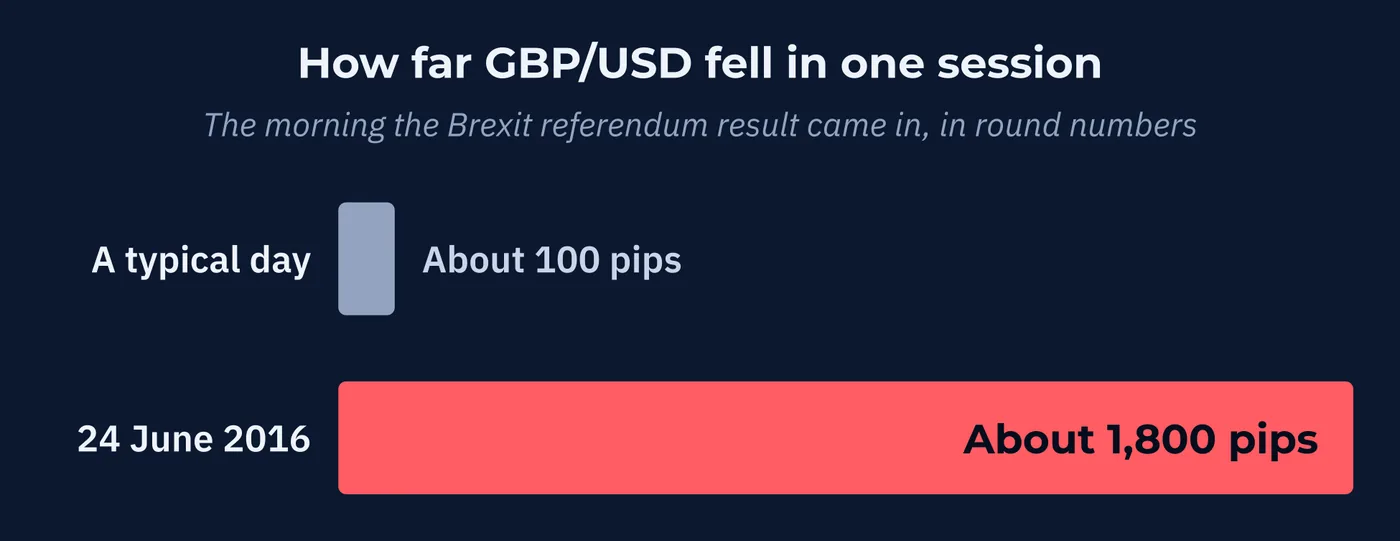
It is driven by the Bank of England against the Federal Reserve, by British economic data, and by British politics. That last one matters more here than in most majors. Since the 2016 Brexit referendum, this pair has carried a lasting political risk premium, meaning political news moves it more than it moves other pairs.
4The Safe Havens: USD/JPY and USD/CHF
The Japanese yen and the Swiss franc share something no other major currency has. Both are safe havens.
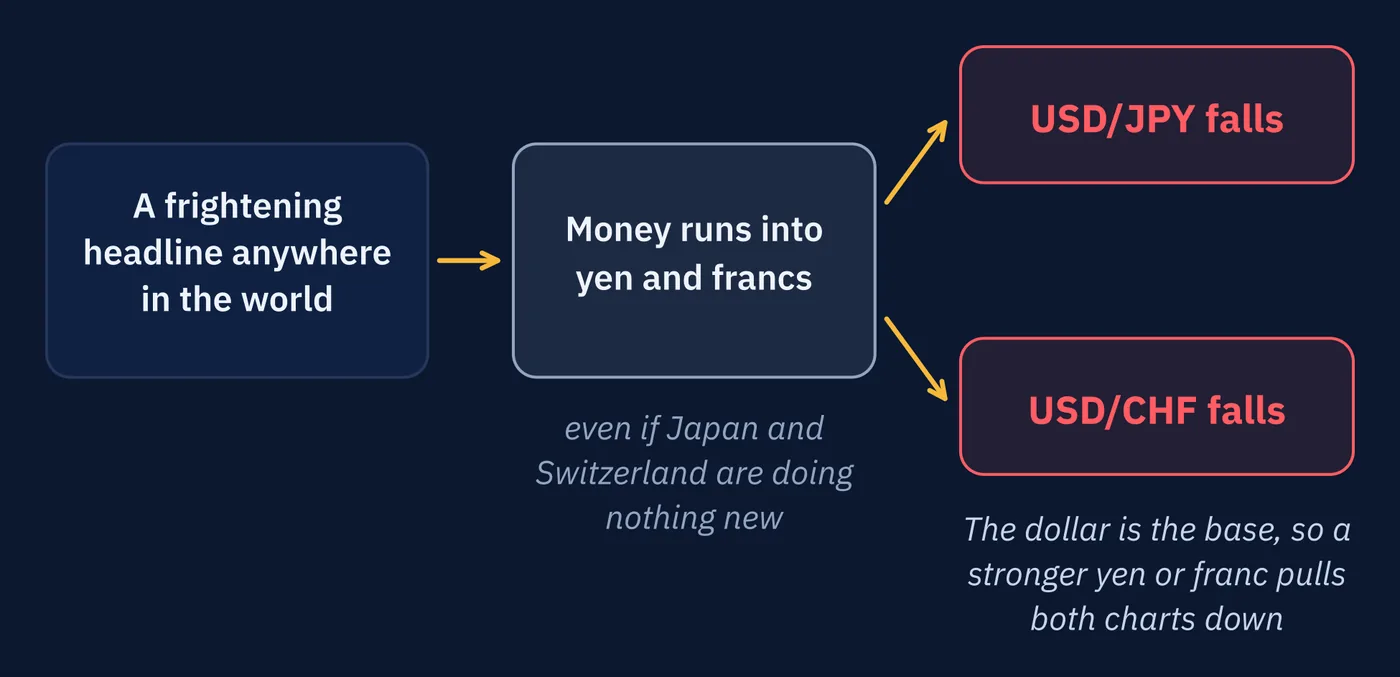
A safe haven currency is one that money runs toward when the world looks frightening. During a crash, a crisis, or a sudden geopolitical shock, investors move capital into yen and francs. That buying strengthens them.
Here is the part that surprises people. This happens whether or not Japan or Switzerland are doing well. The flow is driven by fear somewhere else, not by strength at home. A bad quarter for the Japanese economy does not stop the yen from rising during a global panic.
So these two pairs respond to something the other five largely ignore. A frightening headline anywhere on earth can move them, even when nothing has changed in Japan, Switzerland, or the United States.
Both have the dollar as the base currency, so a rush into the yen pushes USD/JPY down. Money moving into the yen means each dollar buys fewer of them.
USD/JPY has one more feature worth knowing. Japan has held interest rates near zero for a very long stretch. That makes the pair unusually sensitive to the gap between Japanese and American rates, and when that gap widened sharply in recent years, USD/JPY moved to levels it had not seen in decades.
The Swiss franc is a safe haven for different reasons than the yen. Switzerland has a long record of political neutrality, a stable government, and a banking system built over centuries around holding other people's money safely. Money goes there because the country has spent a very long time being the place money goes.
One thing marks USD/CHF out. The Swiss National Bank has historically been more willing than most central banks to step directly into the currency market and act when it judges the franc has moved too far. That is worth knowing before trading the pair. You are not only reading the market, you are reading an institution that has shown it will intervene.
5The Commodity Currencies
The remaining three majors sit at the opposite end of the temperament scale.
The Canadian, Australian, and New Zealand dollars are commodity currencies. Their value is tied to the natural resources their countries sell to the world. When those resources are in demand, money flows into the country, and the currency strengthens.
| Pair | Tied To | What to Watch |
|---|---|---|
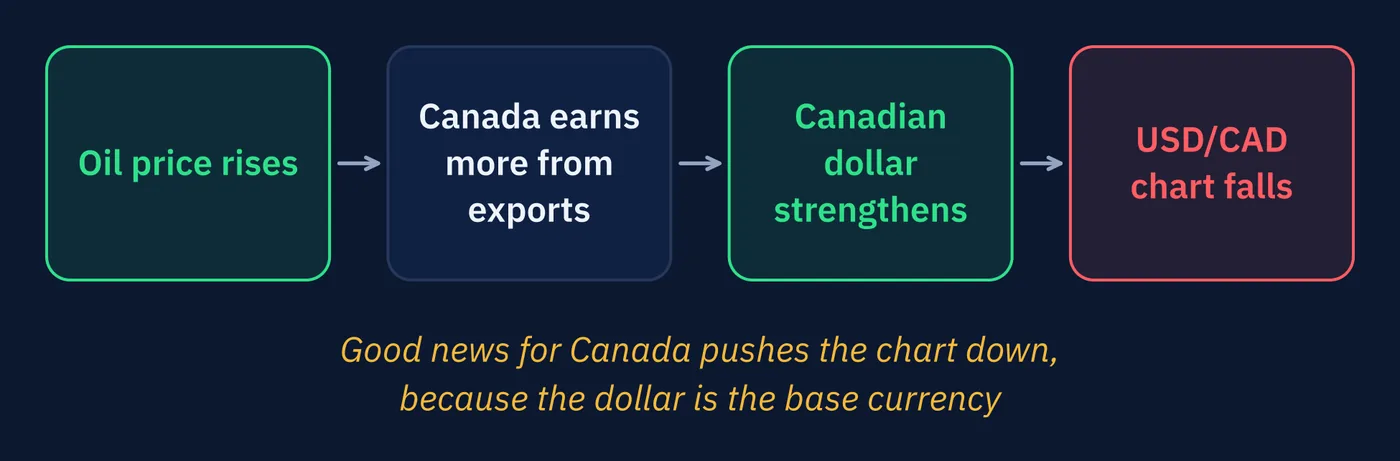
USD/CAD | Crude oil | Canada is a major oil exporter. A rising oil price tends to strengthen the Canadian dollar, which pushes this pair down. |
AUD/USD | Iron ore, coal, metals | Australia sells heavily to China, so Chinese economic data moves this pair. |
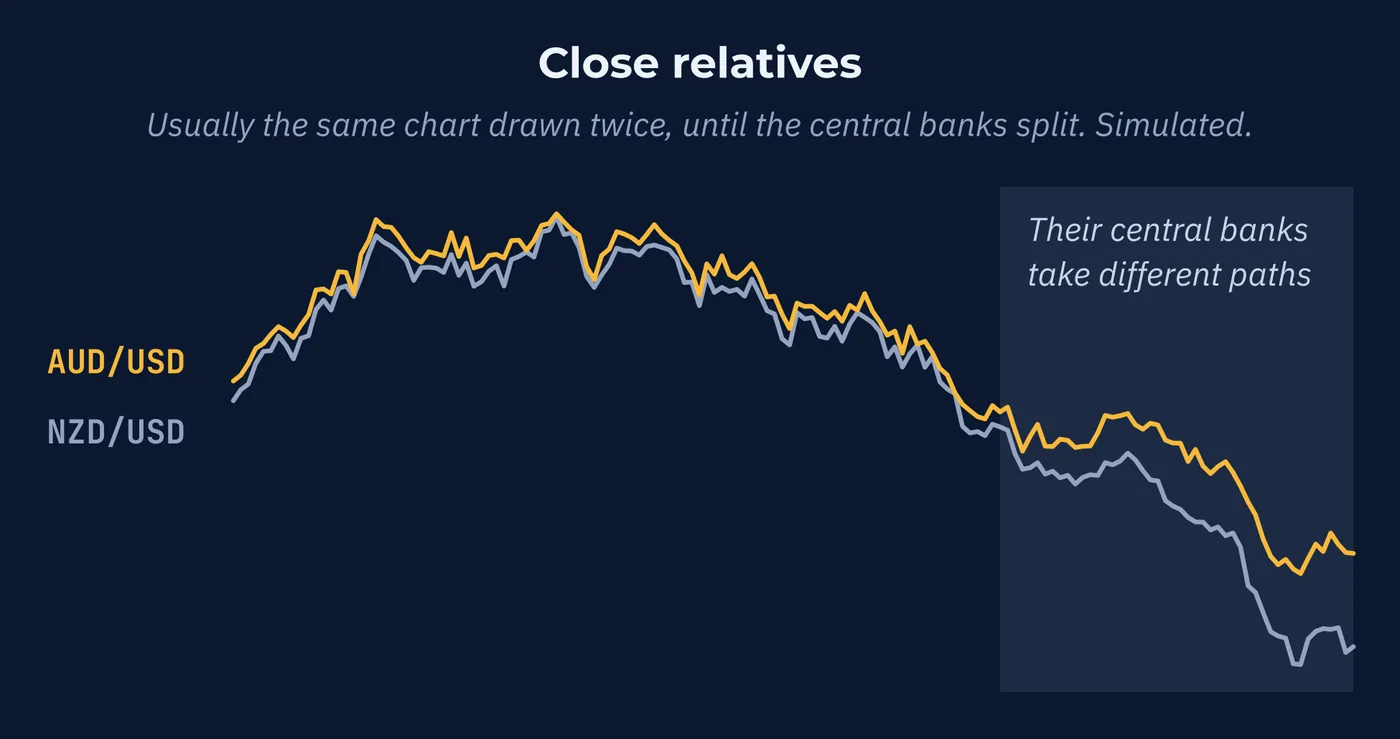
NZD/USD | Dairy and agriculture | Tracks AUD/USD closely most of the time. They separate mainly when their two central banks take different paths. |
Notice that USD/CAD works backward from what you might expect. Good news for Canada pushes the chart down, because the dollar is the base currency in that pair. Lesson 7's rule still applies here.
AUD/USD and NZD/USD are close relatives. Both countries sell raw materials, both depend on Asian demand, and both currencies respond to the same global mood. Watch them side by side and they will often look like the same chart drawn twice.
They separate for one main reason: their central banks. When the Reserve Bank of Australia and the Reserve Bank of New Zealand move in different directions on interest rates, the two pairs pull apart. The rest of the time, whatever moves one usually moves the other.
6Fear and Confidence
Put the last two sections side by side and something useful appears.
The commodity currencies are risk-on currencies. They strengthen when investors feel confident and the world looks like it is growing. Confident investors buy raw materials, and buying raw materials means buying the currencies of the countries that sell them.
The safe havens are the mirror image. They strengthen when investors are frightened.
So a single frightening headline does two things at once.
| When Investors Are | Safe Havens (JPY, CHF) | Commodity Currencies (CAD, AUD, NZD) |
|---|---|---|
| Frightened | Strengthen | Weaken |
| Confident | Weaken | Strengthen |
One event. Opposite effects. Which one you see depends entirely on which chart you have open.
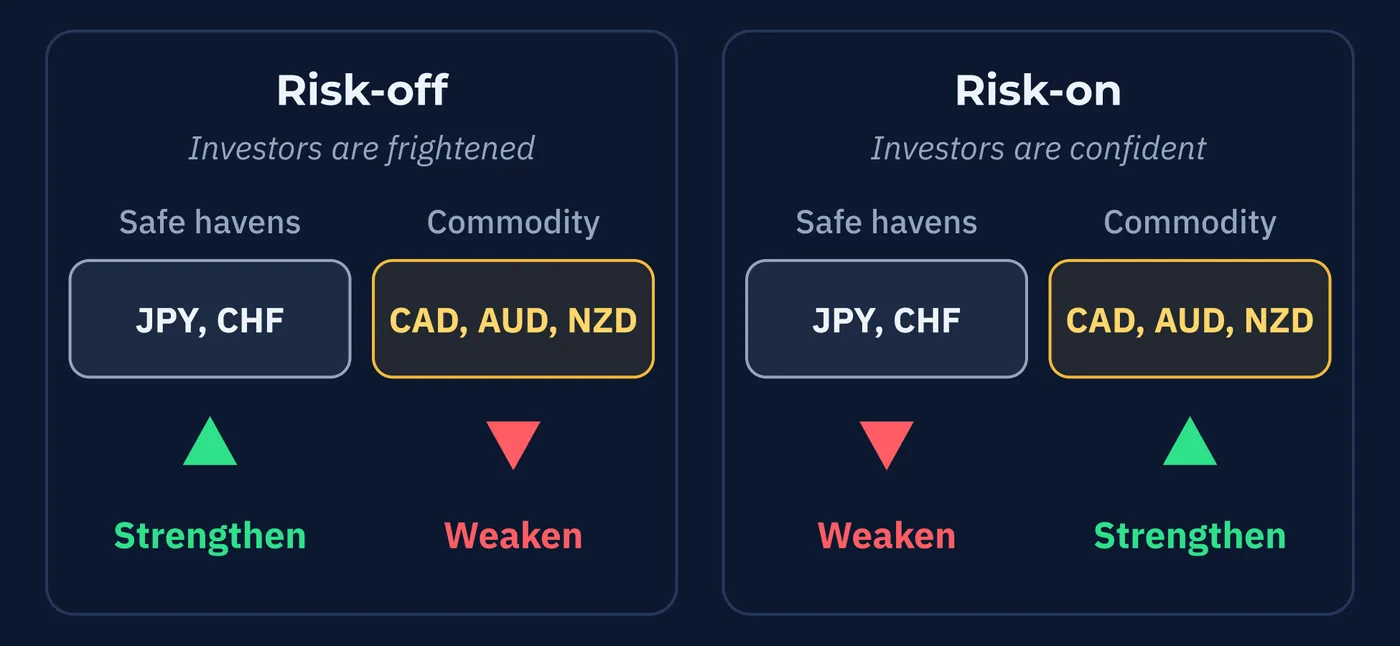
Traders have a shorthand for these two conditions. Risk-on means confidence. Risk-off means fear. You will hear both constantly, and now you know what each one does to which pair.
7Choosing a Pair Is Choosing What to Watch
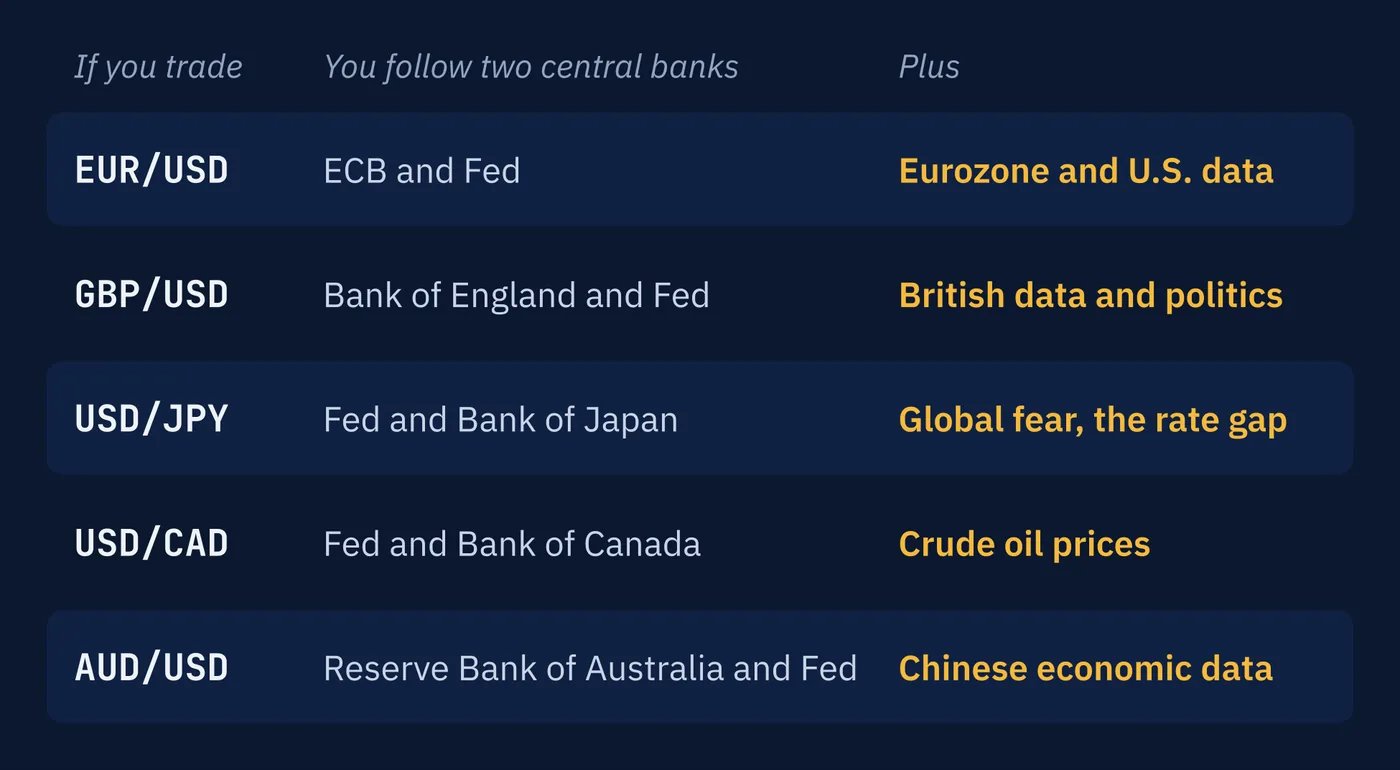
None of this is trivia. A pair's character tells you what you have signed up to follow.
Trade USD/CAD without paying attention to oil prices and you are ignoring one of the two biggest forces acting on your position. Trade AUD/USD with no awareness of Chinese economic data and the same is true. Trade USD/JPY and you have taken on exposure to global fear, whether you meant to or not.
There is a second layer to this. Every pair contains two central banks, not one. A EUR/USD position is exposed to both the European Central Bank and the Federal Reserve, and either can move it sharply.
Choosing a pair is choosing what to pay attention to.
Which is one more reason EUR/USD is the standard recommendation for a beginner. Not because it is easier to trade, but because the homework is easier to do. Fed and ECB decisions are explained everywhere, in plain language, within minutes of happening.
Three Things to Remember
Try This
Ten minutes. This connects a headline to the pair it should move.
Words From This Lesson
| Term | What It Means |
|---|---|
| Safe haven currency | A currency that strengthens when investors are frightened, regardless of its own economy. The yen and Swiss franc are the main examples. |
| Commodity currency | A currency tied to the natural resources its country exports. The Canadian, Australian, and New Zealand dollars. |
| Risk-on | Conditions where investors feel confident. Commodity currencies tend to strengthen and safe havens tend to weaken. |
| Risk-off | Conditions where investors are frightened. Safe havens strengthen and commodity currencies weaken. |
| Political risk premium | Extra price movement a currency carries because its country's politics are seen as unpredictable. |
| Cable | The long-standing nickname for GBP/USD, from the transatlantic telegraph cable that first carried the rate. |
Test Your Knowledge
Eight questions. Answer them all before checking the key on the following pages. If a question gives you trouble, the answer key tells you which section to revisit.
- A. It is guaranteed to be profitable
- B. It is the deepest and smoothest pair, and its drivers are widely reported
- C. It is the only pair open during U.S. hours
- D. It moves further each day than the other majors
- A. It trades only during the Asian session
- B. It moves less because the UK economy is smaller
- C. It is unaffected by central bank decisions
- D. It moves further in a day and reacts more sharply to news
- A. A currency that never falls in value
- B. A currency backed by gold
- C. A currency that strengthens when investors are frightened, regardless of its own economy
- D. A currency with a government-fixed exchange rate
- A. It strengthens, as investors move money into it
- B. It weakens, because crises are bad for all currencies
- C. Nothing, unless the crisis is in Japan
- D. It becomes untradeable until the crisis passes
- A. It rises, because oil is priced in dollars
- B. It falls, because a stronger Canadian dollar pushes the pair down
- C. It is unaffected, since Canada is not an oil producer
- D. It rises for one day, then reverses
- A. AUD/USD
- B. USD/CHF
- C. GBP/USD
- D. EUR/USD
- A. All seven strengthen together
- B. Safe havens strengthen and commodity currencies weaken
- C. Commodity currencies strengthen and safe havens weaken
- D. Nothing changes until a central bank acts
- A. Only one pair can be traded at a time
- B. Some pairs require more screen time than others
- C. You must watch one pair exclusively
- D. Each pair has its own drivers and two central banks you must follow
Answer Key
Each answer explains why the correct choice is correct, why the others are not, and where to reread.
Question 1 · correct answer B
Its enormous volume produces the tightest pricing and the smoothest movement, and the Fed and ECB are the most heavily reported institutions in finance.
A is wrong because no pair carries any guarantee. C is wrong because the currency market runs around the clock on weekdays and every major is available. D reverses the truth, since EUR/USD moves less in a typical day than several other majors.
Review: Section 2, EUR/USD
Question 2 · correct answer D
Cable travels further in an average day and reacts harder to news, and since 2016 it has carried an added political risk premium.
B assumes economy size determines daily range, which it does not. C is wrong because the Bank of England and the Federal Reserve are among its main drivers. A is wrong because it is most active during London hours, and in any case is tradeable throughout the week.
Review: Section 3, GBP/USD
Question 3 · correct answer C
Safe haven status comes from where money flows under stress. Capital moves into yen and francs during crises whatever those economies are doing.
A overstates it, since safe haven currencies fall routinely in calm conditions. B describes a commodity-backed arrangement no major currency has. D describes a currency peg, a different mechanism entirely.
Review: Section 4, The Safe Havens
Question 4 · correct answer A
Fear drives money toward safe havens, and buying strengthens the yen. Because the dollar is the base in USD/JPY, that shows up as the pair falling.
B assumes crises weaken everything, when in fact they redistribute money toward certain currencies. C misses the central point, since the flow comes from fear elsewhere rather than Japanese conditions. D invents a trading halt that does not occur.
Review: Section 4, The Safe Havens
Question 5 · correct answer B
Canada exports oil, so a rising oil price tends to strengthen the Canadian dollar. Since the Canadian dollar is the quote currency, the pair falls.
A notices a true fact about oil pricing and draws the wrong conclusion from it. C is factually wrong, as Canada is a major exporter. D invents a fixed timeline that no market follows.
Review: Section 5, The Commodity Currencies
Question 6 · correct answer A
Australia sells iron ore, coal, and metals heavily into China, so Chinese data feeds directly into demand for Australian exports and therefore the currency.
B is tied to safe haven flows instead. C responds mainly to British data and politics. D is driven by the ECB and the Federal Reserve.
Review: Section 5, The Commodity Currencies
Question 7 · correct answer C
Confidence sends money toward growth and raw materials, which lifts the commodity currencies, and away from the shelters, which weakens the safe havens.
A is impossible, because the majors contain currencies with opposite characters and the dollar sits on different sides. B describes risk-off, the exact reverse. D is wrong because markets reprice on sentiment without waiting for an official response.
Review: Section 6, Fear and Confidence
Question 8 · correct answer D
Each pair comes with its own drivers and two central banks. Picking a pair commits you to following that particular set of news.
B treats it as a question of time spent rather than of subject matter. C and A both invent restrictions that do not exist, since traders routinely follow and hold several pairs.
Review: Section 7, Choosing a Pair Is Choosing What to Watch
Keep going
Currency Pairs is written by Kanin D. Alldredge for The Currency Classroom, and it is free to read. There is more free from CNS: start here.
Start free with CNS →