The Seven Majors

1From Thousands of Pairs to Seven
There are more than a hundred currencies in the world. That means thousands of possible pairings. Almost nobody trades most of them.
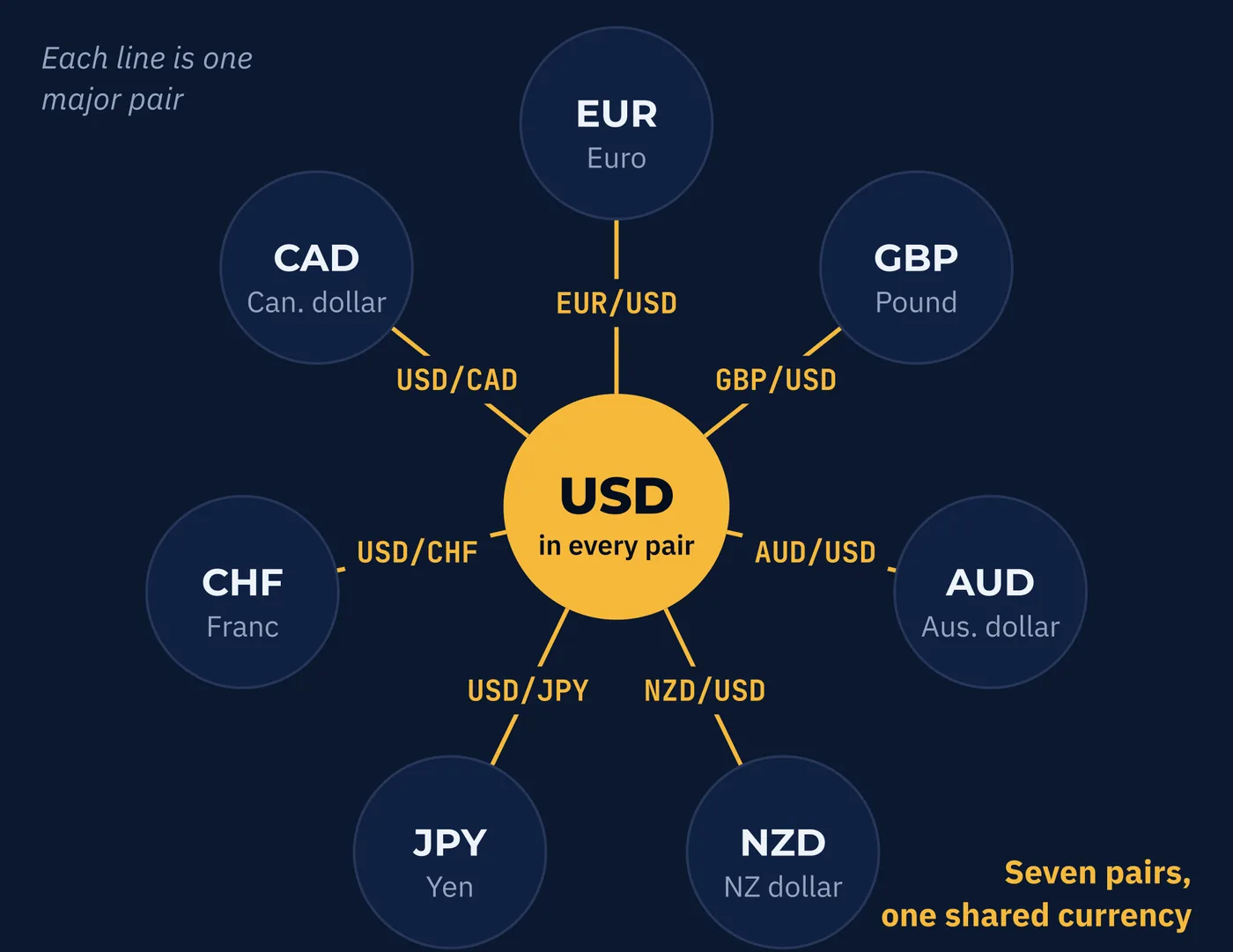
Trading piles into a small group called the major pairs. There are seven. Between them, they carry most of what happens in this market.
Here they are.
| Pair | Base Currency | Quote Currency |
|---|---|---|
EUR/USD | Euro | U.S. dollar |
GBP/USD | British pound | U.S. dollar |
AUD/USD | Australian dollar | U.S. dollar |
NZD/USD | New Zealand dollar | U.S. dollar |
USD/JPY | U.S. dollar | Japanese yen |
USD/CHF | U.S. dollar | Swiss franc |
USD/CAD | U.S. dollar | Canadian dollar |
Read down the list. The dollar is in all of them. Every single one.
2Why the Dollar Is in All of Them
The dollar holds a particular place in the world, and three things explain it.
It is the primary reserve currency. Countries hold dollars in their national reserves the way you might keep savings in a bank.
It is the settlement currency for most international trade. Two countries that use neither dollars at home will often still trade with each other in dollars.
And it is the pricing currency for commodities. Oil, gold, and most globally traded raw materials are quoted in dollars no matter who is buying or selling.
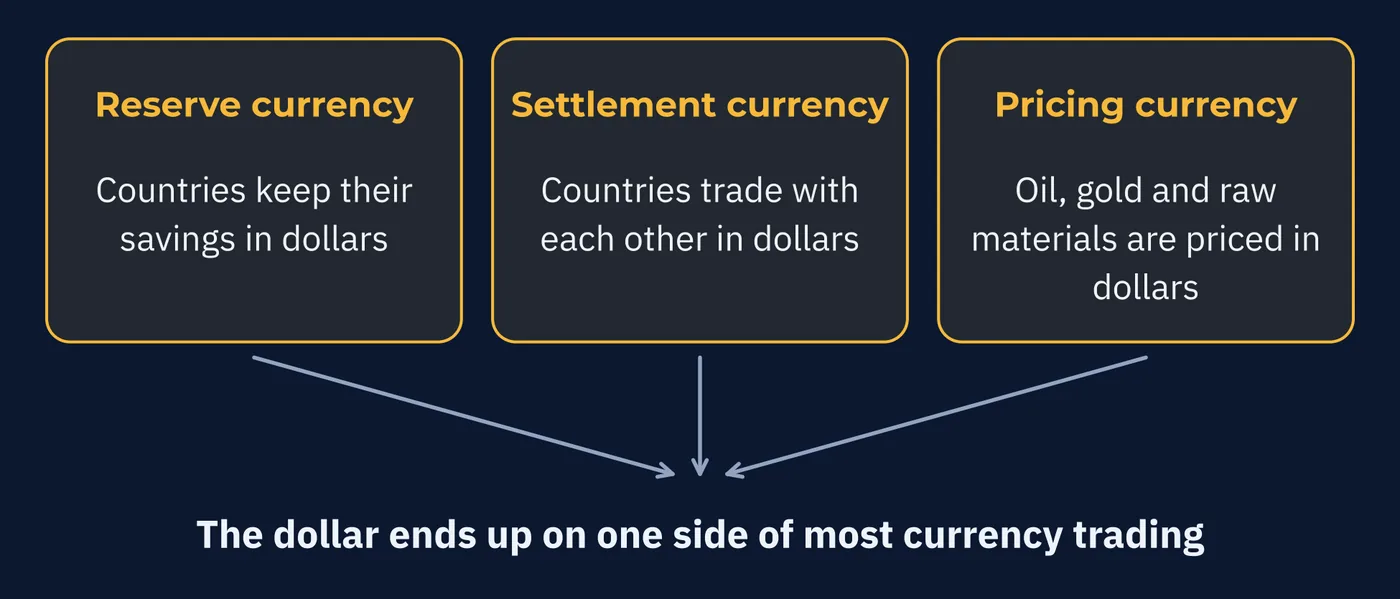
Add those together and the dollar ends up on one side of roughly eighty-nine percent of all currency trading. Not eighty-nine percent of the pairs that exist. Eighty-nine percent of the actual trading.
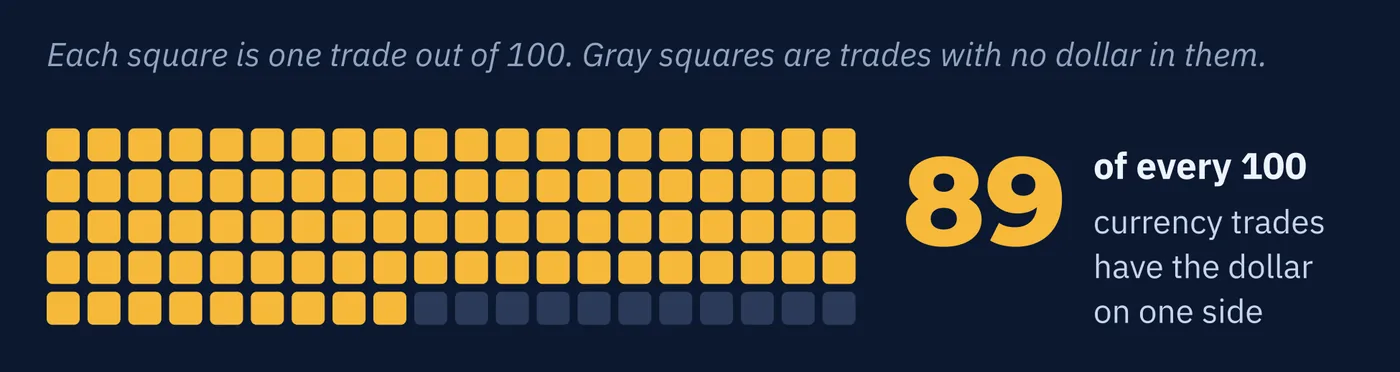
So the seven majors are not major by appointment. They are the seven busiest places where that fact shows up.
3One Dollar Move, Seven Reactions
Because the dollar sits in all seven pairs, anything that moves the dollar moves all seven at once.
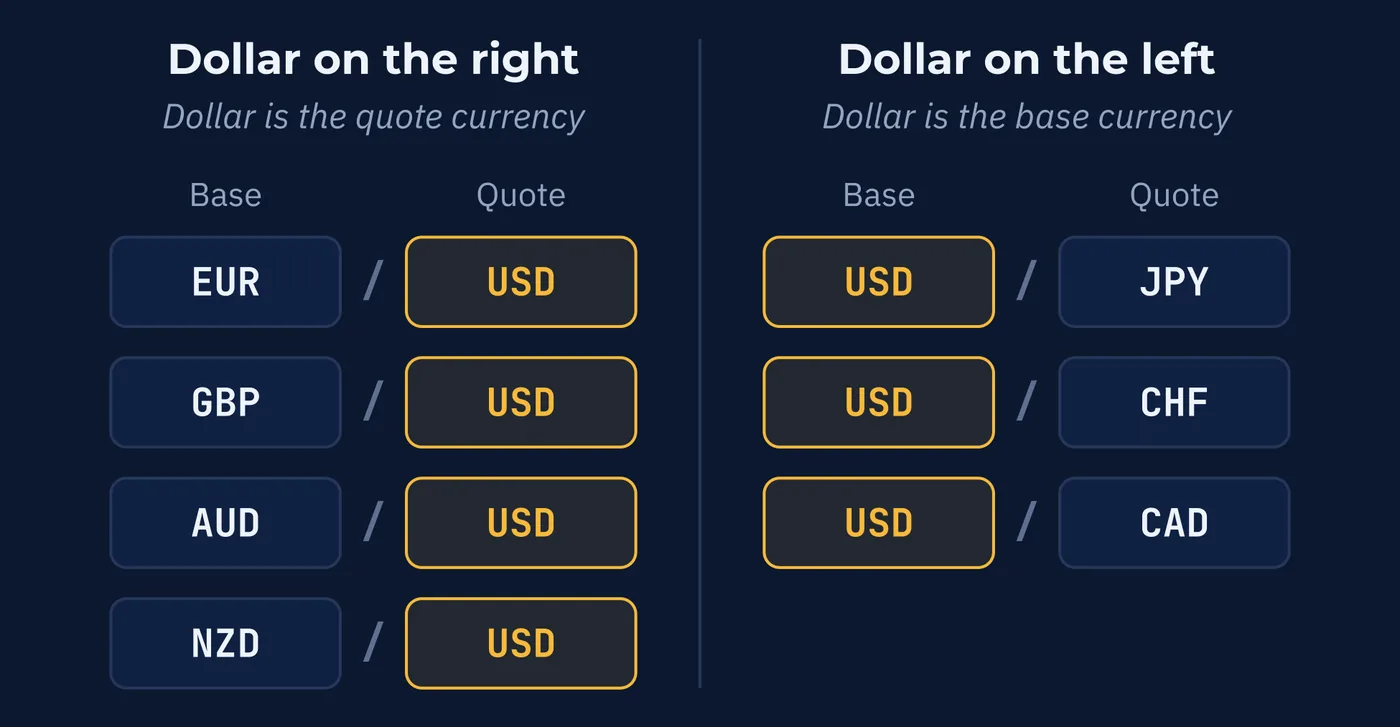
There is a catch, and it catches almost everyone. The dollar is the quote currency in four of the majors. It is the base currency in the other three. That single difference flips what a rising chart means.
Say the Federal Reserve makes an announcement and the dollar strengthens across the board. Here is what your seven charts do.
| Pair | Dollar's Position | The Chart |
|---|---|---|
EUR/USD | Quote | Falls |
GBP/USD | Quote | Falls |
AUD/USD | Quote | Falls |
NZD/USD | Quote | Falls |
USD/JPY | Base | Rises |
USD/CHF | Base | Rises |
USD/CAD | Base | Rises |
Four charts fall. Three charts rise. All seven are showing the same event.
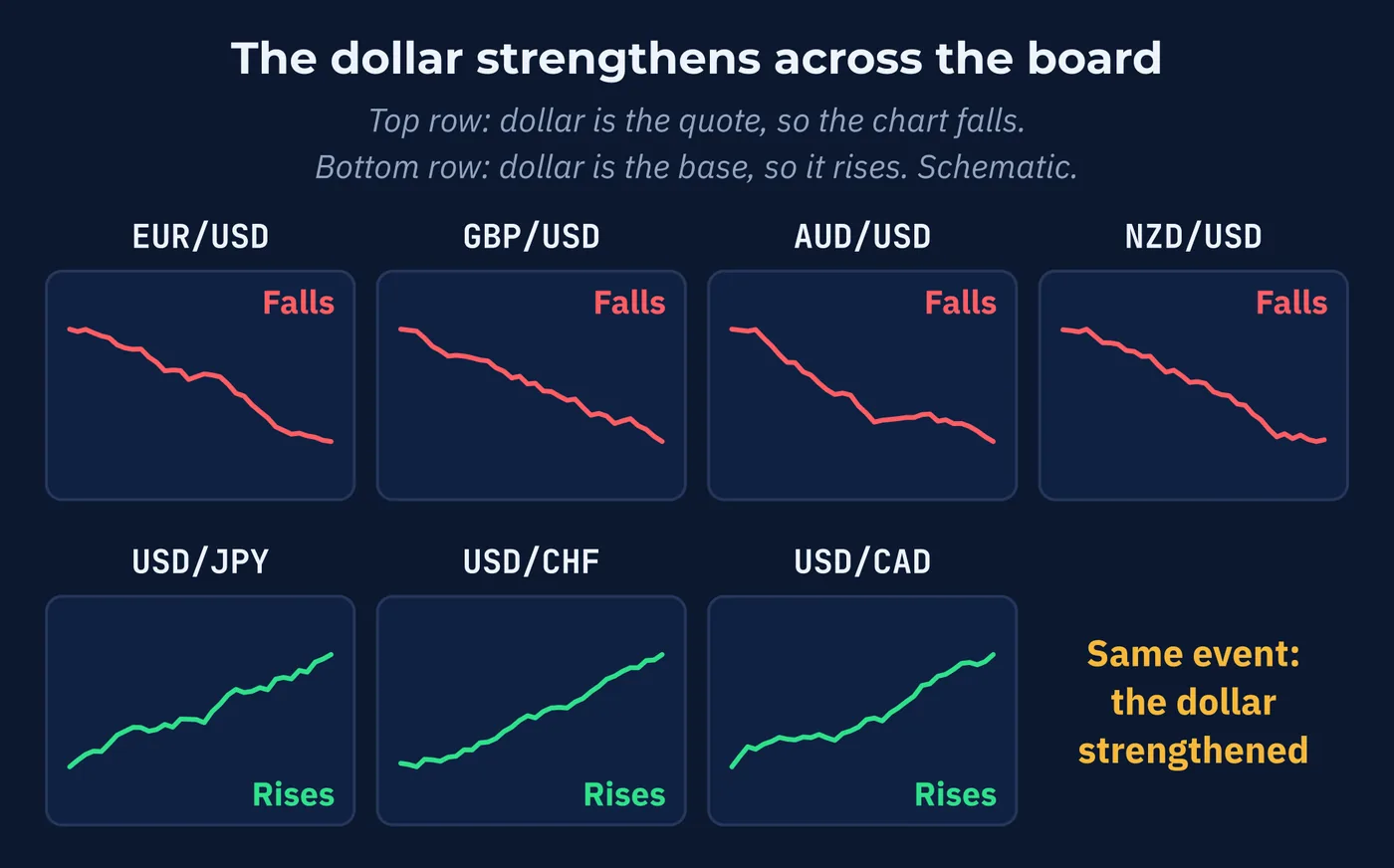
Work through why, because memorizing the table will not survive stressful trading.
When the dollar is the quote currency, the price says how many dollars one unit of the base costs. A stronger dollar means fewer dollars are needed. The number goes down.
When the dollar is the base, the price says how much of the other currency one dollar buys. A stronger dollar buys more. The number goes up.
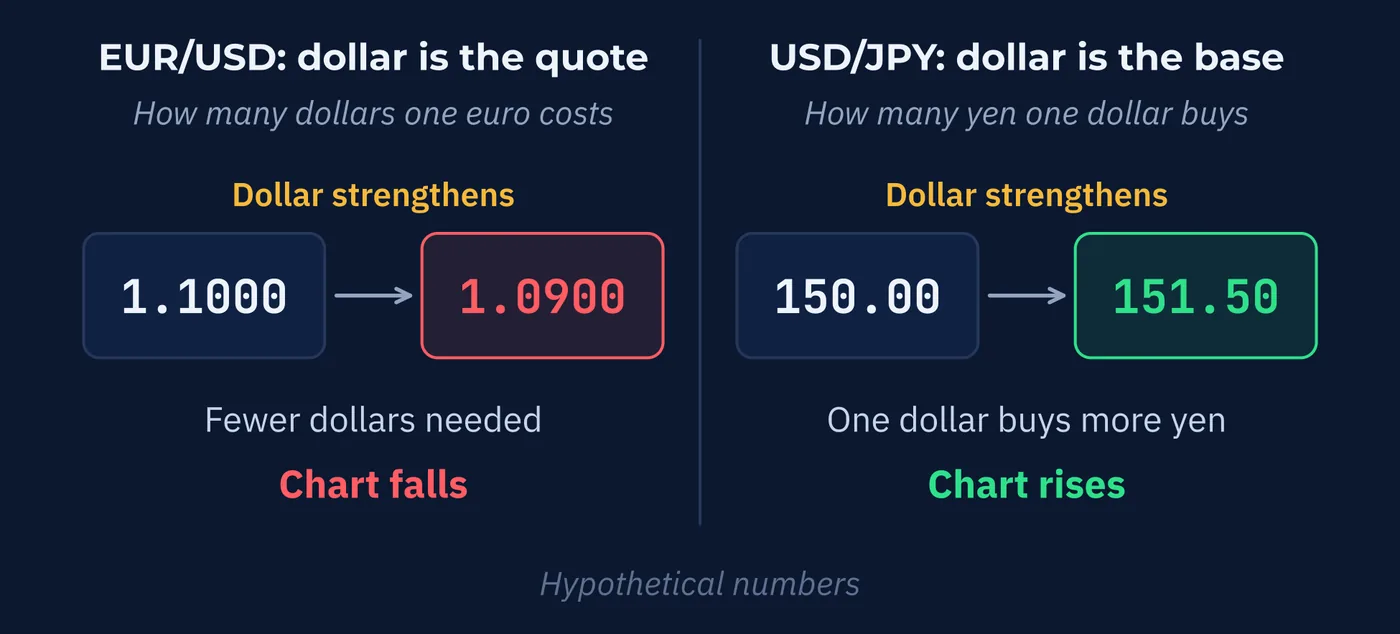
Same force. Opposite direction on the screen. Nothing else is going on.
4Is It the Euro, or Is It the Dollar?
Here is where that idea earns its keep.
EUR/USD is rising. What does that tell you?
On its own, almost nothing. A pair is a ratio between two things, so the number can rise for two completely different reasons. The euro got stronger. Or the dollar got weaker. Both draw an identical chart.
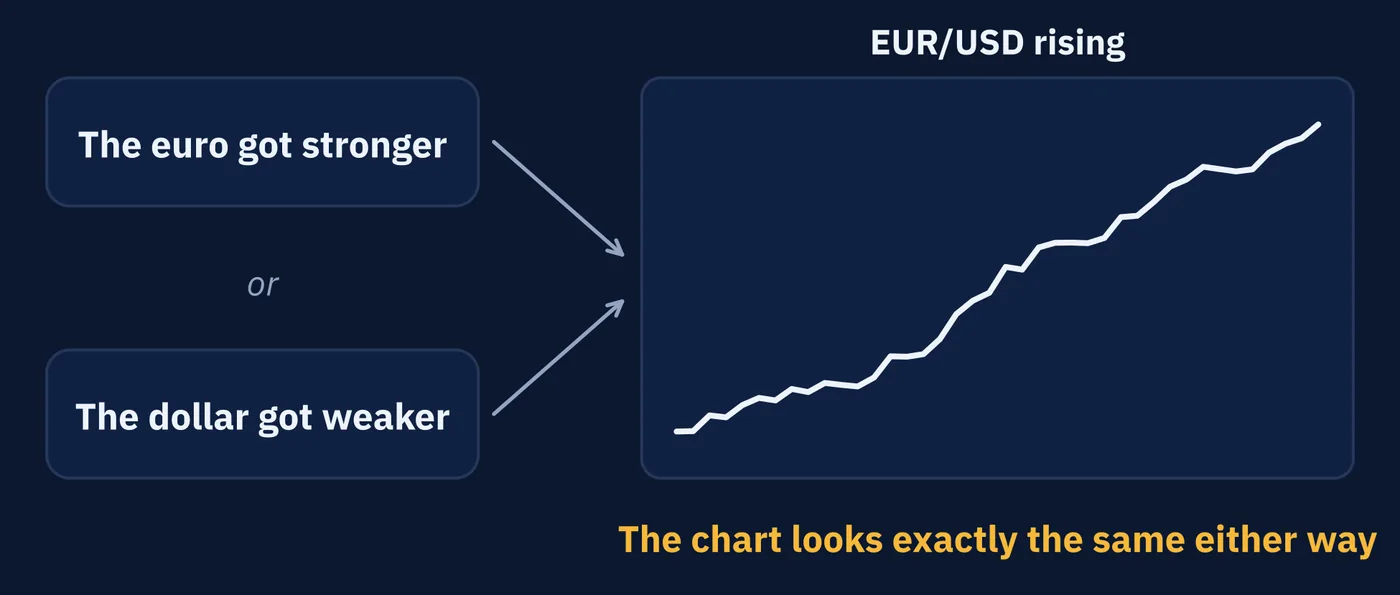
You cannot tell them apart by staring harder at EUR/USD. You tell them apart by looking at the other six.
| What You See | What It Means |
|---|---|
| All four dollar-quoted pairs rising, all three dollar-based pairs falling | A dollar story. The dollar weakened and every major responded. |
| EUR/USD rising while the other six sit still | A euro story. Something happened in Europe. |
| A mixed, messy picture with no clean pattern | No single force is in charge today. Each pair is following its own drivers. |
This is a habit worth building early. Before asking why one pair moved, glance across all seven and ask whether the dollar is the thing that moved.
Work through a morning to see how it plays out.
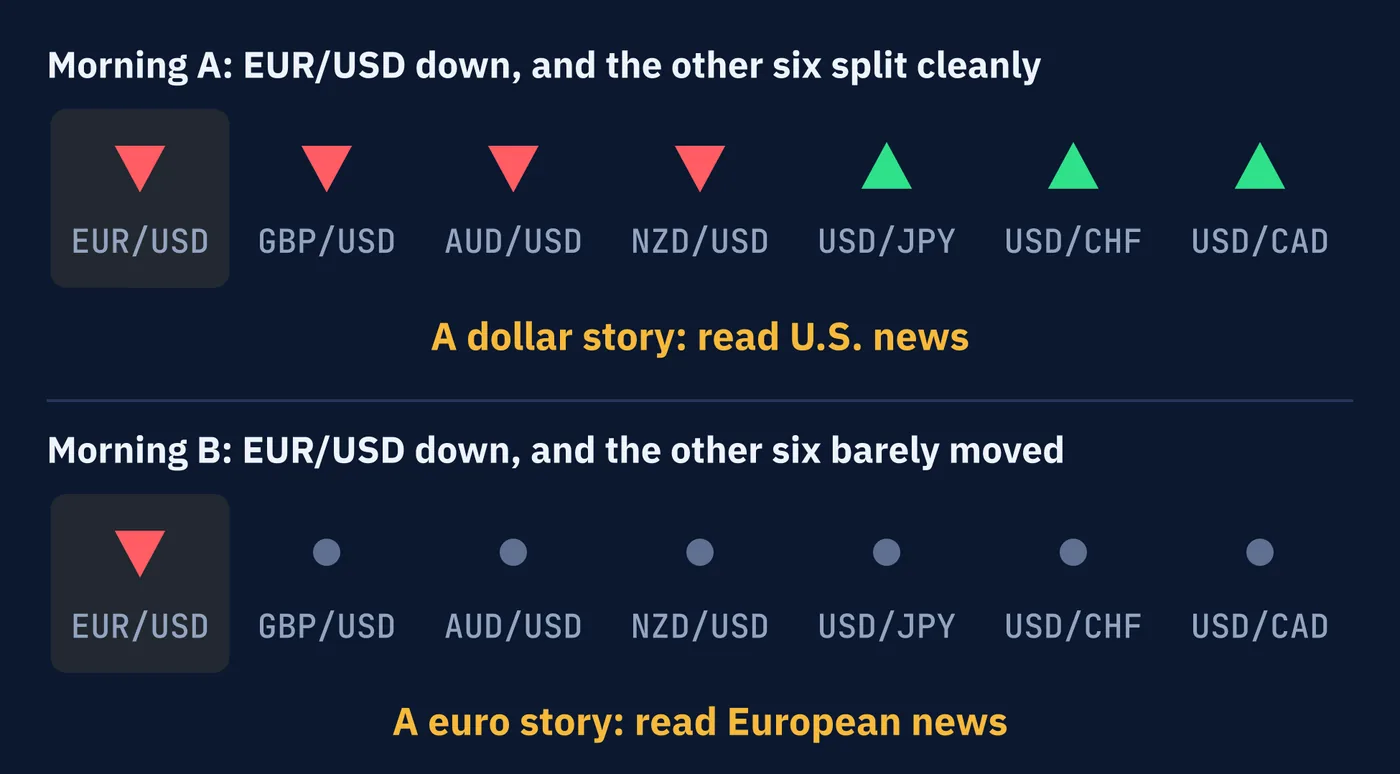
You open your screen and EUR/USD is down forty pips. Your first instinct is that something went wrong in Europe, so you go looking for European news.
Before you do, check the other six. GBP/USD is down. AUD/USD is down. NZD/USD is down. USD/JPY is up, USD/CHF is up, USD/CAD is up.
That is a clean split, and it changes the question entirely. Nothing happened in Europe. The dollar strengthened, and all seven majors reported the same event in whichever direction their structure allows. You should be reading American news, not European news.
Now change one detail. EUR/USD is down forty pips and the other six have barely moved. Now it really is a euro story, and your first instinct was right.
Same starting observation. Two completely different investigations. The only thing that separated them was a ten second glance at six other charts.
5The Dollar Index
Checking seven charts to answer one question gets tiring. So traders built a shortcut.
The U.S. Dollar Index, written DXY, measures the dollar against a basket of six currencies at once. It gives you one number for broad dollar direction. When it rises, the dollar is broadly strengthening.
It has a real weakness, and you should know it before leaning on it. The basket is heavily tilted toward the euro, which makes up well over half of it by weight. So a big DXY move is sometimes telling you about the euro rather than the dollar.
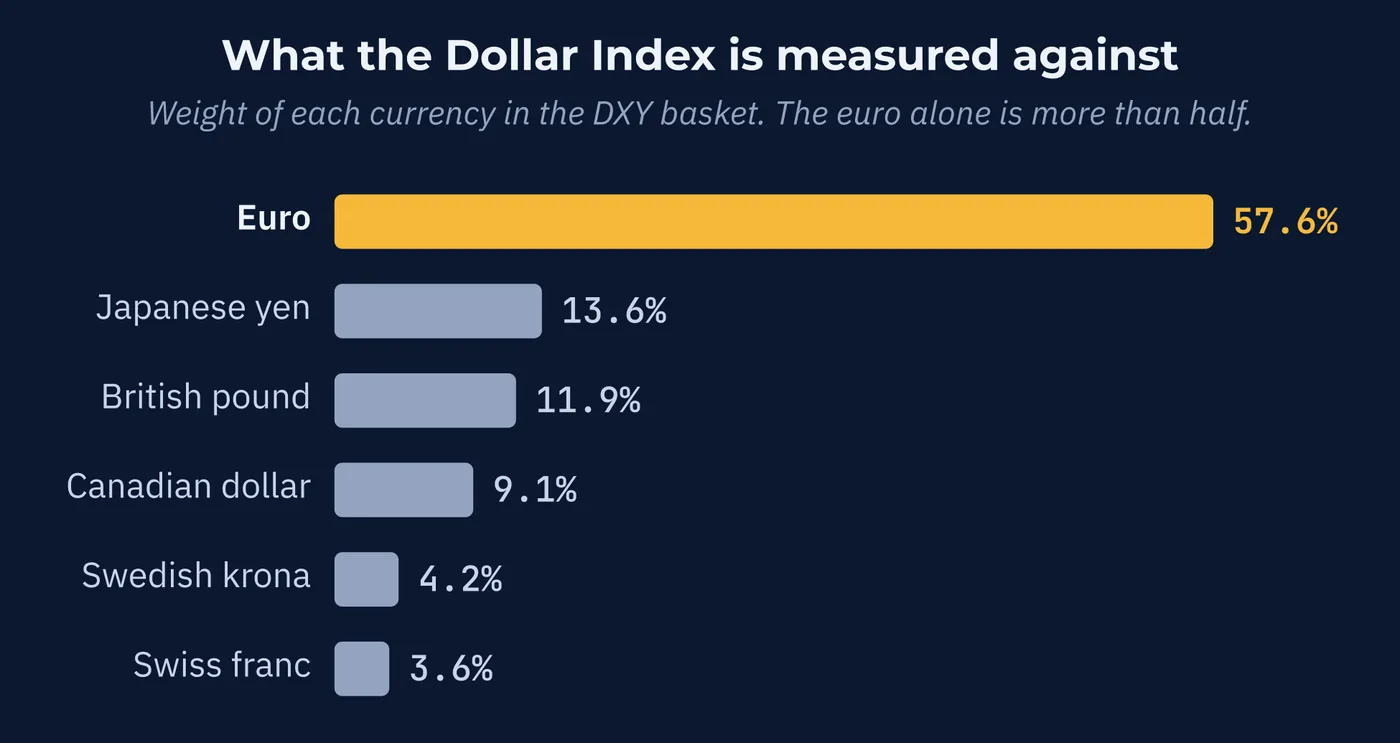
Treat it as a quick orientation tool. It points you in a direction. It does not settle an argument.
6Three Positions, One Bet
There is a practical consequence of all this that catches out a lot of people in their first year.
Suppose you go long EUR/USD because you like the euro. Then long GBP/USD because the pound looks strong. Then long AUD/USD because Australian data was good.
Three pairs. Three reasons. Three separate decisions. It feels like you have spread yourself around.
You have not. All three of those positions rise when the dollar falls and drop when the dollar rises. You have made one bet against the dollar and placed it in three windows.
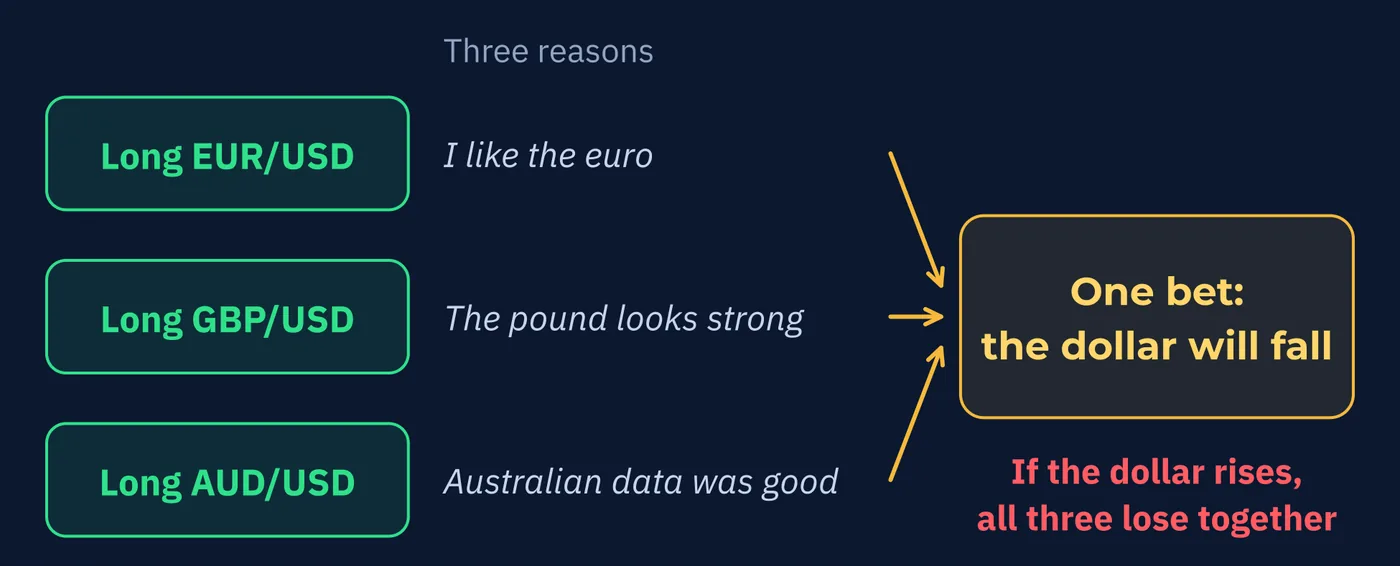
Three charts can still be one trade.
If the dollar then strengthens, all three move against you together. Nothing about holding several pairs protected you, because the thing they had in common was the thing that moved.
You do not need to do anything clever about this yet. You just need to see it, because it is invisible if you only ever look at one chart at a time.
Three Things to Remember
Try This
Fifteen minutes. This makes the dollar visible across seven charts at once.
Words From This Lesson
| Term | What It Means |
|---|---|
| Major pair | One of the seven most heavily traded currency pairs. All seven include the U.S. dollar. |
| Reserve currency | A currency that governments hold in their national reserves. The dollar is the main one. |
| Settlement currency | The currency two parties use to complete a trade, often neither party's home currency. |
| Dollar Index (DXY) | A single measure of the dollar against a basket of six currencies. Useful for direction, heavily weighted toward the euro. |
| Dollar story | A move driven by the dollar itself, visible as a clean split across all seven majors. |
Test Your Knowledge
Eight questions. Answer them all before checking the key on the following pages. If a question gives you trouble, the answer key tells you which section to revisit.
- A. They all include the euro
- B. They all include the U.S. dollar
- C. They all have the dollar as the base currency
- D. They are all quoted to four decimal places
- A. A trading rule requires it
- B. The other currencies are too small to pair together
- C. Most traders are American
- D. It is the main reserve currency and settles most international trade
- A. Both rise
- B. Both fall
- C. EUR/USD rises and USD/JPY falls
- D. EUR/USD falls and USD/JPY rises
- A. Some pairs are more liquid than others
- B. Different pairs trade on different exchanges
- C. The dollar is the quote currency in four pairs and the base in three
- D. Central banks intervene in some pairs but not others
- A. The euro is definitely strengthening
- B. Either could be true, so check the other majors
- C. The dollar is definitely weakening
- D. Both currencies are strengthening at once
- A. It is weighted heavily toward the euro
- B. It updates only once a day
- C. It excludes the Japanese yen
- D. It only works during U.S. market hours
- A. Three unrelated positions
- B. A position that is protected if the dollar rises
- C. One bet against the dollar, held three times
- D. Three positions that cancel each other out
- A. The dollar is strengthening
- B. The euro is weakening
- C. Each pair is following its own drivers
- D. The data is displaying incorrectly
Answer Key
Each answer explains why the correct choice is correct, why the others are not, and where to reread.
Question 1 · correct answer B
The dollar appears in all seven. That is what defines the category and why these pairs carry the most volume.
A is wrong because the euro is in only one major. C is the tempting one, since the dollar is the base in just three of the seven and the quote in the other four. D describes a formatting habit that also varies, because the yen pair uses two decimals.
Review: Section 1, From Thousands of Pairs to Seven
Question 2 · correct answer D
Its role as reserve currency and as the settlement currency for most international trade puts the dollar on one side of roughly eighty-nine percent of all trading.
A is wrong because no rule requires it and the category is a market habit. C confuses where traders live with what the market trades. B is wrong because non-dollar pairs exist and are traded, just in far smaller volume.
Review: Section 2, Why the Dollar Is in All of Them
Question 3 · correct answer D
EUR/USD falls because fewer dollars are needed to buy one euro. USD/JPY rises because one dollar buys more yen. One event, two directions.
A and B assume the majors move together, which they cannot, because the dollar sits on different sides. C describes a weakening dollar instead.
Review: Section 3, One Dollar Move, Seven Reactions
Question 4 · correct answer C
Position in the pair decides chart direction. Dollar as quote means the price falls when the dollar strengthens. Dollar as base means it rises.
A names a real difference that affects pricing rather than direction. B is wrong because currency trading is not organized around exchanges that way. D happens occasionally but cannot explain a routine split across all seven.
Review: Section 3, One Dollar Move, Seven Reactions
Question 5 · correct answer B
A pair is a ratio, so the chart cannot say which side moved. The other majors resolve it, because a dollar move shows up as a clean split.
A and C each take one of the two possible explanations and treat it as settled, which is the error. D is wrong because if both strengthened equally the pair would barely move.
Review: Section 4, Is It the Euro, or Is It the Dollar?
Question 6 · correct answer A
The euro makes up well over half the basket by weight, so a large DXY move can be reporting euro news rather than dollar news.
B is wrong because it updates continuously. C is wrong because the yen is in the basket. D is wrong because it tracks a market that runs around the clock on weekdays.
Review: Section 5, The Dollar Index
Question 7 · correct answer C
All three rise when the dollar falls and drop when it rises. The dollar is the common factor, so this is one bet placed in three windows.
A is how it feels and why the mistake is common. B reverses the situation, because a rising dollar hurts all three at once. D is wrong because positions only cancel out when they point in opposite directions, and these all point the same way.
Review: Section 6, Three Positions, One Bet
Question 8 · correct answer A
That clean split is the signature of a dollar move. Every major reacted to the same force, with the direction depending on where the dollar sits in each pair.
B would move EUR/USD without producing a matching pattern across all six others. C describes a mixed picture, which is the opposite of what is shown. D mistakes normal, expected behavior for a fault.
Review: Section 4, Is It the Euro, or Is It the Dollar?
Keep going
Currency Pairs is written by Kanin D. Alldredge for The Currency Classroom, and it is free to read. There is more free from CNS: start here.
Start free with CNS →