Cross Pairs

1Take the Dollar Out
Every major pair contains the U.S. dollar. But there are plenty of pairs that do not.
EUR/GBP. EUR/JPY. GBP/JPY. AUD/JPY. EUR/CHF. Look at any of them and there is no dollar anywhere in the ticker.
These are cross pairs. A cross pair is any currency pair with no U.S. dollar on either side.
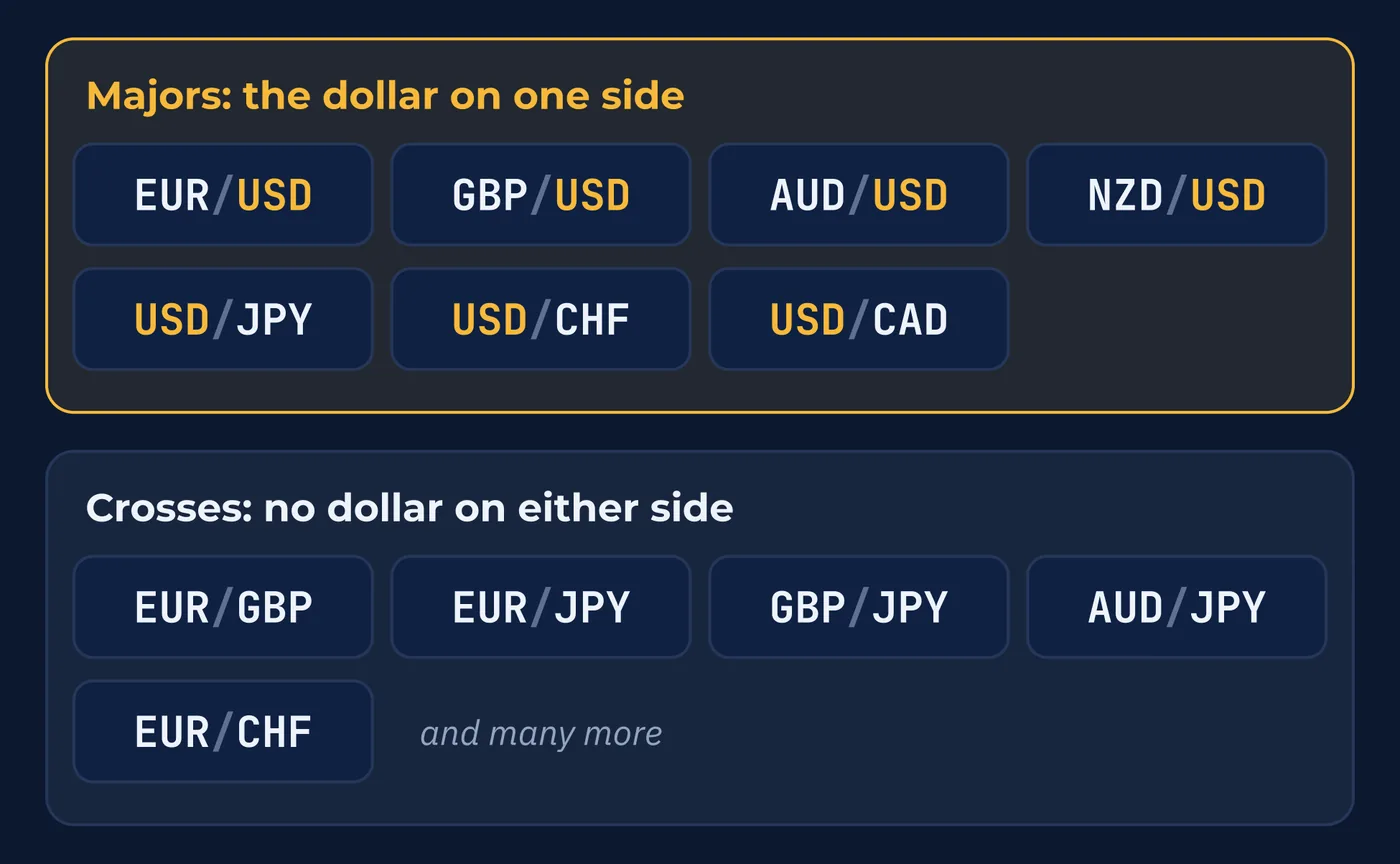
They exist for an obvious reason. A German company paying a British supplier needs euros converted into pounds. Nobody in that transaction wants dollars. So the market quotes a price directly between the two.
That much is straightforward. What happens underneath is not, and it is where this lesson is going.
2Two Names, and One Thing They Are Not
You will see these pairs called two different things.
Some sources say minor pairs. Others say cross pairs, or just crosses. In practice both terms mean the same thing, and traders use them interchangeably.
This lesson uses cross, because it describes what these pairs actually are. They sit at the crossing point of two dollar pairs, which will make more sense shortly.
There is one thing they are definitely not, and this trips people up.
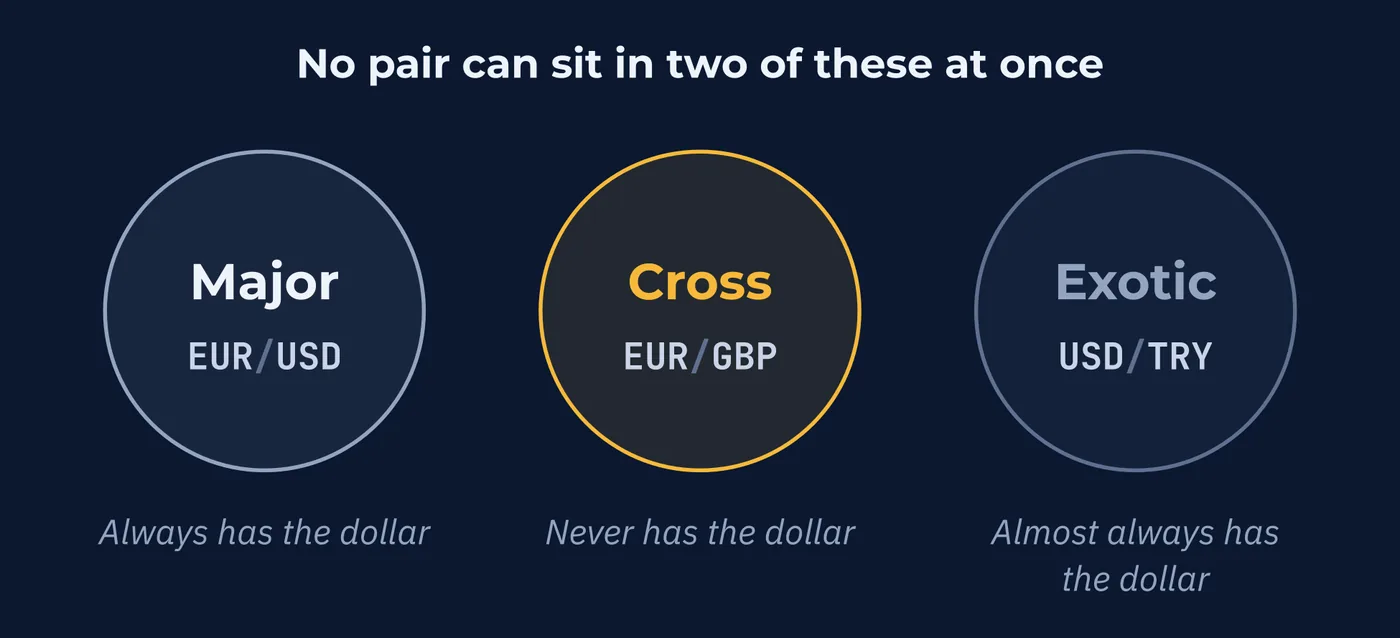
A cross pair is not the same as an exotic pair. Exotics are the subject of the next lesson, but the distinction is worth setting straight now, because the two categories do not overlap at all.
| Category | Contains the Dollar? | Example |
|---|---|---|
| Major pair | Always | EUR/USD |
| Cross pair | Never | EUR/GBP |
| Exotic pair | Almost always | USD/TRY |
So a pair with no dollar is a cross. A pair pairing a major currency with a smaller economy's currency is an exotic. A pair can never be both.
3The Dollar Is Still There
Here is the part that surprises everyone.
Cross pairs do not have their own separate markets. There is no dedicated pool of buyers and sellers trading euros directly for pounds and setting a price between them.
Instead, a cross pair's price is worked out from the two major pairs that contain its currencies. EUR/GBP is calculated from EUR/USD and GBP/USD. EUR/JPY is calculated from EUR/USD and USD/JPY.
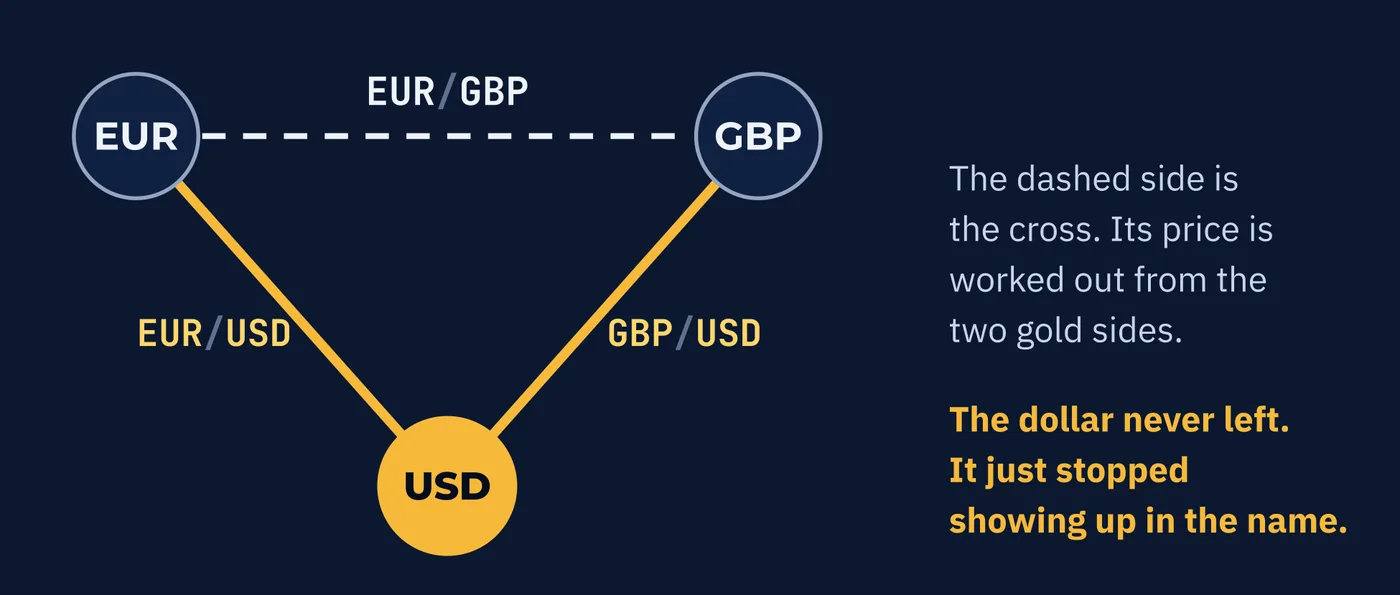
The dollar never left. It just stopped showing up in the name.
This has a consequence you should sit with. When you trade EUR/GBP, you are not escaping the dollar. You hold a position whose price is built from two dollar pairs, and a sharp dollar move reaches you through both of them at once.
Traders sometimes pick a cross specifically to avoid dollar exposure. It does not work that way.
4Doing the Math
The calculation is simple arithmetic, and doing it once makes the idea permanent.
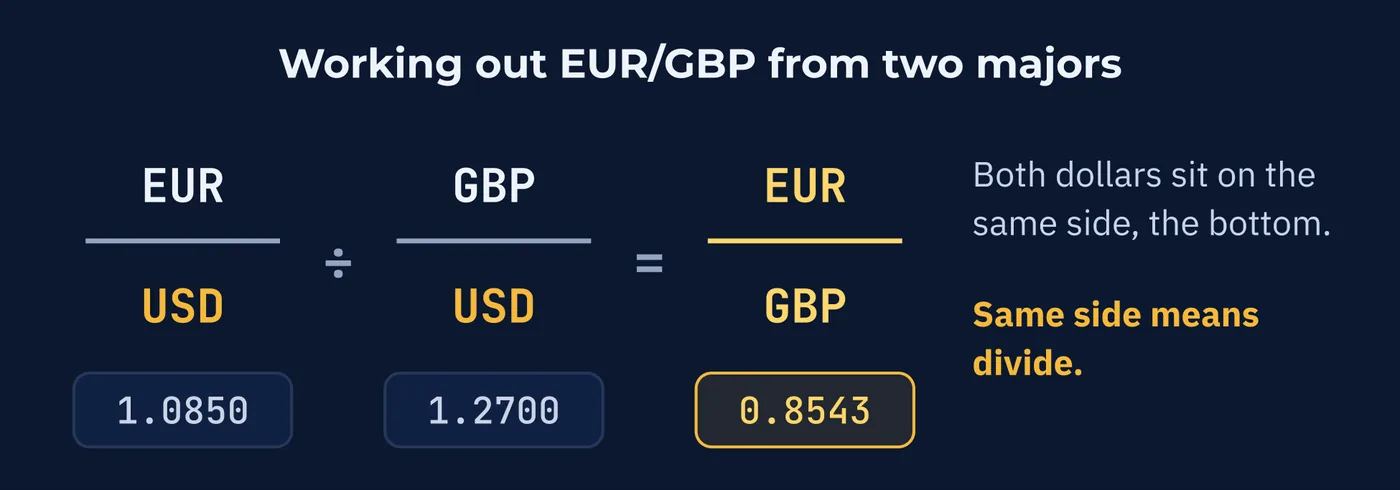
Start with EUR/GBP. Take the two majors that contain those currencies:
EUR/USD = 1.0850 GBP/USD = 1.2700Both have the dollar as the quote currency. To get from one to the other, you divide.
1.0850 ÷ 1.2700 = 0.8543And that is EUR/GBP. Pull it up on any platform right now and it will read almost exactly that.
Now a yen cross, where something changes. EUR/JPY:
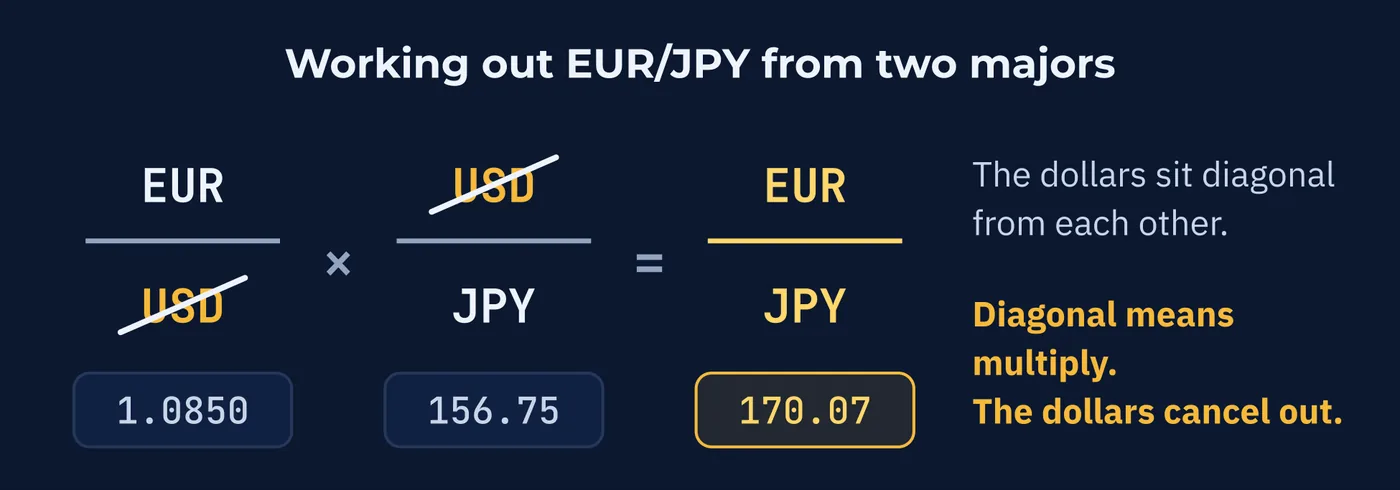
EUR/USD = 1.0850 USD/JPY = 156.75This time you multiply.
1.0850 × 156.75 = 170.07Why the difference? Look at where the dollar sits, which is Lesson 7's idea returning.
In EUR/USD and GBP/USD, the dollar is the quote currency in both. It is on the same side twice, so you divide to cancel it out.
In EUR/USD and USD/JPY, the dollar is the quote in one and the base in the other. It is on opposite sides, so multiplying cancels it. The euro goes in, the dollar cancels through the middle, and the yen comes out.
5Why the Price Cannot Drift
A fair question at this point: if the cross price is calculated rather than set by its own market, what stops it drifting away from the number the math says it should be?
The answer is that people are watching, and they are extremely fast.
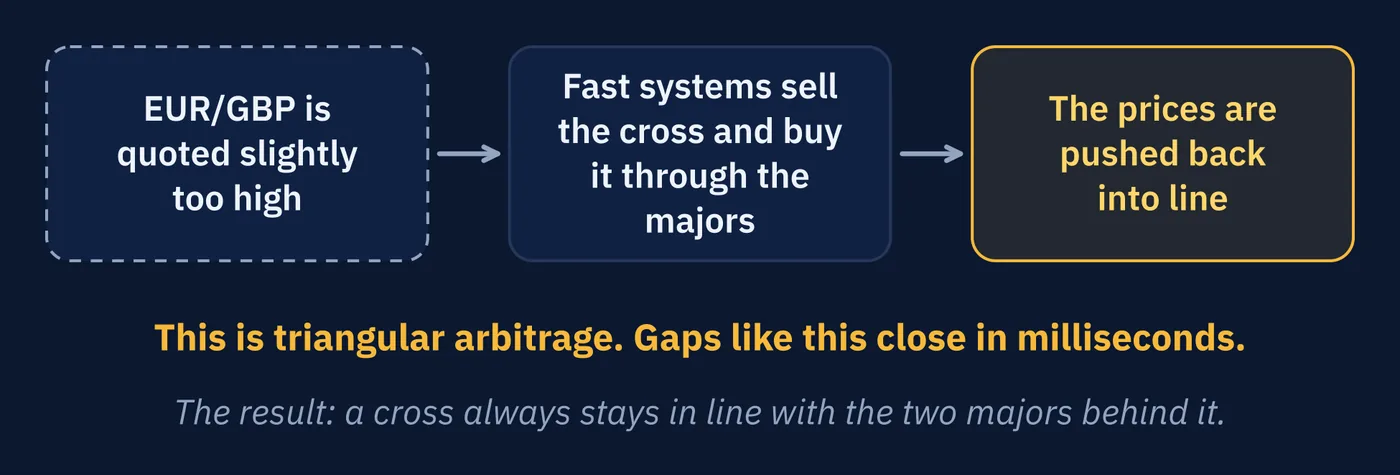
Suppose EUR/GBP is quoted slightly above 0.8543 while the two majors behind it still say 0.8543. Anyone who spots that can buy in one place, sell in the other, and take the difference as a risk-free profit.
So they do. Instantly, automatically, and in enormous volume. The buying and selling pushes the prices back into line, and the gap closes.
This is called triangular arbitrage, named for the three-cornered shape of the trade. It runs continuously through computer systems, and gaps of this kind close in milliseconds.
You will never profit from it. That is not the point of knowing about it. The point is that the relationship between a cross and its two majors is not approximate or occasional. It is enforced, constantly, by people with far better equipment than yours.
6What Crosses Cost You
Two-leg pricing has a price of its own.
Recall from Lesson 2 that every pair carries two prices, a bid and an ask, and that the gap between them is the spread. On EUR/USD that gap is very small, because the pair is the most heavily traded on earth.
Cross pairs are wider. Noticeably so.
The reason follows from everything above. A firm quoting you a price on EUR/GBP is managing positions in two separate dollar pairs behind the scenes to cover itself. It is carrying two sets of costs, not one, and the price it quotes you reflects that.
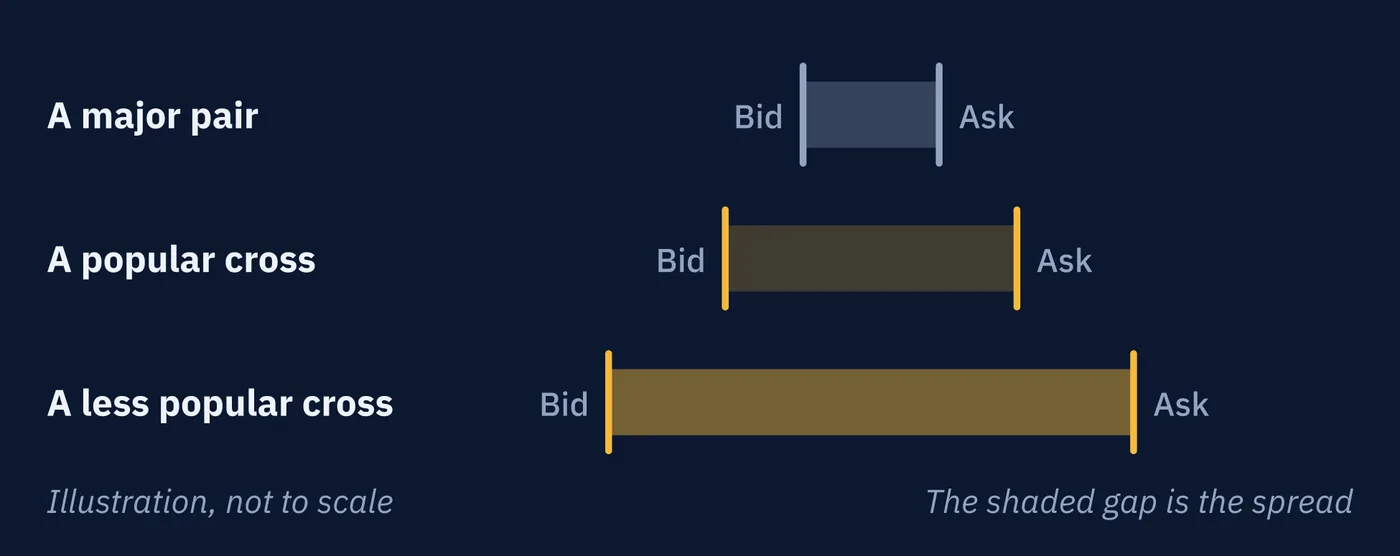
Even the most heavily traded crosses cost more to trade than the majors sitting behind them. Less popular crosses cost more still.
This is not a reason to avoid them. It is a reason to know that the same trade is not equally cheap everywhere, which becomes a much bigger topic later in this series.
7When Both Legs Pull Together
Crosses have a reputation for moving further and faster than the majors. That reputation is deserved, and the reason is structural.
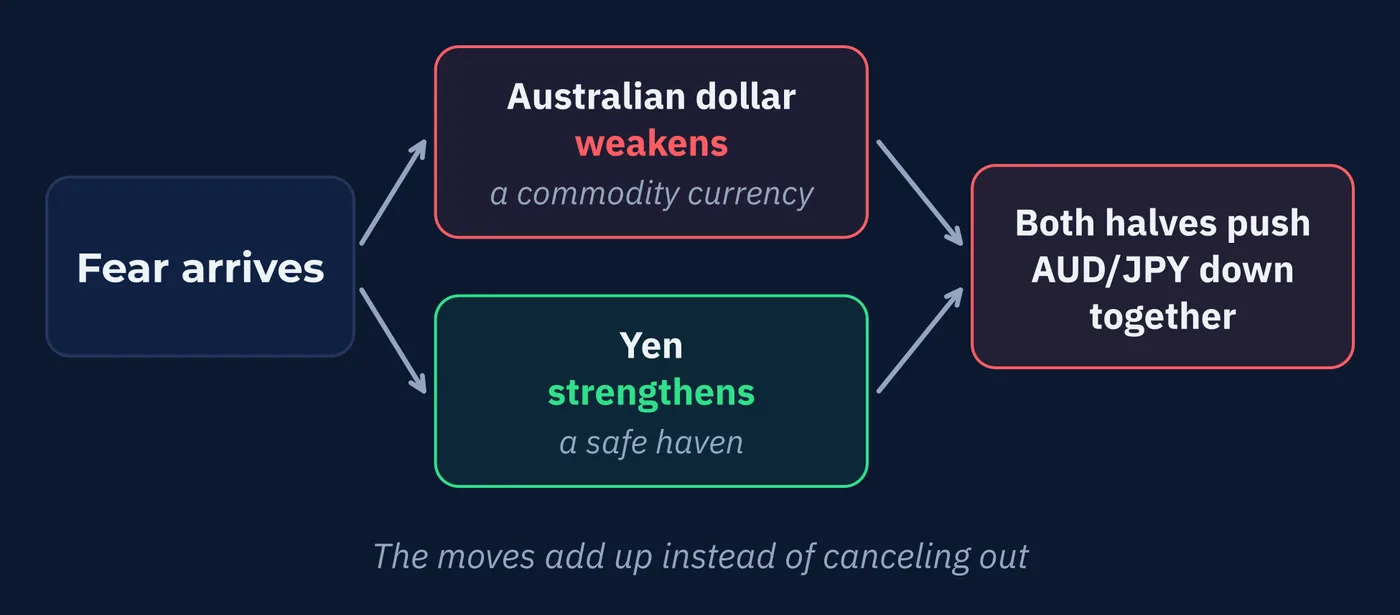
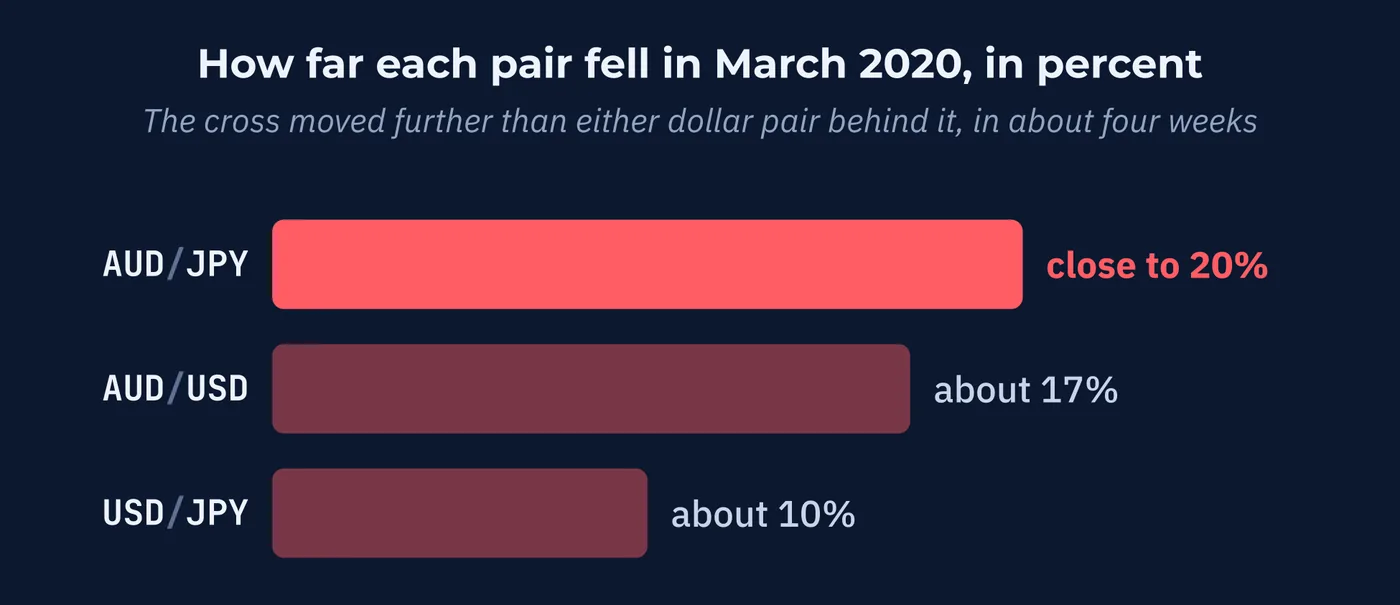
A cross pair is built from two currencies with their own characters. When those characters point in opposite directions, the movements do not cancel out. They add up.
AUD/JPY is the clearest example on the board.
From Lesson 8: the Australian dollar is a commodity currency that strengthens when investors feel confident. The yen is a safe haven that strengthens when investors are frightened.
Put them in one pair and you have built an instrument that responds to nothing but mood. When fear arrives, the Australian dollar weakens and the yen strengthens at the same moment. Both halves push the pair down together.
GBP/JPY works on the same principle and takes it further. It combines a politically sensitive pound with a safe haven yen, and its daily range regularly runs two or three times that of EUR/USD. Traders nicknamed it the Dragon, which tells you most of what you need to know about how it behaves.
8Should You Be Trading These Yet?
Probably not, and it is worth being direct about why.
None of which makes crosses bad. Experienced traders use them deliberately, and for something like AUD/JPY the sensitivity to mood is exactly the point rather than a drawback.
But there is no advantage to be had from starting here. Everything a cross teaches you can be learned on a major, more cheaply and with fewer things moving at once.
Three Things to Remember
Try This
Ten minutes and a calculator. You are going to check the market's arithmetic.
Words From This Lesson
| Term | What It Means |
|---|---|
| Cross pair | Any currency pair with no U.S. dollar on either side. EUR/GBP, EUR/JPY, AUD/JPY. |
| Minor pair | Another name for a cross pair. The two terms are used interchangeably. |
| Component pairs | The two major pairs a cross is calculated from. EUR/USD and GBP/USD are the components of EUR/GBP. |
| Leg | One side of a two-part relationship. A cross pair has two legs, one for each component major. |
| Triangular arbitrage | Buying and selling across three related pairs to capture a pricing gap. It closes such gaps within milliseconds. |
| The Dragon | Trader nickname for GBP/JPY, from its unusually large and rapid moves. |
Test Your Knowledge
Eight questions. Answer them all before checking the key on the following pages. If a question gives you trouble, the answer key tells you which section to revisit.
- A. It contains the dollar as the base currency
- B. It contains no U.S. dollar on either side
- C. It pairs a major currency with an emerging one
- D. It is traded only outside American hours
- A. USD/CAD
- B. AUD/USD
- C. USD/TRY
- D. EUR/GBP
- A. By calculation from two major dollar pairs
- B. By its own separate market of buyers and sellers
- C. By the central banks of the two countries involved
- D. By an average of all other pairs
- A. Roughly 1.3779
- B. Roughly 0.8543
- C. Roughly 2.3550
- D. Roughly 0.1850
- A. Yen pairs use different math because of their two decimal places
- B. It is an arbitrary market convention
- C. Because of where the dollar sits in each component pair
- D. Multiplication gives a more accurate result
- A. Sets the official price for cross pairs each morning
- B. Prevents cross pairs from being traded at all
- C. Allows retail traders to profit from mispricing
- D. Closes pricing gaps between a cross and its component majors within milliseconds
- A. The firm quoting it manages positions in two dollar pairs, carrying two sets of costs
- B. Cross pairs are riskier, so brokers charge extra
- C. Cross pairs trade for fewer hours each day
- D. Governments apply a tax to non-dollar pairs
- A. Australia and Japan were hit harder than other countries
- B. Cross pairs always move more than majors regardless of conditions
- C. Both legs pushed the same direction at once, since fear weakens the Australian dollar and strengthens the yen
- D. The pair was mispriced for several weeks
Answer Key
Each answer explains why the correct choice is correct, why the others are not, and where to reread.
Question 1 · correct answer B
The absence of the dollar is the whole definition. Any pair without it on either side is a cross, also called a minor.
A describes three of the seven majors. C describes an exotic pair, which is a separate category that does not overlap with crosses. D is wrong because trading hours have nothing to do with the classification.
Review: Section 1, Take the Dollar Out
Question 2 · correct answer D
EUR/GBP contains the euro and the pound, with no dollar anywhere, which makes it a cross.
A and B are majors, since both contain the dollar. C is an exotic, pairing the dollar with the Turkish lira. Checking for a dollar in the ticker settles this every time.
Review: Section 2, Two Names, and One Thing They Are Not
Question 3 · correct answer A
Crosses have no independent market. The price is derived from the two major dollar pairs containing the relevant currencies.
B is the intuitive answer and the one this lesson exists to correct. C is wrong because central banks influence currencies without quoting pair prices. D describes nothing that happens in this market.
Review: Section 3, The Dollar Is Still There
Question 4 · correct answer B
Both majors have the dollar as the quote currency, so you divide. 1.0850 divided by 1.2700 gives 0.8543.
A is the result of dividing the other way round, which would give you GBP/EUR. C multiplies instead of dividing, which is the correct operation for a yen cross but not this one. D subtracts, which no cross calculation ever uses.
Review: Section 4, Doing the Math
Question 5 · correct answer C
In EUR/USD and GBP/USD the dollar is the quote in both, so dividing cancels it. In EUR/USD and USD/JPY it sits on opposite sides, so multiplying cancels it.
A confuses the decimal convention with the arithmetic, and those are unrelated. B is wrong because the operation follows necessarily from the structure rather than from convention. D is wrong because only one operation gives the right answer at all.
Review: Section 4, Doing the Math
Question 6 · correct answer D
When a cross drifts from the price its components imply, automated systems trade the gap away almost instantly.
A describes a fixing process that does not apply here, since cross prices update continuously. C is wrong because these gaps close far too fast for anyone trading manually. B reverses the effect, as arbitrage keeps crosses tradeable and correctly priced.
Review: Section 5, Why the Price Cannot Drift
Question 7 · correct answer A
Quoting a cross means managing two underlying dollar positions, so two sets of costs are built into the price you see.
B sounds plausible but treats the wider spread as a penalty rather than a structural consequence. C is wrong because crosses trade the same hours as the majors. D describes a tax that does not exist.
Review: Section 6, What Crosses Cost You
Question 8 · correct answer C
Fear weakens the Australian dollar and strengthens the yen at the same moment, so both halves of the pair moved the same direction together.
A misreads a global risk event as a local one. B overgeneralizes, since crosses only amplify when their two currencies react in opposing ways. D is wrong because arbitrage makes a sustained mispricing impossible.
Review: Section 7, When Both Legs Pull Together
Keep going
Currency Pairs is written by Kanin D. Alldredge for The Currency Classroom, and it is free to read. There is more free from CNS: start here.
Start free with CNS →