A Market With No Center

1No Building, No Bell
Every other market you can name has a place.
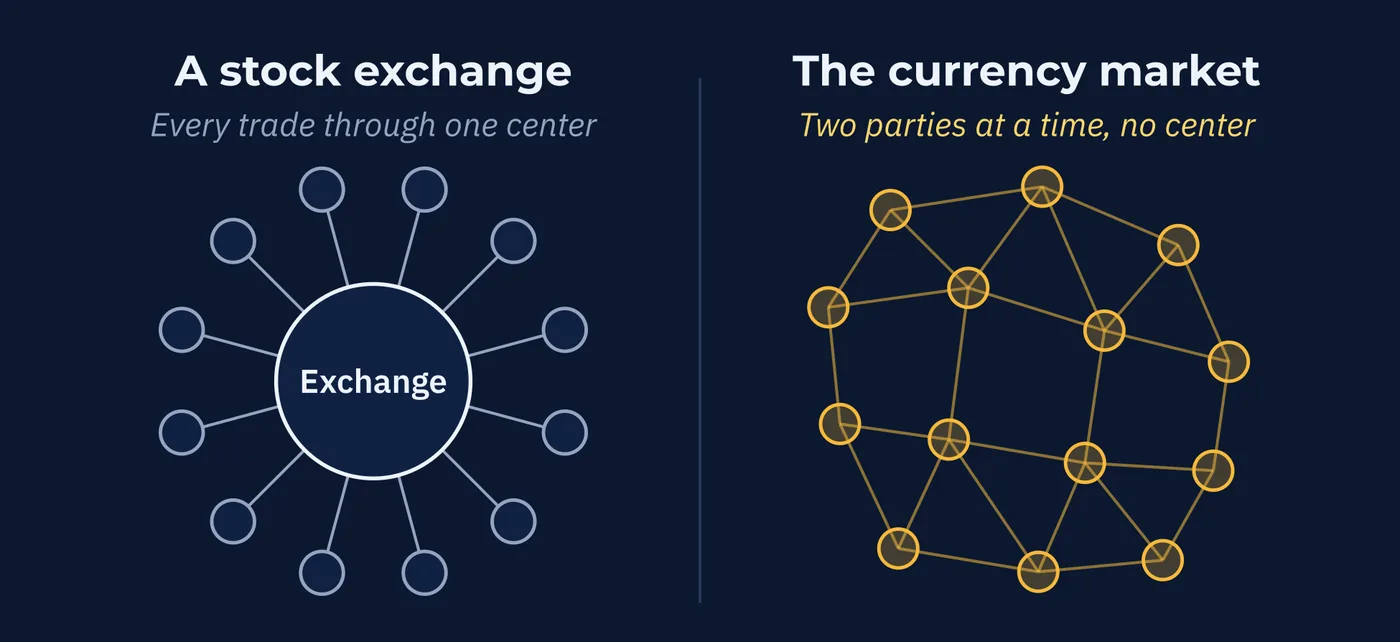
Stock markets have exchanges. A building, a matching engine, an opening time, a closing bell. Every trade goes through the same system. That produces one official price at any moment, and one record of everything that happened.
Currencies have none of that.
| A Stock Exchange Has | The Currency Market Has |
|---|---|
| A central matching engine | No central anything |
| One official price at any moment | No official price |
| A consolidated record of all trades | No consolidated record |
| Opening and closing times | Continuous operation, five days a week |
That list reads like missing features. It is closer to the architecture of the market than a list of shortcomings.
2The Scale, Against Things You Can Picture
Start with size, because it makes the architecture question unavoidable.
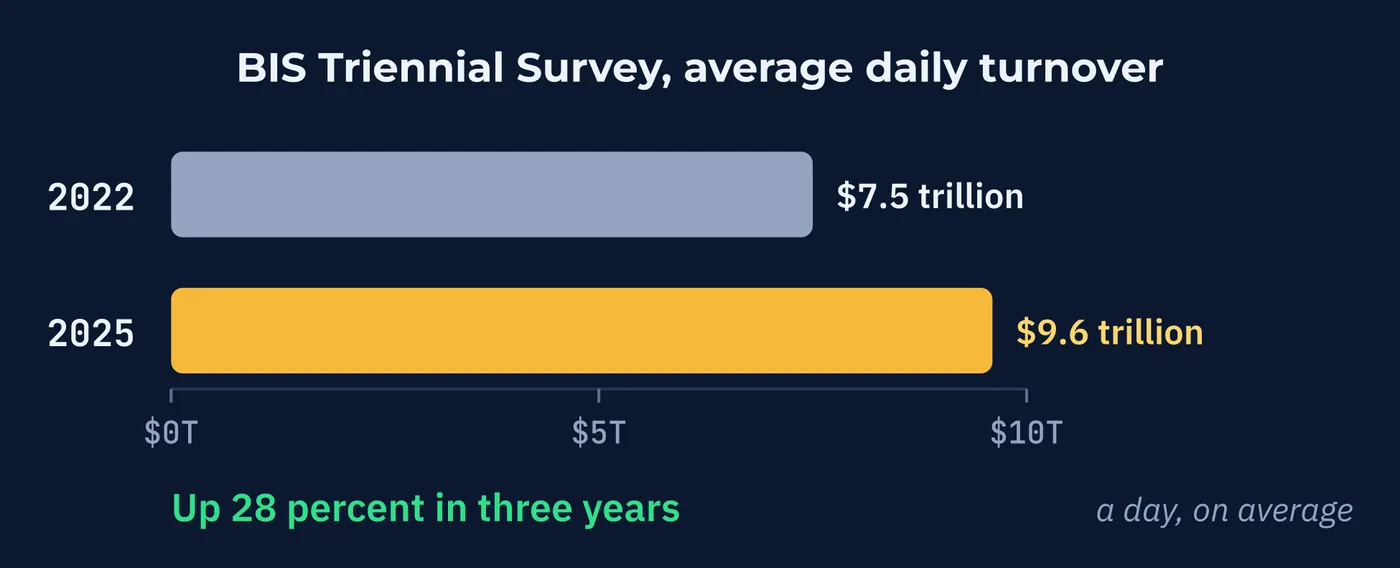
The Bank for International Settlements survey, introduced in Lesson 1, put average daily currency turnover at $9.6 trillion in 2025. That was up 28 percent from $7.5 trillion three years before.
Trillions do not mean much on their own. Compare them to other markets, measured the same way.
| Market | Daily Turnover | Currencies Are |
|---|---|---|
| Currencies | $9.6 trillion | - |
| US government debt | $900 billion to $1 trillion | About 10 times larger |
| The global gold market | About $361 billion | About 27 times larger |
| All the world's stock exchanges combined | About $0.8 trillion | About 12 times larger |
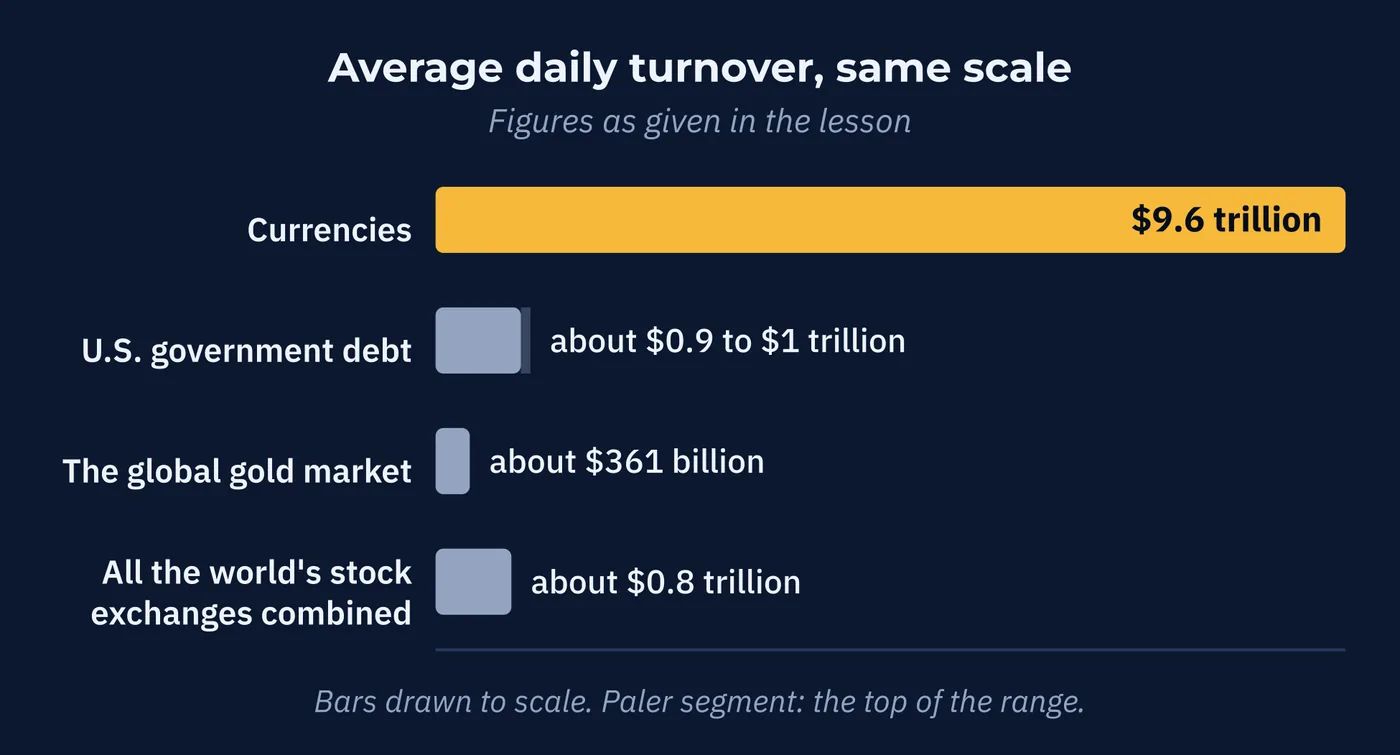
Read the last row. That is every stock exchange in the world added together, not just the biggest few. The gap is still enormous.
Now a practical question. What building could process $9.6 trillion a day, across hundreds of pairs, in every time zone, without stopping?
No such exchange exists, and none could realistically be built.
3What Over-the-Counter Means
So the market solved the problem by not having a center at all.
Currency trading is over-the-counter, which means transactions happen bilaterally. Two parties deal directly with each other, and nothing routes through a central exchange.
Nobody is matched by a system. They are connected by relationships.
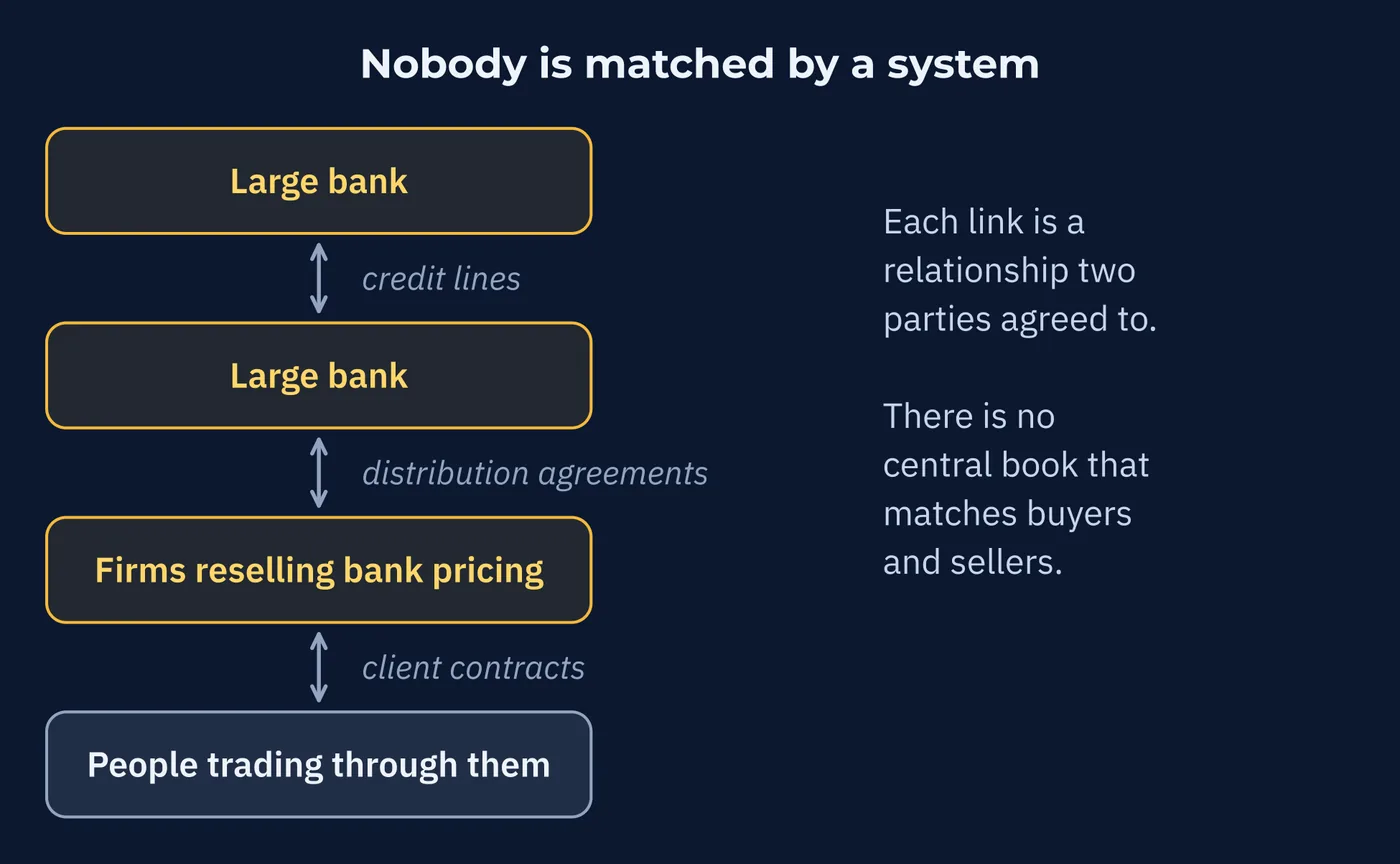
| The Relationship | Between |
|---|---|
| Credit lines | One large bank and another |
| Distribution agreements | Banks and the firms that resell their pricing |
| Client contracts | Those firms and the people trading through them |
The currency market is the largest over-the-counter market in the world. That structure is what makes the continuous operation from Lesson 22 possible. No single system has to be awake.
Activity moves around the world because the market is a network, not a place. When New York sleeps the network is still there. Some of it is just quieter.
4Why There Is No Single Price
Here is a consequence that confuses people the first time they notice it.
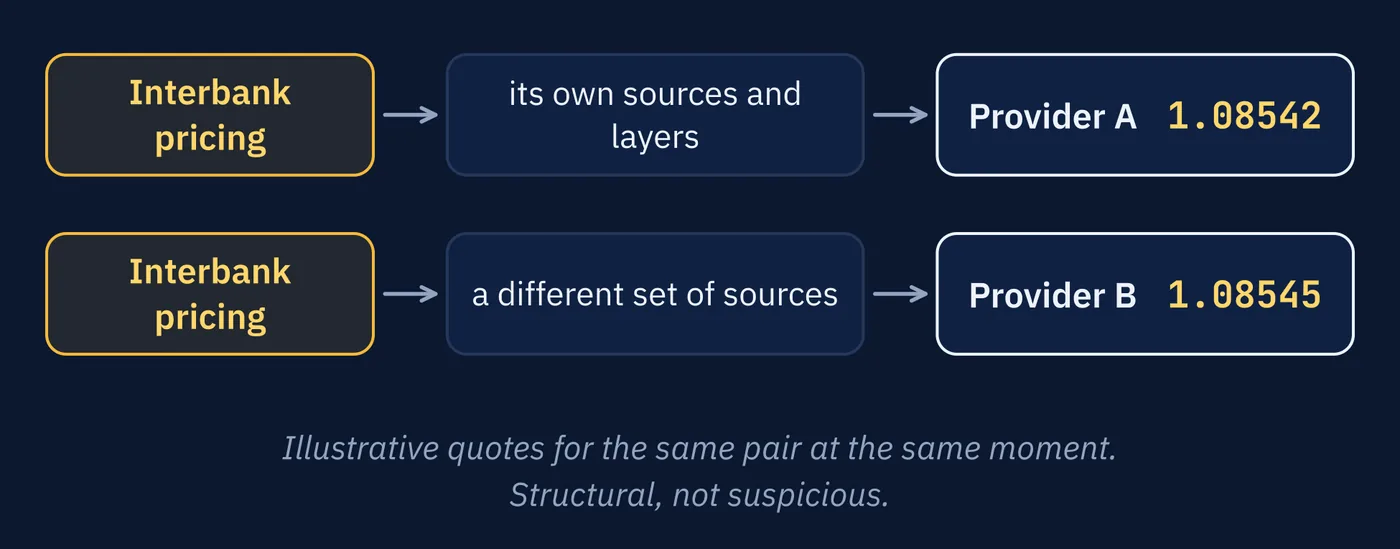
Two platforms can show slightly different prices for the same pair at the same moment. Not wildly different, but different by a pip or a fraction of a pip.
With no central exchange, there is no official rate. Each provider derives pricing through its own chain of sources, and those chains are not identical.
5The Engine Room
No center does not mean no origin. Pricing starts somewhere, and that somewhere has a name.
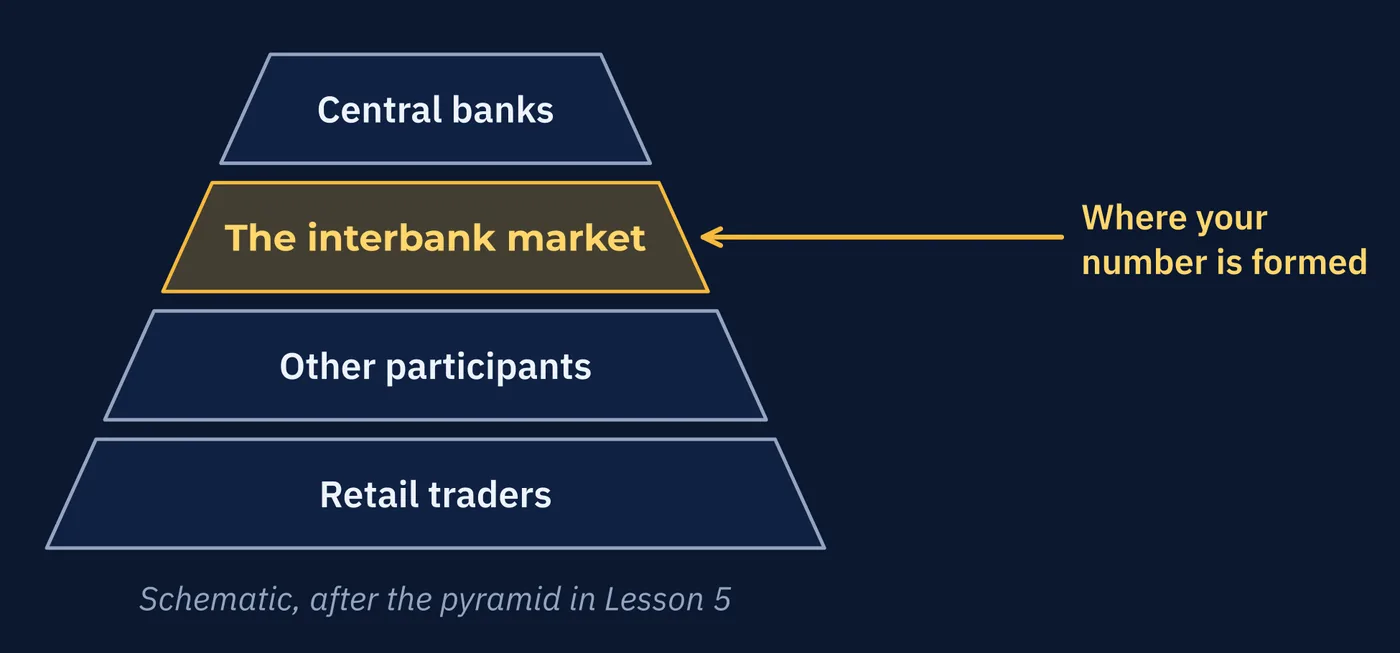
The interbank market is the network of large global banks, big regional banks, and a small number of significant non-bank firms that deal directly with each other in wholesale amounts.
They trade through electronic platforms built for institutional counterparties. The prices formed there are the closest thing this market has to a reference rate.
Every rate on every screen anywhere is downstream from this.
Which connects back to Lesson 5. That pyramid put central banks at the top and retail traders at the bottom. This is the layer just below the top, and it is where your number was formed.
6Why That Layer Is Closed
Why can an individual not just trade there? The answer is not gatekeeping. The requirements are not the kind a person can meet.
| Requirement | What It Means |
|---|---|
| Bilateral credit relationships | An institution must have a credit line with another before it can deal with it at all |
| Minimum transaction sizes | Typically in the millions of dollars per trade |
| Settlement infrastructure | International messaging systems, accounts held with correspondent banks, and real-time settlement systems |
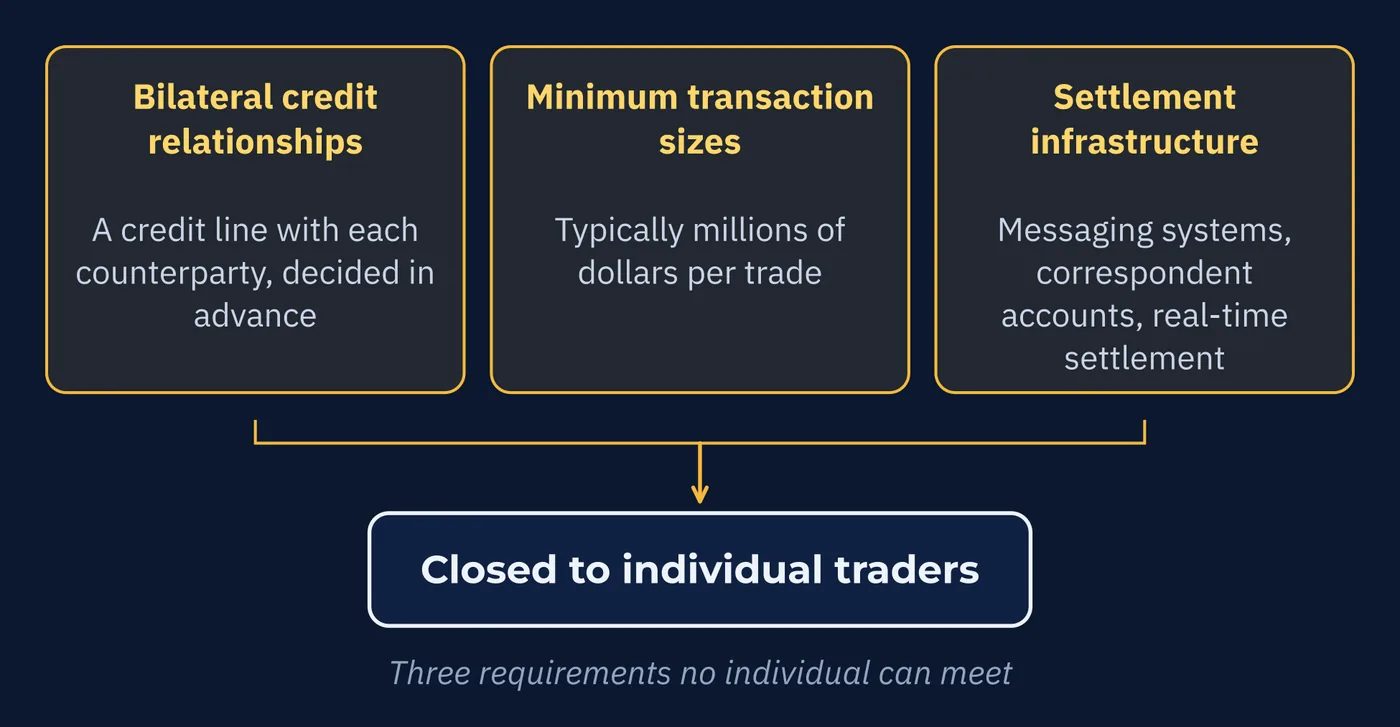
Interbank dealing is not anonymous. Before two institutions can trade, each must have decided the other is good for the money, and written that down as a credit line.
That is nothing like clicking buy. It is closer to a standing business relationship than a marketplace.
7The Layers Between
So how does a price get from there to a screen?
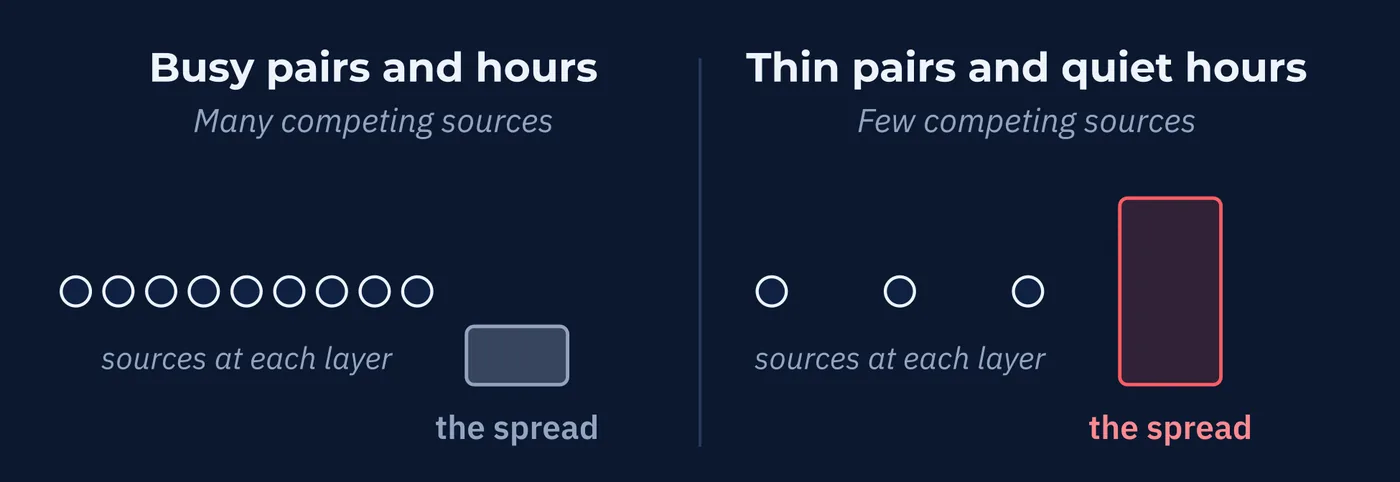
Through intermediaries, in layers, and each one adds a margin to the price it received before passing it on.
interbank → aggregators and prime brokers → retail providers → you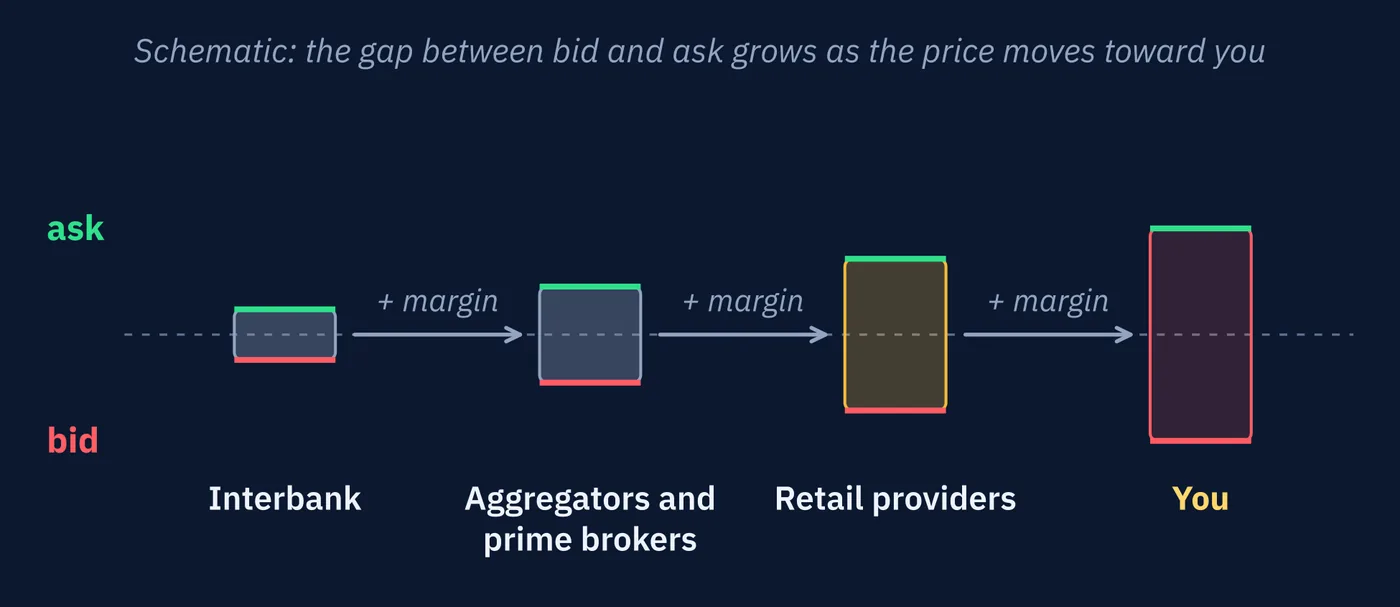
By the time a rate reaches an individual trader it has passed through several hands. What appears on screen is a derived price, carrying the markup of every layer in between.
8What This Explains
Almost everything distinctive about trading currencies follows from a market with no center.
| The Thing | Why It Happens |
|---|---|
| Continuous trading, five days a week | No single system has to be open, because the market is a network |
| No opening or closing bell | There is nothing to open or close |
| Prices differing slightly between providers | No central rate exists for them to agree on |
| The spread you pay | Accumulated markup from each layer between the interbank market and you |
| Wider spreads in thin hours | Fewer participants competing at every layer |
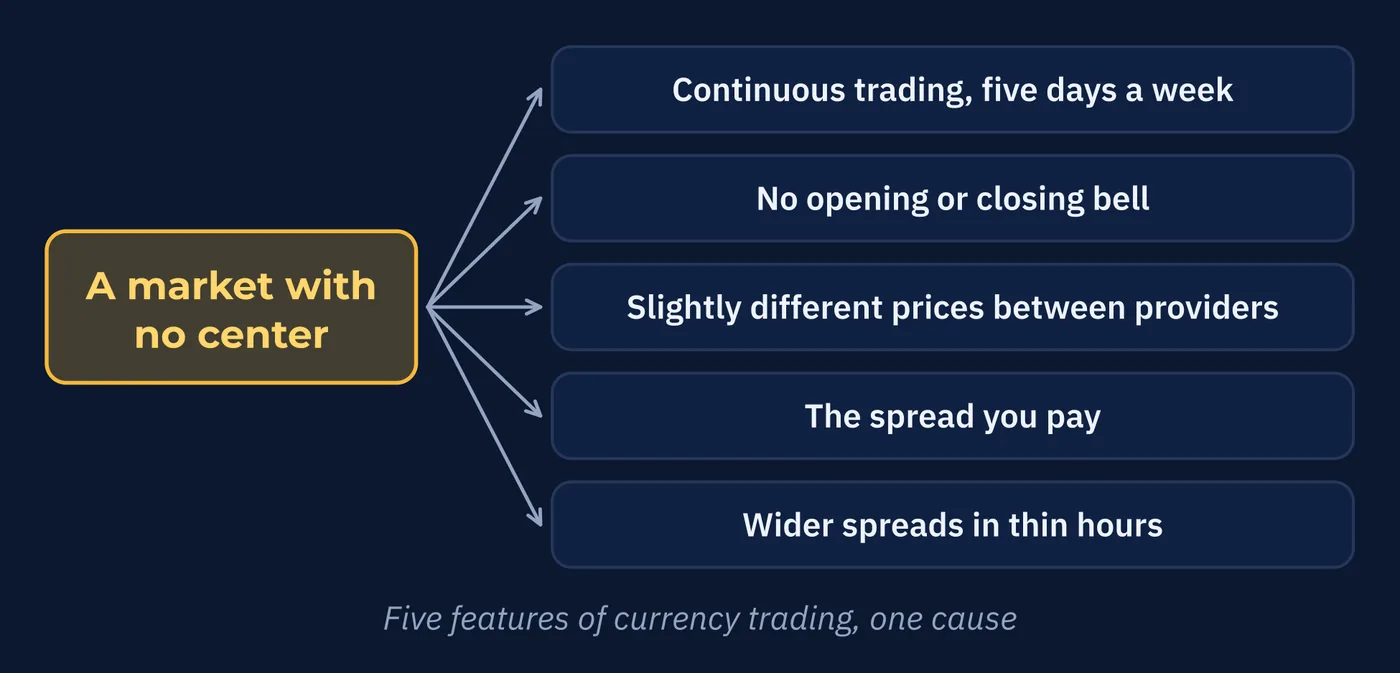
Each of those was introduced earlier in this course as a fact to accept. All five have the same cause.
One more thing follows, and it is the least comfortable.
Lesson 5 said the market has no opinion about you. This lesson shows why that is structurally true rather than a figure of speech. There is no central authority, no operator, nothing overseeing the whole. A network of bilateral relationships cannot have an intention about anyone, because there is no whole to have one.
The next lesson asks what is actually traded inside that network. Most of the $9.6 trillion is not anyone betting on direction.
Three Things to Remember
Try This
Fifteen minutes. One step needs two sources open at once.
Words From This Lesson
| Term | What It Means |
|---|---|
| Over-the-counter | A market where trades happen directly between two parties rather than through a central exchange. |
| Bilateral | Between two parties. The basic unit of how currency trading is arranged. |
| Interbank market | The wholesale layer where large institutions deal directly with each other. Where pricing originates. |
| Credit line | A prior agreement allowing two institutions to deal with each other. Required before any interbank trade. |
| Reference rate | The pricing formed at the interbank level, from which all other quotes are derived. |
| Derived price | The rate on a retail screen, carrying the markup of every layer between the interbank market and the trader. |
| Consolidated tape | A single record of every trade in a market. Stock exchanges have one. Currencies do not. |
Test Your Knowledge
Eight questions. Answer them all before checking the key on the following pages. If a question gives you trouble, the answer key tells you which section to revisit.
- A. Trades are settled in cash
- B. Orders are matched by a government body
- C. Trading occurs only during business hours
- D. Transactions happen bilaterally, without a central exchange
- A. $9.6 trillion
- B. $960 billion
- C. $96 trillion
- D. $1 trillion
- A. About twice as large
- B. About 27 times larger
- C. About 10 times larger
- D. About the same
- A. One of them is manipulating the price
- B. Data feeds update at different speeds only
- C. There is no central exchange and therefore no single official rate
- D. One is quoting a forward rate
- A. At a central exchange in London
- B. At the IMF
- C. In the interbank market, where large institutions deal directly
- D. On retail trading platforms
- A. Membership of a stock exchange
- B. Approval from a central bank
- C. A minimum account balance
- D. A bilateral credit relationship between them
- A. It is verified against an official rate
- B. Each layer adds a margin before passing it on
- C. It is fixed by regulation
- D. It remains unchanged
- A. Fewer participants compete at every layer of the chain
- B. Brokers increase charges deliberately at night
- C. Settlement systems close overnight
- D. Central banks withdraw pricing
Answer Key
Each answer explains why the correct choice is correct, why the others are not, and where to reread.
Question 1 · correct answer D
Two parties deal directly with each other, connected by relationships rather than matched by a central system. Currencies form the largest such market in the world.
A describes settlement, which is a separate matter. C is wrong because the market runs continuously through the week. B invents an authority that does not exist.
Review: Section 3, What Over-the-Counter Means
Question 2 · correct answer A
The 2025 survey recorded average daily turnover of $9.6 trillion, up 28 percent from $7.5 trillion three years earlier.
B is off by a factor of ten. C overstates it by the same factor in the other direction. D is closer to daily turnover in US government debt.
Review: Section 2, The Scale, Against Things You Can Picture
Question 3 · correct answer B
Gold turns over about $361 billion a day against $9.6 trillion in currencies, which makes the currency market roughly 27 times larger.
A and D both badly understate the gap. C is the comparison against US government debt rather than gold.
Review: Section 2, The Scale, Against Things You Can Picture
Question 4 · correct answer C
Without a central exchange there is no single official rate. Each provider derives pricing through its own chain of sources, and those chains differ.
A is the common assumption and it misreads a structural feature. B describes a contributing factor but not the underlying cause. D describes a different instrument entirely.
Review: Section 4, Why There Is No Single Price
Question 5 · correct answer C
Large banks and a small number of significant non-bank firms deal directly with each other in wholesale amounts. Every other rate is downstream from the prices formed there.
A describes a central exchange that does not exist, though London handles the largest share of activity. B is wrong because the IMF does not set market prices. D reverses the direction of the chain.
Review: Section 5, The Engine Room
Question 6 · correct answer D
Interbank dealing is not anonymous. Each institution must have extended a credit line to the other before any trade can happen between them.
B is wrong because central banks do not authorize individual dealing relationships. C describes a retail arrangement. A is wrong because currencies do not trade on stock exchanges.
Review: Section 6, Why That Layer Is Closed
Question 7 · correct answer B
Each intermediary adds a margin over the price it received before distributing it onward. The rate on a retail screen carries the accumulated markup of every layer.
A describes a verification process that no central authority performs. C is wrong because spreads are set commercially rather than by rule. D contradicts how the layers earn anything.
Review: Section 7, The Layers Between
Question 8 · correct answer A
Fewer active participants means fewer competing sources at each layer, so the accumulated markup widens.
B attributes to intent what follows from market conditions. C is wrong because the market operates continuously through the week. D is wrong because central banks are not the source of routine quoting.
Review: Section 8, What This Explains
Keep going
The Market Today is written by Kanin D. Alldredge for The Currency Classroom, and it is free to read. There is more free from CNS: start here.
Start free with CNS →