Where Prices Come From

1The Question Behind the Number
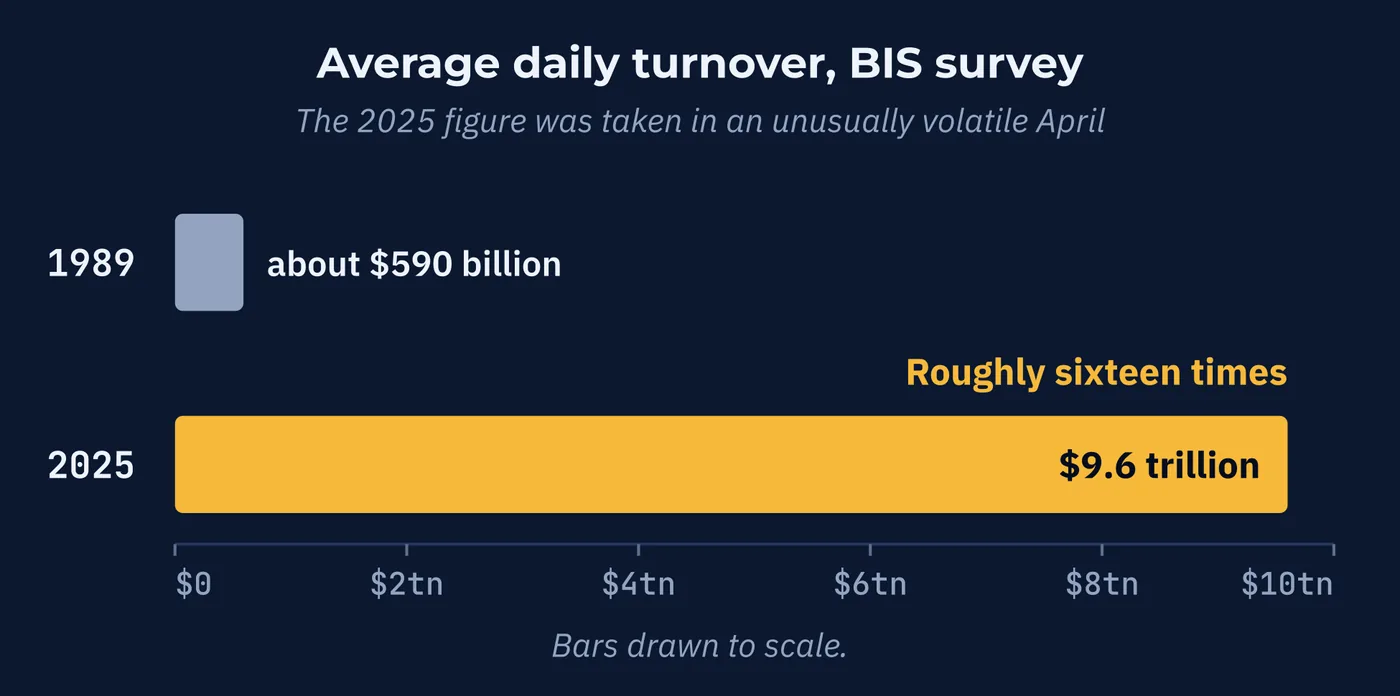
Lesson 40 gave the headline figure. Average daily turnover of $9.6 trillion.
A reasonable assumption is that this is a measure of trading. Millions of participants forming views on direction and acting on them, at enormous scale.
It is not, and the gap between the assumption and the reality is large.
| Instrument | Share of Turnover | What It Is Mainly For |
|---|---|---|
| FX swaps | About 42 percent | Managing cash and funding across dates |
| Spot | About 31 percent | Straightforward exchange, settled in two business days |
| Outright forwards | About 19 percent | Fixing a rate for a known future payment |
| Options and other | About 7 percent | Protection with a choice attached |
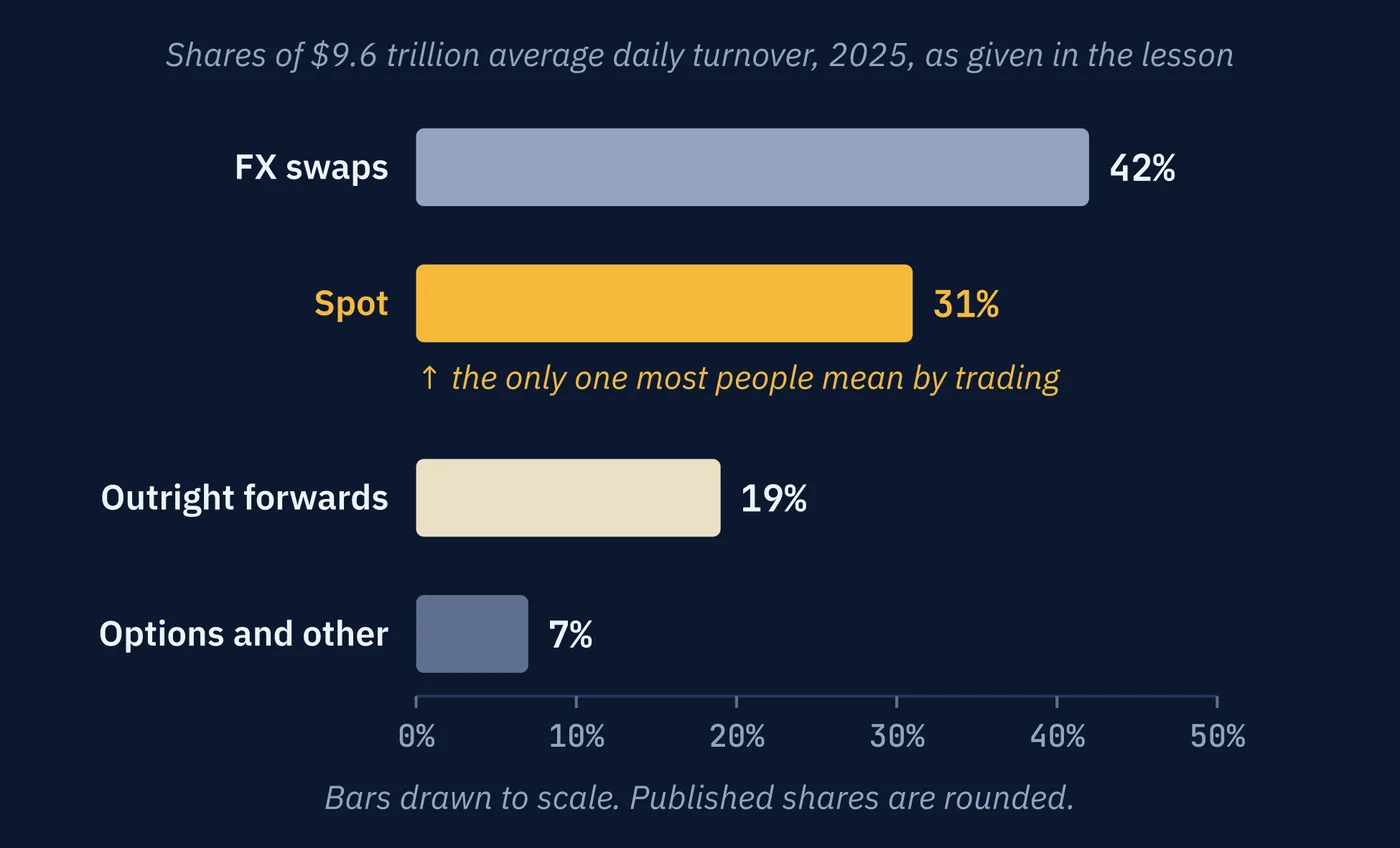
Only one of those four rows is what most people mean by trading. And it is not the biggest. The shares are the survey's rounded figures, so they do not add to exactly 100.
2Spot, the Familiar One
A spot transaction is the direct purchase of one currency for another, settled within two business days.
This is what financial media quotes. When someone says the price of EUR/USD, they mean the spot rate. It is the simplest form of currency exchange and the one every other instrument is priced from.
It accounts for about 31 percent of the total.
Slightly under a third of the market's volume is straightforward exchange of one currency for another. The other two thirds is doing something else.
3The Largest Instrument, and Almost Nobody Knows It
An FX swap is a simultaneous purchase and sale of the same amount of a currency, at two different dates. One leg now, one leg later.
It sounds pointless described that way. An example makes it obvious.
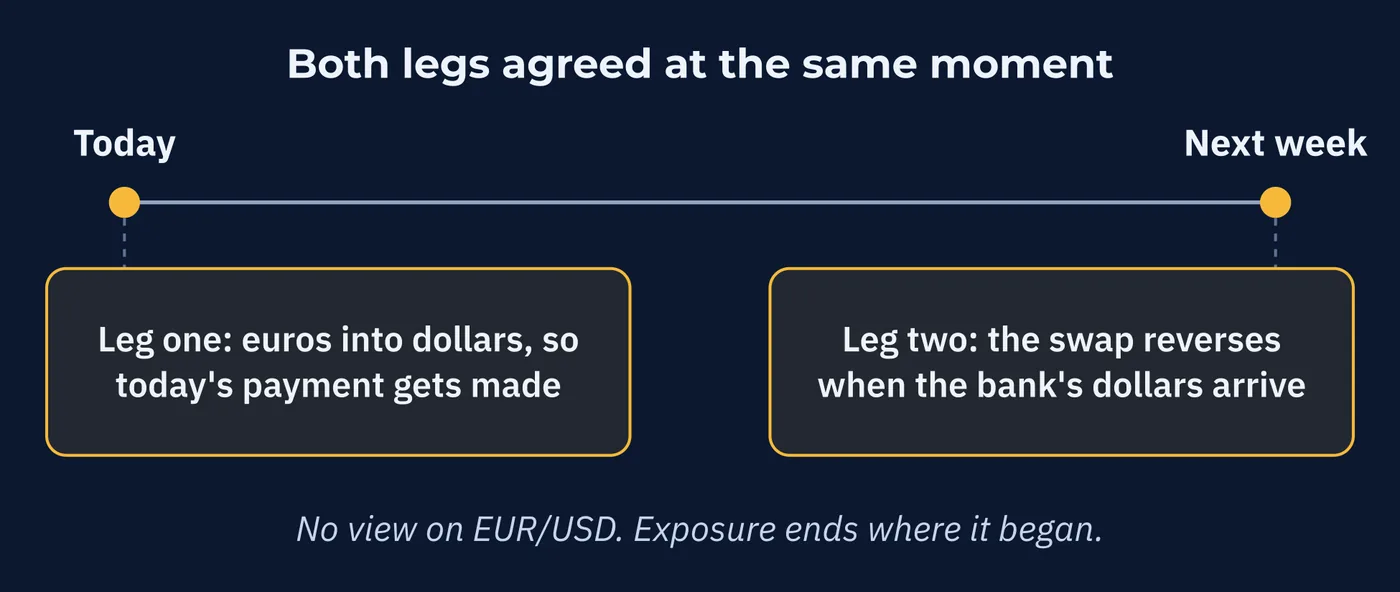
This is the largest single category in the market, at about 42 percent. More than spot. More than any instrument used to bet on direction.
The biggest thing happening in this market is treasury management.
4Forwards, and Removing Uncertainty
A forward contract is a binding agreement to exchange a set amount of currency at a fixed rate on a specified future date.
Lesson 1 described a French company selling to American customers, paid in dollars, with costs in euros. Here is the problem that creates, and the tool that solves it.
The company knows a payment of a certain size arrives in ninety days. It does not know what the rate will be then. Which means it cannot know what those dollars will be worth in euros, and therefore cannot budget.
A forward removes the uncertainty. The rate is fixed today for a transaction ninety days out.
Notice what the company has given up. If the rate moves in their favor they do not benefit, because they are locked in. They accepted that deliberately, because certainty was worth more than the possible gain.
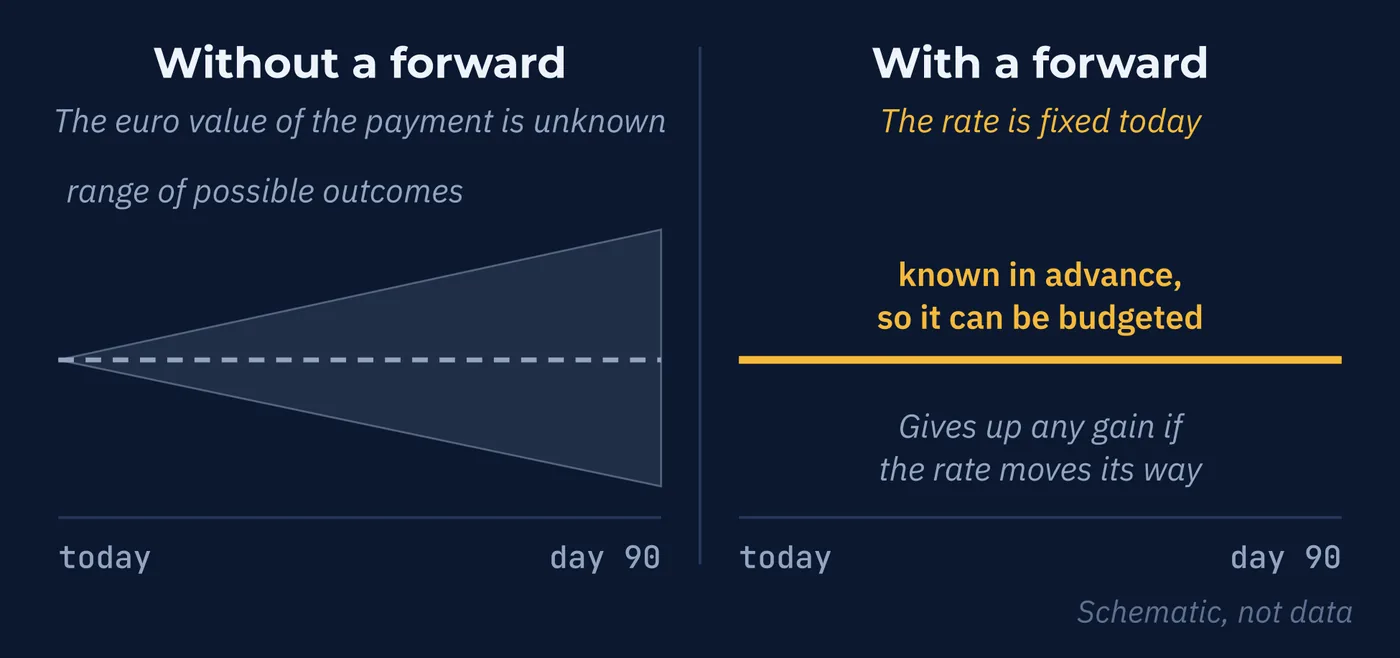
Forwards are about 19 percent of turnover. Almost none of it is anyone trying to profit from a move.
5Two Complications Worth Knowing
Forwards raise a question with a satisfying answer, and they have a variant that connects directly to Lesson 34.
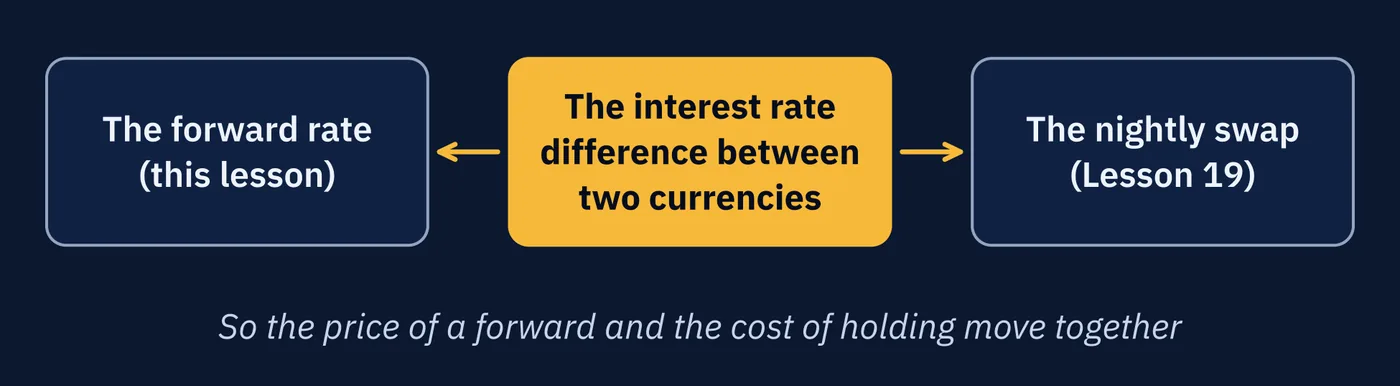
The question first. If a forward fixes a rate for ninety days out, what rate is that? Not simply today's price, and the difference is not a guess about the future.
forward rate = spot ± the interest rate difference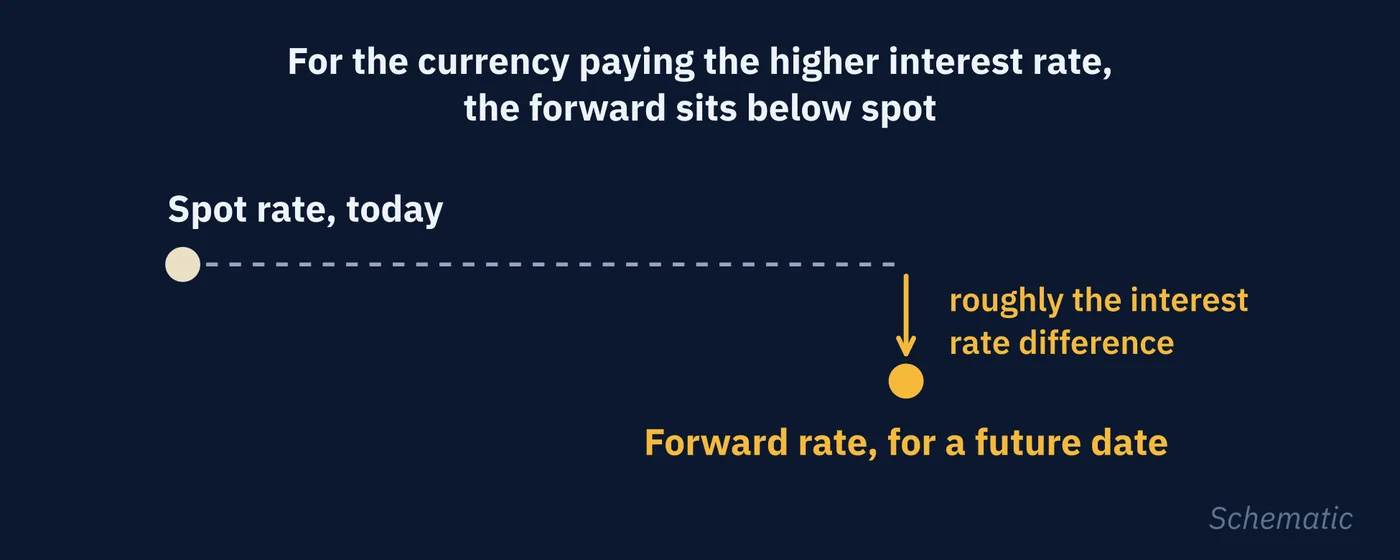
If one currency pays a higher interest rate than the other, its forward rate is lower than its spot rate by roughly that difference. Otherwise there would be a risk-free profit available, and it would be taken until it disappeared.
Now the variant. Lesson 34 covered currencies whose movement across borders is restricted. Those cannot be delivered freely, so an ordinary forward will not work.
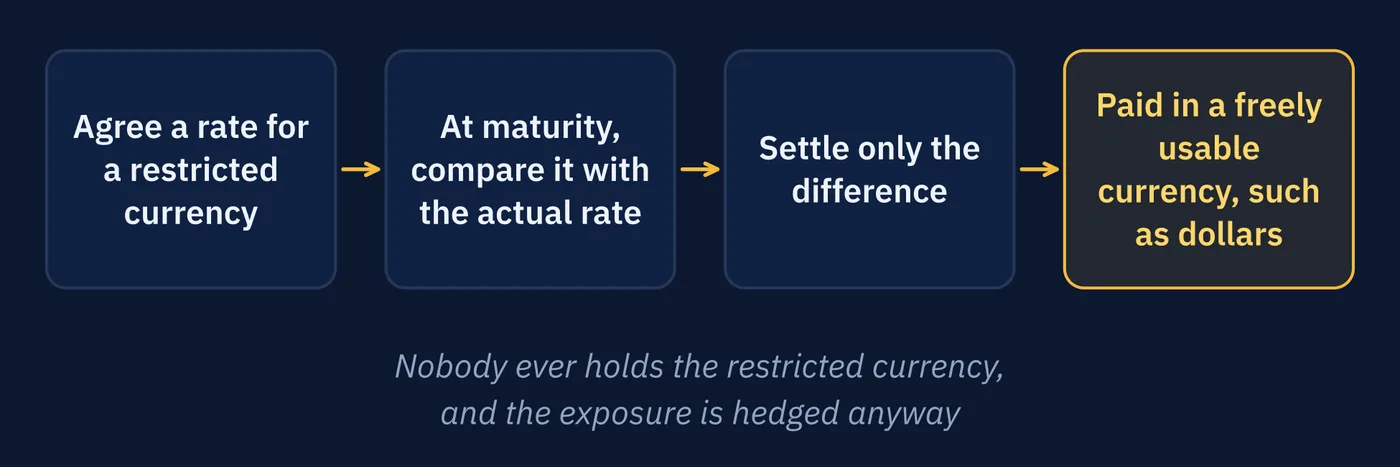
A non-deliverable forward solves it. Rather than exchanging the currencies at maturity, the two parties settle the difference between the agreed rate and the actual rate, paid in a freely usable currency such as dollars.
Nobody ever holds the restricted currency. The exposure is hedged anyway. This is how institutions manage risk in currencies they cannot practically obtain.
6Options, Briefly
A currency option gives the right, but not the obligation, to exchange at a fixed rate by a specified date.
The difference from a forward is the word obligation. A forward binds you. An option lets you walk away and use the market rate instead if that turns out better.
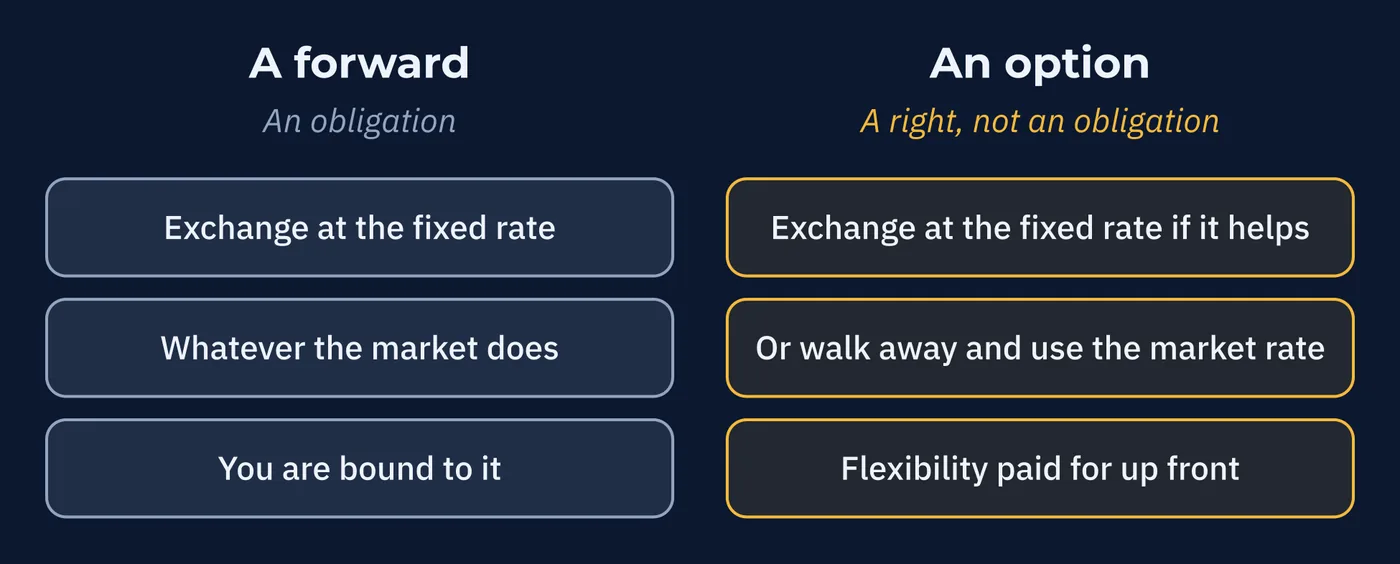
That flexibility is paid for up front. Options are about 7 percent of turnover, used mainly by corporations and institutions that want protection while keeping the upside.
7What You Are Actually Holding
Now the part that surprises people.
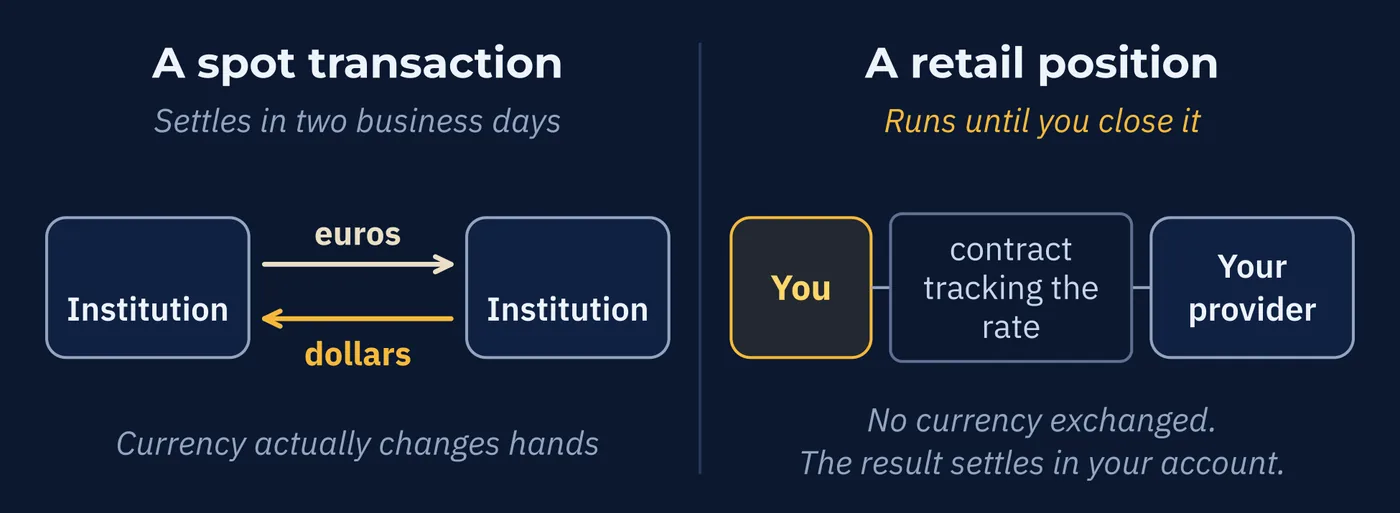
When an individual opens a position on a retail platform, they are almost certainly not buying or selling currency.
They are entering a contract whose value is derived from the exchange rate between two currencies. No euros are acquired. No dollars change hands. The contract tracks the rate, and the result is settled in the account's own currency.
| What a Spot Transaction Does | What a Retail Position Does |
|---|---|
| Currency is actually exchanged | No currency is exchanged |
| Settles in two business days | Runs until you close it |
| Between two institutions | Between you and your provider |
| You end up holding a currency | You end up holding a result |
Which reframes Lesson 4. Going long EUR/USD means holding euros and giving up dollars, and that description is exactly right about what your position tracks. What it does not describe is a physical exchange, because none occurs.
This is not a criticism of the arrangement. Direct participation in the spot market requires everything Lesson 40 listed, and the derivative structure is what makes access possible at all. But knowing what you hold is better than assuming.
8How to Read the Number Now
Return to the $9.6 trillion with everything above in view.
| What People Assume | What the Data Says |
|---|---|
| It measures trading activity | Most of it is funding, hedging, and settlement |
| It shows how many people are betting on direction | Speculation is a minority of a minority |
| A bigger number means more speculation | A bigger number can mean more corporate hedging |
Which vindicates something Lesson 1 said early and briefly. Most of the daily volume is not speculation or strategy. It is the plumbing of the global economy.
Two practical consequences follow.
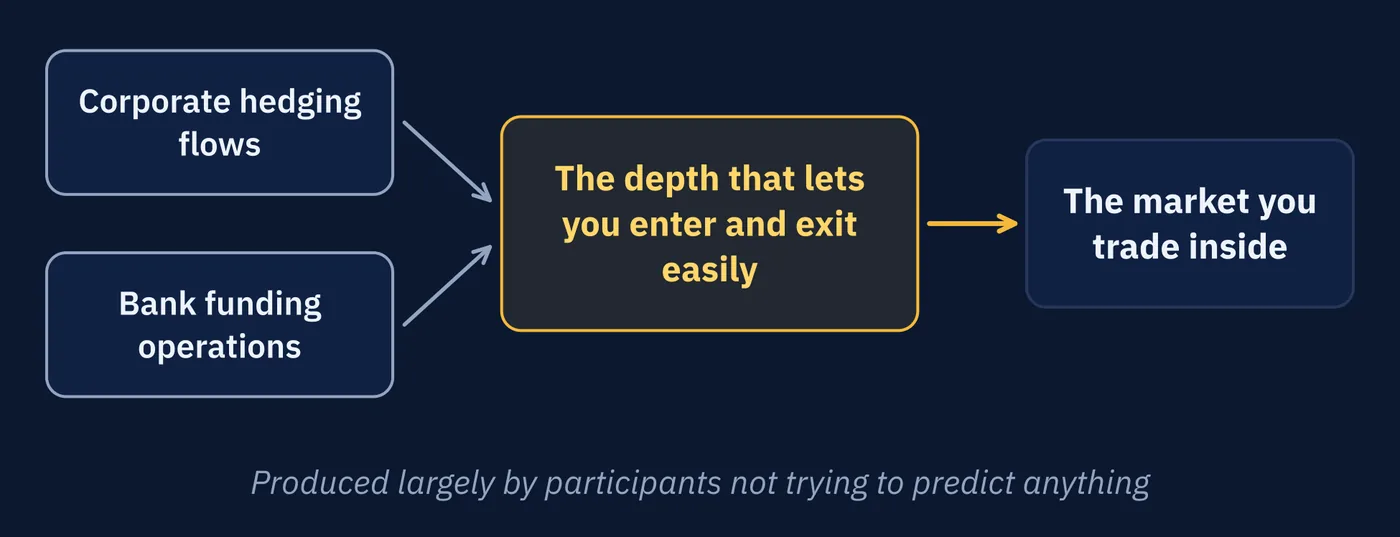
The first is about liquidity. The depth that lets you enter and exit easily is largely produced by participants who are not trying to predict anything. Corporate hedging flows and bank funding operations create the market you trade inside, which is a more comfortable thought than the alternative.
The survey has run since 1989, when daily turnover was about $590 billion. It is now roughly sixteen times that.
The next lesson asks who is behind all of it. Lesson 5 gave a pyramid and a rough ordering. This time the shares are measured, and the answer contains at least one number most retail traders would not guess.
Three Things to Remember
Try This
Fifteen minutes. Mostly thinking, with one piece of arithmetic.
Words From This Lesson
| Term | What It Means |
|---|---|
| Spot transaction | Direct exchange of one currency for another, settled within two business days. About 31 percent of turnover. |
| FX swap | A simultaneous purchase and sale of the same amount at two different dates. Used for funding, not direction. The largest category at about 42 percent. |
| Forward contract | A binding agreement to exchange at a fixed rate on a future date. Used to remove uncertainty from a known future payment. |
| Non-deliverable forward | A forward on a restricted currency, settled as a cash difference in a usable currency rather than by exchange. |
| Currency option | The right, but not the obligation, to exchange at a fixed rate by a set date. Flexibility paid for up front. |
| Derivative | A contract whose value comes from something else. A retail currency position is one. |
| Settlement | The point at which a transaction is completed and currency actually changes hands. |
Test Your Knowledge
Eight questions. Answer them all before checking the key on the following pages. If a question gives you trouble, the answer key tells you which section to revisit.
- A. Spot transactions
- B. Outright forwards
- C. FX swaps
- D. Currency options
- A. About 7 percent
- B. About 19 percent
- C. About 31 percent
- D. About 42 percent
- A. Managing cash and funding across different dates
- B. Betting on direction with less risk
- C. Hedging a corporate payment 90 days out
- D. Speculating on interest rate changes
- A. A forward contract
- B. A spot transaction
- C. An FX swap
- D. A currency option, necessarily
- A. A forecast of where the price will be
- B. The interest rate difference between the two currencies
- C. The size of the transaction
- D. The credit rating of the counterparty
- A. Very large transactions
- B. Trades between central banks
- C. Transactions settling in under two days
- D. Currencies that cannot be freely exchanged
- A. The base currency of the pair
- B. A contract whose value derives from the exchange rate
- C. A share of an interbank spot transaction
- D. A forward contract with a fixed maturity
- A. It is an estimate with a wide margin of error
- B. It has not been updated since 2022
- C. It excludes the largest instrument category
- D. It was measured during a month of unusually high volatility
Answer Key
Each answer explains why the correct choice is correct, why the others are not, and where to reread.
Question 1 · correct answer C
FX swaps are about 42 percent of daily turnover, more than any other category, and they are used for funding rather than for taking a view on direction.
A is about 31 percent and is the instrument most like trading. B is about 19 percent. D is about 7 percent.
Review: Section 1, The Question Behind the Number
Question 2 · correct answer C
Spot is about 31 percent, slightly under a third. The remaining two thirds is doing something other than straightforward exchange.
A corresponds to options. B corresponds to outright forwards. D corresponds to FX swaps, the largest category.
Review: Section 2, Spot, the Familiar One
Question 3 · correct answer A
A swap bridges the gap between when money is needed and when it arrives. Currency exposure at the end matches the start, so no view on direction is involved.
B misreads the purpose entirely, since a swap is designed to leave exposure unchanged. C describes an outright forward. D describes a different kind of position altogether.
Review: Section 3, The Largest Instrument
Question 4 · correct answer A
A forward fixes the rate today for a transaction on a specified future date, which removes the uncertainty from a known future payment.
B settles in two business days and does nothing about a payment three months out. C is for bridging funding gaps rather than hedging a future receipt. D can work but costs a premium, so it is not the necessary answer.
Review: Section 4, Forwards, and Removing Uncertainty
Question 5 · correct answer B
The forward rate is the spot rate adjusted by the interest rate difference between the two currencies. Anything else would create a risk-free profit that would be taken until it vanished.
A is the intuitive answer and it is wrong, since the gap is arithmetic rather than a prediction. C and D can affect pricing at the margin but neither sets the relationship.
Review: Section 5, Two Complications Worth Knowing
Question 6 · correct answer D
Where a currency cannot be freely exchanged, the parties settle the difference between the agreed rate and the actual rate in a usable currency instead. The restricted currency never changes hands.
A is unrelated to size. C describes spot settlement. B invents a restriction on who may use the instrument.
Review: Section 5, Two Complications Worth Knowing
Question 7 · correct answer B
No currency is acquired and none changes hands. The contract tracks the rate, and the result settles in the account's own currency.
A describes what a spot transaction does. C is wrong because retail orders do not become part of an interbank transaction. D is wrong because a retail position has no fixed maturity and runs until closed.
Review: Section 7, What You Are Actually Holding
Question 8 · correct answer D
The survey was taken in April, during a period of elevated trade policy volatility, so it likely reflects a busier than average month rather than typical conditions.
A misstates the issue, since the survey is authoritative and the concern is the window rather than the method. C is wrong because it includes all categories. B is wrong because the 2025 figure is the most recent.
Review: Section 8, How to Read the Number Now
Keep going
The Market Today is written by Kanin D. Alldredge for The Currency Classroom, and it is free to read. There is more free from CNS: start here.
Start free with CNS →