The Challengers

1Three Serious Candidates
There are three. Not a long list, and each is serious in a different way.
| Candidate | What It Is Today |
|---|---|
| The euro | Second reserve currency, about 20 percent of reserves |
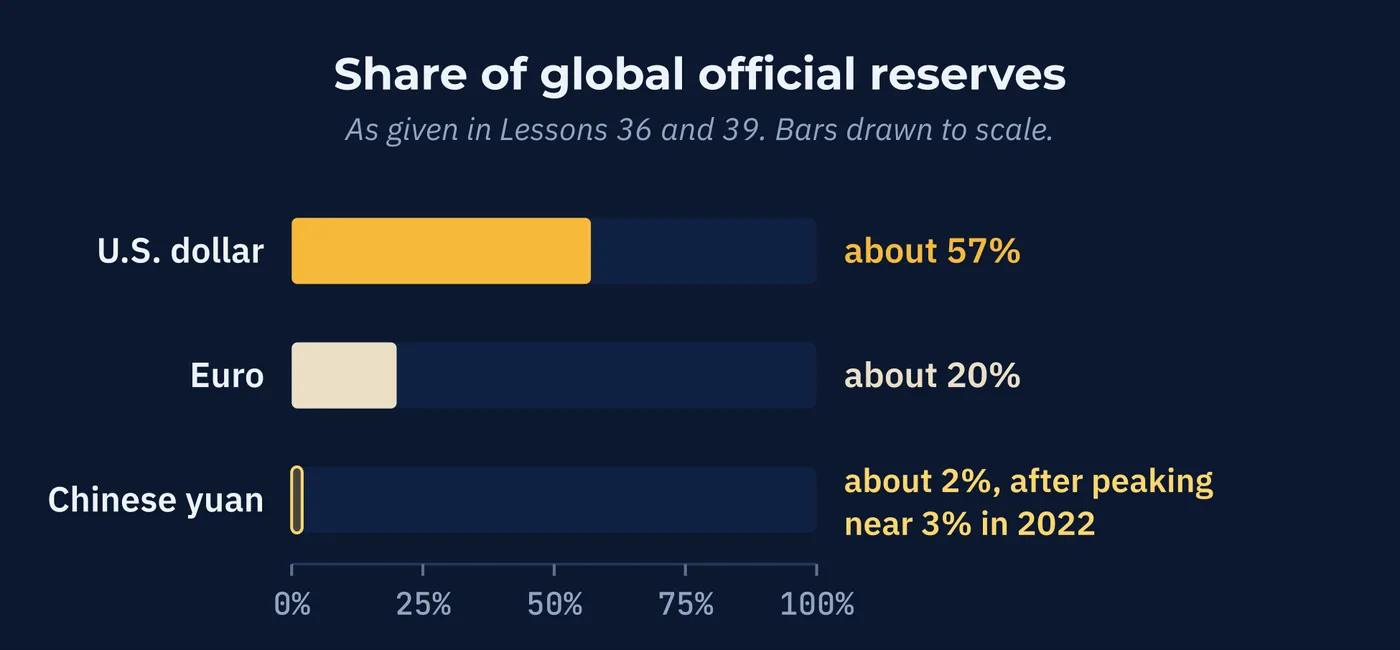
| The Chinese yuan | About 2 percent, after peaking near 3 percent in 2022 |
| Bitcoin | Held by a few institutions and one national government |
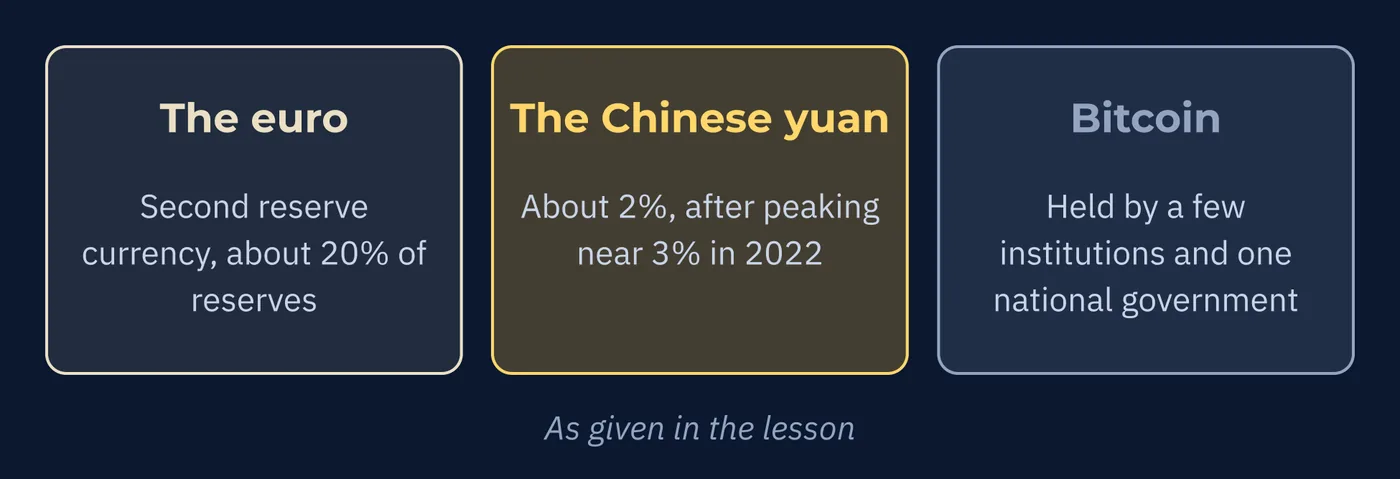
Each is usually judged on its own. What emerges when you put all three together is more interesting, and it is the subject of Section 8.
Take them in order.
2The Euro Has Four of Five
The euro is the strongest candidate by a distance. It is worth being clear how much it already has.
| Condition from Lesson 36 | The Euro |
|---|---|
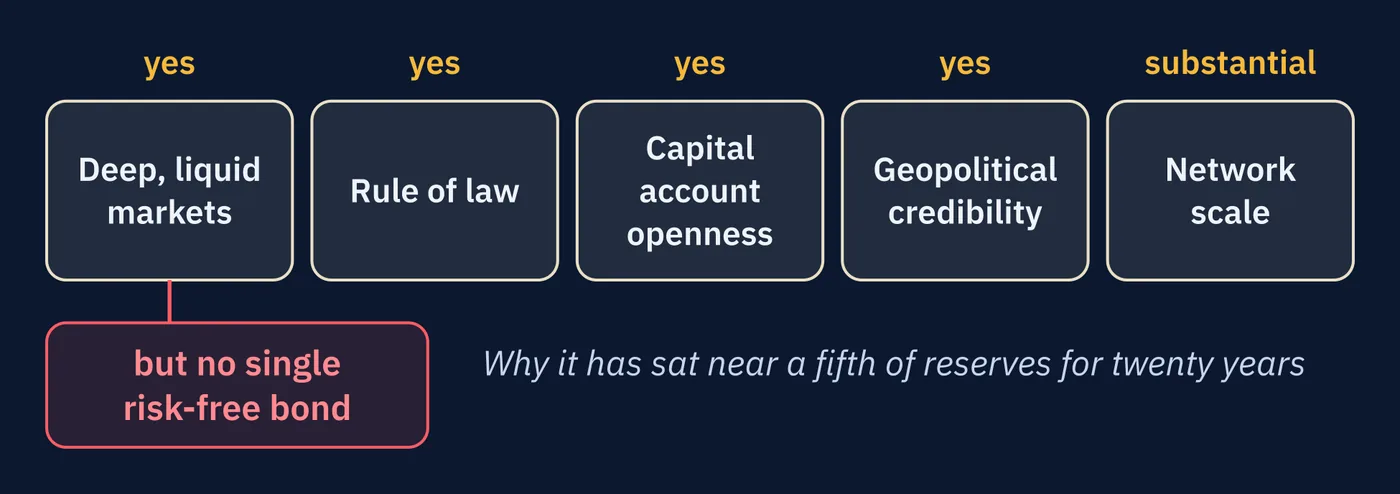
| Deep, liquid markets | Yes. Large and liquid. |
| Rule of law | Yes. Strong protections, independent courts. |
| Capital account openness | Yes. Money moves freely. |
| Geopolitical credibility | Yes. Stable and established. |
| Network scale | Substantial. Already second. |
On the five conditions, the euro does well. So why has it been stuck at roughly a fifth of global reserves for twenty years?
The answer sits underneath the first condition.
3What the Euro Is Missing
The eurozone is a monetary union without a fiscal union.
One central bank sets rates for every member. But each member government runs its own budget, sets its own taxes, and issues its own debt.
That gap matters enormously for a reserve asset.
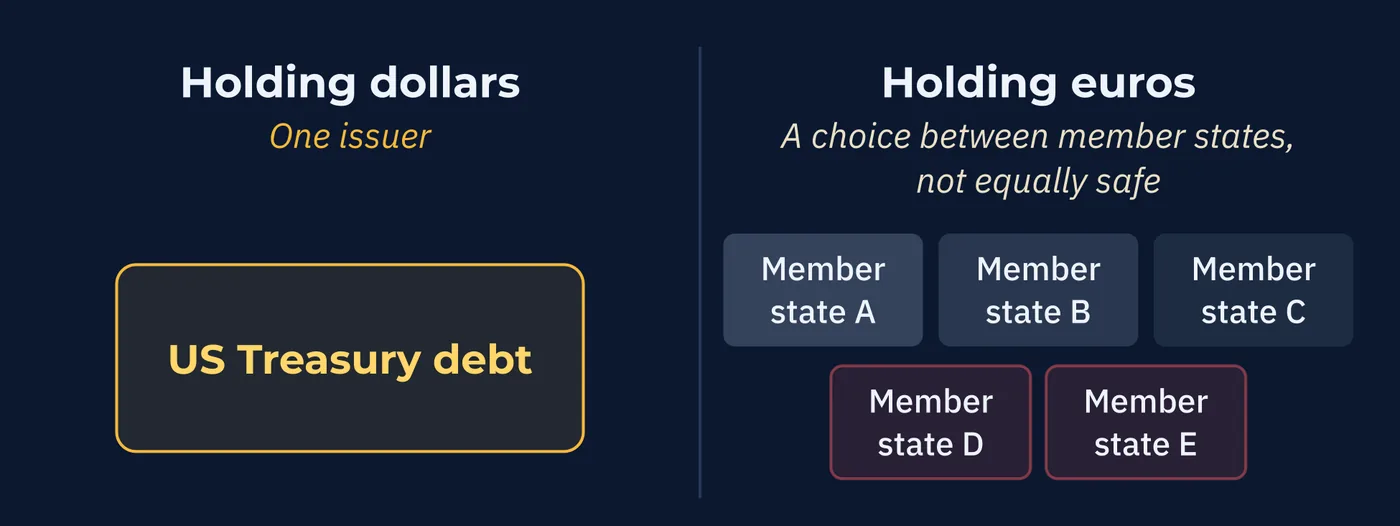
There is no single eurozone government bond.
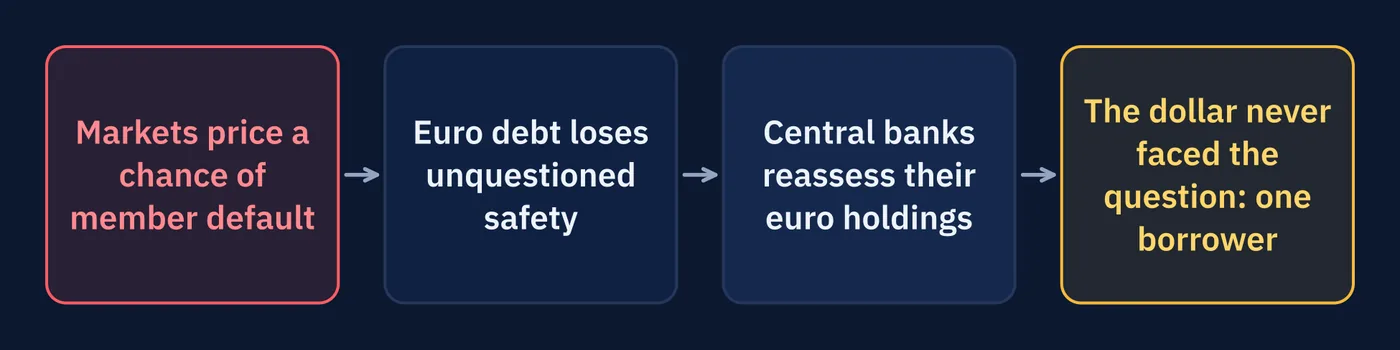
A central bank holding dollars buys United States government debt, from one issuer. A central bank holding euros must choose between member states, and they are not equally safe.
The fix is known and it is not technical. A common eurozone treasury. Common debt backed by the whole bloc. An explicit lender of last resort.
Each step requires member governments to hand fiscal control to a supranational body. Several have consistently declined, for democratic rather than economic reasons.
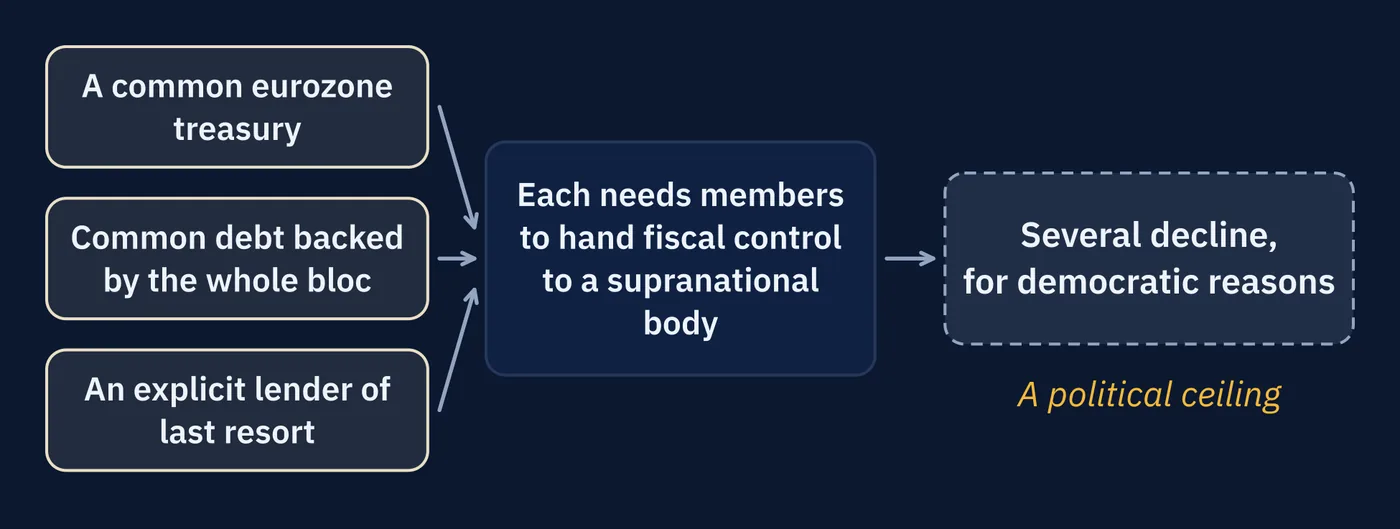
So the euro's ceiling is political. It will likely stay the world's second reserve currency at roughly its current share. On the present path it is not a candidate to displace the dollar.
4The Yuan Has Built the Most
Where the euro's problem is too little integration, the yuan's runs the other way.
China has made the most systematic effort to build reserve currency infrastructure of any challenger since the war. That deserves stating plainly, before the constraint.
| What Has Been Built | What It Does |
|---|---|
| About forty central bank swap agreements | Each one reduces the need for dollar intermediation in that trading relationship |
| Inclusion in the IMF's reserve asset basket, 2016 | Formal recognition that the yuan had reached international usage |
| Loans denominated in yuan under the Belt and Road Initiative | Creates countries with yuan obligations, and therefore a structural reason to hold yuan |
| A domestic cross-border payment system | An alternative route for settlement outside existing networks |
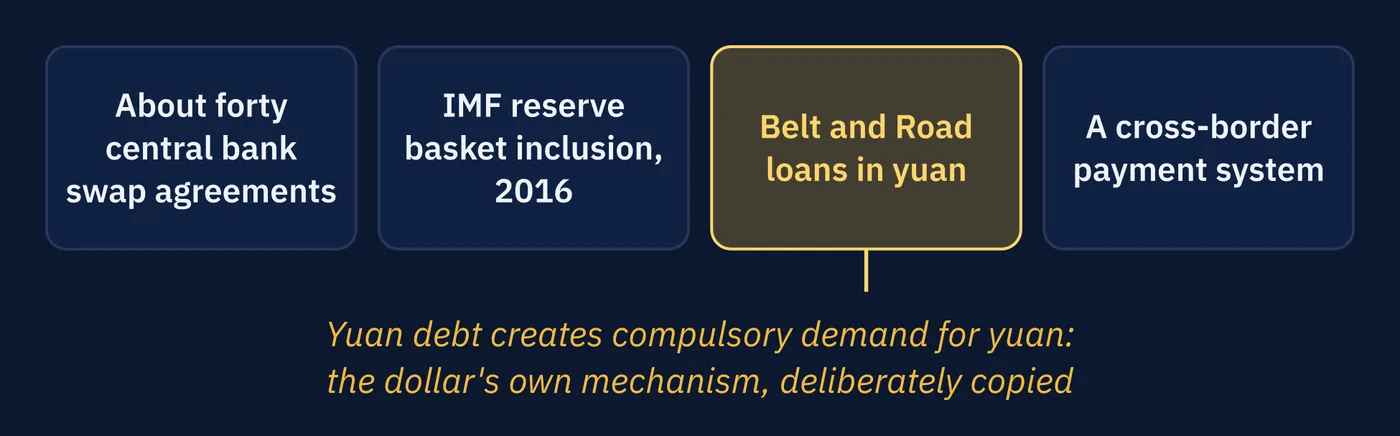
Look at the third row against Lesson 36. Debt in a currency creates compulsory demand for it, because the obligation must be serviced. That is the same mechanism behind dollar debt, deliberately copied.
The results are real but modest. From effectively zero in 2015 to about 2 percent now, after peaking near 3 percent in 2022. That is the fastest growth of any currency in the reserve data, and still a small share.
5The Yuan's Constraint Is a Choice
The yuan fails on capital account openness. Lesson 36 called it the most precise of the five conditions, because capital either moves freely or it does not.
China restricts how money moves in and out. So a country holding large yuan reserves cannot be sure of deploying or repatriating them freely when needed. A reserve you cannot use on demand is not doing the job.
The important part is why.
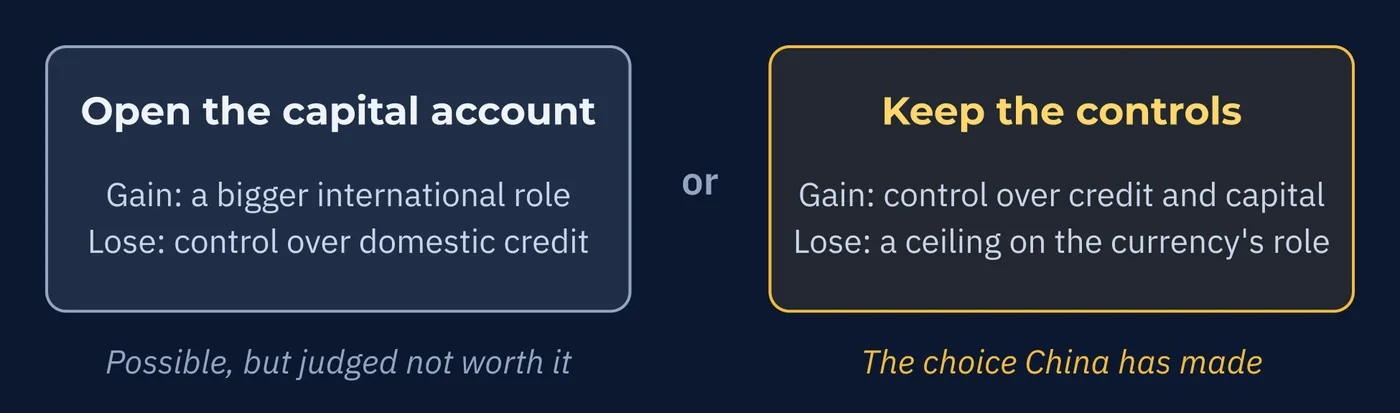
This is not a gap waiting to be closed. It is a decision, and it has costs on both sides.
Opening the capital account fully would mean giving up much control over domestic credit and where capital goes. That control is valued. The price of keeping it is a ceiling on the currency's international role.
So the yuan's constraint is not a problem anybody is trying to solve. It is a trade-off already made. It could be unmade, but only by accepting something China has judged not worth accepting.
6What Bitcoin Actually Solves
The third candidate is different in kind, and the case for it deserves serious consideration.
Bitcoin does not try to match the dollar's properties. It targets specific weaknesses in the current arrangement, and Series F identified every one of them.
| The Weakness | Where This Course Covered It | Bitcoin's Answer |
|---|---|---|
| The Triffin Dilemma | Lesson 33 | No issuer, so nobody must run deficits to supply it |
| Supply expanded by policy | Lesson 30 | A fixed supply of 21 million, set in the protocol |
| The exorbitant privilege | Lesson 38 | No country issues it, so no country gains the advantages |
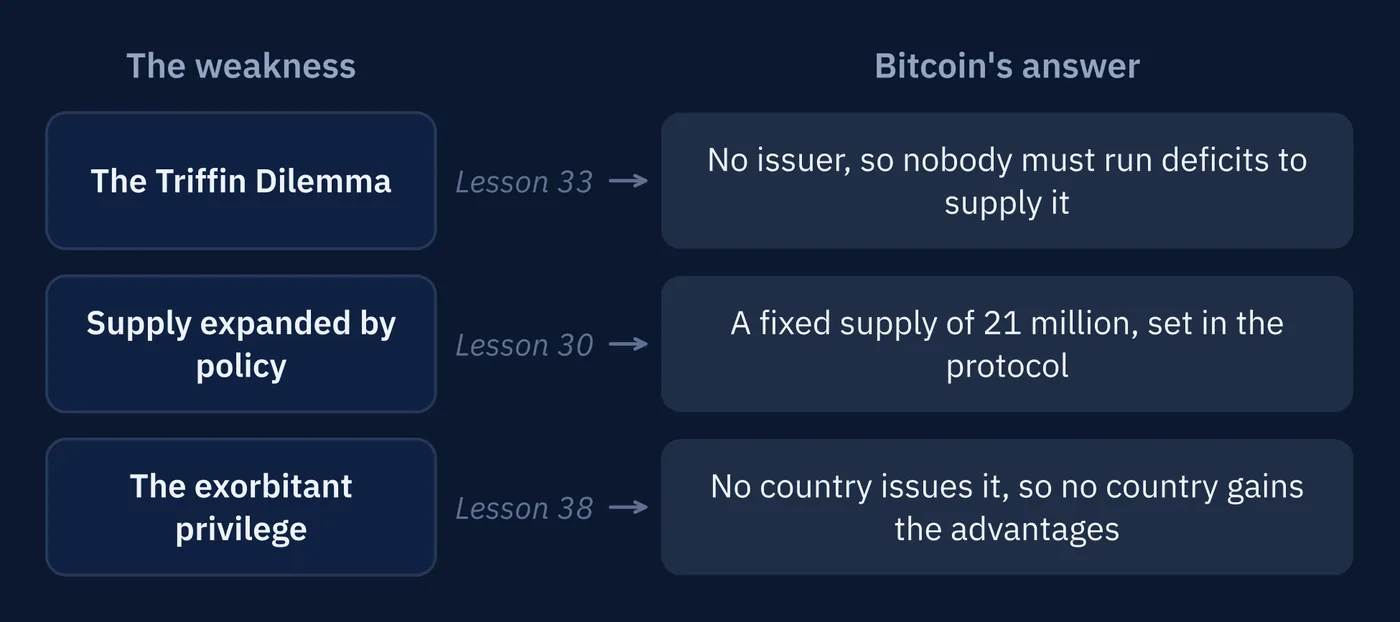
Those are not small points. Each one targets something this course has documented as a real structural problem.
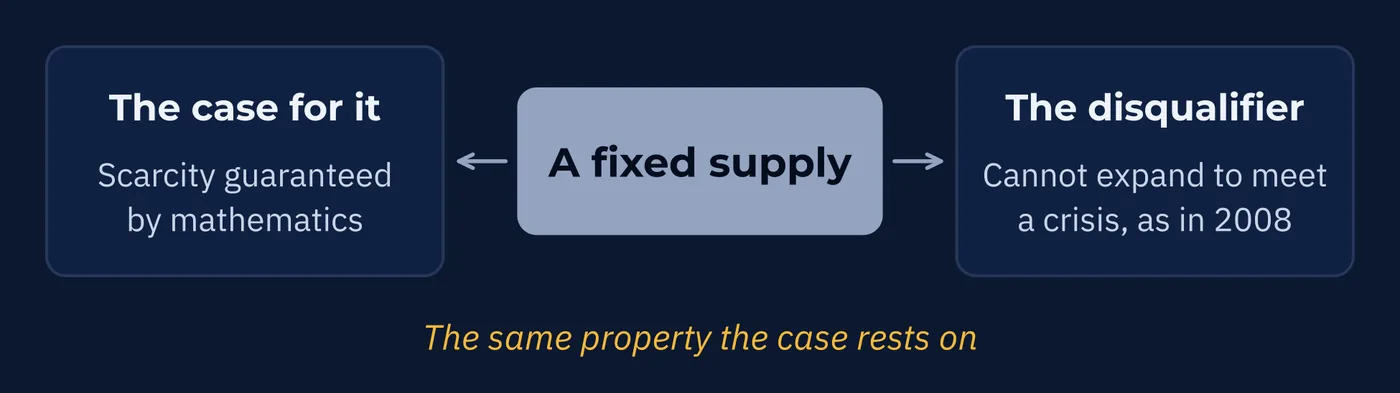
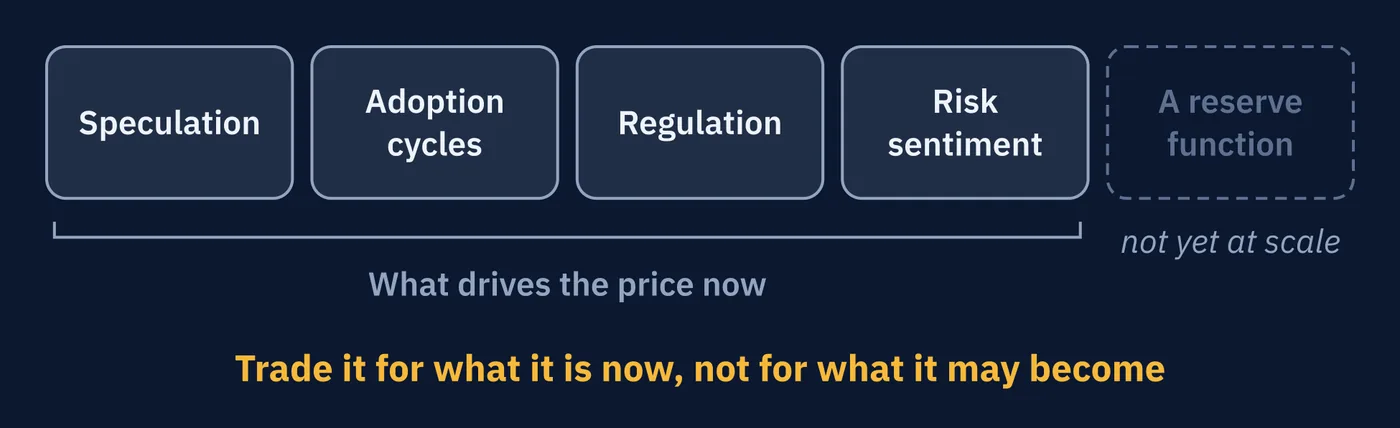
Some governments have begun treating it as a reserve asset. El Salvador made it legal tender in 2021, then in early 2025 amended the law so businesses no longer have to accept it. In March 2025 the United States created a Strategic Bitcoin Reserve, holding bitcoin it already owned through forfeitures, and New Hampshire and Texas passed laws that year allowing their states to hold it. The logic is consistent. A hedge against debasement, behaving less like money and more like digital gold, with scarcity guaranteed by mathematics rather than promised by an institution.
7What Disqualifies It Today
Against the five conditions, Bitcoin currently fails three. The first is decisive.
| The Problem | Why It Disqualifies |
|---|---|
| Volatility | Bitcoin has moved 40 to 80 percent within single calendar years, in both directions. Reserves are held precisely to be stable when other things are falling. |
| No lender of last resort | In a liquidity crisis a central bank can supply dollars without limit. Bitcoin's supply is fixed and cannot be expanded to meet one. |
| Custody at sovereign scale | Holding it securely at central bank size requires key management and security infrastructure most institutions have not built. |
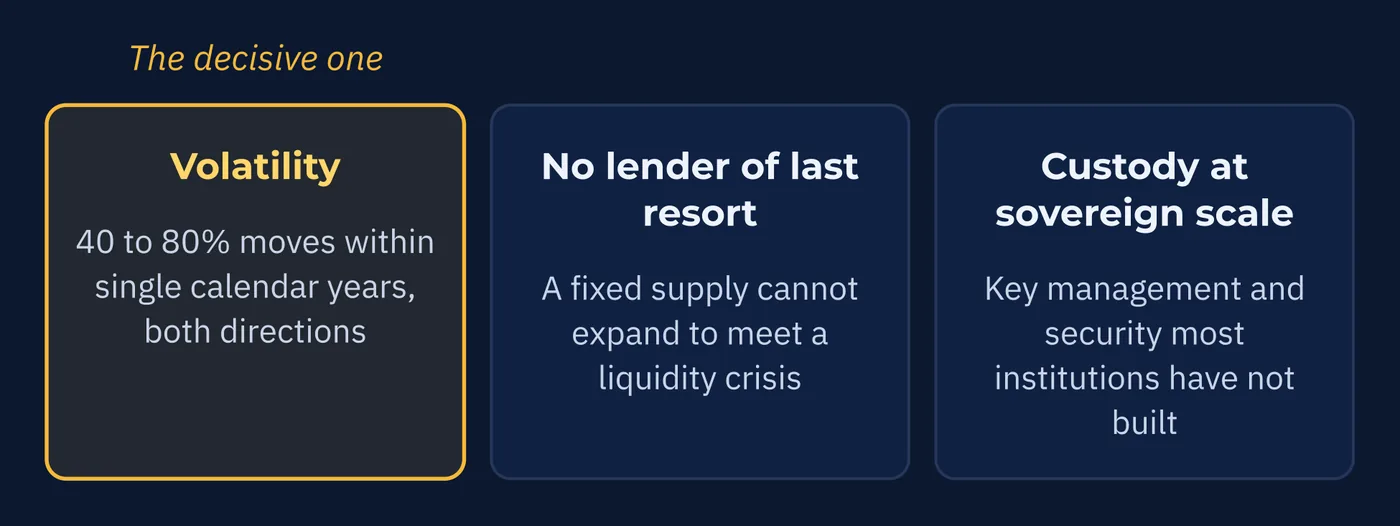
The second row is the one most often skipped, and it is a real problem rather than a preference. Lesson 35 showed a central bank supplying currency without limit to defend a commitment. Lesson 38 showed the Federal Reserve meeting a compulsory global demand for dollars in 2008. A fixed supply cannot do either. And that is the same property the case for Bitcoin rests on.
8Three Walls, No Two the Same
Now put the three together. This is where the useful observation is.
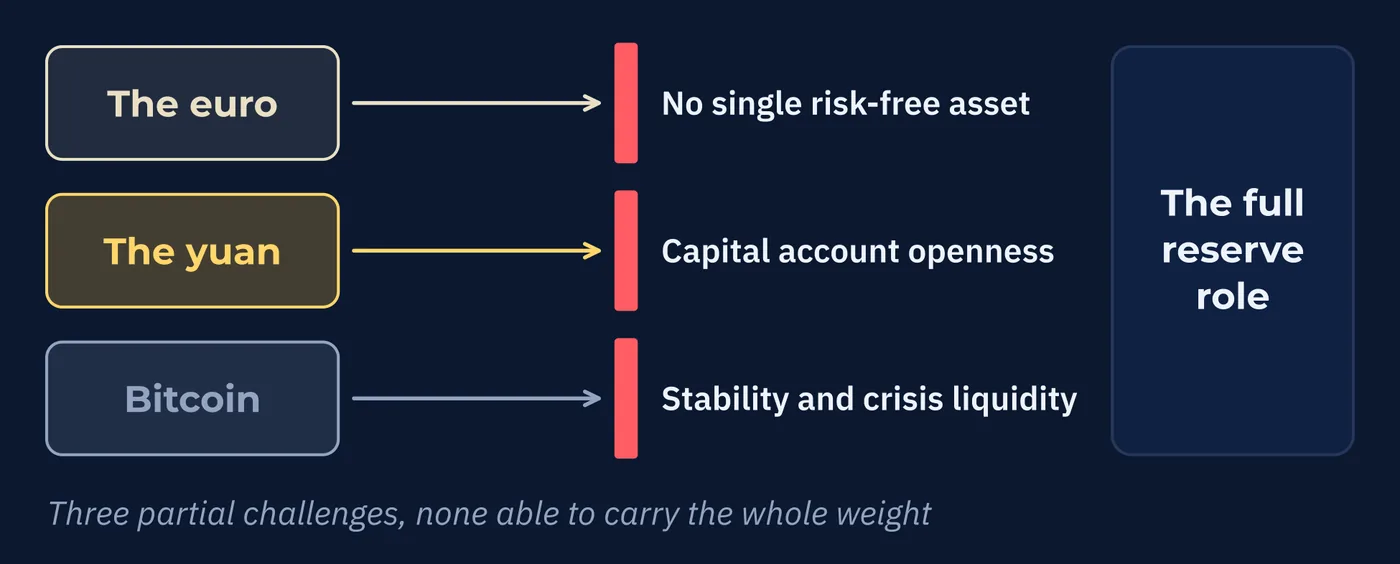
| Candidate | Fails On | Why |
|---|---|---|
| The euro | A single risk-free asset | No unified borrower, and the fix requires political integration members decline |
| The yuan | Capital account openness | Restrictions are a deliberate choice with a real domestic benefit |
| Bitcoin | Stability and crisis liquidity | Volatility, and a fixed supply that cannot expand when needed |
No two fail on the same condition. So the dollar is not facing one consolidated alternative. It faces three partial challenges. Each serious, each blocked by something different, and none able to absorb the full weight of global reserve demand.
That explains something from Lesson 36 that would otherwise be puzzling.
| Over Two Decades | Change in Reserve Share |
|---|---|
| The dollar | Down roughly 14 percentage points |
| The euro | Up roughly 1.5 points |
| The yuan | Up roughly 2 points |
| Everything else | Absorbed the remainder |
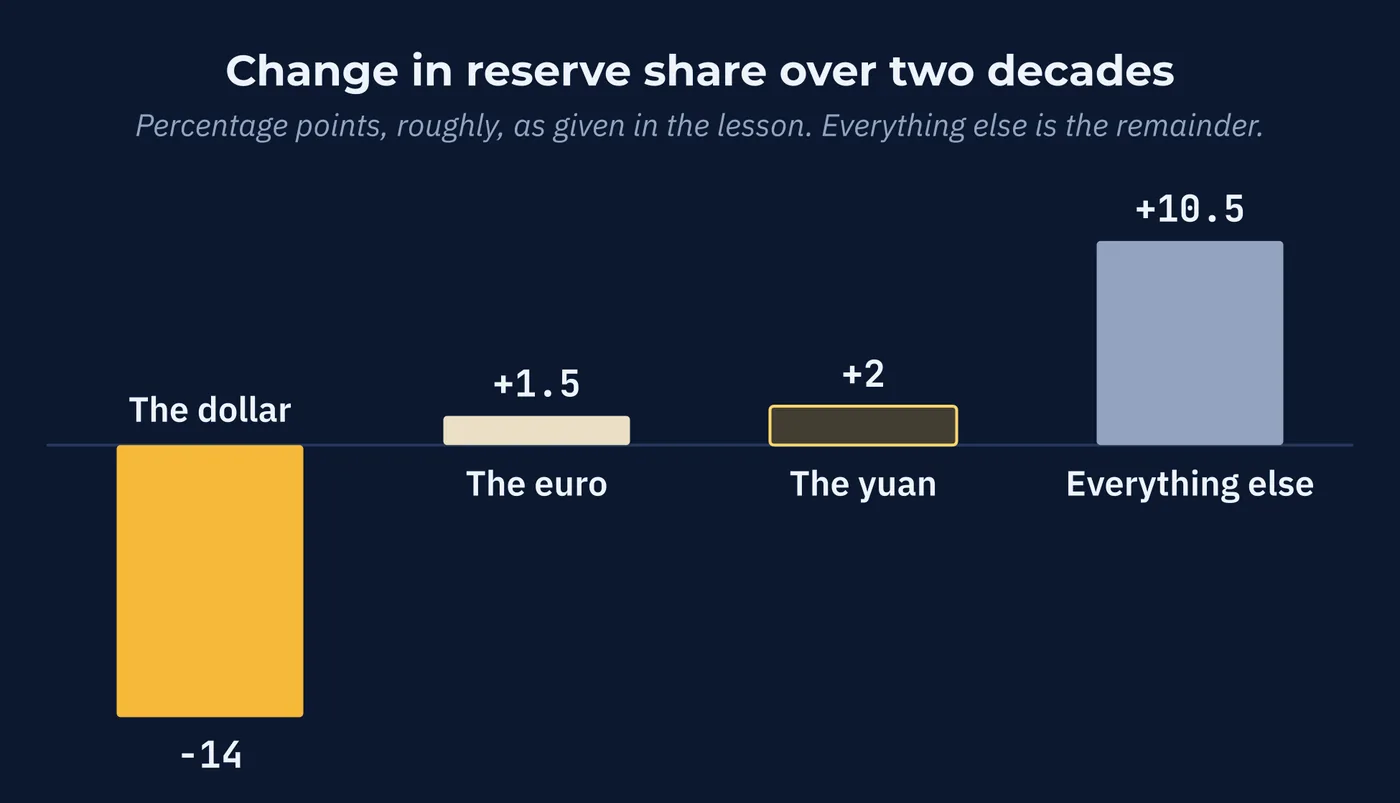
Fourteen points left the dollar and went nowhere in particular. They spread across a wider set of smaller currencies, because no candidate could be a destination for the whole of it.
De-dollarization without a destination is not dollar displacement.
What is happening is real. Diversification, running slowly, consolidating nowhere.
What This Series Was For
Four lessons ago the question was what a reserve currency is. The answer was a function that emerges when five conditions hold at once, defended by a network effect that makes incumbents very hard to move.
Then how the dollar came to hold it, what the position is worth, and who pays for it. And now the candidates, each stopped by something different.
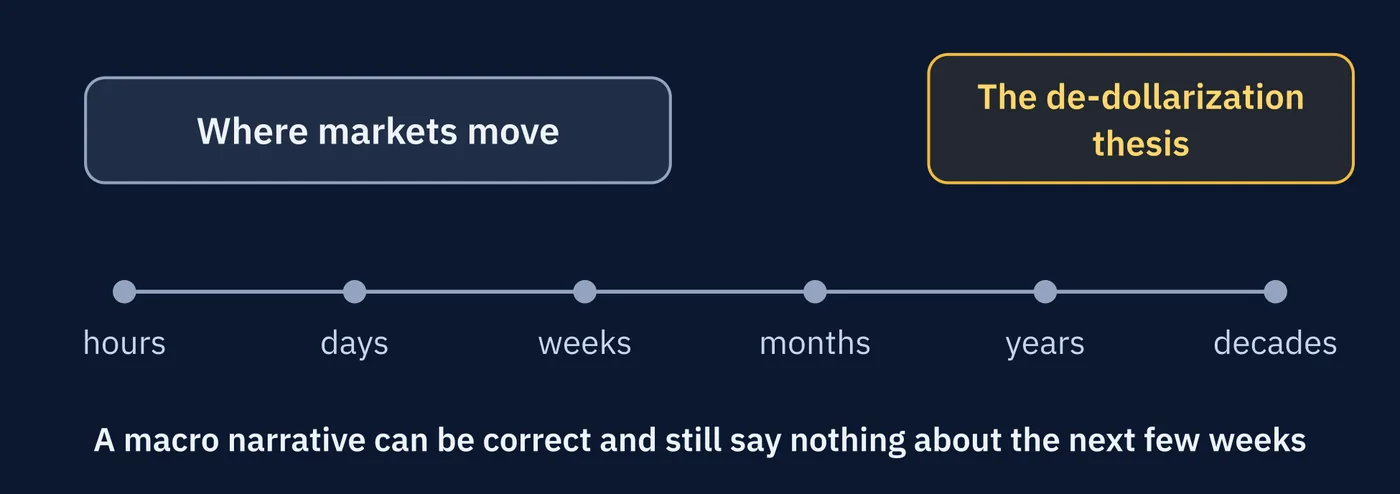
Meanwhile the measure that touches your chart has not moved. The dollar sits on one side of 89.2 percent of currency transactions, up rather than down over three years. Every major pair contains it. One dollar move still produces seven reactions. A crisis anywhere still strengthens it.
The next series returns to the market itself, and to how pairs move together.
Three Things to Remember
Try This
Twenty minutes. The last step is the one that carries forward.
Words From This Lesson
| Term | What It Means |
|---|---|
| Fiscal union | A shared budgetary authority able to tax, spend, and issue debt on behalf of a whole bloc. The eurozone has a monetary union without one. |
| Risk-free asset | Government debt considered certain to be repaid, which reserve holders need somewhere to put their money. |
| Currency swap agreement | An arrangement between two central banks to exchange currencies, reducing the need for a third currency in between. |
| Special Drawing Right | An IMF reserve asset, not a currency, whose value follows a weighted basket of five currencies. |
| Belt and Road Initiative | A Chinese lending and infrastructure program, with loans denominated in yuan creating obligations in that currency. |
| Lender of last resort | An institution able to supply currency without limit during a crisis. A fixed-supply asset cannot perform this role. |
| De-dollarization | Reduced use of the dollar. Currently diversification into many currencies rather than a shift to one successor. |
Test Your Knowledge
Eight questions. Answer them all before checking the key on the following pages. If a question gives you trouble, the answer key tells you which section to revisit.
- A. Rule of law
- B. Deep, liquid financial markets
- C. Capital account openness
- D. The absence of a single risk-free euro government bond
- A. European voters oppose the currency
- B. The ECB lacks legal authority
- C. The fix requires member states to hand fiscal control to a supranational body
- D. Non-eurozone countries block it
- A. The 2008 global financial crisis
- B. The United Kingdom leaving the European Union
- C. The introduction of euro banknotes
- D. The 2010 to 2012 sovereign debt crisis
- A. Central bank swap agreements, reserve basket inclusion, and yuan-denominated lending
- B. A gold-backed convertibility guarantee
- C. Full capital account liberalization
- D. A fixed peg to the euro
- A. A reserve that cannot be freely deployed or repatriated is not performing the job
- B. They make the currency too volatile
- C. They violate IMF rules
- D. They prevent the yuan from being traded at all
- A. Exchange rate volatility
- B. The Triffin Dilemma, since there is no issuer running deficits
- C. Slow settlement times
- D. The absence of a lender of last resort
- A. It makes the price too stable
- B. It cannot be expanded to supply liquidity during a crisis
- C. It prevents institutional custody
- D. It requires government approval
- A. To the euro
- B. To the yuan
- C. Dispersed across a range of smaller currencies
- D. Into Bitcoin holdings
Answer Key
Each answer explains why the correct choice is correct, why the others are not, and where to reread.
Question 1 · correct answer D
The eurozone is a monetary union without a fiscal union. Each member issues its own debt, so there is no single borrower whose bonds are unambiguously safe regardless of who issued them.
A is a genuine euro strength, with strong legal protections. C is also a strength, since capital moves freely. B is a strength too, as European markets are large and liquid. The euro satisfies four of the five.
Review: Section 3, What the Euro Is Missing
Question 2 · correct answer C
A common treasury, common debt, and an explicit lender of last resort would each require member governments to transfer fiscal sovereignty. Several have consistently declined, for democratic reasons.
A misstates the position, since the currency itself is not the contested question. B is wrong because the ECB has full authority over monetary policy. D is wrong because the decision rests with eurozone members.
Review: Section 3, What the Euro Is Missing
Question 3 · correct answer D
During that crisis markets began pricing the possibility that individual members could default on euro-denominated debt, which removed the unquestioned safety a reserve asset requires.
A tested the global system but did not raise this specific question about euro sovereign debt. C was an administrative step. B affected a country outside the eurozone.
Review: Section 3, What the Euro Is Missing
Question 4 · correct answer A
Roughly forty central bank swap agreements, inclusion in the IMF reserve basket in 2016, and lending denominated in yuan that creates obligations in the currency. The most systematic effort any challenger has made.
B describes an arrangement no major currency has had since 1971. C is precisely what China has declined to do. D is wrong because the yuan is managed against a basket rather than pegged to the euro.
Review: Section 4, The Yuan Has Built the Most
Question 5 · correct answer A
Reserves exist to be used when needed. If capital cannot move freely, a holder cannot be certain of deploying or repatriating them, and the holding fails its purpose.
B confuses capital controls with volatility, and controls generally reduce volatility. C is wrong because such controls are permitted. D overstates it, since the yuan is actively traded.
Review: Section 5, The Yuan's Constraint Is a Choice
Question 6 · correct answer B
The Triffin Dilemma requires an issuer running deficits to supply the world. Bitcoin has no issuer and a fixed supply, so the dilemma cannot apply to it structurally.
A reverses the position, since volatility is Bitcoin's main disqualifier. C describes a technical property unrelated to reserve currency structure. D is a weakness of Bitcoin rather than something it solves.
Review: Section 6, What Bitcoin Actually Solves
Question 7 · correct answer B
During a liquidity crisis a central bank can supply currency without limit. A fixed supply cannot expand to meet emergency demand, and that is the same property the case for Bitcoin depends on.
A reverses it, since the price is highly volatile. C describes a separate operational problem rather than a consequence of fixed supply. D invents a requirement that does not exist.
Review: Section 7, What Disqualifies It Today
Question 8 · correct answer C
About fourteen points left the dollar, roughly one and a half went to the euro and two to the yuan, and the remainder spread across a wider set of smaller currencies.
A is the common assumption, and the euro has been roughly flat for two decades. B overstates a share of about two percent. D is wrong because sovereign Bitcoin holdings remain very small.
Review: Section 8, Three Walls, No Two the Same
Keep going
The Dollar's Position is written by Kanin D. Alldredge for The Currency Classroom, and it is free to read. There is more free from CNS: start here.
Start free with CNS →