What Dominance Buys

1One Fact, Two Sides
Issuing the world's reserve currency is usually called a prize. Sometimes it is called a burden. Both are correct, and both are incomplete.
The clearer way to see it is that most of the advantages and most of the costs are the same facts, viewed from different places.
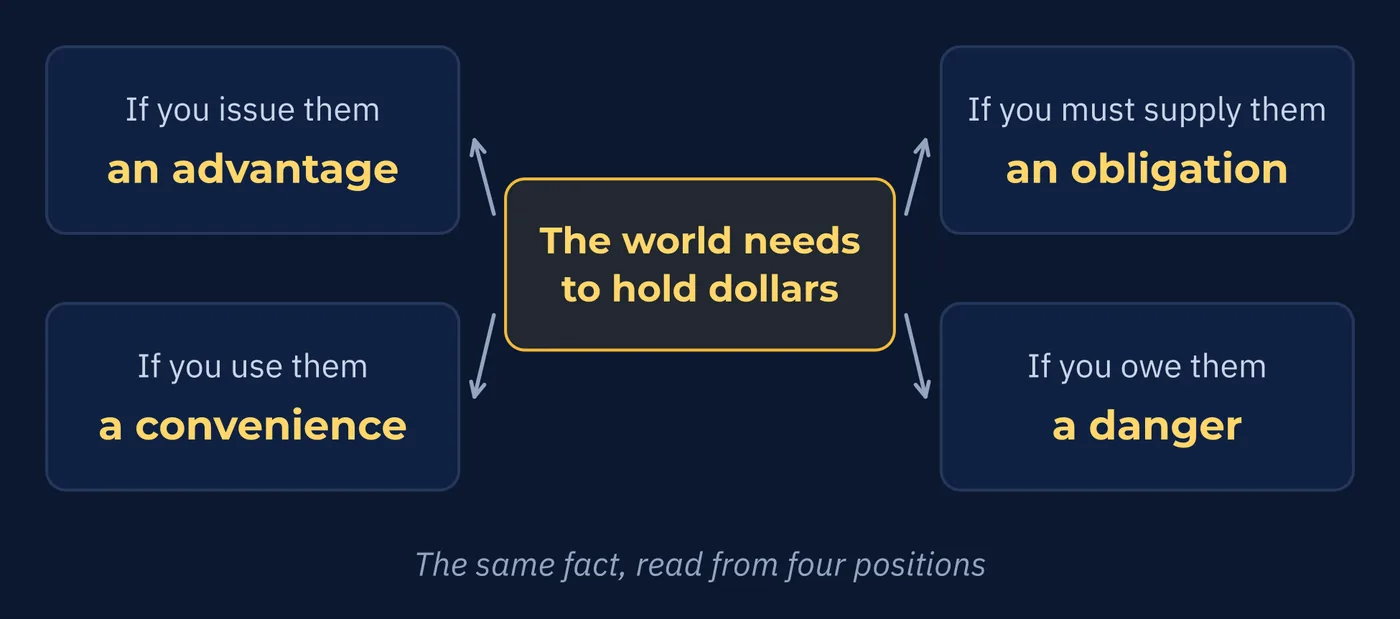
The world needs to hold dollars. That is an advantage if you issue them, and an obligation if you must supply them. A convenience if you use them, and a danger if you owe them.
Start with the advantages, because they have a name.
2Cheaper Borrowing
Lesson 37 introduced the exorbitant privilege, the phrase a French finance minister used for what the reserve issuer gains. The first of its three parts is the most measurable.
Governments borrow by issuing bonds, and the price they pay depends on how much demand exists for them.
American government bonds have a permanent buyer base. Central banks hold them as reserves. Oil exporters recycle revenues into them. Institutions worldwide treat them as the default safe place for money.
None of that demand comes from judging American creditworthiness. It comes from the currency's role.
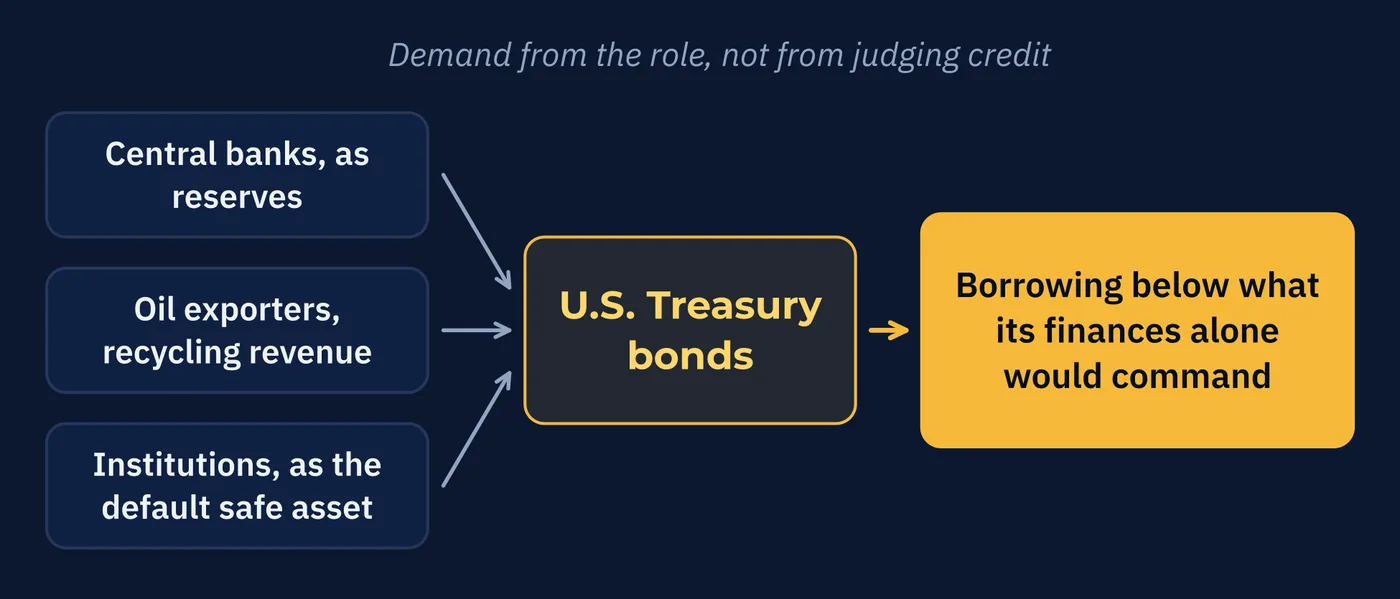
The United States borrows at rates its own finances alone would not command.
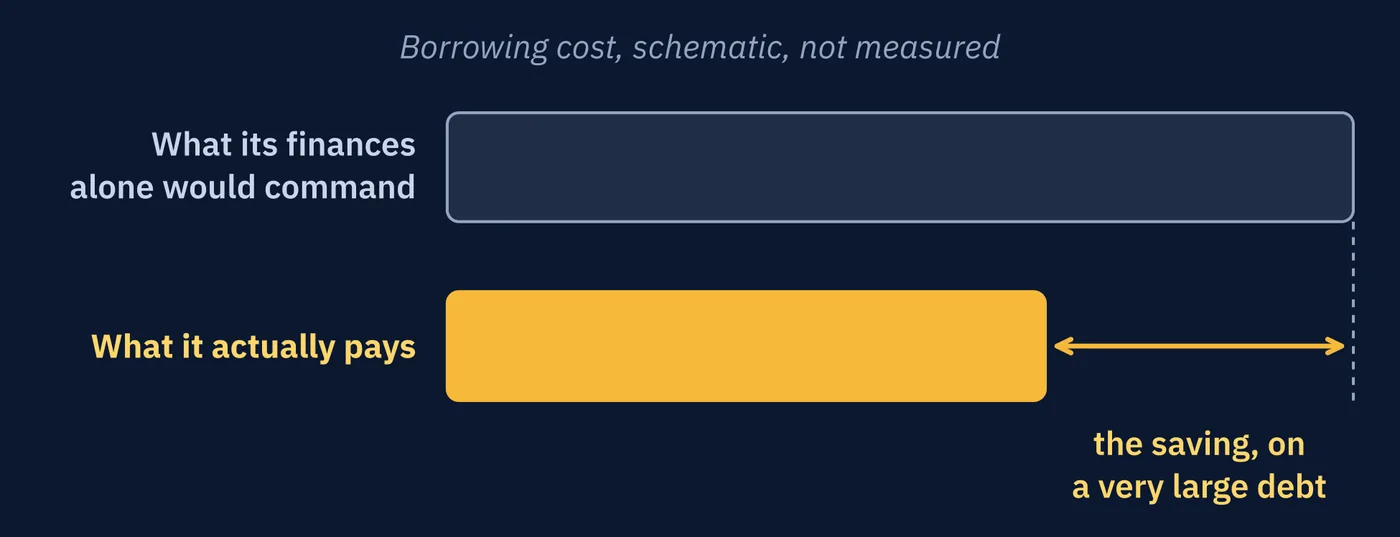
On debt of that size, even a small reduction in borrowing cost is an enormous sum every year.
3Deficits Without Discipline
The second advantage follows from the first, and it is the one other countries find hardest to accept.
When an ordinary country runs persistent deficits, markets respond. Borrowing costs rise. The currency weakens. Capital leaves. Those pressures are how a country gets forced to correct course.
The reserve issuer feels those pressures far less, because the world's need for its currency continues anyway.
| An Ordinary Country | The Reserve Issuer |
|---|---|
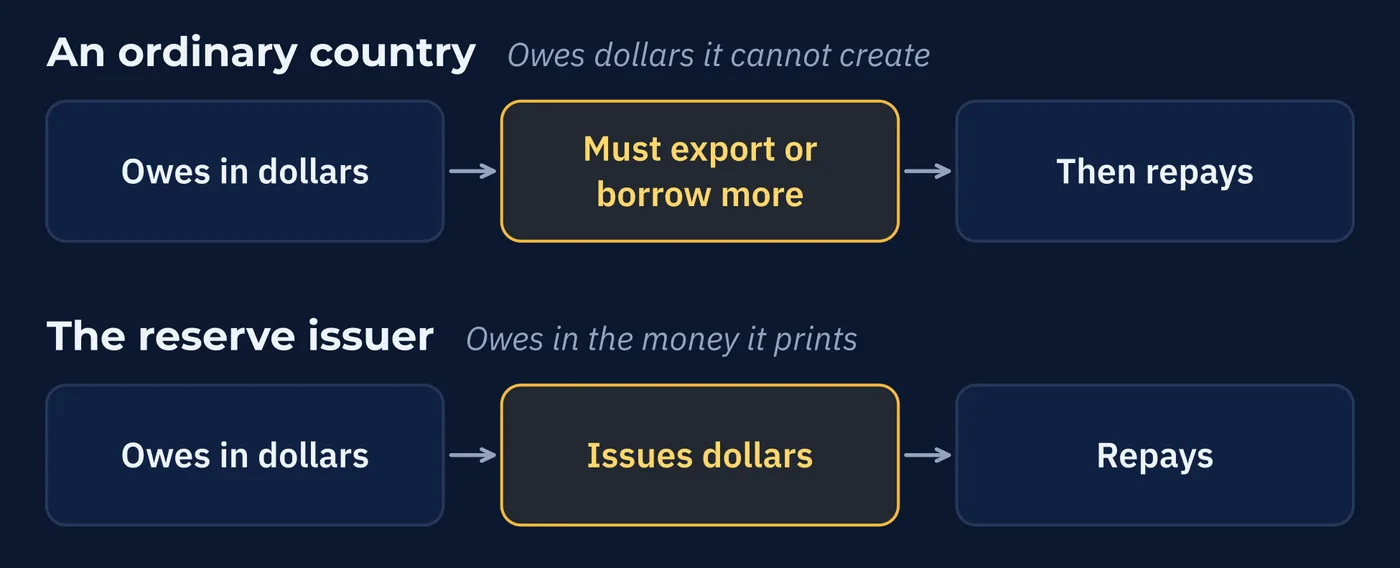
| Must earn foreign currency to service foreign debt | Issues the currency its foreign debt is denominated in |
| Faces rising borrowing costs as deficits grow | Faces structural demand that softens that pressure |
| Is disciplined by the market | Is disciplined considerably less |
Read the first row twice. It is the sharpest single difference in this lesson.
A country that borrowed in dollars must go and get dollars, by exporting or borrowing more. The country that issues dollars has no such problem. Its foreign obligations are in the money it prints.
4A Subsidy That Partly Funds Itself
The third advantage is the least discussed and the most circular.
Cheaper borrowing and looser deficit limits reduce the cost of maintaining a global military and political presence. Lesson 37 described part of that presence in the Gulf.
And that presence helps sustain the conditions under which the currency keeps its role.
reserve status → cheap borrowing → affordable global presence → reserve status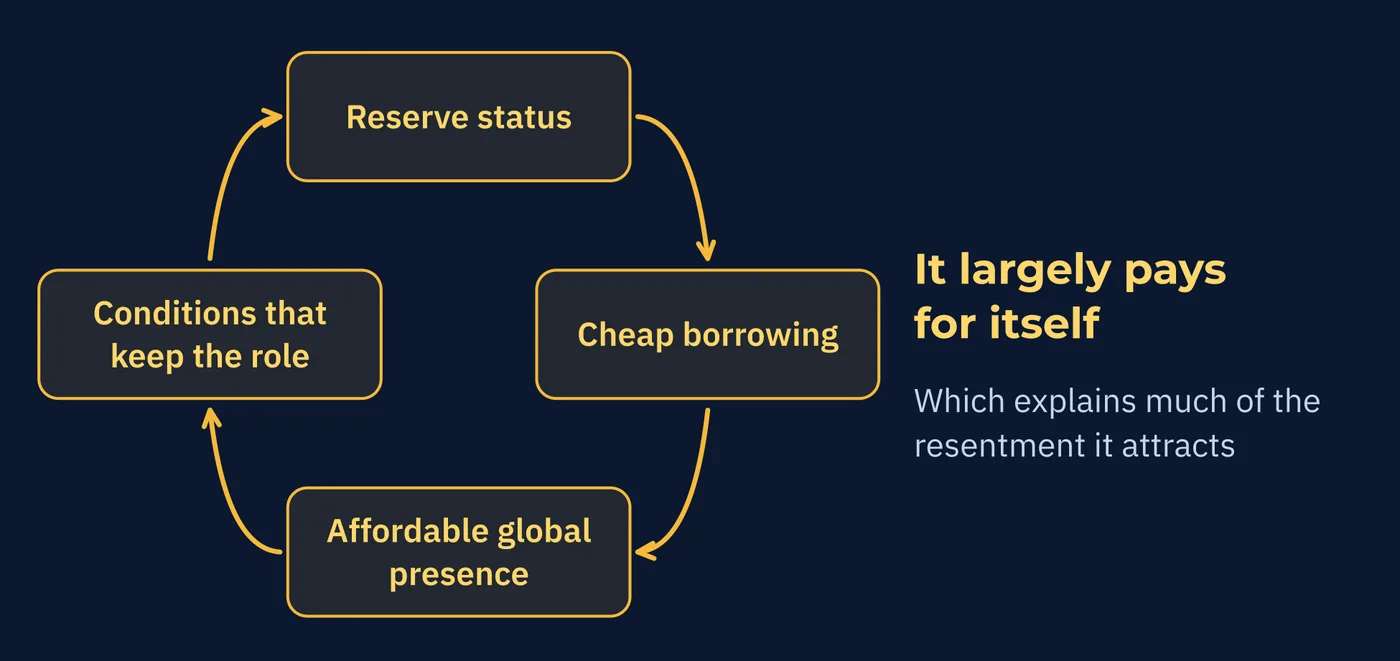
Most national advantages have to be paid for out of something else. This one largely pays for itself. That is unusual, and it explains much of the resentment the arrangement attracts.
5The Obligation Underneath
Now turn the same facts over.
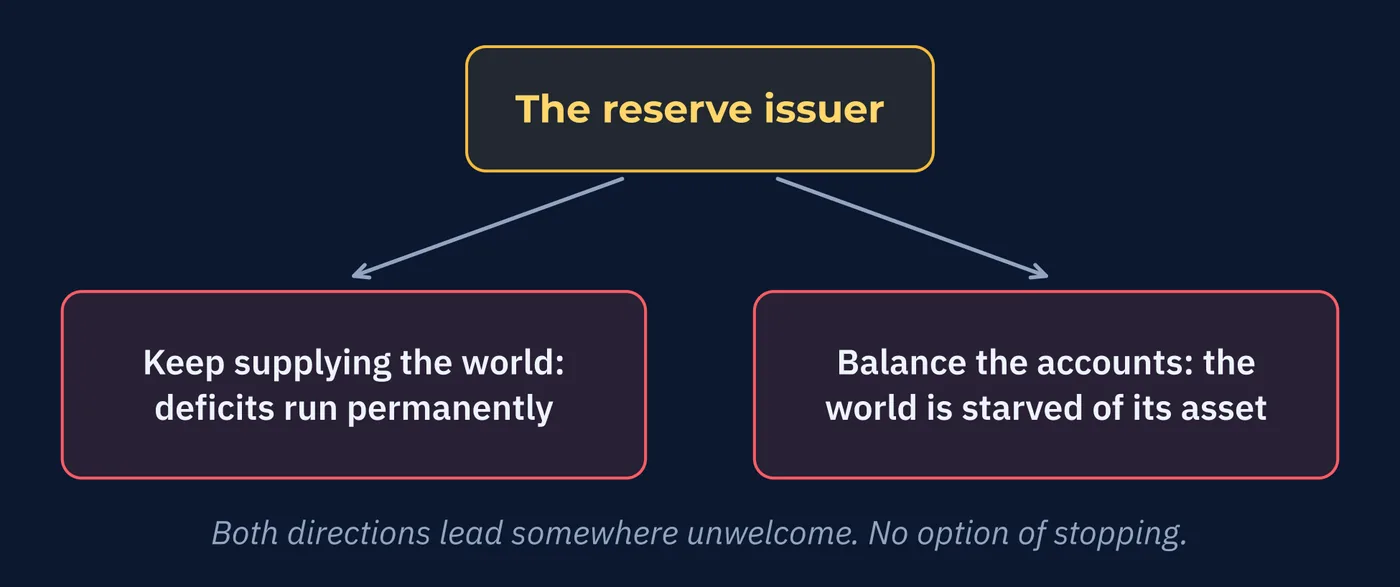
Lesson 33 covered the Triffin Dilemma. The reserve issuer must supply the world with its currency. That means sending out more than it takes in, permanently, as a condition of the role.
Section 3 called that an advantage. It is also a requirement.
The permission to run deficits and the obligation to run them are the same sentence.
A reserve issuer that balanced its external accounts would starve the world of the asset the system runs on. The arrangement does not offer the option of stopping.
Which is why it is called a dilemma rather than a problem. Problems have solutions. This has two directions, and both lead somewhere unwelcome.
6When the Currency Gets Too Strong
There is a second cost, and it lands on the part of an economy that makes things.
The clearest illustration ran from 1979 to 1985, and it began with a domestic problem.
American inflation had reached levels that threatened the currency's standing. Consumer prices were running above thirteen percent by 1979. Paul Volcker was appointed to the Federal Reserve to break it, and he raised interest rates further than any predecessor.
| Before | After | |
|---|---|---|
| Federal Funds rate | About 11 percent in 1979 | A peak of 20 percent in June 1981 |
| US consumer prices | 13.5 percent in 1980 | Below 4 percent by 1983 |
| US unemployment | 5.6 to 6 percent in 1979 | 10.8 percent in late 1982 |
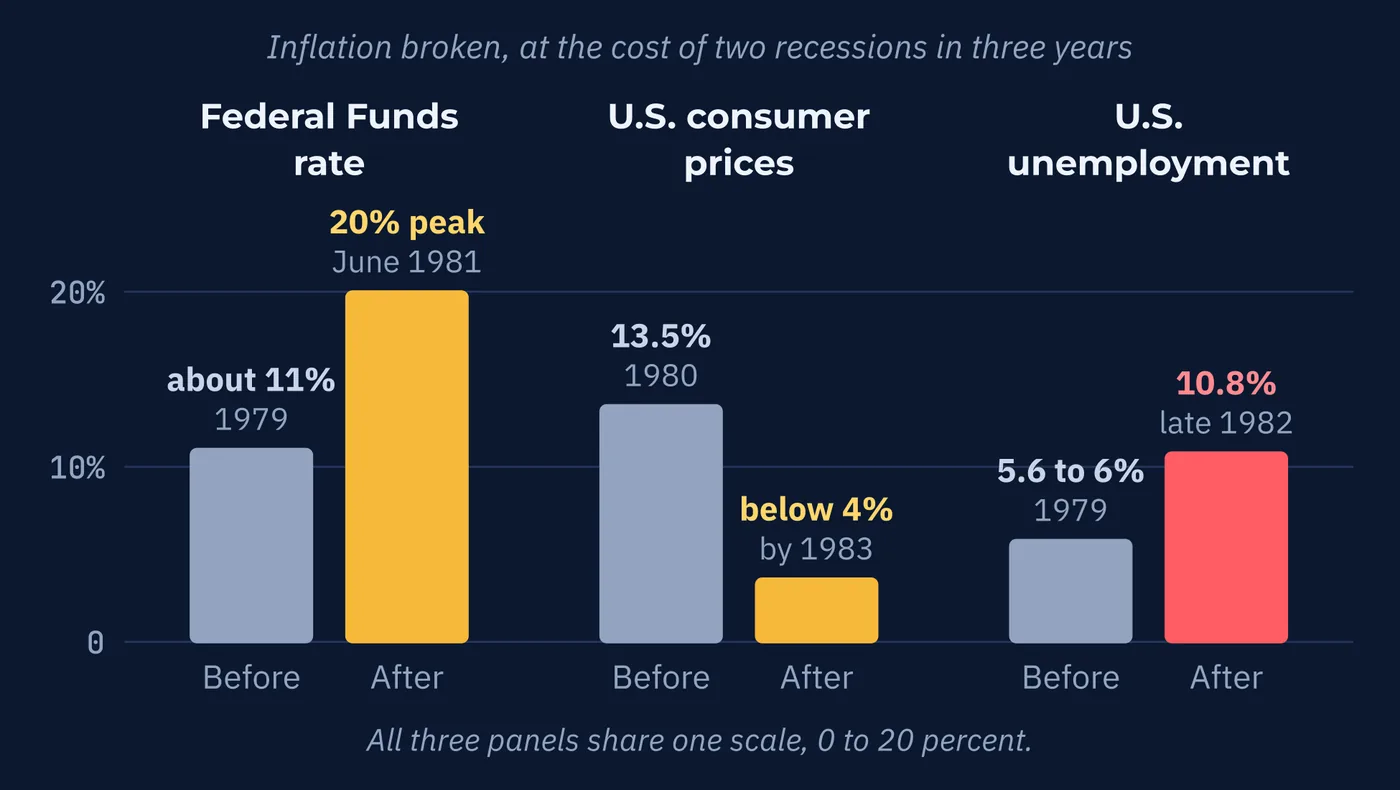
It worked on inflation, at a severe domestic cost of two recessions in three years.
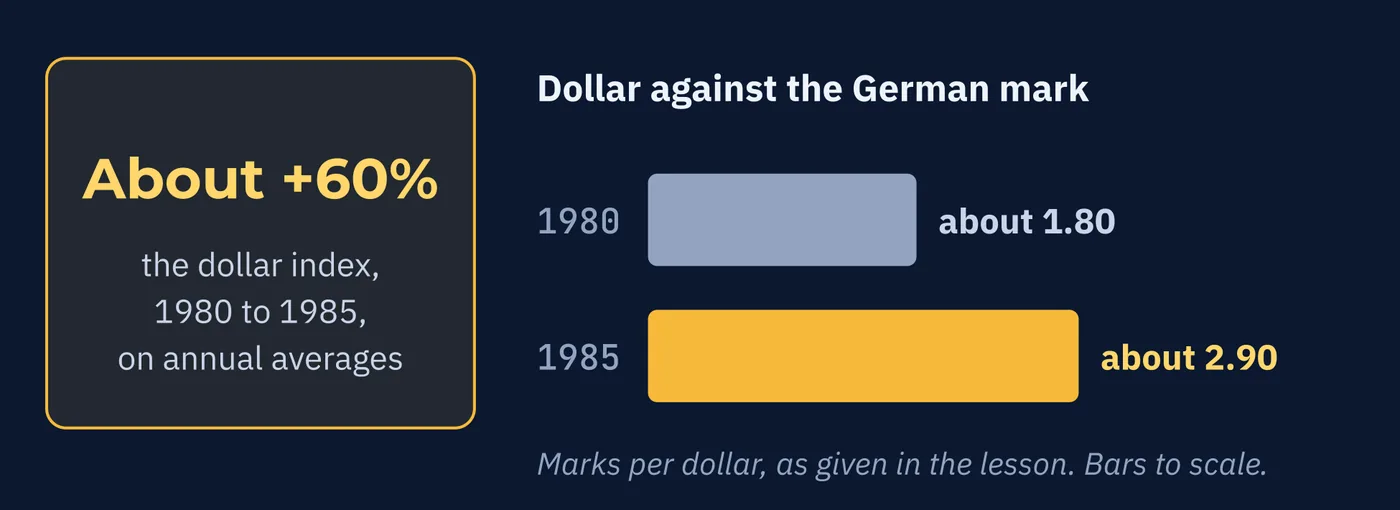
It also did something else. Rates that high pulled capital toward the dollar from everywhere, exactly as Lesson 1's first reason predicts. The dollar index rose about sixty percent between 1980 and 1985, comparing annual averages. Measured from its 1980 low to its February 1985 peak, it nearly doubled. Against the German mark it went from about 1.80 to about 2.90.
Which created a problem of its own. American exports became expensive against foreign competitors. The trade deficit widened. American manufacturers lost ground to Japanese and European producers whose currencies had weakened.
By 1985 the pressure was enough that the major economies acted together to bring the dollar back down. That agreement is known as the Plaza Accord.
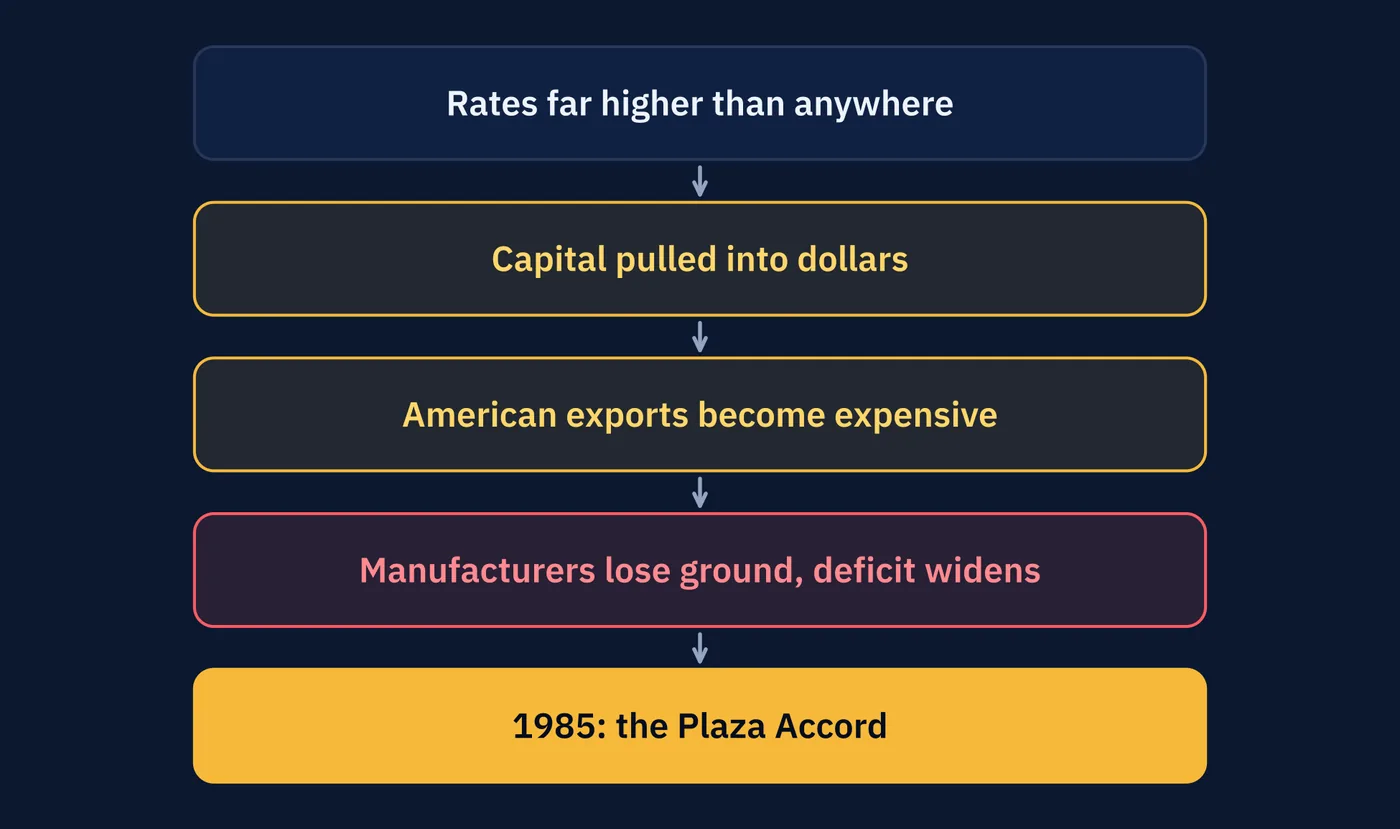
So a currency the world wants can get stronger than its own economy would choose. The demand comes from the global role. The cost falls on the people who export.
7What It Does to Everyone Else
The third cost is not paid by the issuer at all.
Through the 1970s, oil revenues recycled through international banks were lent onward to developing countries, much of it to Latin America. Those loans were in dollars. The borrowers earned their revenues in their own currencies.
Then Volcker raised rates.
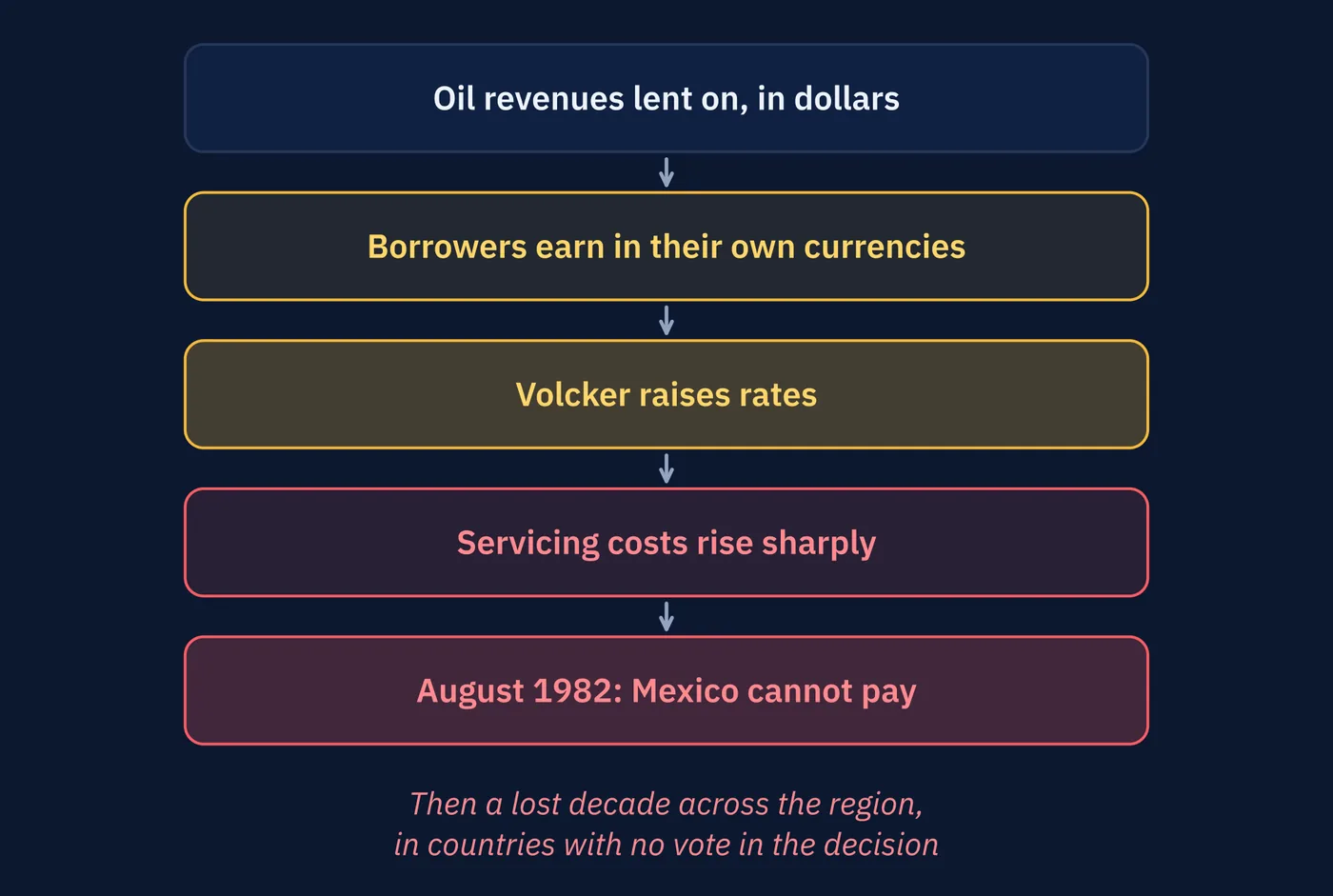
There is a starker version of the same mechanism, and it arrived in 2008.
That crisis originated inside the American financial system. Dollar-denominated mortgage securities, American institutions, leverage built in American markets.
The dollar surged.
| Pair | July 2008 | Late 2008 | Change |
|---|---|---|---|
| AUD/USD | 0.9849 | 0.6008 | Down about 39 percent |
| EUR/USD | 1.6040 | 1.2330 | Down about 23 percent |
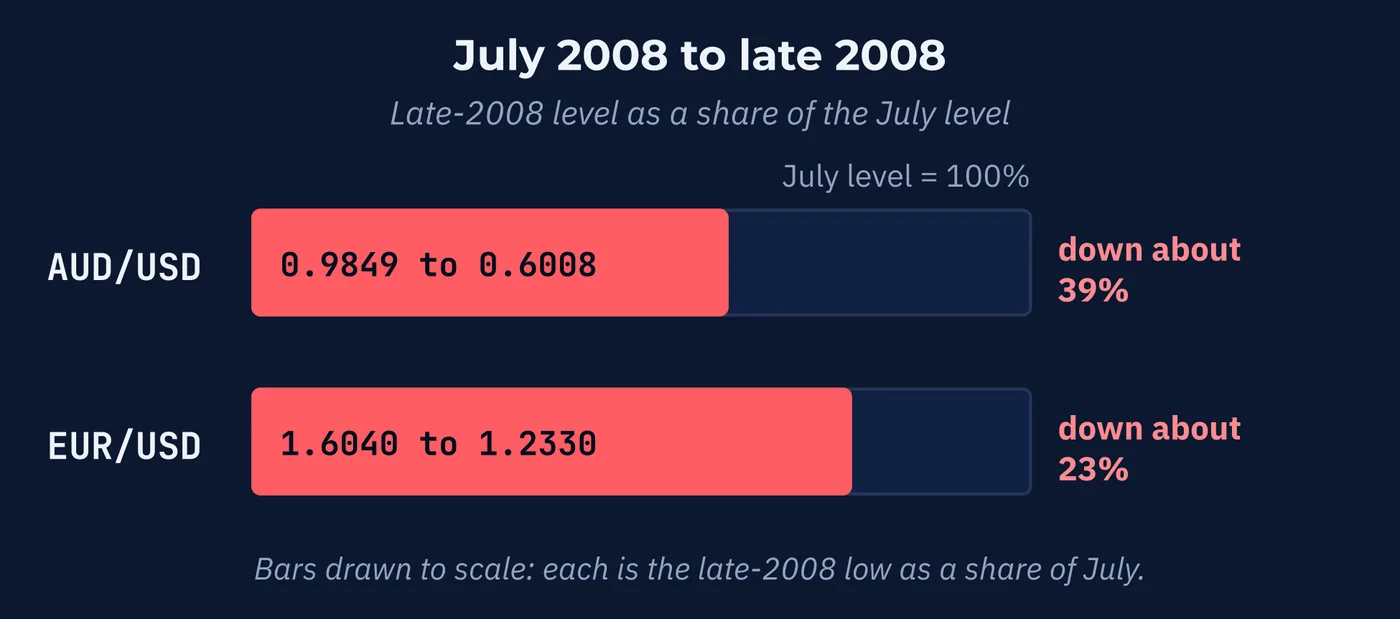
A crisis made in America strengthened the American currency, sharply, within months.
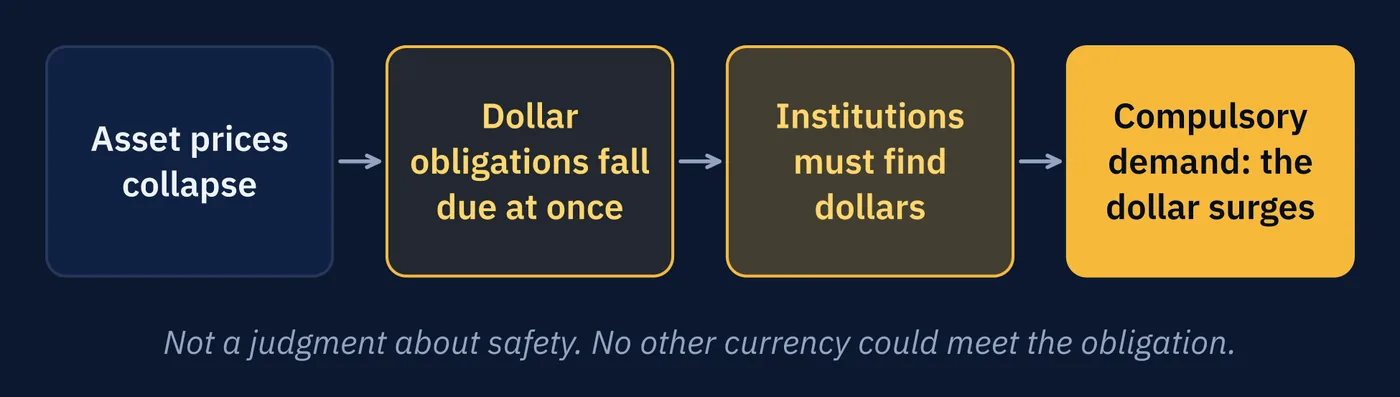
The reason is the third measure from Lesson 36. Institutions worldwide held enormous amounts of dollar debt. When asset prices collapsed and obligations came due at once, they needed dollars to meet them. That demand was not a preference or a judgment about safety. It was compulsory, and no other currency could satisfy it.
8Why This Reaches Your Chart
Three practical consequences follow, and all three touch pairs you might actually trade.
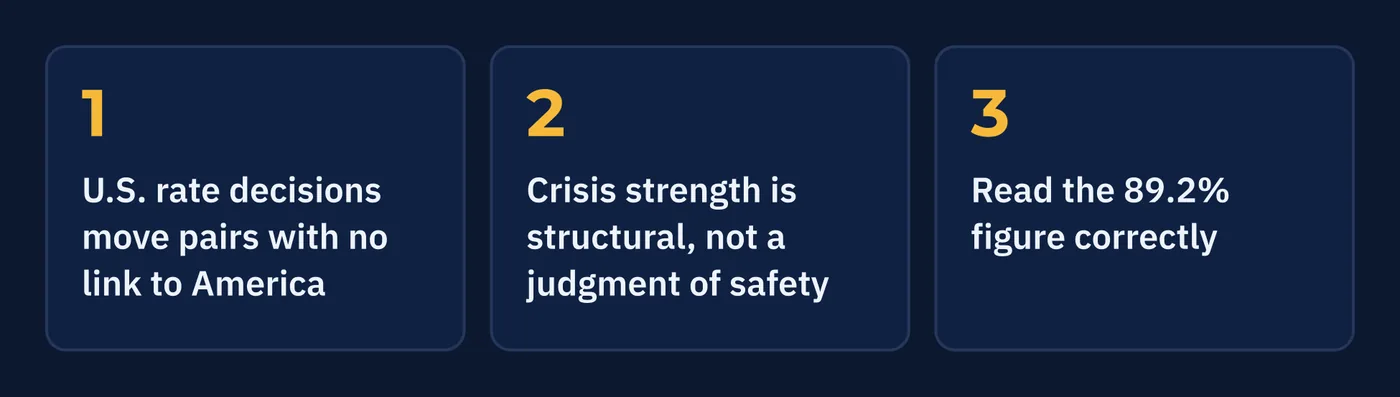
The first is that American rate decisions move currencies with no connection to America. Lesson 7 showed one dollar move producing seven reactions. This lesson explains where that reach comes from.
The second is that dollar strength during a crisis is structural rather than a judgment. The market is not deciding America is safe. Institutions are meeting obligations that happen to be in dollars. Lesson 8's safe haven behavior has this sitting underneath it.
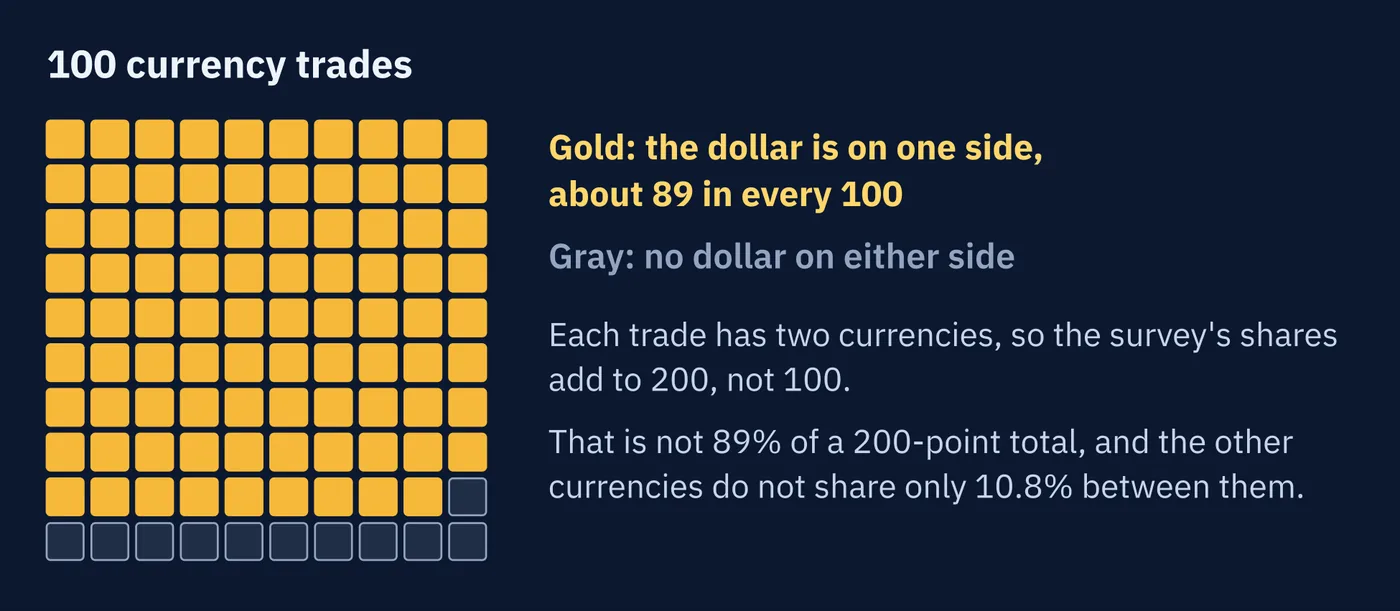
The third is about reading the statistics correctly.
Which leaves one question, and it is the one this series was built to reach.
The position carries real costs for the issuer and real costs for everyone else. It was built by historical accident rather than designed. So something else could, in principle, hold it.
The next lesson looks at the candidates. There are three serious ones, and each fails on a different condition from Lesson 36.
Three Things to Remember
Try This
Fifteen minutes. Two of these are chart work.
Words From This Lesson
| Term | What It Means |
|---|---|
| Exorbitant privilege | The structural advantages the reserve issuer gains: cheaper borrowing, deficits without normal discipline, and a partly self-funding global presence. |
| Market discipline | The pressure markets apply to a country running deficits, through rising borrowing costs, a weaker currency, and capital outflows. |
| Volcker shock | The aggressive American rate rises of 1979 to 1981, which broke inflation and drove a large sustained dollar rally. |
| Plaza Accord | The 1985 agreement among major economies to bring an overvalued dollar back down. |
| Non-discretionary demand | Buying a currency because an obligation requires it, rather than because it looks attractive. |
| Lost decade | The period of economic contraction across Latin America following the 1982 debt crisis. |
Test Your Knowledge
Eight questions. Answer them all before checking the key on the following pages. If a question gives you trouble, the answer key tells you which section to revisit.
- A. Its credit rating is the highest available
- B. International agreements cap its borrowing costs
- C. It borrows only from domestic lenders
- D. Structural global demand for its bonds comes from the currency's role
- A. The reserve issuer has a larger economy
- B. An ordinary country must earn foreign currency to service foreign debt; the issuer prints it
- C. The reserve issuer pays no interest
- D. Ordinary countries cannot borrow internationally
- A. Cheap borrowing makes a global presence affordable, and that presence helps sustain the currency's role
- B. Foreign countries pay for it directly
- C. It generates tax revenue
- D. It is funded by IMF contributions
- A. It forces the issuer to raise interest rates
- B. It requires holding large gold reserves
- C. The issuer must run persistent deficits as a condition of the role, not as a choice
- D. It caps how much debt can be issued
- A. It fell roughly 60 percent
- B. It was fixed against the German mark
- C. It was roughly unchanged
- D. It rose roughly 60 percent
- A. Inflation accelerated further
- B. Borrowing costs rose sharply
- C. Exports became expensive and manufacturers lost ground to foreign competitors
- D. Foreign reserves were depleted
- A. Their debts were in dollars while their revenues were in local currencies
- B. Latin American countries had lent heavily to the United States
- C. The IMF withdrew existing support
- D. Oil prices collapsed simultaneously
- A. Investors judged America the safest place to be
- B. Institutions worldwide needed dollars to service dollar-denominated obligations
- C. The Federal Reserve intervened to support it
- D. Other currencies suspended trading
Answer Key
Each answer explains why the correct choice is correct, why the others are not, and where to reread.
Question 1 · correct answer D
Central banks hold the bonds as reserves, oil revenues are recycled into them, and institutions treat them as the default safe asset. None of that demand comes from assessing creditworthiness.
A confuses a rating with structural demand, and ratings have in fact been lowered without the effect this predicts. C is wrong because a large share of the debt is held abroad. B invents a cap that does not exist.
Review: Section 2, Cheaper Borrowing
Question 2 · correct answer B
Foreign debt must be repaid in foreign currency, which an ordinary country has to earn. The reserve issuer's foreign obligations are denominated in the money it issues.
A confuses size with structure, and size alone confers none of this. C is wrong because interest is paid on all that debt. D is wrong because most countries borrow internationally routinely.
Review: Section 3, Deficits Without Discipline
Question 3 · correct answer A
Suppressed borrowing costs make a global presence cheaper to maintain, and that presence supports the conditions under which the currency keeps its role. The loop closes on itself.
B describes a direct payment that does not occur. C describes domestic taxation, which is unrelated. D misattributes it to an institution that funds different things entirely.
Review: Section 4, A Subsidy That Partly Funds Itself
Question 4 · correct answer C
Supplying the world with currency requires sending out more than comes in. The issuer cannot choose to balance its external accounts without starving the system of the asset it runs on.
A describes a policy response rather than the structural requirement. B describes an arrangement that ended in 1971. D reverses it, since the constraint is a floor on deficits rather than a ceiling on debt.
Review: Section 5, The Obligation Underneath
Question 5 · correct answer D
The dollar index rose roughly sixty percent on annual averages, as very high interest rates drew capital toward dollar assets from around the world.
A reverses the direction. C ignores one of the largest sustained currency moves of the floating era. B describes a fixed rate arrangement that no longer existed after 1973.
Review: Section 6, When the Currency Gets Too Strong
Question 6 · correct answer C
A strong currency makes exports expensive against foreign competitors. The trade deficit widened and American manufacturers lost market share, and by 1985 the pressure produced coordinated action to bring the dollar down.
A reverses the effect, since a stronger currency reduces import prices. B is wrong because high rates were the cause rather than the consequence here. D describes a peg defense, which was not the situation.
Review: Section 6, When the Currency Gets Too Strong
Question 7 · correct answer A
They had borrowed in dollars while earning revenue in their own currencies. When dollar borrowing costs rose sharply, servicing the debt became unsustainable.
B reverses the direction of lending. C is wrong because IMF involvement increased rather than withdrew. D is wrong because oil prices were not the mechanism, though the loans originated in oil revenues.
Review: Section 7, What It Does to Everyone Else
Question 8 · correct answer B
Enormous quantities of dollar-denominated debt existed worldwide. When obligations came due simultaneously, the demand for dollars was non-discretionary and no other currency could satisfy it.
A describes a judgment, when the demand was mechanical rather than chosen. C is wrong because supporting the dollar was not the aim of the policy response. D is wrong because currency trading continued throughout.
Review: Section 7, What It Does to Everyone Else
Keep going
The Dollar's Position is written by Kanin D. Alldredge for The Currency Classroom, and it is free to read. There is more free from CNS: start here.
Start free with CNS →