How the Dollar Got There

1What Replaced the Gold
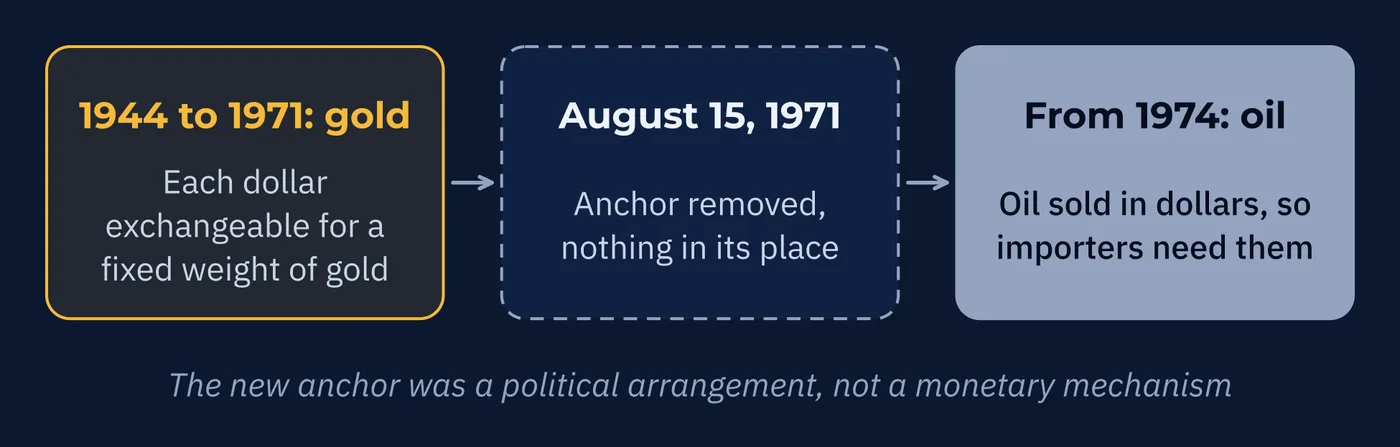
Before 1971, there was a clear reason to hold dollars. Each one could be exchanged for a fixed weight of gold. That was the anchor.
On August 15, 1971 the anchor was removed, and nothing was put in its place.
That should have been a serious problem. When the backing goes, so does the reason to hold it. Or so you would think.
Instead the dollar kept its position. Part of that was inertia, as Lesson 33 said. Contracts, banking ties, and invoicing habits do not switch off when a promise ends.
But something else was built, on purpose, in the years right after. Not a monetary mechanism. A political arrangement. And it gave the world a reason to hold dollars that had nothing to do with gold, or with trusting American policy.
The gold anchor was replaced by an oil anchor.
2Three Components
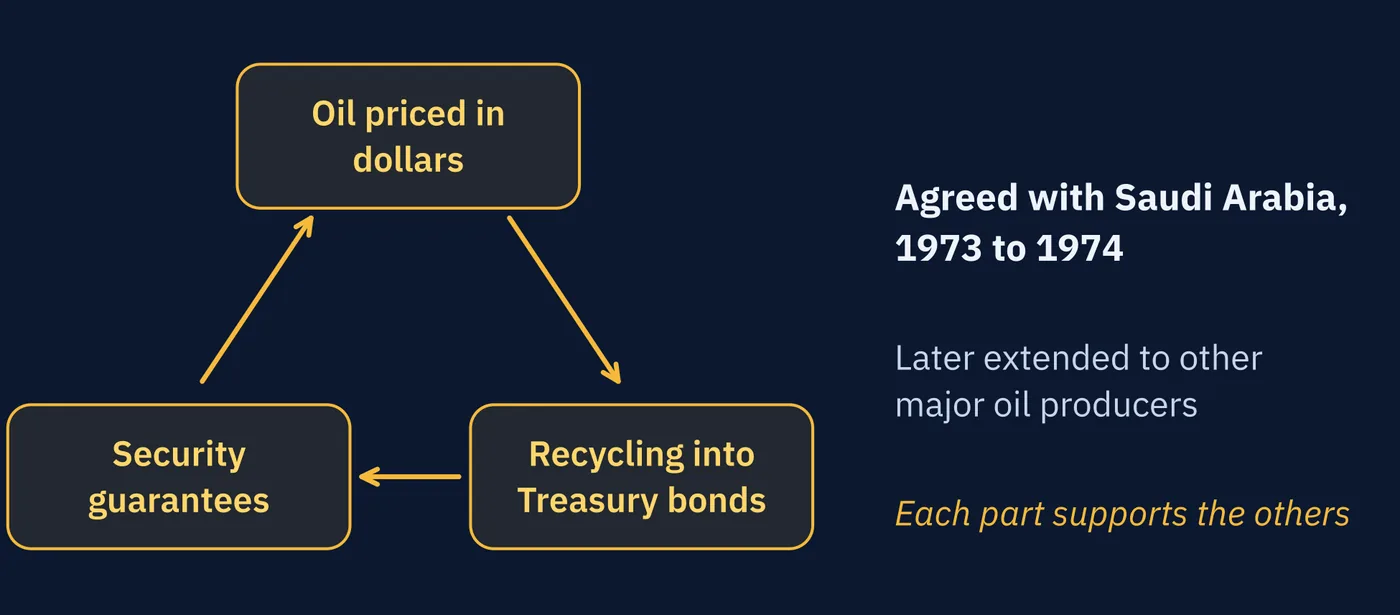
Between 1973 and 1974, talks led largely by Secretary of State Henry Kissinger produced an arrangement with Saudi Arabia. It was later extended to other major oil producers.
It had three parts, and each one supports the others.
| Component | What It Meant |
|---|---|
| Oil priced in dollars | Gulf producers would keep pricing and selling oil exclusively in US dollars |
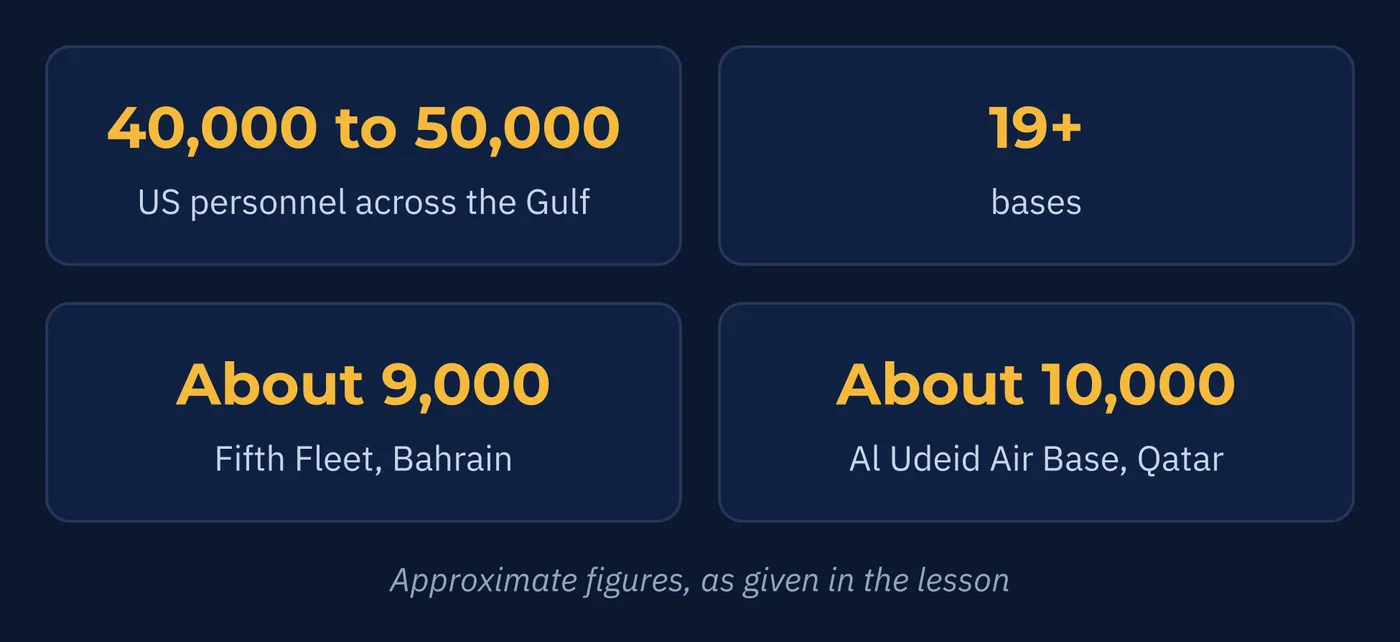
| Security guarantees | The United States would provide military protection to the Gulf monarchies |
| Recycling | The dollar revenues earned would flow back into US Treasury bonds and dollar assets |
Look at the first row and think about what it produces.
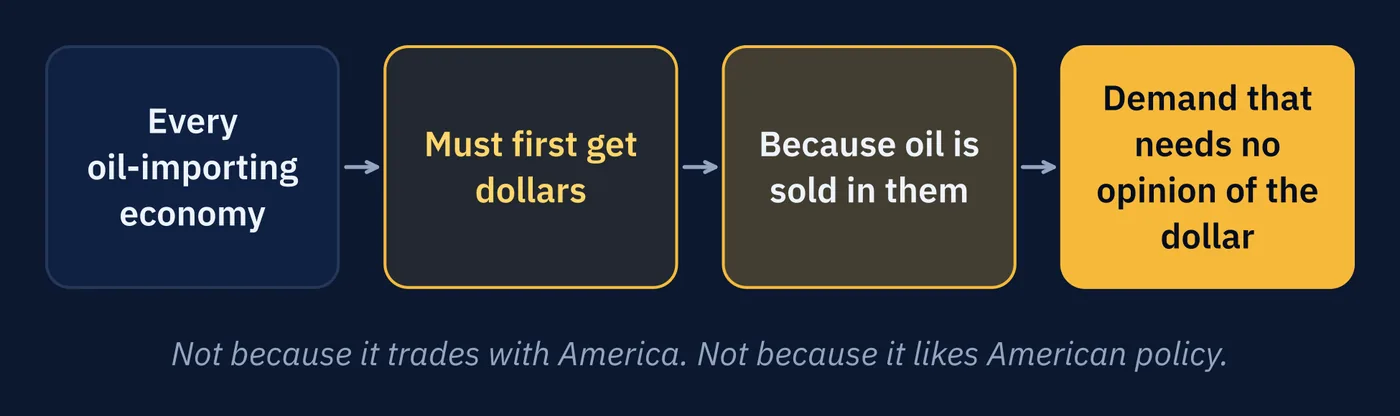
If oil is priced and sold in dollars, every country that imports oil must get dollars. Not because it trades with America. Not because it likes American policy. Because the fuel its economy runs on is overwhelmingly bought that way.
That is demand that does not depend on anyone's opinion of the dollar. Which is exactly what the system had just lost.
3Not a Treaty
These arrangements were not one document with a signature page and a date. They were a set of bilateral understandings, joint commissions, and ongoing relationships, built over several years.
They were not fully disclosed at the time. What is known has emerged since, through declassified documents and historical research.
So the petrodollar system is real, documented, and consequential. It is also not a contract. No page to point to. No signatories. No clause anyone could invoke.
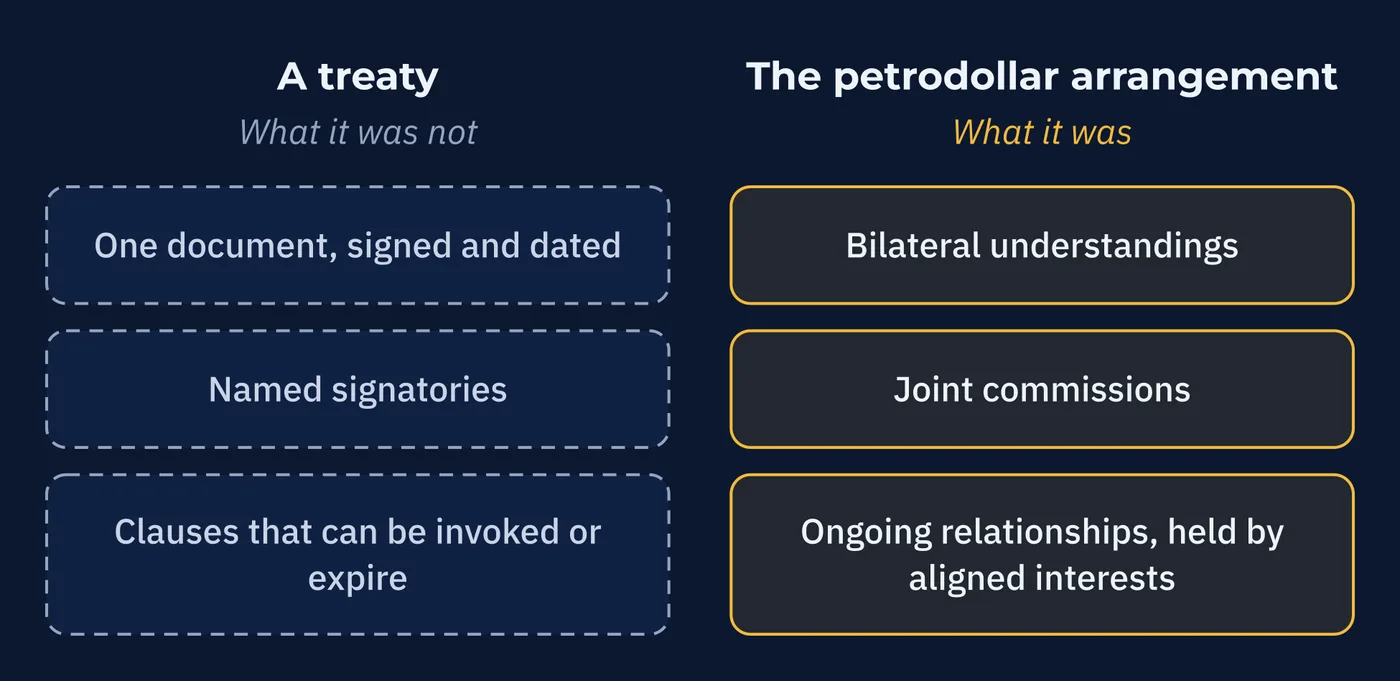
It holds together because the interests still align. That is a different kind of durability from a legal obligation. Sometimes stronger, sometimes weaker, and never enforceable.
4The Loop, in One Transaction
The arrangement is easiest to understand by following a single ordinary transaction all the way around.
A Japanese car manufacturer needs steel.
| Step | What Happens | Priced In |
|---|---|---|
| 1 | Iron ore comes from Australia | Dollars |
| 2 | Coking coal comes from Indonesia | Dollars |
| 3 | The furnace runs on natural gas | Dollars |
| 4 | Finished cars ship on vessels burning heavy fuel oil | Dollars |
| 5 | That fuel comes from a Singapore refinery | Dollars |
| 6 | Which sources its crude from Saudi Arabia | Dollars |
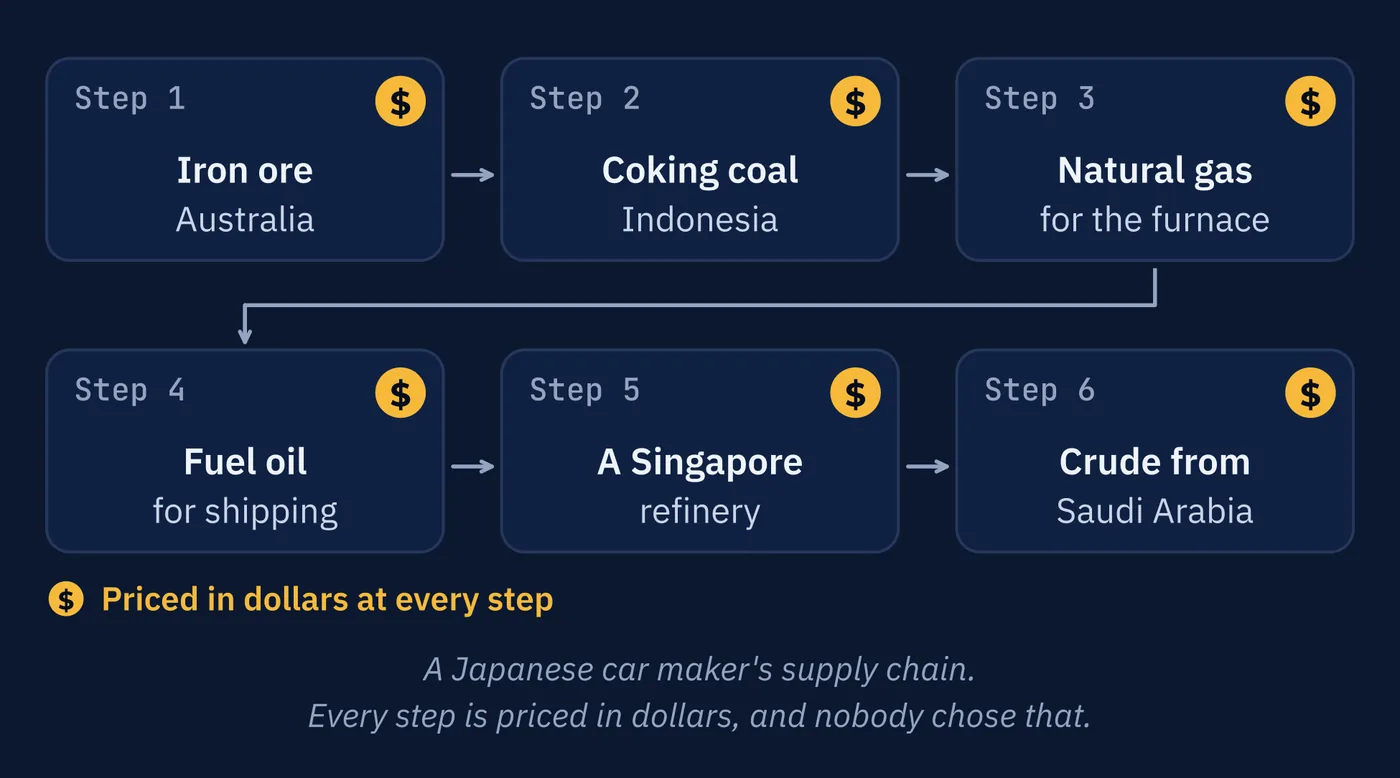
At every step, somebody had to get dollars. The manufacturer. The shipping company. The refinery. None of them decided anything about the dollar. They decided about steel, fuel, and shipping. The dollars followed.
Now follow where those dollars go.
The Saudi government is paid in dollars. Some of it is deposited with a bank in New York, which buys US Treasury bonds. Those bonds help fund the American deficit. That deficit funds, among much else, the naval presence in the Gulf. Which patrols the waters the original crude shipment passed through.
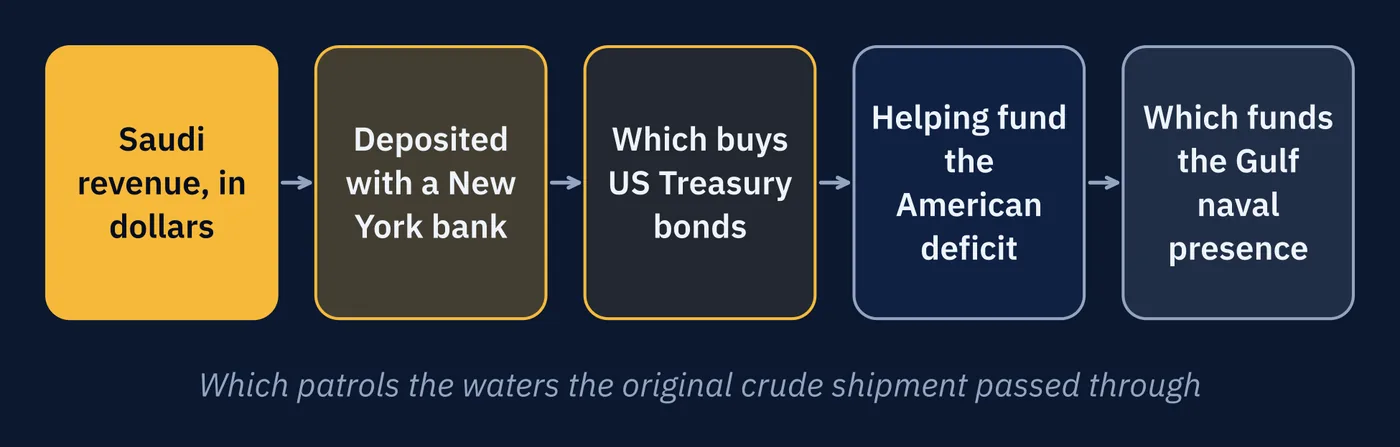
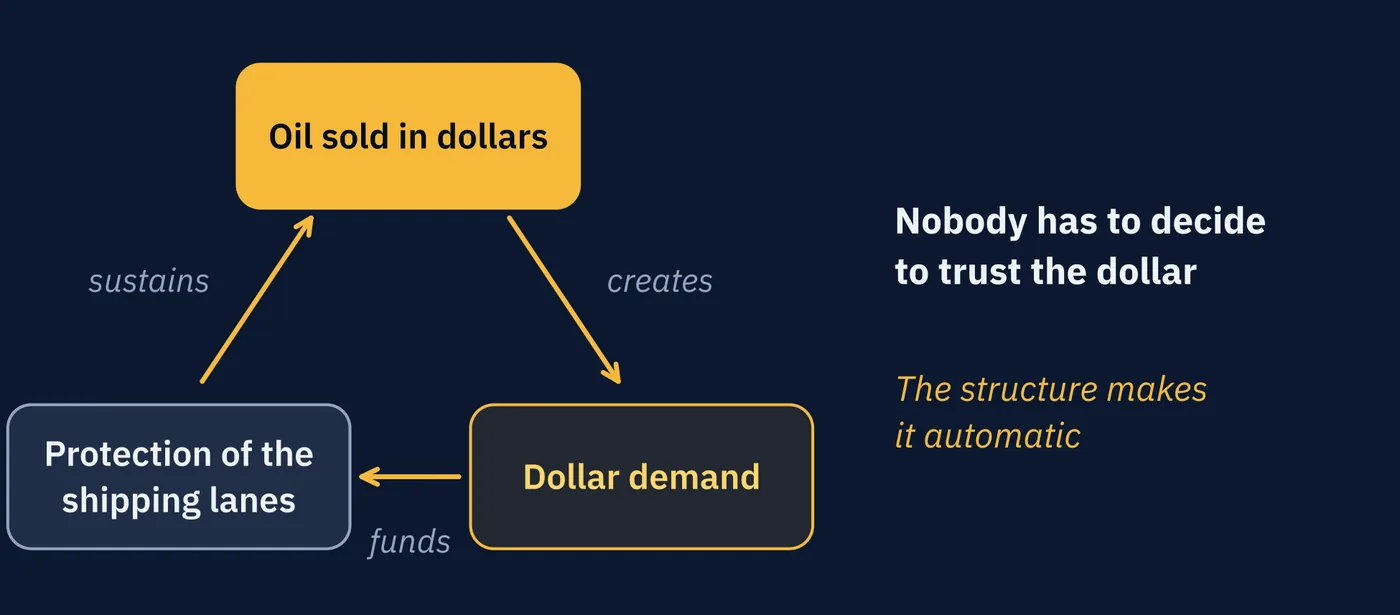
The oil created the dollar demand. The dollar demand funded the protection. The protection sustains the oil pricing.
The loop closes. Nothing in it required anyone to decide they trusted the dollar. The structure made it automatic.
5The Exorbitant Privilege
The phrase exorbitant privilege was coined by Valery Giscard d'Estaing, who was French Finance Minister in the 1960s and later President of France. It captured a frustration that has been voiced by American trading partners for decades.
| The Advantage | What It Means |
|---|---|
| Suppressed borrowing costs | Persistent global demand for Treasury bonds holds American borrowing costs below what its finances alone would justify |
| Deficit without discipline | Most countries face market pressure when deficits grow. Structural demand for dollars softens that pressure considerably |
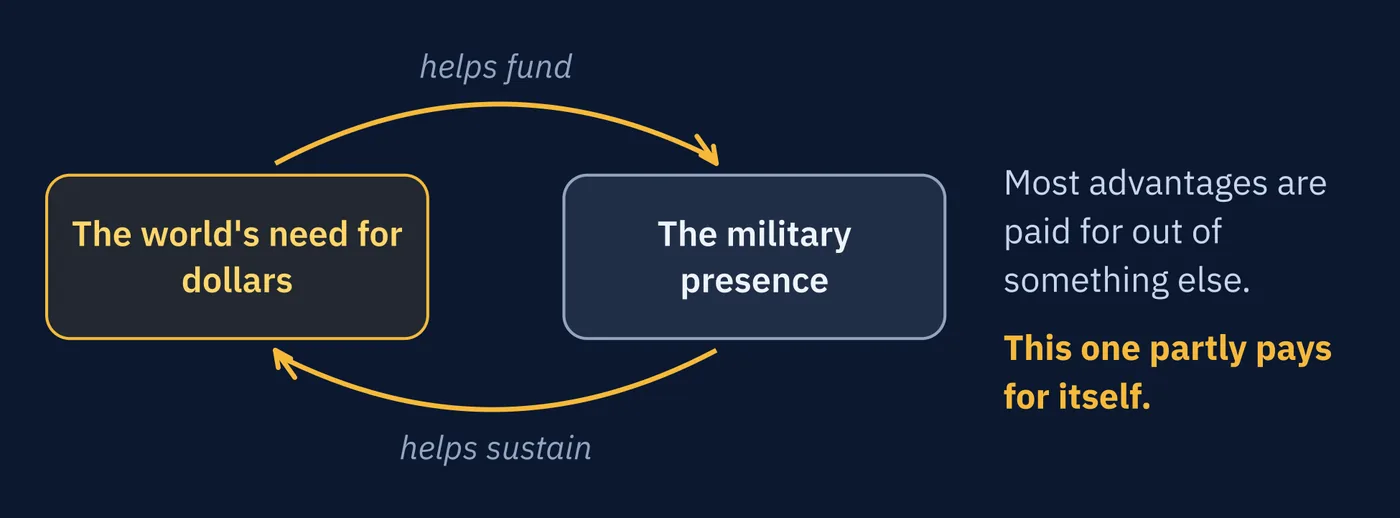
| A geopolitical subsidy | The world's need for dollars helps fund the military presence that helps sustain the world's need for dollars |
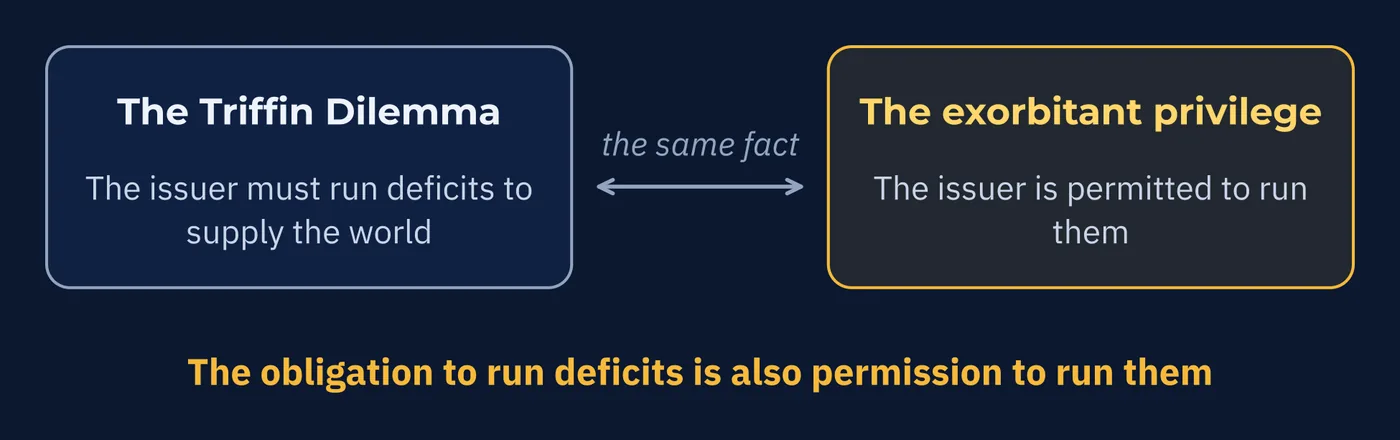
Read the second row against Lesson 33. The Triffin Dilemma said the reserve issuer must run deficits to supply the world. This is the same fact from the other side. The obligation to run deficits is also permission to run them.
And the third row is partly self-funding. That is unusual. Most advantages have to be paid for out of something else.
6The Cracks Are Real
The system is under real pressure. It would be misleading to present it as unchallenged.
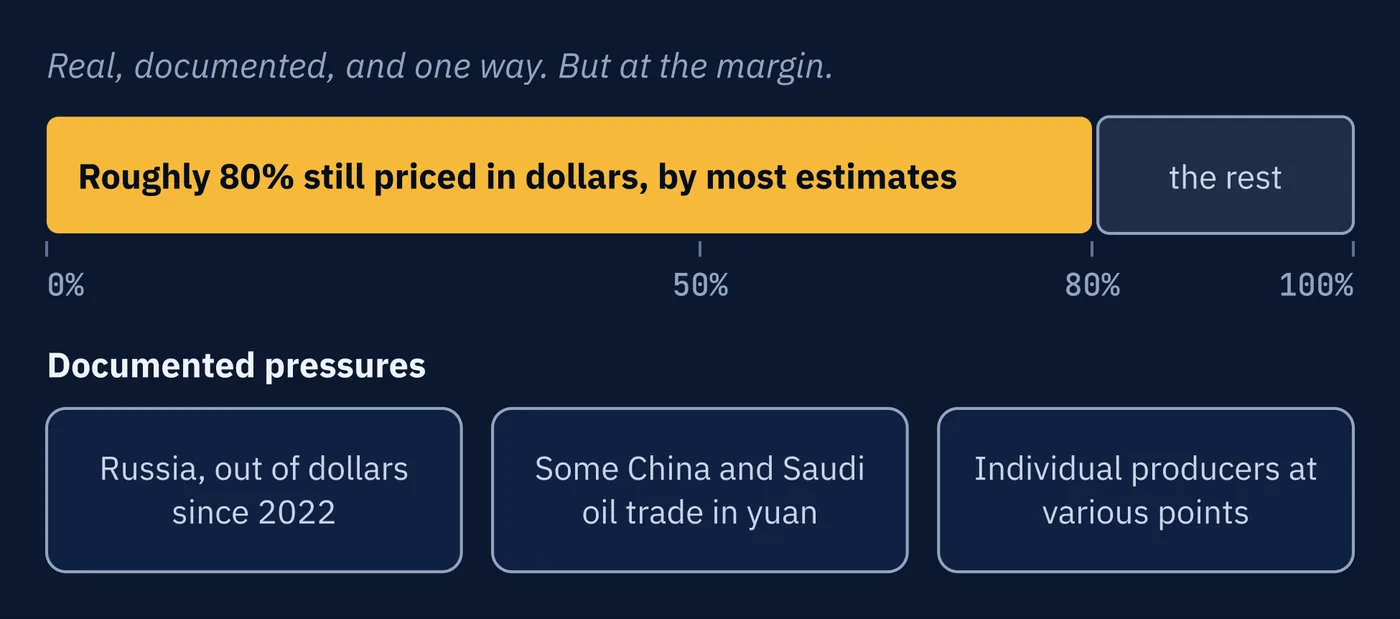
Russia has moved much of its energy trade out of dollars since 2022, under sanctions pressure. China and Saudi Arabia have arranged for some oil trade settled in yuan. Individual producers have priced sales in other currencies at various points.
Those are documented developments and the direction is one way.
Now the counterweight. By most estimates, roughly eighty percent of global oil trade remains priced in dollars. No official series tracks it, so treat the figure as approximate.
| The Claim | The Position |
|---|---|
| Pressure on dollar oil pricing is real | True, and documented across several producers |
| The direction of travel is away from the dollar | True at the margin |
| The system has meaningfully unwound | Not supported by the data |
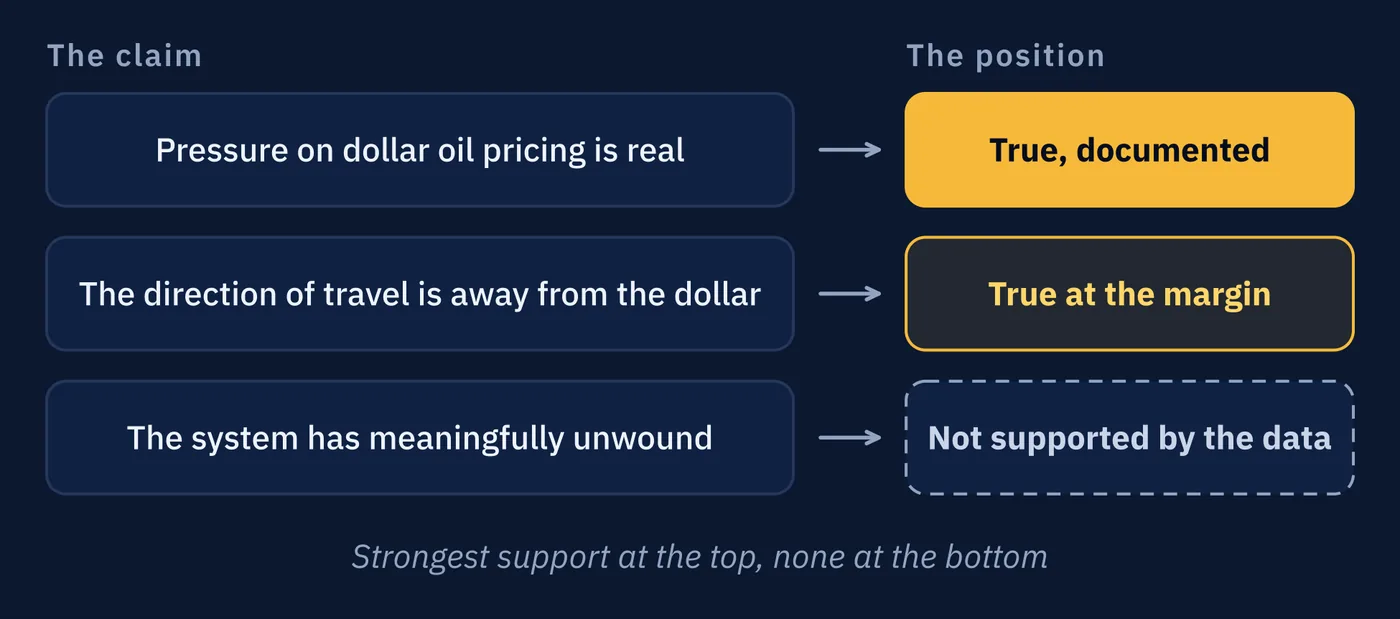
Both halves matter. Dismiss the pressure and you miss a real long-term shift. Overstate it and you expect a change the numbers do not show.
7A Story With No Source
In mid-2024 a story spread widely through financial media and social platforms.
It claimed a formal fifty-year petrodollar agreement between the United States and Saudi Arabia had expired in June 2024. And that the expiry was a historic rupture that could trigger a rapid dollar decline.
The story had everything a compelling narrative needs. A specific date. A named mechanism. A dramatic consequence.
It also had no source.
The useful contrast is with Section 6. The petrodollar system faces real, documented pressures that can be sourced and measured. None of them is a contract running out.
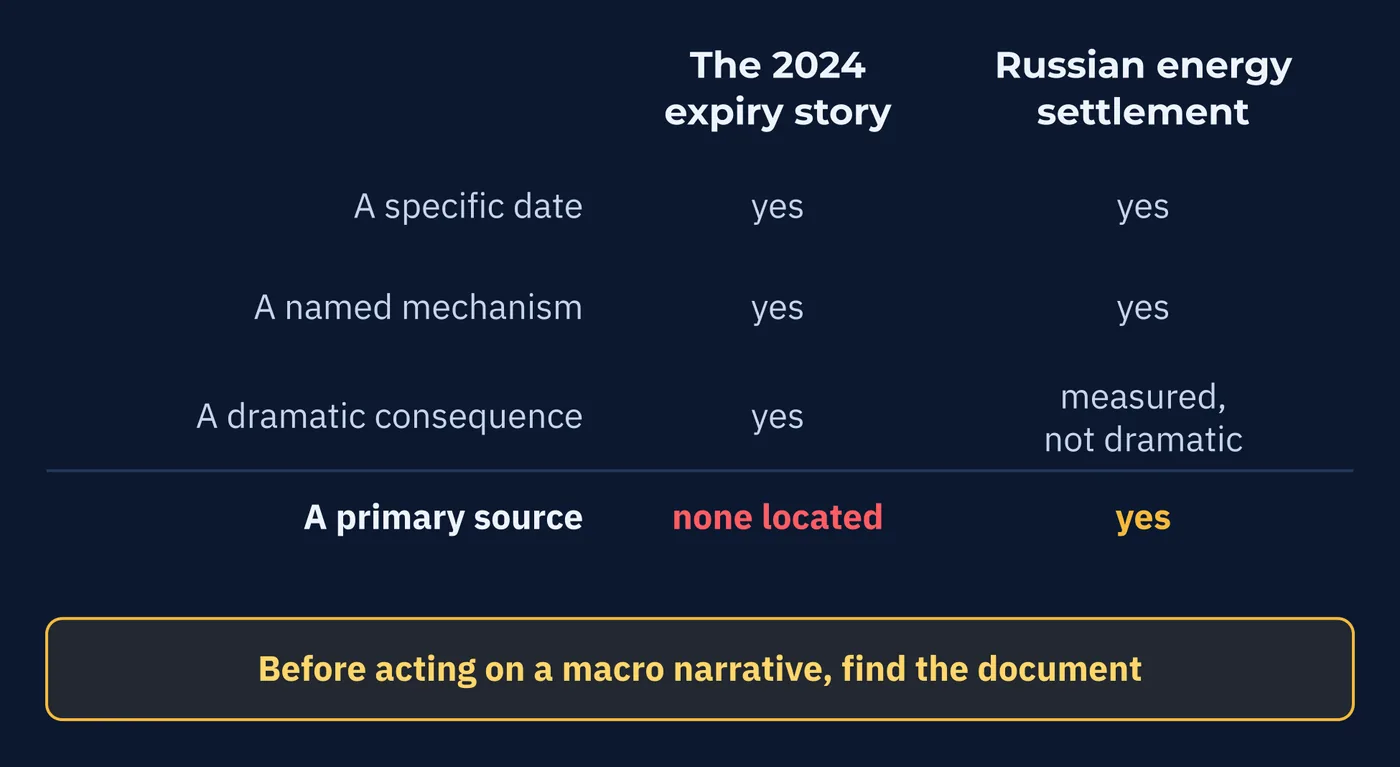
A trader who dismissed the 2024 story was not being complacent about de-dollarization. They declined to act on a claim nobody could substantiate, while the real pressures stayed visible in the data.
8What Holds It Together
Step back and the shape of the last two lessons becomes clear.
The dollar's position was built at Bretton Woods in 1944 on a gold promise. That promise became impossible and was withdrawn in 1971. What kept the position was two things. Accumulated infrastructure, and a new arrangement that gave the world a practical reason to need dollars.
| Era | What Made Holding Dollars Necessary |
|---|---|
| 1944 to 1971 | Convertibility into gold at a fixed rate |
| 1974 onward | Oil was overwhelmingly bought in them |
| Throughout | Contracts, invoicing, banking relationships, and debt already denominated in them |
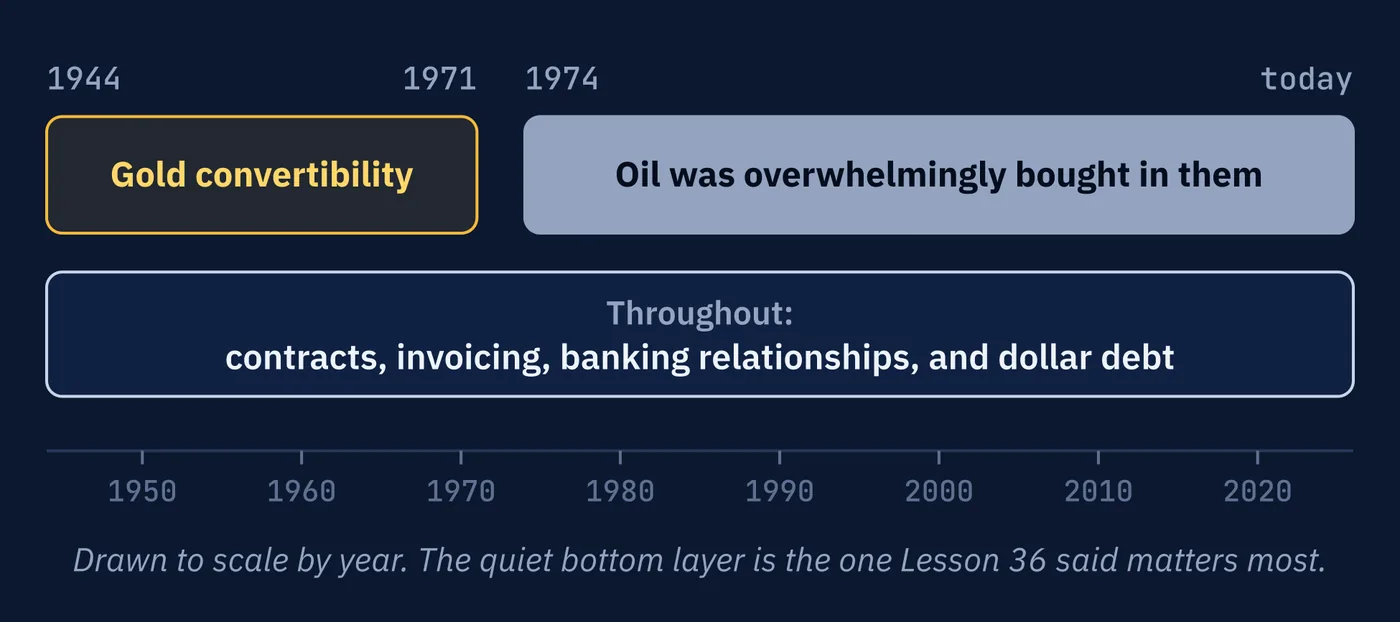
The third row is the quiet one, and Lesson 36 said why it matters most. Debt issued in dollars must be repaid in dollars. Invoicing habits outlive the reasons they were adopted. Network effects defend themselves.
Which returns to the question Series F kept circling. The dollar's position is a historical outcome. Built in stages, and sustained by arrangements that could in principle change.
The next lesson asks what that position is actually worth to the country that holds it, and what it costs.
Three Things to Remember
Try This
Fifteen minutes. One of these steps is a genuinely useful habit.
Words From This Lesson
| Term | What It Means |
|---|---|
| Petrodollar system | The arrangement under which oil is priced and sold in dollars, creating global demand for them. |
| Petrodollar recycling | Oil revenues earned in dollars being reinvested into US Treasury bonds and dollar assets. |
| Exorbitant privilege | The structural advantages the United States gains from issuing the reserve currency. Coined by Valery Giscard d'Estaing. |
| Treasury bonds | US government debt. The asset most reserve dollars are ultimately held in. |
| Bilateral understanding | An arrangement between two governments that is not a formal treaty and carries no enforceable terms. |
| Primary source | An original document or record. The thing to locate before acting on a macro narrative. |
Test Your Knowledge
Eight questions. Answer them all before checking the key on the following pages. If a question gives you trouble, the answer key tells you which section to revisit.
- A. A new precious metal standard
- B. Higher American interest rates
- C. An IMF guarantee
- D. Oil being priced and sold in dollars
- A. Trade tariffs, sanctions, and quotas
- B. Gold, silver, and oil backing
- C. Oil priced in dollars, security guarantees, and revenue recycling
- D. Fixed exchange rates, capital controls, and IMF oversight
- A. Because the oil is priced and sold in dollars
- B. It has a trade agreement with the United States
- C. IMF rules require it
- D. Its own currency is not convertible
- A. A series of bilateral understandings and ongoing relationships
- B. A single signed treaty with a fifty-year term
- C. A United Nations resolution
- D. An OPEC founding charter
- A. Gold reserves
- B. Shares in oil companies
- C. US Treasury bonds and dollar assets
- D. Foreign currency other than dollars
- A. OPEC's ability to set oil prices
- B. Structural advantages the United States gains from issuing the reserve currency
- C. The IMF's voting structure
- D. The right to devalue a currency without approval
- A. About 40 percent
- B. About 60 percent
- C. About 95 percent
- D. About 80 percent
- A. The date was slightly incorrect
- B. No such agreement is documented to exist, since the arrangements were never a treaty
- C. It applied only to Saudi Arabia, not all producers
- D. The expiry was later extended
Answer Key
Each answer explains why the correct choice is correct, why the others are not, and where to reread.
Question 1 · correct answer D
Pricing oil in dollars meant every oil-importing country needed dollars regardless of its opinion of the United States. That is demand independent of confidence, which is what gold convertibility had previously supplied.
A is wrong because no metal standard returned. C invents a guarantee the IMF never gave. B describes a policy that affects the currency without anchoring global demand for it.
Review: Section 1, What Replaced the Gold
Question 2 · correct answer C
Gulf producers would keep pricing oil in dollars, the United States would provide security guarantees, and the resulting dollar revenues would be recycled into Treasury bonds and dollar assets.
B describes backing arrangements that did not exist. A lists trade instruments unrelated to the arrangement. D describes elements of Bretton Woods, which had already collapsed.
Review: Section 2, Three Components
Question 3 · correct answer A
If oil is sold in dollars, then any country needing oil must obtain dollars. The requirement follows from the pricing convention rather than from any relationship with America.
B is unnecessary, since the requirement applies to countries with no such agreement. C invents a rule. D is wrong because even fully convertible currencies must still be exchanged for dollars to buy oil.
Review: Section 2, Three Components
Question 4 · correct answer A
They were understandings, joint commissions, and continuing diplomatic relationships built over several years, not a single instrument with signatories and terms.
B is the widely repeated claim that Section 7 shows has no documentary basis. C and D describe formal multilateral instruments that were not the mechanism here.
Review: Section 3, Not a Treaty
Question 5 · correct answer C
Recycling means the dollar revenues flow back into US government debt and dollar-denominated assets, which sustains demand for both the currency and the bonds.
A describes what a pre-1971 arrangement might have involved. B and D happen at the margins but are not the mechanism that closes the loop.
Review: Section 4, The Loop, in One Transaction
Question 6 · correct answer B
It covers suppressed borrowing costs, the ability to run deficits without normal market pressure, and a partly self-funding geopolitical subsidy. Coined by a French finance minister expressing a long-standing frustration.
A describes OPEC's role, which is a different power. C describes an institutional arrangement unrelated to the term. D describes a policy option available to many countries.
Review: Section 5, The Exorbitant Privilege
Question 7 · correct answer D
Roughly eighty percent, by most estimates. Pressures on that share are real and documented, but the system has not meaningfully unwound.
A and B understate the current position considerably. C overstates it and ignores genuine movement at the margin.
Review: Section 6, The Cracks Are Real
Question 8 · correct answer B
No government document or credible historical record identifies such an agreement. There was never a single treaty, so there was nothing with an expiry date to run out.
A implies the agreement existed with a different date, which it did not. C and D both accept the premise that a formal agreement existed, which is the part with no source behind it.
Review: Section 7, A Story With No Source
Keep going
The Dollar's Position is written by Kanin D. Alldredge for The Currency Classroom, and it is free to read. There is more free from CNS: start here.
Start free with CNS →