What a Reserve Currency Is

1What a Central Bank Holds
Lesson 5 put central banks at the top of the pyramid. Lesson 34 described them defending exchange rates with reserves. Neither lesson said what those reserves actually are.
They are holdings of foreign money. A central bank keeps a stock of other countries' currency. What goes in that stock is a choice, made and remade by every central bank in the world.
A reserve currency is one held in significant quantities by those institutions as part of their official reserves.
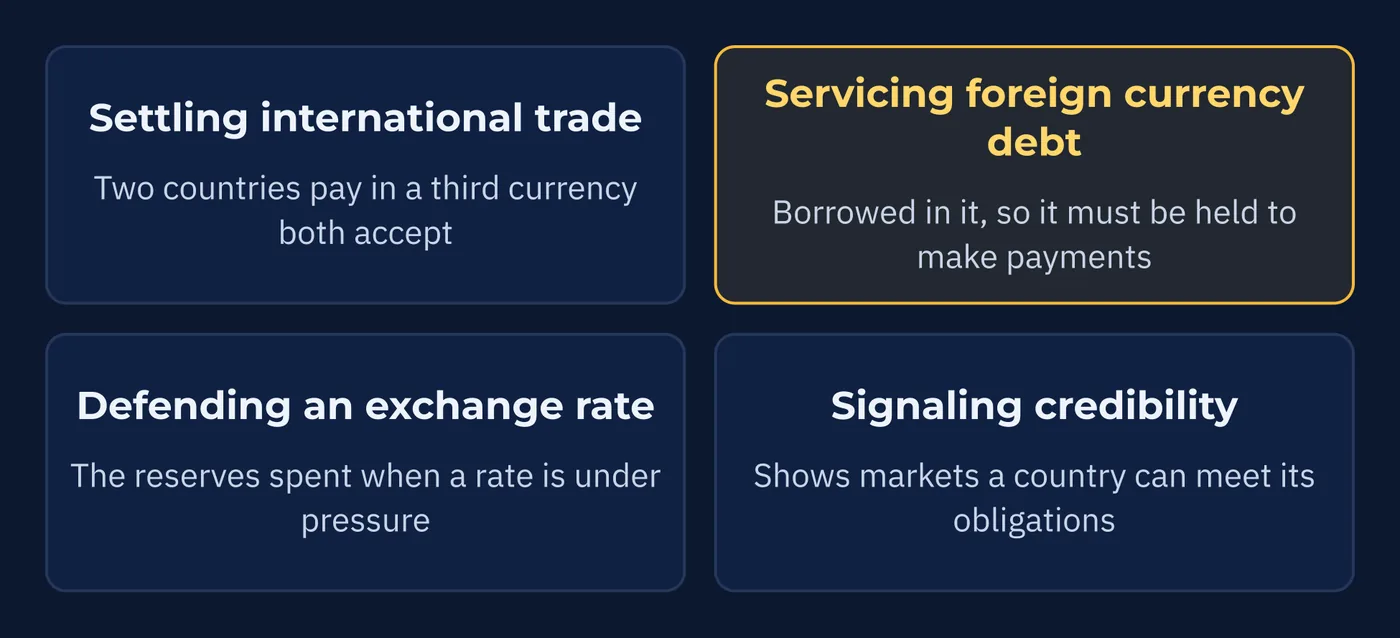
That sounds passive, as if the money just sits there. It does not. It is held because it does four jobs.
2Four Jobs
| The Job | What It Means in Practice |
|---|---|
| Settling international trade | Two countries trading with each other frequently pay in a third currency, because both already accept it |
| Servicing foreign currency debt | Governments and companies borrow in it, so they must hold it to make the payments |
| Defending an exchange rate | The reserves from Lesson 34 that a central bank spends when a rate is under pressure |
| Signaling credibility | Holding a substantial stock of a trusted currency tells markets a country can meet its obligations |
Read the second row twice, because it is the least obvious and the most binding.
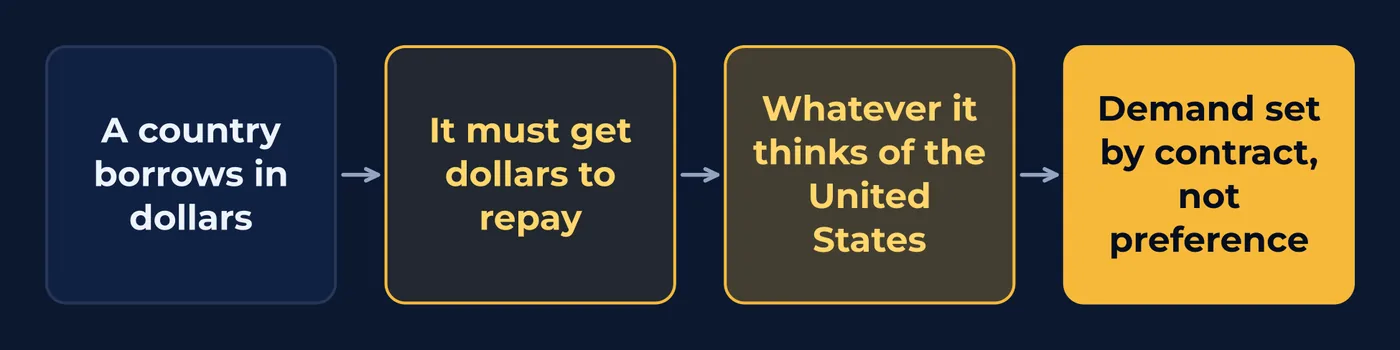
A country that borrowed in dollars must get dollars to repay. That holds whatever the country thinks of the United States, and whether or not it trades with America. It is not a preference. It is a contract, and it creates demand no political decision can quickly undo.
3Not Awarded. Emerged.
Most people assume the biggest economy issues the reserve currency, and that the title moves when the ranking does.
That is not how it works, and two facts make it obvious.
| The Case | What It Shows |
|---|---|
| The eurozone rivals the United States in economic size | It holds only around 20 percent of global reserves |
| China leads on some measures of economic size | Its currency holds a low single-digit share |
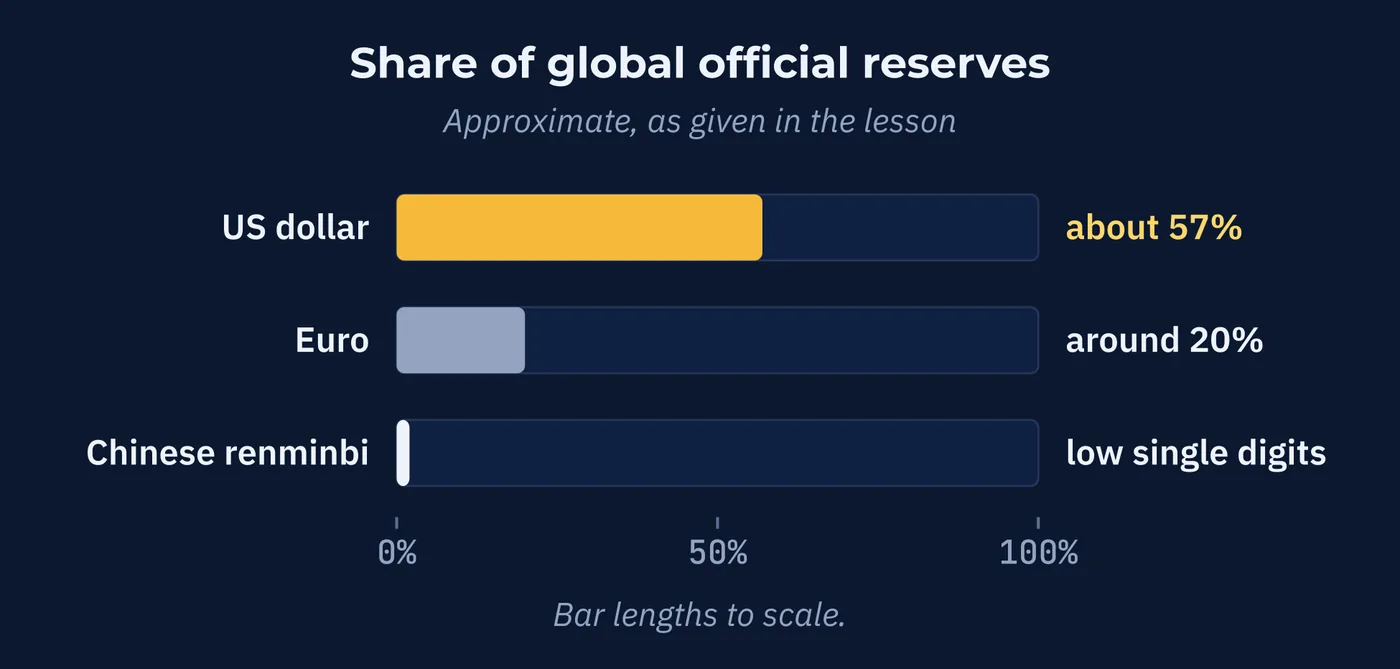
Reserve status is a function that emerges, not a prize that gets handed over.
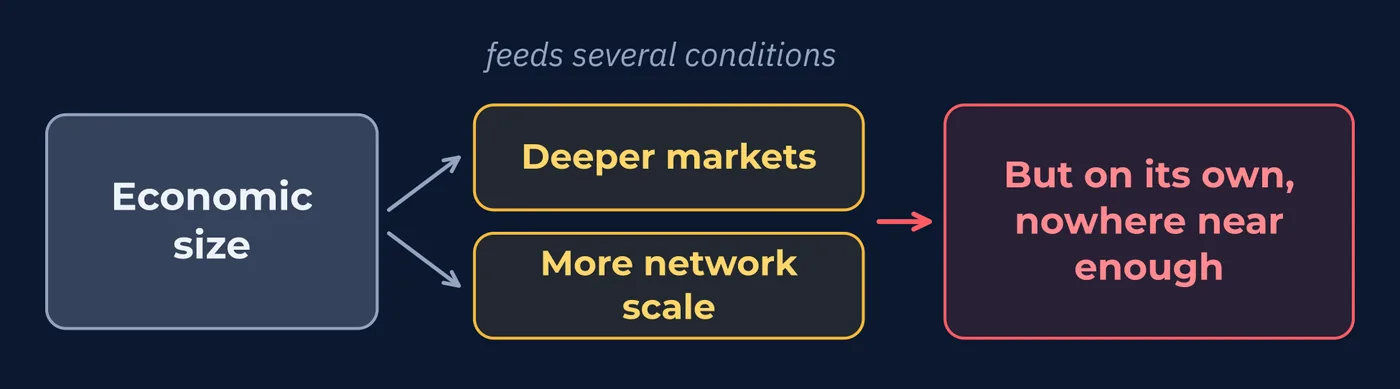
Economic size matters. It feeds several of the conditions below. But it is not one of them, and alone it is nowhere near enough.
4Five Conditions, All at Once
Reserve status needs five things to be true at once. Failing any one is disqualifying, whatever the others look like.
| Condition | What It Requires |
|---|---|
| Deep, liquid financial markets | Somewhere to put reserves at scale, and to move them without shifting the price |
| Rule of law and property rights | Confidence that holdings will not be seized, frozen, or redenominated by arbitrary decision |
| Capital account openness | Money can move in and out freely, so reserves can actually be deployed and brought home |
| Geopolitical credibility | The issuer is stable enough to be worth anchoring to |
| Network scale | Enough others already hold it that holding it is useful |
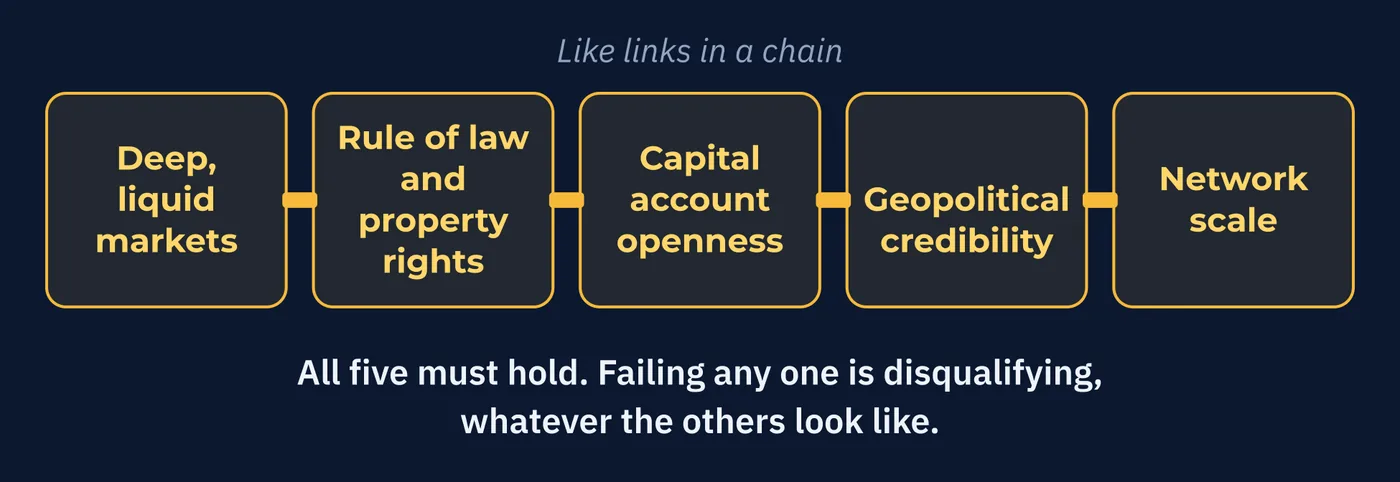
Two of these deserve a closer look.
Rule of law and property rights is political, not financial. It is not a number you can look up. It sits on a spectrum, and markets reprice it constantly. Lesson 29's fourth pillar, in a different form.
Capital account openness is the most precise of the five. Capital either flows freely or it does not. There is no partial version that satisfies a reserve holder. A reserve you cannot deploy or bring home when you need it is not doing the job. That condition matters enormously in Lesson 39.

5The Loop
The fifth condition is different in kind, because it feeds on itself.
more holders → more useful to hold → more holders
This is a network effect, and it is the same property that makes a widely used language or a widely accepted payment method hard to displace. The value comes from how many other people are already using it.
A currency everyone accepts is worth holding because everyone accepts it. That sounds circular because it is, and the circularity is the point. Once established, the position defends itself with nobody defending it.
Which produces the observation that shapes the rest of this series.
6Why Displacement Is So Hard
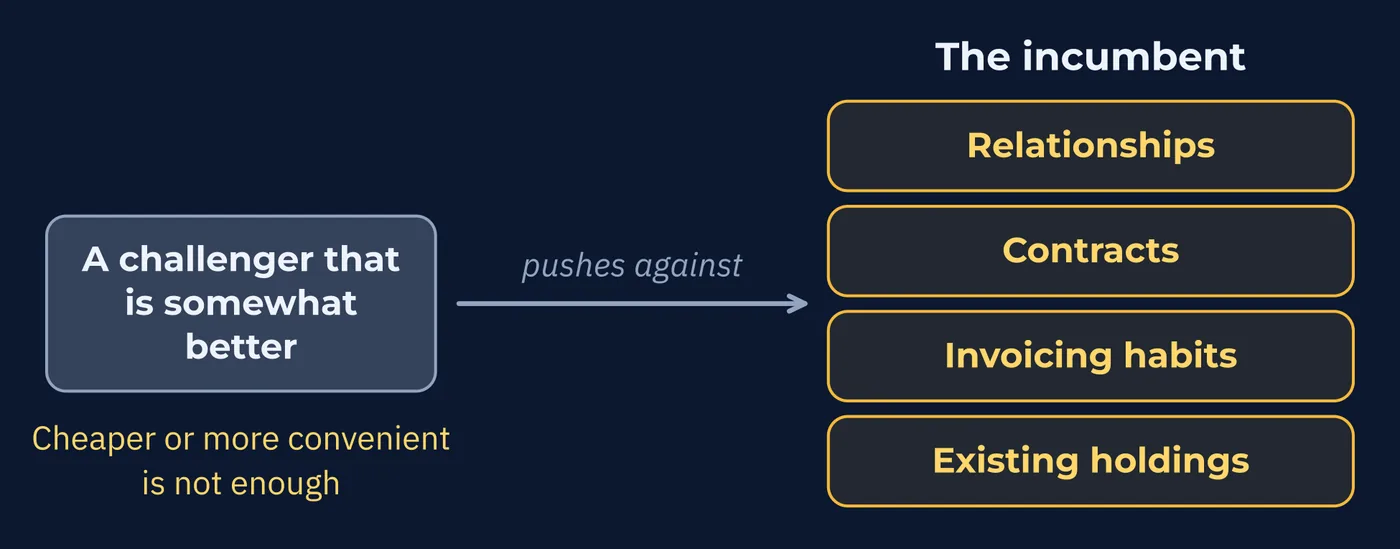
A network effect means a challenger cannot win by being somewhat better.
Being cheaper or more convenient is not enough. The incumbent's advantage is not quality. It is everyone else. A challenger has to overcome the accumulated weight of existing relationships, contracts, invoicing habits, and holdings.
Displacing an incumbent takes structural rupture, not marginal improvement.
7Four Ways to Measure It
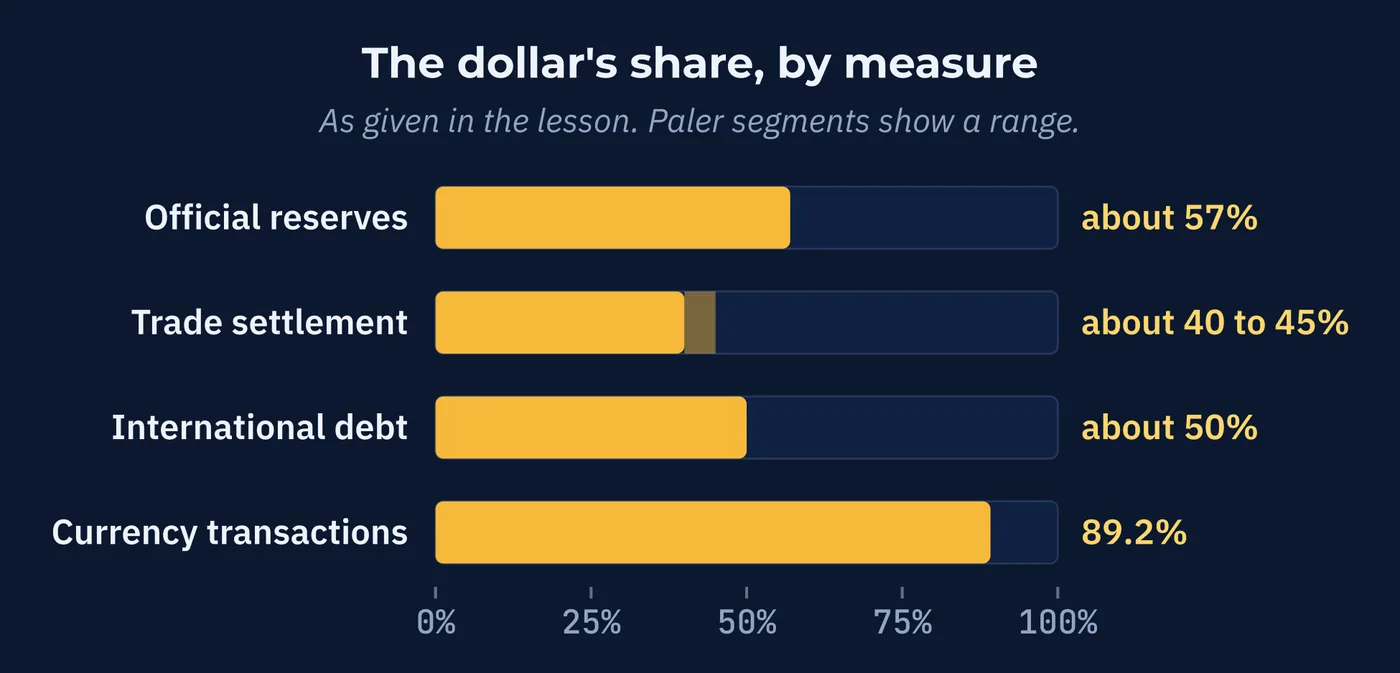
Dominance gets discussed constantly and measured carelessly. There are four measures, and they answer different questions.
| Measure | The Dollar's Share | What It Tells You |
|---|---|---|
| Official reserves | About 57 percent | What central banks choose to hold |
| Trade settlement | About 40 to 45 percent | How cross-border payments are actually made |
| International debt | About 50 percent | What the world has borrowed in |
| Currency transactions | 89.2 percent | How much trading has a dollar on one side |
Two of those rows deserve comment.
The trade settlement figure is roughly twice the American share of world output. So the dollar is used far more in payments than the size of the United States would explain. That is the network effect, showing up in data.
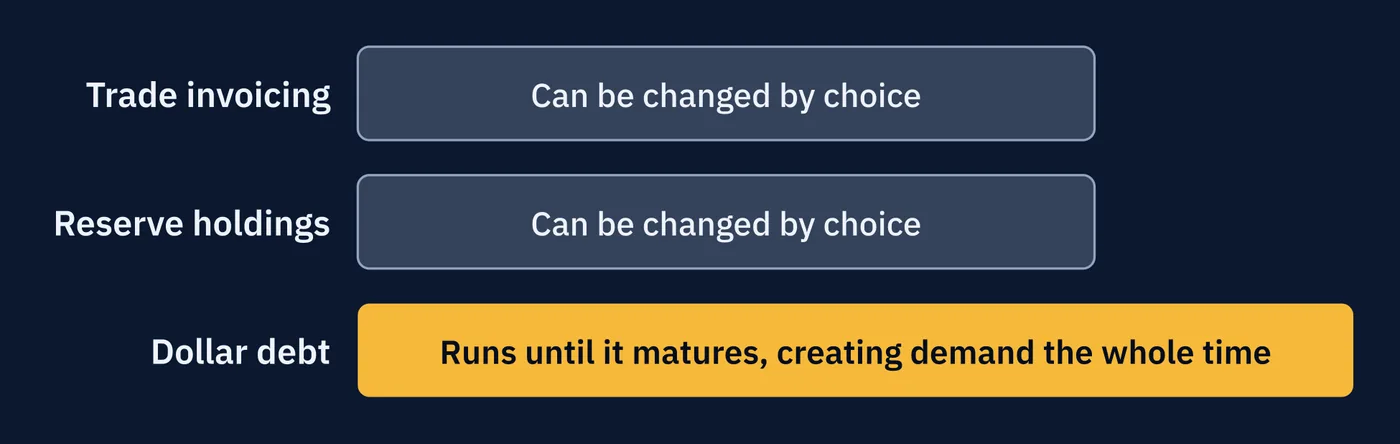
The debt figure is the most durable of the four. A country can invoice trade differently or hold different reserves. It cannot decide to stop owing dollars it has already borrowed. Those obligations run until they mature, and they generate demand the whole time.
8Two Numbers, Opposite Directions
Now put the first and fourth measures side by side over time, because they are not doing the same thing.
| Measure | Then | Now | Direction |
|---|---|---|---|
| Share of official reserves | About 71 percent in 2000 | About 57 percent | Down |
| Share of currency transactions | 88.5 percent in 2022 | 89.2 percent in 2025 | Up |
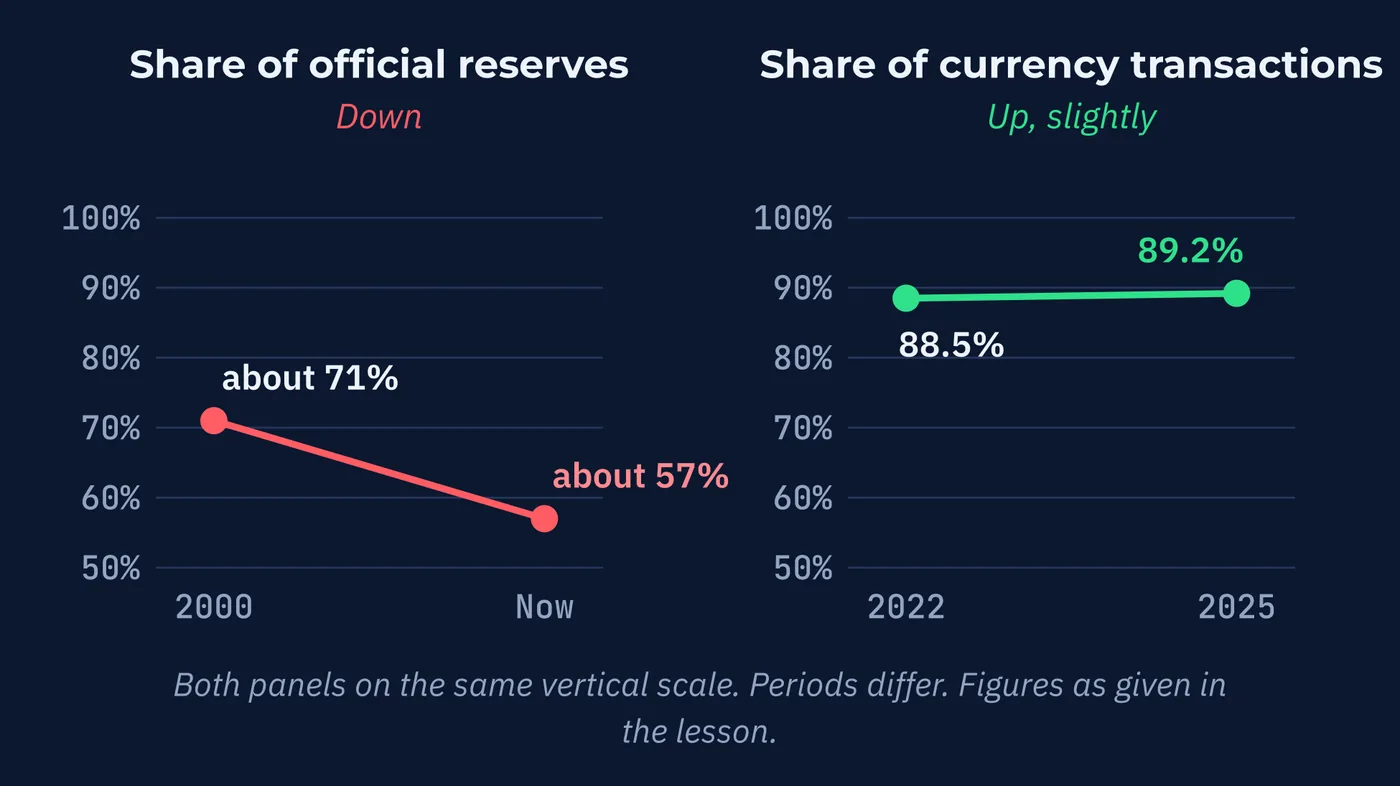
A decline of roughly fourteen percentage points in what central banks hold. A slight rise in how much trading involves a dollar.
Both are real, and they measure different things. Reserve share reflects decisions by a few hundred institutions about what to hold. Transaction share reflects what happens in the market every day.
And for you specifically, the fourth row is the one that touches a chart.
Lesson 7 said the dollar sits on one side of roughly eighty-nine percent of currency trading, and used that to explain why it appears in every major pair. The figure is 89.2 percent. It went up over the last three years, not down.
Whatever is happening to reserve composition, the thing that determines how your pairs behave has not moved.

The next lesson is how the dollar got here. It involves an arrangement from the 1970s that many people have heard of and almost nobody describes accurately.
Three Things to Remember
Try This
Fifteen minutes. Mostly looking, with one comparison that matters.
Words From This Lesson
| Term | What It Means |
|---|---|
| Reserve currency | A currency held in quantity by central banks as part of official reserves, and used to settle trade, service debt, and defend exchange rates. |
| Official reserves | The stock of foreign currency and other assets a central bank holds. |
| Capital account openness | Whether money can move freely in and out of a country. Either it can or it cannot. |
| Network effect | The property by which something becomes more useful as more people use it, making incumbents hard to displace. |
| Trade settlement | The currency actually used to pay for cross-border transactions, which is often neither party's own. |
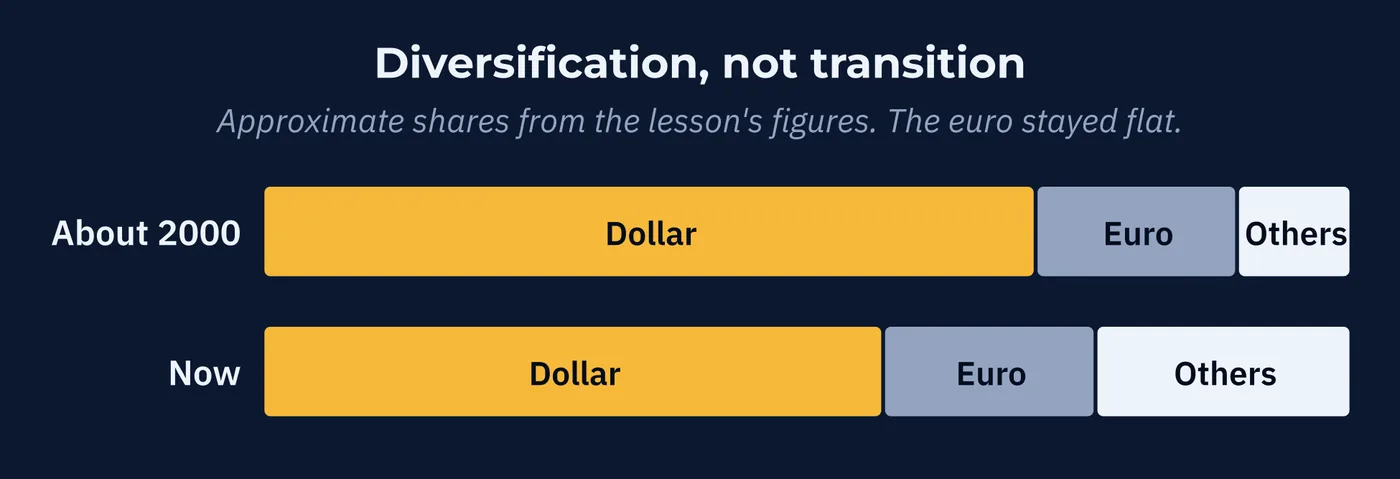
| De-dollarization | A reduction in dollar use. Currently diffuse diversification rather than a shift to any single alternative. |
Test Your Knowledge
Eight questions. Answer them all before checking the key on the following pages. If a question gives you trouble, the answer key tells you which section to revisit.
- A. The currency of the largest economy
- B. One held in quantity by central banks as part of official reserves
- C. Any currency in a major pair
- D. A currency backed by gold
- A. Setting global interest rates
- B. Guaranteeing trade balances
- C. Servicing foreign currency debt
- D. Fixing commodity prices
- A. The euro is too new
- B. Its reserve share is falling rapidly
- C. The eurozone declined the role
- D. Reserve status requires five conditions simultaneously, and size is not one of them
- A. Capital account openness
- B. Rule of law and property rights
- C. Deep, liquid financial markets
- D. Geopolitical credibility
- A. A currency becoming more useful to hold as more people hold it
- B. Central banks coordinating their reserve decisions
- C. Faster settlement through modern payment systems
- D. Currencies moving together during crises
- A. A single policy decision at Bretton Woods
- B. A vote among major economies
- C. A gradual improvement in American financial products
- D. Roughly four decades, two world wars, and deliberate institutional construction
- A. Official reserve share
- B. International debt denominated in dollars
- C. Trade settlement share
- D. Currency transaction share
- A. To the euro
- B. To the Chinese yuan
- C. Dispersed into a range of smaller currencies
- D. Into gold holdings exclusively
Answer Key
Each answer explains why the correct choice is correct, why the others are not, and where to reread.
Question 1 · correct answer B
It is defined by who holds it and what it is used for. Central banks hold it as part of official reserves, to settle trade, service debt, defend rates, and signal credibility.
A confuses economic size with the role, which Section 3 disproves. C is far too broad, since a currency can be widely traded without being widely held in reserves. D describes an arrangement no major currency has had since 1971.
Review: Section 1, What a Central Bank Holds
Question 2 · correct answer C
Governments and companies borrow in reserve currencies, so they must hold them to make the payments. That obligation is contractual and cannot be undone by preference.
A is wrong because each central bank sets its own rate. B is wrong because no currency guarantees a trade balance. D is wrong because commodity pricing conventions are separate from reserve status, though related.
Review: Section 2, Four Jobs
Question 3 · correct answer D
Five conditions must hold at once, and economic size is not one of them. It contributes to several without being sufficient on its own.
A treats age as the barrier, when the euro has existed for decades. C is wrong because no such choice was offered or made. B misstates the data, since the euro's share has been roughly flat for twenty years.
Review: Section 3, Not Awarded. Emerged.
Question 4 · correct answer A
Capital either moves freely across a border or it does not. There is no partial version that satisfies a reserve holder, because a reserve you cannot deploy is not doing the job.
C is measurable but exists on a scale of depth. B is explicitly political and sits on a spectrum. D is a judgment rather than a threshold.
Review: Section 4, Five Conditions, All at Once
Question 5 · correct answer A
The value comes from how many others already use it. More holders make it more useful to hold, which produces more holders. The loop defends the incumbent without anyone defending it.
B describes coordination, which is a different thing and largely does not happen. C describes a technology improvement. D describes correlation, which Lesson 7 covered separately.
Review: Section 5, The Loop
Question 6 · correct answer D
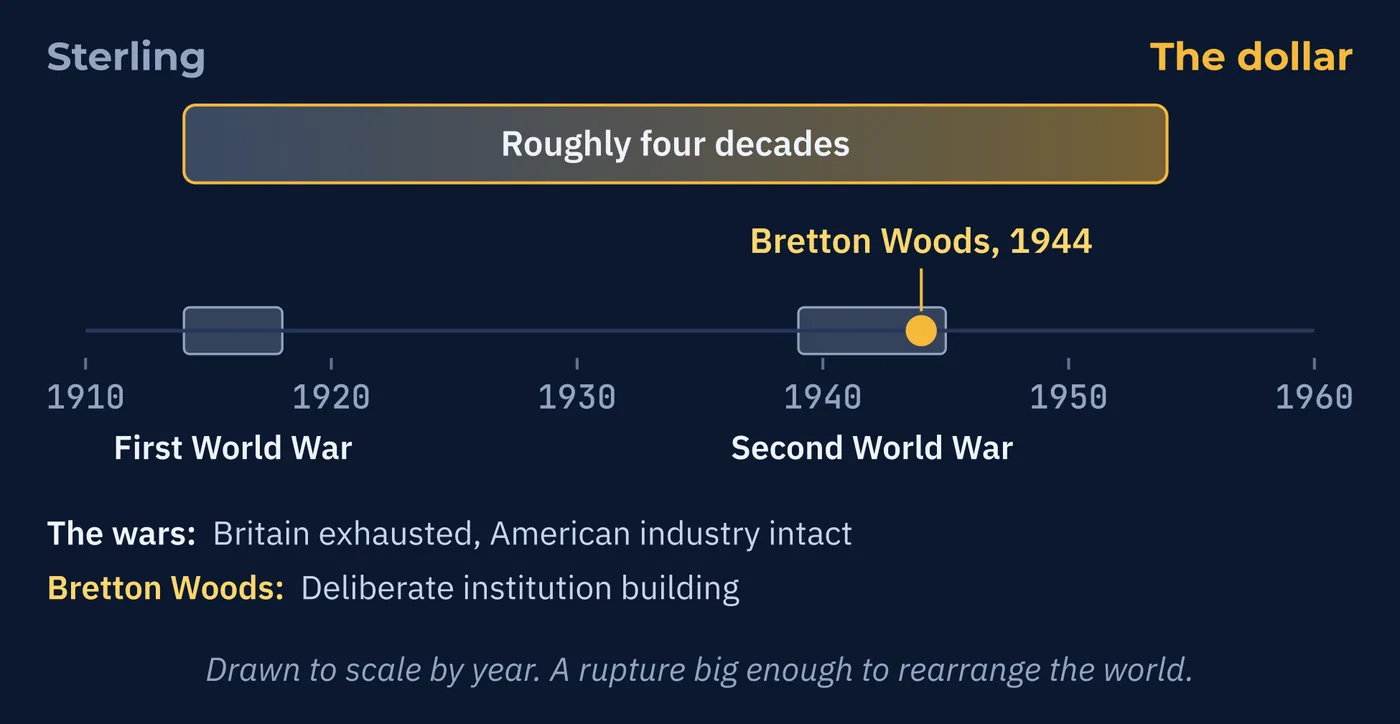
The only modern displacement of a reserve currency took roughly four decades, two wars that exhausted Britain while leaving American industry intact, and deliberate institution building.
A understates it enormously, since Bretton Woods formalized a shift already largely accomplished. C describes marginal improvement, which a network effect defeats. B is wrong because no vote decided it.
Review: Section 6, Why Displacement Is So Hard
Question 7 · correct answer B
Debt already issued in dollars must be repaid in dollars until it matures. A country can change what it holds or how it invoices, but it cannot decide to stop owing what it already borrowed.
A is a choice central banks revisit continually, and it has been falling. C reflects invoicing conventions that can change. D is high and stable but reflects daily activity rather than a fixed obligation.
Review: Section 7, Four Ways to Measure It
Question 8 · correct answer C
The lost share dispersed into a range of smaller currencies rather than consolidating anywhere. That makes it diversification rather than a transition to a successor.
A is the common assumption, and the euro's share has been roughly flat at 18 to 20 percent for two decades. B overstates a share still in low single digits. D is wrong because no single asset absorbed the shift.
Review: Section 8, Two Numbers, Opposite Directions
Keep going
The Dollar's Position is written by Kanin D. Alldredge for The Currency Classroom, and it is free to read. There is more free from CNS: start here.
Start free with CNS →