Floating and Pegged

1The Question Before the Chart
Most traders open a pair and ask which way it is going.
There is a question that comes before that one, and skipping it causes a specific kind of expensive mistake.
What force is actually setting this price?
For EUR/USD the answer is straightforward. Supply and demand, from millions of participants, as Lesson 5 described.
For a lot of the world's tradeable currencies, that is not the answer. The price on the screen is being held, steered, or bounded by an institution making decisions.
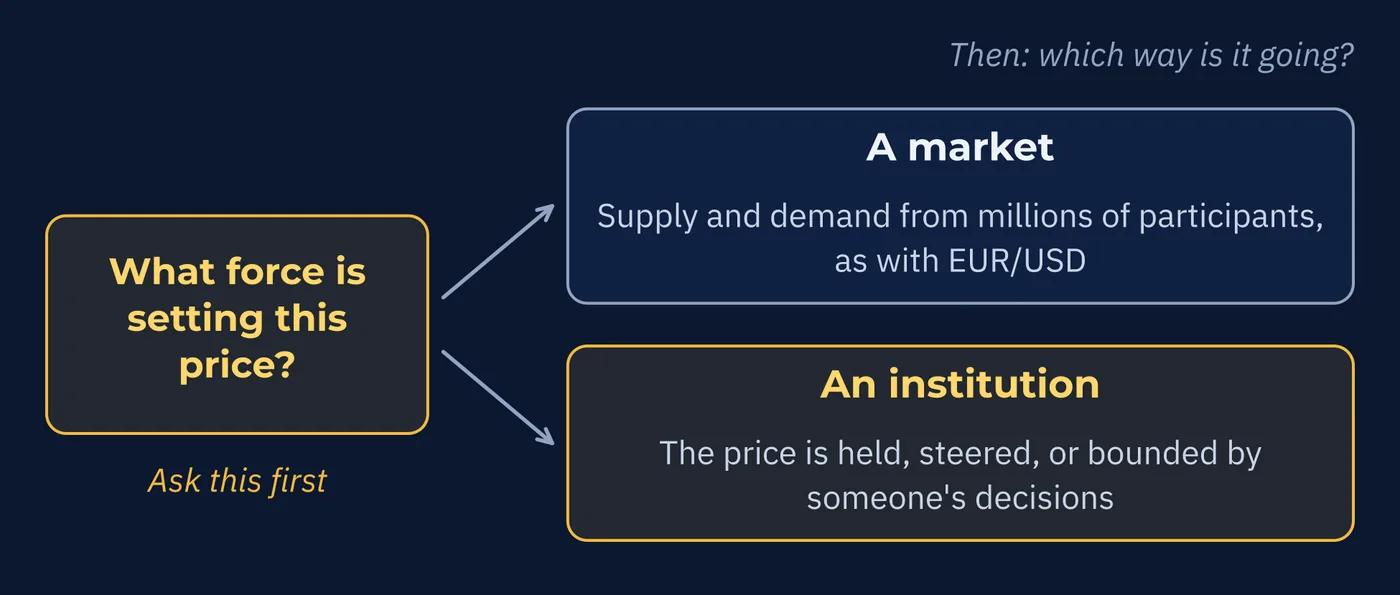
Assuming every price is a market price is an analytical error. It is not a rare one. It applies to a large share of what you can trade.
2A Spectrum, Not a Binary
It is tempting to sort currencies into floating and fixed. The reality runs along a line, with more institutional control at each step down.
| Regime | Who Sets the Price | Example |
|---|---|---|
| Free float | The market, with occasional tactical intervention | EUR/USD, GBP/USD, USD/JPY |
| Managed float | The market, within a framework a central bank steers | USD/CNH |
| Hard peg | The central bank, defending a declared rate or band | USD/HKD, USD/SAR (a currency board is the strictest hard peg) |
| Currency board | A legal mechanism, backing every unit with reserves | Hong Kong dollar, Bosnian convertible mark |
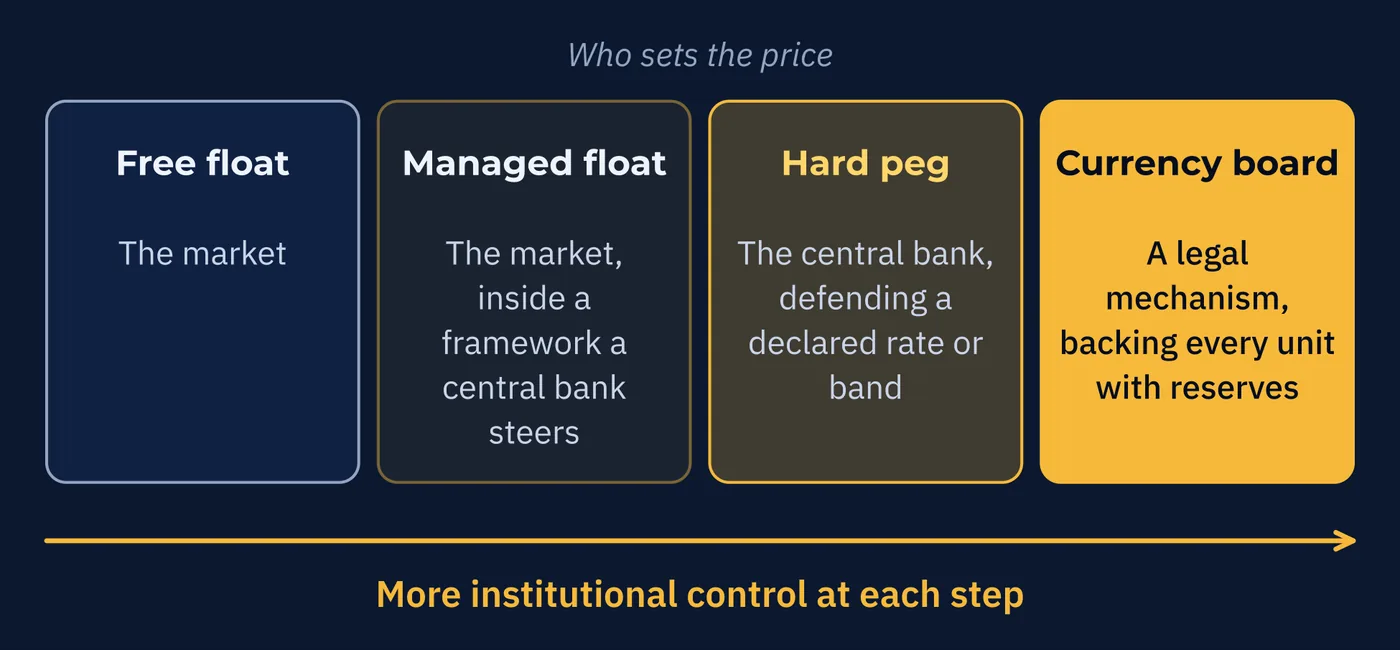
Each step down changes what moves the price, which tools read it, and what the risk looks like.
Take them in turn.
3Free Float, With an Asterisk
A free-floating currency has its rate set primarily by market forces. The majors from Lesson 7 all sit here.
But the word free is doing less work than it appears, and this catches people out.
Central banks of free-floating currencies do intervene. Japan has done so repeatedly to manage yen volatility, and it is not alone. No major central bank has promised never to intervene.
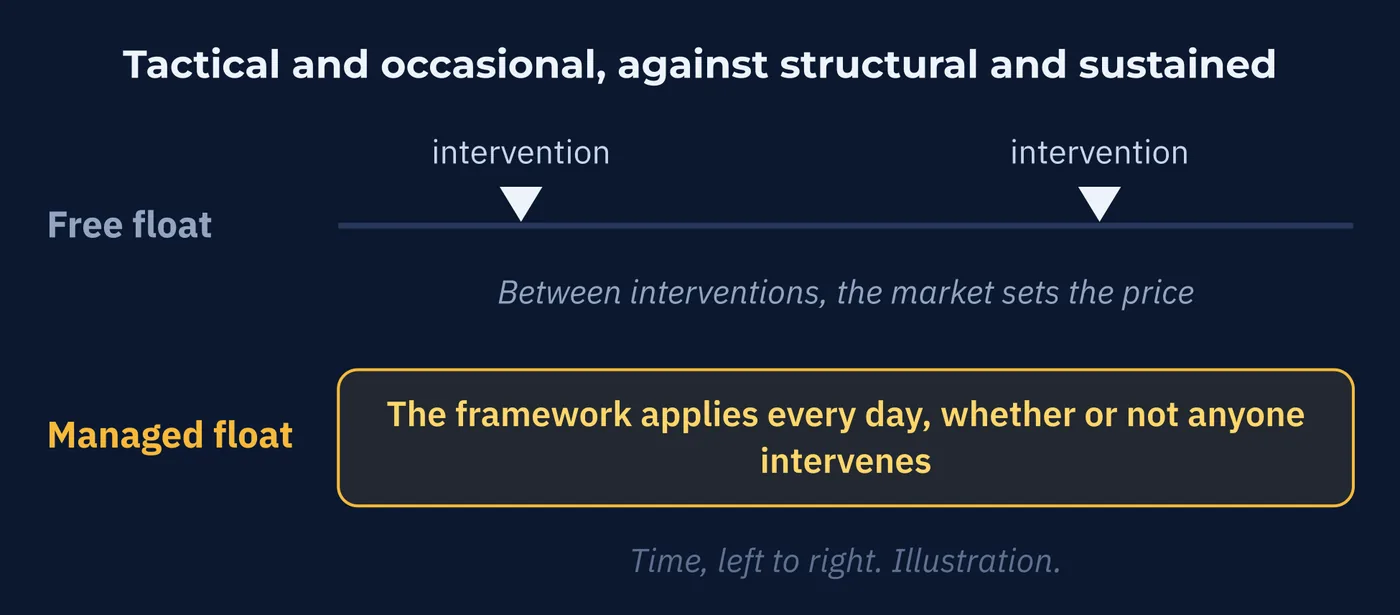
So the distinction is not whether intervention happens. It is what kind.
| Free Float | Managed Float | |
|---|---|---|
| Intervention is | Tactical and occasional | Structural and sustained |
| Its purpose | To calm disorderly conditions | To hold the rate within a framework |
| Between interventions | The market sets the price | The framework still applies |
A free float can be intervened in. A managed float is being managed whether or not anyone is intervening today.
4Managed Float
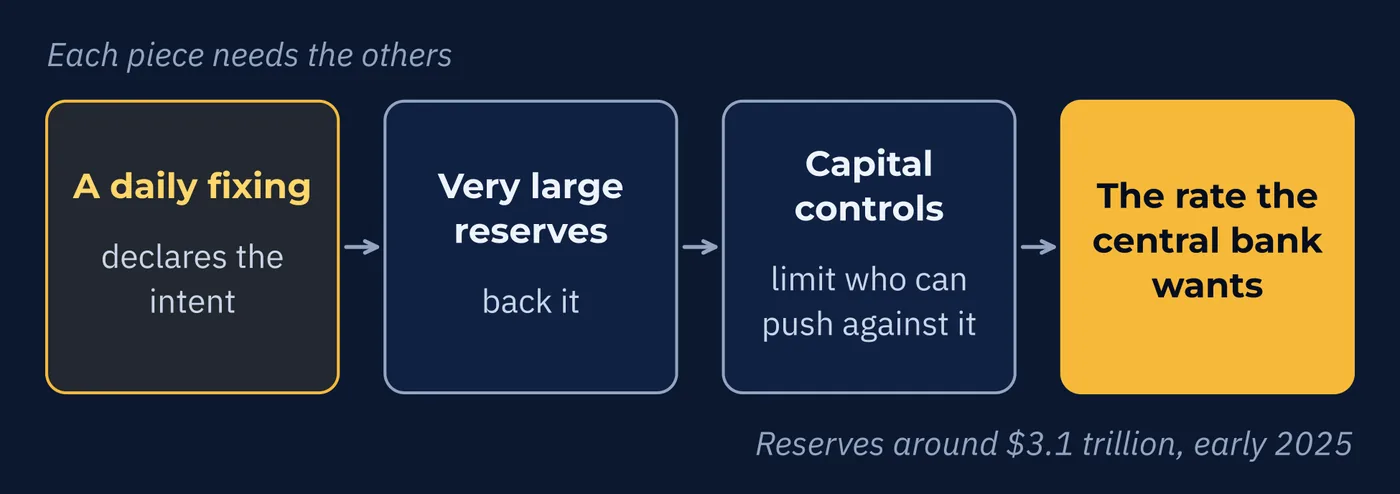
Most of the world's currencies sit somewhere in this middle ground. China's arrangement is the largest, and the clearest illustration of how the pieces fit.
| Component | What It Does |
|---|---|
| A daily reference rate | The central bank publishes a fixing each day, declaring where it considers the rate should sit |
| Very large reserves | Around $3.1 trillion as of early 2025, which is the firepower to intervene at scale if required |
| Capital controls | Restrictions on moving money in and out, which limit how much pressure can build against the rate |
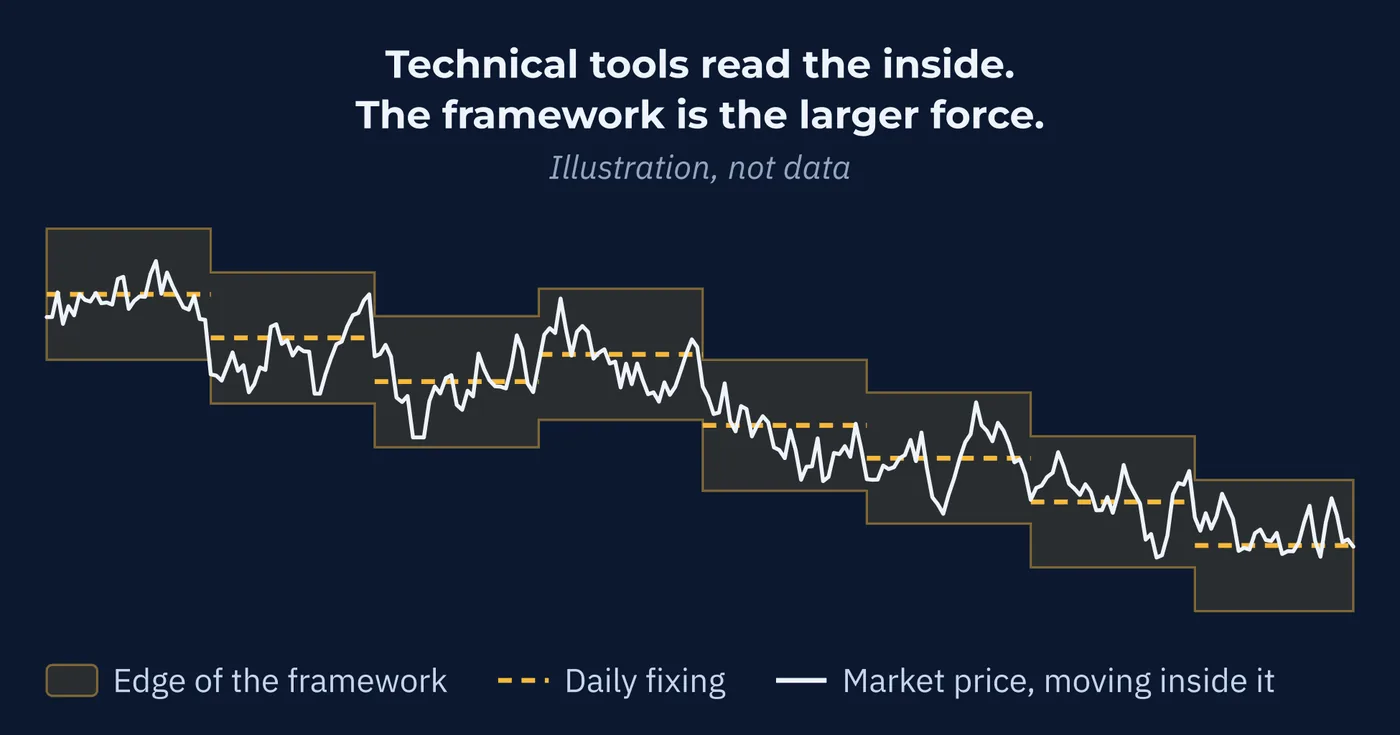
Those three work as a system. The fixing declares the intent. The reserves back it. The controls limit who can push against it.
For a trader this changes the analysis rather than ruling it out. Technical tools still tell you something, because a real market operates inside the framework. But the framework is a force no chart can show you, and it is often the larger one.
5Hard Pegs
A hard peg is a declared commitment to hold a specific rate or a narrow band, defended indefinitely.
Lesson 10 introduced the example. The Hong Kong dollar has been pegged to the US dollar since 1983, and held within a band of 7.75 to 7.85 since 2005.
Pull that chart up and it looks like a flat line. Almost nothing happens, for years at a time.
That flatness is not low volatility. It is institutional constraint, drawn as a price.
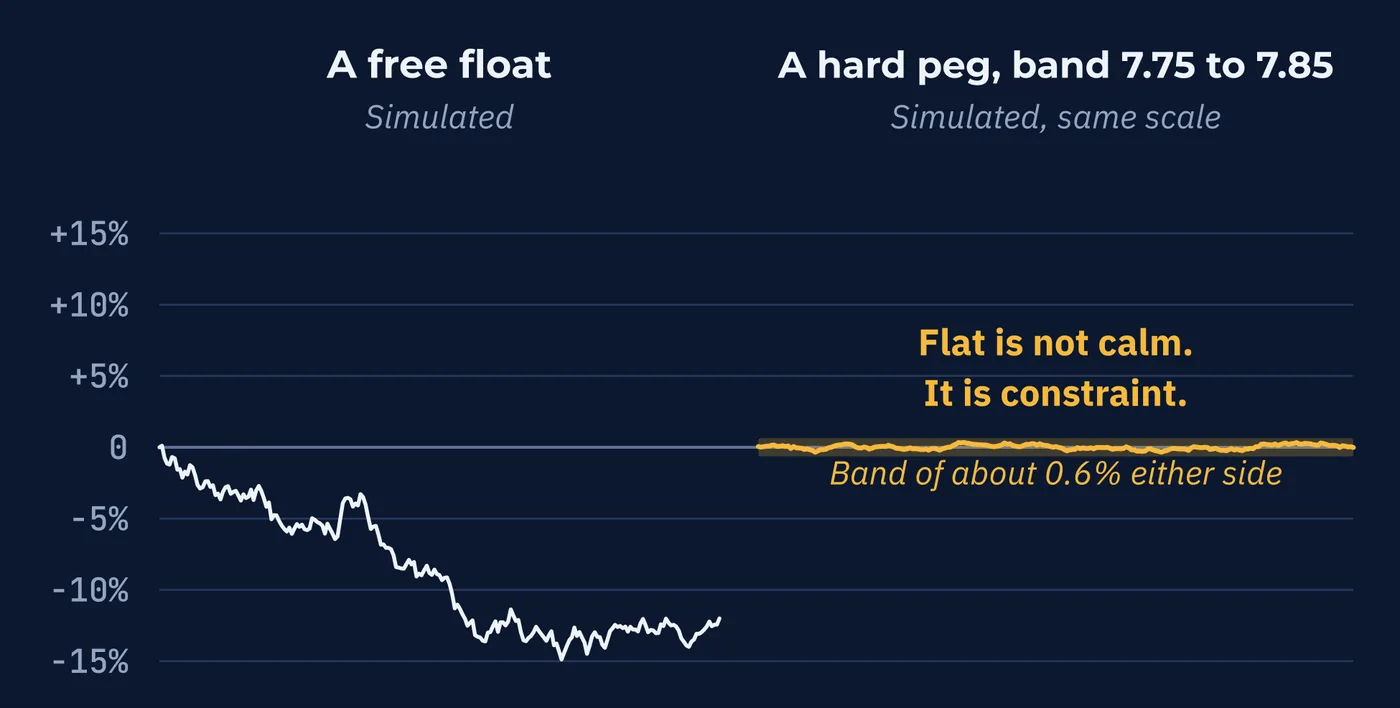
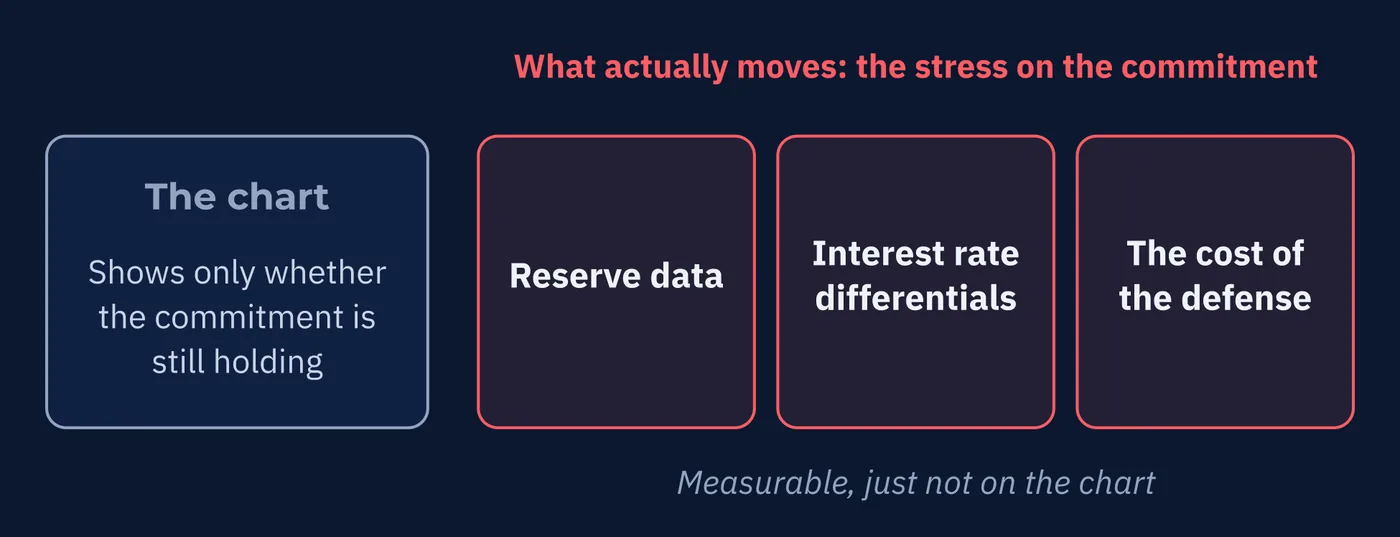
Which changes what there is to analyze. On a hard peg the price barely moves, so watching it tells you little. What moves is the stress on the commitment. How hard the market is testing it, and how expensive the defense has become.
That stress is measurable. It just is not measurable on the chart.
6Currency Boards
A currency board goes one step further, and the difference is not a matter of degree.
Under a currency board, every unit of domestic currency must be backed by foreign reserves at a fixed rate. The currency cannot be issued unless the foreign currency is received in exchange. The arrangement is written into law.
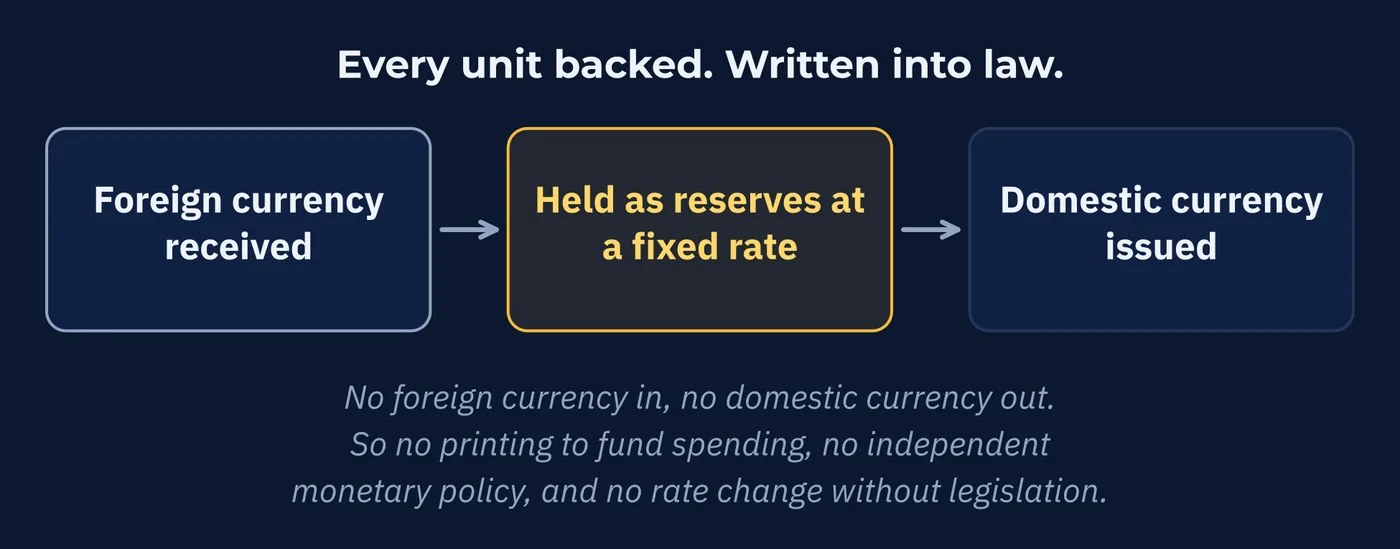
The consequences are strict. The authority cannot print money to fund government spending. It cannot run its own monetary policy. It cannot move the rate without legislation.
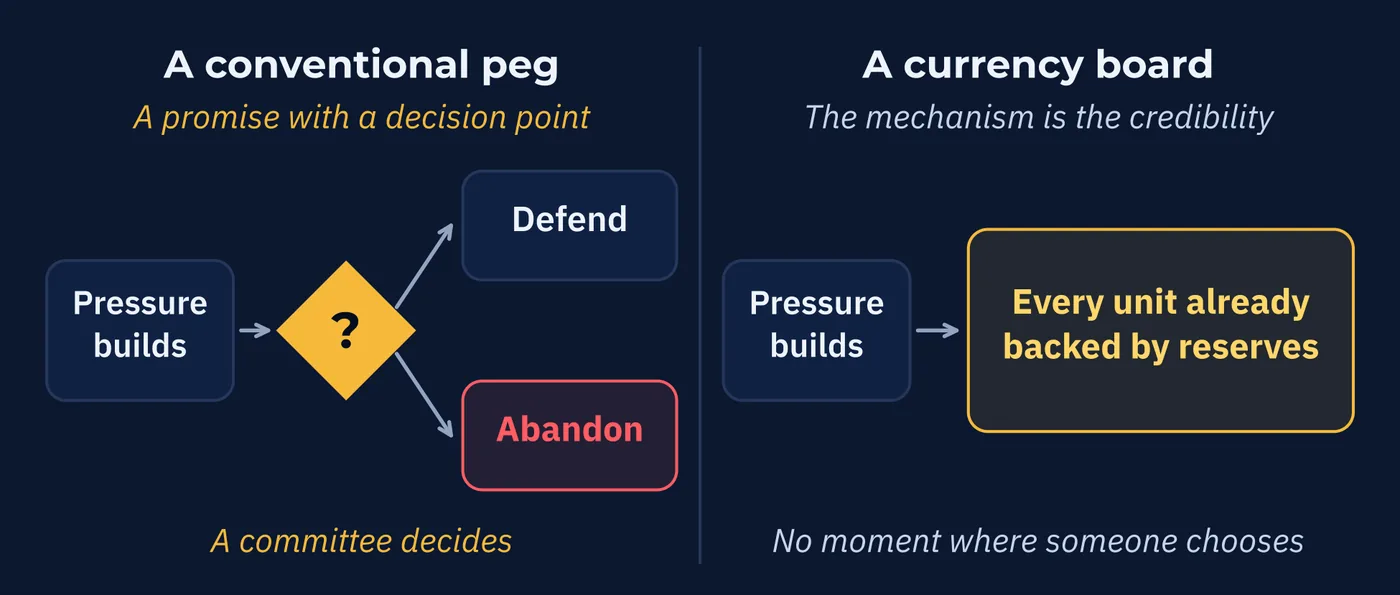
Hong Kong has run one since 1983, backing every Hong Kong dollar with US dollars in its Exchange Fund. Bulgaria ran one from 1997, after a currency crisis, holding the lev first against the Deutsche Mark and then the euro at a rate carried to five decimal places, until it adopted the euro itself in January 2026.
7Three Ways to Defend a Rate
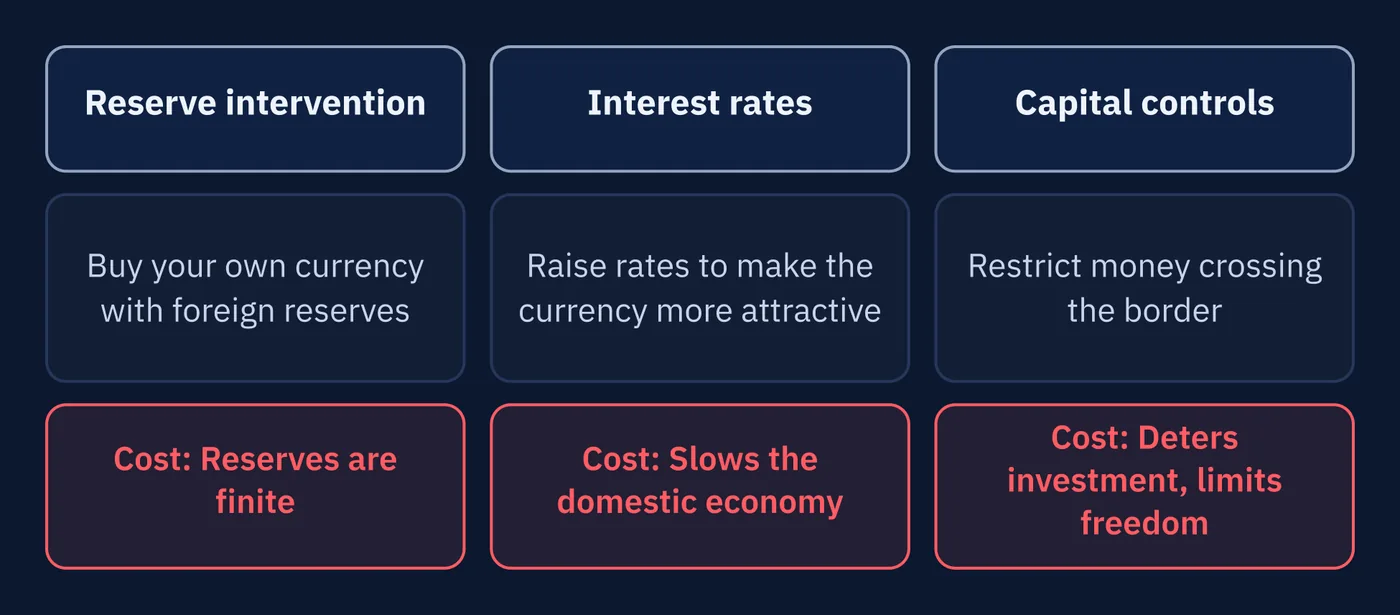
Whatever the regime, a central bank holding a rate has three tools. Each one works. Each has a cost and a limit.
| Tool | How It Works | What It Costs |
|---|---|---|
| Reserve intervention | Buy your own currency with foreign reserves to support it | Reserves are finite. Every defense spends some. |
| Interest rate policy | Raise rates to make holding the currency more attractive | Higher rates slow the domestic economy, whatever it needs |
| Capital controls | Restrict money moving across the border | Deters foreign investment and limits domestic freedom |
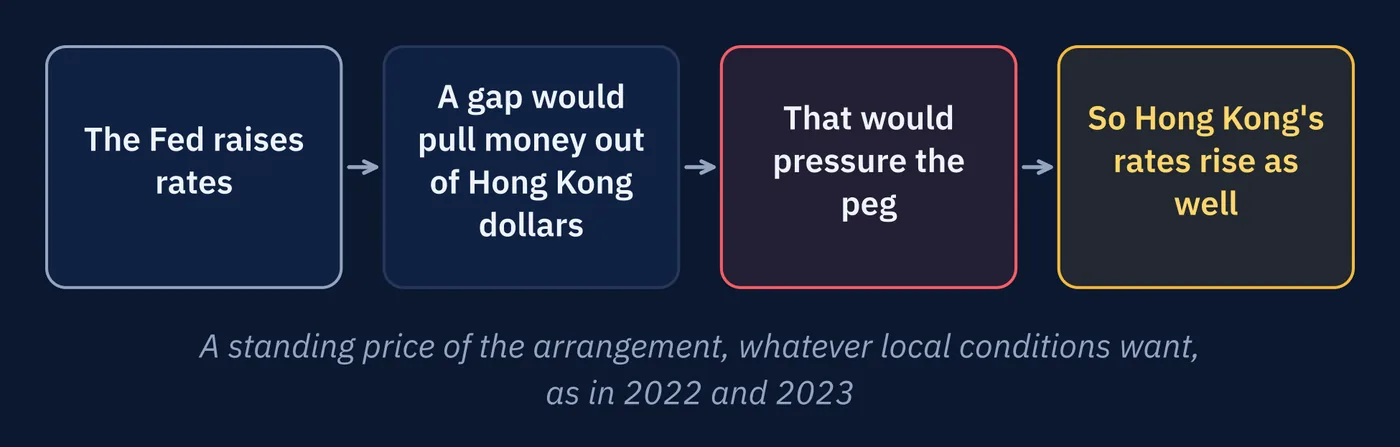
The second tool has a deeper consequence, and it is permanent rather than occasional.
A country that fixes to another currency imports that country's monetary conditions. Hong Kong's interest rates must broadly follow the Federal Reserve, because any real divergence would create capital flows that pressure the peg.
So when the Fed raised rates sharply in 2022 and 2023, Hong Kong had to follow, whatever local conditions wanted. That is the standing price of the arrangement, not an occasional inconvenience.
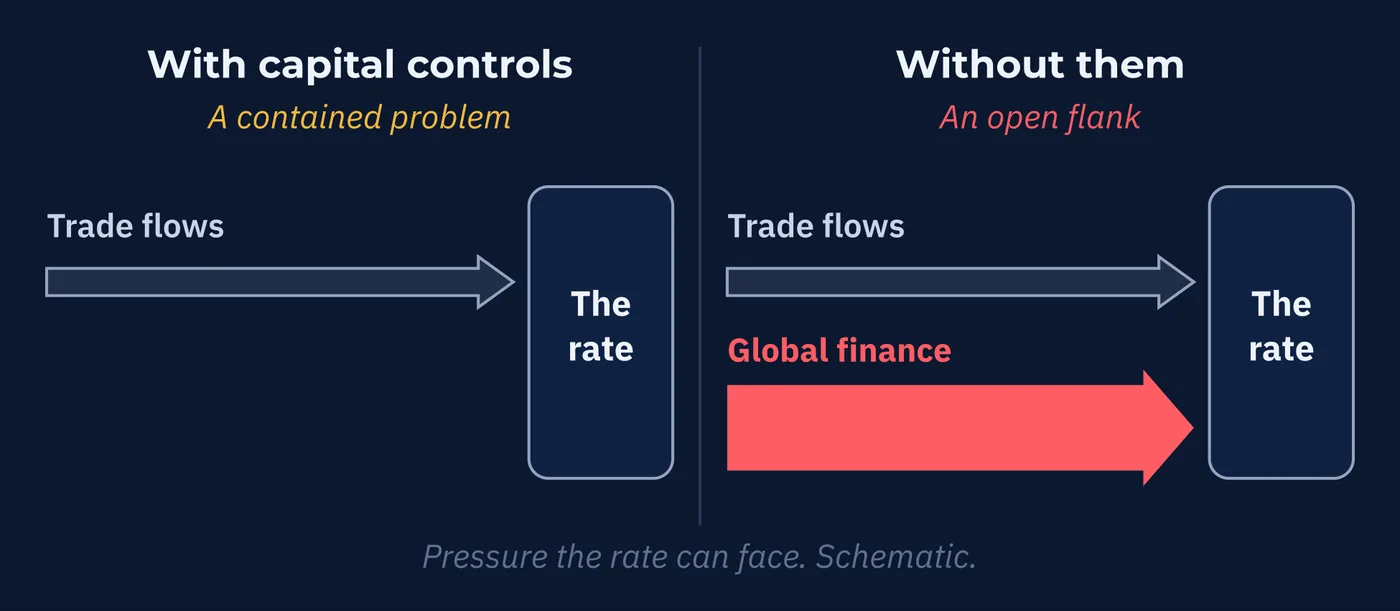
The third tool changes the size of the problem more than the others. If capital cannot leave freely, the pressure is limited to trade flows rather than the full weight of global finance. That is the difference between a contained problem and an open flank.
8What Regime Changes About Your Analysis
Here is the practical payoff, and it is the reason this lesson exists in a trading course rather than an economics one.
| If the Regime Is | Then |
|---|---|
| A free float | Everything in this course applies in full. Supply and demand are real, and the chart reflects genuine market opinion. |
| A managed float | Charts retain partial value, but the institutional framework is a force they cannot show. Policy direction and reserve trends sit alongside the chart. |
| A hard peg or currency board | The chart is not the primary tool. Reserve data, interest rate differentials, and the cost of defense are what tell you anything. |
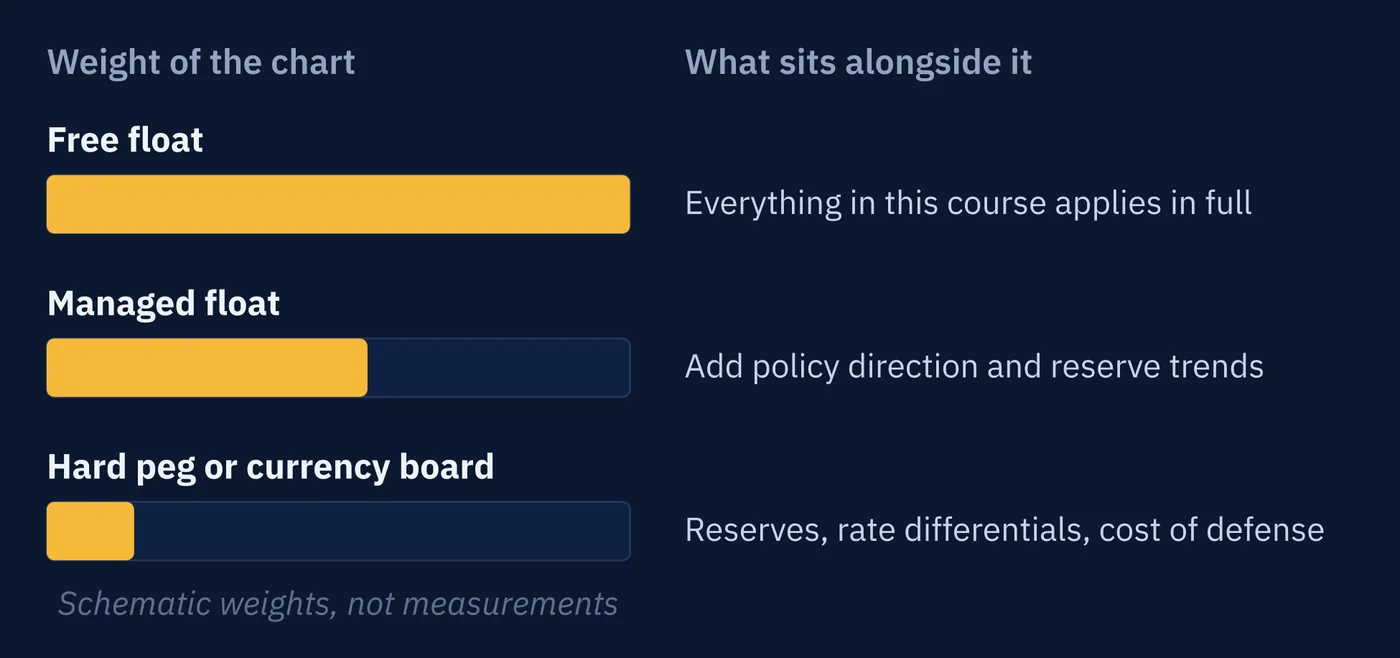
Read the last row against Lesson 3, which taught you to read a chart, and Lesson 10, which warned that some prices are held rather than free. On a hard peg the chart tells you only whether the commitment is still holding. It cannot tell you whether it will hold tomorrow.
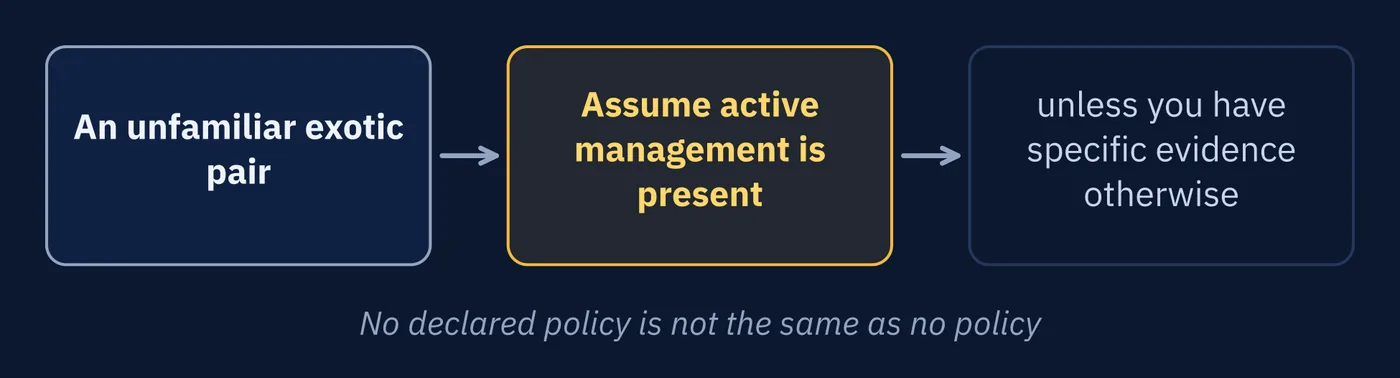
None of which makes pegged currencies untradeable. It makes them a different problem, needing different information. The mistake is not trading them. The mistake is trading them as though they were EUR/USD.
Which leaves the question this lesson has been circling. Every one of these commitments is defended by an institution with finite resources and real costs. So what happens when the defense fails?
That is the next lesson, and it contains two of the largest single-day moves in the history of currency markets.
Three Things to Remember
Try This
Fifteen minutes. Build the habit of asking the prior question.
Words From This Lesson
| Term | What It Means |
|---|---|
| Exchange rate regime | The arrangement determining how a currency's rate is set, from free floating to legally fixed. |
| Free float | A rate set primarily by market forces, with occasional tactical intervention. |
| Managed float | A rate that moves with the market inside a framework a central bank actively steers. |
| Hard peg | A declared commitment to hold a specific rate or narrow band, defended indefinitely. |
| Currency board | A peg written into law, with every unit of currency backed by foreign reserves. No discretionary decision point. |
| Reserve intervention | Buying or selling your own currency using foreign reserves to influence its rate. |
| Capital controls | Restrictions on moving money across a border, which limit pressure that can build against a rate. |
| Peg stress | How hard the market is testing a commitment, and how costly the defense is becoming. |
Test Your Knowledge
Eight questions. Answer them all before checking the key on the following pages. If a question gives you trouble, the answer key tells you which section to revisit.
- A. Which direction is it heading
- B. What is the current spread
- C. What force is actually setting this price
- D. Which session is most active
- A. No, by definition
- B. Only if the IMF approves
- C. Only during declared crises
- D. Yes, tactically and occasionally
- A. Managed floats have wider spreads
- B. Intervention is structural and sustained rather than tactical
- C. Managed floats cannot be traded by retail participants
- D. Free floats have no central bank
- A. Institutional constraint expressed as price behavior
- B. Unusually low market volatility
- C. A data error on the chart
- D. Lack of trading interest in the pair
- A. It holds larger reserves
- B. It is supported by the IMF
- C. Every unit is mechanically backed, removing the discretionary decision point
- D. It permits a wider band
- A. Devaluation, revaluation, and floating
- B. Spread widening, margin calls, trading halts
- C. Inflation targeting, bond issuance, taxation
- D. Reserve intervention, interest rate policy, capital controls
- A. Higher inflation, always
- B. Importing the anchor country's monetary conditions
- C. Loss of foreign investment
- D. Mandatory capital controls
- A. Reserve data, rate differentials, and the cost of defense
- B. The price chart
- C. Candlestick patterns
- D. Session timing
Answer Key
Each answer explains why the correct choice is correct, why the others are not, and where to reread.
Question 1 · correct answer C
The regime determines which analytical tools apply, what the risk looks like, and what needs monitoring. Direction is the second question, not the first.
A is what most traders ask first, which is the habit this lesson exists to change. B and D are real pre-trade checks from Series B and D, but neither tells you what kind of price you are looking at.
Review: Section 1, The Question Before the Chart
Question 2 · correct answer D
Major central banks do intervene, and Japan has done so repeatedly. No major central bank has committed to never intervening under any circumstances.
A takes the word free too literally, which is exactly the trap. C narrows it too far, since intervention is not restricted to declared crises. B invents an approval process that does not exist.
Review: Section 3, Free Float, With an Asterisk
Question 3 · correct answer B
A free float can be intervened in occasionally. A managed float is being managed continuously, whether or not intervention happens on any given day.
A describes a cost difference that does not define the regime. C is wrong because managed float currencies are widely traded. D is wrong because free floating countries have central banks too.
Review: Section 3, Free Float, With an Asterisk
Question 4 · correct answer A
The narrow range exists because an authority defends the band edges. The flatness is the constraint made visible, not an absence of forces acting on the pair.
B describes the appearance and misses the cause. C mistakes a real and deliberate outcome for an error. D is wrong because the pair is actively traded.
Review: Section 5, Hard Pegs
Question 5 · correct answer C
A conventional peg is a promise with a committee behind it, and committees can decide the cost has become too high. A currency board backs every unit mechanically, so no such decision point exists.
A is not the distinguishing feature, since reserve size varies in both arrangements. B is wrong because IMF support does not define a currency board. D reverses it, as currency boards are stricter rather than looser.
Review: Section 6, Currency Boards
Question 6 · correct answer D
Buying your own currency with reserves, raising rates to make it attractive to hold, and restricting cross-border flows. Each works, and each has a cost and a limit.
B lists things brokers and exchanges do, not central banks. C lists genuine policy tools that are not the mechanisms for defending a rate. A lists outcomes rather than defenses.
Review: Section 7, Three Ways to Defend a Rate
Question 7 · correct answer B
Fixing to another currency means following its monetary conditions, because any real divergence creates capital flows that pressure the peg. Hong Kong had to follow the Fed through 2022 and 2023 regardless of local conditions.
A is not automatic, and pegs are often adopted to control inflation. C describes a possible effect of capital controls rather than of pegging. D is wrong because capital controls are a choice, not a requirement.
Review: Section 7, Three Ways to Defend a Rate
Question 8 · correct answer A
On a hard peg the price barely moves, so the chart only tells you whether the commitment is still holding. Whether it will continue to hold shows up in reserves and the cost of defense.
B is the intuitive answer and the one that misses what is actually happening. C and D are tools built for market-determined prices, which is not what a hard peg produces.
Review: Section 8, What Regime Changes About Your Analysis
Keep going
Where Money Came From is written by Kanin D. Alldredge for The Currency Classroom, and it is free to read. There is more free from CNS: start here.
Start free with CNS →