The Day the Gold Window Closed

1It Worked, and Then It Did Not
Begin with something that gets lost when a system is remembered mainly for how it ended.
Bretton Woods worked. Through the 1950s and into the 1960s it oversaw the strongest run of economic growth the developed world has recorded. Reconstruction, expanding trade, and decades of exchange rate stability all happened inside it.
It also took time to start. European currencies were not fully convertible until 1958, and the system needed that to work as designed. Fourteen years after the conference.
So the working life of the system was shorter than it looks. Roughly a decade of running properly before the strain showed.
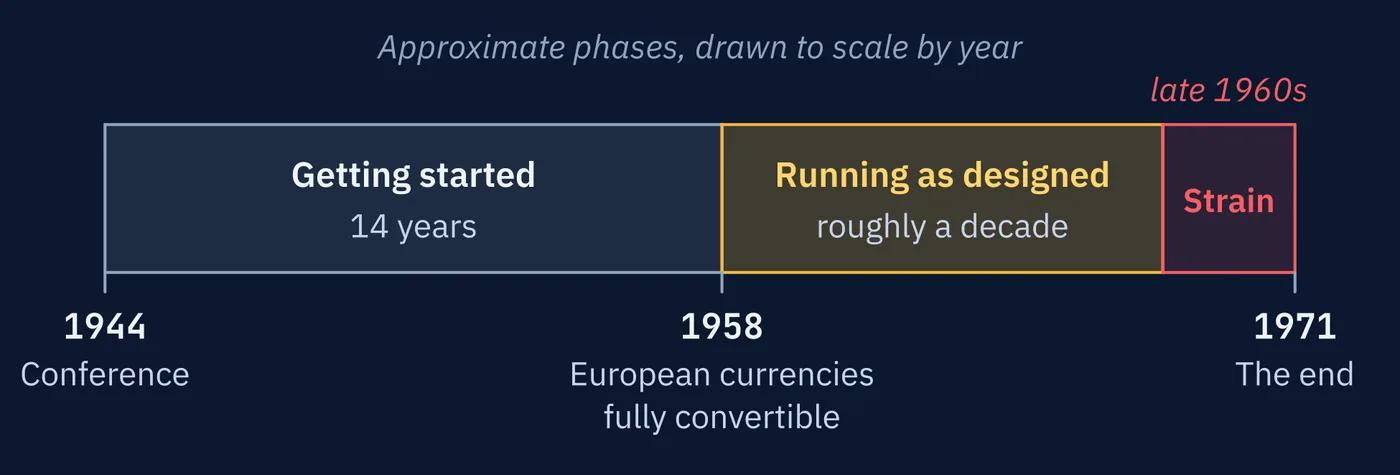
And the strain was exactly the one Lesson 32 identified.
2The Diagnosis
In 1960, a Belgian-American economist named Robert Triffin explained the problem to a Congressional committee.
His argument had two halves, and each was obviously true on its own.
| For the System to Work | But |
|---|---|
| The world needs dollars to hold as reserves and settle trade | Every dollar abroad is a claim on American gold |
| So the United States must supply them, by spending more abroad than it takes in | So the more dollars supplied, the weaker the promise to convert them looks |
This became known as the Triffin Dilemma, and it is called a dilemma because there is no good way out. Both roads lead somewhere bad.
Supply the world with dollars and the promise weakens. Restrict supply to protect the promise and the world is starved of the asset it runs on.
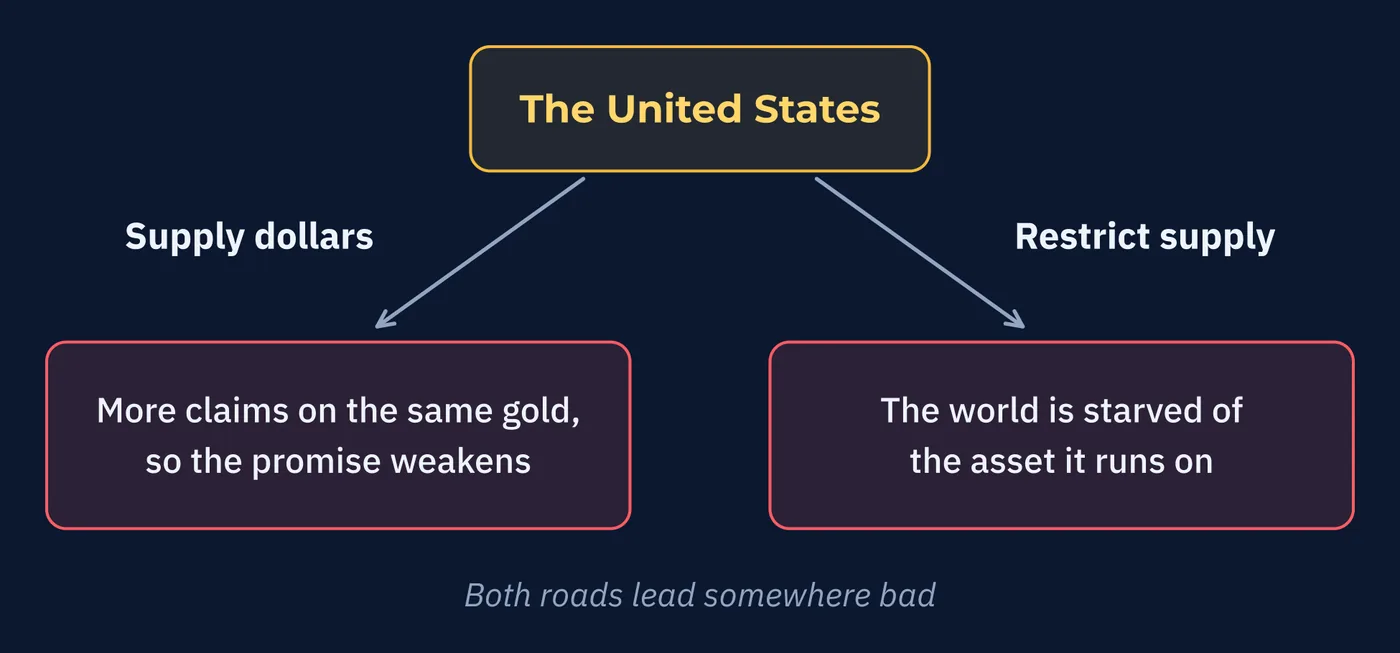
The better the dollar served the world, the less credible its promise became.
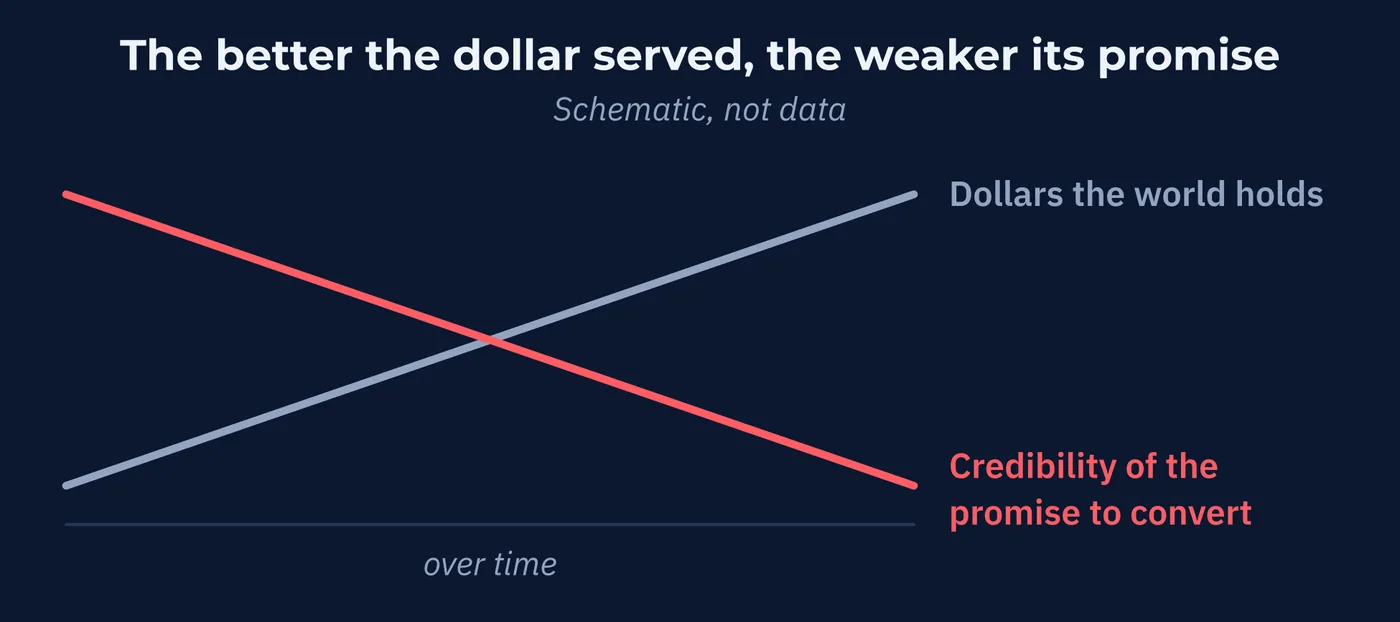
Note what this was not. Triffin was not predicting a distant risk. He was describing something already underway, in 1960, eleven years before the end.
3The 1960s
Abstract contradictions become concrete through specific events. Three did most of the work.
| What Happened | Why It Mattered |
|---|---|
| American deficits grew sharply | The Johnson administration financed a major war in Vietnam and a large expansion of domestic programs at the same time, without raising taxes to cover both. |
| France began converting dollars into gold | Rather than holding dollar reserves, de Gaulle's government systematically presented them and took the metal. Others watched closely. |
| The London Gold Pool collapsed in 1968 | An arrangement among central banks to hold the gold price near $35 gave way. The market price and the official price separated. |
Each of those was manageable on its own. Together they were not.
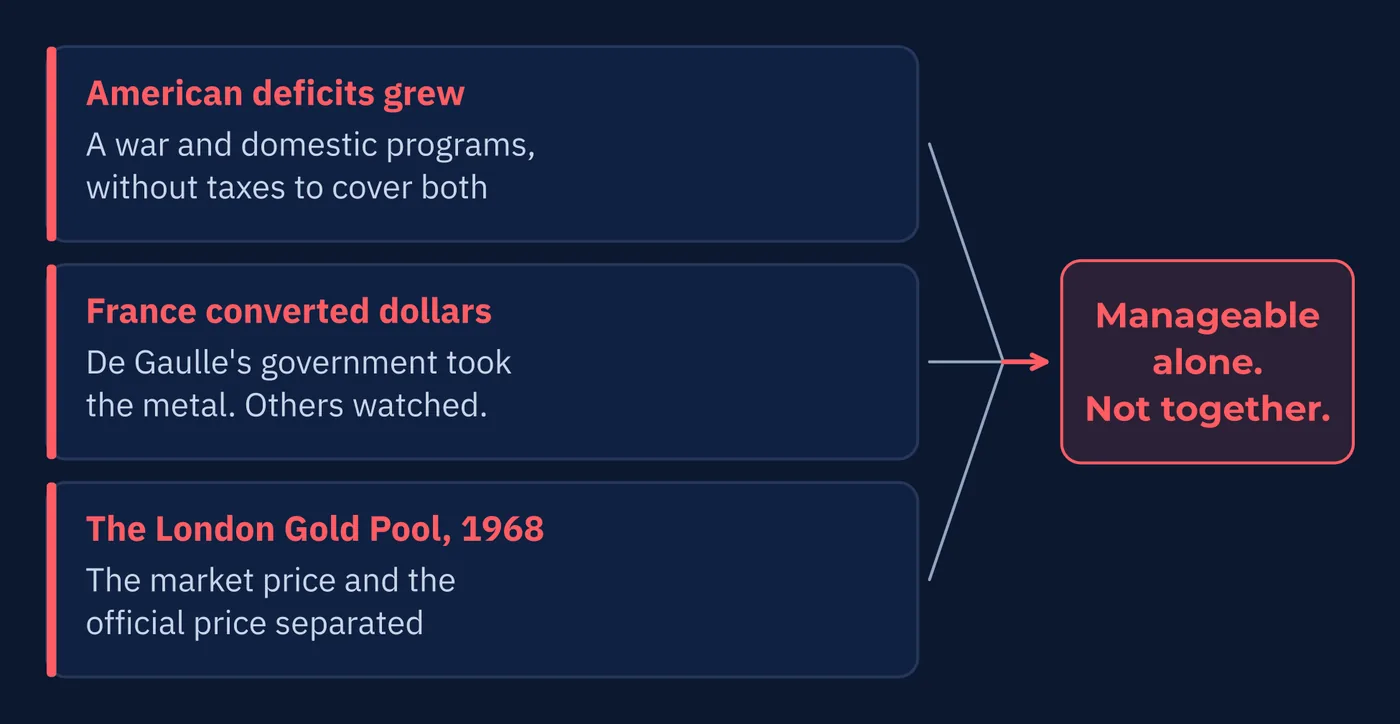
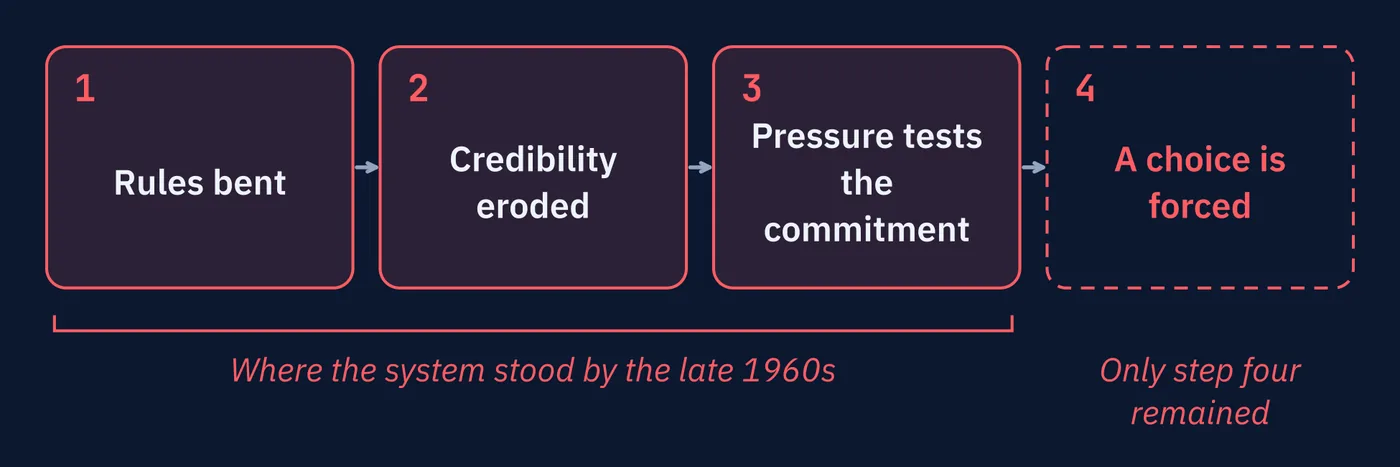
Now set that against Lesson 31's four-step sequence. Rules bent. Credibility eroded. Pressure arrived to test whether the commitment was real. The system was at step three, and only step four remained.
4The Arithmetic
By August 1971 the position could be stated in two numbers.
| Amount | |
|---|---|
| American gold reserves | About $10 billion |
| Dollars held by foreign central banks | About $40 billion |
A ratio of one to four. And it was climbing fast. Those holdings had been about $23 billion at the end of 1970, and passed $50 billion by the end of 1971.
So if every foreign central bank had presented its dollars for gold at the promised rate, the United States could have paid about twenty-five cents on the dollar.
$10bn ÷ $40bn = about 25 cents on the dollar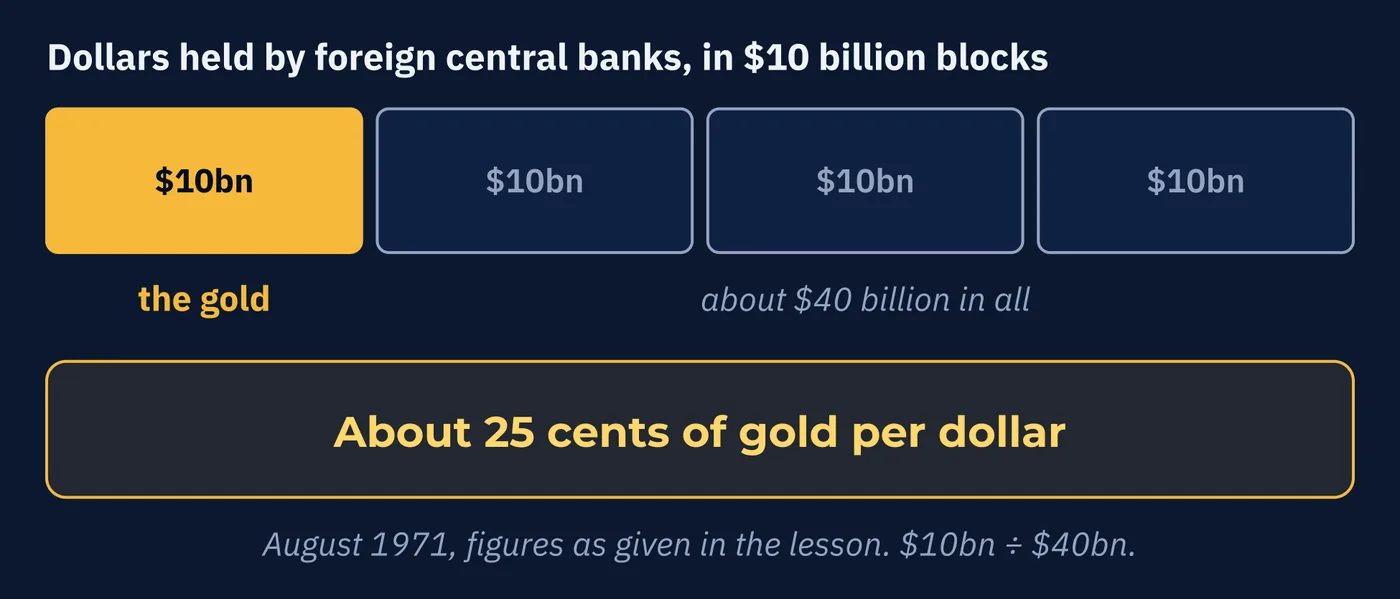
The promise at the foundation of the system was not under strain. It was arithmetically impossible, and had been for years.
Everyone with access to the figures could see it. What remained was the timing of the acknowledgment.
5A Weekend at Camp David
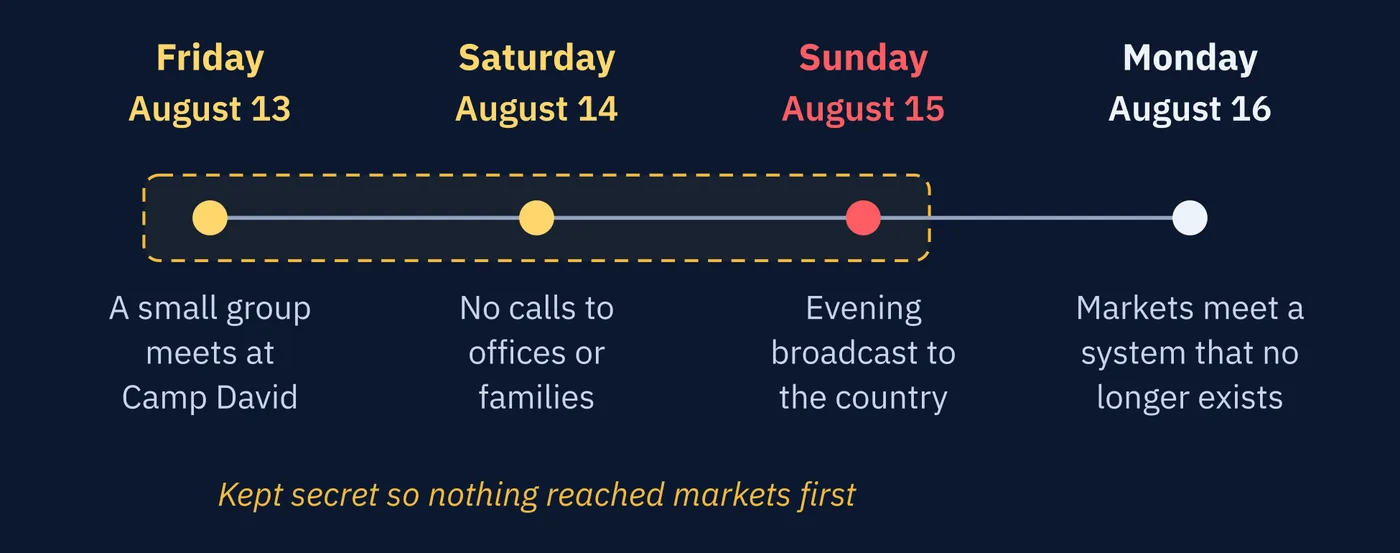
The decision was made over a secret weekend beginning Friday, August 13, 1971.
Nixon convened a small group at Camp David. Participants were told not to contact their offices or families, so nothing could reach markets before the announcement.
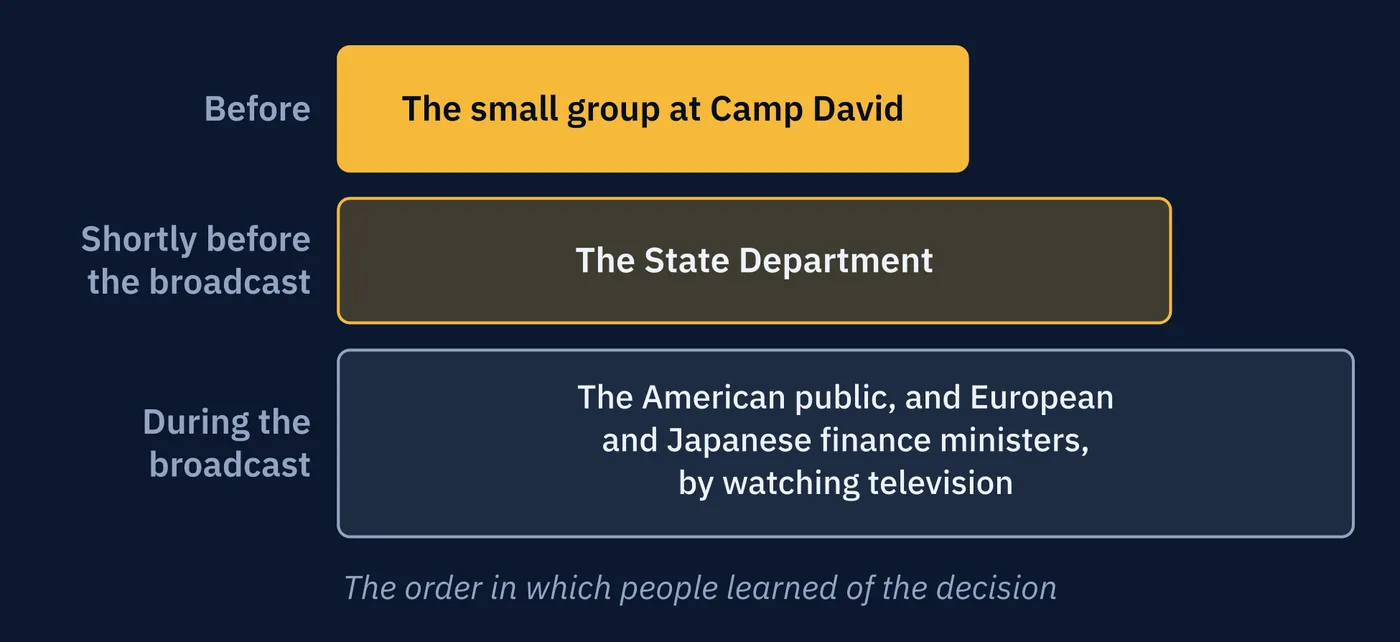
The secrecy held. The State Department was informed shortly before the broadcast.
6Sunday Evening, August 15, 1971
Nixon interrupted regular television programming to address the country.
The speech was framed mostly as a domestic economic measure. Wage and price controls. A tax on imports. And, among the announcements, the suspension of the dollar's convertibility into gold.
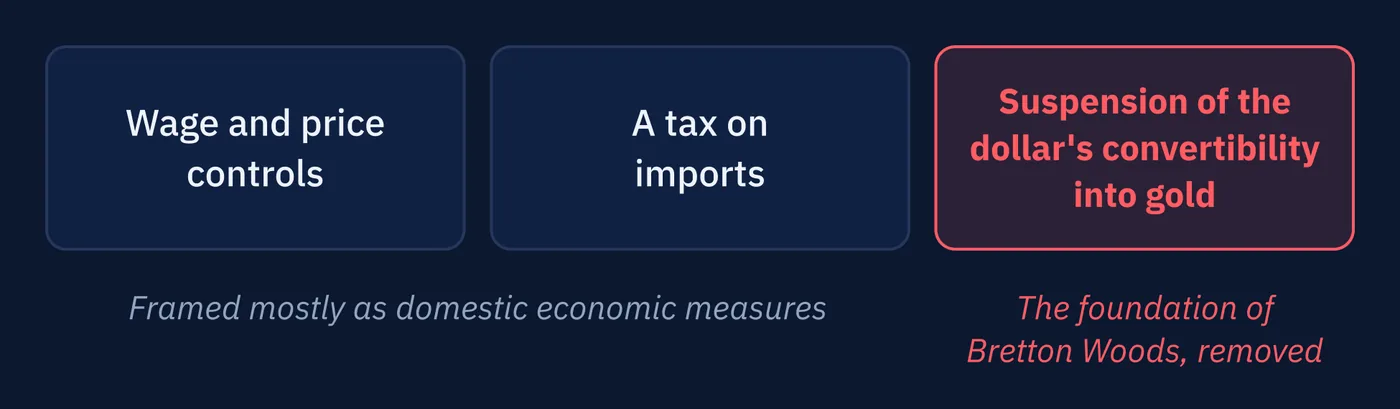
The legal foundation of Bretton Woods was removed unilaterally. No negotiation, no notice, and nothing put in its place.
It was not a crisis decision. It was arithmetic being formalized.
Asked afterward by European allies why the United States had acted without consulting them, Nixon's Treasury Secretary John Connally gave an answer that has been quoted ever since.
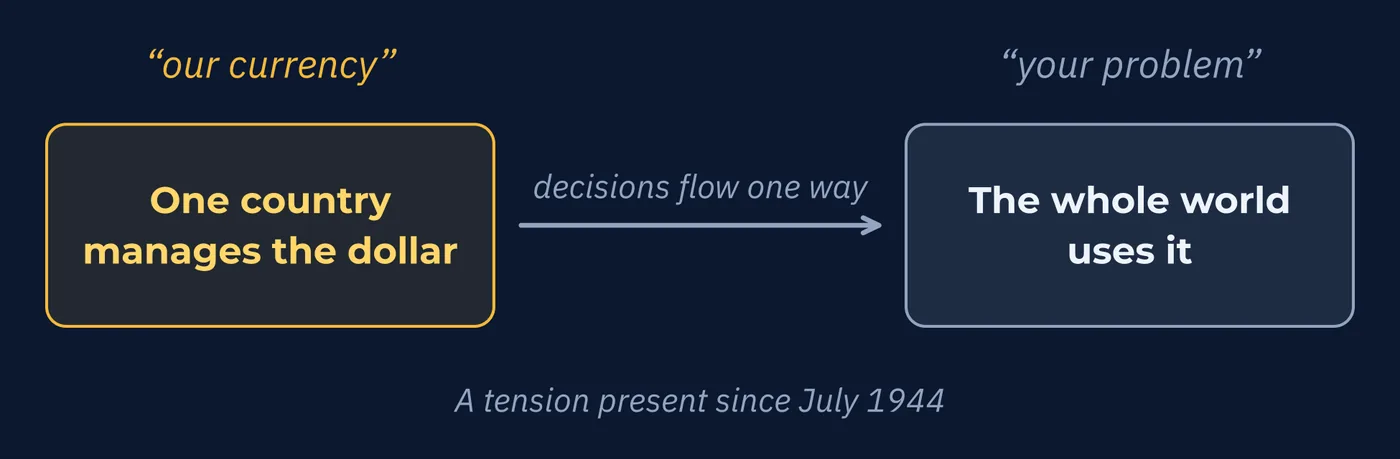
“The dollar is our currency, but it's your problem.”It was blunt to the point of contempt toward allies whose arrangements had just been dismantled. It was also entirely accurate.
The dollar anchored a system serving the whole world. Managing it was the business of one country alone. That tension had existed since July 1944. On that Sunday evening it resolved.
7The Patch That Lasted Fourteen Months
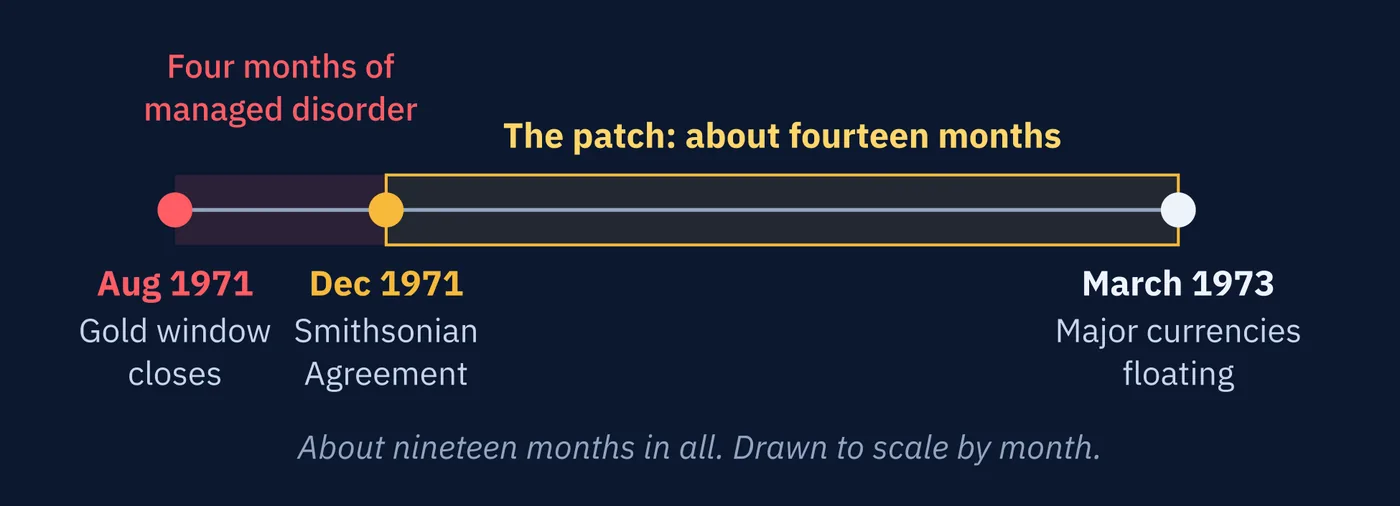
Removing the foundation had not replaced it. For four months the major currencies floated in managed disorder, while finance ministers tried to work out whether fixed rates could be saved.
The initial view was that they could. In December 1971 the major economies met at the Smithsonian Institution in Washington and produced an agreement.
| What the Smithsonian Agreement Did | |
|---|---|
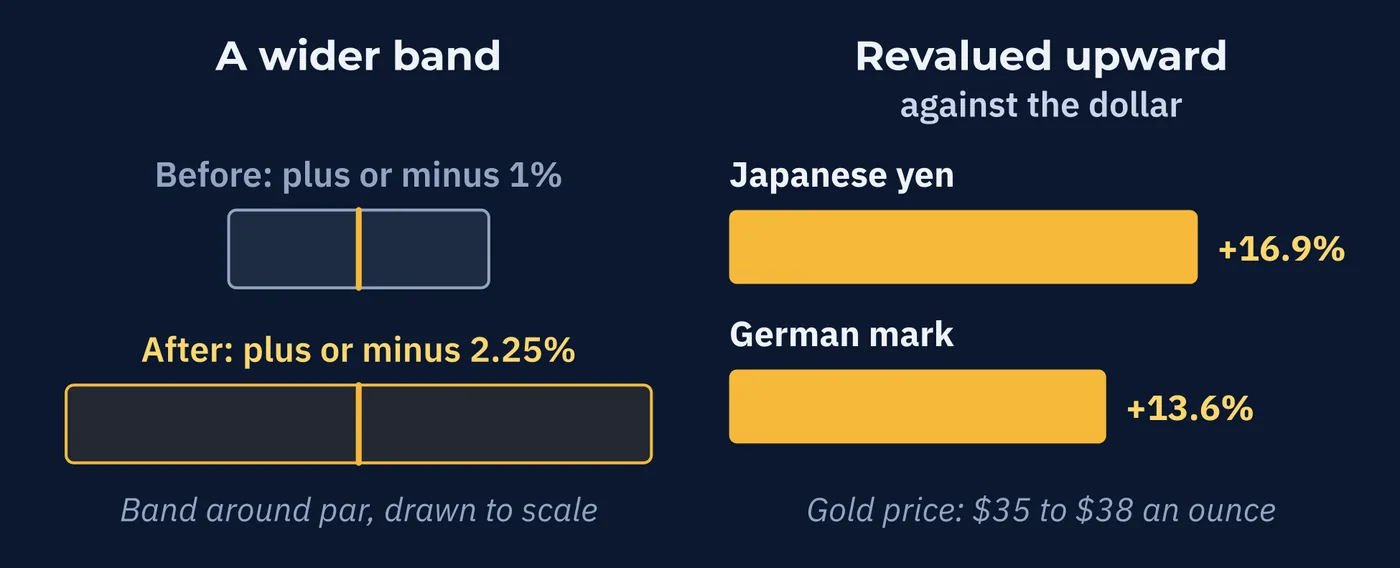
| Devalued the dollar against gold | From $35 to $38 an ounce, largely symbolic since convertibility was already suspended |
| Revalued other currencies upward | The Japanese yen by 16.9 percent, the German mark by 13.6 percent, others by less |
| Widened the permitted band | From plus or minus 1 percent to plus or minus 2.25 percent |
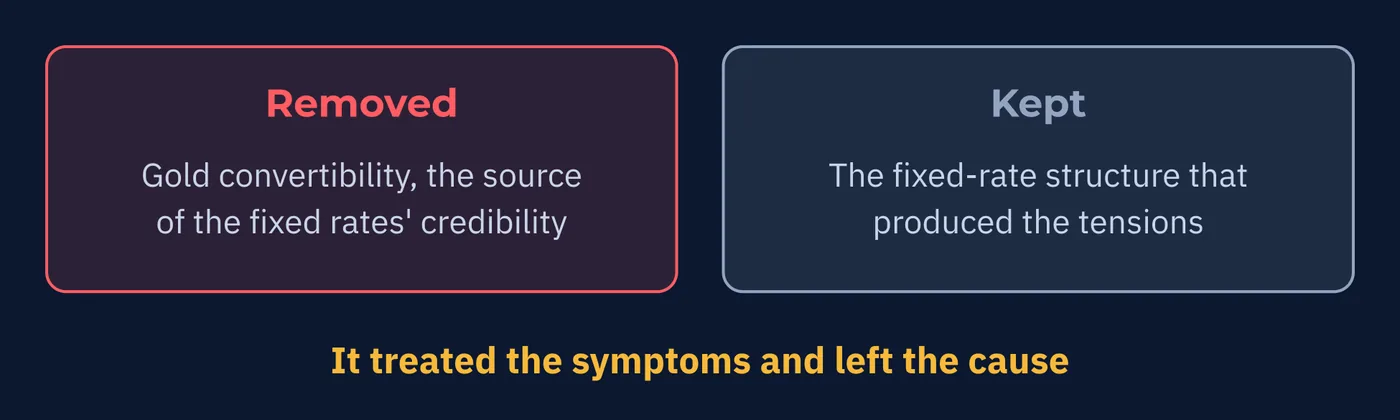
| Kept fixed rates | Without the gold convertibility that had made them credible |
Nixon called it the greatest monetary agreement in the history of the world.
Read the last row again. The agreement removed the one thing that gave the fixed rate structure its credibility, and kept the structure that produced the tensions. It treated symptoms and left the cause.
It lasted about fourteen months.
8March 1973
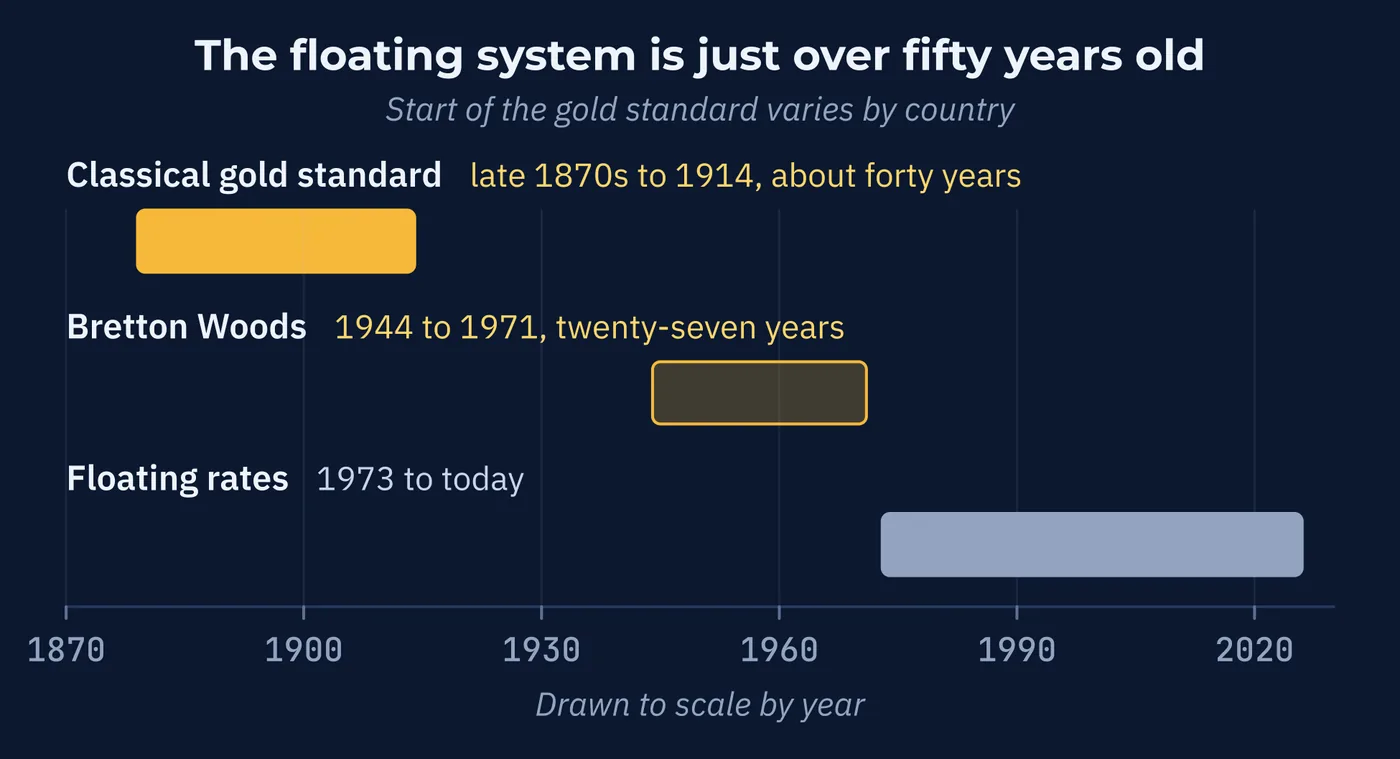
Here is how a century of fixed exchange rates actually ended.
There was no announcement. No conference, no agreement, no declaration that an era had closed. No moment when policymakers decided floating rates were better.
By March 1973 the major currencies were simply floating, because every available means of defending fixed rates had been used and had not worked.
What replaced the plan that failed was not a better plan. It was the absence of one.
One more thing did not change in 1971, and it matters enormously.
The dollar lost its gold anchor. It did not lose its position. Trade was still invoiced in dollars. Banking relationships were still built around dollar clearing. American government debt was still the deepest market in the world. None of that switched off because a promise ended.
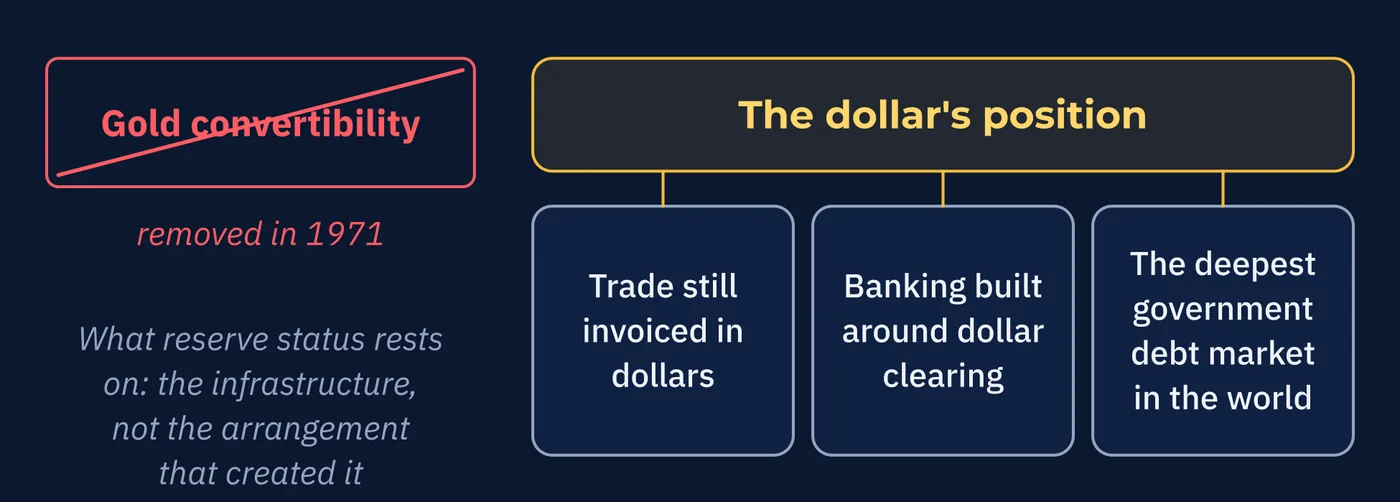
Which shows what reserve currency status actually rests on. Not the arrangement that created it, but the accumulated infrastructure built on top of it.
That is the subject of the next series, which asks how the dollar got there, what its position is worth, and what would actually be required to displace it.
Three Things to Remember
Try This
Fifteen minutes. Two calculations and some perspective.
Words From This Lesson
| Term | What It Means |
|---|---|
| Triffin Dilemma | The contradiction in any system where one national currency is the world reserve asset. Supplying it requires deficits that undermine confidence in it. |
| Balance of payments deficit | Spending and investing more abroad than a country takes in. The mechanism that put dollars into foreign hands. |
| London Gold Pool | A central bank arrangement to hold the gold price near $35. It collapsed in 1968. |
| Nixon Shock | The unilateral suspension of dollar-gold convertibility, announced August 15, 1971. |
| Smithsonian Agreement | The December 1971 attempt to restore fixed rates without gold convertibility. It lasted about fourteen months. |
| Floating rate | An exchange rate set by market supply and demand rather than by official commitment. The system since 1973. |
Test Your Knowledge
Eight questions. Answer them all before checking the key on the following pages. If a question gives you trouble, the answer key tells you which section to revisit.
- A. The tendency of surplus countries to avoid adjusting
- B. Supplying the world with a reserve currency requires deficits that undermine confidence in it
- C. The difficulty of defending a peg during a recession
- D. The conflict between inflation targets and employment
- A. 1960, in Congressional testimony
- B. 1944, at the conference itself
- C. 1971, days before the announcement
- D. 1973, after floating began
- A. The creation of the euro
- B. Britain rejoining the gold standard
- C. France systematically converting dollars into gold
- D. The abolition of the IMF
- A. About $10 billion against $40 billion
- B. About $40 billion against $10 billion
- C. Roughly equal
- D. Gold reserves exceeded claims by half
- A. All of it, at the promised rate
- B. About 50 cents on the dollar
- C. About 80 cents on the dollar
- D. About 25 cents on the dollar
- A. Through advance diplomatic notice
- B. At an emergency IMF session
- C. By watching the television broadcast
- D. In a letter delivered the following week
- A. It abolished fixed rates too abruptly
- B. It kept fixed rates while removing the gold convertibility that made them credible
- C. It was rejected by the major economies
- D. It restored gold convertibility at an impossible rate
- A. By formal international agreement in 1973
- B. With the Smithsonian Agreement in 1971
- C. By a vote at the IMF
- D. With no announcement, as fixed rates simply ran out of defenses
Answer Key
Each answer explains why the correct choice is correct, why the others are not, and where to reread.
Question 1 · correct answer B
The issuing country must run deficits to put its currency into foreign hands, and those same deficits progressively weaken confidence in the backing promise. There is no exit within the system.
A describes the adjustment asymmetry from Lesson 31, which is a different problem. C describes the political will weakness. D describes a modern policy trade-off unrelated to reserve currency supply.
Review: Section 2, The Diagnosis
Question 2 · correct answer A
Robert Triffin set it out in Congressional testimony in 1960, eleven years before the system ended. He was describing something already underway rather than predicting a distant risk.
B is close in spirit, since Keynes saw the tension in 1944, but the formal diagnosis came later. C and D place it far too late, when the outcome was already determined or complete.
Review: Section 2, The Diagnosis
Question 3 · correct answer C
France under de Gaulle systematically presented dollars and took gold rather than holding dollar reserves, and other countries watched closely.
B is wrong because Britain had left gold in 1931 and did not return. A is wrong by several decades. D is wrong because the IMF continued and continues to operate.
Review: Section 3, The 1960s
Question 4 · correct answer A
About $10 billion of gold stood against about $40 billion held by foreign central banks, a ratio of one to four.
B reverses the figures, which would describe a comfortably backed system. C and D describe positions the United States had not held for many years.
Review: Section 4, The Arithmetic
Question 5 · correct answer D
Ten divided by forty is 0.25. The promise was not under strain, it was arithmetically impossible, and had been for some time.
B and C overstate the coverage considerably. A describes the commitment as written, which the reserves could no longer support.
Review: Section 4, The Arithmetic
Question 6 · correct answer C
The Camp David weekend was kept secret to prevent leaks reaching markets. Allies found out the same way the public did, and several European exchanges could not open the following Monday.
A describes what convention would have suggested and what did not happen. B and D describe processes that were bypassed entirely.
Review: Section 5, A Weekend at Camp David
Question 7 · correct answer B
It adjusted rate levels and widened the bands while keeping the fixed rate structure, having removed the gold convertibility that gave the structure its credibility. It treated symptoms and left the cause.
A reverses what it did, since it tried to preserve fixed rates. C is wrong because it was agreed and implemented. D is wrong because convertibility was not restored.
Review: Section 7, The Patch That Lasted Fourteen Months
Question 8 · correct answer D
There was no announcement, agreement, or declaration. By March 1973 the major currencies were floating because every means of defending fixed rates had been exhausted.
A describes a formal process that did not occur. C is wrong because no such vote decided it. B confuses the failed patch with the end, since the Smithsonian tried to preserve fixed rates.
Review: Section 8, March 1973
Keep going
Where Money Came From is written by Kanin D. Alldredge for The Currency Classroom, and it is free to read. There is more free from CNS: start here.
Start free with CNS →