What Each Style Demands

1The Wrong Question
Plenty of places will offer you a quiz to determine your trading style. Ten questions, a result at the end, a label.
They are not useless, but they share a flaw that makes their answers unreliable.
They measure what you prefer. And what you prefer reflects who you would like to be rather than who you currently are.
Someone who wants to day trade answers the day trading questions favorably. Not dishonestly. They do find the idea appealing. They would enjoy the pace. They believe they would handle it well. None of that tells you whether their Tuesday afternoons are free.
A quiz asks who you want to be. The useful answer is who you are.

So the questions here are factual instead. How many hours do you have. When do they fall. How have you behaved under pressure before. Those have observable answers, and observable answers are the only useful kind.
2Four Things Have to Line Up
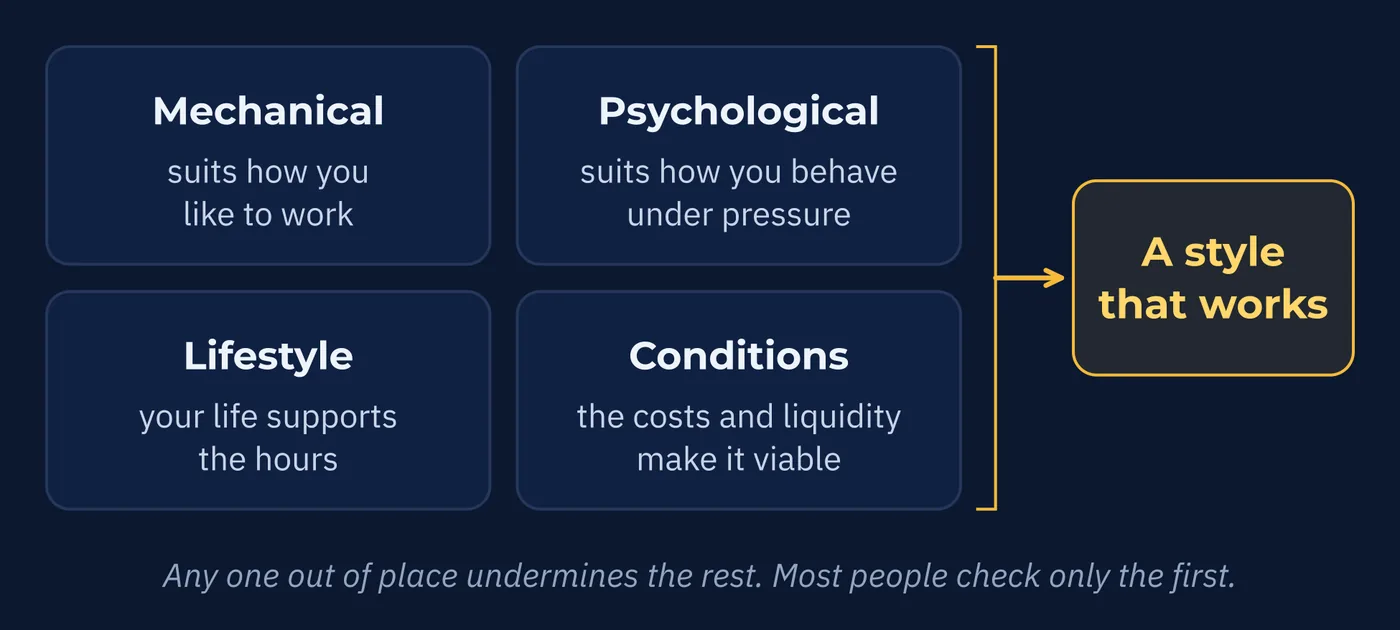
A style works when four things agree. Any one out of place undermines the rest, and it does so before your analysis has had any effect.
| Dimension | The Question It Asks |
|---|---|
| Mechanical | Does the way this style operates suit how you like to work? |
| Psychological | Does it suit how you actually behave under pressure? |
| Lifestyle | Can the life you have support the hours it requires? |
| Conditions | Do the costs and liquidity you can access make it viable? |
Each mismatch fails in its own way, and the failures look different from the outside.
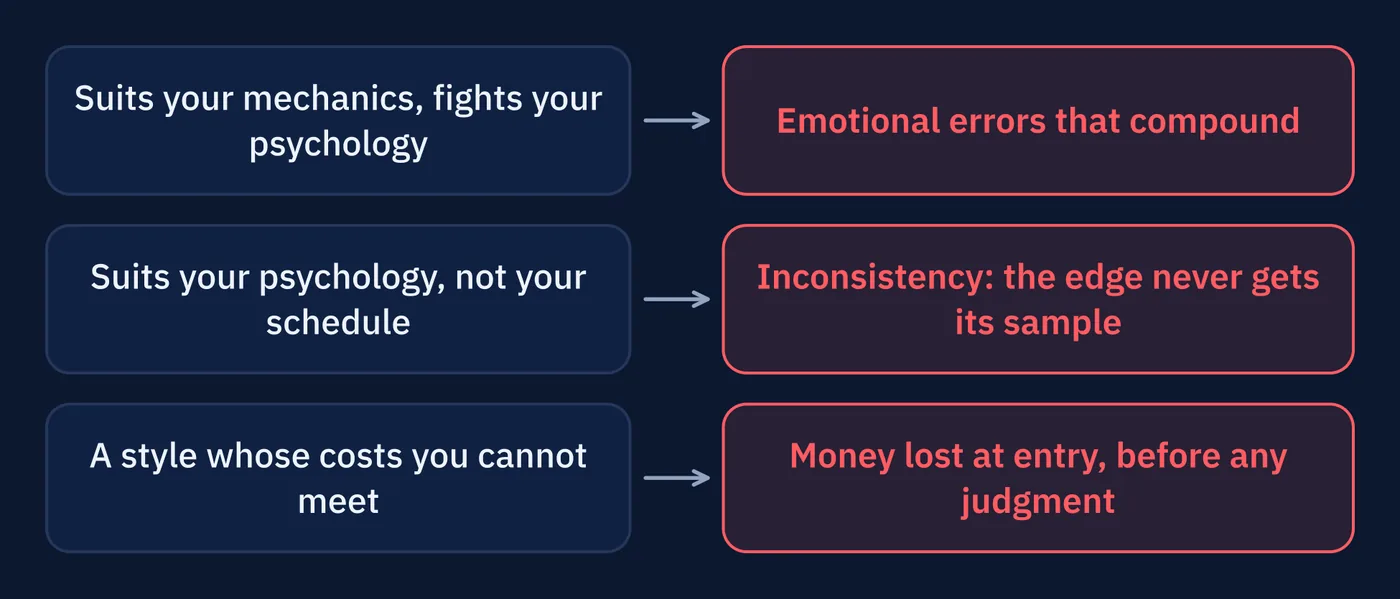
A style that suits your mechanics but fights your psychology produces emotional errors that compound. A style that suits your psychology but not your schedule produces inconsistency, so the edge never gathers the sample it needs. And a style whose costs you cannot meet loses money at entry, before any judgment is made.
Most people check the first one and assume the rest.
3Hours: The Most Binding Constraint
Time is where honesty pays best. It is the least negotiable of the four and the most underestimated.
The figures below include preparation and review, not just chart time. Reviewing a scalping session properly takes about as long as the session did.
| Style | Honest Weekly Commitment | When It Has to Happen |
|---|---|---|
| Scalping | 40 to 50 hours | During specific high-liquidity windows |
| Day trading, one session | 20 to 25 hours | During that session, every day |
| Day trading, both windows | 40 to 50 hours | Across two windows daily |
| Swing trading | 4 to 8 hours | Whenever suits you |
| Position trading | Less again, periodic | Whenever suits you |
Read the top rows against the bottom ones. Scalping and full day trading are jobs. Not demanding hobbies. Jobs, with hours like full-time work and no say in when they fall.
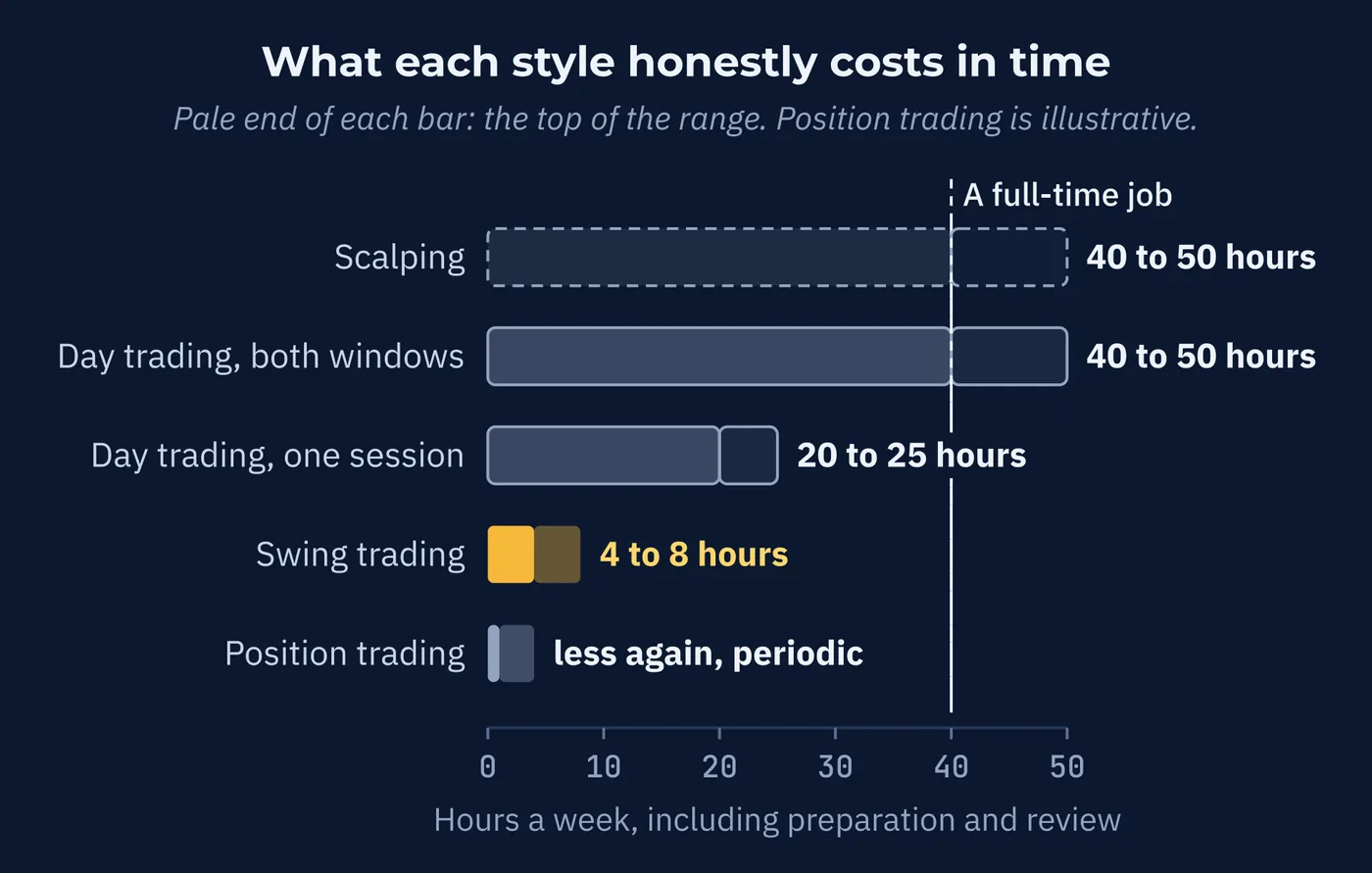
The swing trading figure should look familiar. Lesson 24 put a part-time routine at five to eight hours a week. That was not a coincidence. It was this style, described before it had a name.
4Psychology: Read the Evidence
This one is harder, because most people assess it by asking how they think they would react.
Look instead at what you have already done. Not in trading necessarily, but anywhere the conditions were similar.
| Facet | Ask Yourself | Points Toward Shorter | Points Toward Longer |
|---|---|---|---|
| Decision tempo | How do you decide under time pressure? | Quickly and cleanly | Deliberately, with thought |
| Holding discomfort | Can you sit with something going wrong? | It gnaws at you | You can leave it alone |
| Need for feedback | How often do you need a result? | Daily, or it feels aimless | You are content to wait |
| After losses | What happens after two or three in a row? | You want to act, now | You carry on as planned |
Notice these are not a single scale from less mature to more mature. They are genuinely different profiles.
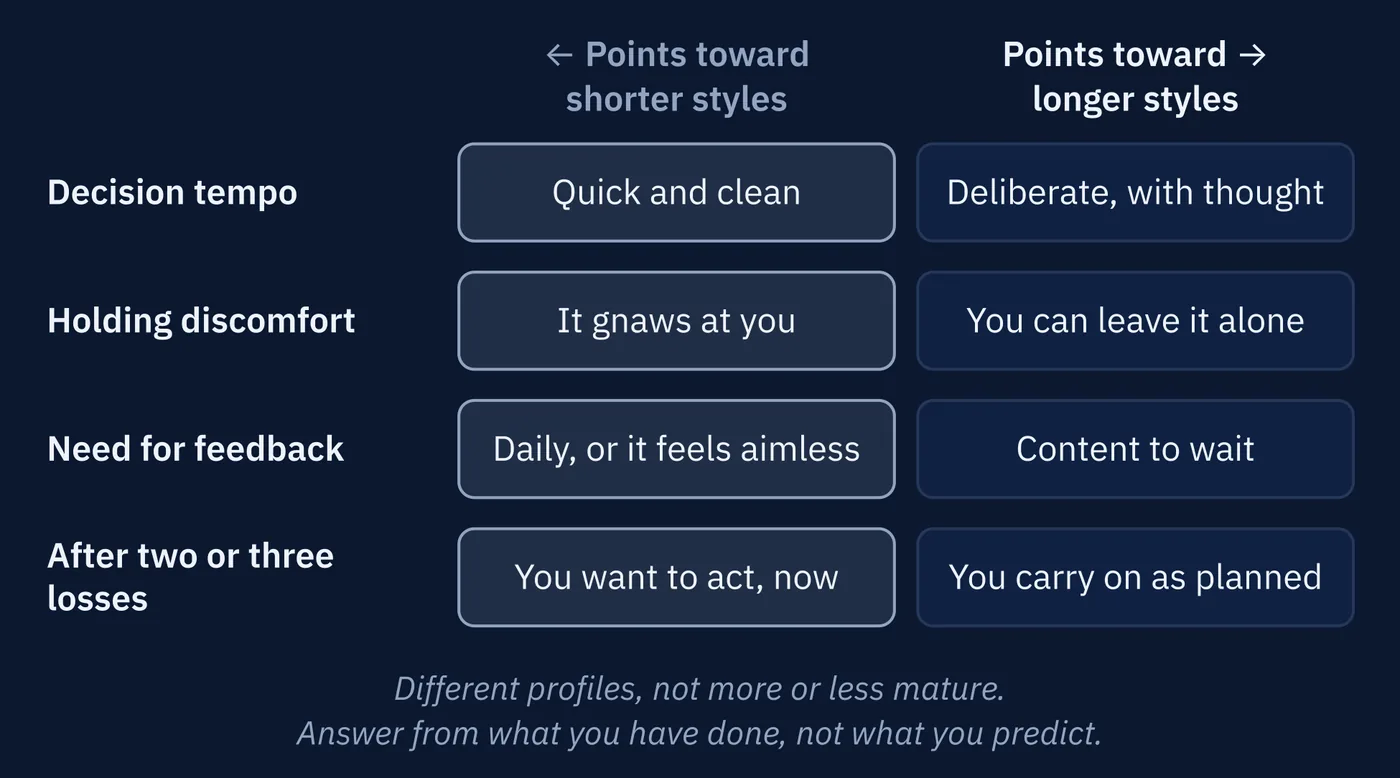
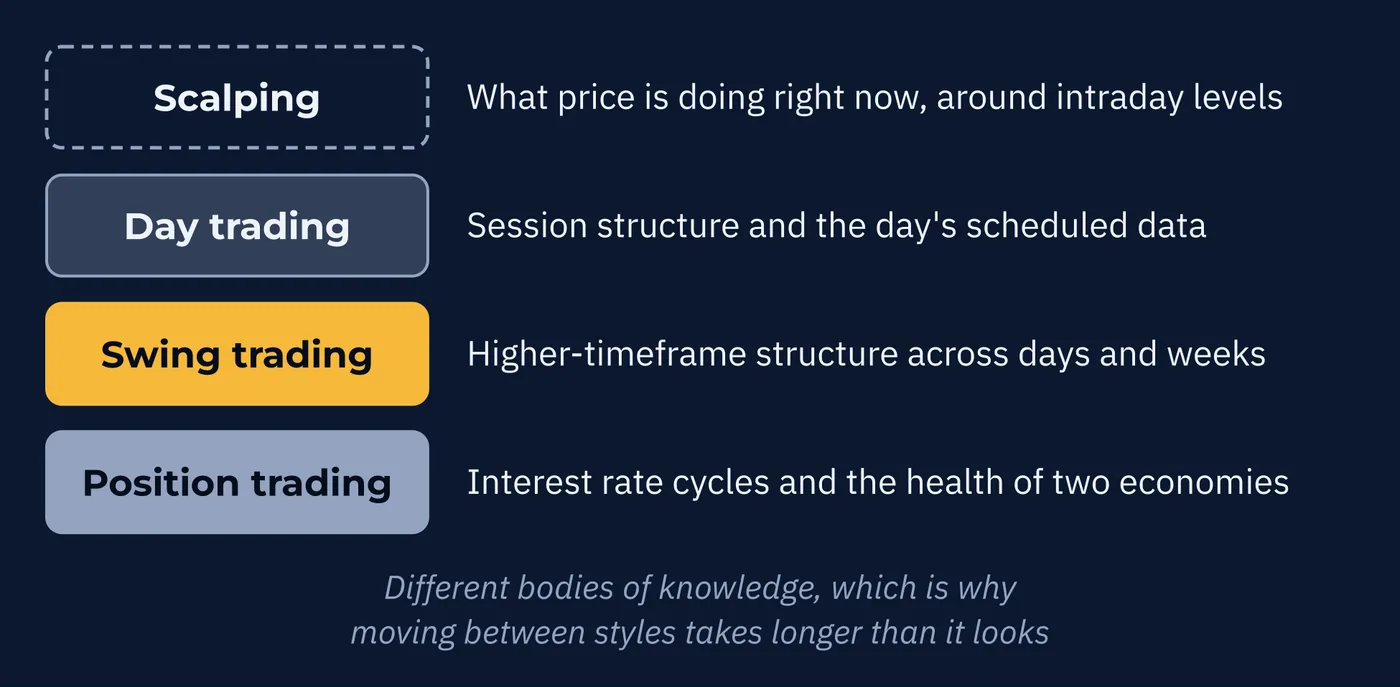
Scalping needs fast decisions, quick acceptance of small losses, and focus through continuous activity. Position trading needs close to the opposite. Holding a view for months. Sitting with a position moving against you. Not acting when doing nothing is correct.
Someone who thrives in one may struggle in the other. It says nothing about their technical ability.
5Capital and Stage
Two more inputs, both connecting to work already done.
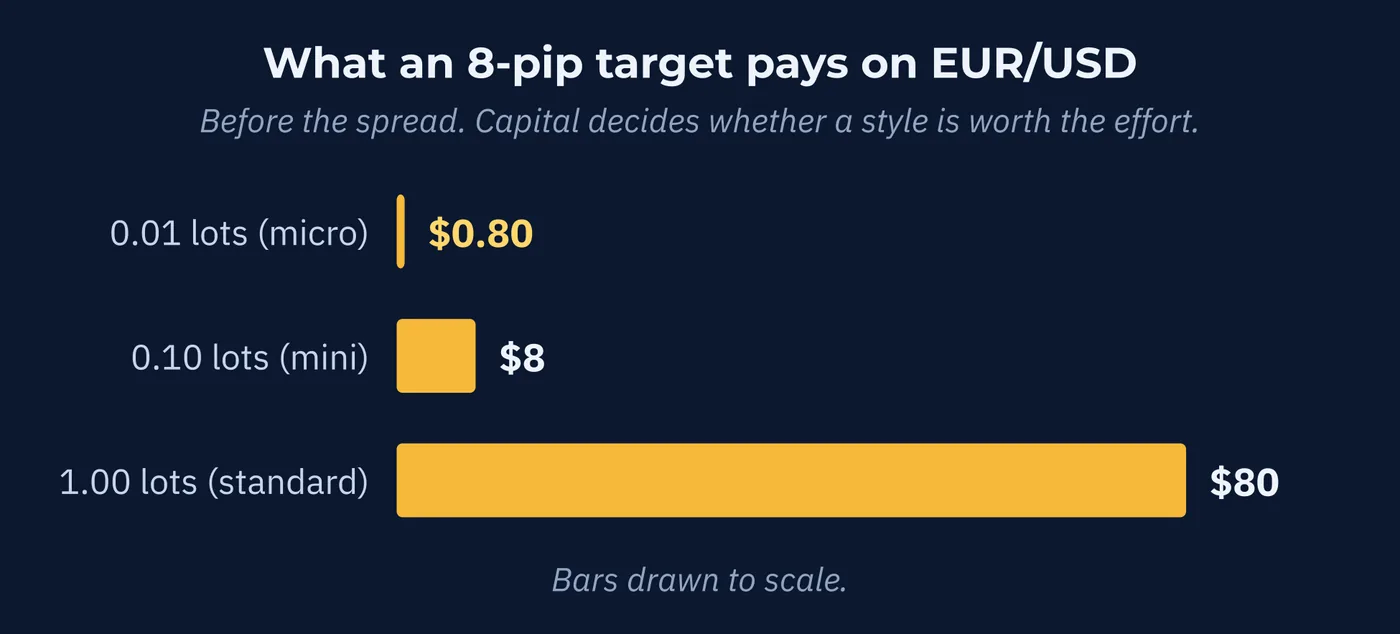
Capital, from Lesson 20, sets which position sizes are open to you. That decides whether a style's usual targets produce anything worth the effort. A style built on eight pip targets needs those pips to be worth something. At micro lot sizes they are worth very little.
Stage of development is the one people most want to skip. Position trading rests on reading the wider economic picture, and that reading develops slowly. It cannot be acquired by deciding to have it.
Which produces an unwelcome but useful observation. Most professional scalpers did not begin as scalpers. The style looks like an entry point, because the trades are small and quick and frequent. It is one of the hardest to execute consistently, and it is usually arrived at rather than started from.
6When They Point Different Ways
In a tidy assessment all four dimensions agree and the answer is obvious. In practice they often conflict, and knowing how to resolve that matters as much as the assessment itself.
The usual conflict is between what suits you and what your circumstances allow. A temperament that suits fast decisions, paired with a schedule that cannot support session hours. An attraction to day trading, paired with a time audit pointing at swing trading.
The most binding constraint wins.
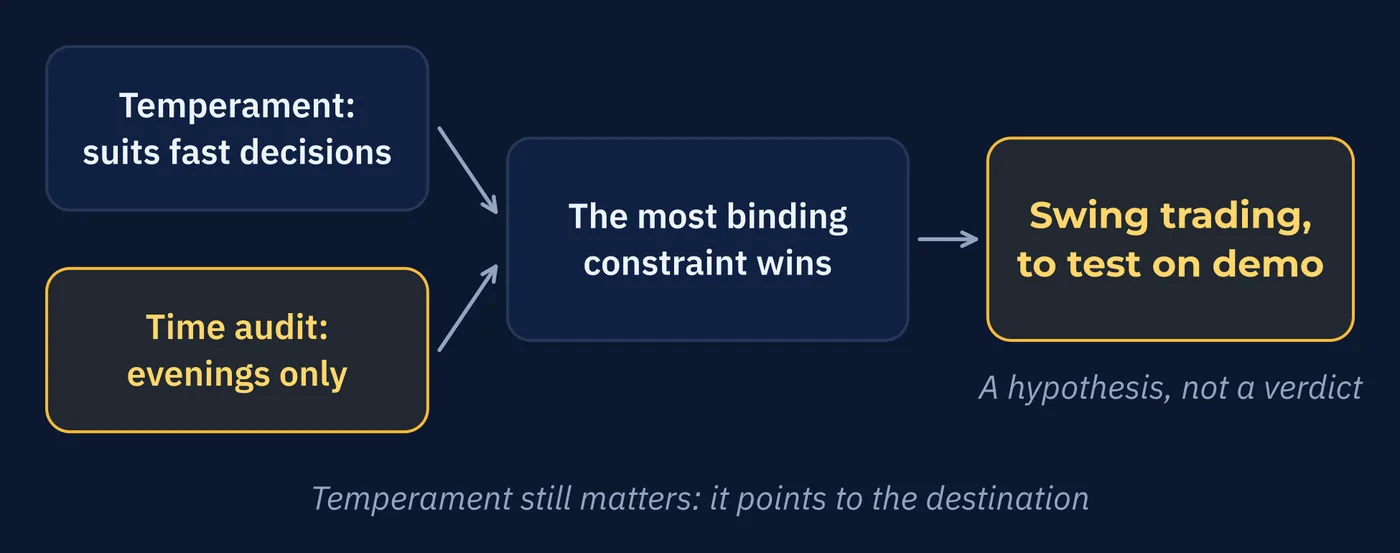
For someone beginning, time and stage of development are almost always the most binding, because they are the least changeable. You cannot acquire macro literacy by wanting it. You cannot make Tuesday afternoon free by preferring that it were.
Preference and temperament still matter. They tell you about the destination rather than the starting point.
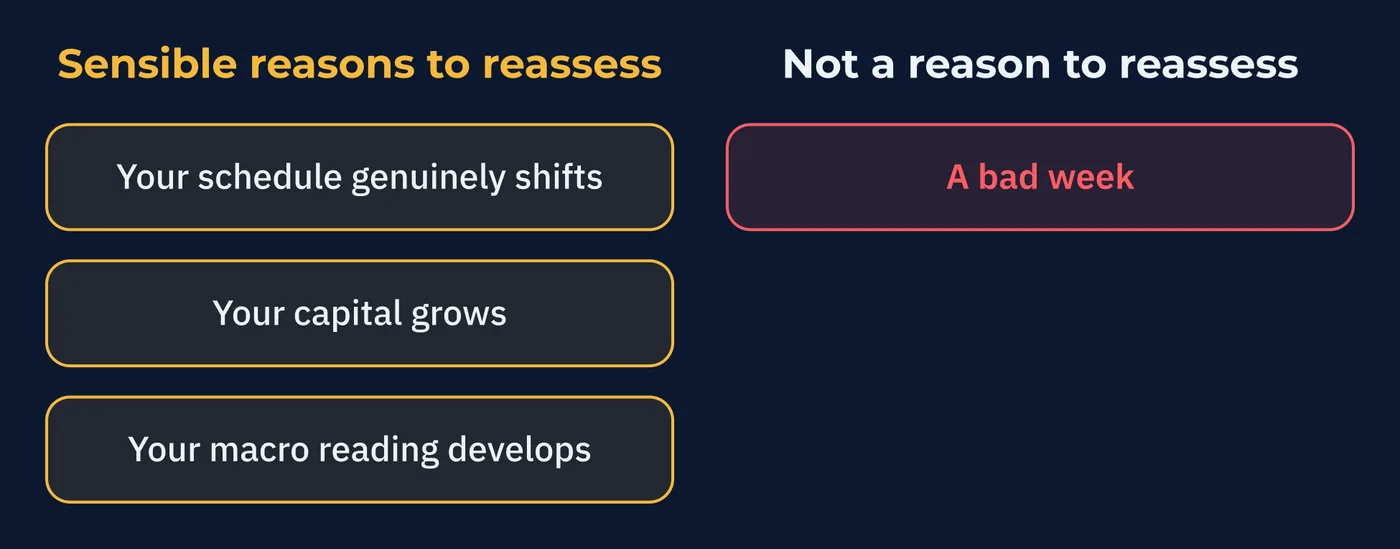
The answer is a hypothesis, not a verdict. Hold it like this: the assessment points here, so this is what I will test on demo for a few months. Circumstances do change. Schedules shift, capital grows, macro literacy develops. Reassessing when something genuinely changes is sensible. Reassessing after a bad week is not.
7Style Drift
One failure mode deserves naming, because it undoes more sound approaches than any technical mistake.
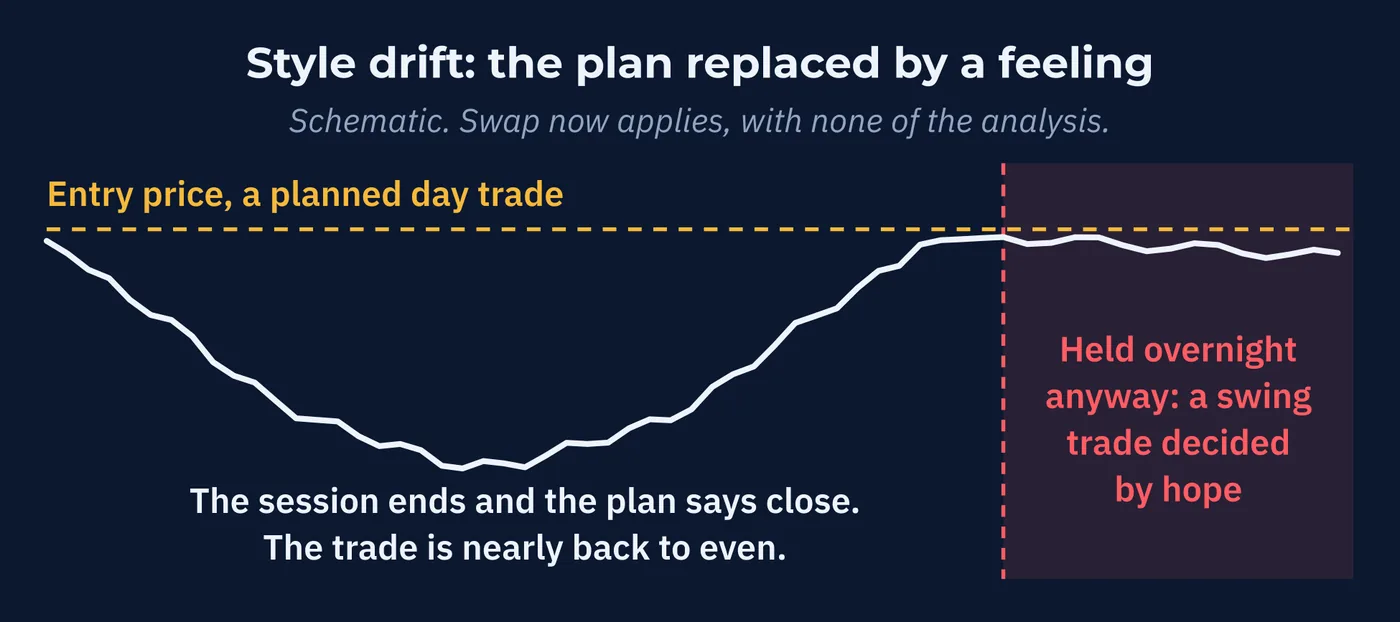
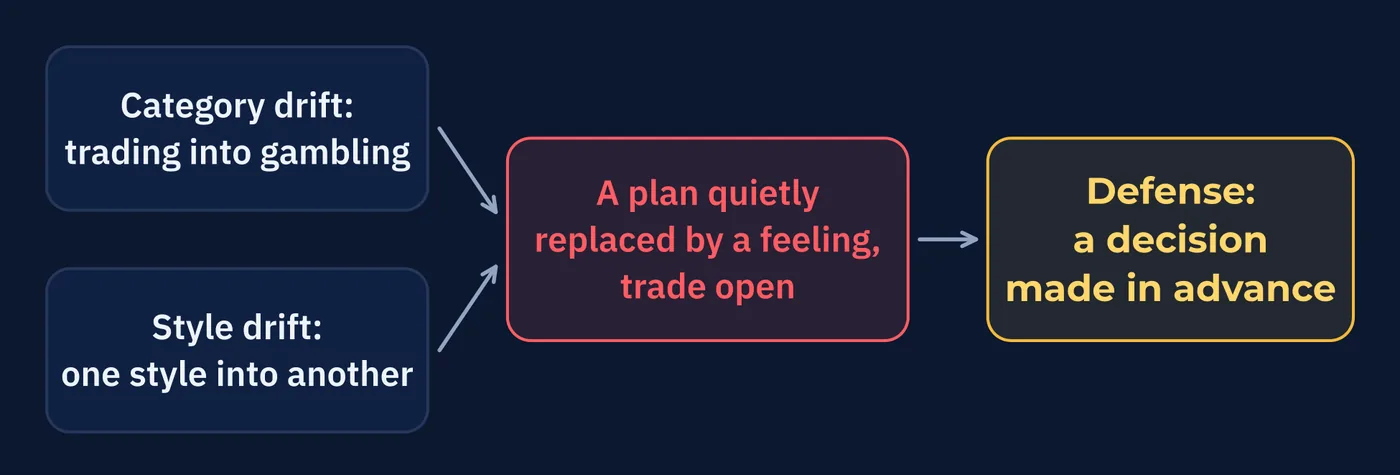
Style drift is changing style in the middle of a live position, without deciding to, because of how the position feels.
| What Happens | What It Was | What It Became |
|---|---|---|
| A swing position closed after two hours because it dipped | A days-to-weeks trade | A day trade, decided by discomfort |
| A day trade held overnight because it is nearly back to even | An intraday trade | A swing trade, decided by hope |
| A scalp left open to see if it runs further | A minutes-long trade | Something with no plan at all |
The middle row does the most damage. It converts a position that never paid swap into one that does, without any of the analysis a swing trade would have required.
8What This Series Was For
Three lessons ago the question was what you are actually doing when you open a position. Four possible answers, and the one that applies depends on you rather than the market.
Then four styles, which are not four speeds but four different jobs with different tools, costs, and hours.
And now four dimensions that have to agree before any of it works.
The thread running through all three is the same, and it is not a comfortable one.
Almost none of this is decided by the market. It is decided by you.
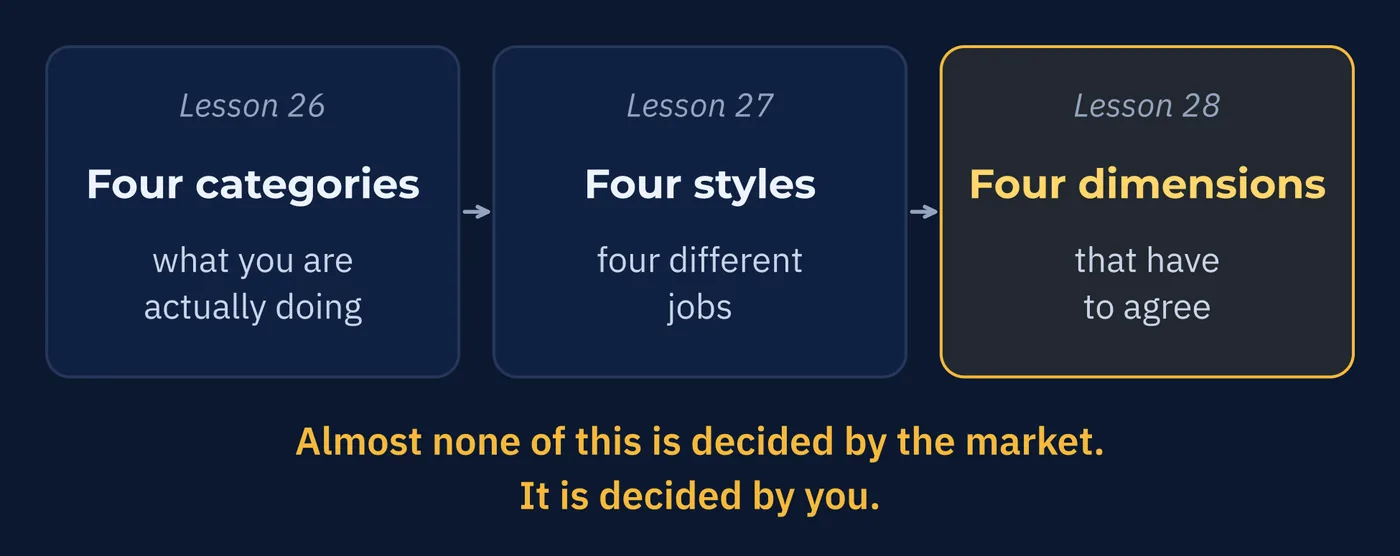
Which category you are in. Which container you put a strategy inside. Whether the hours exist. Whether you can hold through discomfort. The market has no view on any of it and will not adjust to suit your answer.
The next series goes somewhere different. Back to first principles, to what money actually is and where it came from. The answer explains a great deal about why currencies behave as they do.
Three Things to Remember
Try This
Thirty minutes. The answer matters less than the honesty.
Words From This Lesson
| Term | What It Means |
|---|---|
| Mechanical fit | Whether the way a style operates suits how you prefer to work. |
| Psychological fit | Whether a style suits how you actually behave under pressure, judged from evidence. |
| Lifestyle fit | Whether your available hours, and when they fall, can support the style. |
| Style drift | Changing style mid-position, unconsciously, because of how the trade feels. |
| Stage of development | How far your knowledge and tested experience have progressed. One of the least changeable constraints. |
| Binding constraint | The limit that decides the outcome because it is the least negotiable. |
Test Your Knowledge
Eight questions. Answer them all before checking the key on the following pages. If a question gives you trouble, the answer key tells you which section to revisit.
- A. They measure stated preferences rather than actual circumstances
- B. They ask too few questions
- C. They are designed to sell something
- D. They only cover two of the four styles
- A. Entry, exit, stop, and target
- B. Capital, leverage, spread, and swap
- C. Mechanics, psychology, lifestyle, and conditions
- D. Pair, session, timeframe, and size
- A. 1 to 2 hours
- B. 4 to 8 hours
- C. 20 to 25 hours
- D. 40 to 50 hours
- A. By predicting how you would react
- B. From evidence of how you have actually behaved under pressure
- C. By taking a personality test
- D. By trying every style with real money
- A. Temperament, since psychology matters most
- B. Neither, so avoid trading entirely
- C. The schedule, because it is the more binding constraint
- D. Whichever you feel more strongly about
- A. Only switching to a different chart timeframe
- B. Nothing beyond adjusting position size
- C. Opening a second account
- D. Changing what you analyze, since the styles rest on different bodies of knowledge
- A. Style drift
- B. Good risk management
- C. A correct application of a stop loss
- D. Position sizing working as intended
- A. Greater willpower in the moment
- B. Checking the chart more frequently
- C. Trading a smaller size
- D. A decision made in advance, specific enough that departing from it is obvious
Answer Key
Each answer explains why the correct choice is correct, why the others are not, and where to reread.
Question 1 · correct answer A
A preference reflects who you would like to be. Someone drawn to day trading answers day trading questions favorably regardless of whether their afternoons are free.
B treats it as a problem of length rather than of the kind of question being asked. C assumes bad intent, when the flaw exists even in well-meant quizzes. D is wrong because coverage is not the issue.
Review: Section 1, The Wrong Question
Question 2 · correct answer C
Mechanical fit, psychological fit, lifestyle fit, and the cost and liquidity conditions the style requires. Any one out of place undermines the rest.
B lists costs from Series A, which are inputs rather than dimensions of fit. A describes the parts of a single trade. D describes choices made within a style rather than the choice of style itself.
Review: Section 2, Four Things Have to Line Up
Question 3 · correct answer B
Four to eight hours weekly, being thirty to sixty minutes on most days plus a longer weekend review. Close to the five to eight hours Lesson 24 gave for a part-time routine.
A is too little to sustain the routine consistently. C corresponds to single-session day trading. D corresponds to scalping or full day trading, which are closer to full-time employment.
Review: Section 3, Hours
Question 4 · correct answer B
Past behavior under similar conditions is observable. Predictions about your own reactions tend to describe who you hope to be.
A is exactly the unreliable method this lesson warns against. C measures general traits rather than conduct under financial pressure. D is an expensive way to learn something a demo account reveals for nothing.
Review: Section 4, Psychology
Question 5 · correct answer C
The most binding constraint takes priority, and for someone beginning, time availability is almost always the least changeable of the four.
A inverts the priority, since temperament indicates a destination rather than a starting point. B overreacts, because a suitable style almost certainly exists. D substitutes preference for assessment, which is the original problem.
Review: Section 6, When They Point Different Ways
Question 6 · correct answer D
A scalper reads immediate price behavior. A position trader reads interest rate cycles and economic health. Those are different bodies of knowledge, not different zoom levels.
A is the assumption the callout in Section 4 exists to correct. C is unnecessary and unrelated. B confuses a risk decision with an analytical framework.
Review: Section 4, Psychology
Question 7 · correct answer A
A swing trade is a days-to-weeks position. Closing it in two hours because of discomfort converts it into a day trade, decided by feeling rather than by plan.
B mistakes an unplanned exit for risk management, which would have been defined in advance. C is wrong because no stop was reached. D describes sizing, which had nothing to do with the exit.
Review: Section 7, Style Drift
Question 8 · correct answer D
A decision made in advance, specific enough that breaking it is obvious while it happens, is what makes drift visible in real time rather than in hindsight.
A relies on willpower at exactly the moment it is weakest. C reduces the cost of drifting without preventing it. B increases exposure to the discomfort that causes drift in the first place.
Review: Section 7, Style Drift
Keep going
What You Are Actually Doing is written by Kanin D. Alldredge for The Currency Classroom, and it is free to read. There is more free from CNS: start here.
Start free with CNS →