What Money Actually Is

1Trust in What, Exactly?
Lesson 1 made a claim and moved on quickly. A twenty dollar bill costs six cents to make and buys twenty dollars of goods, because everyone agrees it does. Money is trust, printed.
That is true. It is also incomplete in a way worth fixing, because it leaves the obvious question unanswered.
Trust in what?
Not a vague social feeling. Something specific enough that you could watch it weaken and see the currency fall as it did. That is the question this lesson answers, and the answer turns out to have four parts.
But first, a prior question. What is money for?
2Money Is a Job, Not a Thing
Ask most people what money is and they describe an object. Notes, coins, a balance in an app.
That is the wrong kind of answer, and history proves it. Shells have been money. Salt has been money. Grain, cattle, silver, and enormous carved stones have all been money at various times and places.
Money is defined by what it does, not what it is made of.
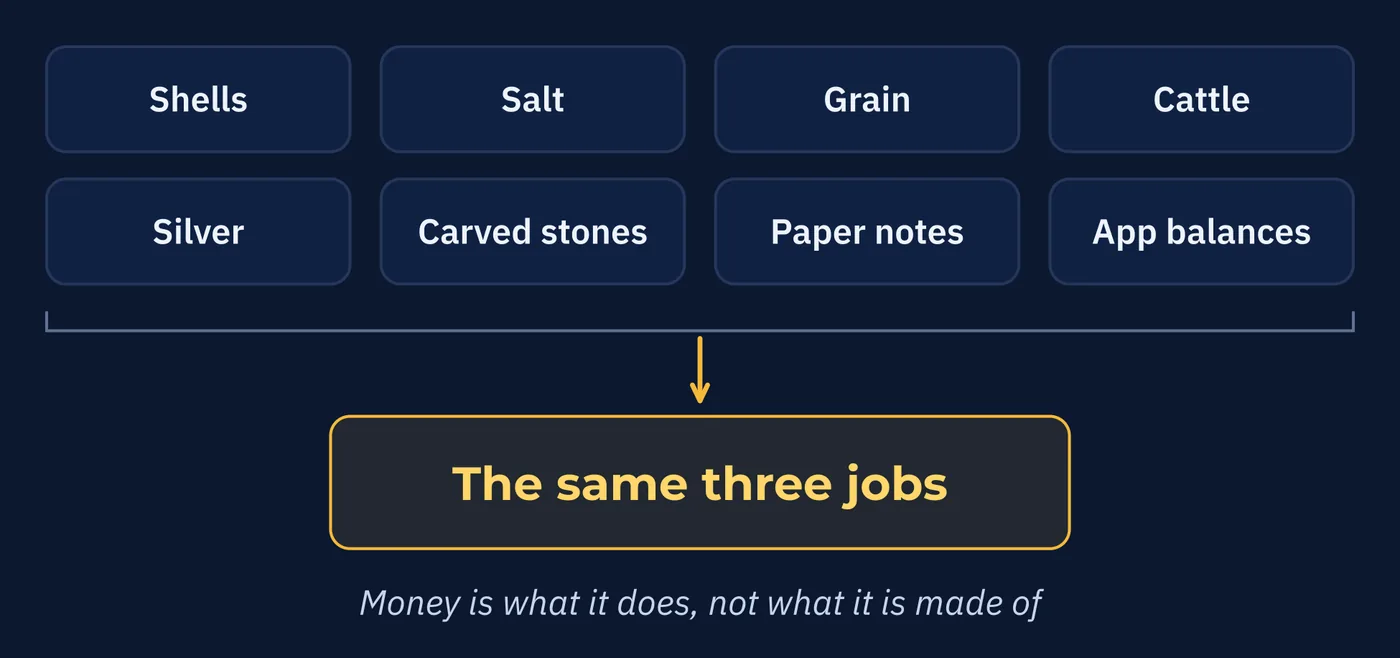
And what it has to do is three jobs, all at the same time.
| The Job | What It Means | The Test |
|---|---|---|
| Medium of exchange | People will accept it in return for real things | Can you spend it? |
| Store of value | It holds its worth over a reasonable stretch of time | Is it still worth something next year? |
| Unit of account | Things get priced in it | Are the shop's labels written in it? |
A healthy currency does all three without anybody thinking about it. You spend dollars, you keep dollars, and prices are written in dollars. Three jobs, invisible, held together.
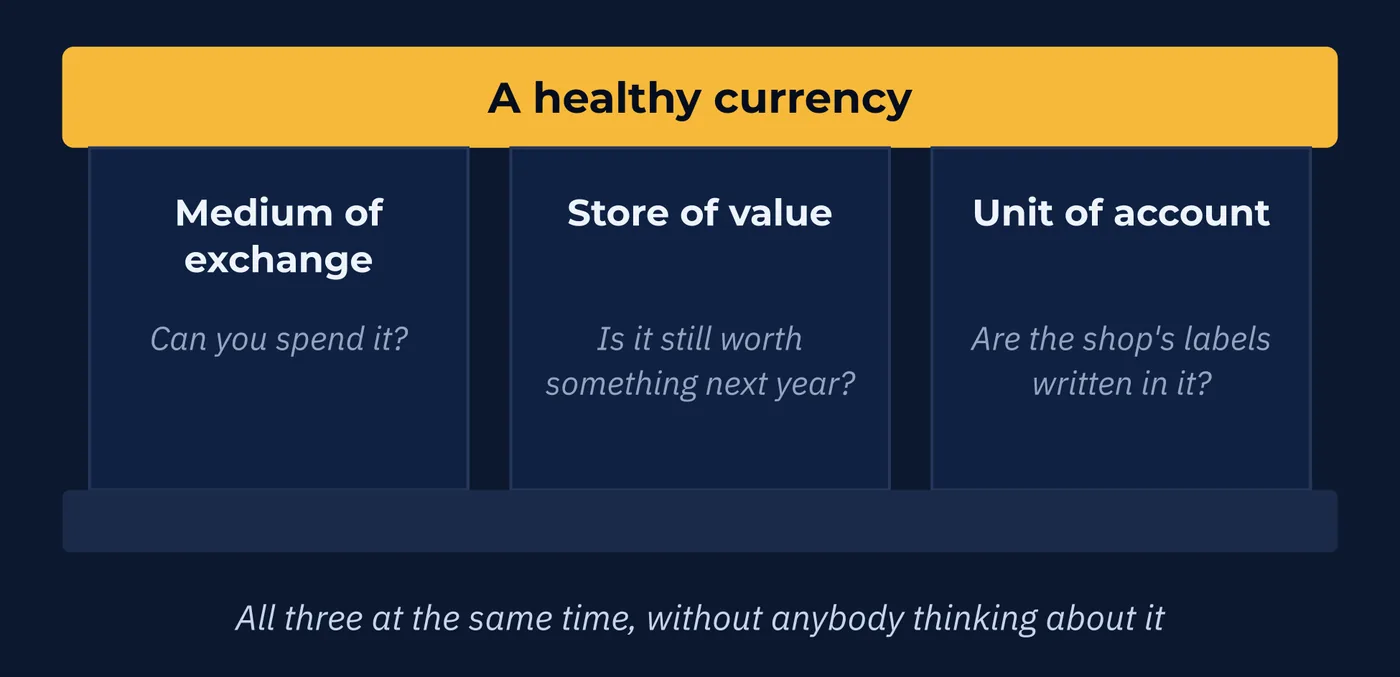
That invisibility is the point. You only notice the three functions when one of them starts to come apart.
3When One Job Fails
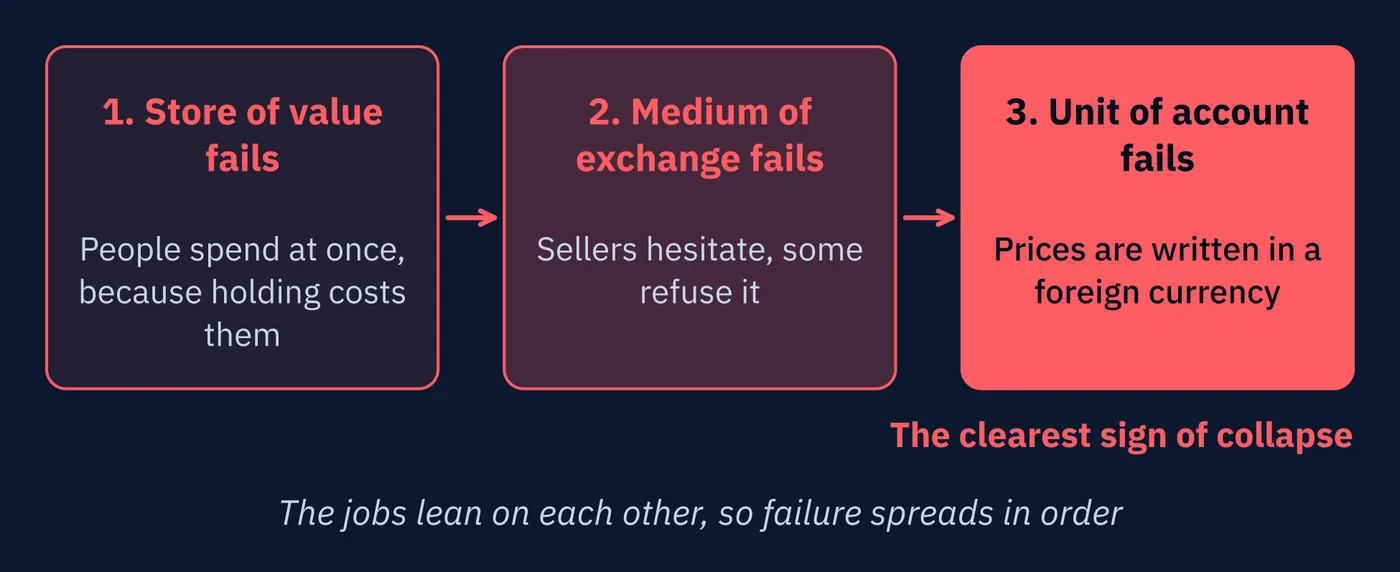
The three functions are not independent. They lean on each other, which means failure spreads in a predictable order.
Store of value goes first. Prices climb quickly enough that holding the currency becomes a losing proposition. People who have money spend it immediately rather than keep it, because keeping it costs them.
Medium of exchange goes next. Sellers begin to hesitate, because by the time they spend what they took in this morning it will buy less. Some refuse it. Others demand something else.
Unit of account goes last, and its failure is the clearest signal of all. Prices stop being quoted in the currency. Shops start writing their labels in a foreign one.
4How We Got to Fiat
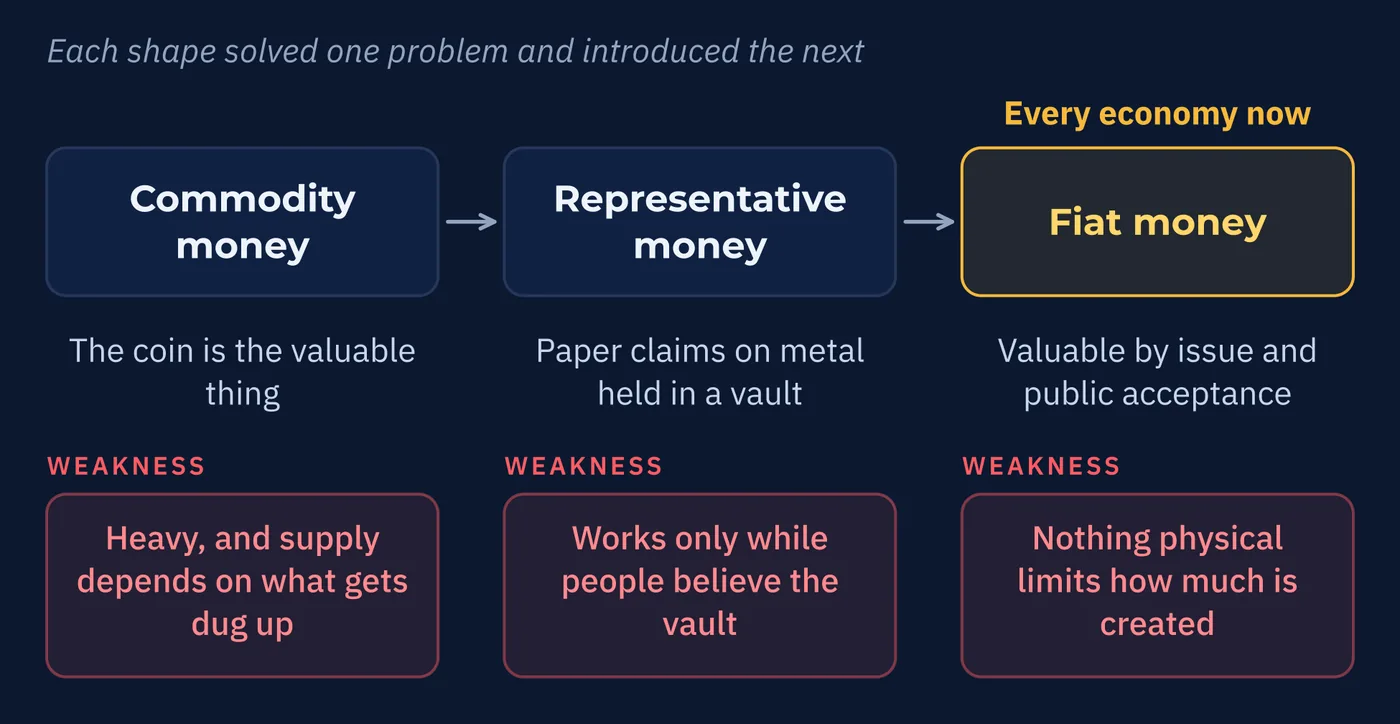
Monetary systems have taken three broad shapes, and each one solved the previous problem while introducing a new one.
| System | How It Worked | Its Weakness |
|---|---|---|
| Commodity money | The money was the valuable thing. Coins of silver or gold. | Heavy, hard to move, and supply depends on what gets dug up. |
| Representative money | Paper claims redeemable for a commodity held in a vault. | Only works while people believe the vault holds what it claims. |
| Fiat money | Currency valuable by government issue and public acceptance. | Nothing physical limits how much can be created. |
Every economy in the world now runs the third one. Lesson 1 named it and dated the moment the United States left the second: 1971, when foreign governments could no longer redeem dollars for gold.
What Lesson 1 did not say is what replaced the gold.
5Backed by Nothing Is Wrong
You will hear fiat currency described as backed by nothing. It is a common phrase and it sounds sophisticated.
It is also wrong, and it hides something worth seeing. Fiat money rests on four things.
| Pillar | What It Provides |
|---|---|
| Legal tender status | The currency must be accepted by law as payment for debts. |
| The taxing power of the state | Taxes are owed in it, so everyone must acquire some. |
| The productive capacity of the economy | There are real goods and services the currency can buy. |
| The credibility of the institution managing it | Someone competent and believable controls the supply. |
That is not nothing. It is a structure, and each part carries load.
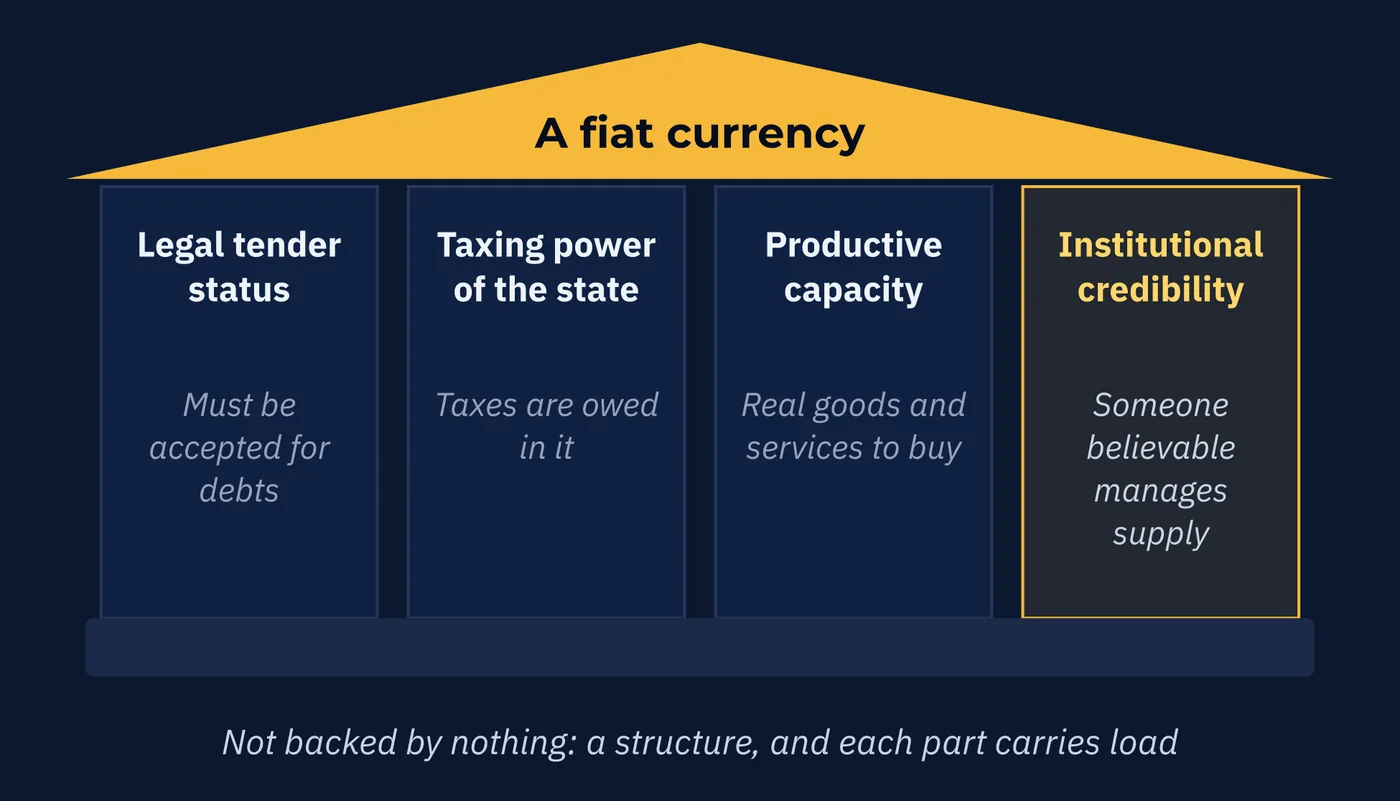
Remove legal tender status and contracts and debts lose their anchor. Remove the productive capacity and the currency buys nothing because there is nothing to buy. Remove the credibility of the institution and everything else starts to wobble, which is the subject of Section 7.
6The Pillar Nobody Mentions
The second pillar deserves its own moment, because most people have never considered it and it is genuinely clever.
Your government demands taxes, and it demands them in its own currency. Not in gold, not in a foreign currency, not in goods.
Which means every person and business in the country has to acquire that currency, every year, whether they like it or not. Not because they trust it. Because the alternative is a legal problem.
Taxation creates permanent demand for a currency, by law.
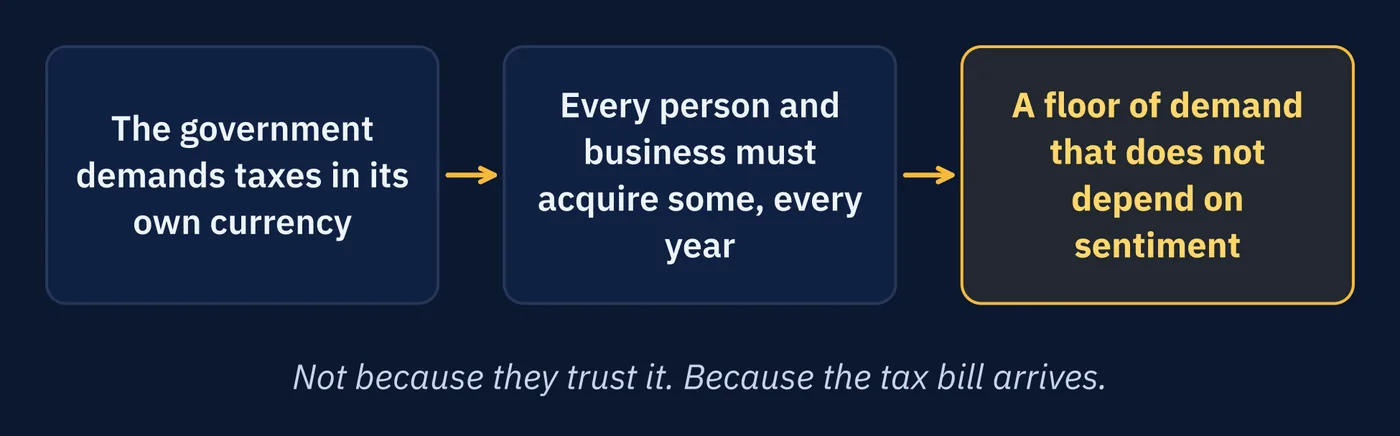
That is a floor under the currency that exists regardless of sentiment. It does not depend on anyone finding the currency attractive or the government popular. It exists because the tax bill arrives.
Which is also why currency collapses are so revealing. When a currency fails badly enough that people abandon it despite owing taxes in it, the failure has overwhelmed one of the strongest structural supports a currency has.
7Credibility Moves First
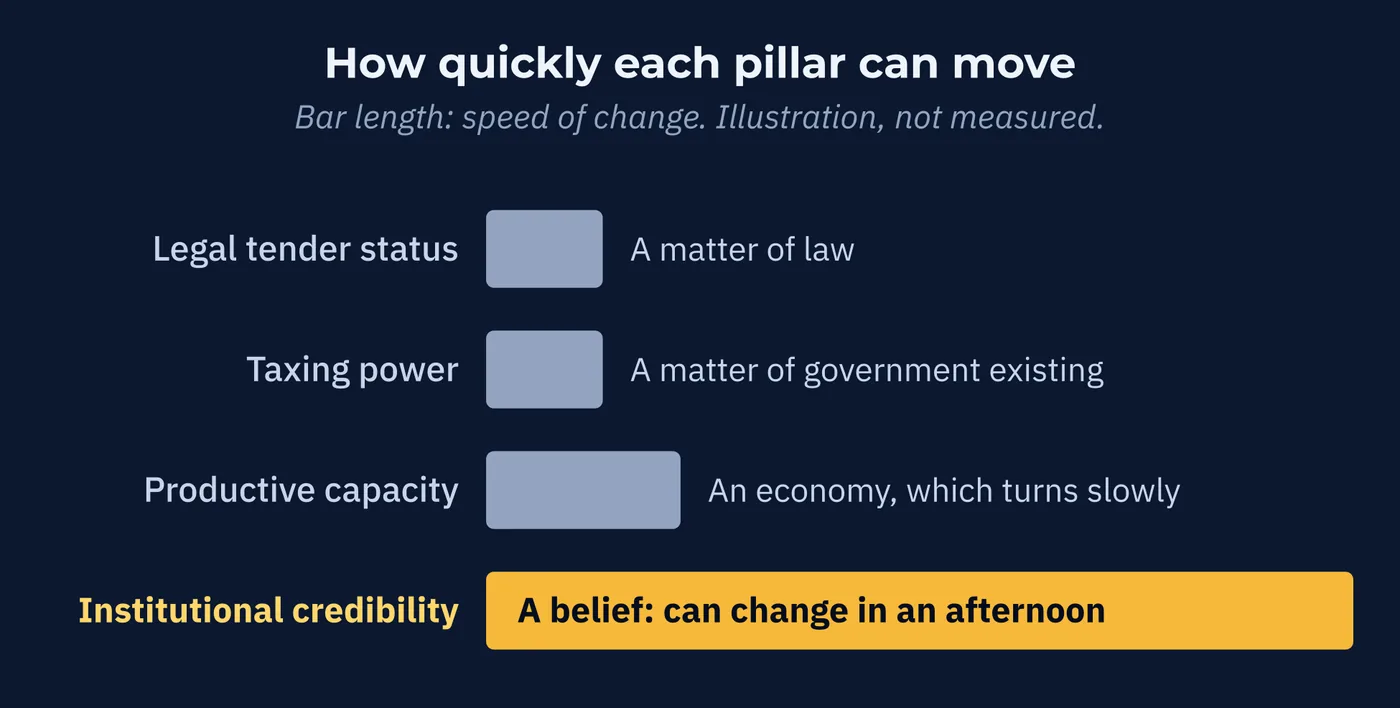
Of the four pillars, three change slowly. Legal tender status is a matter of law. Taxing power is a matter of government existing. Productive capacity is an economy, and economies turn slowly.
The fourth moves fast. Institutional credibility is a belief about whether the people managing the currency are competent, independent, and likely to keep doing sensible things.
Beliefs can change in an afternoon.
Which produces something important for a trader, and it explains something Lesson 10 raised without explaining.
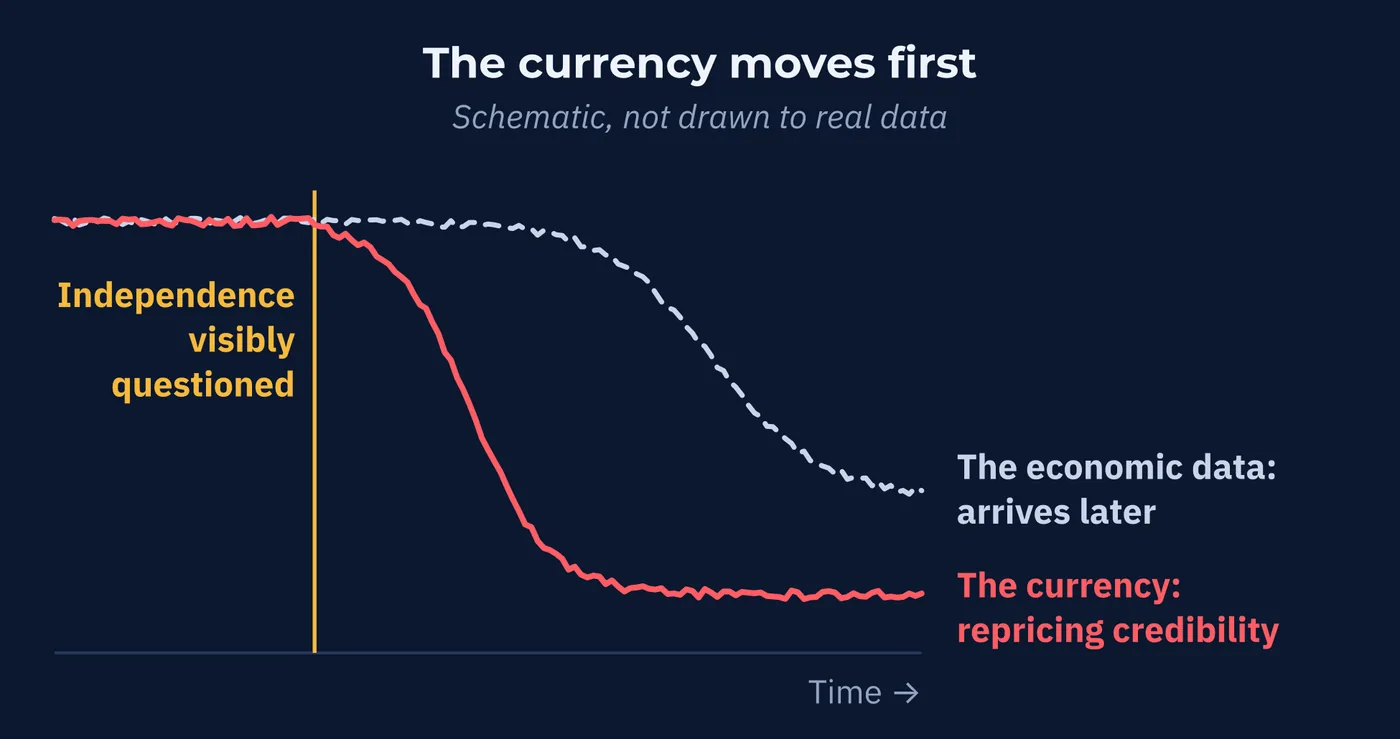
Which is worth examining, because it explains why currency traders pay such close attention to things that are not numbers. A central bank losing its independence, a government losing the confidence of international lenders, a policy decision that arrives without explanation. None of those appear in an economic release, and all of them move currencies.
8Every System Is a Trust Architecture
One last thing, and it is the point the whole lesson has been building toward.
It would be easy to read the four pillars and conclude that fiat money is uniquely fragile. Gold-backed money looks sturdier by comparison, because at least there was metal involved.
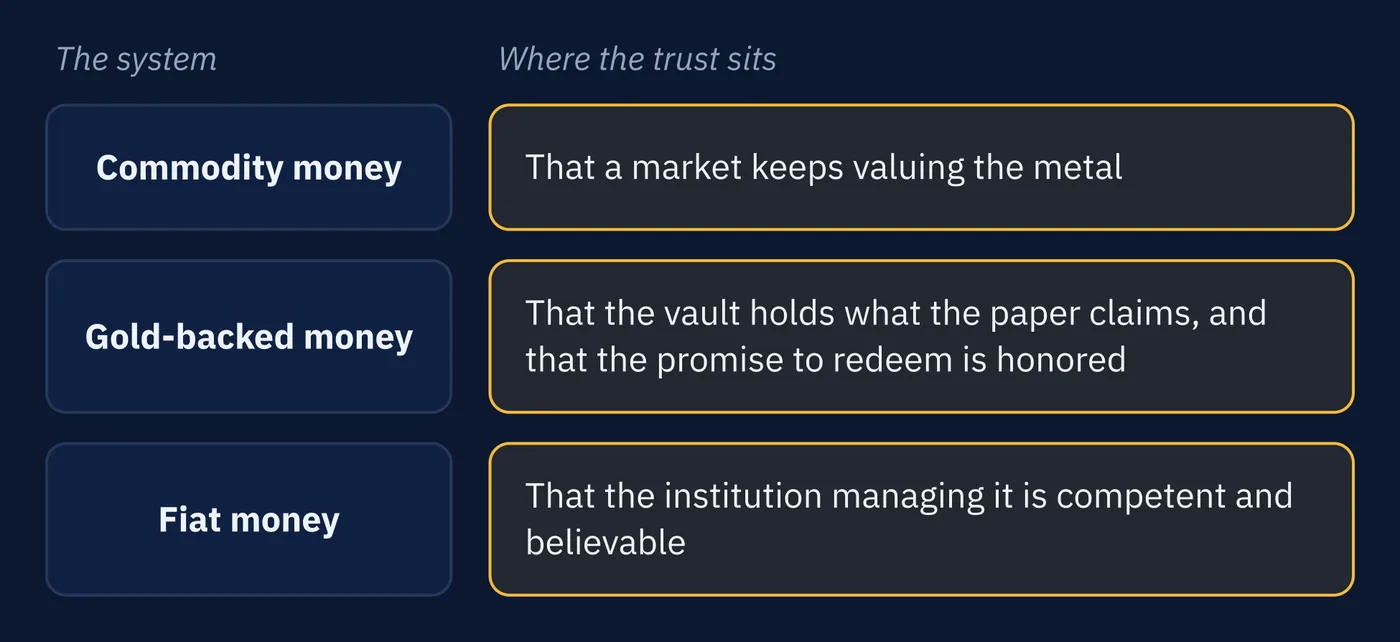
But gold-backed money also rested on trust. Trust that the vault held what the paper claimed. Trust that the promise to redeem would be honored. Trust that the metal would continue to be valued by other people, which is itself only a convention that has lasted a very long time.
Commodity money was the same. A silver coin is worth something because a market values silver, and that valuation is a collective agreement rather than a physical property.
Every monetary system is a trust architecture. Only the location of the trust changes.
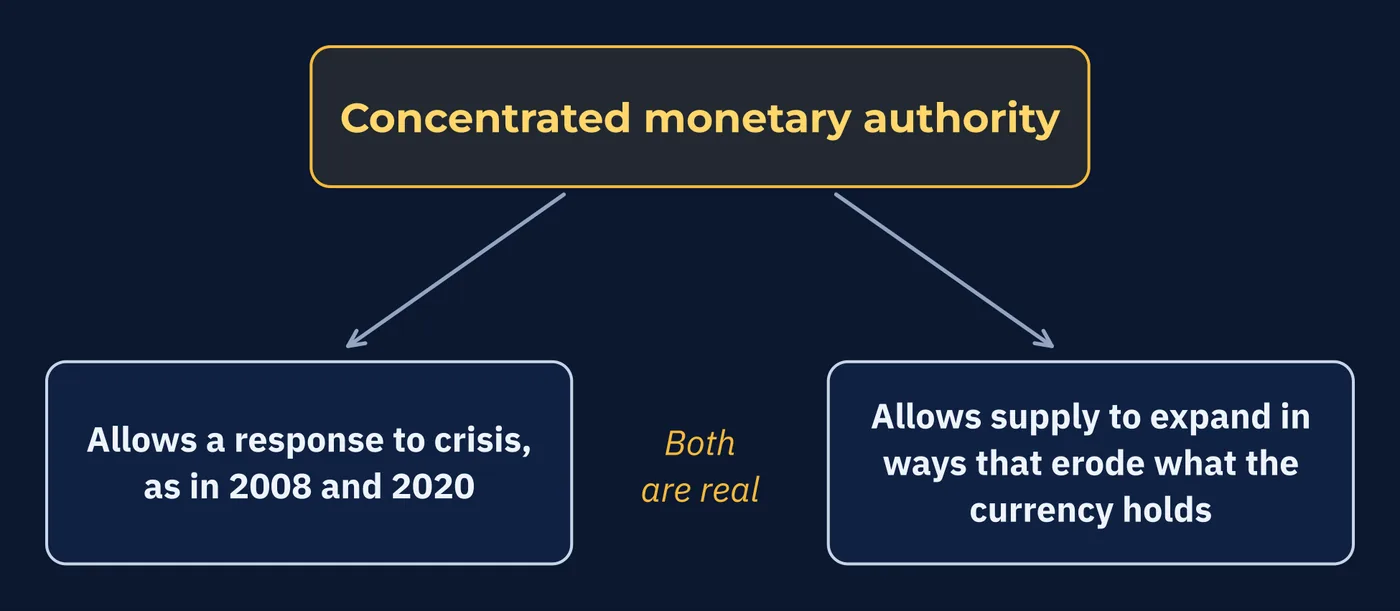
So Lesson 1's answer stands, with a better foundation under it. Money is trust. What this lesson adds is where the trust sits, and which part of it can move quickly enough to matter to a chart.
The next lesson goes one layer further down. If money is created rather than mined, then somebody creates it, and the answer to who is not the one most people assume.
Three Things to Remember
Try This
Fifteen minutes. Test the three functions on money you actually hold.
Words From This Lesson
| Term | What It Means |
|---|---|
| Medium of exchange | Money's function as something people will accept in return for goods and services. |
| Store of value | Money's function as something that holds its worth over time. |
| Unit of account | Money's function as the common measure things are priced in. |
| Commodity money | Money that is itself the valuable thing, such as silver or gold coins. |
| Representative money | Paper claims that can be redeemed for a commodity held in reserve. |
| Fiat money | Currency valuable because a government issues it and people accept it. Every major currency today. |
| Legal tender | Currency that must be accepted by law as payment for debts. |
| Institutional credibility | Belief that the body managing a currency's supply is competent, independent, and predictable. |
Test Your Knowledge
Eight questions. Answer them all before checking the key on the following pages. If a question gives you trouble, the answer key tells you which section to revisit.
- A. The functions it performs
- B. The material it is made from
- C. Whether a government issues it
- D. Whether it is backed by gold
- A. Saving, spending, and lending
- B. Issuance, circulation, and redemption
- C. Value, scarcity, and portability
- D. Medium of exchange, store of value, unit of account
- A. Medium of exchange
- B. Unit of account
- C. Store of value
- D. They fail simultaneously
- A. A minor inconvenience for tourists
- B. The unit of account function has failed, the clearest sign of collapse
- C. A deliberate government policy
- D. A temporary effect of high interest rates
- A. Legal tender status
- B. The taxing power of the state
- C. Gold held in reserve
- D. The credibility of the institution managing supply
- A. Tax revenue is used to buy the currency
- B. Taxation guarantees the currency against inflation
- C. Taxes reduce the money supply
- D. Everyone must acquire the currency to pay taxes, creating baseline demand
- A. Legal tender status
- B. Institutional credibility
- C. Productive capacity
- D. The taxing power of the state
- A. Markets reprice institutional credibility rather than waiting for numbers
- B. Data is always published late
- C. Traders have access to unpublished figures
- D. Currency prices are set independently of economies
Answer Key
Each answer explains why the correct choice is correct, why the others are not, and where to reread.
Question 1 · correct answer A
Shells, salt, grain, silver, and digital entries have all been money. What they had in common was performing the three functions, not any shared material.
B is the intuitive answer and the one history disproves repeatedly. C describes fiat money specifically, which is one kind rather than the definition. D describes a backing arrangement that most money has never had.
Review: Section 2, Money Is a Job, Not a Thing
Question 2 · correct answer D
Money must be accepted in exchange, hold its worth over time, and serve as the measure things are priced in. All three, at once.
A lists things you do with money rather than functions it performs. C lists useful properties, which support the functions without being them. B describes how currency is issued and managed.
Review: Section 2, Money Is a Job, Not a Thing
Question 3 · correct answer C
Store of value goes first. Prices rise fast enough that holding the currency loses money, so people spend it immediately rather than keep it.
A follows second, as sellers begin hesitating to accept something losing value. B fails last and is the clearest sign of full collapse. D is wrong because the functions lean on each other, so failure spreads in order.
Review: Section 3, When One Job Fails
Question 4 · correct answer B
When shops price goods in a foreign currency, the domestic one has lost its role as the measure of value. That is the final function to go.
A badly understates what the signal means. C reverses it, since governments resist this rather than choose it. D confuses a monetary collapse with an ordinary policy effect.
Review: Section 3, When One Job Fails
Question 5 · correct answer C
Gold reserves belong to representative money, the system fiat replaced. The four pillars are legal tender status, taxing power, productive capacity, and institutional credibility.
A, B, and D are all genuine pillars. The gold answer is tempting because backing is what people assume money needs, which is exactly the assumption this section corrects.
Review: Section 5, Backed by Nothing Is Wrong
Question 6 · correct answer D
Taxes are owed in the national currency, so every person and business must acquire some regardless of what they think of it. That produces demand by law rather than by sentiment.
A describes a transaction that does not happen, since tax is collected in the currency rather than used to buy it. C describes one possible effect of fiscal policy, not the pillar. B overstates it enormously, as taxation guarantees nothing about inflation.
Review: Section 6, The Pillar Nobody Mentions
Question 7 · correct answer B
Credibility is a belief about the people managing the currency, and beliefs can change in an afternoon. The other three are matters of law, government, and the real economy.
A changes only through legislation. D changes only if the state itself changes. C is an economy, which turns slowly even under stress.
Review: Section 7, Credibility Moves First
Question 8 · correct answer A
Markets price expectations. A visible loss of central bank independence changes what people expect long before it shows up in growth, inflation, or employment figures.
B describes a publication delay that does not account for moves of this size. C alleges access that ordinary participants do not have. D is wrong because currencies are tightly connected to their economies, just not on the same timetable.
Review: Section 7, Credibility Moves First
Keep going
Where Money Came From is written by Kanin D. Alldredge for The Currency Classroom, and it is free to read. There is more free from CNS: start here.
Start free with CNS →