The Four Trading Styles

1The Same Strategy, Three Different Trades
Take one strategy. A simple one: wait for the price to break out of a range, then trade in the direction of the break.
Now run it on three timeframes.
| Run On | The Trade Lasts | What You Are Reacting To |
|---|---|---|
| One-minute chart | Seconds to minutes | A brief burst of order flow |
| Thirty-minute chart | Hours | A session finding its direction |
| Daily chart | Days to weeks | A structural shift in the market |
Same rule. Same logic. Same words on paper.
They are not the same trade at three speeds. They are three different trades that happen to share a name.
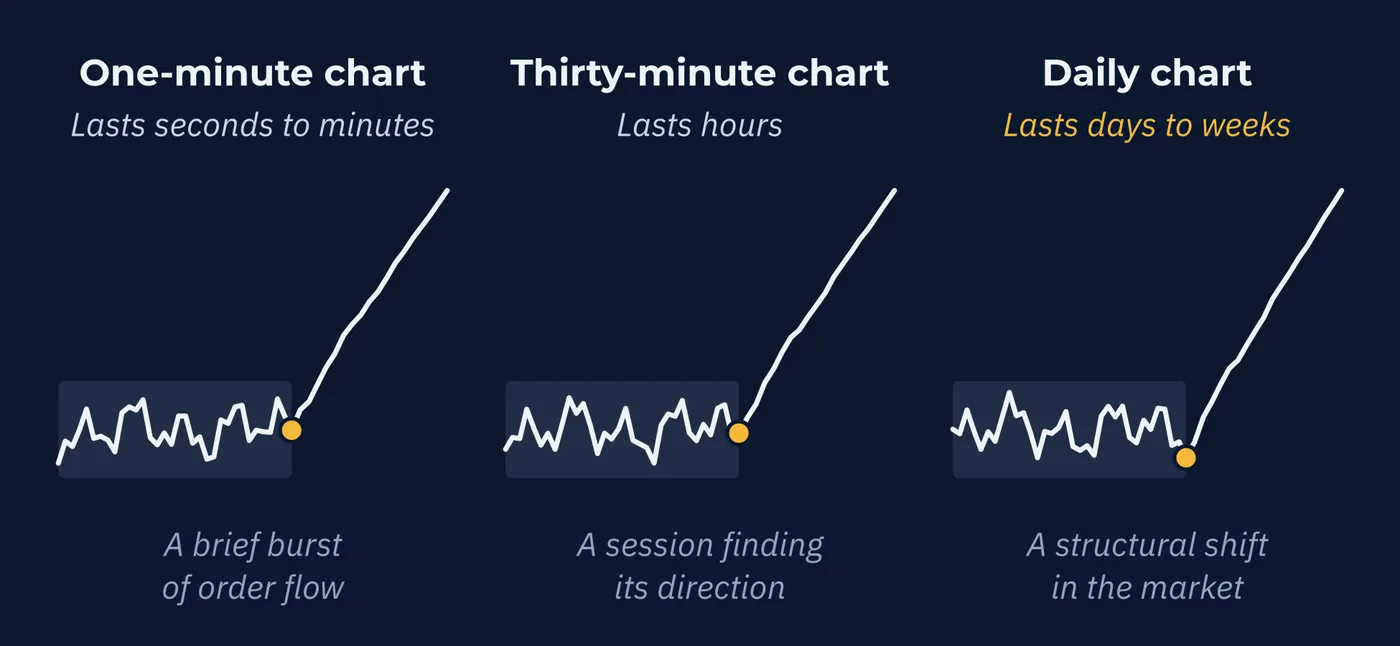
Each needs different tools to spot. Each needs a different stop distance, which from Lesson 21 means a different position size. Each costs a different share of its target to enter, which from Lesson 14 changes whether it works at all. And each asks something different of the person doing it.
A style is not a speed setting. It is a different activity.
2Style Is the Container
A strategy tells you when to enter and exit. A style is the whole framework the strategy sits inside: the timeframe, the holding period, the trade frequency, the risk structure, and the hours it requires of you.
Strategy is the content. Style is the container.
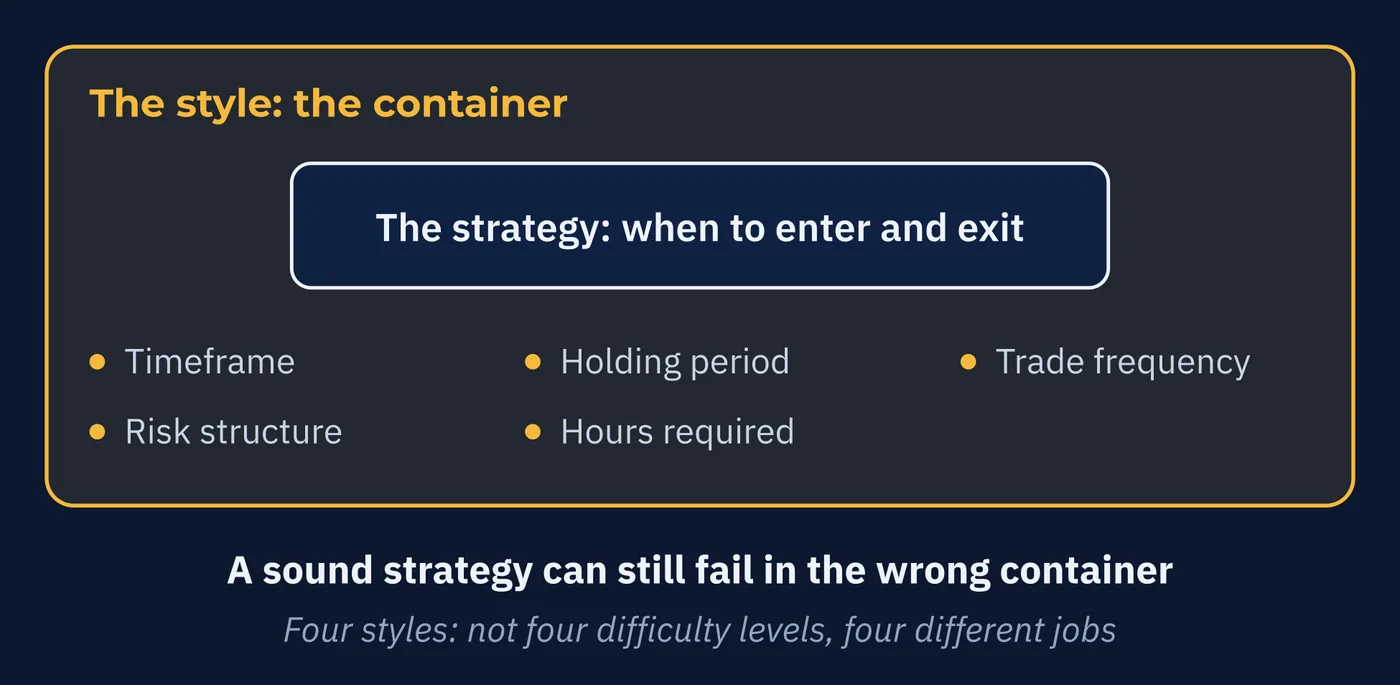
Which explains something that puzzles a lot of beginners. A trader can find a genuinely sound strategy, follow it faithfully, and still fail, because the container cannot hold it. The strategy needed four hours a day of attention and they had forty minutes. The strategy needed tight spreads and they were trading in the quiet hours.
Nothing was wrong with the strategy. It was in the wrong container.
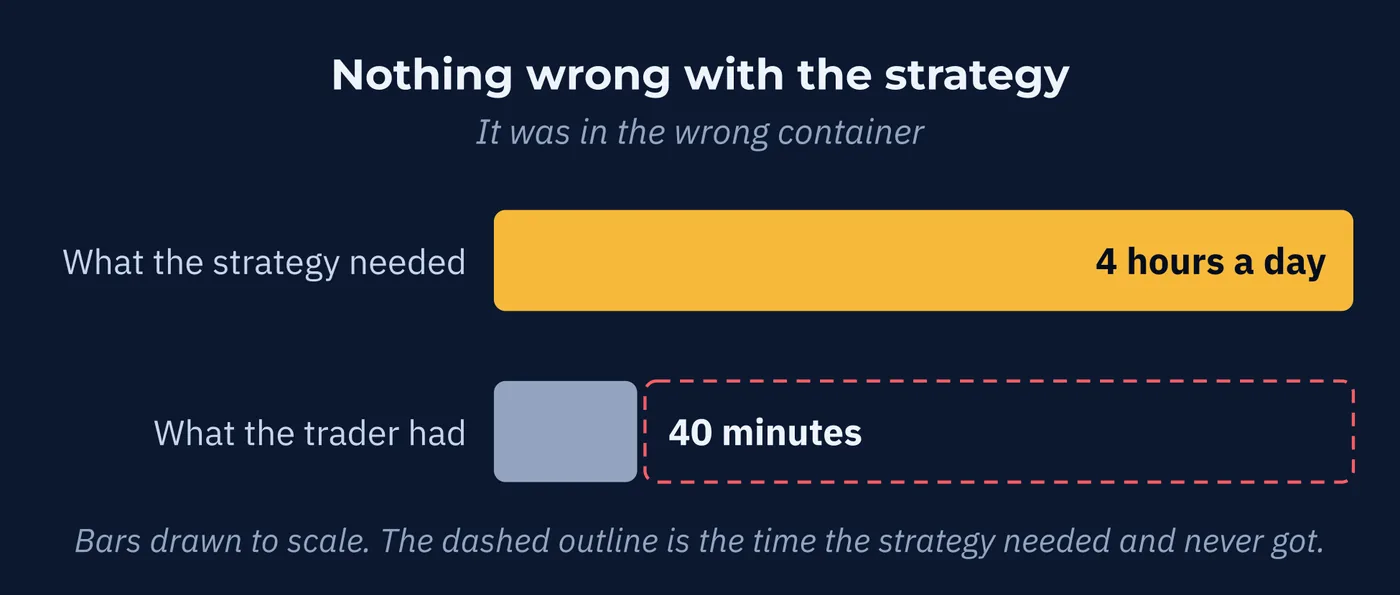
So the four styles below are not four difficulty levels. They are four different jobs.
3Scalping
The shortest of the four. Positions last seconds to minutes, read on one-minute charts, with dozens of trades in a single session.
A scalper is not trying to catch a big move. They are applying a very small advantage many times over, so the edge comes from volume and consistency rather than from any individual trade being impressive.
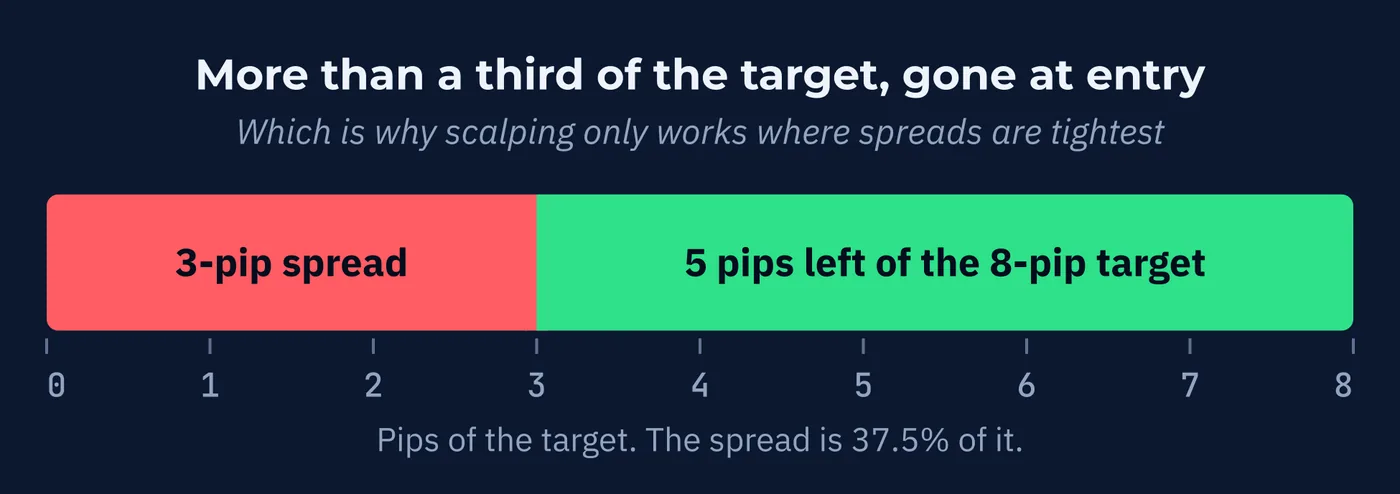
Which makes cost the central constraint, in a way it is not for any other style.
| Targeting | With a 3-Pip Spread | Cost as Share of Target |
|---|---|---|
| 8 pips | 3 pips gone at entry | Over a third |
That is Lesson 14's viability test applied at the shortest horizon, and it produces a hard requirement. Scalping only works where spreads are tightest and liquidity is deepest, which from Lesson 23 means the London session and the London and New York overlap. Outside those windows the arithmetic stops working.
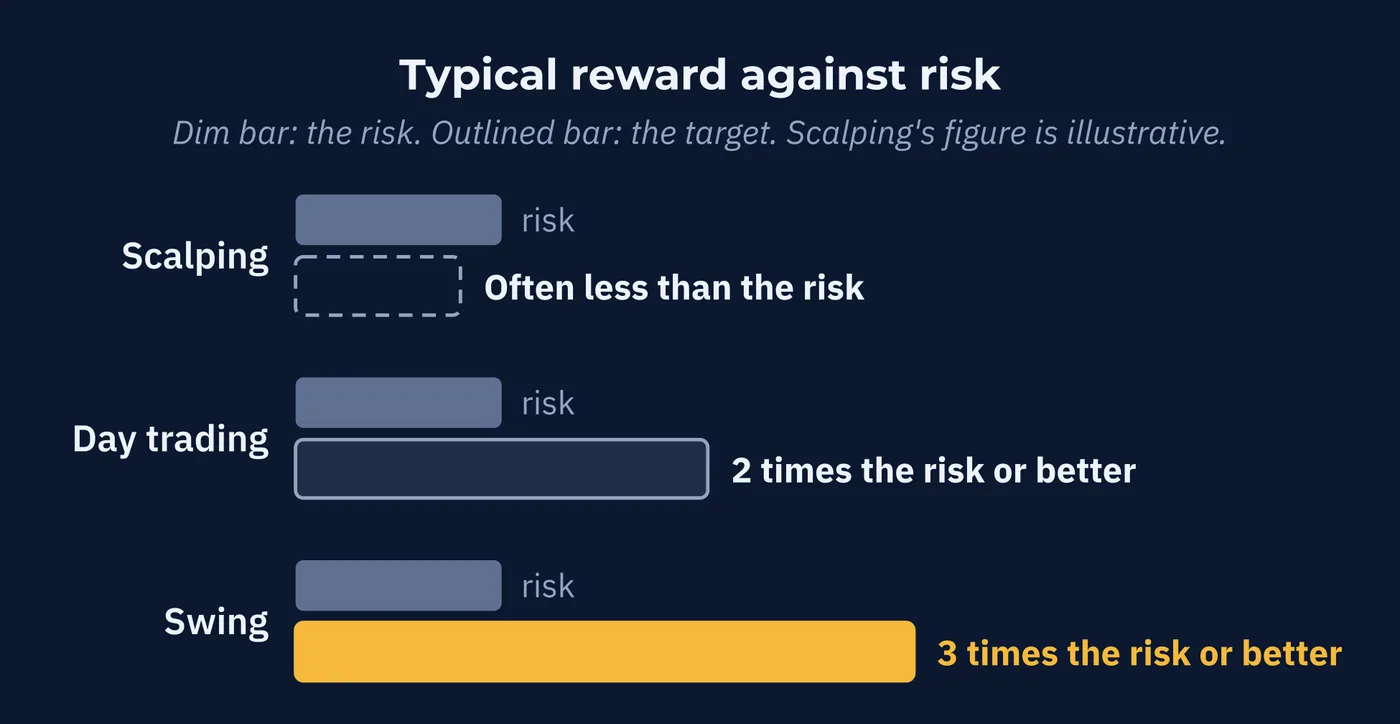
Stops are narrow and non-negotiable. The reward on any single trade is often modest relative to the risk, which is the opposite of how the other styles are built.
4Day Trading
Positions last minutes to hours, read on fifteen-minute, thirty-minute, and one-hour charts. Everything is closed before the session ends, so nothing is held overnight.
One consequence follows immediately, and it connects to the lesson before this series. A day trader never pays swap. Lesson 19 covered a cost that this style simply does not encounter.
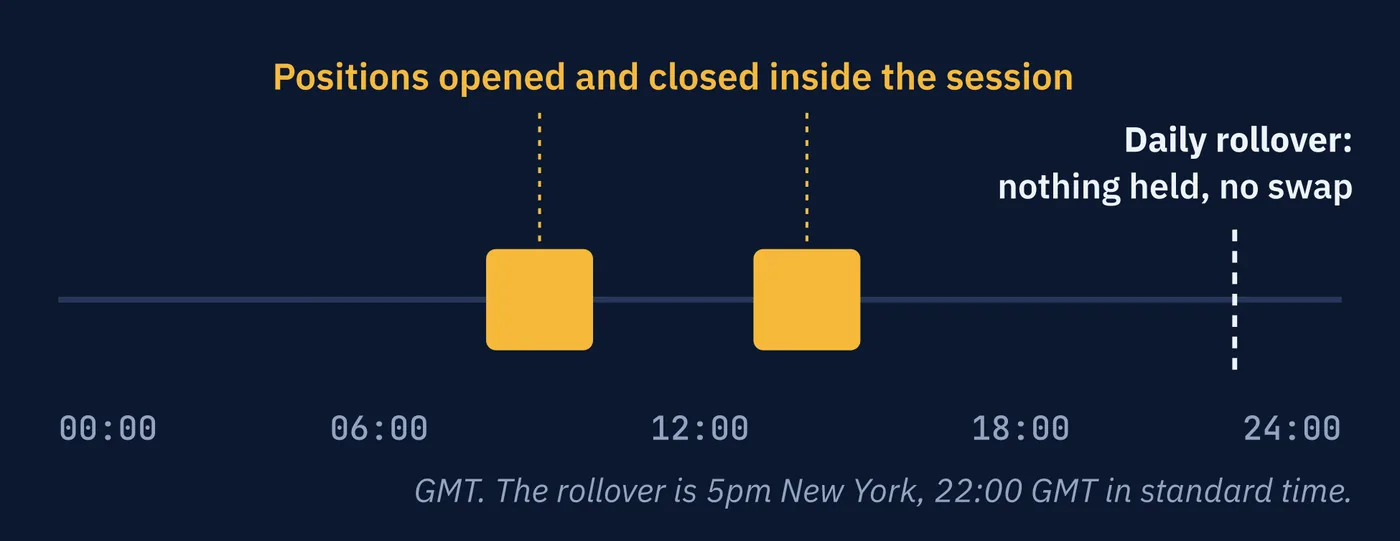
This is the style most people picture when they imagine trading. It is also where the gap between the picture and the reality is widest.
Day trading is session-dependent. The opportunity exists during specific windows and largely does not exist outside them, which means the hours are not negotiable. The economic calendar is not a pre-session courtesy check but a structural part of managing the day, because a release landing mid-session changes the conditions you are working in.
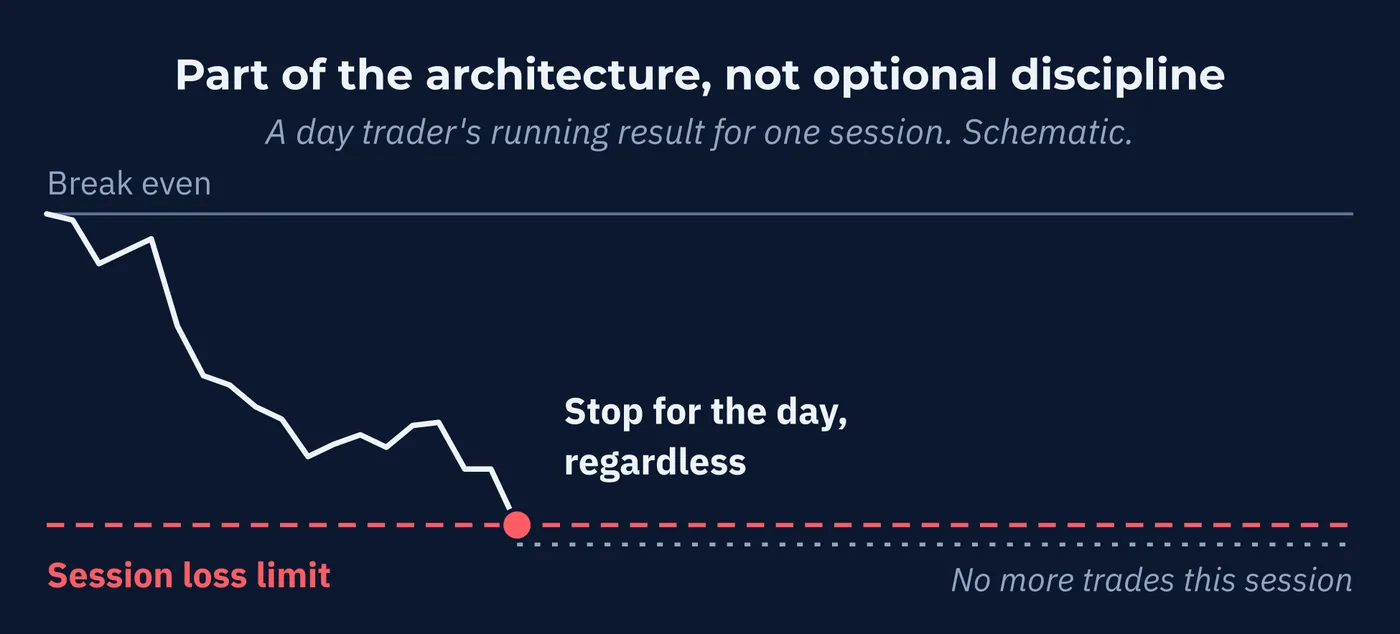
Reward targets of two times the risk or better are the normal expectation. Session loss limits, meaning a point at which you stop for the day regardless, are part of the architecture rather than an optional discipline.
5Swing Trading
Positions last days to weeks, read on four-hour and daily charts. A small number of considered positions per week, drawn from a watchlist prepared in advance.
The important difference from the two styles above is in how it treats sessions.
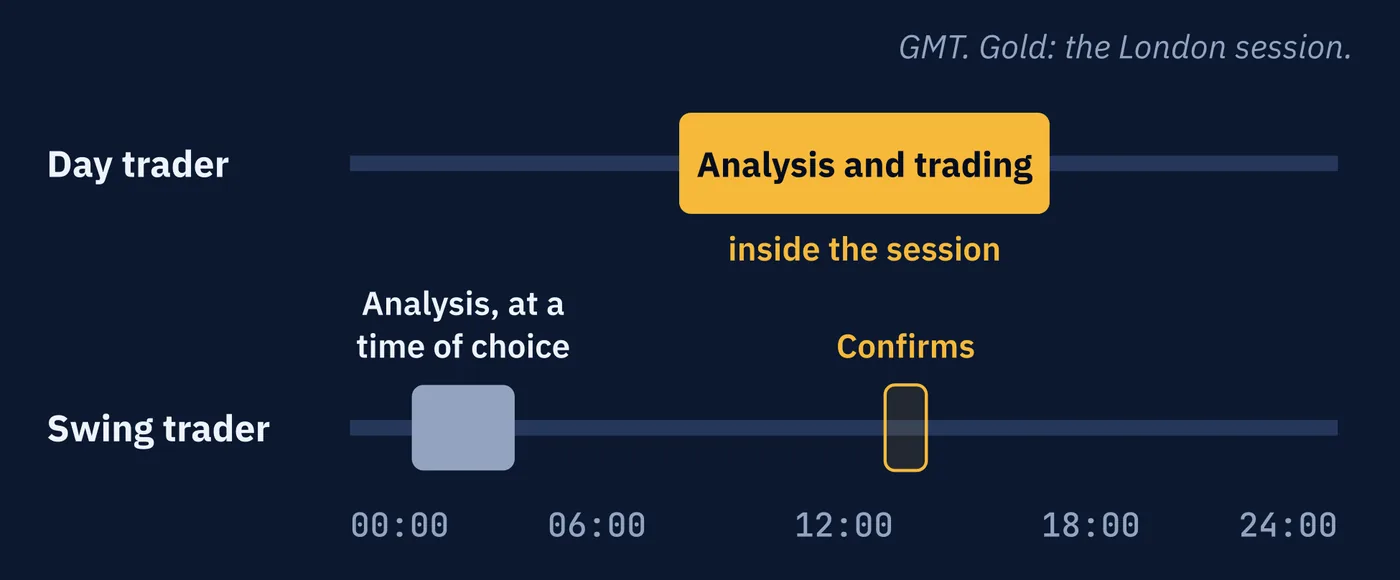
A day trader needs the session. A swing trader uses it.
For a swing trader, the London and New York opens are places to confirm something already identified on a higher timeframe. They are not where the analysis happens. Which is why Lesson 24 pointed at this style for anyone with a job: the thinking can be done at nine in the evening, and the chart says the same thing then as it did that morning.
Because the targets are larger, reward of three times the risk or better is realistic on well-structured setups. Stops are set wide enough to survive several days of ordinary movement rather than being tightened until noise triggers them.
The characteristic failure of this style is not bad analysis. It is impatience. The position gets closed on Tuesday because holding it felt uncomfortable, and it reaches its target on Thursday.
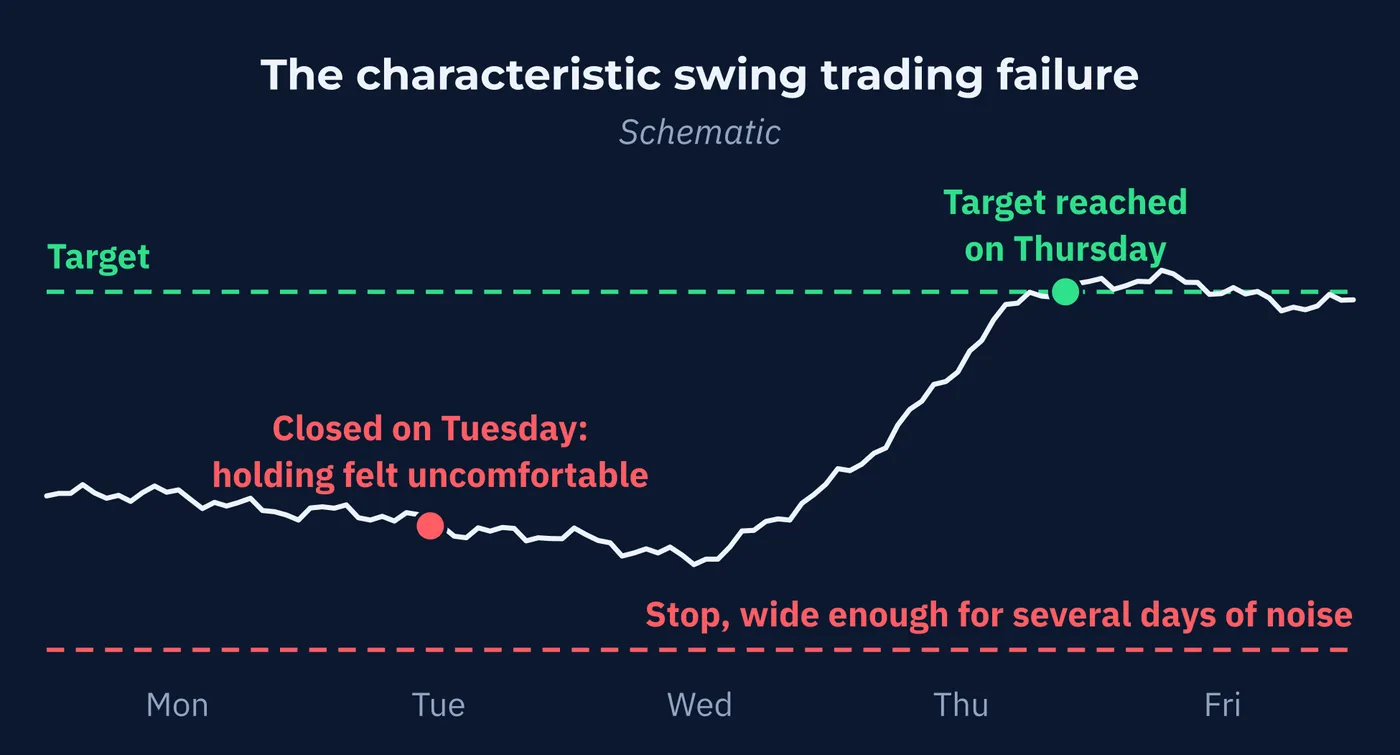
Holding through movement against you, without acting, is a genuine psychological demand. It is different from the demands of intraday trading rather than lighter than them.
6Position Trading
The longest of the four. Positions last weeks to months, read on daily and weekly charts, with very low trade frequency. Results are measured in quarters rather than sessions.
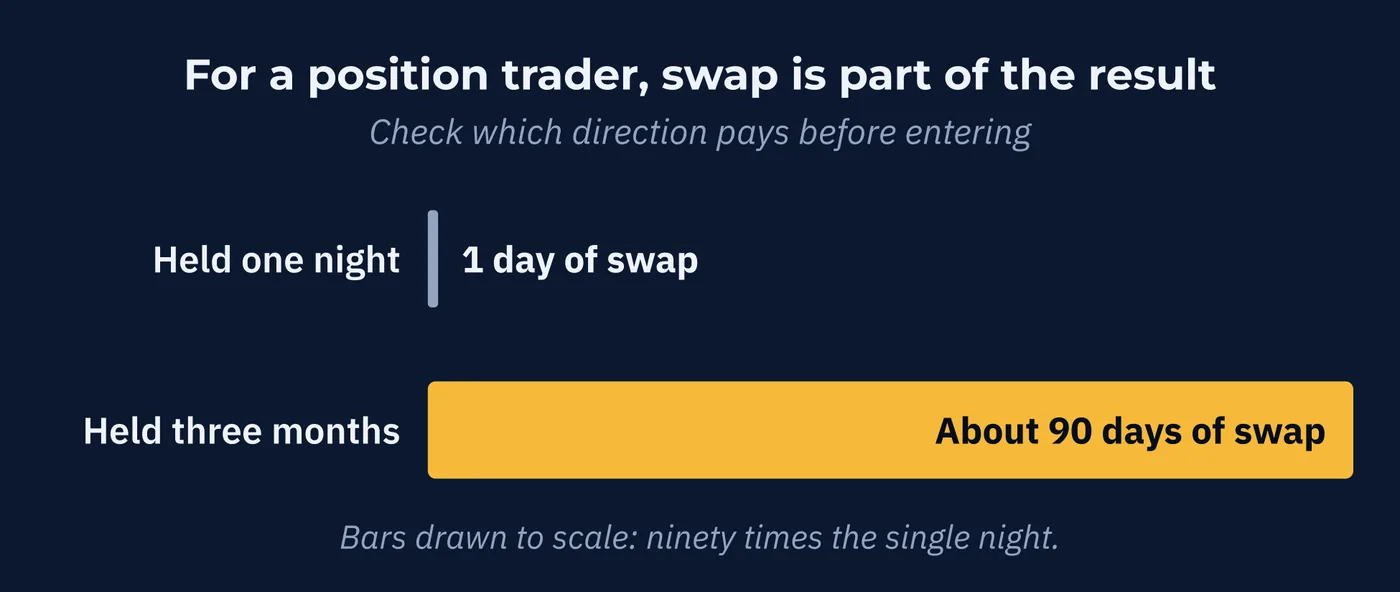
Here swap stops being a footnote. A position held for three months accumulates roughly ninety days of it, which from Lesson 19 makes it a real component of the outcome rather than a rounding error. Position traders check which direction pays before entering, because over that horizon it matters.
What drives a position trade is different too. Over weeks and months, the things that move a currency are the ones Lesson 1 named. Interest rate cycles, the relative health of two economies, and the slower shifts in what a country's money is trusted to be worth.
Most serious traders develop some position trading eventually, layered alongside whatever they do day to day, as their reading of the wider picture improves. The useful question is not whether that happens but whether it happens on purpose.
7The Four Side by Side
| Scalping | Day Trading | Swing | Position | |
|---|---|---|---|---|
| Holding period | Seconds to minutes | Minutes to hours | Days to weeks | Weeks to months |
| Charts used | 1 minute | 15 min to 1 hour | 4 hour, daily | Daily, weekly |
| Trades | Dozens a session | Several a session | A few a week | A few a quarter |
| Held overnight | No | No | Yes | Yes, at length |
| Swap applies | Never | Never | Yes | Substantially |
| Sessions | Required | Required | Used | Largely irrelevant |
| Spread cost | Decisive | Significant | Minor | Negligible |
As the holding period lengthens, the cost of entry becomes a smaller share of the target and matters less. But the cost of time, which is swap, grows from nothing to substantial. The two costs trade places as you move left to right.
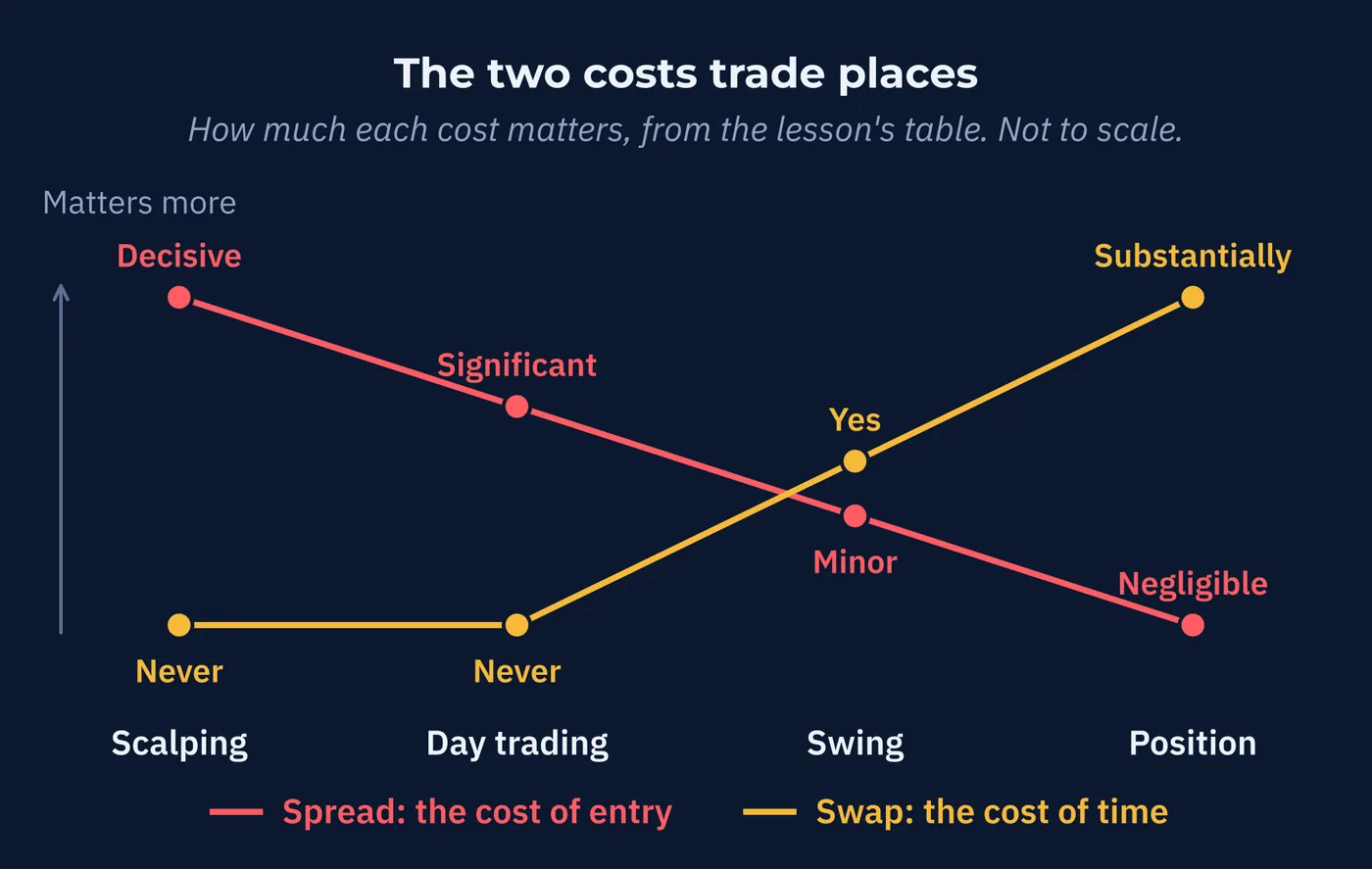
And the demands on your hours run the same way. Scalping and day trading need you present during specific windows. Swing and position trading need you thoughtful at a time of your choosing.
8Why Most People Pick Wrong
Almost everyone arrives wanting to day trade.
It is the style in every film, every video thumbnail, and every image the word trading conjures. Multiple screens, rapid decisions, a session that ends with a result.
Swing trading is the more natural starting point for most developing traders, and not as a consolation. It asks for less screen time, it is more forgiving of a modest account because targets are larger relative to costs, and it leaves room for the thinking to happen when you are not under time pressure.
It is also the ground from which position trading grows naturally, as your reading of the wider picture develops.
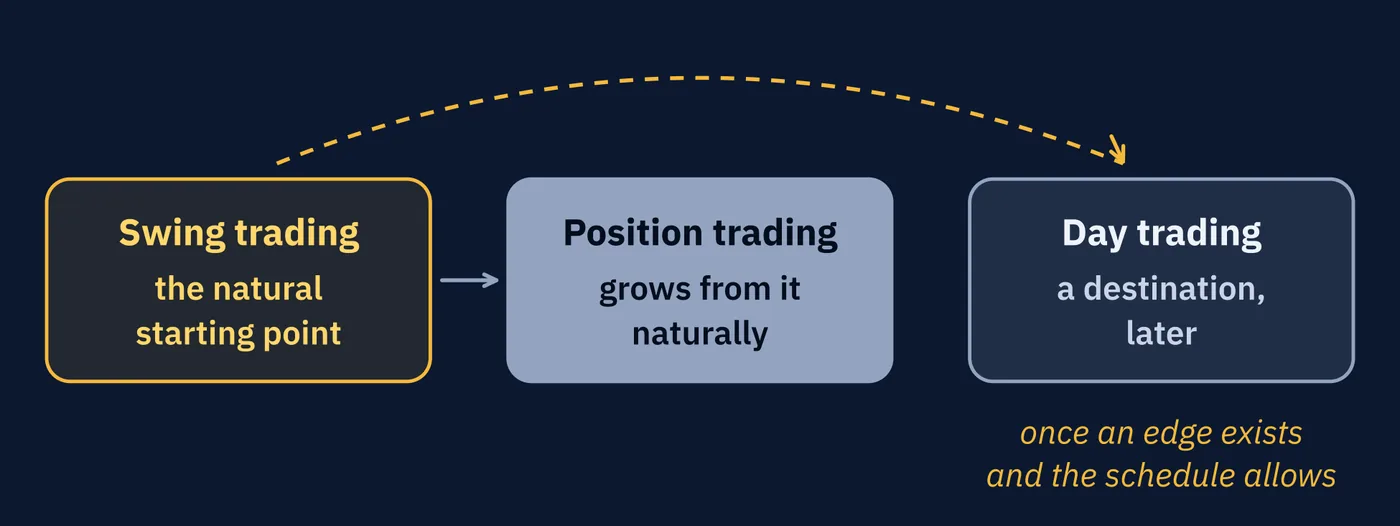
Which leaves the actual question. Not which style is best, since none of them is, but which one fits the person you are and the life you have. The next lesson works through that properly, because there are four things that have to line up and most people only check one.
Three Things to Remember
Try This
Fifteen minutes with one chart. See the three trades for yourself.
Words From This Lesson
| Term | What It Means |
|---|---|
| Trading style | The framework a strategy operates inside: timeframe, holding period, frequency, risk structure, and hours required. |
| Scalping | Seconds to minutes, dozens of trades a session, edge built through volume and very tight costs. |
| Day trading | Minutes to hours, everything closed before the session ends, no overnight exposure. |
| Swing trading | Days to weeks on higher timeframes, a few considered positions a week. |
| Position trading | Weeks to months, very low frequency, driven by the wider economic picture. |
| Session-dependent | A style whose opportunities exist only during specific market hours. |
| Session loss limit | A point at which a trader stops for the day regardless of what the market is doing. |
Test Your Knowledge
Eight questions. Answer them all before checking the key on the following pages. If a question gives you trouble, the answer key tells you which section to revisit.
- A. They are two words for the same thing
- B. Strategy is when to enter and exit; style is the whole framework it sits inside
- C. Style applies to forex and strategy applies to crypto
- D. Strategy is for beginners and style is for professionals
- A. It is the same trade at two speeds
- B. The daily version is simply a slower version of the same thing
- C. They are two different trades with different tools, costs, and demands
- D. Only one of them can be profitable
- A. Scalpers are charged higher spreads
- B. A fixed spread is a far larger share of a small target
- C. Position traders do not pay spread
- D. Scalpers trade less liquid pairs
- A. Swing trading
- B. Position trading
- C. All styles pay swap equally
- D. Day trading
- A. As confirmation for setups already identified on higher timeframes
- B. As the only window in which analysis can happen
- C. They ignore sessions entirely
- D. They trade exclusively during the dead zone
- A. Analysis that is too shallow
- B. Trading during the wrong session
- C. Impatience, closing the position before the move develops
- D. Spreads consuming the target
- A. A wasted session
- B. They should lower their entry criteria
- C. The strategy has stopped functioning
- D. The filter worked correctly
- A. It requires specific hours and exposes weaknesses in discipline many times a day
- B. It is the least profitable style
- C. It is prohibited for new traders
- D. It requires the largest account of the four
Answer Key
Each answer explains why the correct choice is correct, why the others are not, and where to reread.
Question 1 · correct answer B
A strategy is the content, telling you when to act. A style is the container, setting the timeframe, holding period, frequency, risk structure, and hours required.
A misses a distinction that explains why sound strategies fail in the wrong container. C invents a division between markets that does not exist. D treats them as skill levels rather than different things.
Review: Section 2, Style Is the Container
Question 2 · correct answer C
Each version reacts to something different, needs a different stop and therefore a different position size, and costs a different share of its target to enter.
A and B both treat the timeframe as a speed dial, which is the misconception this section exists to correct. D is wrong because both can work, in the right container for the person trading them.
Review: Section 1, The Same Strategy, Three Different Trades
Question 3 · correct answer B
A three pip spread against an eight pip target consumes over a third of it. Against a three hundred pip target it is negligible. The spread did not change, the target did.
A is wrong because the spread depends on the pair and conditions, not the style. C is wrong because every trade pays the spread at entry. D reverses it, since scalping requires the most liquid pairs available.
Review: Section 3, Scalping
Question 4 · correct answer D
Day trading closes everything before the session ends, so no position is held past the daily cut-off and swap never applies.
A and B both hold overnight, which is exactly when swap is charged. C is wrong because swap depends on holding past the cut-off, which two of the four styles never do.
Review: Section 4, Day Trading
Question 5 · correct answer A
The analysis happens on higher timeframes, outside market hours. Session opens serve to confirm something already identified rather than to generate it.
B describes day trading, where the session is the opportunity. C overstates it, since sessions still matter for confirmation and cost. D describes trading the worst conditions of the day deliberately.
Review: Section 5, Swing Trading
Question 6 · correct answer C
The defining failure is closing early. The position that felt uncomfortable on Tuesday reaches its target on Thursday, and holding through that discomfort is the real demand of the style.
A can happen in any style and is not characteristic of this one. B matters more to session-dependent styles. D is the central problem for scalping, not for swing trading.
Review: Section 5, Swing Trading
Question 7 · correct answer D
If nothing met the criteria, the criteria did their job. A session with no trades is the approach working rather than failing.
A treats activity as the measure of a session, which is how sound approaches get abandoned. C draws a conclusion about the strategy from a single quiet day. B is the instinct that turns a working filter into a broken one.
Review: Section 4, Day Trading
Question 8 · correct answer A
It needs presence during specific hours, which for most people fall inside a working day, and its decision frequency exposes any weakness in discipline many times over.
B is wrong because no style is inherently more or less profitable than another. C invents a prohibition. D confuses style with capital requirements, which follow from position sizing rather than from the style itself.
Review: Section 8, Why Most People Pick Wrong
Keep going
What You Are Actually Doing is written by Kanin D. Alldredge for The Currency Classroom, and it is free to read. There is more free from CNS: start here.
Start free with CNS →