Trading, Investing, Speculating, and Gambling

1Four Words, Four Different Activities
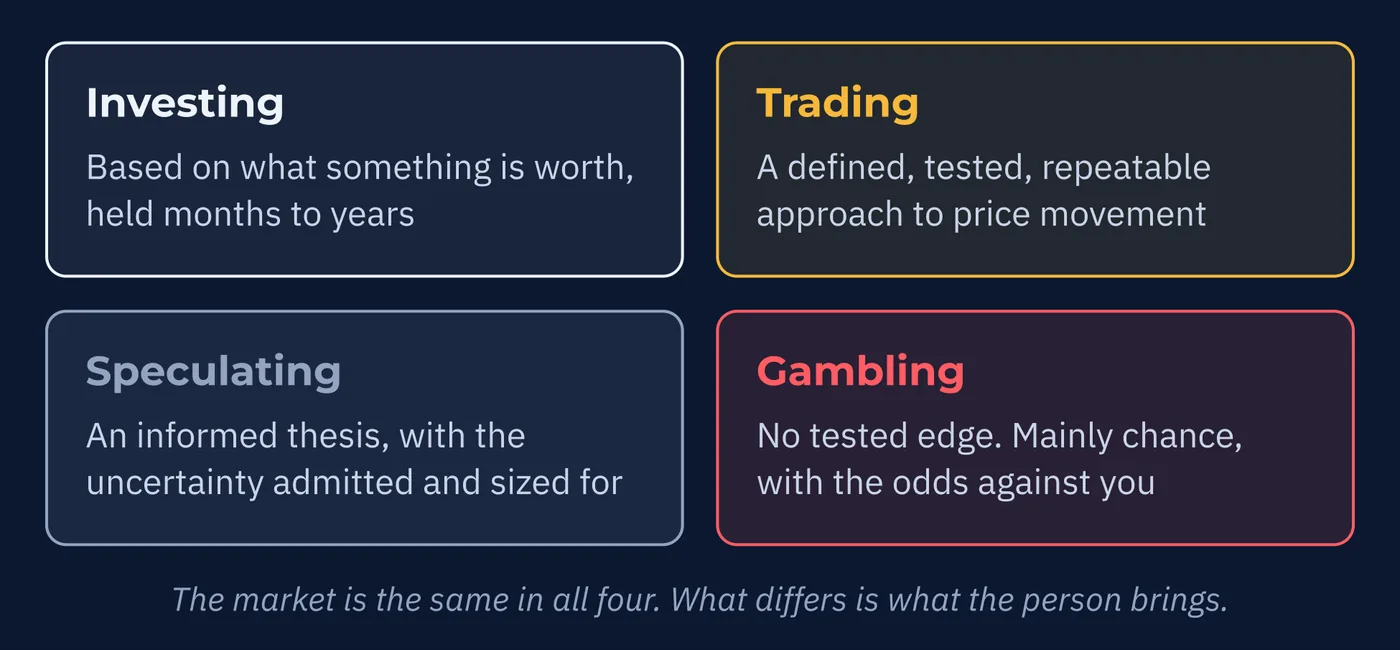
Investing. Trading. Speculating. Gambling.
Most people use these interchangeably. Gambling is the insult, investing is the compliment. But they describe four different activities, and confusing them is expensive.
Here is the part that surprises people. Which one you are doing has nothing to do with the market you are in.
The same position in the same market can be any of the four.
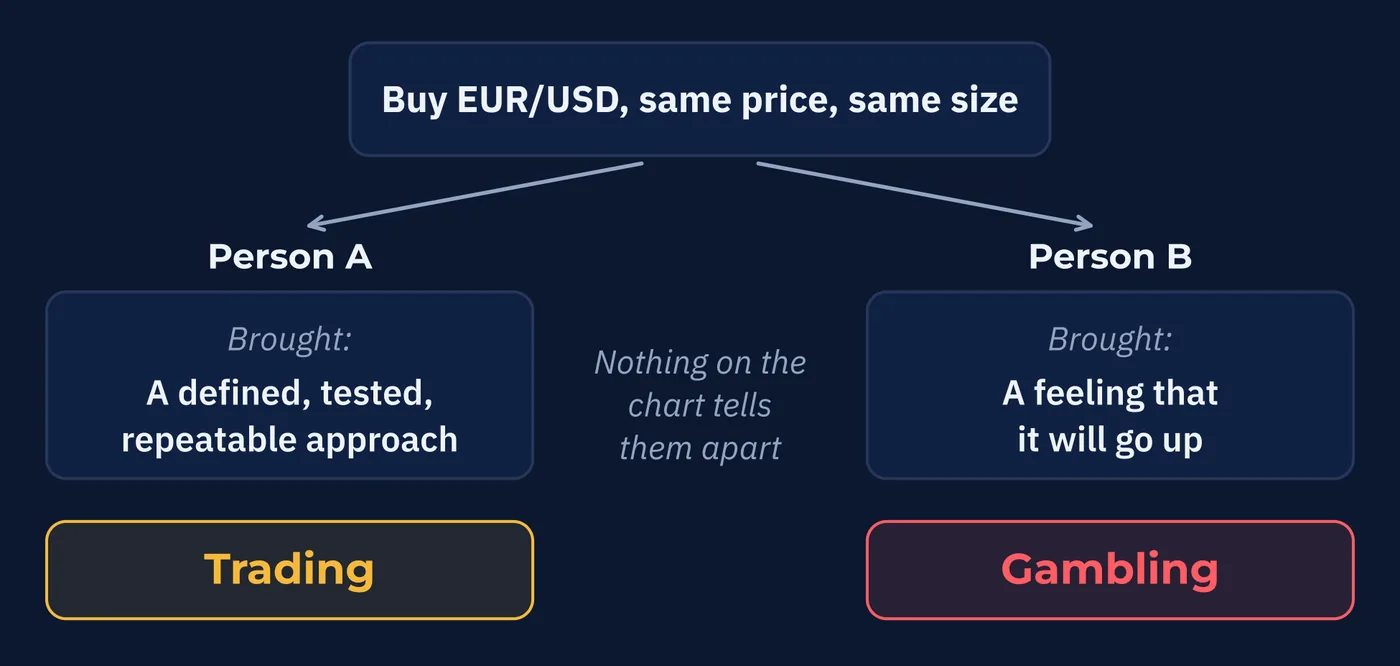
Two people can buy EUR/USD at the same price on the same afternoon at the same size. One is trading. One is gambling. Nothing about the pair, the platform, or the chart tells you which is which.
What decides it is what the person brought with them.
2What Investing Is
Investing is putting capital into something based on what it is fundamentally worth, over a horizon measured in months to years.
The key word is worth. An investor has a view on what the thing is actually worth, and holds long enough for that to show up in the price.
Which produces a useful test. Buying because the price is going up is not investing, whatever the holding period turns out to be. It is a bet on momentum wearing longer clothes.
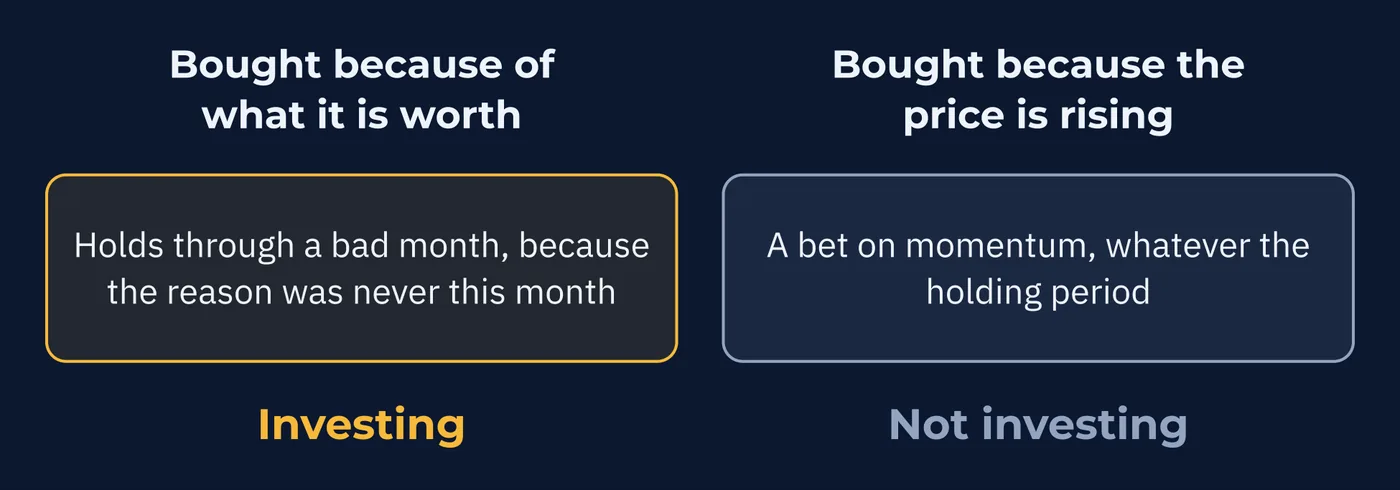
An investor sits through a bad month because their reason for holding was never about this month. That is not patience as a personality trait. It comes from the reason resting on something other than today's price.
3What Trading Is
Trading is buying and selling to profit from price movement, over shorter horizons, using a defined and repeatable approach.
Read that last clause twice, because everything hangs on it.
Time horizon is not what makes something trading. Plenty of people hold positions for hours, days, or weeks and are not trading in any real sense. The approach is what makes it trading. Defined in advance, tested, repeatable.
Trading comes in several shapes, and they differ enormously in how much attention they demand. Scalping, day trading, swing trading, and position trading are the four. Choosing between them is the whole of the next lesson.
For now, the important thing is not which style. It is the thing all four have in common, and that thing has a name.
4The Edge
An edge is a defined, tested, repeatable approach that produces a positive result over a large enough number of trades.
Two things about that definition are worth pulling out, because both are commonly misunderstood.
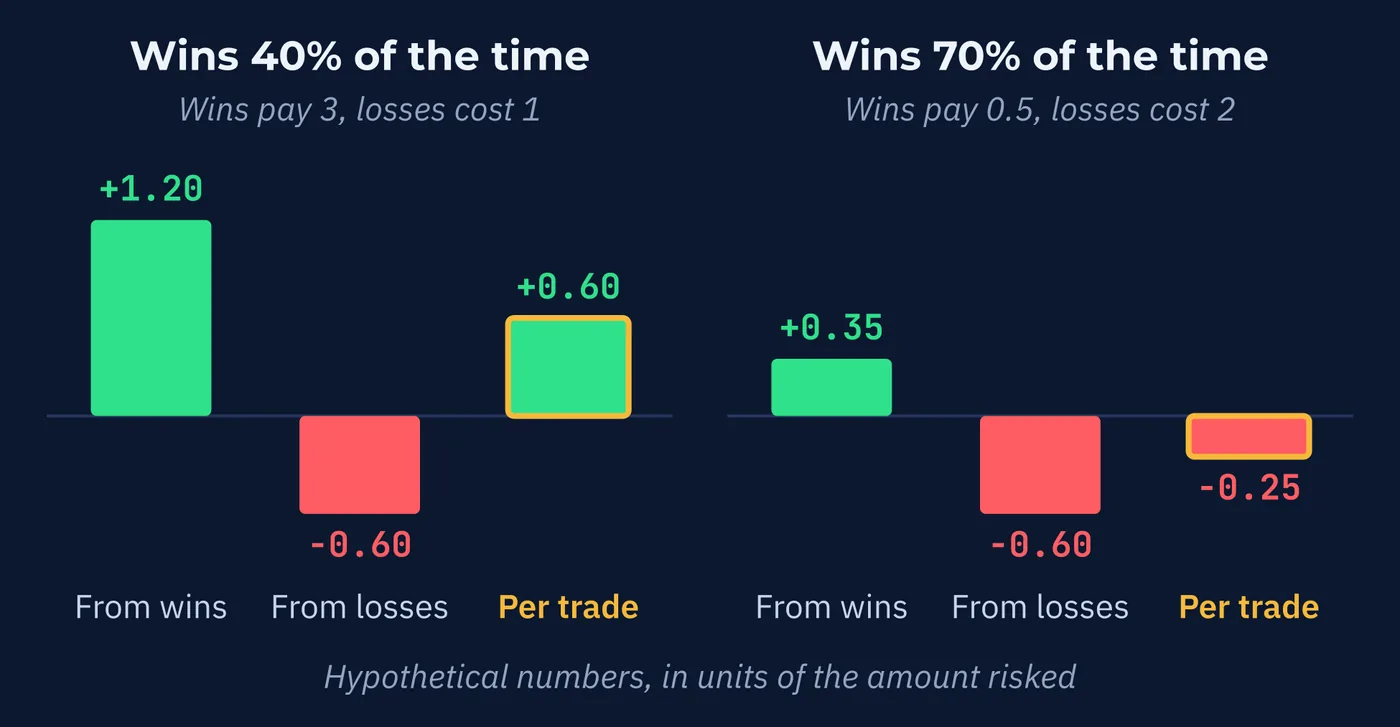
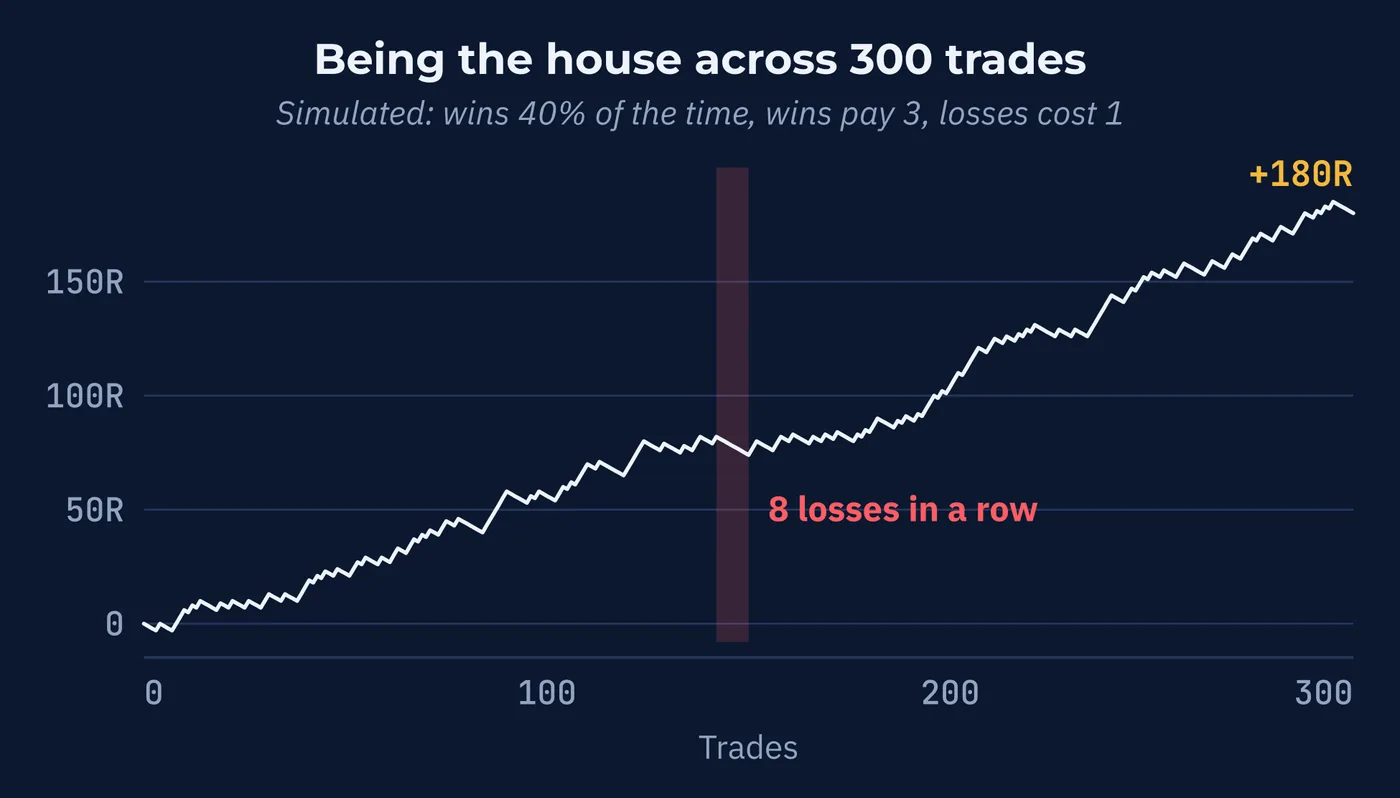
The first is that an edge is not a win rate. A trader who wins forty percent of the time can have a real edge, if the winners are big enough. A trader who wins seventy percent can have none, depending on the losses. Frequency is half the arithmetic. Lesson 21 showed the other half.
The second is that an edge is not a strategy you have read about. It is a strategy you have tested. Somebody else's validated approach is, to you, an untested idea until you have done the work yourself.
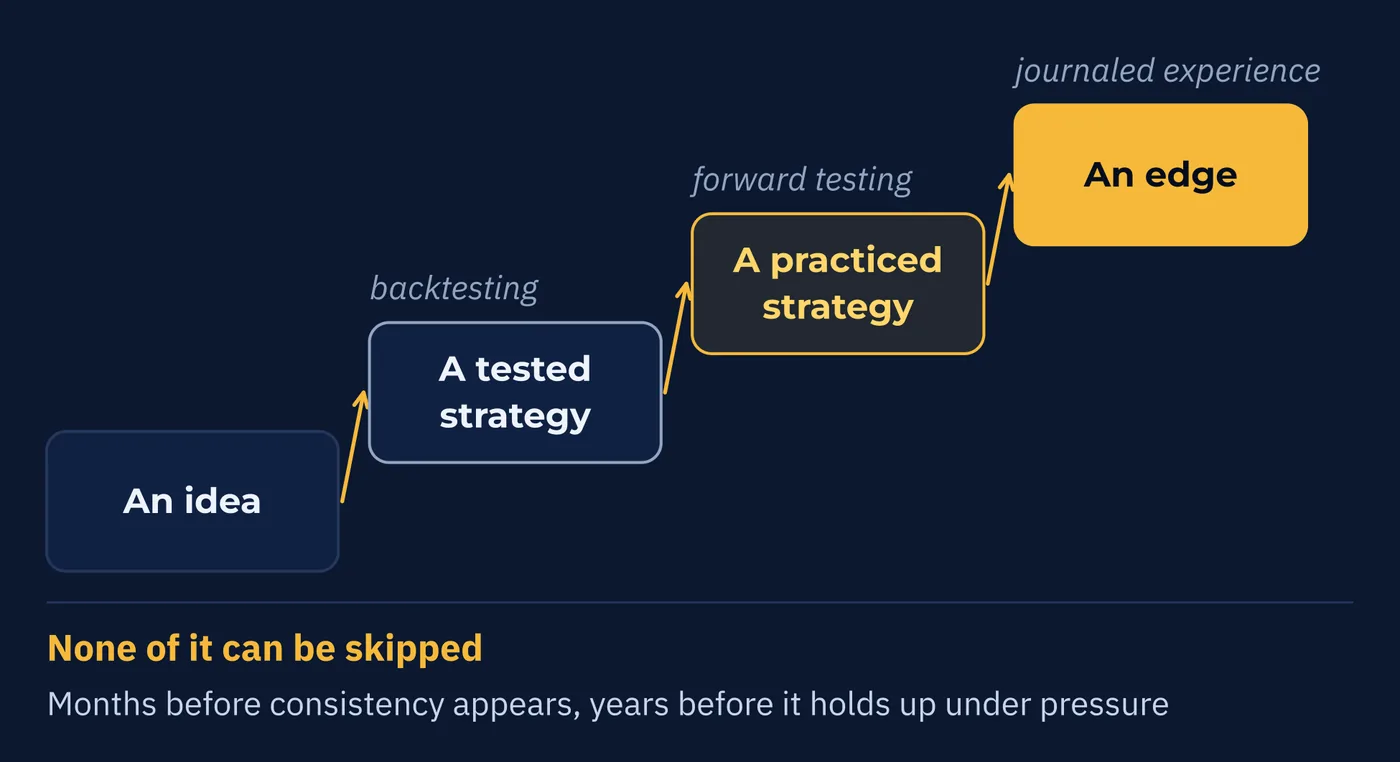
How long does that take? For most people, months before any real consistency appears, and years before it is robust enough to trust under pressure.
That is not discouraging. It is clarifying, because it tells you what the work actually is and gives you an honest way to measure where you are.
5What Speculation Is
Speculation is taking a position based on an informed view about a likely outcome, under conditions of higher uncertainty than investing.
It is legitimate, and it is not a polite word for gambling. A speculator has a thesis built on evidence, admits the uncertainty out loud, and sizes the position to match.
But the evidence available is not equal everywhere, and this is worth being precise about.
| Forex Speculation | Crypto Speculation | |
|---|---|---|
| History available | Decades | Comparatively short |
| What informs a thesis | Inflation, growth, employment, interest rate cycles | Sentiment, adoption, narrative, some on-chain data |
| Relationships to price | Extensively studied and documented | Thinner, less established |
Both are legitimate activities. What differs is how much confidence the evidence can support.
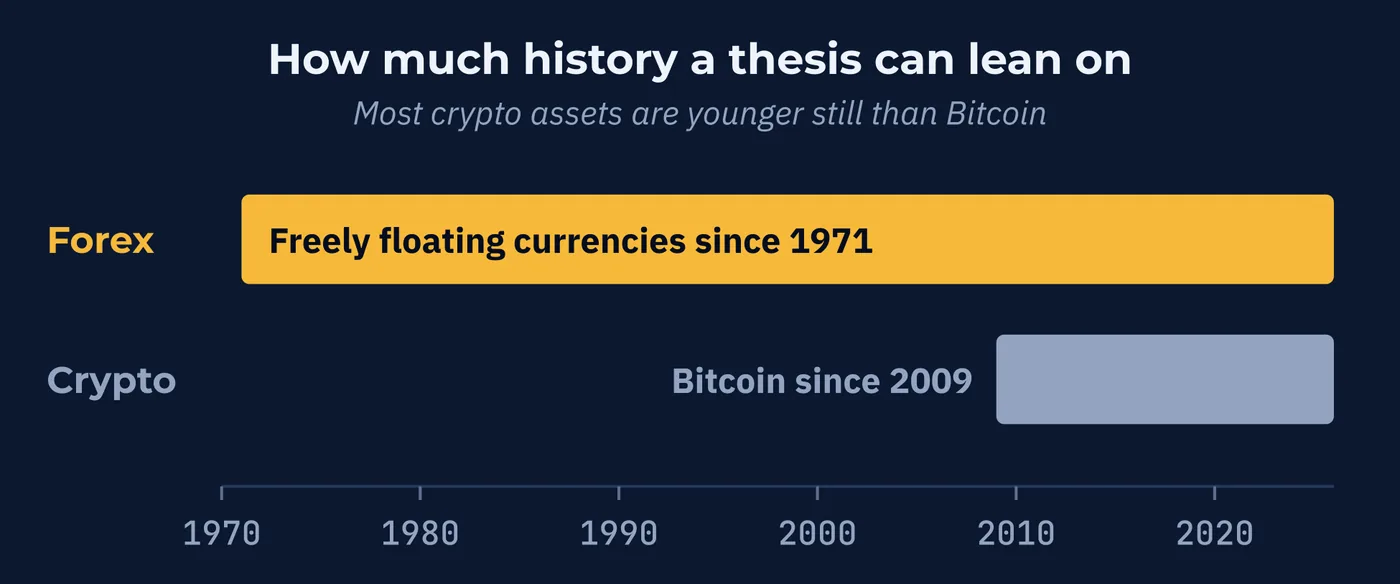
A view on the euro can lean on decades of published data about how currencies respond to rates and inflation. That is the machinery Lesson 1 introduced. A view on a cryptocurrency has far less to stand on. Most crypto assets have no earnings, no government behind them, and a short price history.
The honest position is to hold both kinds of thesis, and to hold the second one more loosely.
6What Gambling Is
Gambling is staking capital on an outcome decided mainly by chance, with the odds structurally against you.
Notice what is absent from that definition. No mention of a casino, a card table, or a slot machine. No mention of the instrument or the platform.
The defining feature is the absence of a tested edge. Which means it can happen anywhere, including on a serious market with a serious chart open.
A trader without an edge is gambling. A poker professional with one is not.
A professional poker player has spent thousands of hours building a tested approach. They know which situations favor them. They size their bets to the odds. They take a bad beat without it disturbing the next decision. By the definition above they are not gambling. They are doing something much closer to speculating, in a different room.
7Being the House
The clearest way to understand an edge is to look at who reliably wins in a casino.
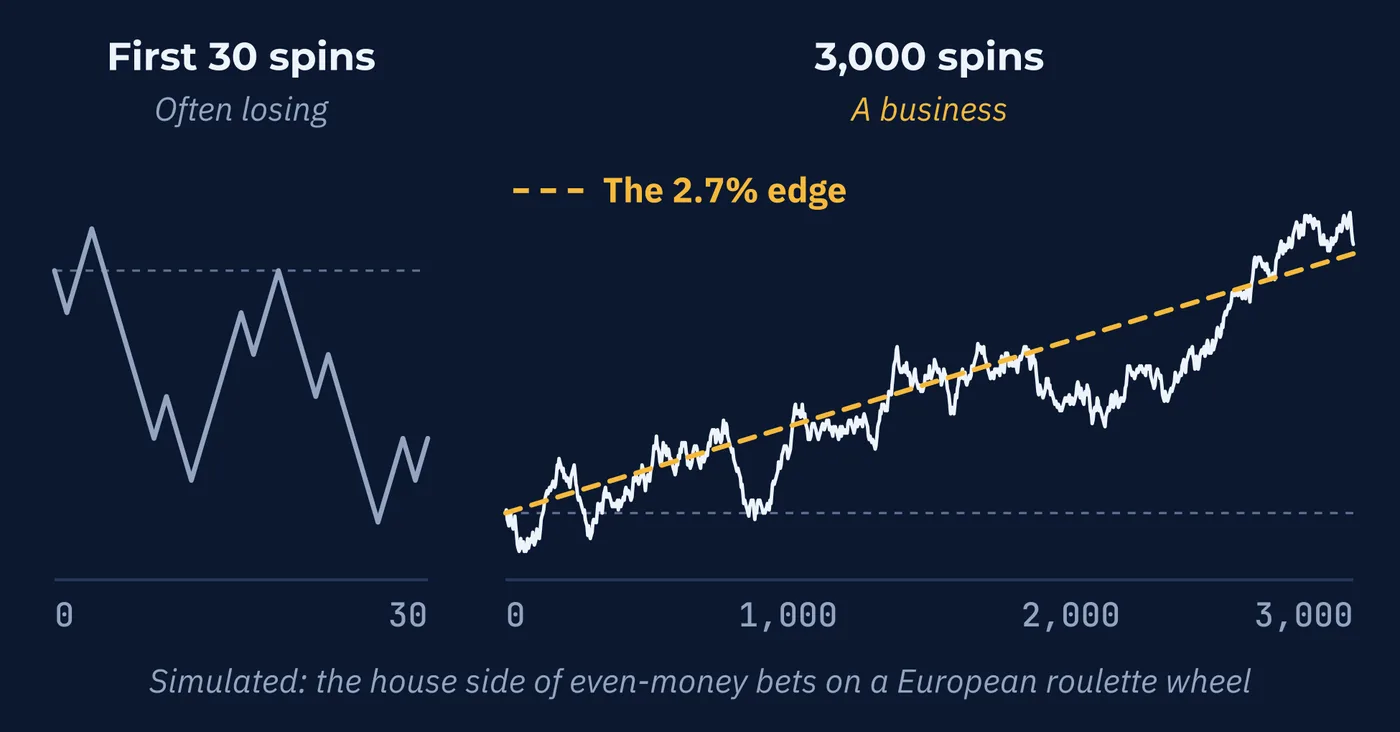
The house does not win because its dealers are lucky. It wins because every game is built so the math favors it slightly. On a roulette wheel that edge runs from under three percent to over five, depending on the version.
Three percent is nothing on a single spin. The house frequently loses a spin, and a table, and occasionally a whole evening.
Applied across thousands of spins, it is a business.
| The Casino | The Trader With an Edge |
|---|---|
| Small structural advantage on each bet | Small positive expectation on each trade |
| Loses plenty of individual spins | Loses plenty of individual trades |
| Needs a large number of repetitions | Needs a large number of trades |
| Never changes the rules mid-evening | Never abandons the approach mid-streak |
Which reframes the goal entirely. A trader with an edge is not trying to be right about the next trade. They are trying to be the house across the next three hundred.
And it explains why Lesson 21 spent so long on losing streaks. An edge only shows up over a sample. Anything that stops you reaching that sample prevents it from ever appearing. A position size too large to survive a normal losing run will do it. So will abandoning the approach halfway through.
8The Line Moves
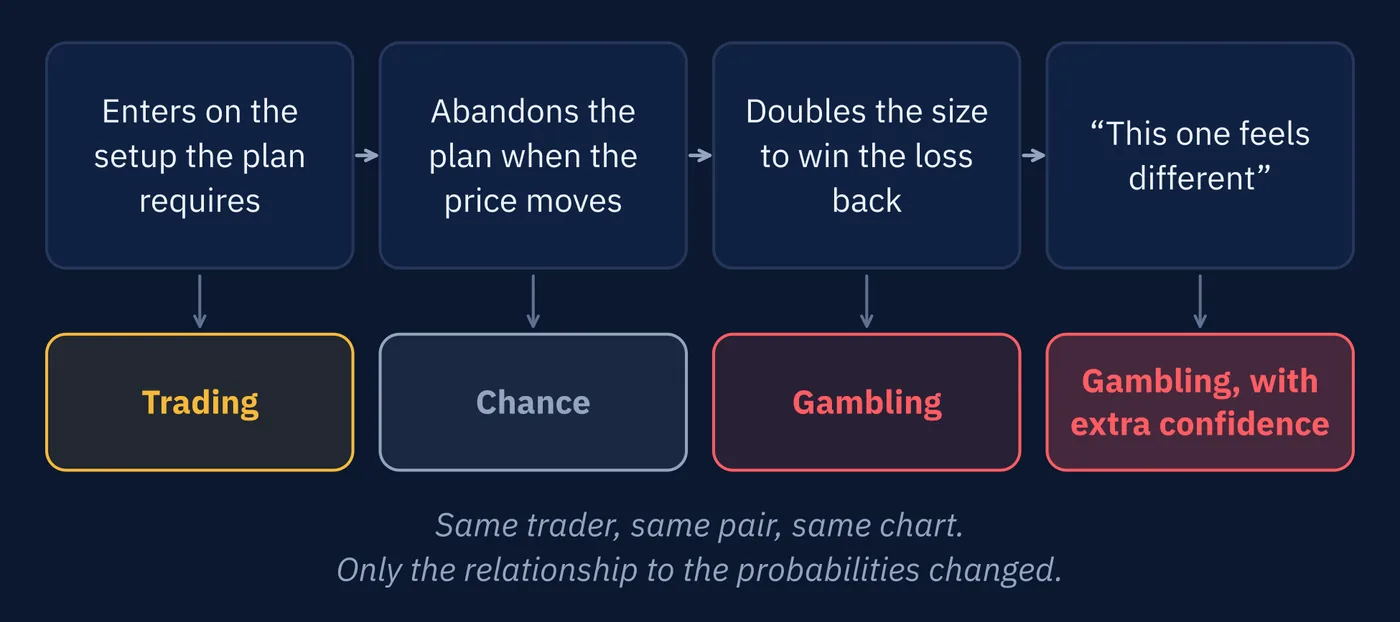
Here is the part that matters most in practice. These are not four fixed rooms you choose between once. The line moves during the day, and it moves based on what you do.
A trader with a genuinely tested approach can become a gambler in a single afternoon, without changing market, instrument, or platform.
| What Happens | What It Becomes |
|---|---|
| Entering without the setup your approach requires | A guess wearing the clothes of a system |
| Abandoning the plan mid-trade because the price moved | Chance, from that moment on |
| Doubling the size after a loss to win it back | Gambling, and the most costly version of it |
| Overriding your risk rules because this one feels different | Gambling, with extra confidence attached |
In every row the instrument is unchanged and the chart is unchanged. What changed is the relationship between the person and the probabilities.
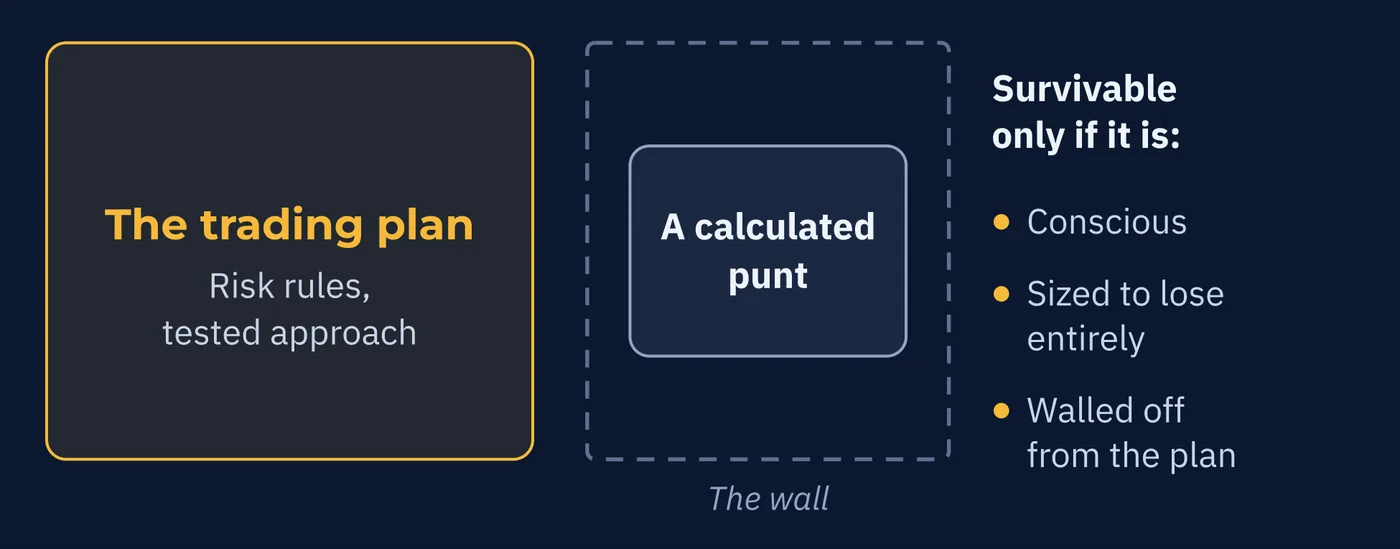
Most people, looking honestly, find their activity sits closer to speculation or gambling than they assumed. That is not a verdict. It is a starting point, and a far more useful one than a comfortable assumption.
The goal is not to never gamble. It is to know, at the time rather than afterward, which of the four you are doing and why.
The next lesson takes the four trading styles named in Section 3 and looks at them properly. Choosing between them turns out to be a decision about you, not about markets.
Three Things to Remember
Try This
Twenty minutes, and it asks for honesty rather than effort.
Words From This Lesson
| Term | What It Means |
|---|---|
| Investing | Committing capital based on fundamental value, over months to years. |
| Trading | Buying and selling to profit from price movement, using a defined, tested, repeatable approach. |
| Edge | An approach that produces a positive result over a large enough sample of trades. Not the same as a win rate. |
| Speculation | A position taken on an informed thesis under higher uncertainty, with risk sized accordingly. |
| Gambling | Staking capital without a tested edge, whatever the market or platform. |
| Backtesting | Applying a strategy to historical price data to see how it would have performed. |
| Forward testing | Running a strategy in real time, usually on demo, before committing real money. |
| Revenge trading | Increasing size after a loss to recover it. One of the clearest markers of category drift. |
Test Your Knowledge
Eight questions. Answer them all before checking the key on the following pages. If a question gives you trouble, the answer key tells you which section to revisit.
- A. The approach, preparation, and discipline of the person
- B. The market or instrument involved
- C. The size of the position
- D. Whether the outcome was profitable
- A. Buying anything and holding it for over a year
- B. Committing capital based on fundamental value over months to years
- C. Buying whatever has been rising steadily
- D. Any position held without a stop loss
- A. Winning more than half your trades
- B. A charting system that identifies direction correctly
- C. A strategy recommended by an experienced trader
- D. A defined, tested, repeatable approach with a positive result over a large sample
- A. No, an edge requires winning more than half
- B. Yes, if the winners are large enough relative to the losers
- C. Only if they use leverage
- D. Only over very short time horizons
- A. Executing an edge
- B. Investing
- C. Betting that you have one
- D. Speculating on a documented thesis
- A. Poker is a game of skill rather than a financial market
- B. They win the majority of hands they play
- C. They have a tested edge and size their risk to the probabilities
- D. Casinos classify professionals differently
- A. Forex is legitimate and crypto is not
- B. Only forex allows a thesis to be formed at all
- C. Crypto positions are always larger
- D. Forex has decades of documented data behind it; crypto's statistical base is thinner
- A. They have moved from trading to gambling
- B. Nothing, since the market and instrument are unchanged
- C. They have increased their edge
- D. They have switched to speculation
Answer Key
Each answer explains why the correct choice is correct, why the others are not, and where to reread.
Question 1 · correct answer A
The same position in the same market can be any of the four categories. What decides it is what the person brought with them.
B is the assumption this lesson exists to break, since no market is inherently one category or another. C is wrong because a small position without an edge is still gambling. D confuses outcome with process, and a lucky gamble is still a gamble.
Review: Section 1, Four Words, Four Different Activities
Question 2 · correct answer B
Investing rests on a view about what something is fundamentally worth, held long enough for that value to show up in the price.
A takes the time horizon as the whole definition, when the reason for holding is what matters. C describes momentum buying, which is not investing whatever the holding period. D describes a risk decision rather than a category.
Review: Section 2, What Investing Is
Question 3 · correct answer D
An edge is an approach you have defined, tested, and can repeat, producing a positive result across enough trades for the probability to show.
A mistakes win rate for expectation, and the two are different. C describes somebody else's edge, which is an untested idea until you validate it yourself. B describes a tool rather than an approach.
Review: Section 4, The Edge
Question 4 · correct answer B
Frequency is only half the arithmetic. If the average winner is meaningfully larger than the average loser, a 40% win rate can produce a positive result over a sample.
A treats win rate as the definition of an edge, which is the most common misunderstanding here. C is wrong because leverage multiplies results rather than creating an edge. D invents a restriction that does not exist.
Review: Section 4, The Edge
Question 5 · correct answer C
Someone else's tested strategy is, to you, an untested idea. Without your own backtesting, forward testing, and journaled experience, you are wagering that it works for you.
A assumes the testing transfers between people, which it does not. B is wrong because a short-horizon strategy is not investing. D is wrong because you have adopted a conclusion rather than formed a thesis.
Review: Section 4, The Edge
Question 6 · correct answer C
Gambling is defined by the absence of a tested edge, not by the venue. A professional with a validated approach and disciplined sizing does not meet that definition.
A relies on a skill-versus-chance distinction the lesson deliberately avoids, since the same reasoning would misclassify an untested trader. B is wrong because professionals lose plenty of individual hands. D introduces a classification that has no bearing on the definition.
Review: Section 6, What Gambling Is
Question 7 · correct answer D
Currency movements have decades of published data behind them and well-studied relationships to inflation, growth, and rates. Crypto has a shorter history and a thinner evidence base.
A misstates it, since both are legitimate. C is unrelated, as position size is the trader's choice in either market. B overstates the difference, because crypto theses can be formed, just held with less confidence.
Review: Section 5, What Speculation Is
Question 8 · correct answer A
Increasing size to recover a loss is revenge trading. The approach has been abandoned and the position is now driven by the previous outcome rather than by the plan.
B notes correctly that the market is unchanged and draws the wrong conclusion, since what changed is the person. C reverses the effect, as departing from a tested approach removes the edge. D is wrong because speculation requires a thesis, and recovering a loss is not one.
Review: Section 8, The Line Moves
Keep going
What You Are Actually Doing is written by Kanin D. Alldredge for The Currency Classroom, and it is free to read. There is more free from CNS: start here.
Start free with CNS →