The Routine

1What Actually Separates People
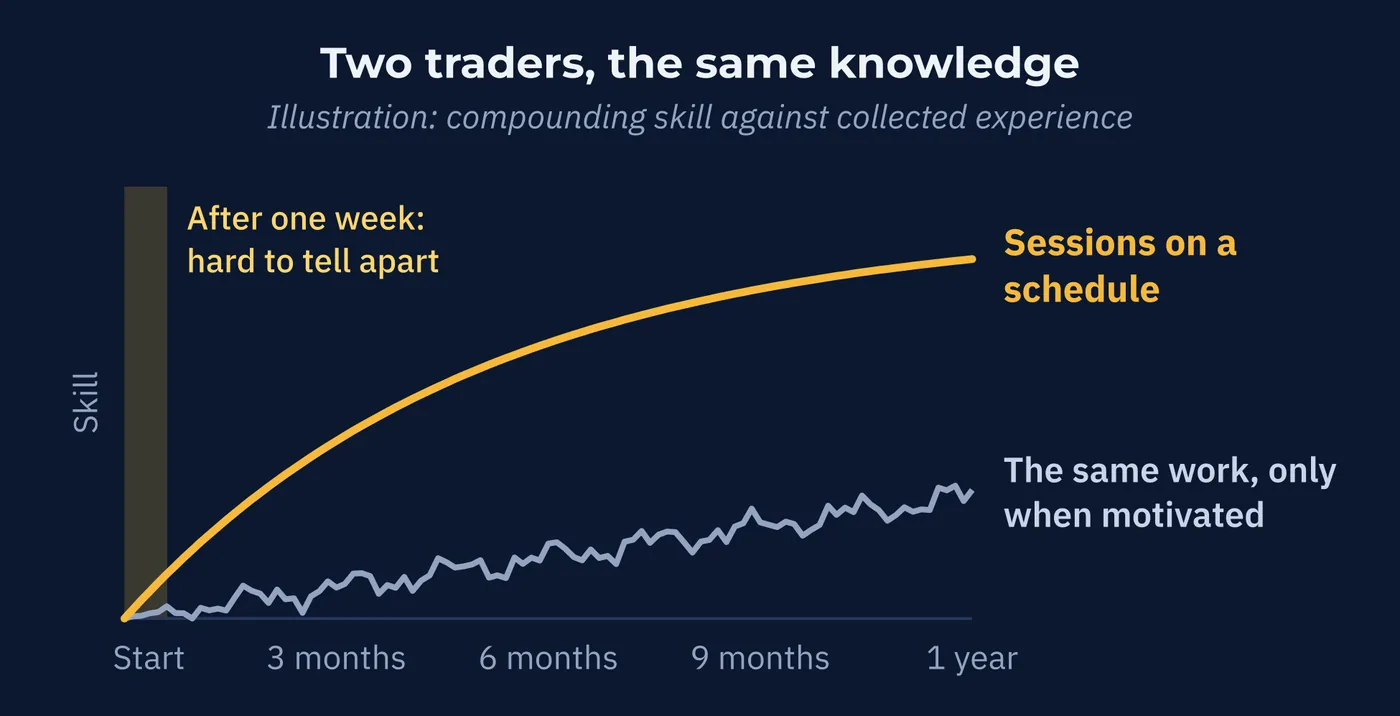
Two people start at the same time with the same knowledge and the same account. A year later one has improved noticeably and the other has not.
The difference is usually not intelligence, or the pairs they chose, or the platform they used. It is not even how many hours they spent, which is the answer most people would guess.
It is whether the hours happened on a schedule.
One trader reviewed charts, checked the calendar, and wrote in a journal at set times each week, whether or not the week had gone well and whether or not they felt like it. The other did the same activities when motivation was high and skipped them when it was not.
One built something that compounds. The other collected experiences.
The market cannot tell them apart in a week. Over a year the gap is obvious, and by then it is a gap in skill rather than effort.
2Think in Weeks, Not Days
Advice written for full-time traders describes a daily routine, and that shape does not fit a life with a job in it.
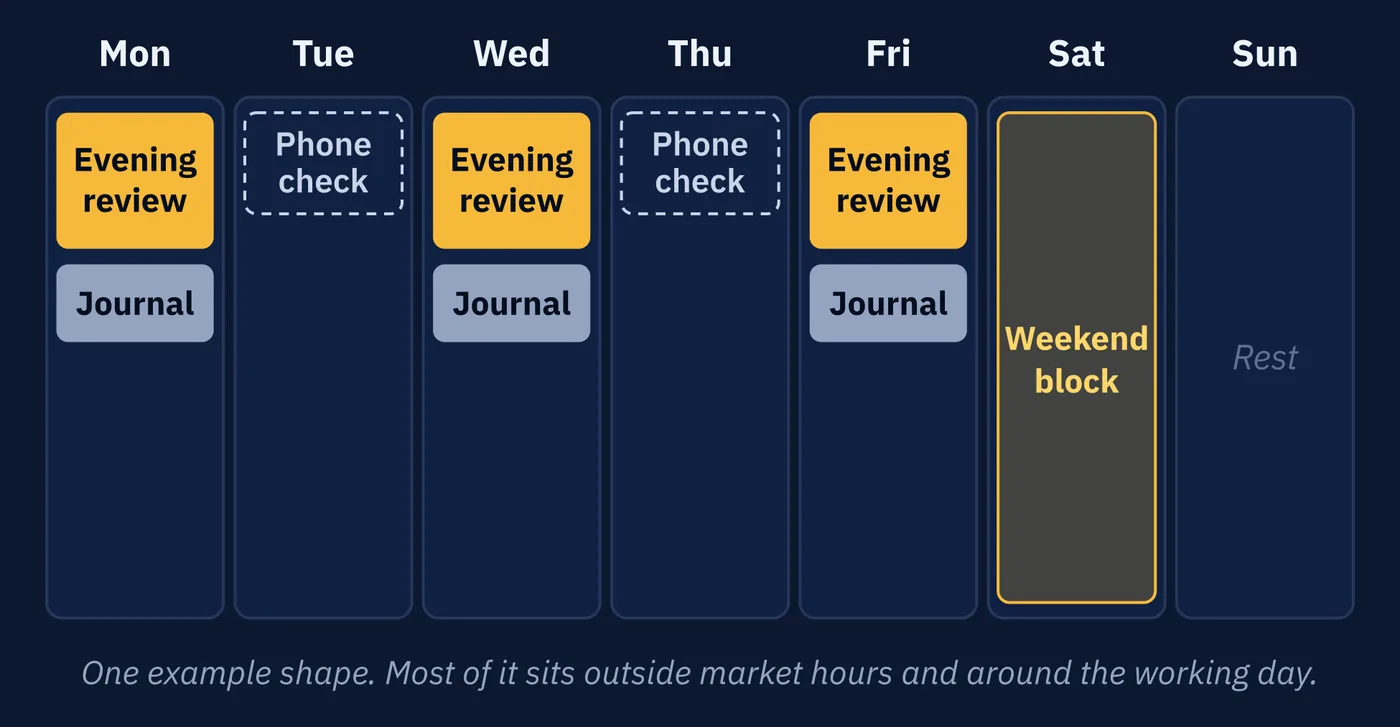
A week is the better unit. Some days you will have an hour and some days nothing at all, and a weekly structure absorbs that without breaking.
Here is a shape that works on five to eight hours, which is what Lesson 24 established as sufficient.
| When | What Happens | Roughly |
|---|---|---|
| Weekday evenings | Chart review, calendar check, place or manage trades | 30 to 45 minutes, a few nights |
| Mid-day, from a phone | Confirm open positions are as expected | A minute or two |
| End of any session | Journal entry | 5 to 10 minutes |
| Weekend block | Full review, journal reading, watchlist for the week ahead | 2 to 3 hours |
Notice how much of that sits outside market hours. Chart review does not need the market open. Neither does the journal, the calendar check, or the watchlist.
Which means the routine is not competing with your working day for the same time. It mostly runs in the space around it.
3Before You Look at a Chart
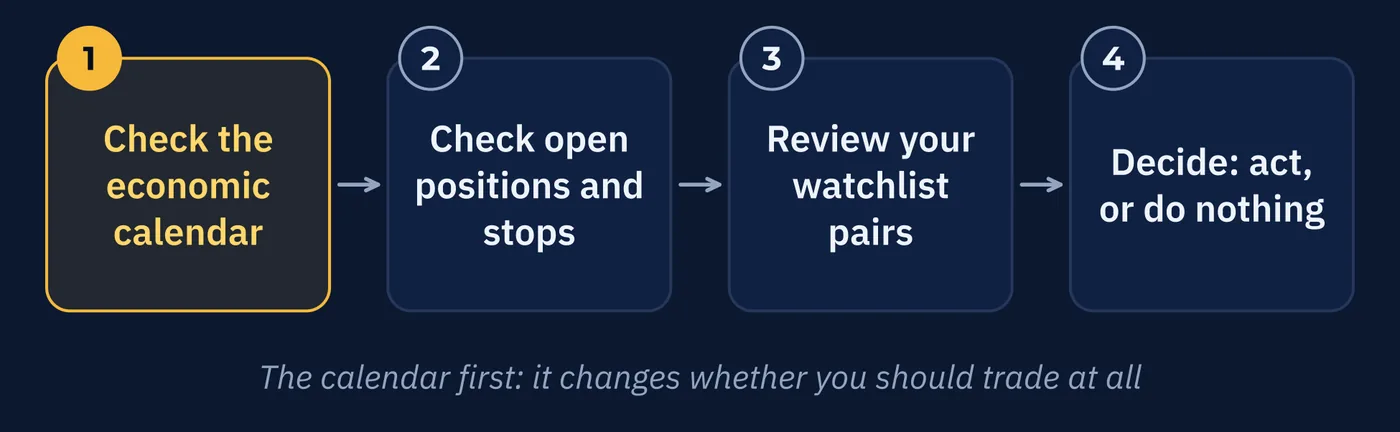
A session should start the same way every time, and the order matters.
| Step | Why It Comes Here |
|---|---|
| 1. Check the economic calendar | Before anything else. It changes whether you should trade at all. |
| 2. Check open positions | Confirm they are where you left them and stops are still in place. |
| 3. Review your watchlist pairs | Now that you know what is scheduled and what you are holding. |
| 4. Decide, and act or do nothing | With the first three steps behind you. |
The calendar goes first for a reason worth understanding. If a major announcement lands in two hours, that changes what is sensible tonight. Discovering it after you have found a setup you like is a much harder moment to be objective in.
The habit takes five minutes and it protects everything downstream.
4The Check During the Day
If you hold positions overnight or across a working day, one brief check is useful. One.
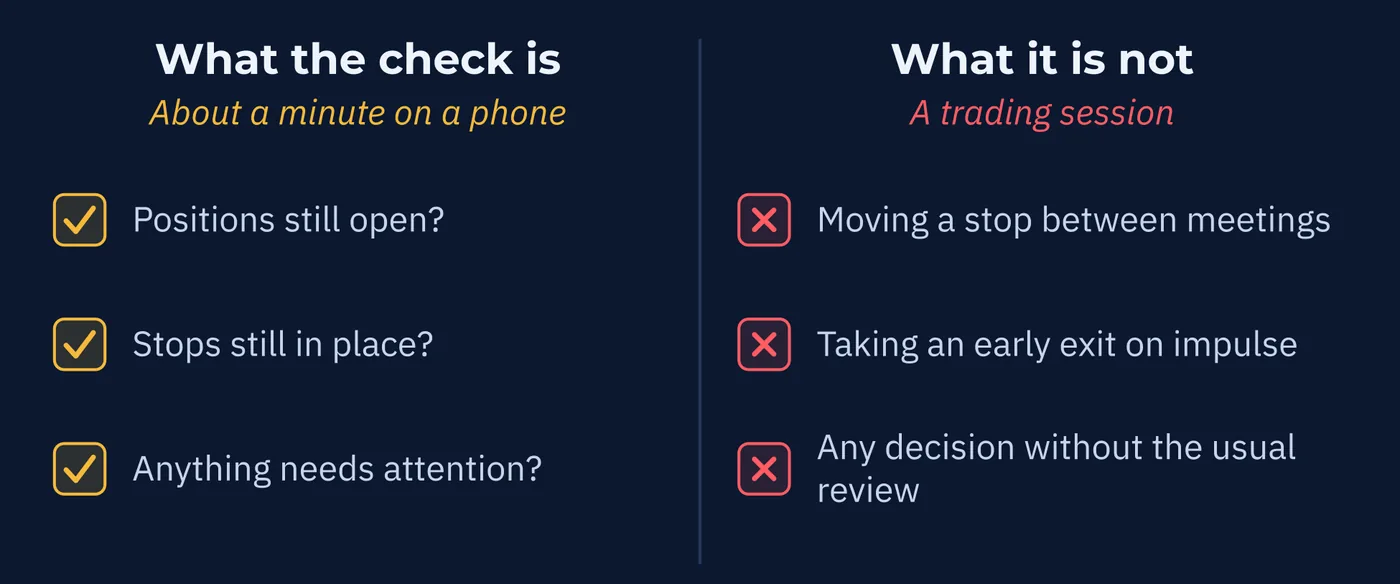
It has a narrow purpose. Confirm the positions are open, the stops are still there, and nothing needs attention. That takes about a minute on a phone.
What it is not is a trading session. Deciding to move a stop or take an early exit from a phone, between other commitments, without the review that would normally precede such a decision, is how carefully placed positions get interfered with.
The instruction is small and oddly effective. Before the usual scroll through everything else, check the pairs. It occupies the same minute and returns something more useful.
5The Journal
This is the component most often skipped and the one that does the most work.
A trading journal is a record of what you did and why. Not a list of results, which your account already keeps. A record of reasoning.
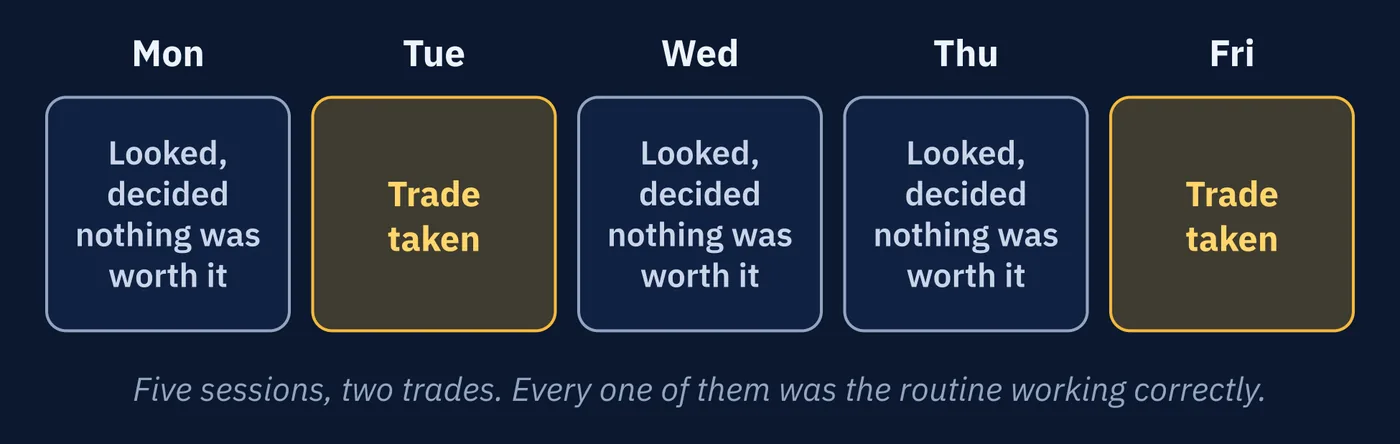
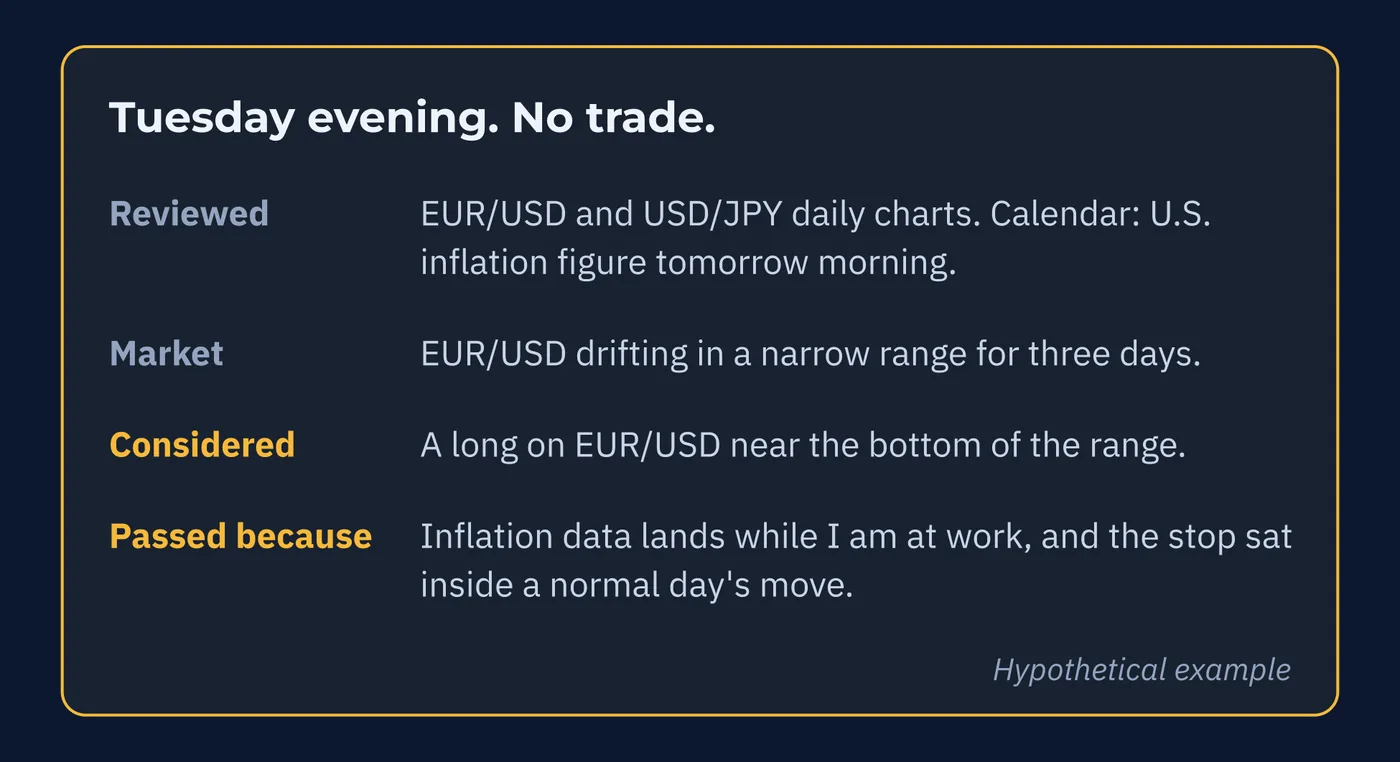
Here is the part that surprises people. The most valuable entries are the ones from sessions where you did not trade.
A no-trade session feels like nothing to write about. It is the opposite. It is where your decision-making is most visible, because nothing happened to distract you from it.
| Record This | Because |
|---|---|
| What you reviewed | Shows what you were actually looking at over time |
| What the market was doing | Gives context you will not remember in a month |
| Any setup you considered and passed on | This is the valuable one |
| Why you passed on it | The specific reason, not just that you did |
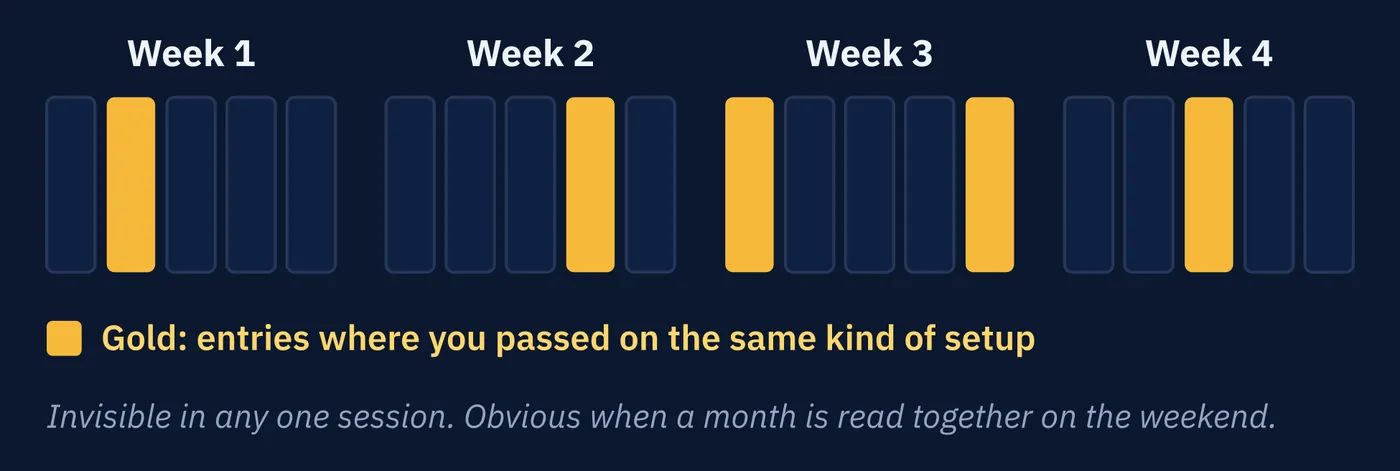
The third and fourth rows are why this works. Across weeks, patterns appear that are invisible in any single session.
You might find you consistently pass on a particular kind of setup. The journal will tell you whether that judgment was right, because you can look at what those trades would have done. Either you confirm a good instinct or you discover you have been declining valid opportunities out of an unexamined habit.
Neither of those discoveries is available without the record. And neither happens in a week. They emerge from reading a month of consistent sessions together, which is what the weekend block is for.
6The Weekend Block
Lesson 24 called the weekend the most underused resource available. This is what to do with it.
The market is closed. Nothing is moving, nothing needs a decision, and no price is pressuring you. That is exactly why the thinking is better.
| Activity | What It Gives You |
|---|---|
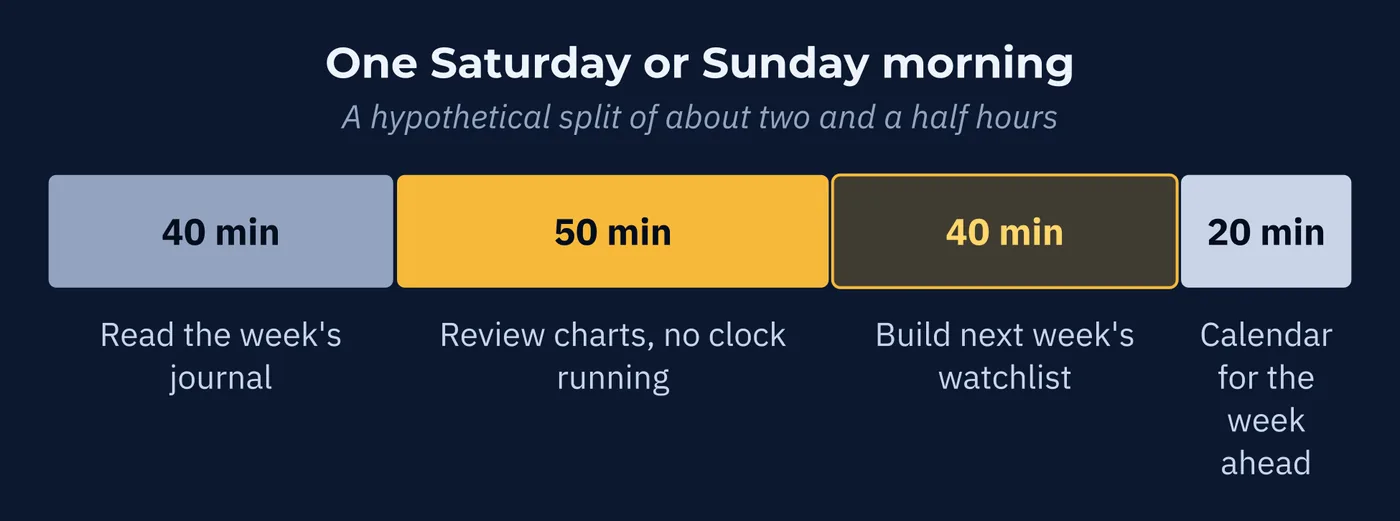
| Read the week's journal entries together | Patterns across sessions rather than within one |
| Review charts without a clock running | Analysis that is not rushed by a closing window |
| Build a watchlist for the week ahead | You arrive Monday with a plan instead of a blank screen |
| Check the calendar for the coming week | You know where the significant events land before they arrive |
For most people with a full schedule, this is the largest single block of the week and the most productive one. Two or three hours on a Saturday or Sunday morning does more than several rushed weekday evenings.
It also solves the Monday problem from Lesson 23. Monday is a tentative day, poorly suited to fresh decisions made in a hurry. Arriving with a watchlist prepared on Sunday means Monday requires observation rather than improvisation.
7Decide Before You Open the Platform
One habit worth more than its size, and it applies to every session.
Decide how long the session will be before you start it.
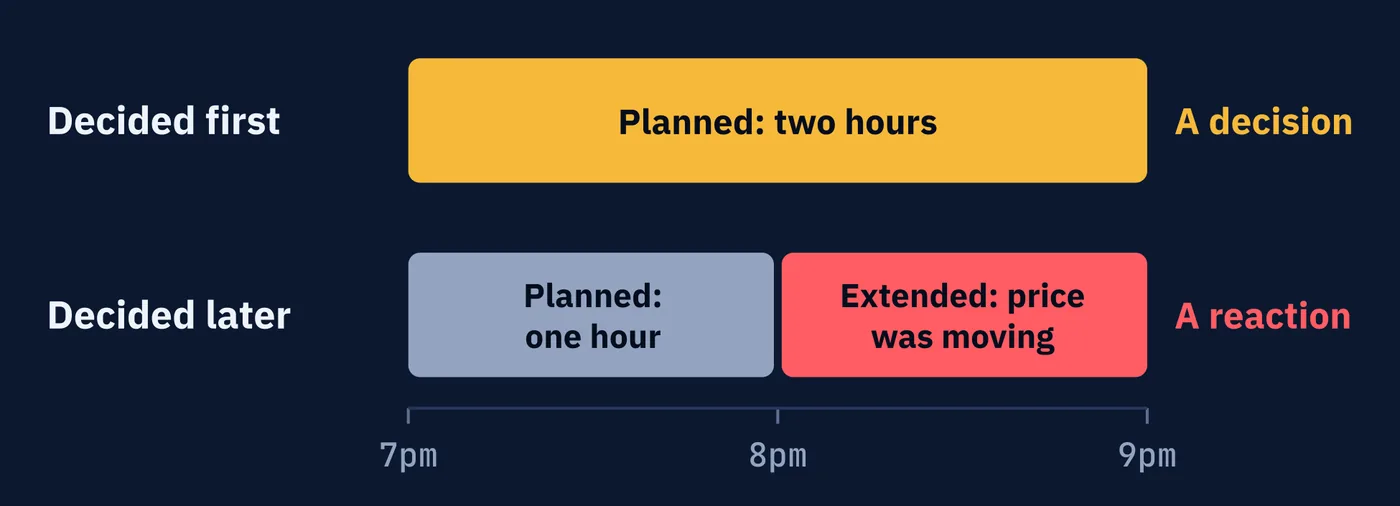
Consider two traders with the same free evening. One looks at their schedule at seven, sees the night is genuinely clear, and decides on a two hour session. The other sits down for an hour, and an hour later decides to keep going an additional hour because price is moving.
Both end up trading for two hours. Only one of them decided to. The other extended the session because the market was moving, then risked feeling that the extra hour needed to produce a trade to justify staying.
A decision made before the platform opens is a decision. Afterward it is a reaction.
8What You Have Built
This is the last section of the lesson, so it is worth looking back at the distance covered.
You started with a twenty dollar bill that costs six cents to make, and the observation that it works because everybody agrees it does. Money is trust, printed.
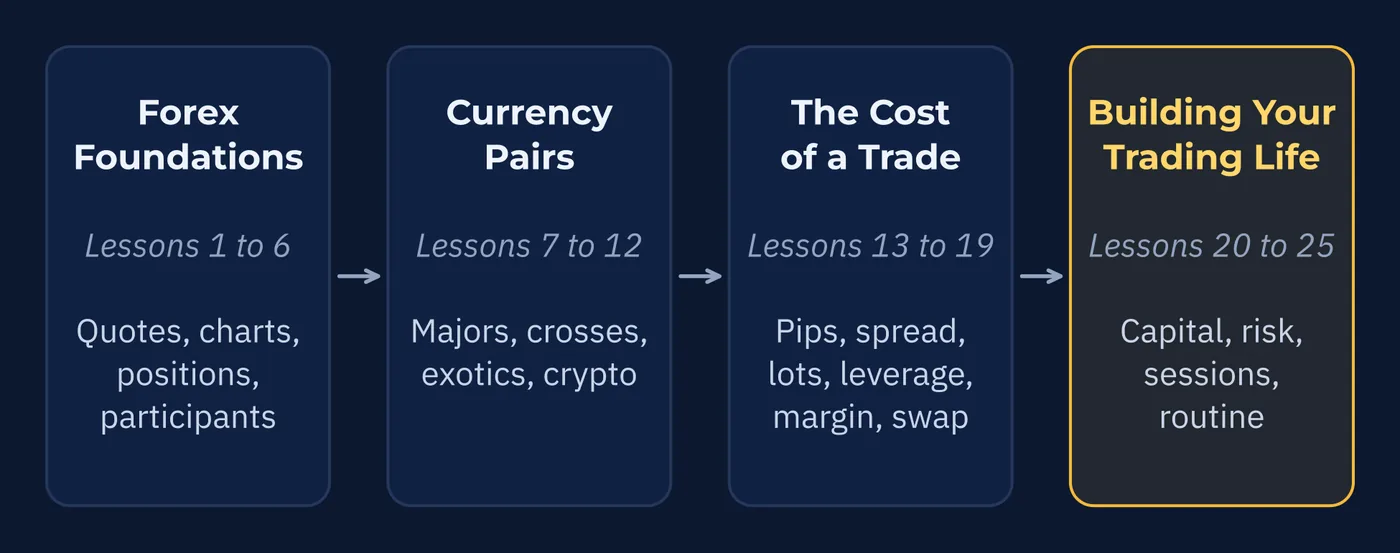
From there you learned to read a quote, then a chart, then a position. You met the participants who move prices and found where you sit among them. You learned which pairs exist and what separates them. You worked out what a trade costs before it starts, what a pip is worth, what leverage does in both directions, and where the decision to close stops being yours.
Then the practical questions. How much capital, how much risk, which hours, and how any of it fits around a working life.
Notice what this course has not given you.
It has not told you which way any price will go. There is no strategy in these twenty-five lessons, no entry signal, and no method for predicting the market. That was deliberate.
None of this tells you what will happen. All of it decides what happens to you.
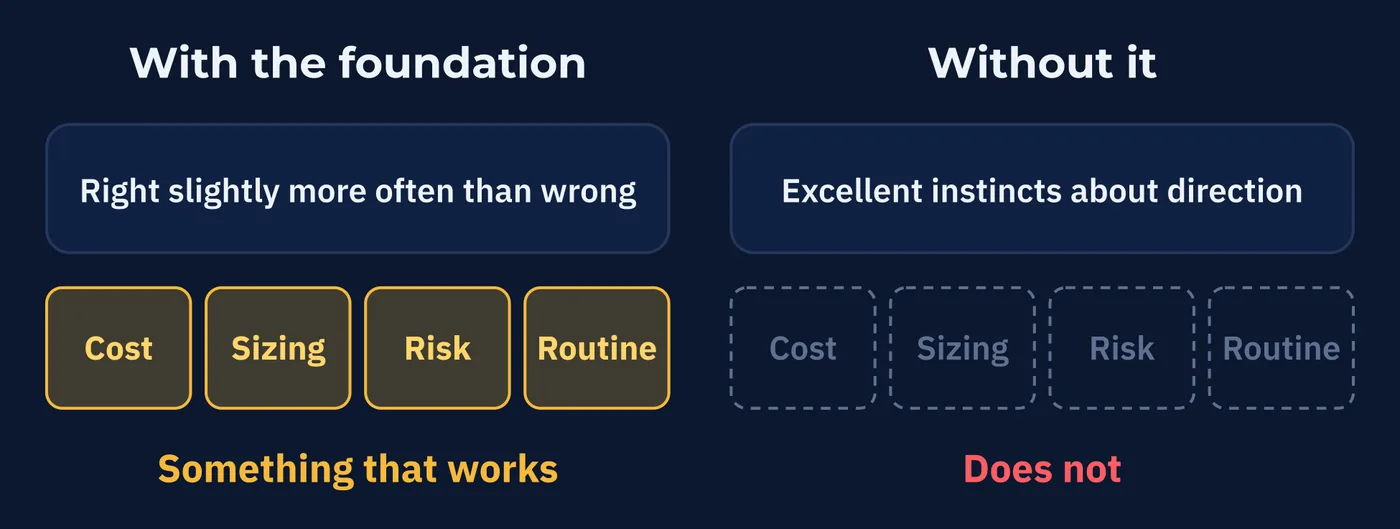
Being right about direction is the part everyone focuses on and the part that matters least without the rest. A trader who is right slightly more often than they are wrong, and who has the cost, the sizing, the risk, and the routine handled, has something that works. A trader with excellent instincts and none of that does not.
What you have now is the foundation the rest is built on. Whatever strategy you eventually learn, and strategies will come, it will run on top of exactly these things.
Three Things to Remember
Try This
Thirty minutes, once. Then a few minutes a week forever.
Words From This Lesson
| Term | What It Means |
|---|---|
| Trading journal | A record of what you reviewed, what you decided, and why. Including the sessions where you did not trade. |
| Watchlist | The short list of pairs you are actively following, prepared in advance of the week. |
| Pre-session check | The fixed sequence run before analysis: calendar, open positions, watchlist, decision. |
| No-trade session | A session that ends without a trade. Normal, and among the most instructive to record. |
| Session length | How long you intend to be at the platform, decided before you open it. |
Test Your Knowledge
Eight questions. Answer them all before checking the key on the following pages. If a question gives you trouble, the answer key tells you which section to revisit.
- A. Whether the hours happen on a schedule
- B. The number of hours spent
- C. The platform they use
- D. The pairs they choose
- A. The market only moves weekly
- B. Brokers report results weekly
- C. Daily routines are only for crypto
- D. Available time varies day to day, and a weekly structure absorbs that
- A. Reviewing charts
- B. Checking the economic calendar
- C. Placing a trade
- D. Reading the news
- A. It takes longer, so it should be done while fresh
- B. Charts are unreliable before the calendar is checked
- C. A scheduled event changes whether trading tonight is sensible at all
- D. It is a broker requirement
- A. Entries from winning trades
- B. Entries from sessions with no trade at all
- C. Entries from losing trades
- D. Entries recording account balance
- A. Only the date
- B. The account balance and nothing more
- C. What you reviewed, what you considered, and specifically why you passed
- D. Nothing, since no trade occurred
- A. One made a decision in advance, the other reacted to the market
- B. Nothing, since the time spent is identical
- C. The second trader is more engaged
- D. The first trader missed opportunities
- A. Crypto spreads are wider at night
- B. Crypto only trades on weekends
- C. Crypto platforms log you out automatically
- D. The market never closes, so no external boundary stops you
Answer Key
Each answer explains why the correct choice is correct, why the others are not, and where to reread.
Question 1 · correct answer A
Scheduled sessions accumulate into skill. The same activities done only when motivation is present produce experience without the review that turns it into improvement.
B is the intuitive answer, and hours matter far less than whether they recur reliably. C and D are real choices with real consequences, but neither explains a year-long gap between two people who started together.
Review: Section 1, What Actually Separates People
Question 2 · correct answer D
Some days offer an hour and some none at all. A weekly structure survives that variation, where a daily one breaks the first time a day disappears.
A is wrong because the market moves continuously through the week. C invents a distinction that does not exist. B is unrelated to how you plan your own time.
Review: Section 2, Think in Weeks, Not Days
Question 3 · correct answer B
The calendar comes first because it can change whether trading is sensible at all before any analysis has begun.
A is third in the sequence, after positions have been confirmed. C is the last step, if it happens. D is useful but does not replace a scheduled calendar of known upcoming events.
Review: Section 3, Before You Look at a Chart
Question 4 · correct answer C
Knowing a major announcement is coming changes what is reasonable tonight. Finding that out after you have identified an appealing setup is a much harder moment to stay objective in.
A misstates the order's purpose and the check takes only minutes. B is wrong because charts are unaffected by whether you have looked at a calendar. D invents a requirement.
Review: Section 3, Before You Look at a Chart
Question 5 · correct answer B
A no-trade session is where decision-making is most visible, because nothing happened to distract from it. Those entries reveal patterns across weeks.
A and C are worth recording, but the outcome is already in your account history. B adds the reasoning that nothing else captures. D records a number your platform already keeps.
Review: Section 5, The Journal
Question 6 · correct answer C
The specific reason for passing is what makes patterns visible later. Across weeks it either confirms a good instinct or reveals an unexamined habit.
A records too little to be useful. B duplicates information the account already holds. D is the assumption this section exists to correct.
Review: Section 5, The Journal
Question 7 · correct answer A
One set the length in advance with a clear head. The other let a moving price extend the session, which is a decision the market made rather than the trader.
B treats identical time spent as identical behavior, which is exactly the confusion. C mistakes reacting for engagement. D is wrong because the first trader chose their session deliberately.
Review: Section 7, Decide Before You Open the Platform
Question 8 · correct answer D
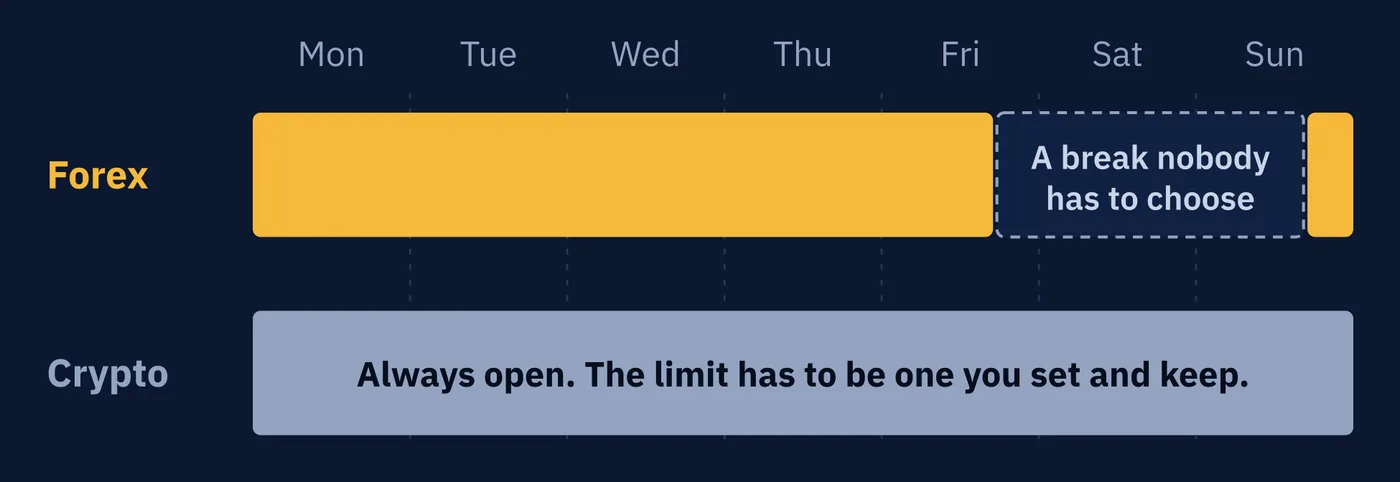
Forex eventually runs out of market at the weekend, which enforces a break. Crypto never does, so any boundary has to be one you set and keep.
A describes a real cost effect but not the reason session length needs deciding in advance. C is wrong because platforms do not enforce breaks. B reverses the facts, since crypto trades every day.
Review: Section 7, Decide Before You Open the Platform
Keep going
Building Your Trading Life is written by Kanin D. Alldredge for The Currency Classroom, and it is free to read. There is more free from CNS: start here.
Start free with CNS →