Trading Around a Job

1The Awkward Arithmetic
Lesson 23 named the best window in the trading week. Tuesday to Thursday, during the London and New York overlap.
For a trader in the eastern United States, that runs from about 8am to noon. Which is, for most people, work.
The London open is worse. It lands around 3am. Not a scheduling conflict, simply the middle of the night.
| The Best Hours | Roughly When, Eastern | Realistically Available? |
|---|---|---|
| London open | 3am | No |
| London and New York overlap | 8am to noon | Not on a workday |
| Dead zone | 5pm to 7pm | Yes, and it is the worst window |
Read that last row carefully. The hours most people actually have free are the ones the previous lesson identified as the least worth trading.
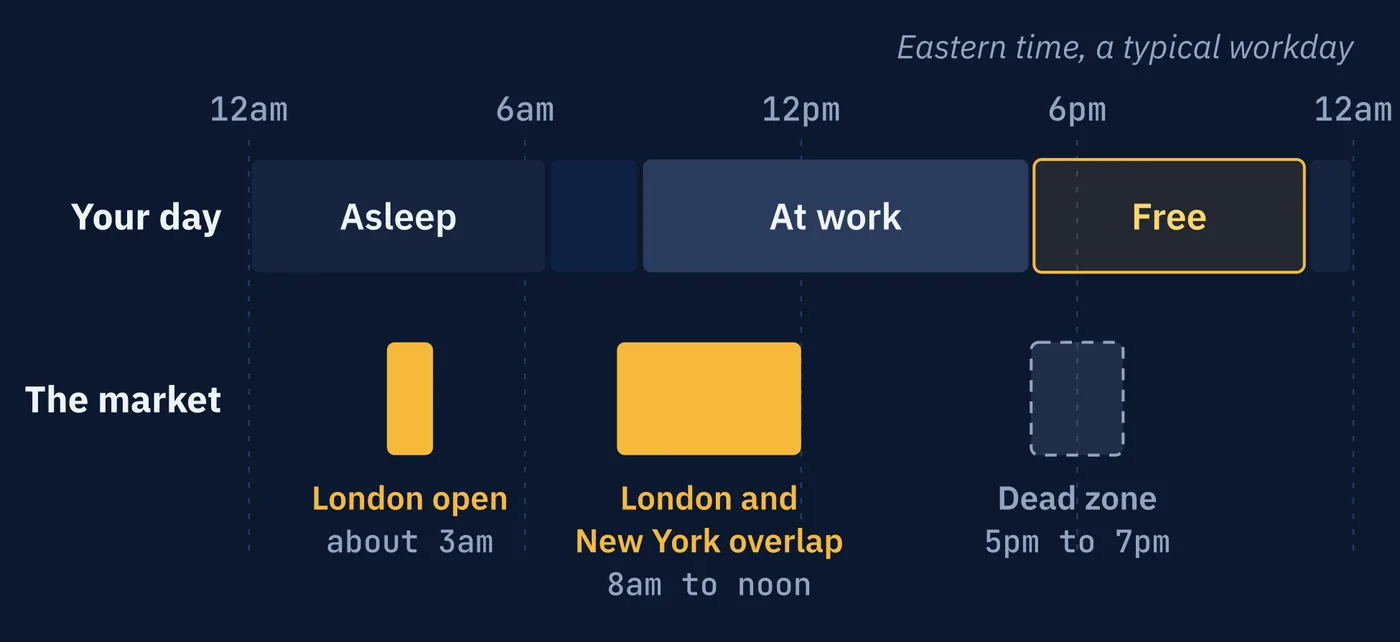
That looks like a serious problem. It is a real constraint, and it is not the obstacle it appears to be, for a reason that takes the rest of this lesson to unpack.
2Watching Is Not the Job
The instinctive response is to try to find more screen time. Wake earlier. Check during breaks. Sneak a look between meetings.
That approach fails, and not because of discipline. It fails because it misunderstands what a trade requires.
A position placed with a stop loss and a target continues to be managed by those two instructions whether or not anybody is looking at it. The stop does not need you present to work. Neither does the target.
The question is not how to watch more. It is how to position correctly when you can.
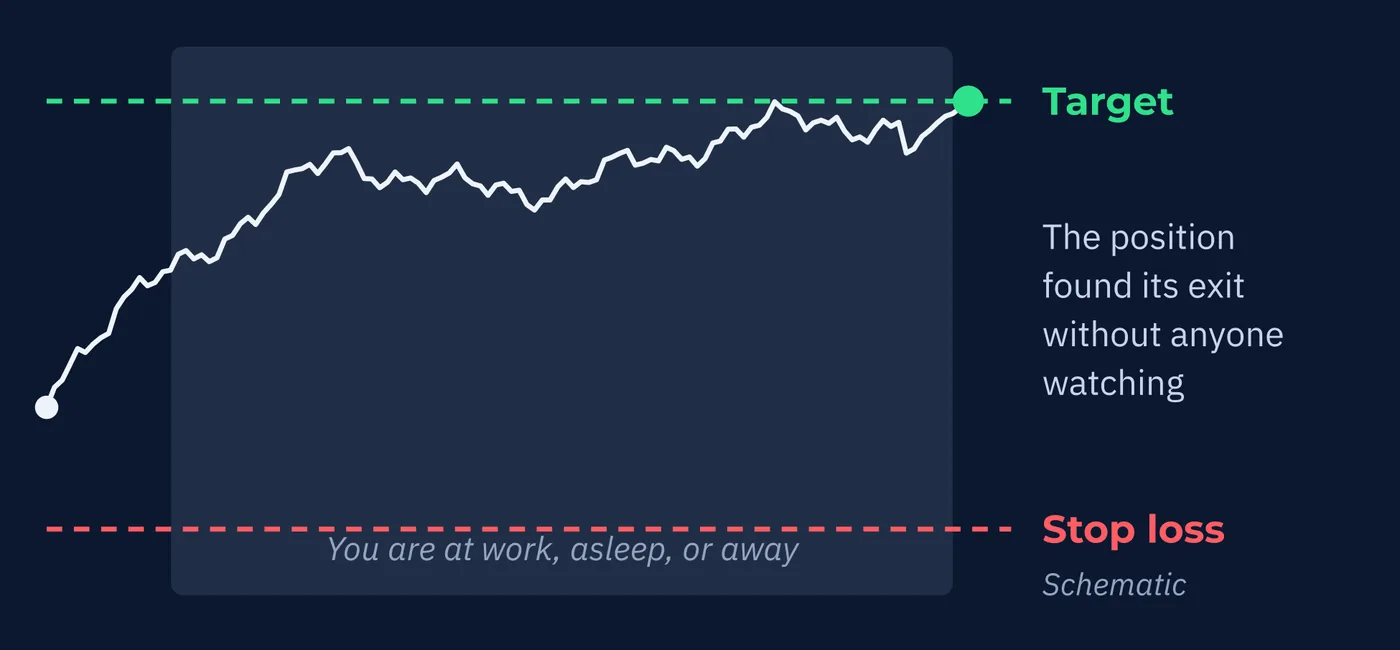
Which reframes the constraint entirely. You are not trying to be present for the market's best hours. You are trying to make good decisions during the hours you have, and to let those decisions carry themselves through the hours you do not.
Constant watching is not an advantage that a full-time trader has and you lack. For a great many people it produces worse results, because a screen in front of you all day invites interference with positions that were fine as placed.
3The Style That Fits
Trading approaches differ enormously in how much attention they require. That difference matters more than anything else for someone with a job.
| Style | Holding Period | Attention Required |
|---|---|---|
| Very short term | Minutes to hours | Constant. Incompatible with a job. |
| Swing trading | Days to weeks | Analysis outside market hours. Little management after entry. |
| Position trading | Weeks to months | Less again. Patience is the main demand. |
Swing trading is the natural fit, and the reason is structural rather than a matter of preference.
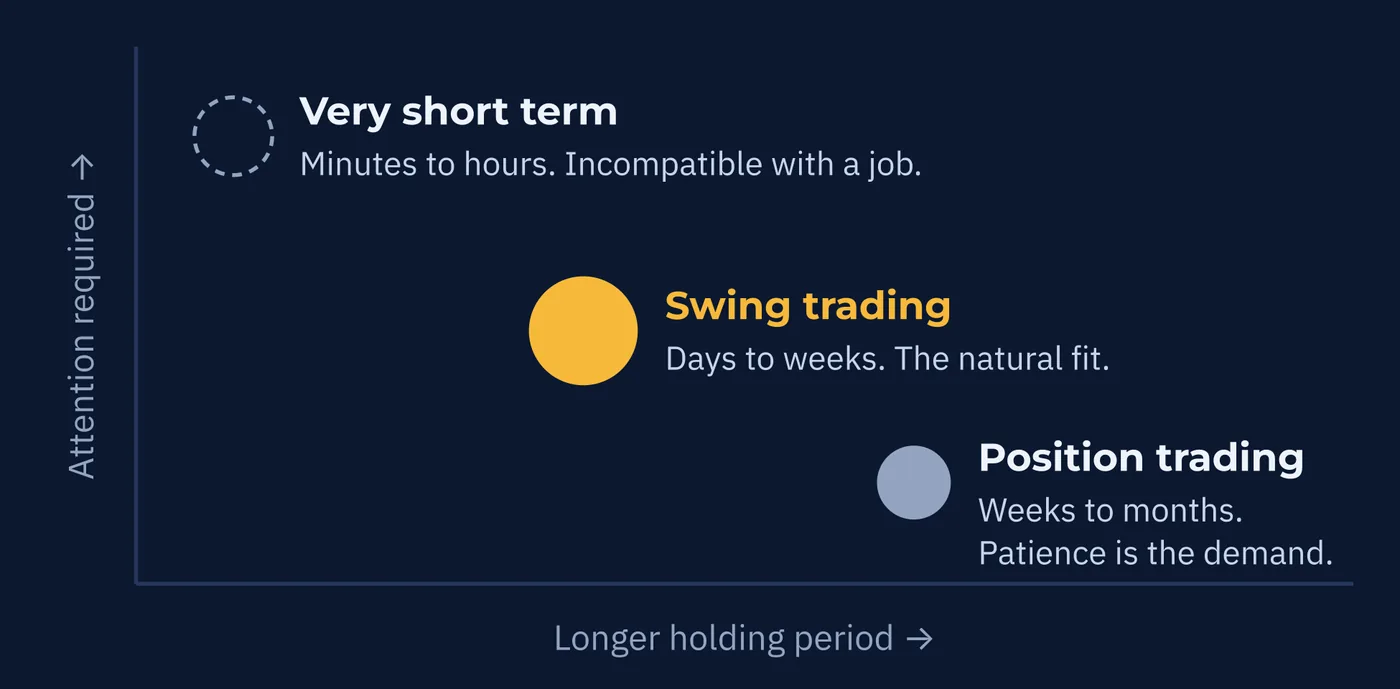
Its analysis happens on higher timeframes, which do not require watching in real time. A daily chart is just as readable at nine in the evening as it was at nine in the morning. Nothing was missed by not being present.
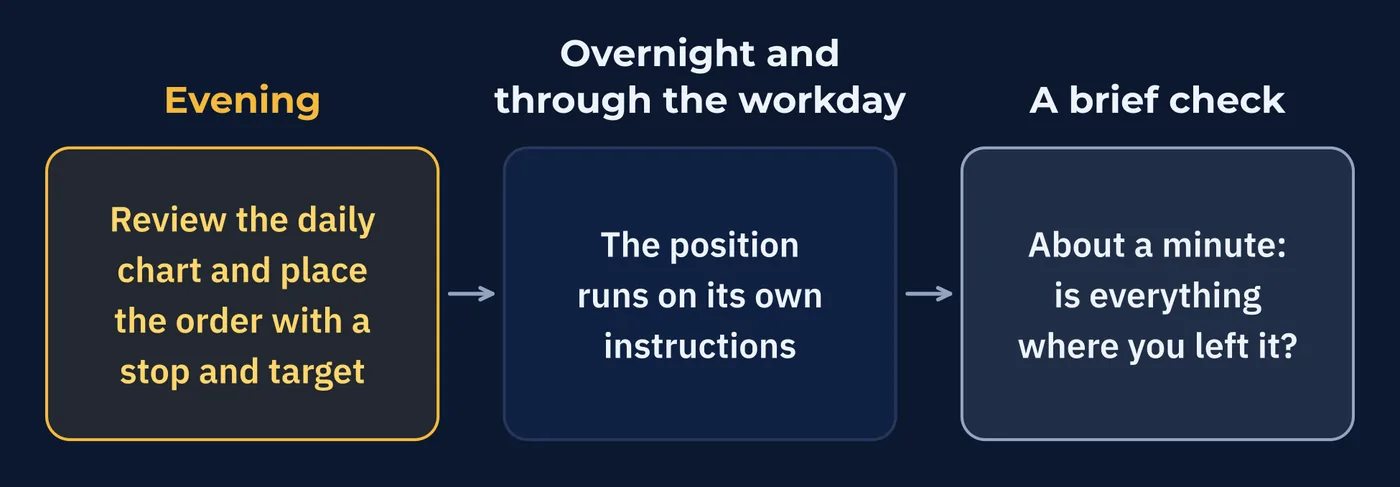
And once a swing position is placed, with a stop and a target, it does not need managing through the day. It needs checking, briefly, and otherwise leaving alone.
Position trading takes this further and demands even less time. The trade-off is patience, since holding for weeks means sitting through movement against you that a shorter approach would have exited long before.
4The Calendar Check
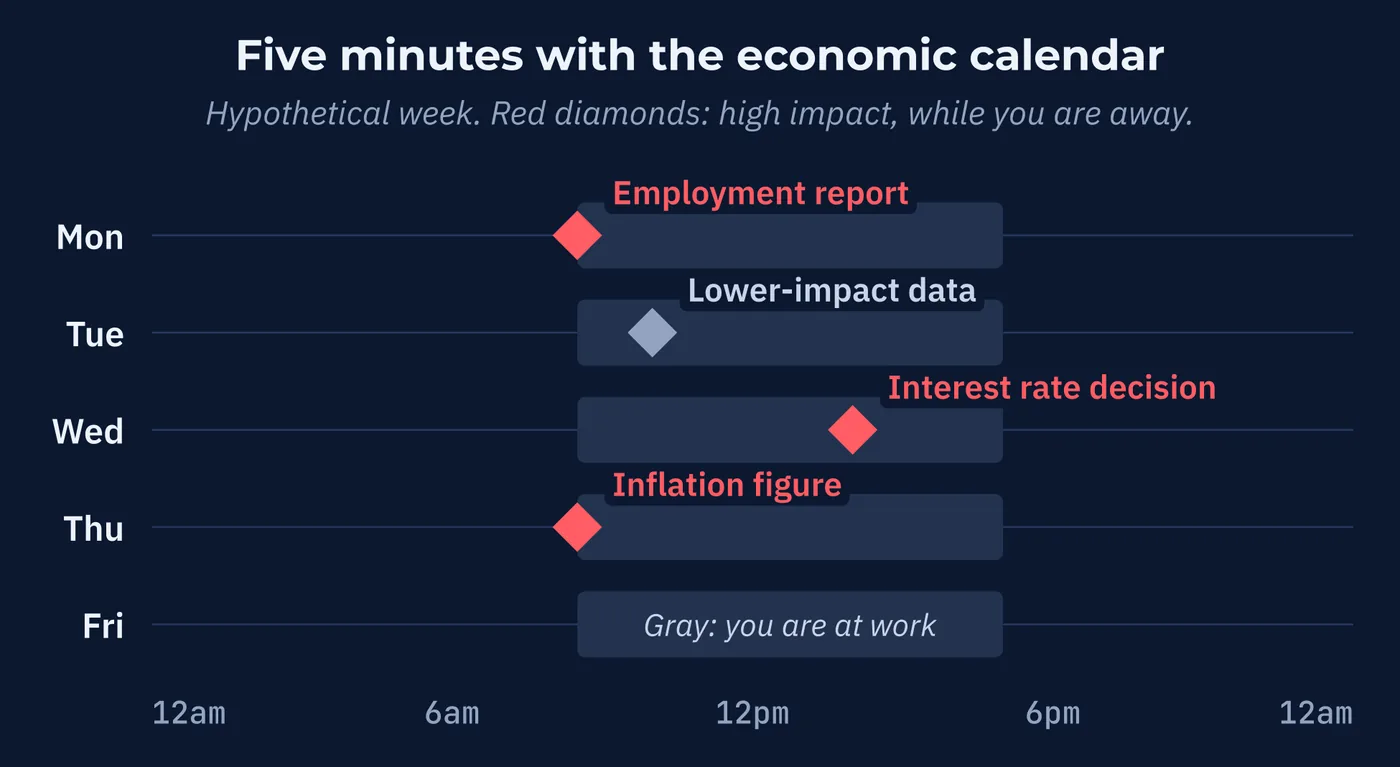
One habit matters more than any other for someone who cannot watch, and it takes five minutes.
Before entering anything, and before leaving an open position unattended, check the economic calendar.
From Lesson 5, you know that central bank announcements and major data releases produce the largest moves of any event. Those events are scheduled, published in advance, and free to look up.
The person who cannot watch the market is precisely the person who most needs to know what is coming while they are away.
5The Stop Loss Becomes Non-Negotiable
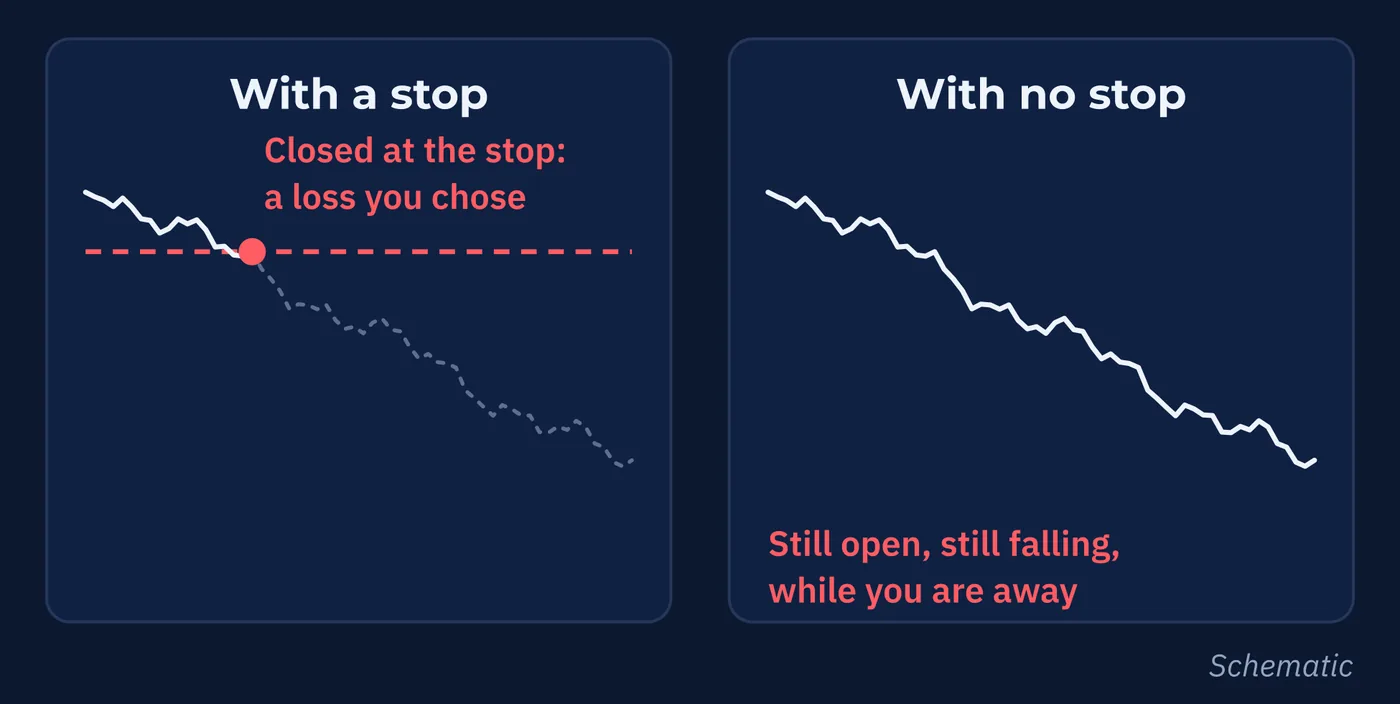
Lesson 18 made the case for stop losses in general. For someone who cannot watch, the case becomes absolute.
A full-time trader without a stop is being reckless, but they are at least present. They can see the position and act on it.
You cannot. Between closing your laptop and opening it again, the only thing standing between your position and your account is whatever instruction you left behind.
An open position with no stop is not a trade. It is exposure left unattended.
So the rule is simple and worth treating as absolute. Every position gets a stop before the platform is closed. Not later, not when you next check, and not once the trade looks like it needs one.
Set the profit target at the same time. Then the position has both of its exits defined, and it will find one of them whether you are watching, working, or asleep.
6Tools That Work While You Do Not
A few practical things make the gap between sessions considerably easier to manage.
| Tool | What It Does | What It Does Not Do |
|---|---|---|
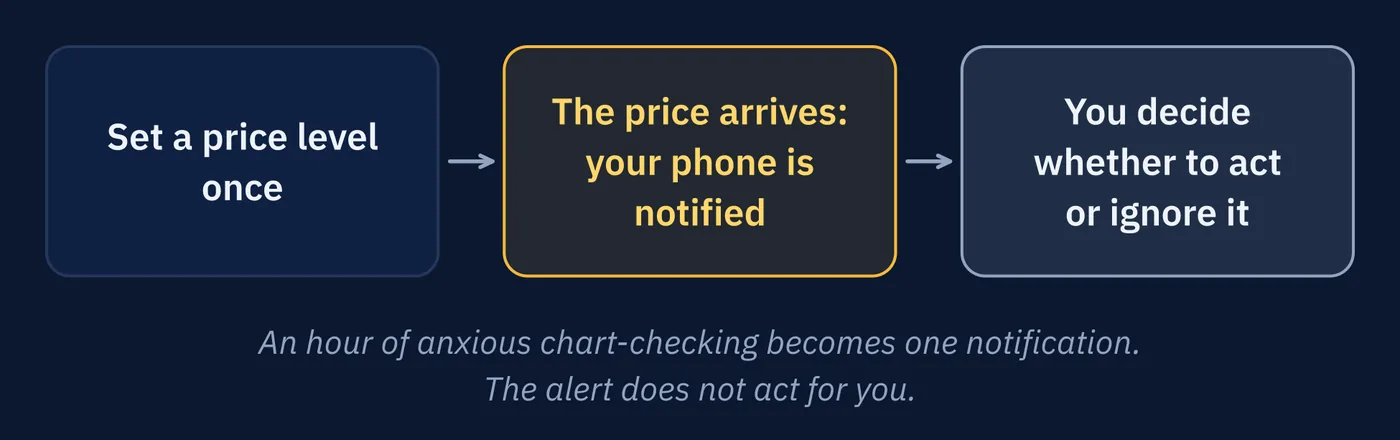
| Price alerts | Notifies your phone when a level is reached | Act on it for you |
| Mobile platform apps | Lets you check positions and orders in a minute | Replace a proper review session |
| Automated systems | Execute a defined plan in your absence | Create a plan that works |
Alerts are the most useful and the most underrated. Rather than checking a chart repeatedly to see whether a price has arrived, you set a level and get told. That converts an hour of anxious watching into a notification you either act on or ignore.
Mobile apps are worth having for one narrow purpose. A brief, structured check that positions are where you left them and nothing needs attention. That takes about a minute and it is a different activity from trading from your phone, which is generally a poor idea.
7What Automation Cannot Do
Automated systems, also known as robots or expert advisors (EAs), deserve their own treatment, because they are marketed heavily at exactly the audience this lesson addresses.
The pitch is appealing. Software that trades while you work, covering the London open you will never see.
The mechanism is real. A program can watch a market continuously and execute rules faster than any person. For a window that is structurally unavailable to you, that is a genuine use.
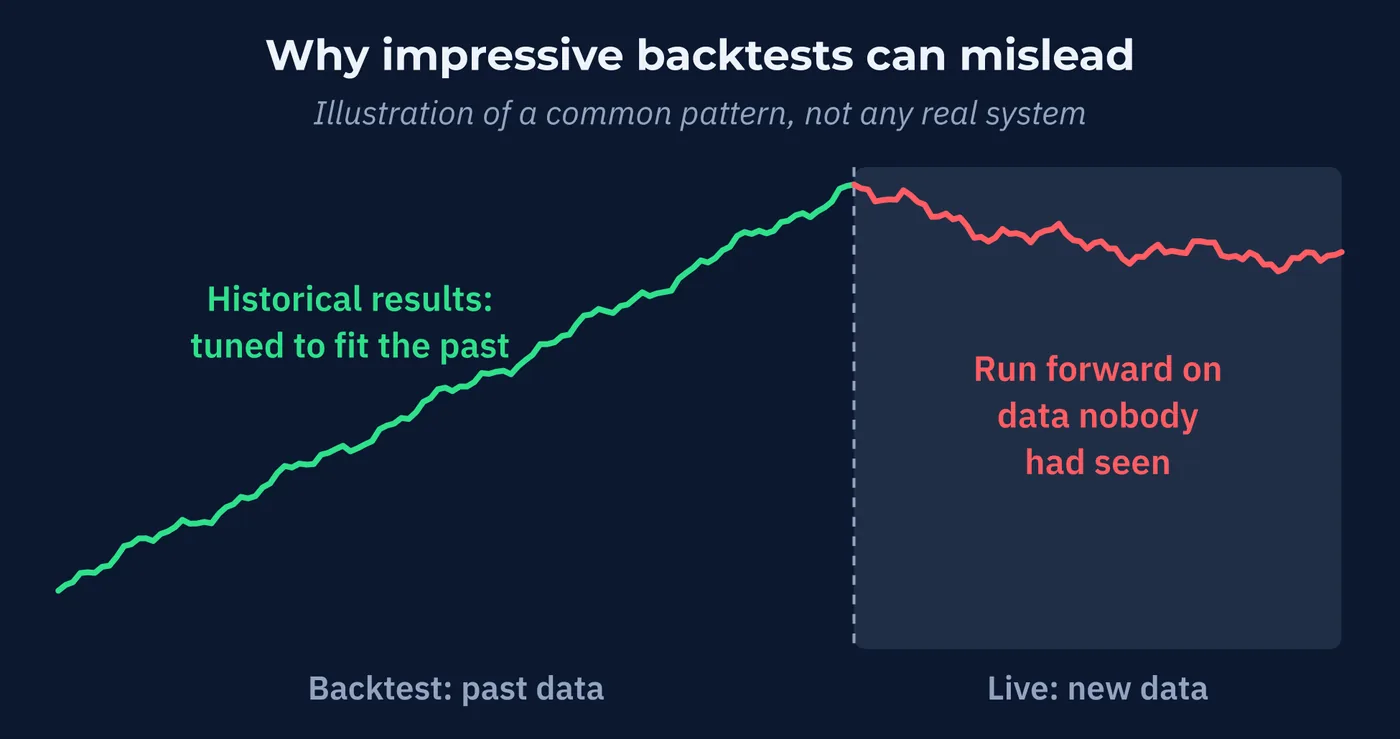
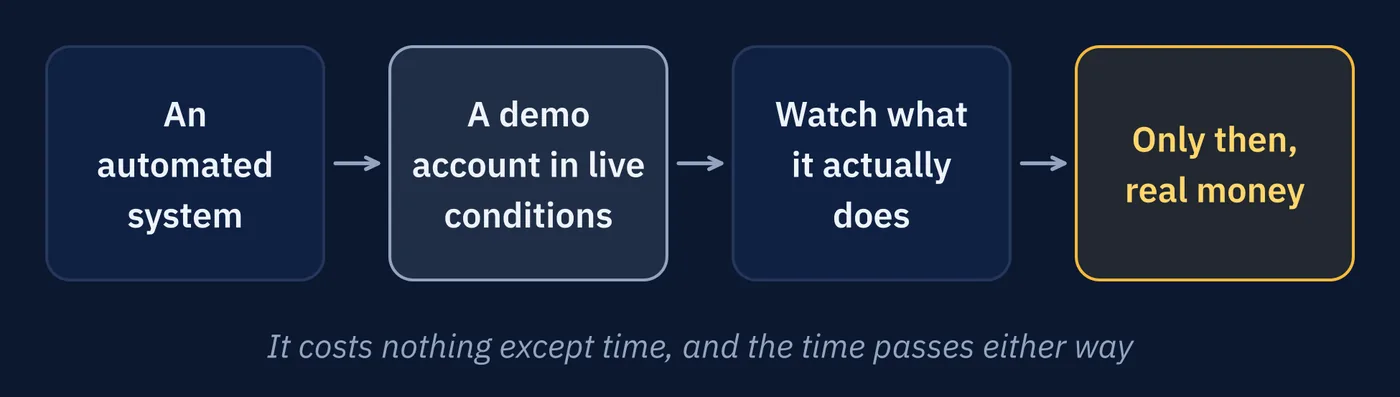
Which gives one straightforward precaution. Before letting any automated system trade real money, run it on a demo account for a stretch of live conditions and watch what it actually does.
It costs nothing except time, and the time passes either way. A system whose live performance is entirely unknown is not a tool. It is a guess with a user interface.
8How Long This Actually Takes
A reasonable question, and the honest answer is smaller than most people assume.
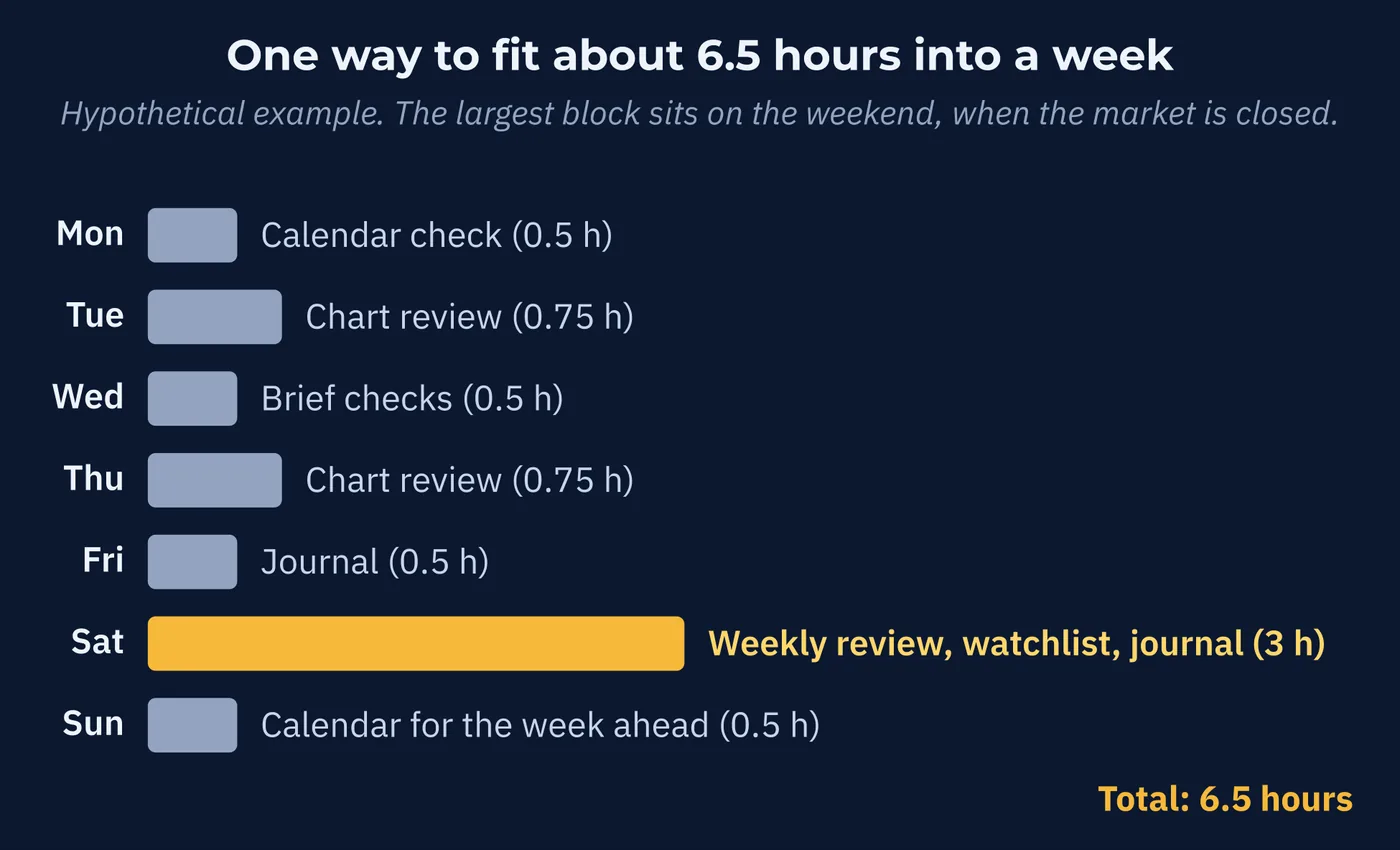
Five to eight hours a week is enough to run this properly. Not to run it in a rush, but to review charts, check the calendar, maintain a watchlist, place a small number of considered trades, and keep a journal.
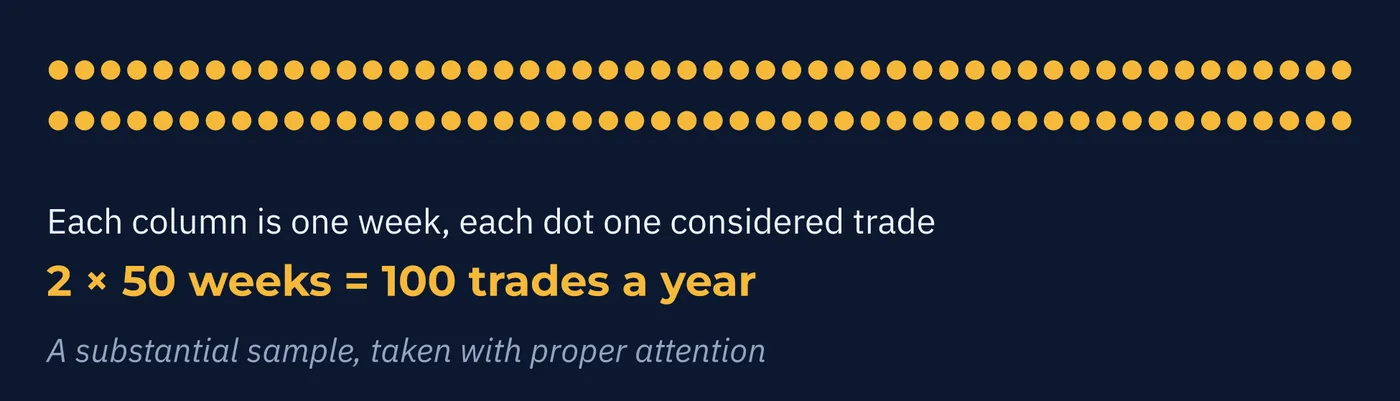
Consider what that supports. Two quality setups a week is a hundred trades a year, which is a substantial sample by any standard.
2 trades per week × 50 weeks = 100 trades a yearTwo trades a week does not sound like much, and the instinct is that more must be better. It is not. Fewer trades taken with proper attention beat many trades taken hurriedly around the edges of a busy day.
Notice where those hours can sit. Chart review does not need the market open. Journal work does not either. Neither does calendar checking or watchlist preparation.
The next lesson turns all of this into an actual routine. What the sessions look like, what belongs in each one, and why doing it on schedule matters more than doing it well on any particular day.
Three Things to Remember
Try This
Twenty minutes with a calendar. Find the hours you actually have.
Words From This Lesson
| Term | What It Means |
|---|---|
| Swing trading | Holding positions for days to weeks. Analysis is done outside market hours, and the position needs little management. |
| Position trading | Holding for weeks to months. Even less screen time, with patience as the main demand. |
| Economic calendar | A published schedule of upcoming data releases and central bank decisions, rated by likely impact. |
| Price alert | A notification sent when a pair reaches a level you specified. |
| Automated system | Software that executes a defined set of trading rules without you present. |
| Forward testing | Running a system on live conditions, usually on demo, rather than only against historical data. |
Test Your Knowledge
Eight questions. Answer them all before checking the key on the following pages. If a question gives you trouble, the answer key tells you which section to revisit.
- A. It requires special software
- B. The London and New York overlap falls during a normal working morning
- C. It only happens once a month
- D. Brokers restrict access during those hours
- A. Positioning correctly when available and letting the position manage itself
- B. Finding ways to watch more often
- C. Trading only on weekends
- D. Avoiding trading until they can watch full time
- A. Very short term trading
- B. Swing trading
- C. Trading only during the dead zone
- D. Any style, since schedule does not matter
- A. It produces larger profits
- B. It requires no stop loss
- C. It carries no risk
- D. Analysis happens on higher timeframes outside market hours
- A. Brokers require it on smaller accounts
- B. It guarantees the exit price
- C. It is the only thing managing the position while you are away
- D. It reduces the spread
- A. Creates a profitable strategy for you
- B. Guarantees results shown in its historical testing
- C. Executes a plan you have defined, whether that plan works or not
- D. Removes the need for a stop loss
- A. Brokers require a demo period
- B. It is faster than backtesting
- C. Demo accounts produce better results
- D. Historical results can be tuned to fit the past and may not hold going forward
- A. Five to eight hours
- B. One to two hours
- C. Twenty to thirty hours
- D. It cannot be done in under forty
Answer Key
Each answer explains why the correct choice is correct, why the others are not, and where to reread.
Question 1 · correct answer B
The overlap runs roughly 8am to noon Eastern, which is a working morning for most people. The London open is earlier still, around 3am.
A is unrelated, since the same platforms work at any hour. C is wrong because the overlap occurs every trading day. D invents a restriction that does not exist.
Review: Section 1, The Awkward Arithmetic
Question 2 · correct answer A
A position with a stop and a target is managed by those instructions whether or not you are watching. The decisions matter, the observation does not.
B chases screen time, which is the instinct this lesson exists to correct. C ignores that the market is closed on weekends. D postpones indefinitely something that works perfectly well part-time.
Review: Section 2, Watching Is Not the Job
Question 3 · correct answer B
Swing trading holds for days to weeks, with analysis done outside market hours and little management needed after entry.
A requires constant presence and is genuinely incompatible with a job. C would mean deliberately trading the worst conditions of the day. D is wrong because attention requirements differ enormously between styles.
Review: Section 3, The Style That Fits
Question 4 · correct answer D
Higher timeframes do not need watching in real time. A daily chart reads the same in the evening as it did that morning, so nothing is missed by being unavailable.
A is not a property of the style, since results depend on the approach rather than the holding period. C is wrong because every style carries risk. B contradicts Section 5 directly.
Review: Section 3, The Style That Fits
Question 5 · correct answer C
Between closing the platform and opening it again, the instruction you left is the only thing standing between the position and the account.
A invents a broker rule. B overstates it, since gaps can prevent execution at the intended level, as Lessons 18 and 23 explained. D confuses a risk instruction with a cost.
Review: Section 5, The Stop Loss Becomes Non-Negotiable
Question 6 · correct answer C
Automation executes rules. If those rules do not work, it executes them consistently and quickly, which does not improve the outcome.
A is the marketing claim rather than the mechanism. B is wrong because historical results can be fitted to the past. D is wrong because an automated position needs a stop like any other.
Review: Section 7, What Automation Cannot Do
Question 7 · correct answer D
A system tuned closely to historical data can look excellent against the past and perform poorly on conditions it has never seen. Demo exposes it to live conditions at no cost.
A invents a requirement. C is wrong because demo conditions do not flatter results, they simply cost nothing. B confuses the two kinds of testing, since backtesting is the faster one.
Review: Section 7, What Automation Cannot Do
Question 8 · correct answer A
Five to eight hours supports chart review, the calendar check, a watchlist, a small number of considered trades, and a journal.
B is too little to maintain the routine consistently. C and D describe a full-time commitment, and the point of this lesson is that such a commitment is not required.
Review: Section 8, How Long This Actually Takes
Keep going
Building Your Trading Life is written by Kanin D. Alldredge for The Currency Classroom, and it is free to read. There is more free from CNS: start here.
Start free with CNS →