Overlaps and Dead Zones

1Where Sessions Meet
The four sessions do not run one after another in a tidy queue. They overlap, because business hours in different parts of the world genuinely do.
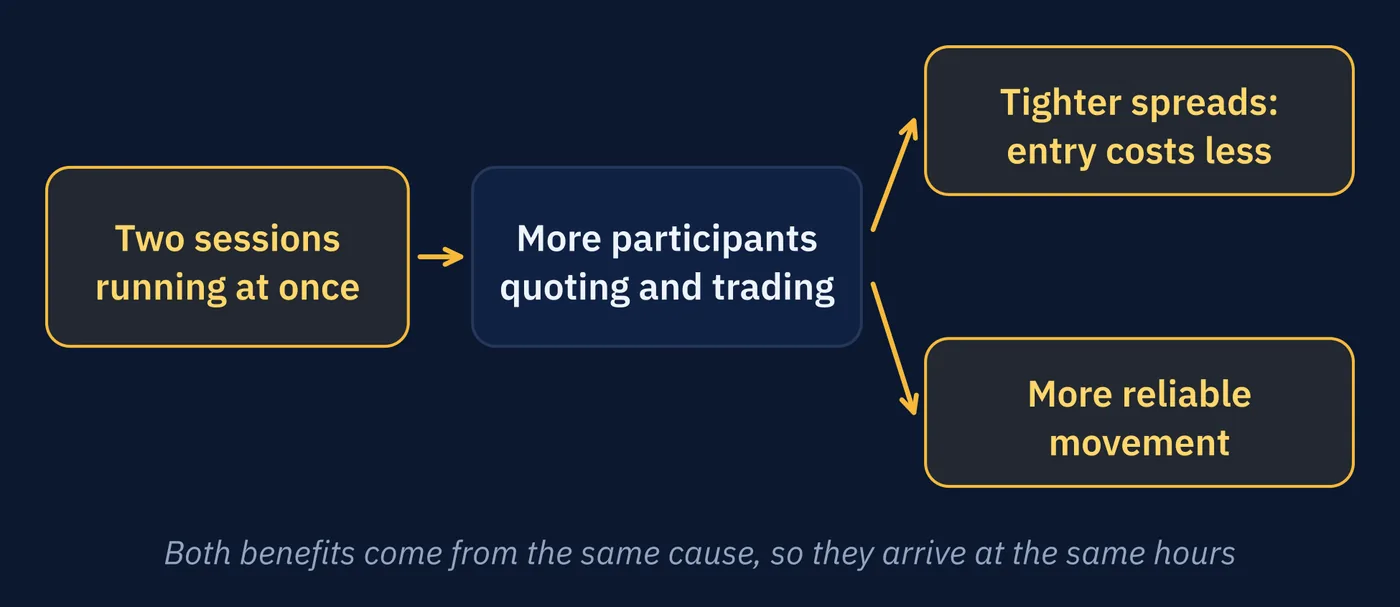
When two sessions run at once, two regions of institutions are working simultaneously. More participants are quoting prices, more money is moving, and more of it has a reason behind it.
Which produces exactly what you want, and it produces both halves at once.
| More Participants Means | Which Matters Because |
|---|---|
| Tighter spreads | Entry costs less, as Lesson 14 established |
| More reliable movement | Price is moving on genuine interest rather than thin conditions |
Those two things rarely arrive together in markets. Here they do, because both come from the same cause.
The best conditions and the lowest costs occur at the same hours.
2The Three Overlaps
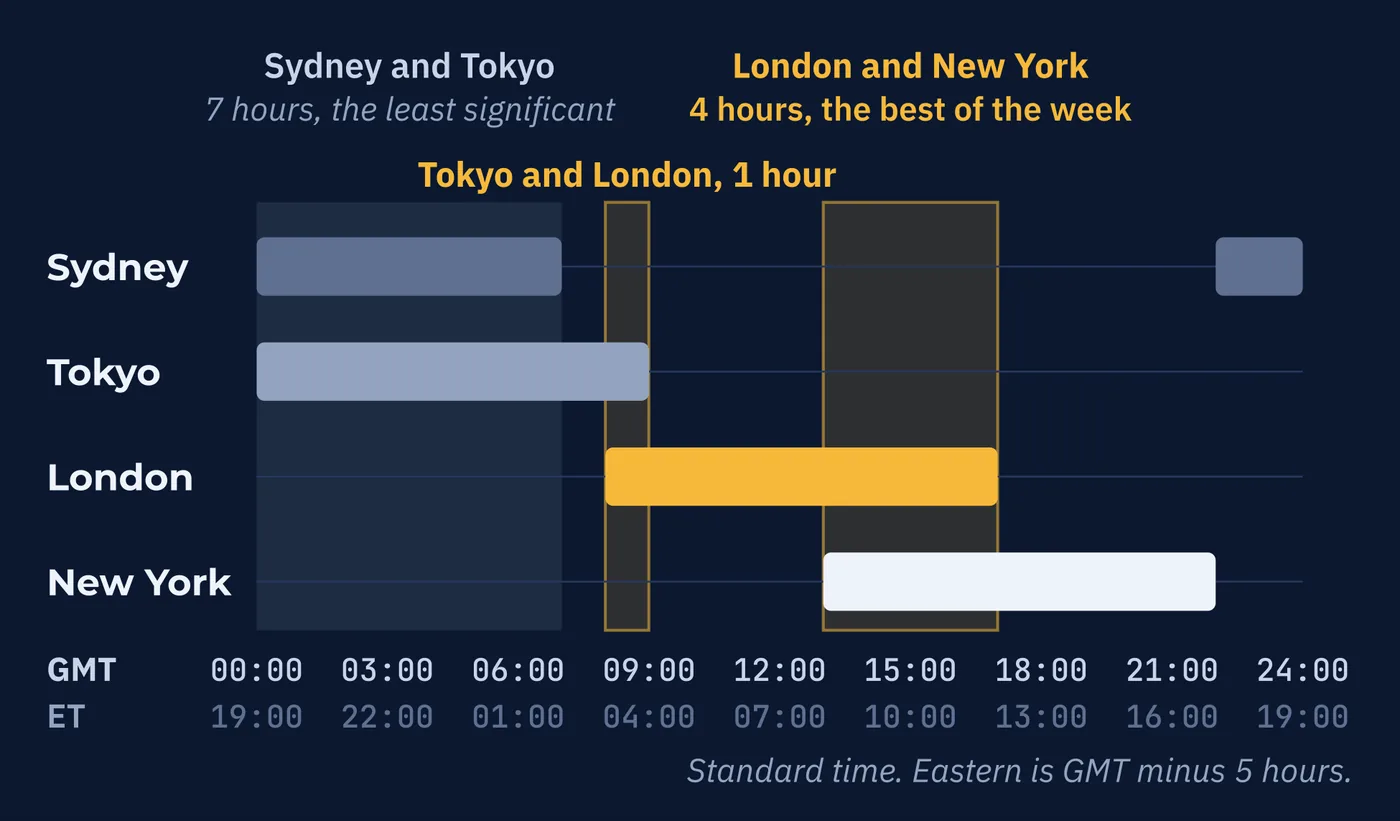
There are three, and they are not equally useful.
| Overlap | GMT | Roughly ET | Length |
|---|---|---|---|
| Sydney and Tokyo | 12am to 7am | 7pm to 2am | 7 hours |
| Tokyo and London | 8am to 9am | 3am to 4am | 1 hour |
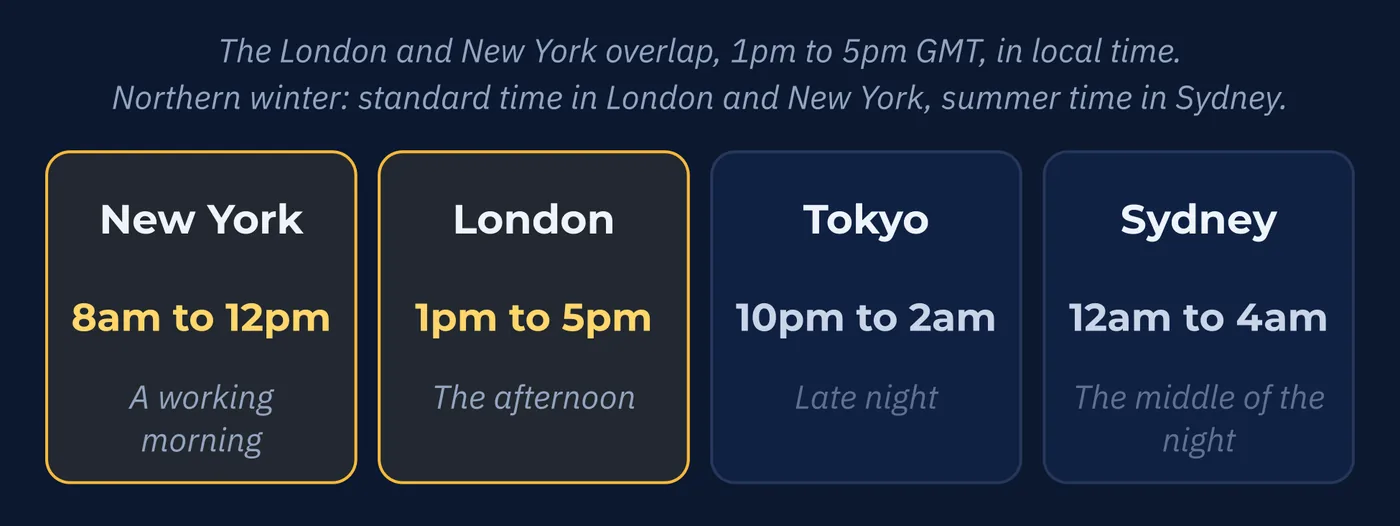
| London and New York | 1pm to 5pm | 8am to 12pm | 4 hours |
The first is the longest and the least significant for major dollar pairs. Both sessions involved are relatively quiet, so the overlap does not add up to much. Its real role is as the overnight period where prices settle into a range before Europe arrives.
The other two matter a great deal, and they matter for different reasons. The next two sections take them one at a time.
3The London Open
The Tokyo and London overlap lasts one hour. It contains the most significant recurring moment in the trading day.
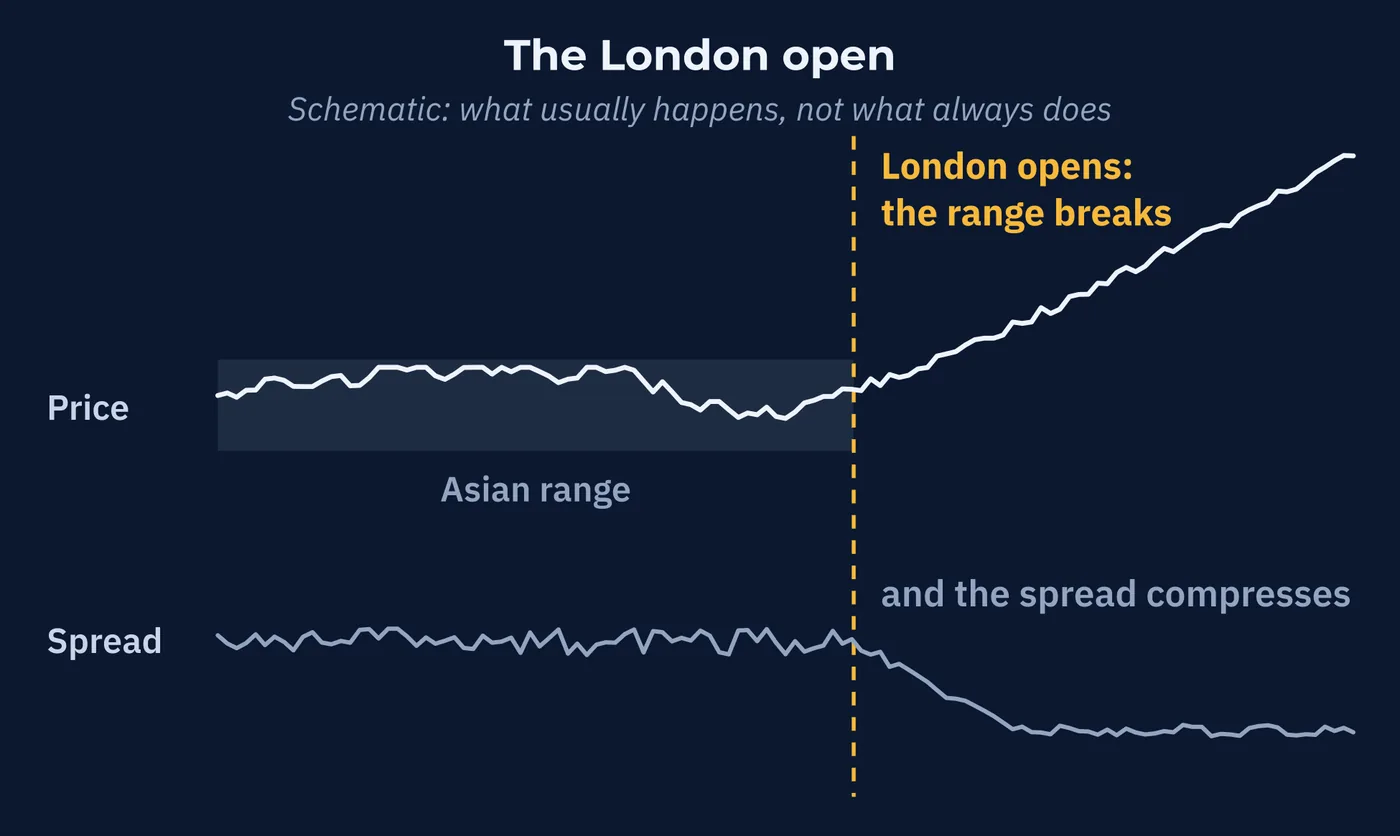
Here is what has usually happened by that point. Asian hours have produced a fairly contained range. Prices have drifted within a band, without much conviction, because the participants who move major pairs hardest are not at work yet.
Then London opens, and the largest session in the world arrives all at once.
Two things follow almost immediately. Spreads compress sharply, because a great many firms have just started quoting. And the overnight range frequently breaks, because a large volume of genuine interest has entered a market that had been drifting.
This is why the London open gets watched so closely. It is the moment the day's direction is most likely to be established, and price often makes its decisive move within the first hours.
4The Best Four Hours
Now the important one.
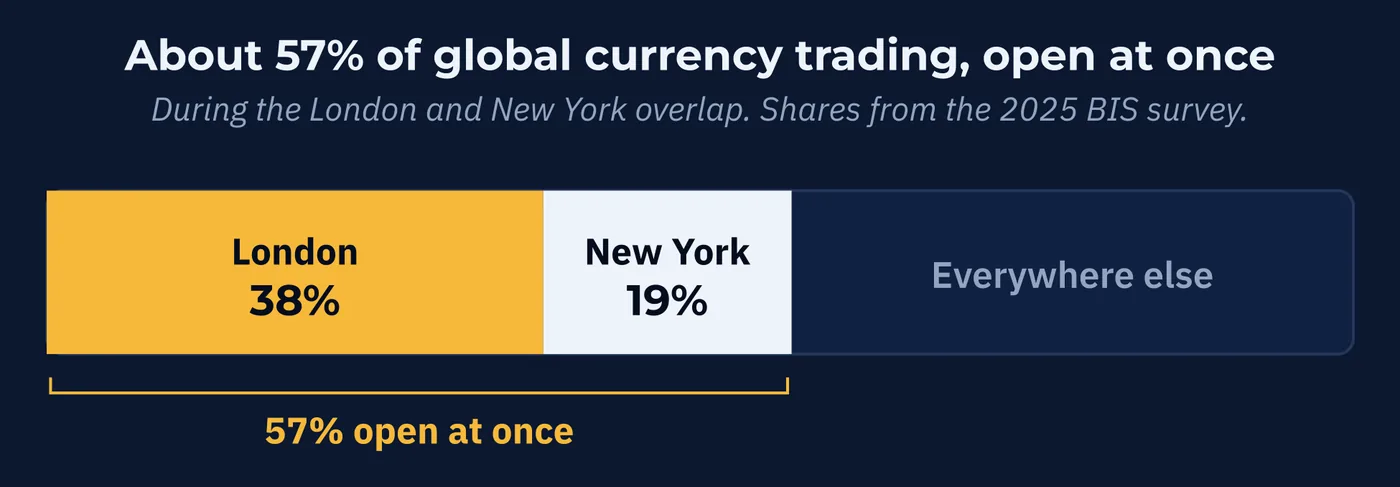
For four hours, the world's two largest financial centers are open at the same time. London has not finished and New York has begun. Roughly 57 percent of global currency trading is happening simultaneously.
It produces the best conditions available in the entire week.
| During the Overlap | What You Get |
|---|---|
| Volume | The highest of the trading week |
| Spreads | The tightest, often under a pip on EUR/USD |
| Price movement | The most consistently directional, on major dollar pairs |
There is a second reason this window matters. American economic data is typically released in the morning Eastern, which places it inside the overlap. So the events most capable of moving dollar pairs arrive during the hours when the market is best equipped to absorb them.
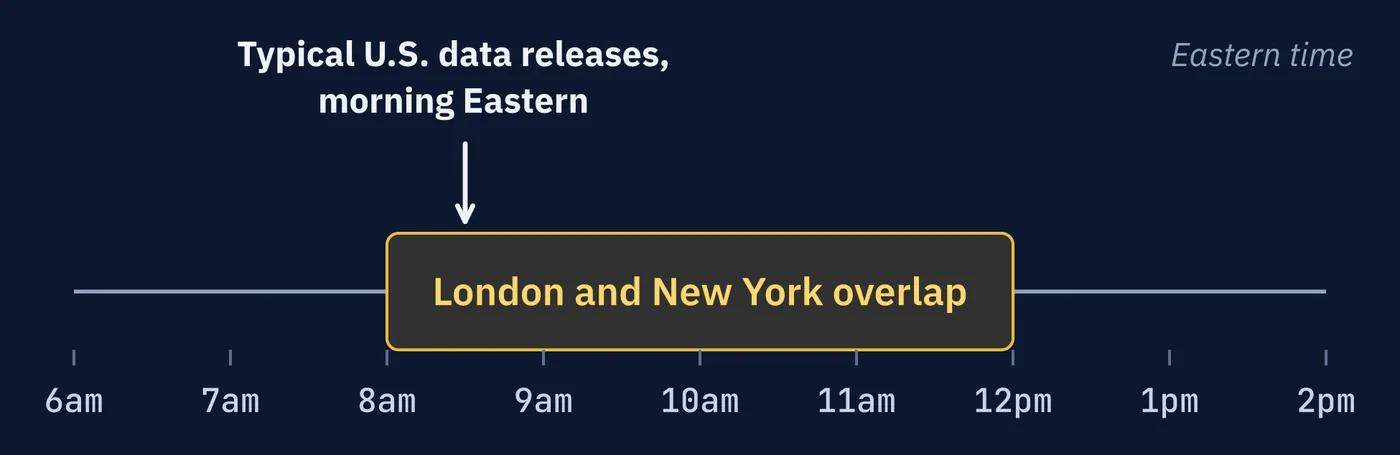
For a trader in North America, this is the fortunate part. The best window of the global trading week falls during a normal working morning rather than the middle of the night.
For a trader in Europe it lands in the afternoon, which is also workable. Traders in Asia and the Pacific have the hardest version of this problem, and the next lesson deals with what to do about it.
5The Dead Zone
Now the opposite. There is a window each day when almost nothing is running.
New York finishes. Only Sydney, the thinnest session, is open. For roughly two hours, until Tokyo starts, the market is at its thinnest of the day.
10pm to 12am GMT roughly 5pm to 7pm ETTraders call it the dead zone, and it has the lowest liquidity of the entire trading week.
Two things happen there, and both are bad.
Spreads widen substantially. With few firms quoting, the ones that remain compensate for having fewer counterparties. EUR/USD, which can cost under a pip to enter during the overlap, can run to several pips here.
And price action becomes unreliable. With few participants to absorb an order, a modest trade can move the price further than its significance warrants. You see movement that looks like information and is mostly just thinness.
| EUR/USD | Typical Spread | A 40 Pip Target Costs |
|---|---|---|
| London and New York overlap | 0.5 to 1.0 pips | About 1.25% to 2.5% of the move |
| Dead zone | 3 to 8 pips | About 7.5% to 20% of the move |
Run through Lesson 14's viability test, the same trade costs up to eight times more to enter. Nothing about the analysis changed. Only the hour.
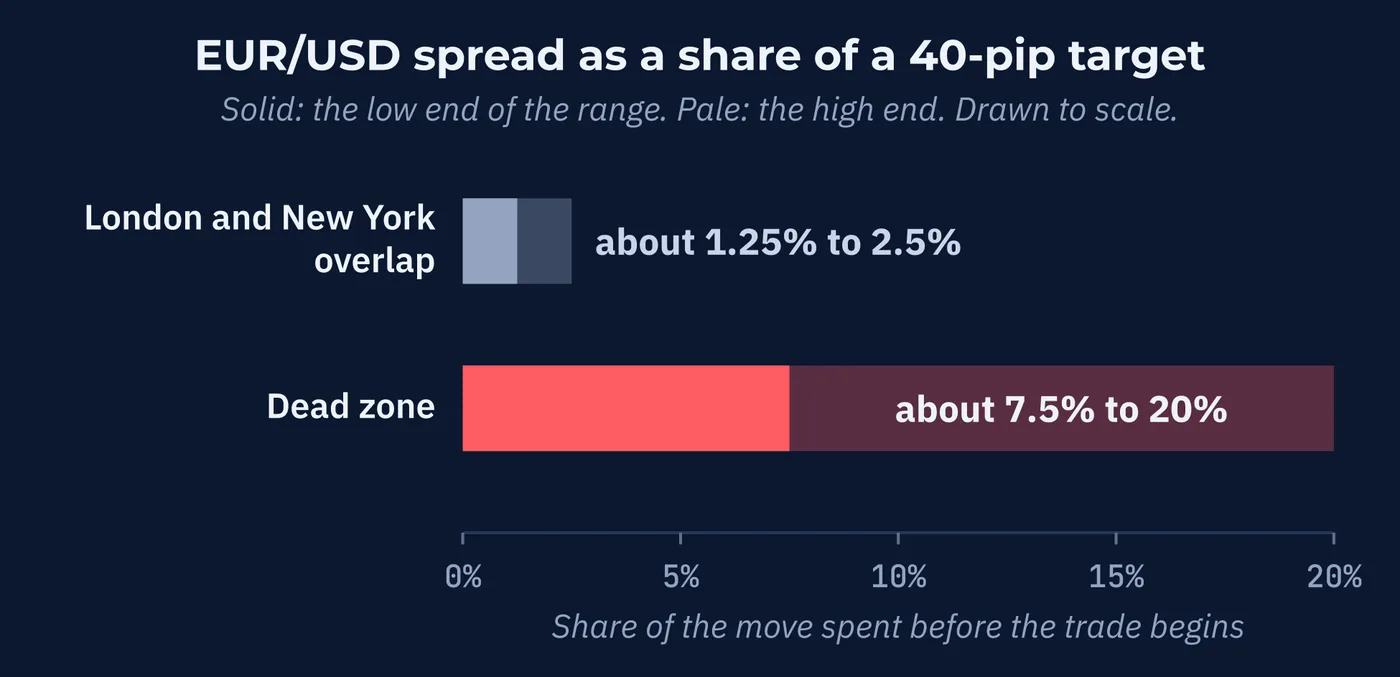
Experienced traders treat this window as a default no-trade period. Not a rule handed down, just an obvious conclusion from the arithmetic.
6The Daily Rhythm
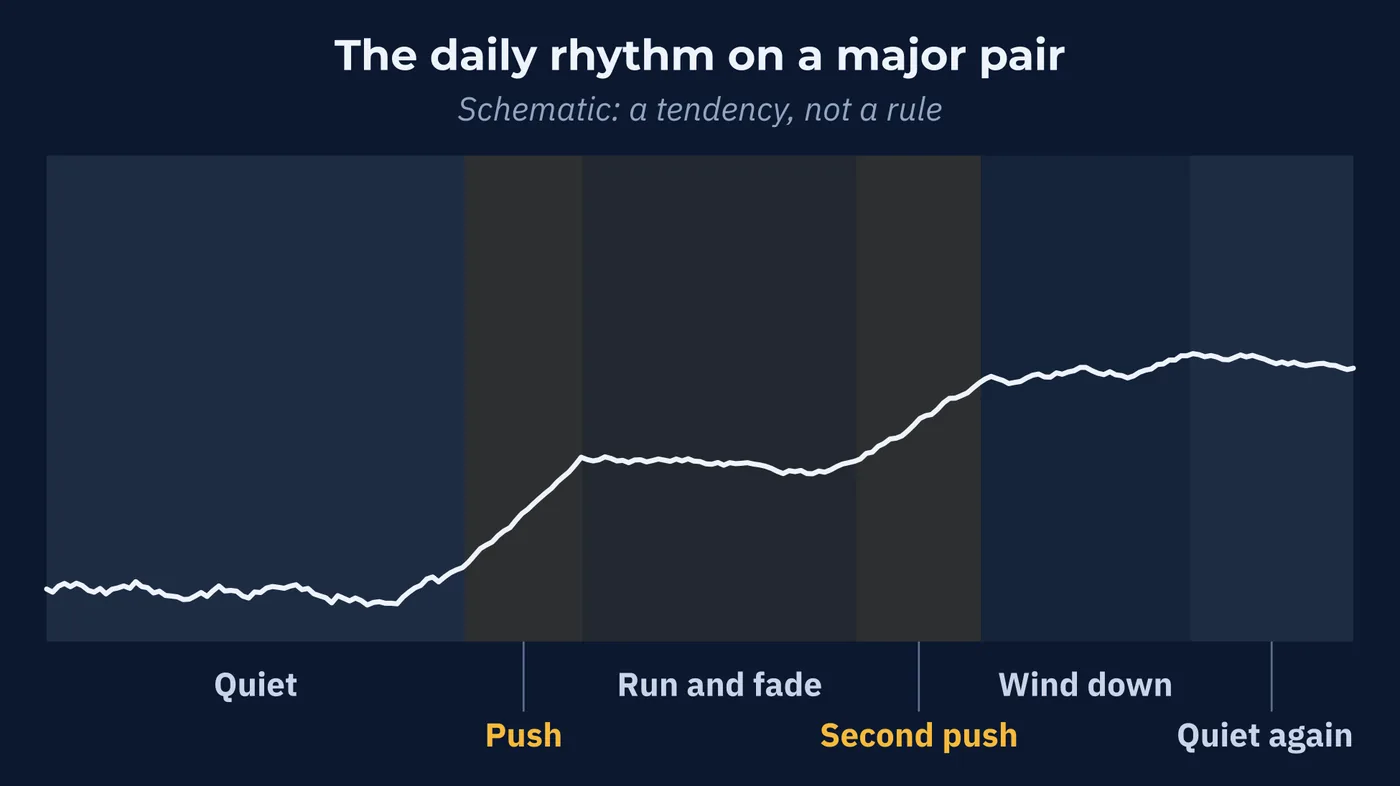
Put the overlaps and the dead zone in order and a pattern appears that repeats most days.
| Phase | Roughly When | What It Looks Like |
|---|---|---|
| Quiet | Asian hours | Price drifts within a range. Little conviction. |
| Push | The London open | The range breaks. Direction gets established. |
| Run and fade | Through the London session | The move continues, then loses momentum. |
| Second push | The New York open | Fresh participants, often fresh data. |
| Wind down | After London closes | Liquidity falls away. Direction gets less reliable. |
| Quiet again | The dead zone | The cycle prepares to repeat. |
Knowing this rhythm changes how you read a chart. A quiet Asian range is not the market doing nothing. It is the market waiting, and it frequently resolves at the London open.
7Not All Days Are Equal
The week has a shape too, and it is not flat.
| Day | What Tends to Happen |
|---|---|
| Monday | Tentative. The market is absorbing the weekend and establishing positions. |
| Tuesday to Thursday | The bulk of institutional activity and most scheduled data. |
| Friday | Deteriorates after London closes as participants prepare for the weekend. |
Combine that with the overlap and you get the most useful single sentence in this lesson.
Tuesday to Thursday, during the London and New York overlap.
That is the highest quality intersection of time and conditions in the entire week. If your available hours are limited, this is where to spend them and where to place your most considered decisions.
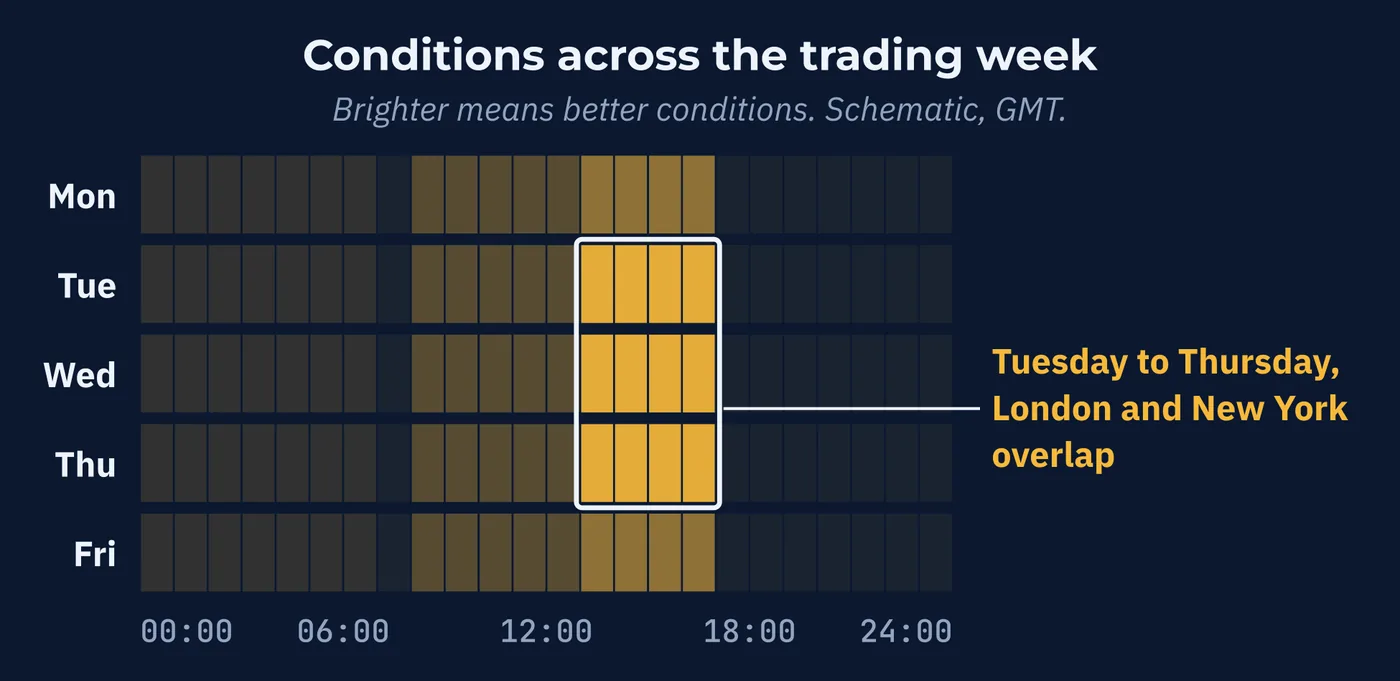
Monday deserves particular care. It can produce sharp moves as the market resolves whatever happened over the weekend, and those early moves can reverse once full participation returns. Monday is a good day to watch and a poor day to commit on the first hour's evidence.
Public holidays extend all of this. When a Friday or Monday holiday closes London or New York, the overlap either shrinks or disappears entirely, and the surrounding days thin out further. Checking an economic calendar for holidays in the major centers is a small weekly habit that avoids a predictable surprise.
8The Weekend
One last window, and it is the one that carries a specific risk you have already met in another form.
From Friday evening until Sunday evening, the currency market is closed. Nothing trades. From Lesson 6, you know the chart simply stops.
But the world does not stop. Elections happen on weekends. Policy announcements happen. Events happen.
So when trading resumes, the price reflects everything that occurred while nobody could act on it. It can reopen some distance from where it closed, with no trading in between.
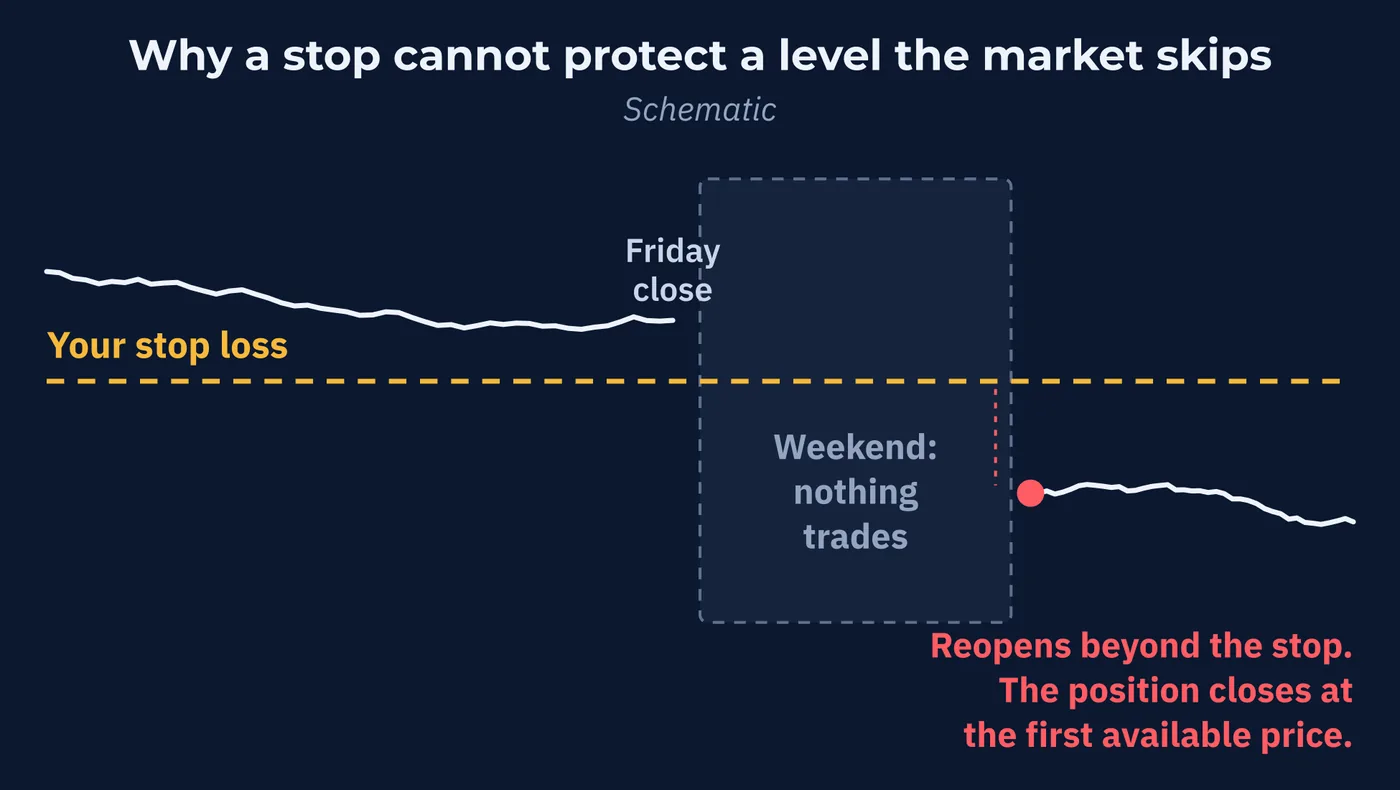
None of which means never holding through a weekend. Plenty of approaches hold positions for weeks and accept it as an ordinary cost of the method.
It means the decision should be a decision. Entering something late on a Friday afternoon without noticing that it will sit through a two-day closure is not the same as choosing to hold through one.
Which leaves one uncomfortable question hanging over this lesson. The best window of the week falls squarely inside a working day, and the hours most people reliably have free are the ones this lesson just called the worst. The next lesson deals with that directly.
Three Things to Remember
Try This
Fifteen minutes across a few days. Watch the spread rather than the price.
Words From This Lesson
| Term | What It Means |
|---|---|
| Overlap | A period when two sessions are running at the same time, producing more participants and tighter spreads. |
| London open | The start of the London session. The overnight range frequently resolves here. |
| London and New York overlap | Four hours when the world's two largest centers both trade. The best conditions of the week. |
| Dead zone | The window between the New York close and the Tokyo open, when only Sydney is trading. Lowest liquidity of the week. |
| Weekend gap | A jump between Friday's close and Sunday's open, caused by events occurring while the market is shut. |
| Range | A band of prices a market drifts within without establishing clear direction. |
Test Your Knowledge
Eight questions. Answer them all before checking the key on the following pages. If a question gives you trouble, the answer key tells you which section to revisit.
- A. Two regions of institutions are active at once, so there are more participants
- B. Brokers reduce spreads as a promotion
- C. Volatility is always lower
- D. Fewer traders compete for the same prices
- A. Sydney and Tokyo
- B. Tokyo and London
- C. London and New York
- D. They are all equivalent
- A. Four hours
- B. One hour
- C. Seven hours
- D. Twelve hours
- A. Spreads widen as European traders leave
- B. The overnight range often breaks as major participants arrive
- C. The market closes briefly
- D. Nothing significant until New York opens
- A. Between the London close and the New York open
- B. During the Tokyo session
- C. Between the New York close and the Tokyo open
- D. Only on Friday evenings
- A. 2%
- B. 8%
- C. 40%
- D. 20%
- A. Monday morning at the London open
- B. Tuesday to Thursday during the London and New York overlap
- C. Friday afternoon after London closes
- D. Any time during the Tokyo session
- A. Brokers cancel stops on Fridays
- B. Weekend positions are automatically closed
- C. Stops only work during the London session
- D. If the market reopens beyond the stop level, it closes at the first available price instead
Answer Key
Each answer explains why the correct choice is correct, why the others are not, and where to reread.
Question 1 · correct answer A
Two regions working simultaneously means more firms quoting and more genuine interest, which tightens spreads and makes movement more reliable at the same time.
B is wrong because spreads narrow through competition among participants rather than through a broker decision. C reverses it, since overlaps typically carry more movement rather than less. D inverts the cause, as more participants is exactly what produces the improvement.
Review: Section 1, Where Sessions Meet
Question 2 · correct answer C
For four hours the world's two largest centers are open together, producing the highest volume, tightest spreads, and most directional conditions of the week.
A is the longest overlap and the least significant for major dollar pairs. B contains the London open, which matters enormously but lasts one hour. D is wrong because the three differ substantially.
Review: Section 4, The Best Four Hours
Question 3 · correct answer A
It runs from 1pm to 5pm GMT, roughly 8am to noon Eastern in standard time.
B is the Tokyo and London overlap. C is the Sydney and Tokyo overlap. D is longer than any overlap and closer to the span of a full session pair.
Review: Section 2, The Three Overlaps
Question 4 · correct answer B
Asian hours usually produce a contained range. When London arrives, a large volume of genuine interest enters a drifting market and the range frequently breaks.
A reverses it, since spreads compress sharply as London firms begin quoting. C is wrong because the market does not close during the week. D understates the most significant recurring intraday event there is.
Review: Section 3, The London Open
Question 5 · correct answer C
New York finishes and only Sydney is open, leaving roughly two hours before Tokyo starts with the thinnest trading of the day.
A describes a period when London is still open and overlapping with New York, which is the best window rather than the worst. B is a full session with real activity in yen pairs. D is wrong because the dead zone occurs daily.
Review: Section 5, The Dead Zone
Question 6 · correct answer D
Eight divided by forty is 0.2, or twenty percent of the move consumed by cost before the trade begins.
A is roughly the cost during the overlap, which is the comparison worth holding. B reports the spread in pips rather than as a share. C would require the spread to equal the entire target.
Review: Section 5, The Dead Zone
Question 7 · correct answer B
Midweek carries the bulk of institutional activity and scheduled data, and the overlap carries the best conditions. The two together are the strongest intersection available.
A combines the best time of day with the weakest day of the week. C falls after London closes, when liquidity is deteriorating ahead of the weekend. D describes a quieter session that suits yen pairs rather than the week's best conditions.
Review: Section 7, Not All Days Are Equal
Question 8 · correct answer D
A stop loss works by its level being reached during trading. If the market reopens past it, having never traded there, the position closes at whatever price is available instead.
A invents a practice that does not occur. C is wrong because stops are active whenever the market is trading. B is wrong because positions remain open through the weekend closure unless you close them.
Review: Section 8, The Weekend
Keep going
Building Your Trading Life is written by Kanin D. Alldredge for The Currency Classroom, and it is free to read. There is more free from CNS: start here.
Start free with CNS →