Pips and Pipettes

1The Rule Underneath the Rule
You already know that a pip is the fourth decimal place on most pairs and the second on yen pairs. That works, and it is what most beginners carry around.
But there is a more precise way to hold it.
A pip is the standard unit used to measure a currency pair's price movement.
On most pairs, that unit is 0.0001, which puts the pip at the fourth decimal place. On yen pairs, it is 0.01, which puts the pip at the second decimal place.
That distinction matters because the number of decimals you see on a trading platform does not necessarily define the pip. Modern quotes can carry more precision than the pip itself.
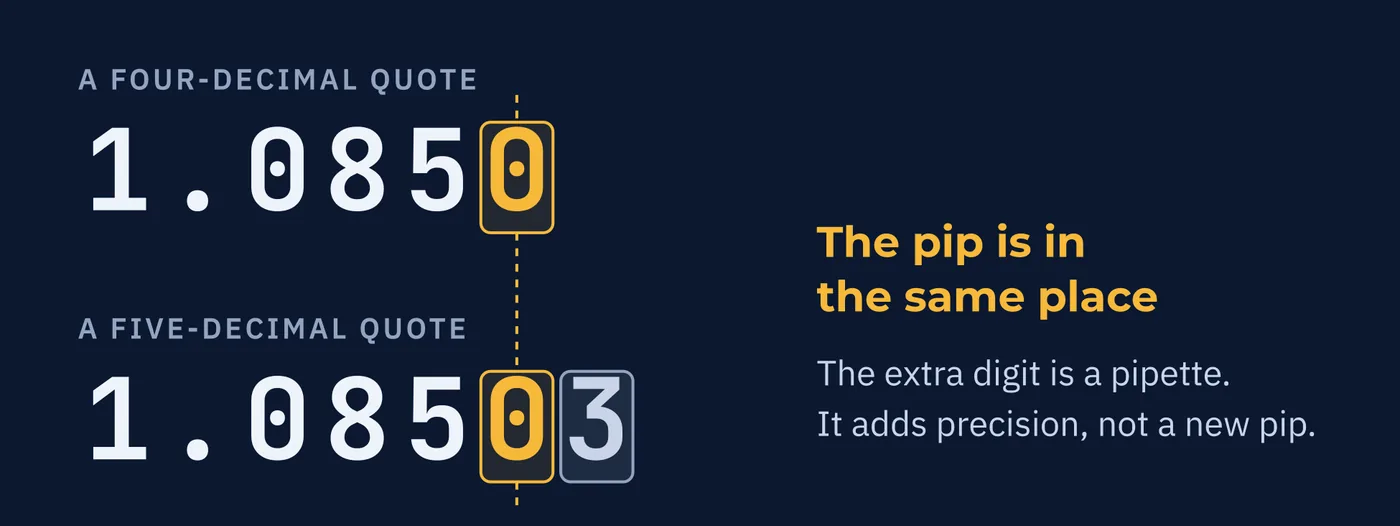
So instead of remembering that the pip is simply the last decimal shown, remember the unit: 0.0001 on most pairs and 0.01 on yen pairs.
In a moment, you will see why a broker may show another digit beyond it.
2A Pip Is a Basis Point
Here is something that connects this back to Lesson 1.
Take a pip on a standard pair, 0.0001, and write it as a percentage. It is one hundredth of one percent.
That quantity already has a name in finance, and you have already met it. It is a basis point, and it is how interest rate changes are described.
When a central bank raises rates by 25 basis points, it raises them by 0.25 percent. When EUR/USD moves 25 pips, it moves by 0.0025. Same magnitude, same arithmetic, two different names because two different markets grew up using them.
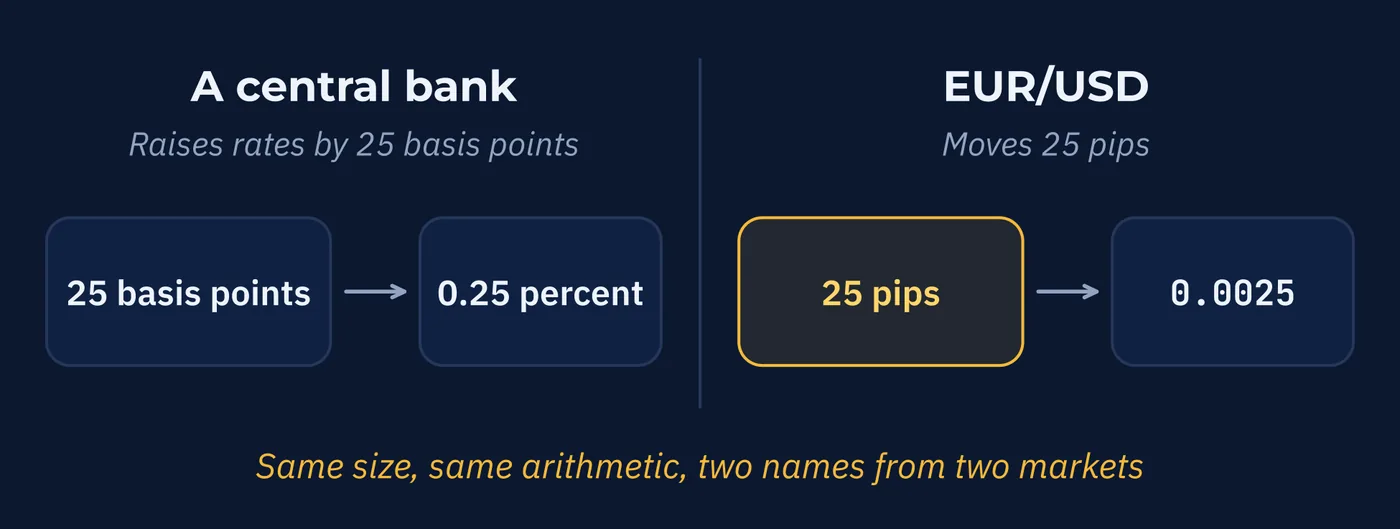
This matters for a practical reason. The pip is not a strange invention belonging only to currency trading. It is a unit the whole financial world already uses, wearing local clothing. If you are comfortable with the idea of a quarter-point rate hike, you are already comfortable with pips.
3The Fifth Decimal
Open almost any modern trading platform and the prices carry one more digit than you expect.
EUR/USD 1.08503 GBP/USD 1.26847Five decimals, not four. That last digit is smaller than a pip.
It is called a pipette, or a fractional pip, and it is one tenth of a pip.
1.08500 → 1.08501 one pipette1.08500 → 1.08510 ten pipettes, which is one pip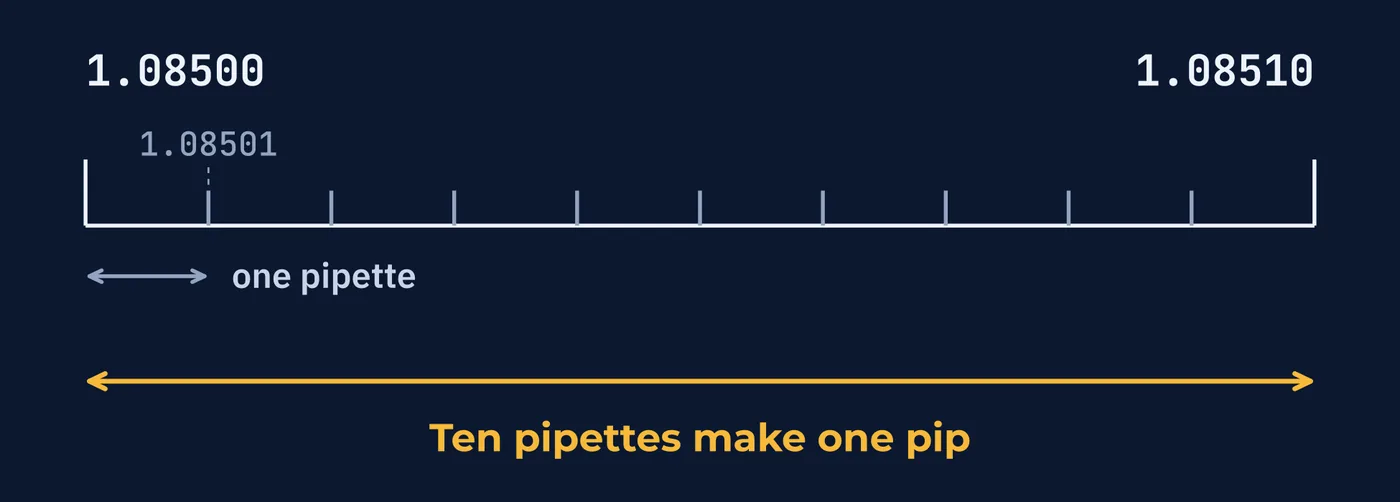
The same idea applies to yen pairs, shifted along. A yen pair quoted to three decimals has its pip at the second decimal and its pipette at the third.
| Pair Type | Example Price | The Pip Is | The Pipette Is |
|---|---|---|---|
| Most pairs | 1.08503 | 4th decimal | 5th decimal |
| Yen pairs | 149.503 | 2nd decimal | 3rd decimal |
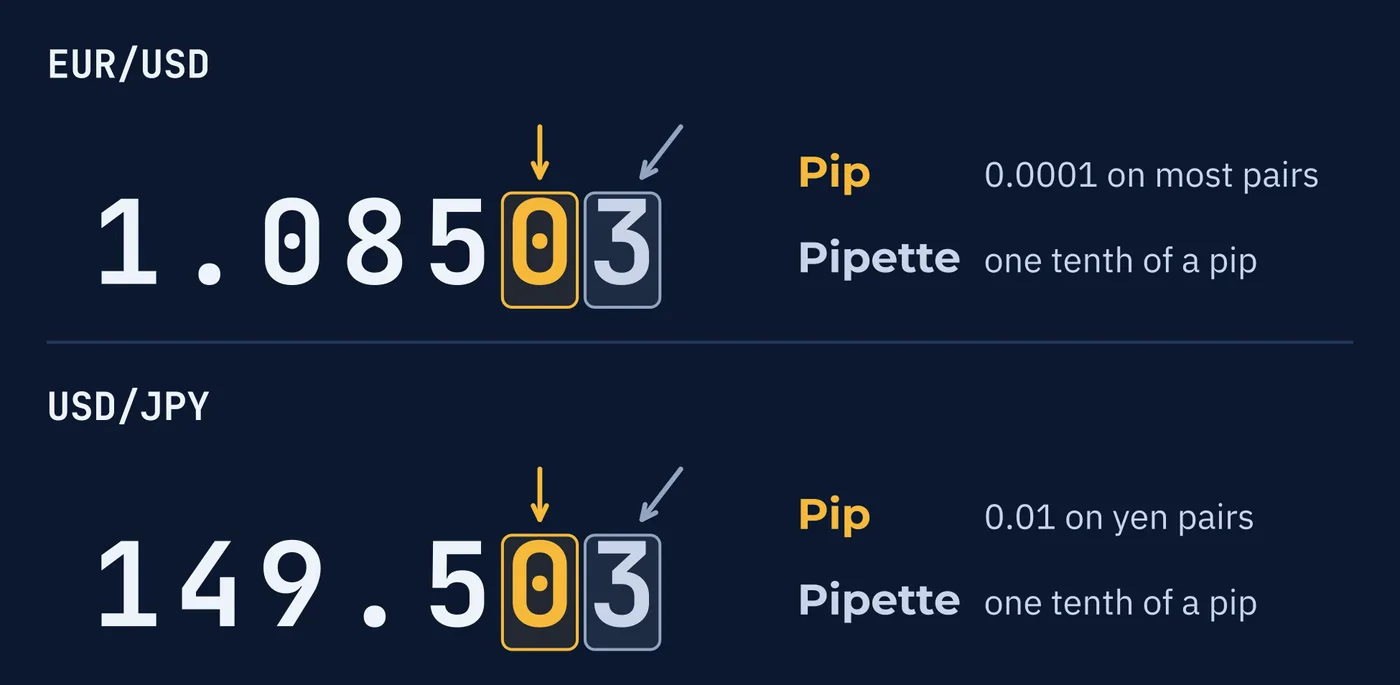
Brokers quote this finely because they compete on price. A firm offering a spread of 0.8 pips is offering something a four-decimal quote could not even express.
4Why Pipettes Matter More Than They Look
A tenth of a pip sounds too small to care about. Here is why it is not.
Spreads are quoted in fractional pips almost everywhere. You will see a spread advertised as 1.2 pips, or 0.8 pips, or 1.5 pips. Those decimals are pipettes.
| Advertised Spread | In Pipettes | What It Means |
|---|---|---|
| 0.8 pips | 8 pipettes | Less than one full pip |
| 1.2 pips | 12 pipettes | One pip and a bit |
| 1.5 pips | 15 pipettes | One and a half pips |
A trader who thinks only in whole pips will misread every one of these. Rounded up, a 1.2-pip spread becomes two pips in their head, which is over sixty percent more than the real figure. Rounded down, it becomes one.
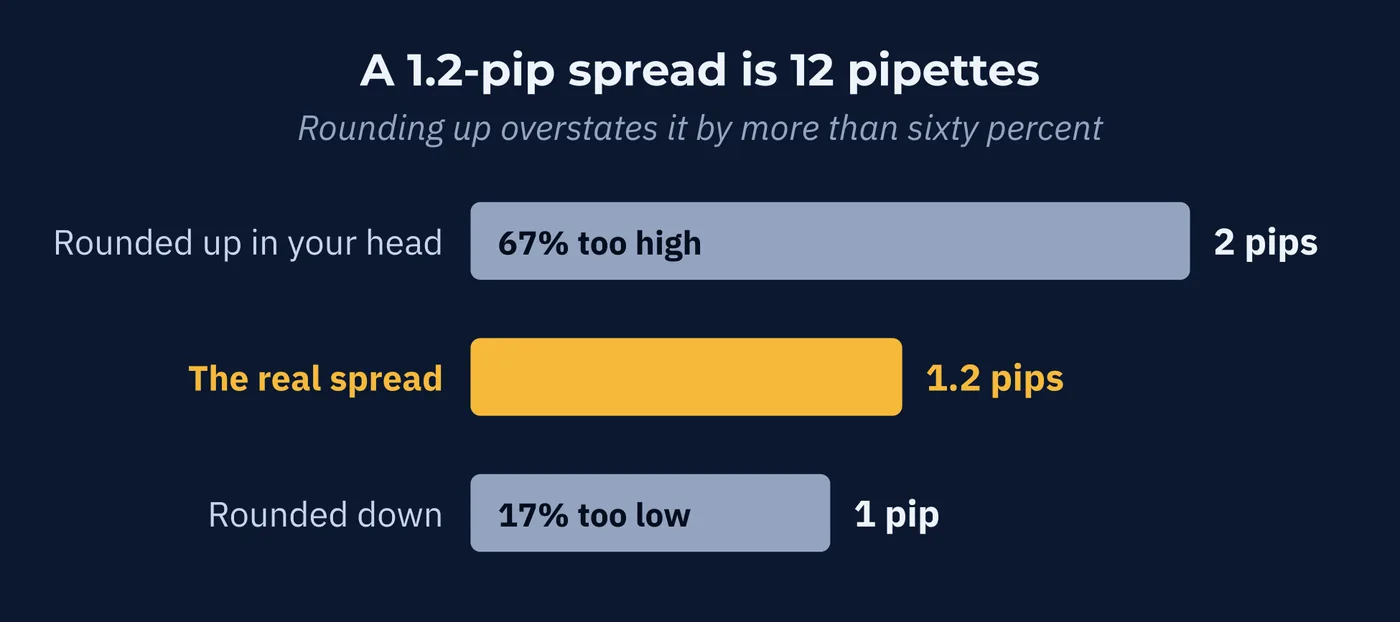
That error compounds across every cost calculation you make. And cost calculations are the entire subject of this series.
So the fifth decimal is not decoration. It is the level of precision at which trading costs are actually quoted, and reading it correctly is a prerequisite for everything ahead.
5Why Yen Pairs Use Two Decimals
Now the yen, which is not an exception once you know the reason.
Currency quoting conventions track the nominal size of the currency. The question a convention answers is: how many decimals do we need before one unit of the last one is an amount worth caring about?
For the euro against the dollar, sitting near 1.08, that takes four decimals.
For the yen it does not. When Japan introduced the yen in 1871 it was worth roughly one dollar. A century of inflation and economic change moved that a long way. By the time modern quoting conventions settled in the 1970s a dollar bought around 300 yen, and today it buys around 150.
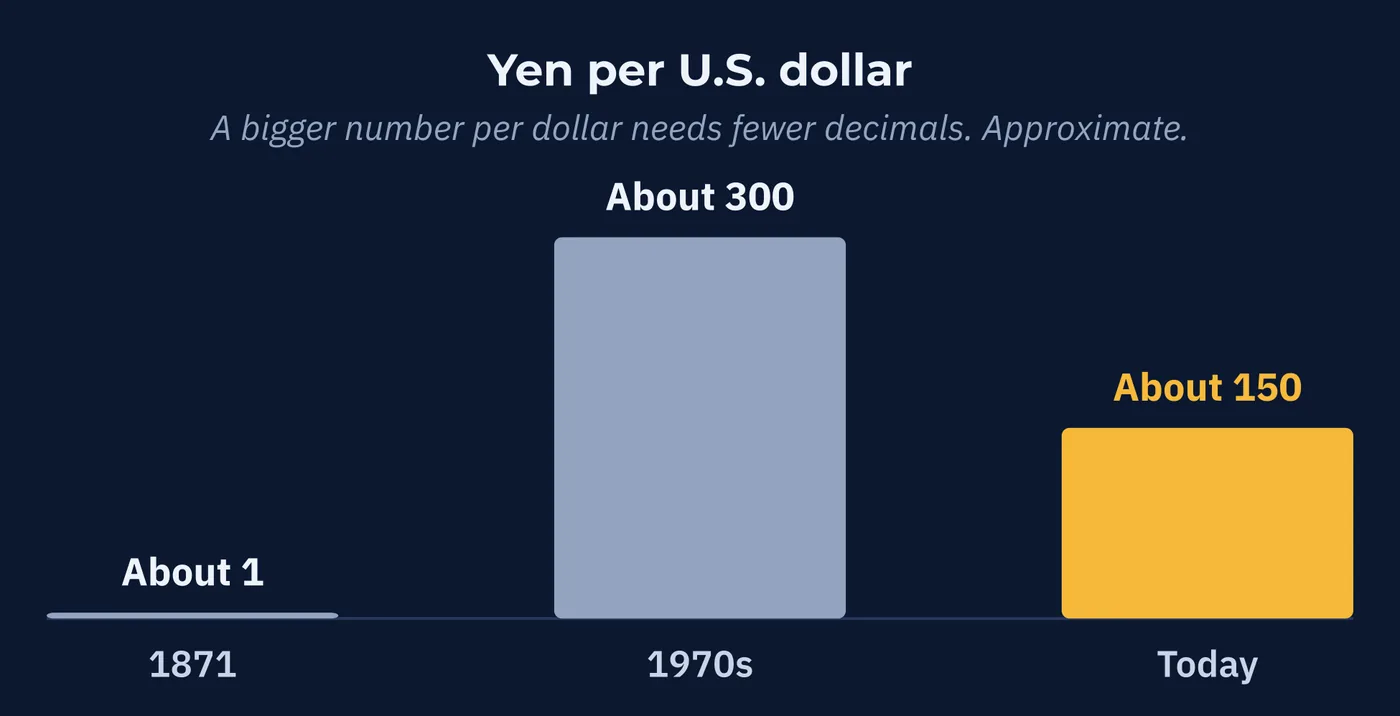
At a price near 150, two decimals already give you meaningful increments. Adding two more would make one unit of the last decimal worth a tiny fraction of a cent, which is no use to anybody.
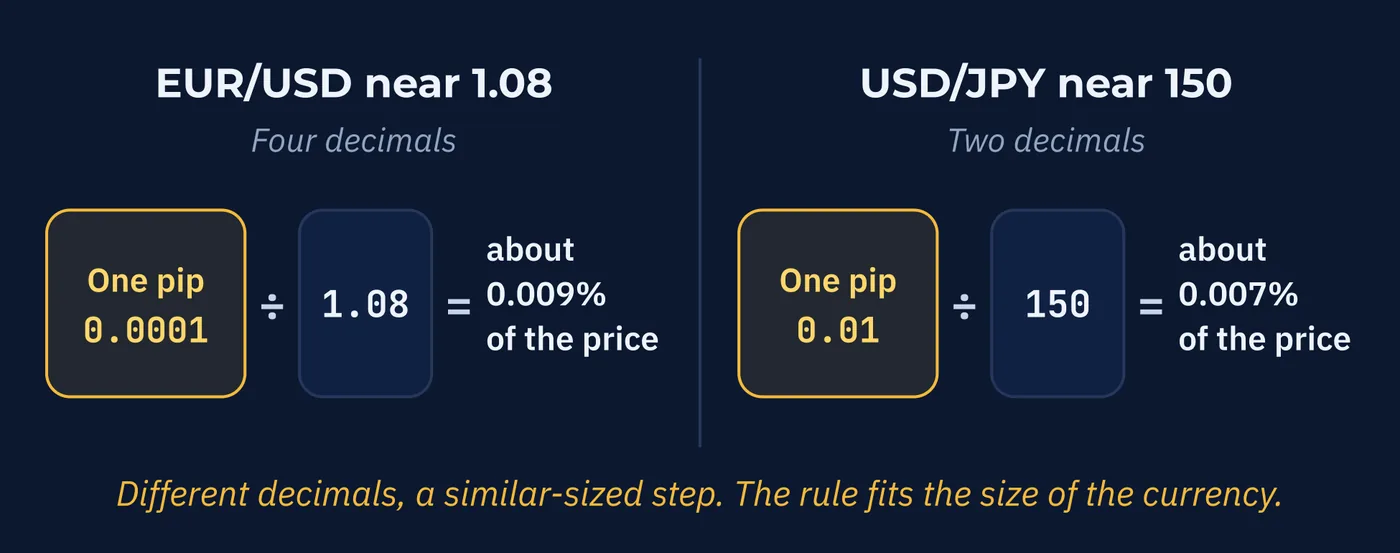
So the yen convention is not the rule being broken. It is the rule applied to a currency with a different nominal scale.
One consequence catches almost everyone at least once, so it is worth stating outright.
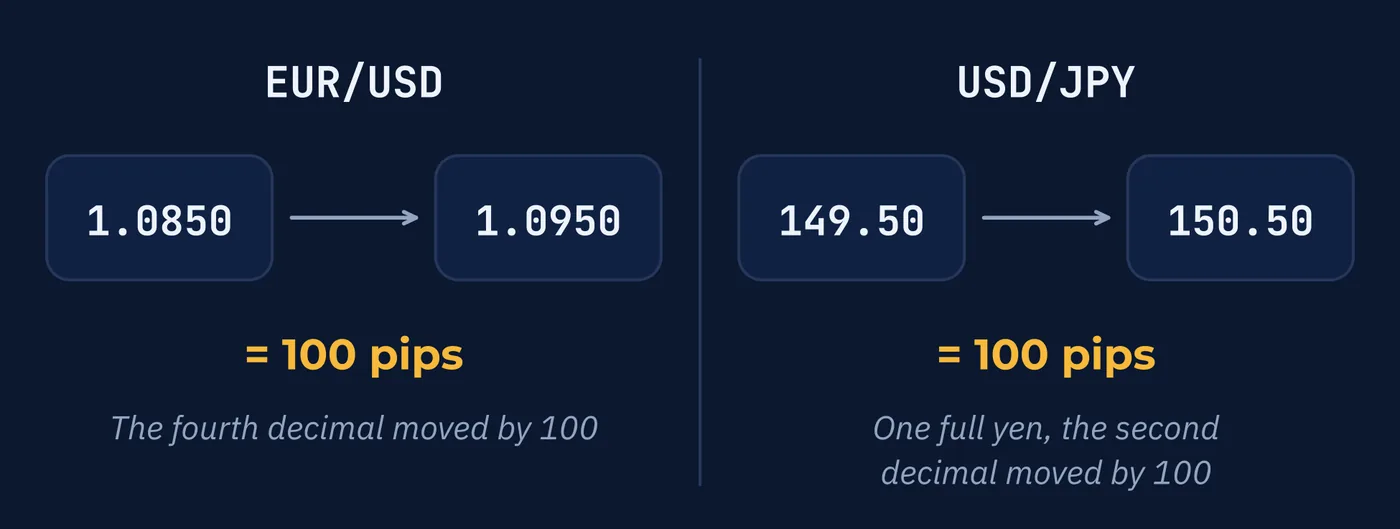
USD/JPY 149.50 → 150.50 = 100 pipsNot ten thousand. The price moved one full yen, and on a pair where the pip is the second decimal, one yen is a hundred pips. The number on screen looks nothing like a EUR/USD move of the same size, and that is purely a matter of where the decimal sits.
6Where the Pip Came From
The pip is younger than you might assume, and it exists because of a specific historical moment.
Recall from Lesson 7 that currencies were tied to the dollar under the Bretton Woods arrangement, and that the link to gold was cut in 1971. What followed was a world where exchange rates floated freely and moved continuously, in very small increments, all day.
Traders suddenly needed a standard way to talk about those increments. Saying a price changed by 0.0001 is accurate and useless in conversation. Saying it moved one pip is accurate and instant.
The convention settled across the market during the 1970s and has not changed since.
7Why Crypto Has No Pips
Lesson 6 mentioned that crypto is measured in percentages rather than pips. Now the reason is available to you.
The pip works in currency markets because major pairs sit at broadly similar price levels. EUR/USD near 1.08, GBP/USD near 1.27, AUD/USD near 0.65. A four-decimal convention produces comparable increments across all of them, which is what makes a pip mean roughly the same thing wherever you apply it.
Crypto has no such property. Bitcoin trades in the tens of thousands. Ether in the thousands. Smaller tokens trade at a few dollars, or a few cents, or a fraction of a cent.
Apply a fixed decimal unit across that range and it falls apart immediately. A move of 0.0001 is meaningless on an asset priced at sixty thousand dollars. On an asset priced at three ten-thousandths of a dollar, the same 0.0001 is a third of its entire value.
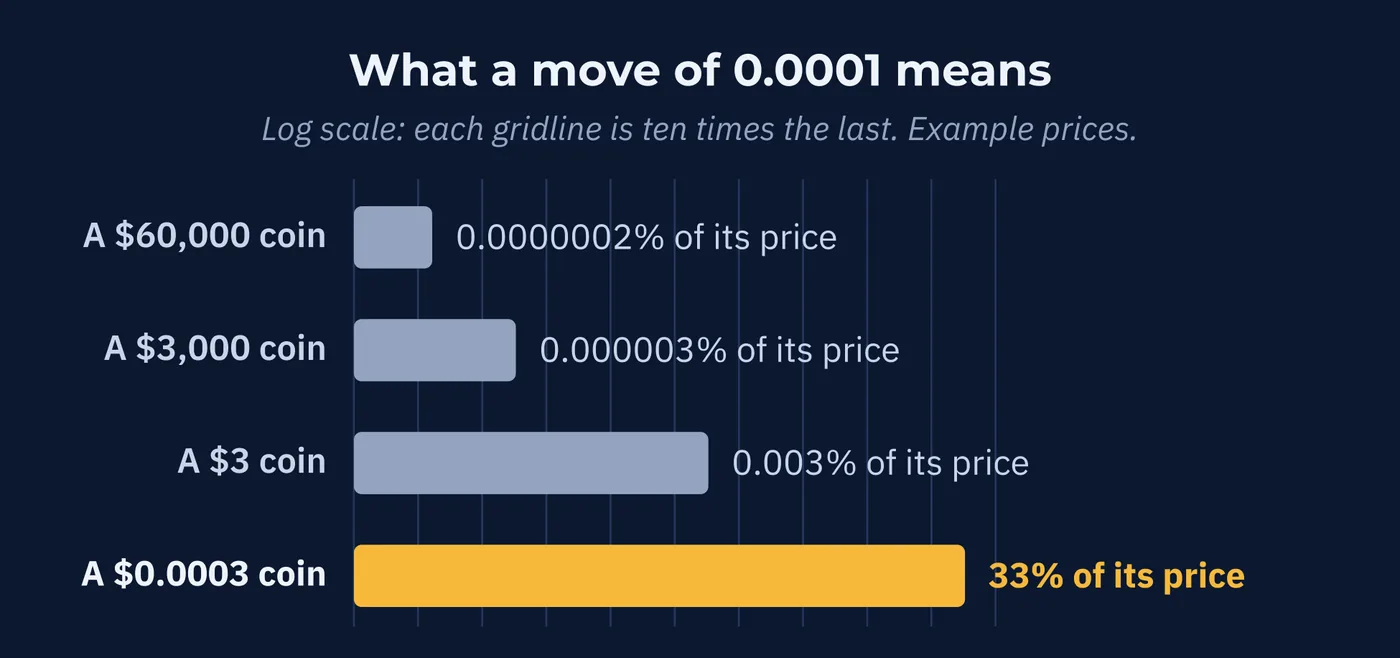
Percentages solve it, because a percentage is proportional by construction. A two percent move means the same thing whatever the price level, which is why equities and bonds use percentages too.
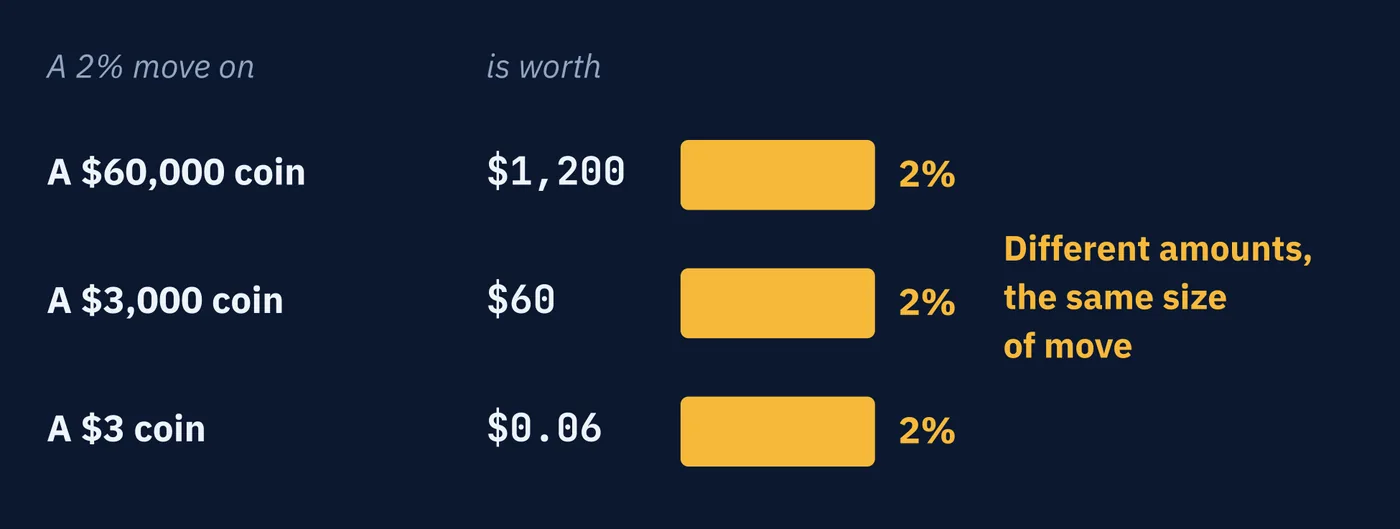
So crypto is not refusing a convention out of stubbornness. The conditions that make the pip useful simply do not exist there.
8What a Pip Does Not Tell You
One limitation to carry into the next lesson, and it is a significant one.
A pip measures movement. It says nothing about money.
Knowing that EUR/USD moved a hundred pips tells you how far the price traveled. It tells you nothing about whether that was worth ten dollars or ten thousand to you, because that depends on how large your position was.
Worse, the same pip count produces different amounts on different pairs, even at identical position sizes. A hundred pips on EUR/USD and a hundred pips on USD/JPY are not the same amount of money, and the reason is structural rather than arbitrary.
The pip is the ruler. It is not the price tag.
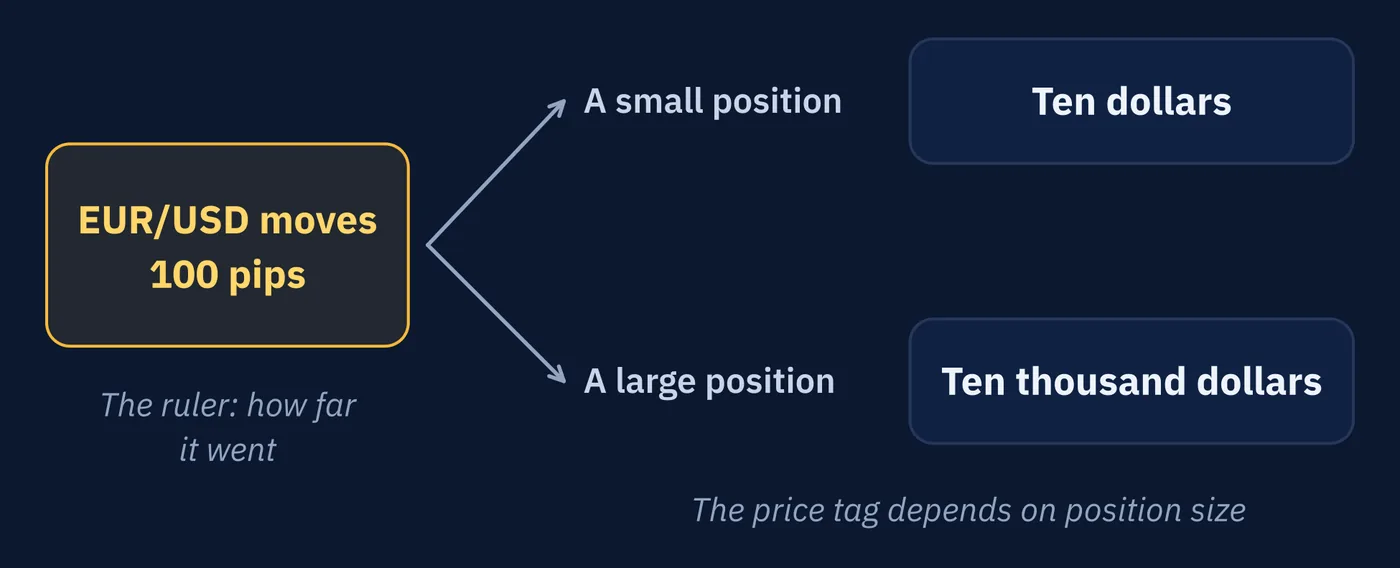
Turning pips into money needs one more piece, which is position size. Lesson 15 covers that, and Lesson 16 puts the two together. Before either, Lesson 14 uses what you now know about pipettes to look properly at what the spread actually costs.
Three Things to Remember
Try This
Ten minutes. This is about reading a price to the last digit.
Words From This Lesson
| Term | What It Means |
|---|---|
| Pip | The standard unit used to measure price movement in a currency pair. 0.0001 on most pairs and 0.01 on yen pairs. |
| Pipette | One tenth of a pip. The fifth decimal place on most pairs, the third on yen pairs. Also called a fractional pip. |
| Basis point | One hundredth of one percent. The same magnitude as a pip, used to describe interest rate changes. |
| Fractional pip pricing | Quoting prices to one decimal place beyond the pip, which is standard at most retail brokers. |
| Low-denomination currency | A currency whose nominal value is small relative to the dollar, and which therefore needs fewer decimal places. The yen, the won, the rupiah. |
Test Your Knowledge
Eight questions. Answer them all before checking the key on the following pages. If a question gives you trouble, the answer key tells you which section to revisit.
- A. It is always the final decimal place shown by a broker
- B. It is the standard unit used to measure a currency pair's price movement
- C. It is always 0.0001
- D. It depends on how many decimals the broker displays
- A. One percent
- B. One cent
- C. One tenth of a percent
- D. One basis point
- A. One tenth of a pip
- B. Ten pips
- C. Another name for the spread
- D. A pip on a yen pair only
- A. 12 pipettes
- B. 1.2 pipettes
- C. 120 pipettes
- D. 2 pipettes
- A. One pipette
- B. One pip
- C. Ten pips
- D. One hundred pips
- A. 1 pip
- B. 1,000 pips
- C. 100 pips
- D. 10,000 pips
- A. Japanese regulations require it
- B. Yen pairs are less important than other majors
- C. The yen's nominal value is low, so fewer decimals give meaningful increments
- D. It is an arbitrary historical accident
- A. Crypto moves too fast for a fixed unit
- B. Crypto exchanges have not adopted the convention yet
- C. Pips are only allowed in regulated markets
- D. Crypto prices span too wide a range for one fixed decimal unit to work
Answer Key
Each answer explains why the correct choice is correct, why the others are not, and where to reread.
Question 1 · correct answer B
A pip is the standard unit used to measure price movement in a currency pair. On most pairs that unit is 0.0001, while on yen pairs it is 0.01.
A is wrong because many brokers display an additional decimal place beyond the pip. C is true for most pairs but not yen pairs. D is wrong because the broker may choose how much precision to display, but that does not change the pair's standard pip size.
Review: Section 1, The Rule Underneath the Rule
Question 2 · correct answer D
A pip is one hundredth of one percent, which is precisely what a basis point is. The two describe the same magnitude in different markets.
A is a hundred times too large. C is ten times too large. B confuses a unit of currency with a unit of proportion, and a cent means nothing as a measure of exchange rate movement.
Review: Section 2, A Pip Is a Basis Point
Question 3 · correct answer A
A pipette is one tenth of a pip. It appears at the fifth decimal place on most pairs and the third on yen pairs.
B inverts the relationship. C confuses a unit of measurement with a cost, though spreads are commonly expressed in pipettes. D is wrong because pipettes exist on every pair, just at different decimal positions.
Review: Section 3, The Fifth Decimal
Question 4 · correct answer A
The decimal in a spread figure is pipettes. One pip is ten pipettes, so 1.2 pips is twelve.
B treats the whole figure as pipettes, which would make the spread ten times smaller than advertised. C treats it as pips converted the wrong way. D rounds to whole pips, which is the exact error this section warns about.
Review: Section 4, Why Pipettes Matter More Than They Look
Question 5 · correct answer B
The move is 0.00010, which is ten pipettes, and ten pipettes make one pip.
A counts a single unit of the fifth decimal rather than the tenth. C counts pipettes and calls them pips. D is off by a factor of a hundred.
Review: Section 3, The Fifth Decimal
Question 6 · correct answer C
The price moved one full yen. On a pair where the pip is the second decimal, one yen is one hundred pips.
A counts the whole-number move and calls it a pip. B and D apply the four-decimal convention to a two-decimal pair, which is the most common mistake on yen pairs.
Review: Section 5, Why Yen Pairs Use Two Decimals
Question 7 · correct answer C
Quoting conventions track a currency's nominal scale. At around 150 to the dollar, two decimals already produce useful increments, and adding more would make the last one economically trivial.
A invents a regulation that does not exist. B is wrong because USD/JPY is among the most heavily traded pairs in the world. D is wrong because the convention follows a consistent logic that also applies to the won and the rupiah.
Review: Section 5, Why Yen Pairs Use Two Decimals
Question 8 · correct answer D
Crypto assets range from tens of thousands of dollars to fractions of a cent. No single fixed decimal unit produces comparable increments across that span, whereas a percentage is proportional by construction.
A confuses speed with scale, and the pip handles fast movement perfectly well in currencies. C invents a rule about regulation. B suggests it is a matter of time, when in fact percentages are the better tool for the job.
Review: Section 7, Why Crypto Has No Pips
Keep going
The Real Cost & Mechanics of a Trade is written by Kanin D. Alldredge for The Currency Classroom, and it is free to read. There is more free from CNS: start here.
Start free with CNS →