Exotic Pairs

1The Outer Edge
Majors contain the dollar. Crosses contain no dollar. There is a third group, and it sits further out.
An exotic pair combines one major currency, almost always the U.S. dollar, with the currency of a smaller or developing economy.
USD/TRY is the dollar against the Turkish lira. USD/ZAR is the dollar against the South African rand. USD/MXN is the Mexican peso. USD/BRL is the Brazilian real. USD/SGD is the Singapore dollar.
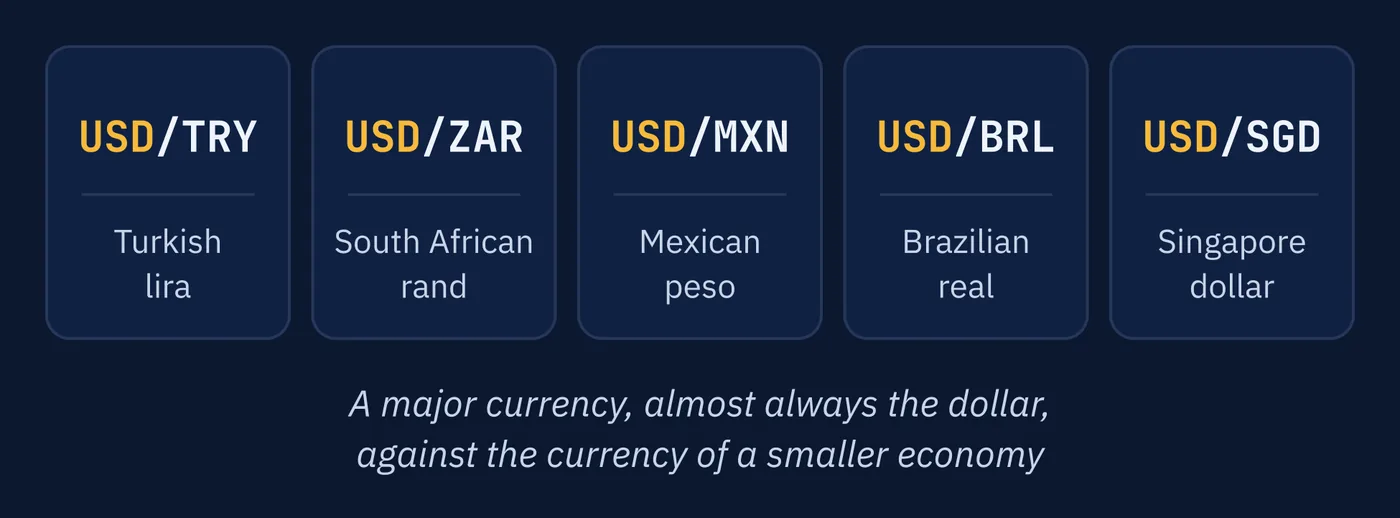
These appear on nearly every trading platform, listed alongside the majors and crosses. They quote in the same format. Their charts look like every other chart.
And they behave very differently, in ways a beginner is unlikely to work out on their own. That is what this lesson is for.
2What Makes a Currency Exotic
There is no official list. The category is defined by shared characteristics rather than by a rule someone published.
The currencies in question come from economies that are smaller, less established, or less woven into the global financial system than the ones behind the majors. Many are countries that export raw materials heavily, or that depend on foreign money flowing in to fund themselves.
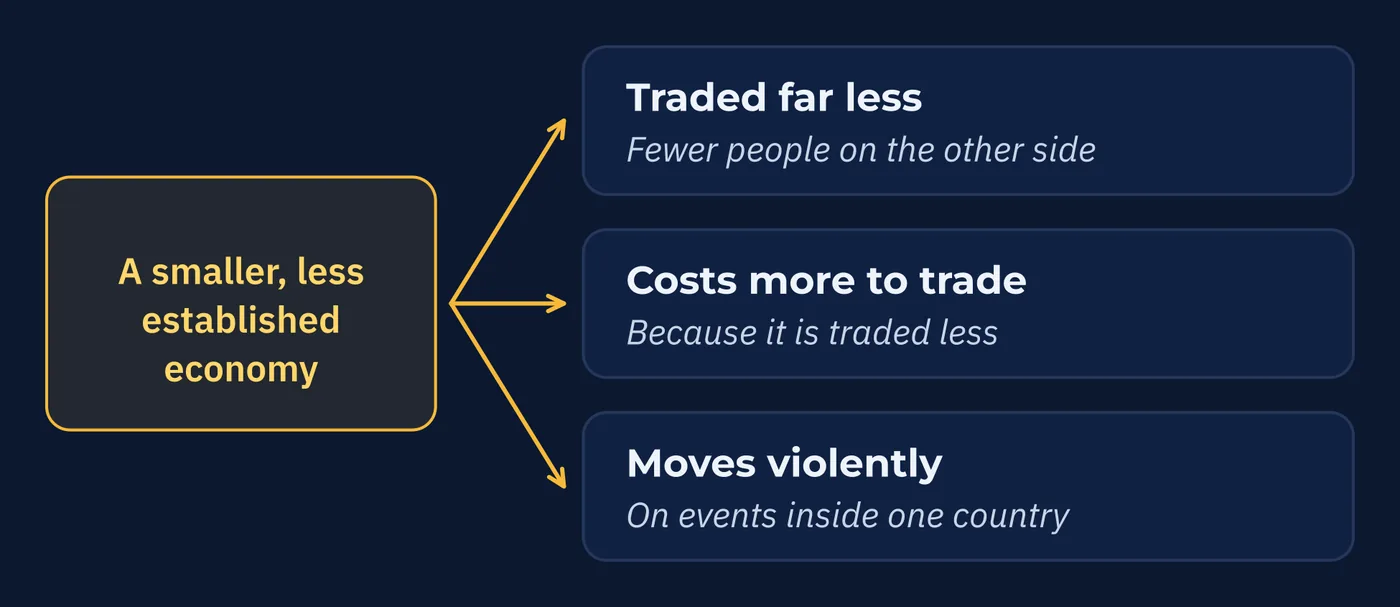
Three things follow from that, and all three matter to you as a trader.
They are traded far less. Fewer participants means fewer people willing to buy when you want to sell.
They cost more to trade, for the reason above.
And they can move violently in response to events inside one country, with very little warning.
3The Price Tag
Start with cost, because the size of the difference is genuinely hard to believe until you see it laid out.
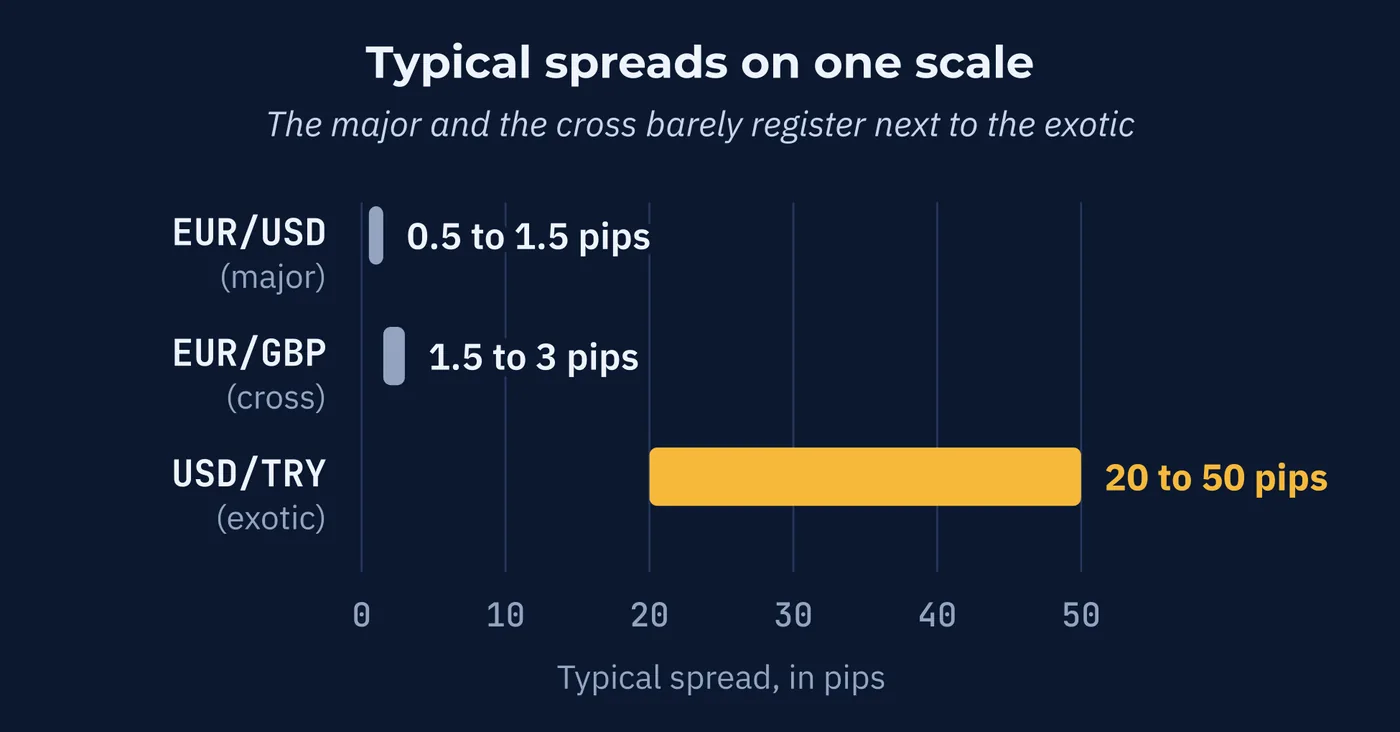
Recall the spread from Lesson 2. Every pair carries two prices, a bid and an ask, and the gap between them is the spread. On EUR/USD in normal conditions that gap runs about half a pip to one and a half pips.
On an exotic pair like USD/TRY, the spread commonly runs twenty to fifty pips.
| Pair | Typical Spread | Compared to EUR/USD |
|---|---|---|
| EUR/USD | 0.5 to 1.5 pips | Baseline |
| EUR/GBP (cross) | 1.5 to 3 pips | Roughly 2 to 3 times |
| USD/TRY (exotic) | 20 to 50 pips | Roughly 10 to 100 times |
Roughly ten to a hundred times. That is not a small penalty for going somewhere less popular. It is a different order of magnitude, and it changes what a trade needs to do in order to work.
To see why, we need one fact that earlier lessons deliberately left out.
4You Pay the Spread Before You Start
Here is the mechanic, and it applies to every pair in every market. It simply matters far more on some than others.
When you buy, you buy at the ask, which is the higher of the two prices. The moment you own the position, it is valued at the bid, which is the lower one. That is what you would receive if you sold it back immediately.
So the instant you open a trade, you are behind. Not because anything went wrong, and not because the market moved. Simply because you bought at one price and are being valued at the other.
Every trade starts at a loss the size of the spread.
Before you can make a single unit of profit, the price has to move far enough in your favor to cover that gap. On EUR/USD with a one pip spread, the price needs to travel one pip just to reach the point where you have neither gained nor lost.
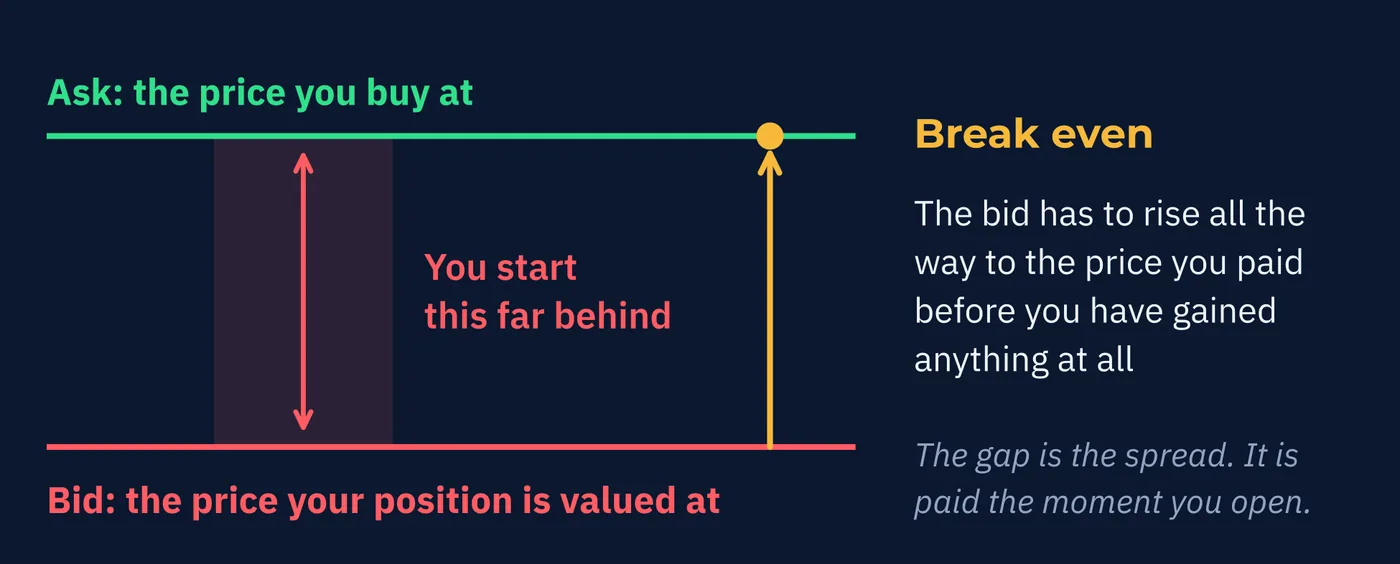
One pip is minimal. This is why the cost barely registers when you trade the majors, and why it is easy to forget the mechanic exists at all.
Now apply it to an exotic.
5What That Does to a Trade
Take a realistic setup. You have looked at a pair, you have a view, and you expect the price to move fifty pips in your favor.
On EUR/USD, with a spread of one pip:
50 pips expected − 1 pip cost = 49 pips leftThe cost consumed two percent of the move. You keep the rest.
Now the identical trade on an exotic, with a spread of thirty pips:
50 pips expected − 30 pips cost = 20 pips leftThe cost consumed sixty percent of the move.
| EUR/USD | Exotic Pair | |
|---|---|---|
| Spread | 1 pip | 30 pips |
| Move needed to break even | 1 pip | 30 pips |
| Left from a 50 pip move | 49 pips | 20 pips |
| Share of the move lost to cost | 2% | 60% |
Read the bottom row twice. Both traders were equally right about direction. Both got the fifty pip move they predicted. One kept nearly all of it and one kept less than half.
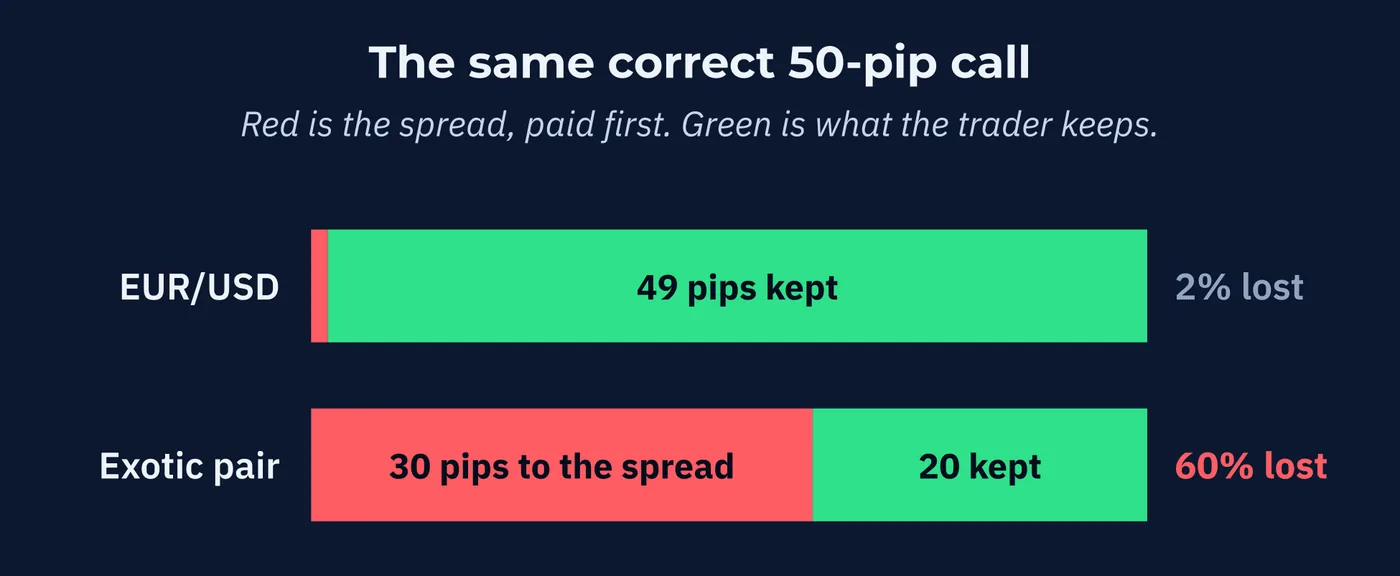
This is the thing people miss when an exotic chart catches their eye. The large candles are real. So is the cost of stepping into them, and the cost is charged first.
6The Risk No Chart Can Show You
Cost is the predictable problem. There is a second one that is not predictable at all.
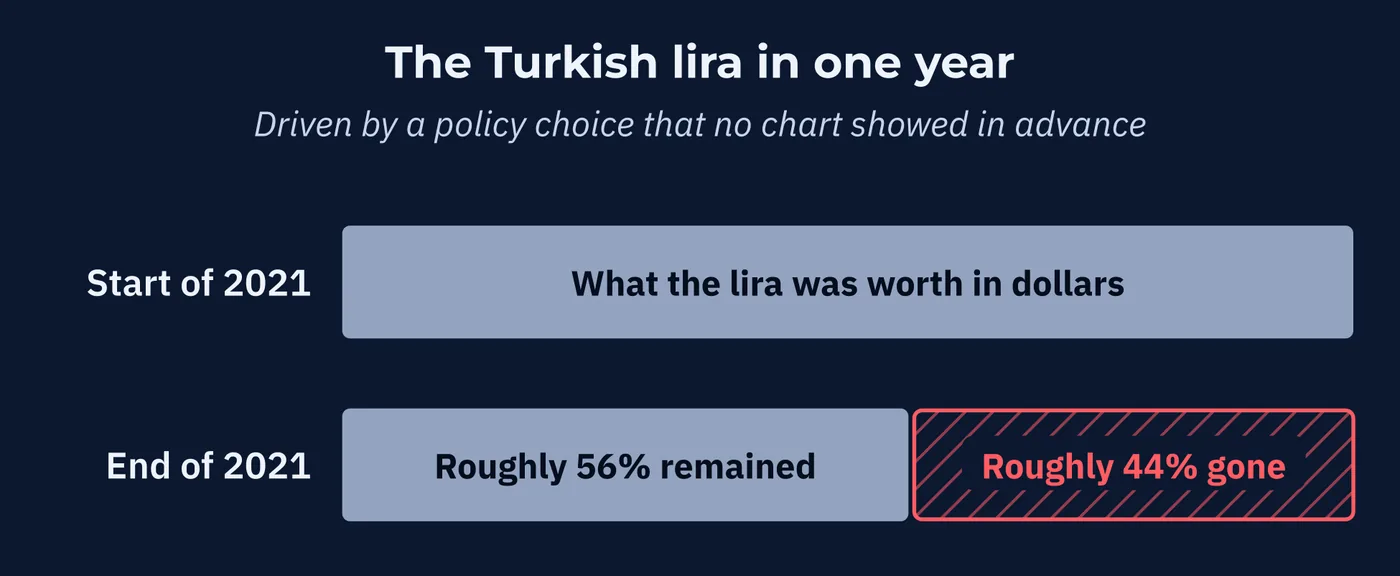
Exotic currencies belong to individual countries whose politics and policies can shift suddenly. A surprise election result, an unexpected decision by the central bank, a change in how the government handles its debt. Any of these can reprice a currency enormously within hours.
When that happens, the price can jump so far and so fast that there is effectively no trading in between. A trader who arranged to exit at a particular level may find that level was skipped entirely, and that they exited far worse than planned.
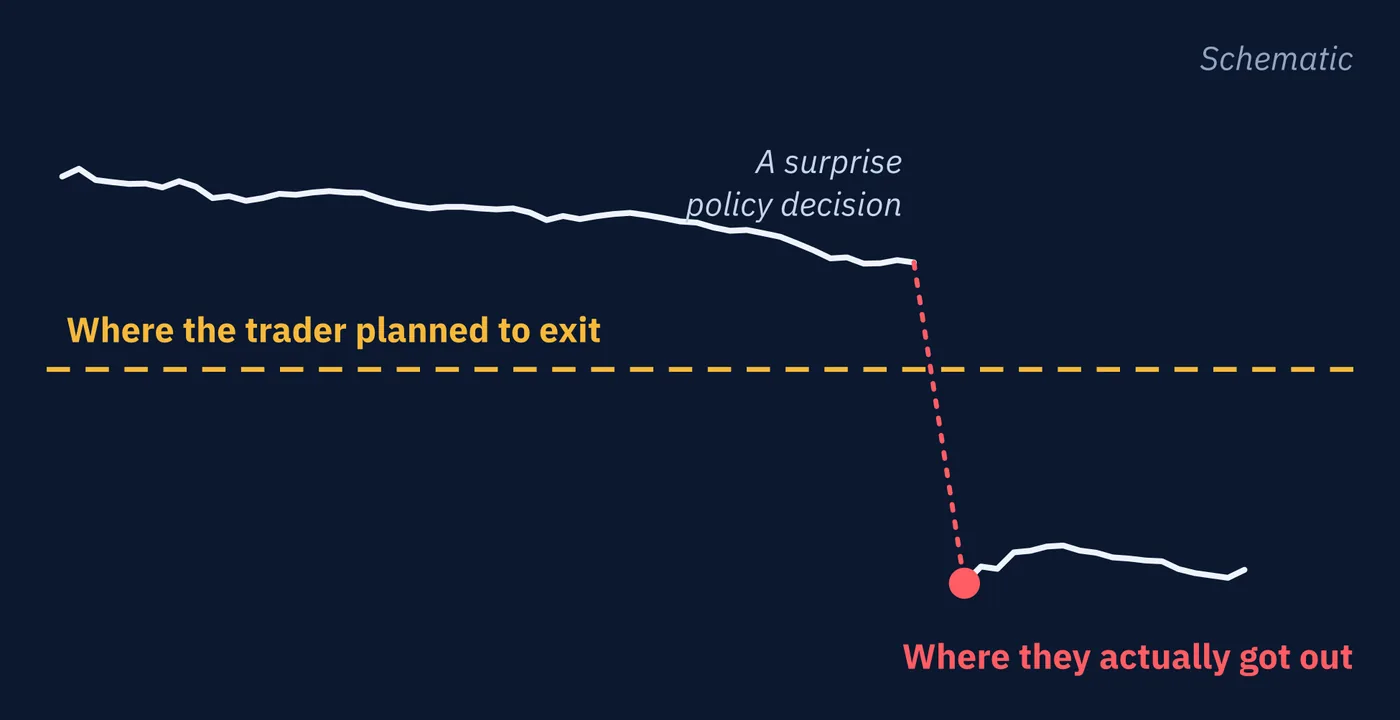
Which brings up the uncomfortable point about charts. Everything you learned in Lesson 3 still works on an exotic. The candles are read the same way. But no chart pattern anywhere has ever predicted a policy decision, and a currency can look perfectly orderly right up until the moment the ground moves.
7Ask Whether the Price Is Even Free to Move
It would be easy to leave this lesson thinking exotic simply means wild. Some are the opposite, and this is where it gets genuinely interesting.
USD/HKD, the dollar against the Hong Kong dollar, appears in the exotic list on most platforms. It behaves nothing like the others.
Since 1983, Hong Kong has pegged its currency to the U.S. dollar at about 7.8. Since 2005, its monetary authority has held it inside a formal band, 7.75 to 7.85, and it defends that band deliberately. The pair has stayed close to 7.8 for over forty years.
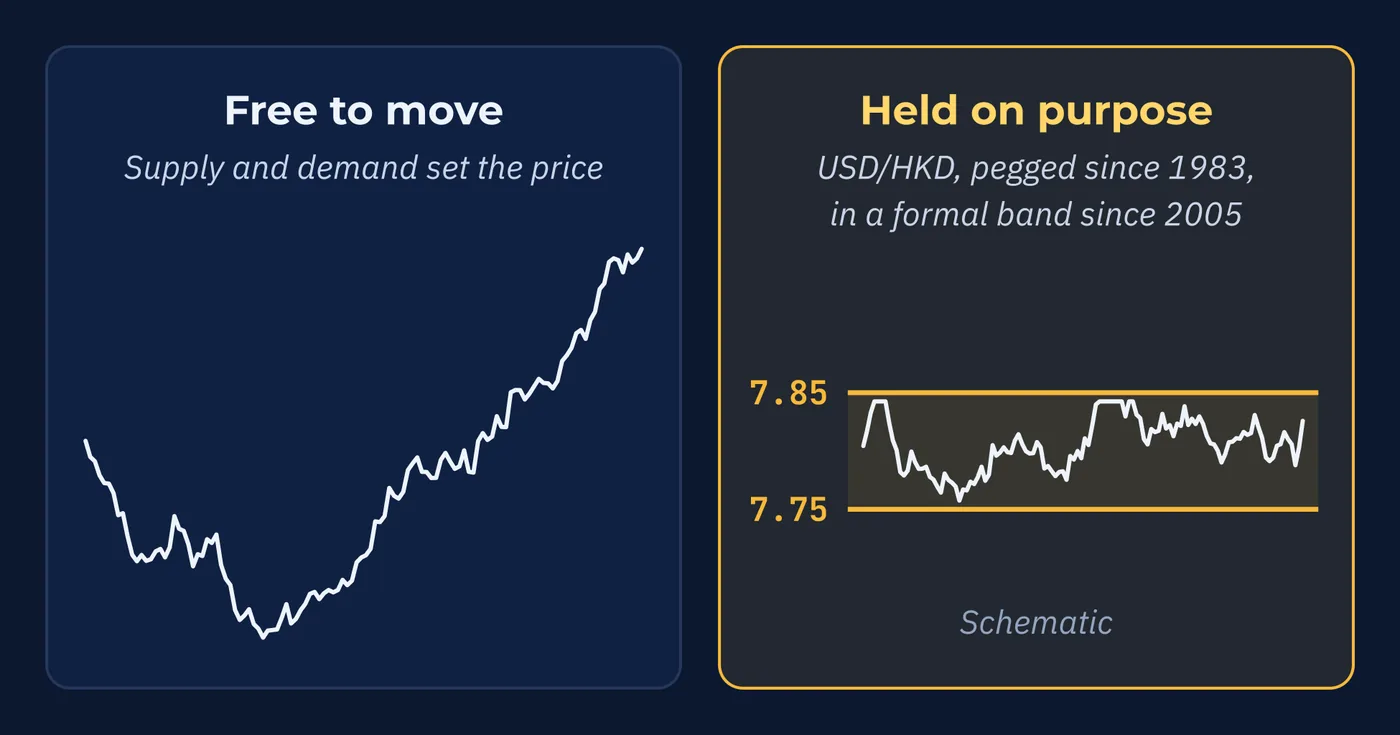
So a trader who opens that chart looking for a big directional move is not taking a risk. They are making a mistake of a different kind. The price is not being set by supply and demand in the way other prices are. It is being held in place on purpose.
This is worth generalizing into a habit. Before analyzing any unfamiliar pair, ask a prior question.
Is this price free to move, or is somebody holding it?
If an institution is committed to keeping a currency inside a range, the usual tools tell you very little. That question comes before the chart, not after it.
8Where This Leaves You
Exotic pairs are not a trap, and they are not forbidden. Real traders trade them, and businesses with genuine exposure to those economies need them.
The wider point outlives this lesson. You now know that every trade begins with a cost, and that the cost varies enormously between pairs. Future lessons return to this properly, because it turns out to shape far more than which pairs you choose.
Three Things to Remember
Try This
Ten minutes. This turns an abstract cost into a number you have seen with your own eyes.
Words From This Lesson
| Term | What It Means |
|---|---|
| Exotic pair | A pair combining one major currency, usually the dollar, with the currency of a smaller or developing economy. |
| Breakeven | The point at which a trade has recovered its cost and has neither gained nor lost. |
| Gap | A jump in price with effectively no trading in between, so intended exit levels can be skipped entirely. |
| Currency peg | An arrangement where an institution holds a currency at a fixed value or inside a narrow band against another currency. |
| Liquidity | How readily a pair can be traded. Lower liquidity means fewer participants and wider spreads. |
Test Your Knowledge
Eight questions. Answer them all before checking the key on the following pages. If a question gives you trouble, the answer key tells you which section to revisit.
- A. It contains no U.S. dollar
- B. It can only be traded by professionals
- C. It pairs a major currency with a smaller economy's currency
- D. It is quoted to more decimal places than a major
- A. EUR/GBP
- B. USD/TRY
- C. AUD/JPY
- D. GBP/USD
- A. When you close the trade
- B. The moment you open the trade
- C. Once per day while the trade is open
- D. Only if the trade loses money
- A. Brokers charge an opening fee
- B. The market always moves against new positions first
- C. You buy at the ask but the position is valued at the bid
- D. Prices update on a delay
- A. 50 pips
- B. 30 pips
- C. 80 pips
- D. 20 pips
- A. The exotic trader keeps far less of the move because of the wider spread
- B. Nothing, since both were right about direction
- C. The exotic trader keeps more because exotic pips are worth more
- D. The EUR/USD trader waits longer for the move
- A. Charts cannot anticipate sudden political or policy decisions
- B. The candles work differently on exotics
- C. Exotic charts update less frequently
- D. Exotic pairs have no price history to study
- A. The pair is very safe to trade for profit
- B. The chart must be displaying incorrectly
- C. Hong Kong's economy never changes
- D. Its price is held in place deliberately, so tools that assume free movement do not apply
Answer Key
Each answer explains why the correct choice is correct, why the others are not, and where to reread.
Question 1 · correct answer C
An exotic combines a major currency, nearly always the dollar, with the currency of a smaller or developing economy. The second currency defines the category.
A describes a cross pair, which is a separate group that never contains the dollar. B is wrong because anyone can trade exotics at most brokers, which is part of why the costs are worth understanding. D describes a formatting convention rather than a category.
Review: Section 1, The Outer Edge
Question 2 · correct answer B
USD/TRY pairs the dollar with the Turkish lira, which comes from a smaller and less established economy than any of the majors.
A is a cross, containing no dollar. C is also a cross, pairing two major currencies with no dollar between them. D is a major. Checking both currencies rather than just one settles this each time.
Review: Section 1, The Outer Edge
Question 3 · correct answer B
You buy at the ask and the position is immediately valued at the bid, so the cost is charged at the moment of opening rather than at any later point.
A is the intuitive answer and the one this lesson corrects. C describes a separate overnight cost that exists but is not the spread. D is wrong because the spread applies to every trade regardless of outcome.
Review: Section 4, You Pay the Spread Before You Start
Question 4 · correct answer C
The two prices are different by definition. Buying at the higher one and being valued at the lower one puts you behind by exactly the spread.
A describes a commission, which is a separate charge some brokers apply on top. B attributes intent to a market that has no knowledge of your position. D is wrong because the gap is structural rather than a delay in updating.
Review: Section 4, You Pay the Spread Before You Start
Question 5 · correct answer D
Thirty pips of the move go to covering the spread, leaving twenty. That is sixty percent of the move consumed by cost.
A forgets the cost entirely. B gives the cost rather than what remains after it. C adds the spread instead of subtracting it, which would be the case only if the spread paid you.
Review: Section 5, What That Does to a Trade
Question 6 · correct answer A
Being right about direction is only half of it. The exotic trader's cost consumed sixty percent of the move while the EUR/USD trader's consumed two percent.
B is the assumption this section exists to break, since accuracy and outcome are not the same thing. C invents a difference in pip value that does not follow from the pair being exotic. D describes timing, which is not what separates the two results.
Review: Section 5, What That Does to a Trade
Question 7 · correct answer A
Charts record what has already happened. A surprise policy or political decision leaves no trace in price history until after it occurs.
B is wrong because candles are read identically on every pair. C is wrong because exotic charts update continuously like any other. D is wrong because these pairs have long price histories, which is exactly why the false confidence is possible.
Review: Section 6, The Risk No Chart Can Show You
Question 8 · correct answer D
The band is maintained deliberately by Hong Kong's monetary authority, so the price is institutionally constrained rather than freely determined.
A confuses stability with opportunity, since a price held in place offers little to trade. C overstates it, because the economy changes while the currency arrangement holds. B mistakes a deliberate policy outcome for a display fault.
Review: Section 7, Ask Whether the Price Is Even Free to Move
Keep going
Currency Pairs is written by Kanin D. Alldredge for The Currency Classroom, and it is free to read. There is more free from CNS: start here.
Start free with CNS →