Crypto Pairs

1Same Mechanics, Different Ground
Everything structural you know still applies. A crypto pair has a base and a quote. The price says how much of the quote one unit of the base costs. You can go long or short. Candles read the same way.
Lesson 6 covered that ground and noted that crypto pairs can be quoted three different ways. That is where this lesson picks up, because the choice of quote currency turns out to matter far more than it first appears.
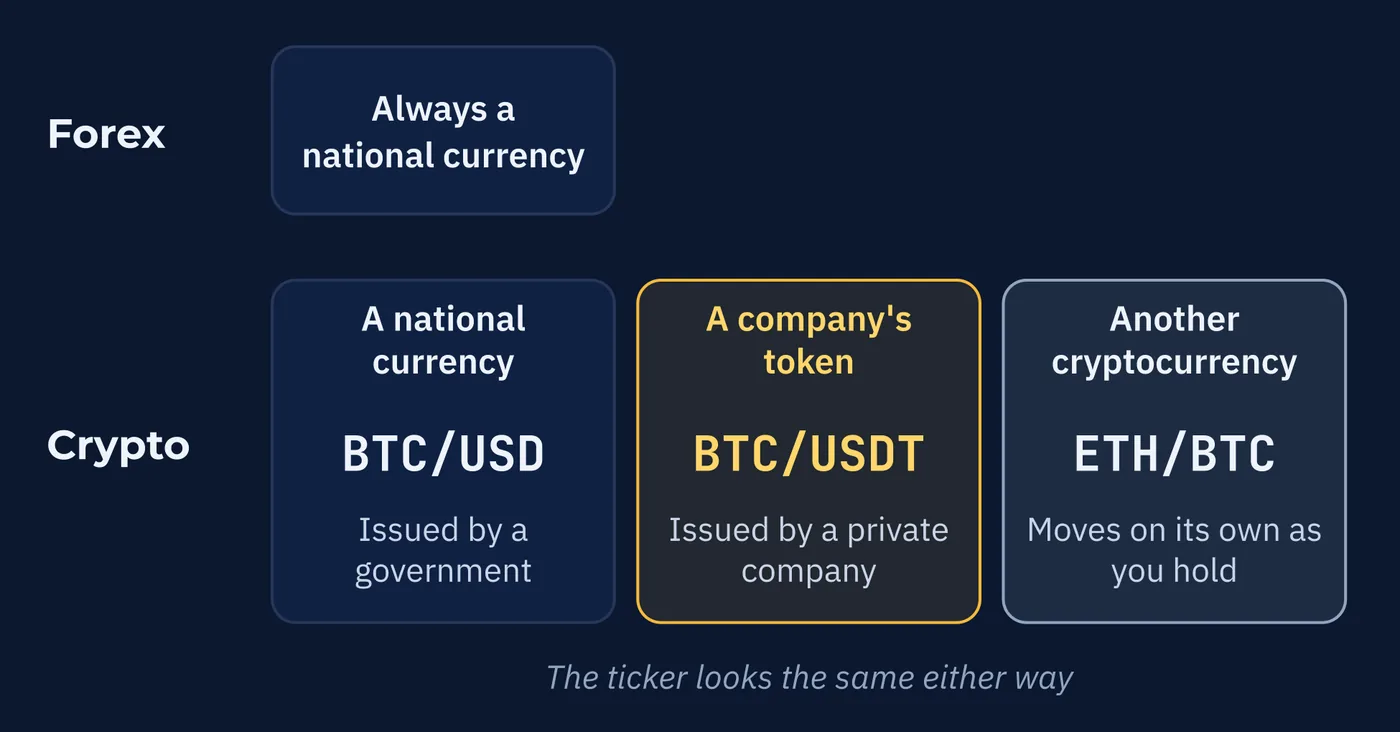
In forex, the quote currency is always a national currency. A euro, a dollar, a yen. Something a government issues and a central bank is responsible for.
In crypto, that is not guaranteed. The thing pricing your position might be a national currency. Or it might be a token issued by a private company. Or it might be another cryptocurrency that is moving around independently while you hold the trade.
Three quite different situations, and the ticker does not make the difference obvious.
2The Crypto Majors
Forex has seven majors that carry most of the volume and set the reference point for everything else. Crypto has an equivalent, and the list is even shorter.
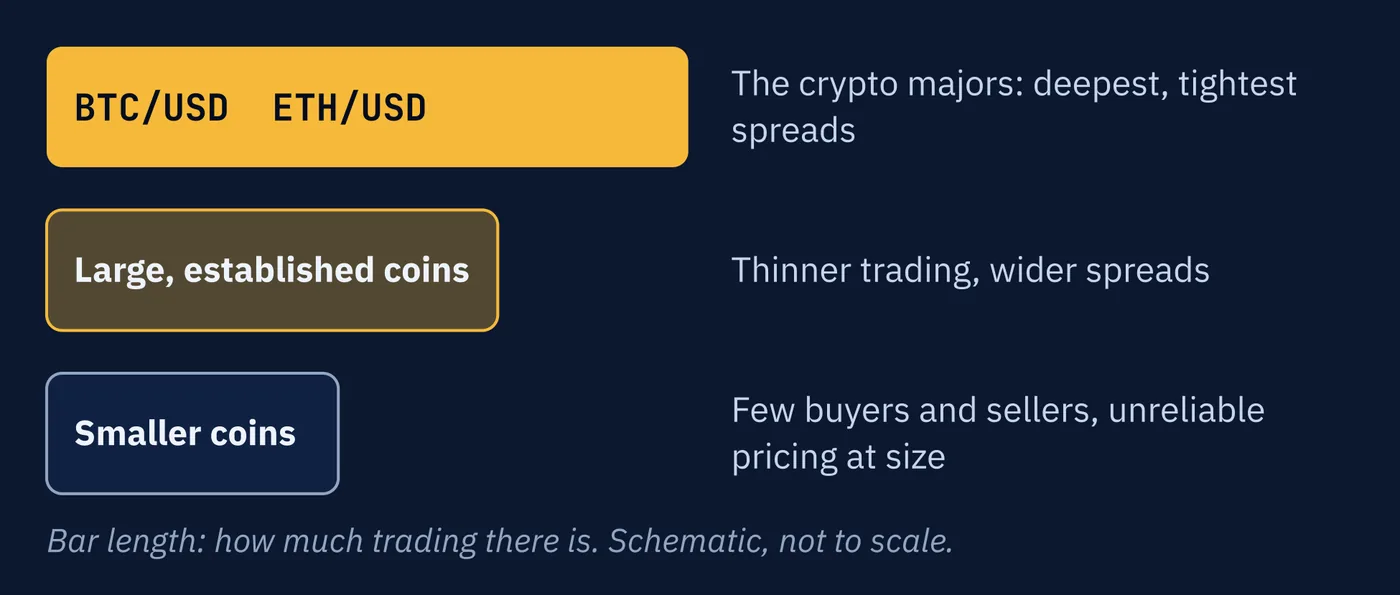
BTC/USD and ETH/USD are the crypto majors. Bitcoin and Ethereum priced in dollars. These are the pairs the rest of the market takes its bearings from, in the same way EUR/USD anchors forex.
They are the deepest and most heavily traded crypto pairs available. On the largest exchanges during busy hours, the spread on BTC/USD can be comparable to a forex major, which is a genuinely remarkable thing for an asset that did not exist twenty years ago.
ETH/USD tends to run slightly wider spreads and slightly larger moves. Ether generally travels further than Bitcoin in both directions, up and down.
Everything below these two gets thinner. Smaller cryptocurrencies have fewer buyers and sellers, wider spreads, and less reliable pricing when you actually try to trade size. Lesson 10's arithmetic about cost applies here exactly as it did to exotic pairs.
3Three Ways to Quote a Crypto Pair
Here are the three architectures, with what each one actually means for you.
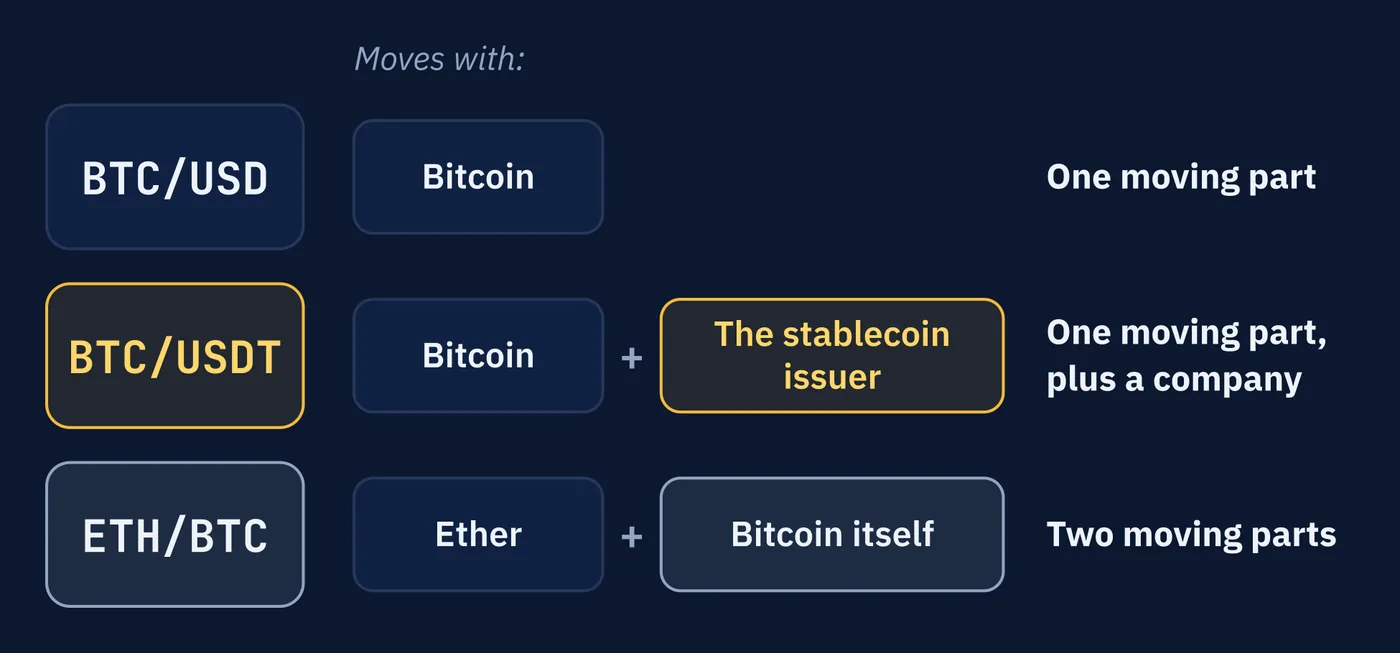
| Quote Currency | Example | What Is Pricing Your Position |
|---|---|---|
| A national currency | BTC/USD | Actual U.S. dollars. Same structure as any forex pair. |
| A stablecoin | BTC/USDT | A privately issued token intended to be worth one dollar. |
| Another cryptocurrency | ETH/BTC | Bitcoin, which is itself moving against everything else. |
On a chart during a calm week, all three look and behave almost identically. The differences show up under stress, and under stress is exactly when you least want to be discovering them.
Take them one at a time.
4What a Stablecoin Actually Is
On most crypto exchanges worldwide, the dominant quote currency is not the dollar. It is a stablecoin, usually Tether, written USDT, or USD Coin, written USDC.
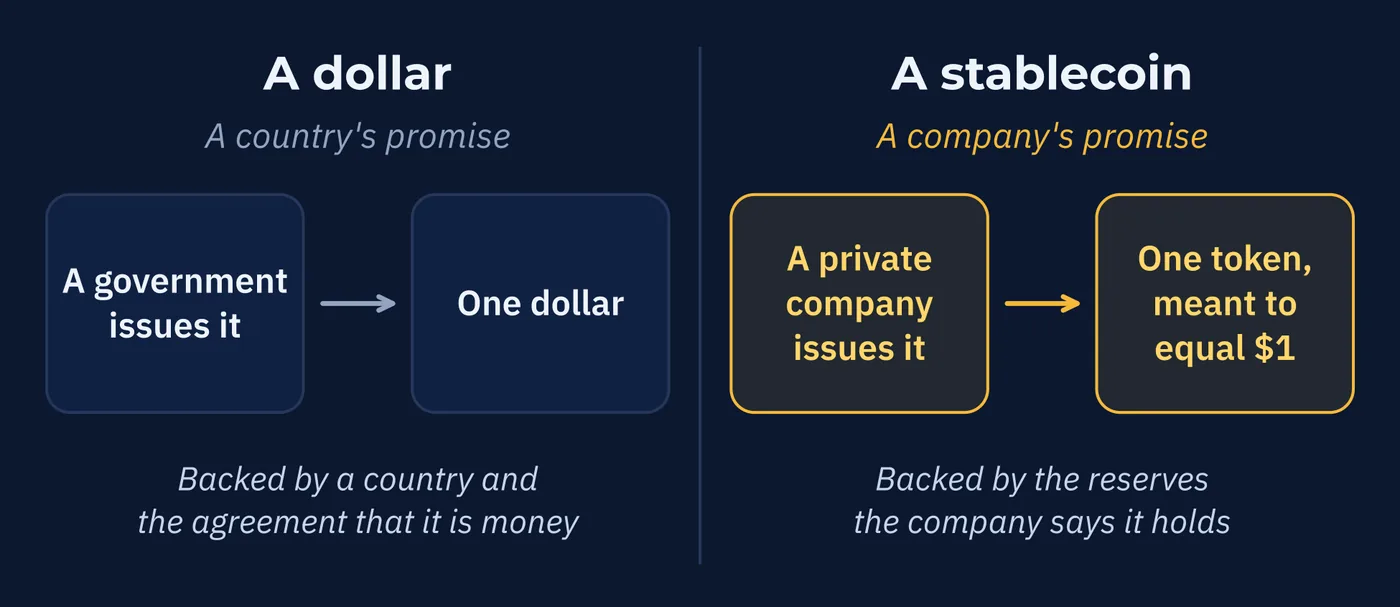
A stablecoin is a token created by a private company, designed to be worth exactly one U.S. dollar at all times. The company issues tokens and says it holds real assets in reserve to back them, so that anyone can redeem a token for a dollar.
When it works, and it usually does, it is genuinely useful. It gives crypto exchanges a stable unit to price everything in without needing access to the traditional banking system. A chart of BTC/USDT looks essentially identical to BTC/USD.
But notice what has just happened, and compare it to Lesson 1.
A dollar is worth a dollar because a government issues it and everyone accepts it. That was the shared agreement we called money. A stablecoin is worth a dollar because a private company says it is, and because it says it holds enough in reserve to make that true.
A dollar is a country's promise. A stablecoin is a company's.
Both are promises. They are not the same promise, and they are not backed by the same thing.
5The Quote Currency Is a Counterparty
This is the idea worth carrying out of the lesson.
In forex, the quote currency is neutral background. Nobody trading EUR/USD worries that the dollar will stop being a dollar during the trade. The question does not arise.
In a stablecoin pair, the quote currency is a financial product with its own risk. If confidence in the issuer weakens, the token can slip below a dollar. And if that happens, the value of everything priced in it moves, regardless of what Bitcoin or Ethereum did.
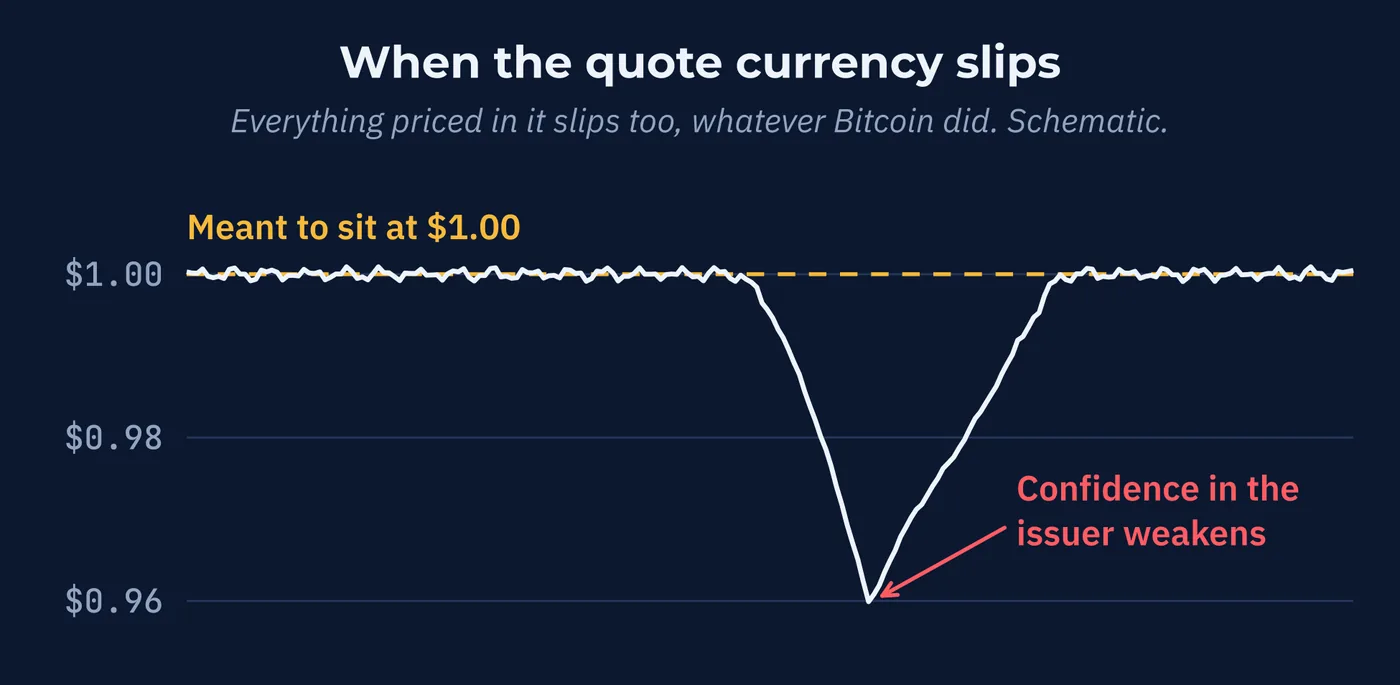
This is not hypothetical. Stablecoins have traded below their intended value during periods when the market doubted the assets behind them. They have generally recovered. The point is that it can happen, and that it happens for reasons entirely unconnected to whatever you were trading.
So there is a question worth asking before trading a stablecoin pair, and it takes about a minute. Which stablecoin is the quote currency, who issues it, and what do they publish about their reserves?
You are not only taking a view on Bitcoin. You are also holding a company's token while you do it.
6When the Quote Currency Is Bitcoin
The third architecture prices one cryptocurrency in another. ETH/BTC, SOL/BTC, XRP/BTC.
Structurally these are crypto's version of the cross pairs from Lesson 9. Two non-dollar assets priced directly against each other. Buying ETH/BTC means buying Ethereum and selling Bitcoin at the same moment.
And they carry a trap that catches people who are otherwise doing everything right. Work through it with numbers.
You buy ETH/BTC. At the time, Bitcoin is at forty thousand dollars and ETH/BTC is at 0.060.
0.060 × $40,000 = $2,400 per etherA month later, your trade has worked. Ether has gained on Bitcoin, and ETH/BTC has risen to 0.070. In the terms of the pair you traded, you are up nearly seventeen percent.
But over that same month, Bitcoin fell to thirty thousand dollars.
0.070 × $30,000 = $2,100 per ether| At Entry | A Month Later | Change | |
|---|---|---|---|
| ETH/BTC | 0.060 | 0.070 | Up 16.7% |
| Bitcoin in dollars | $40,000 | $30,000 | Down 25% |
| Your position in dollars | $2,400 | $2,100 | Down 12.5% |
You were right. The pair moved your way by a wide margin. And you have less money than when you started.
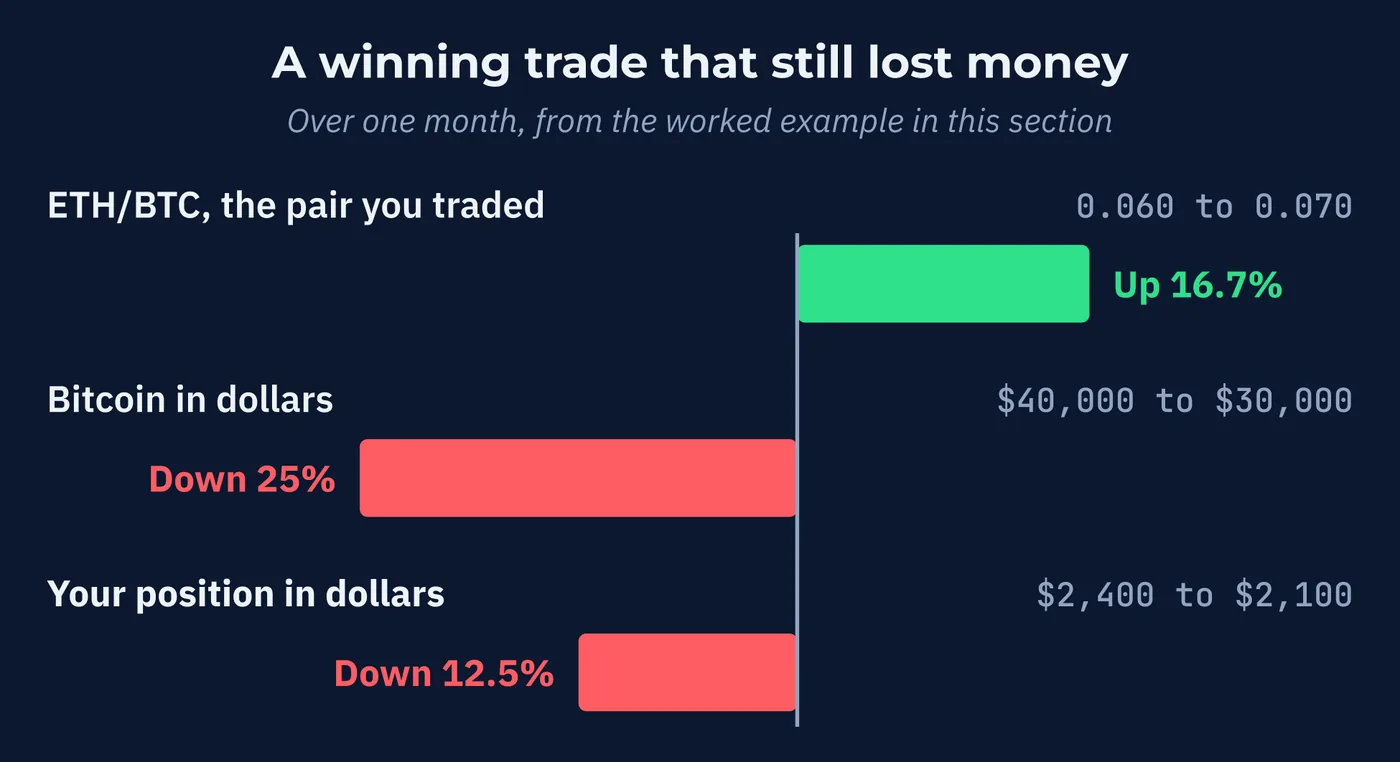
The reason is that your yardstick shrank while you were using it. You measured the trade in Bitcoin, and Bitcoin lost a quarter of its value against the dollar during the same period.
Nothing about this is unfair or hidden. It follows from the pair being a ratio, which Lesson 2 established on the first page. It is simply much easier to overlook when both sides of the ratio can move dramatically.
7Bitcoin Dominance
One more idea, and it connects back to something you already know.
Lesson 8 covered risk-on and risk-off in forex. Money moves toward safe havens when investors are frightened and toward commodity currencies when they are confident. Crypto has a rough equivalent, and it is called Bitcoin dominance.
Dominance measures Bitcoin's share of the total value of all cryptocurrency. When the number rises, money is consolidating into Bitcoin. When it falls, money is spreading out into smaller cryptocurrencies.
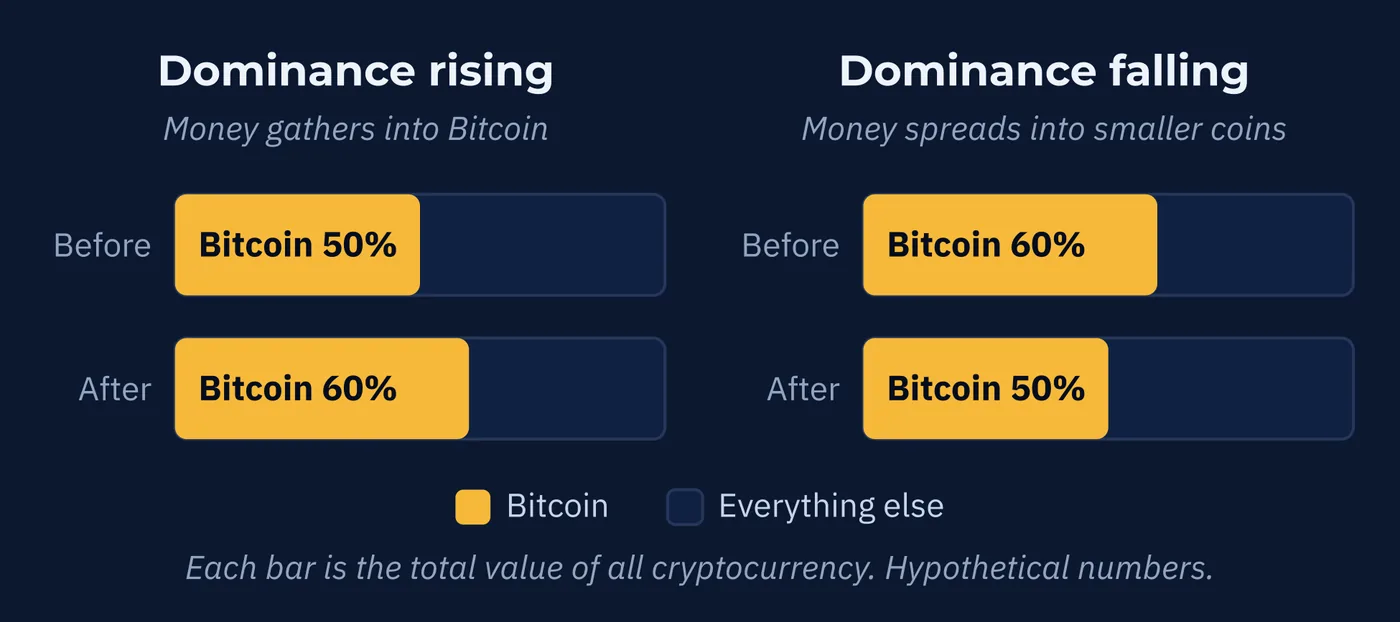
| When Dominance Is | Money Is Moving | Which Suggests |
|---|---|---|
| Rising | Into Bitcoin, out of smaller coins | Caution within the crypto market |
| Falling | Out of Bitcoin, into smaller coins | Appetite for risk within the crypto market |
Within crypto, Bitcoin plays a role loosely comparable to a safe haven. It is the largest, oldest, and most established, so nervous money tends to gather there. Confident money spreads outward looking for bigger moves.
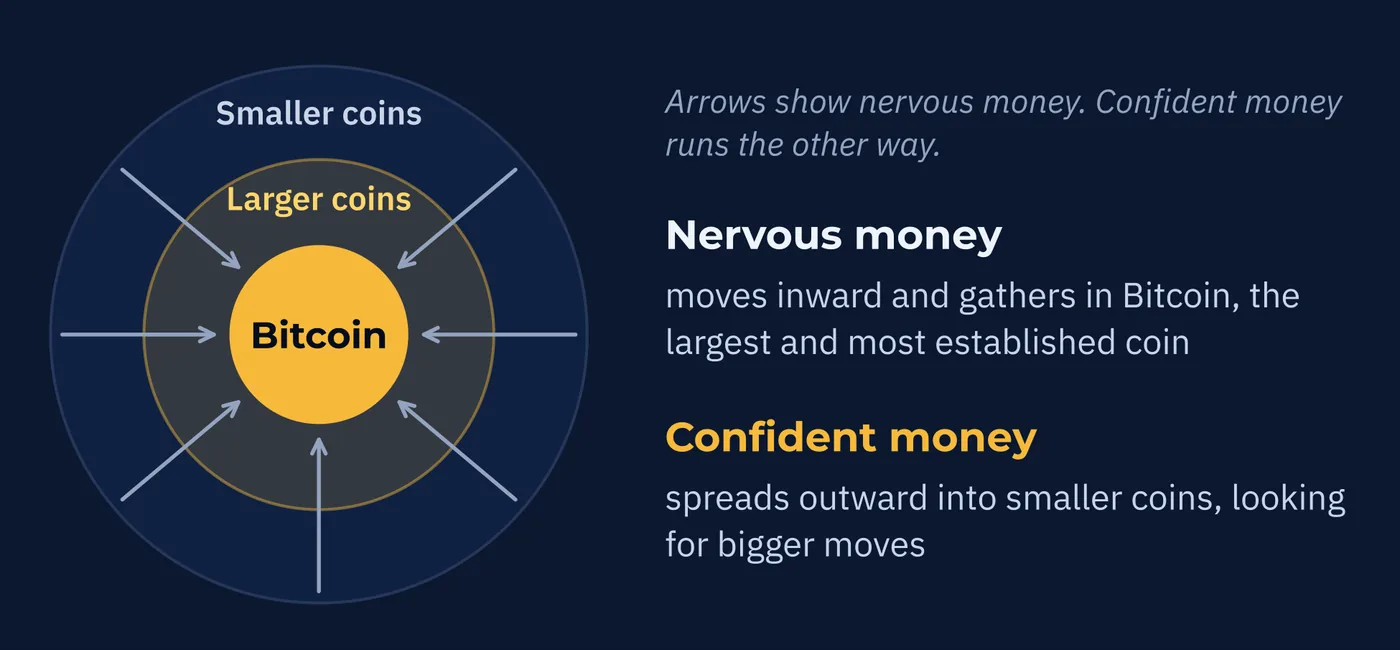
It is a rough signal rather than a precise one. But it costs nothing to glance at, and it tells you something about mood that an individual chart will not.
8Where This Leaves You
Crypto pairs are read with exactly the tools you already have. Nothing in this lesson changed how a chart works or how a position behaves.
What changes is the ground underneath the pair.
For someone learning, the dollar-quoted crypto majors are the simplest starting point for the same reason EUR/USD is in forex. BTC/USD has one moving part instead of two, and no third party standing behind the quote.
Three Things to Remember
Try This
Ten minutes. This is about knowing what you are holding.
Words From This Lesson
| Term | What It Means |
|---|---|
| Crypto majors | BTC/USD and ETH/USD. The deepest crypto pairs, used as reference points for the rest of the market. |
| Stablecoin | A token issued by a private company, designed to hold a value of one U.S. dollar. USDT and USDC are the largest. |
| Issuer risk | The risk that the company behind a stablecoin cannot maintain its value, independent of what the traded asset does. |
| Reserve attestation | A periodic third-party check on the assets an issuer holds. More limited than a full independent audit. |
| Bitcoin dominance | Bitcoin's share of the total value of all cryptocurrency. A rough gauge of risk appetite within crypto. |
| Counterparty | Any party whose ability to meet its obligations affects the value of what you hold. |
Test Your Knowledge
Eight questions. Answer them all before checking the key on the following pages. If a question gives you trouble, the answer key tells you which section to revisit.
- A. Any pair quoted in a stablecoin
- B. ETH/BTC and SOL/BTC
- C. BTC/USDT and USDT/USD
- D. BTC/USD and ETH/USD
- A. A token issued by a private company, designed to be worth one dollar
- B. A cryptocurrency whose price never moves
- C. A digital currency issued by a government
- D. A cryptocurrency backed by gold
- A. The exchange might go out of business
- B. The asset you are trading might fall in price
- C. The company behind the token might not maintain its dollar value
- D. The network might become congested
- A. It does not, since they are the same thing
- B. A stablecoin is a company's promise rather than a government's
- C. Stablecoin pairs cannot be traded outside the United States
- D. Stablecoin pairs use different chart types
- A. It gained about 16.7%
- B. It gained slightly
- C. It broke even
- D. It lost about 12.5%
- A. The quote currency itself was falling against the dollar
- B. Exchanges charge extra fees on Bitcoin-quoted pairs
- C. Bitcoin-quoted pairs are priced with a delay
- D. The pair was mispriced during the trade
- A. Bitcoin's dollar price must be rising
- B. Money is rotating into smaller coins, suggesting appetite for risk
- C. Money is consolidating into Bitcoin, suggesting caution within crypto
- D. The total crypto market is shrinking
- A. Which exchange has the prettiest charts
- B. What is the quote currency, and what stands behind it
- C. Whether the pair has moved recently
- D. How many people are talking about it online
Answer Key
Each answer explains why the correct choice is correct, why the others are not, and where to reread.
Question 1 · correct answer D
Bitcoin and Ethereum priced in dollars are the deepest, most heavily traded crypto pairs, and the rest of the market takes its bearings from them.
B names two Bitcoin-quoted pairs, which are crypto's equivalent of cross pairs rather than reference points. C invents a pair that is not meaningfully traded. A describes a quoting architecture rather than a specific set of reference pairs.
Review: Section 2, The Crypto Majors
Question 2 · correct answer A
A stablecoin is a privately issued token designed to hold a value of one U.S. dollar, with the issuer holding reserves intended to back it.
B overstates it, since stablecoins can and do slip from their intended value under stress. C describes a central bank digital currency, which is a different thing. D describes a commodity-backed token, which is not how the major stablecoins work.
Review: Section 4, What a Stablecoin Actually Is
Question 3 · correct answer C
Issuer risk is the risk attached to the quote currency itself. If confidence in the company weakens, the token can fall below a dollar and every position priced in it is affected.
A describes exchange risk, which is real but separate. B describes ordinary market risk, which applies to any asset in any market. D describes a network issue, which affects transactions rather than the token's value.
Review: Section 5, The Quote Currency Is a Counterparty
Question 4 · correct answer B
A dollar is backed by a government. A stablecoin is backed by a private company's reserves and its ability to honor redemptions. Both are promises, but not the same promise.
A is how they behave in calm conditions, which is exactly why the difference is easy to miss. C invents a restriction that does not exist. D is wrong because charting is identical across all quote types.
Review: Section 4, What a Stablecoin Actually Is
Question 5 · correct answer D
At entry the position was worth 0.060 times $40,000, or $2,400. Afterward it was 0.070 times $30,000, or $2,100. That is a loss of 12.5% in dollars despite the pair rising.
A reports the gain in the pair and stops there, which is precisely the error. B underestimates the effect of a 25% fall in the quote currency. C would require the two movements to offset exactly, which they do not.
Review: Section 6, When the Quote Currency Is Bitcoin
Question 6 · correct answer A
The pair measures the base against Bitcoin. If Bitcoin is falling against the dollar, the yardstick is shrinking while you use it.
B describes fees, which are far too small to reverse a result of this size. C is wrong because these pairs price continuously like any other. D is wrong because the outcome follows from ordinary price movement rather than any mispricing.
Review: Section 6, When the Quote Currency Is Bitcoin
Question 7 · correct answer C
Rising dominance means Bitcoin is taking a larger share of total crypto value, which indicates money consolidating into the largest and most established asset.
B describes falling dominance, the opposite case. A is wrong because dominance is a ratio, and it can rise while Bitcoin's dollar price falls if smaller coins fall further. D confuses a share of the market with the size of the market.
Review: Section 7, Bitcoin Dominance
Question 8 · correct answer B
The quote currency determines what your position is actually measured in, and whether a third party stands behind that measurement.
A is a matter of preference with no bearing on what you hold. C describes recent price action, which says nothing about the pair's structure. D describes attention, which is not a property of the pair at all.
Review: Section 8, Where This Leaves You
Keep going
Currency Pairs is written by Kanin D. Alldredge for The Currency Classroom, and it is free to read. There is more free from CNS: start here.
Start free with CNS →