Five Ways to Decide

1Two Traders, Same Trade
On Tuesday morning, two traders buy EUR/USD.
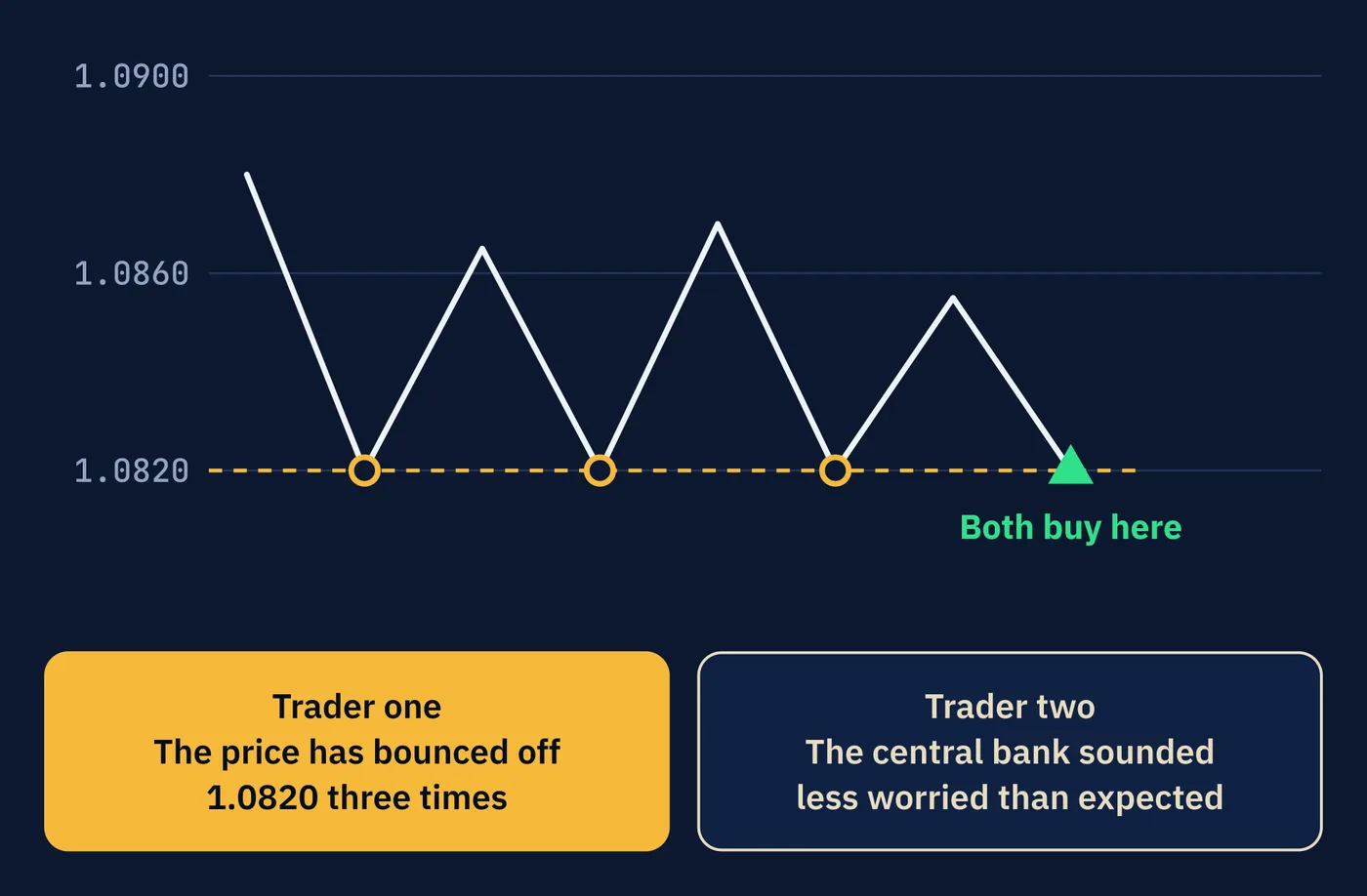
The first buys because the price has dropped to 1.0820 three times in the past two weeks and bounced every time. It is sitting there again. That is the reason.
The second buys because the European Central Bank met last week and sounded less worried about slowing growth than anyone expected. That changes what the market thinks interest rates will do. That is the reason.
Same pair. Same direction. Same morning. Possibly the same entry price and the same position size. On any broker statement the two trades are identical.
The traders have almost nothing in common.
The trade was identical. The reasoning was not.
Watch what happens next. If the price rises, the first trader learns that the level held. The second learns that the market agreed with her read on the central bank. Those are different lessons, and they will push the two traders toward different trades next week.
If the price falls, they do different things. The first closes when the level breaks, because the level breaking is the whole reason the trade existed. The second holds, because the central bank has not changed its mind and a few days of selling does not mean it has.
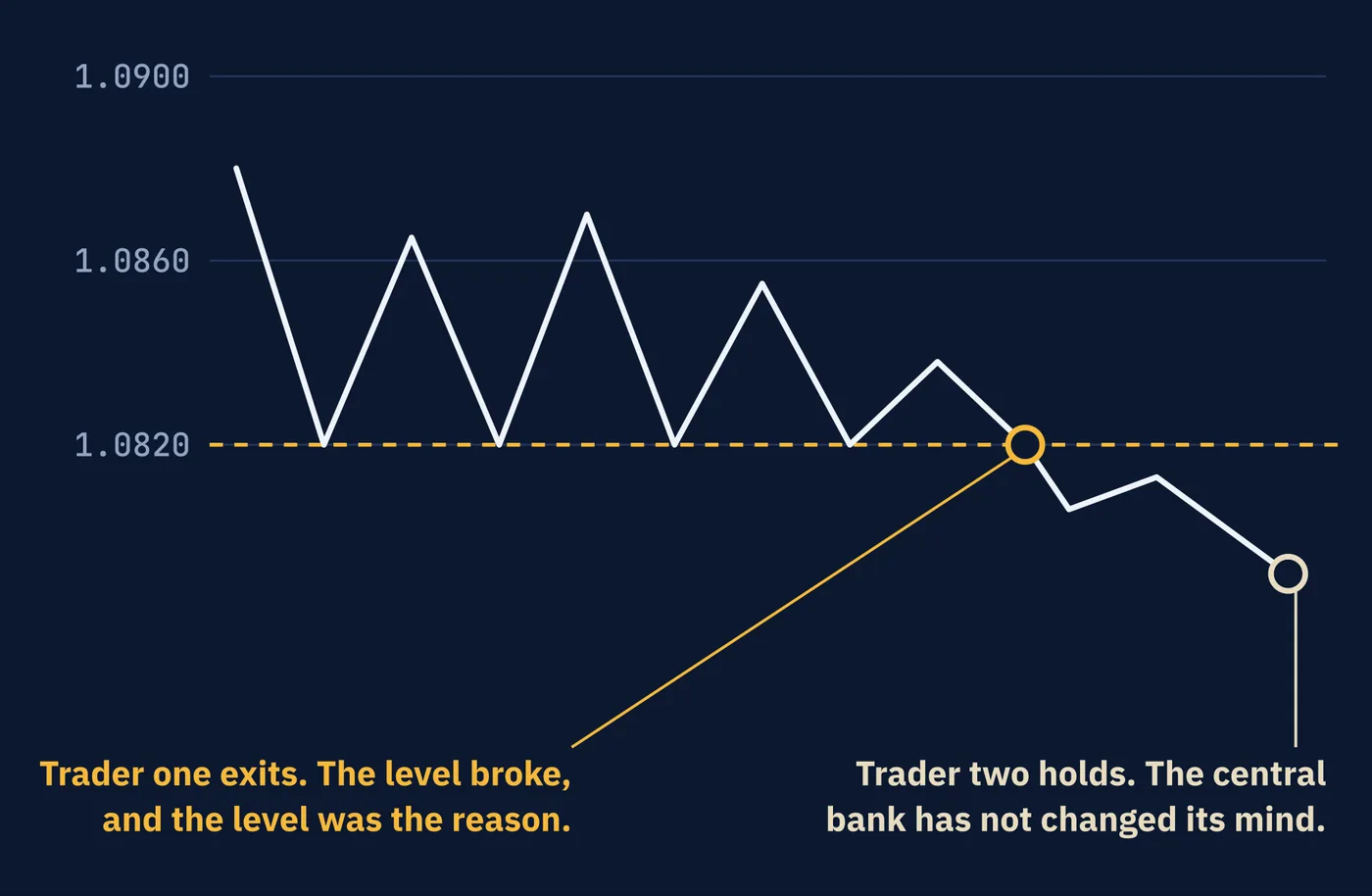
One of them may be right. That is not the point. The point is that the reason for the trade decided the exit before the trade was ever placed.
2The Question Behind Every Trade
There are three separate questions inside any trading decision, and they are easy to confuse because people answer all three at once without noticing.
| The Question | What It Decides | Where the Course Covers It |
|---|---|---|
| How long do I hold? | Your style | Lesson 27 |
| What is my rule? | Your strategy | Upcoming |
| What am I reading? | Your approach | Lessons 52 to 54 |
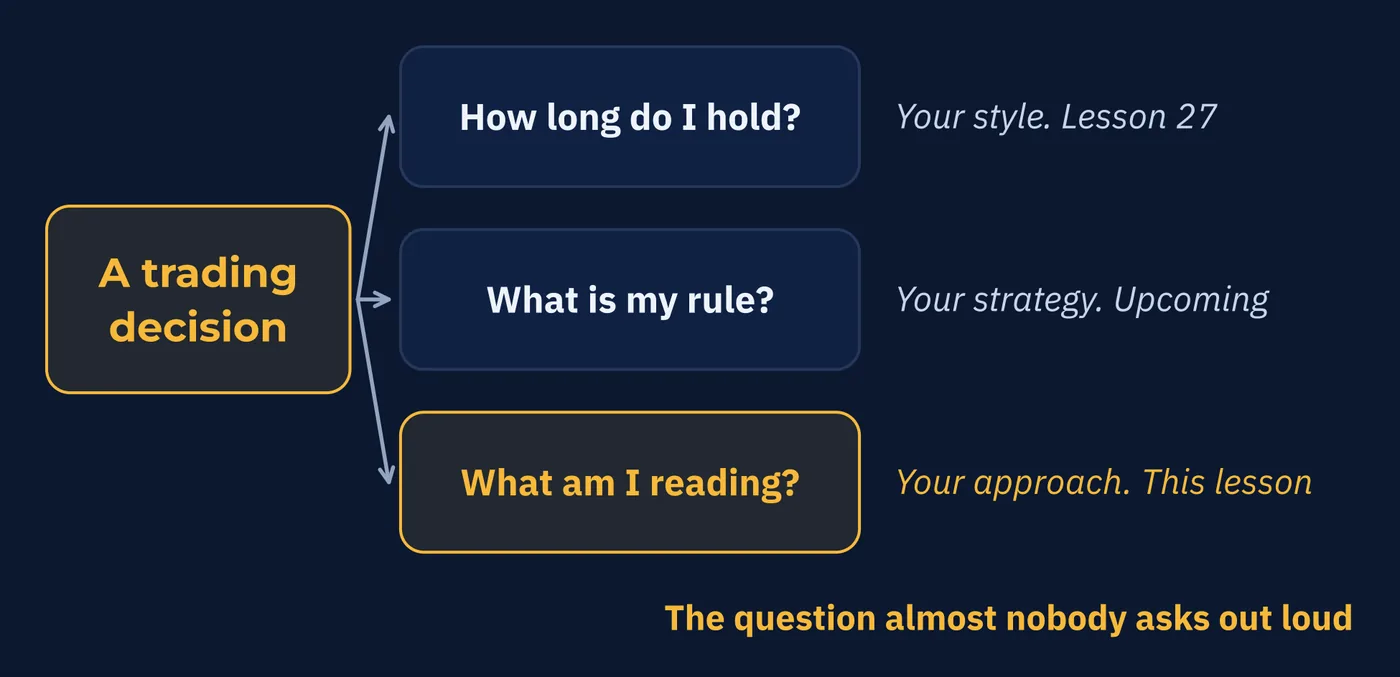
Lesson 27 established the first one. Scalping, day trading, swing trading and position trading are answers to how long, and the same rule run on three timeframes produces three different trades.
The second question is the one most people mean by strategy, and the bulk of the next several series is devoted to it.
The third question is the one almost nobody asks out loud, which is why it causes so much trouble. It is simply this: what kind of information are you actually using to decide?
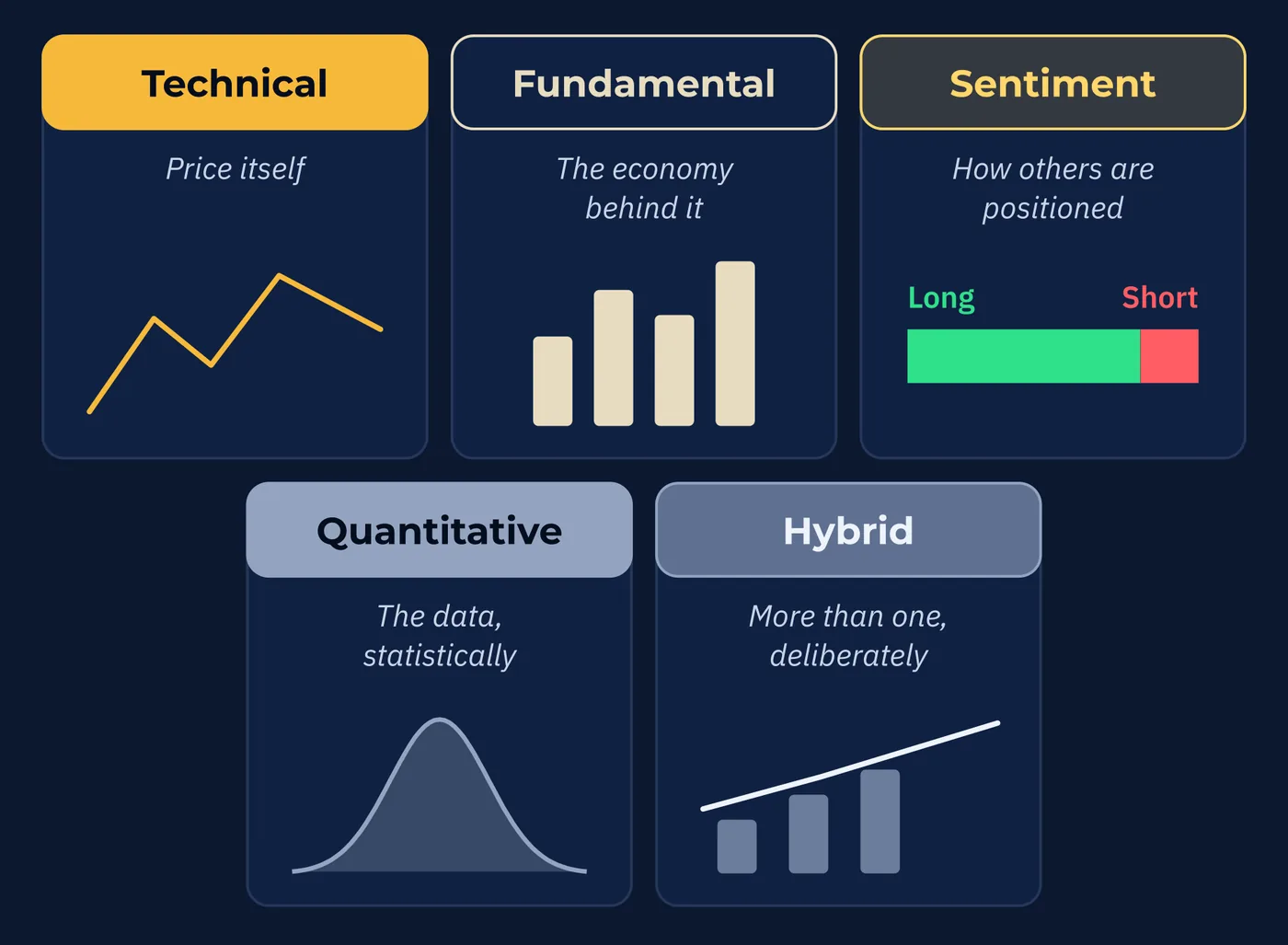
There are five common answers.
3Technical Analysis
A technical trader studies price itself. Charts, levels, trends, ranges, indicators, the shapes candles make. Everything that appears on the screen in front of you and nothing that does not.
The claim underneath it is specific and worth stating plainly: whatever anyone knows about a currency has already reached the price, because the only way to act on knowing something is to trade, and trading moves the price. So the price is the summary. Reading the summary is enough.
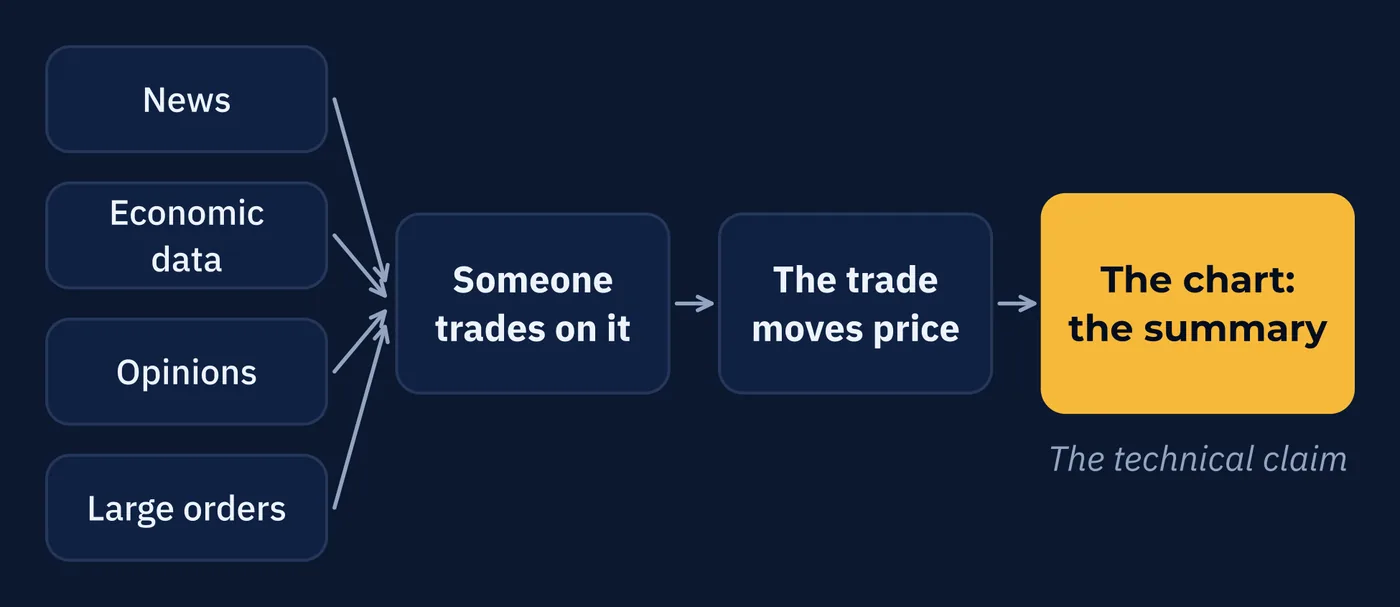
This is by a wide margin the most visible approach in retail education. Charts are free, they update instantly, and a chart gives you an answer in seconds where an economic argument takes a week to resolve.
Whether its visibility reflects how well it works is a separate question, and Lesson 53 discusses it.
4Fundamental Analysis
A fundamental trader studies the economy behind the currency. Inflation, employment, growth, interest rates, and what the central bank is likely to do about all of it.
The claim underneath is that a currency is a claim on an economy. If one economy is strengthening and another is weakening, and if money moves toward higher returns, then the economic picture should eventually show up in the exchange rate.
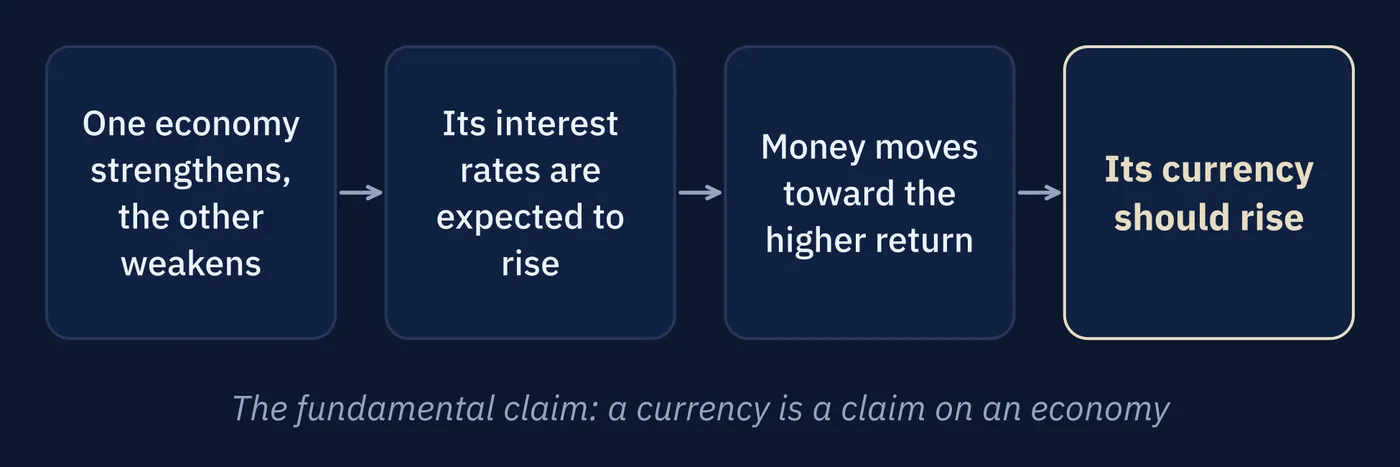
You’ve already built a foundation for this. Series F traced where money comes from and what happens when a peg breaks. Series G covered why the dollar sits where it does. That was the machinery. Series S turns it into a way of reading the week ahead.
5Sentiment Analysis
A sentiment trader studies what other participants have already done. Not what is happening in the world, and not what the chart looks like, but how the rest of the market is positioned.
The claim underneath is almost mechanical. Every buyer eventually sells. If a very large share of participants have already bought, then the buying that could push the price higher has largely happened, and the people holding those positions are all potential sellers. Crowding is information.
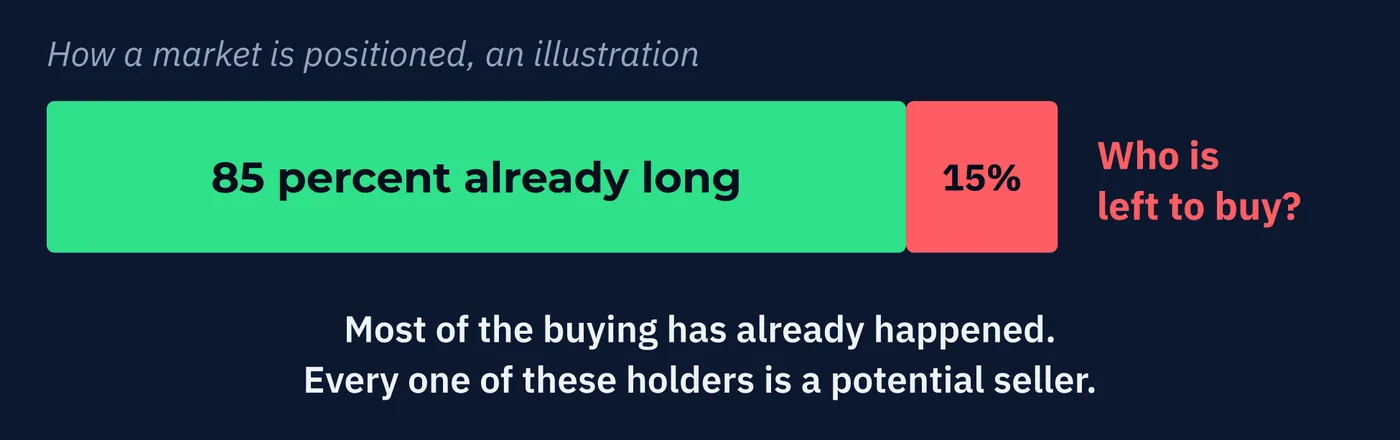
This is the least intuitive of the five, because it inverts the normal instinct. Most people treat widespread agreement as confirmation. A sentiment trader treats it as a warning.
The main published source is a weekly report from a United States regulator showing how different categories of large trader are positioned in currency futures. Lesson 98 covers what it says and Lesson 99 covers what it cannot say, which turns out to be most of what people claim for it.
6Quantitative Analysis
A quantitative trader studies the data, statistically. Rules written precisely enough to be tested, run across years of history, judged by whether the numbers hold up.
The claim underneath is a standard of evidence rather than a view about the market. If an edge is real, it can be measured. If it cannot be measured, there is no particular reason to believe it is there.
This is easy to confuse with technical analysis, because a quantitative trader often works with the same raw material. The difference is not the tool, it is the burden of proof.
A technical trader might use a moving average because it looks like it works. A quantitative trader has to answer the question how would I know if it did not, and then go and check.
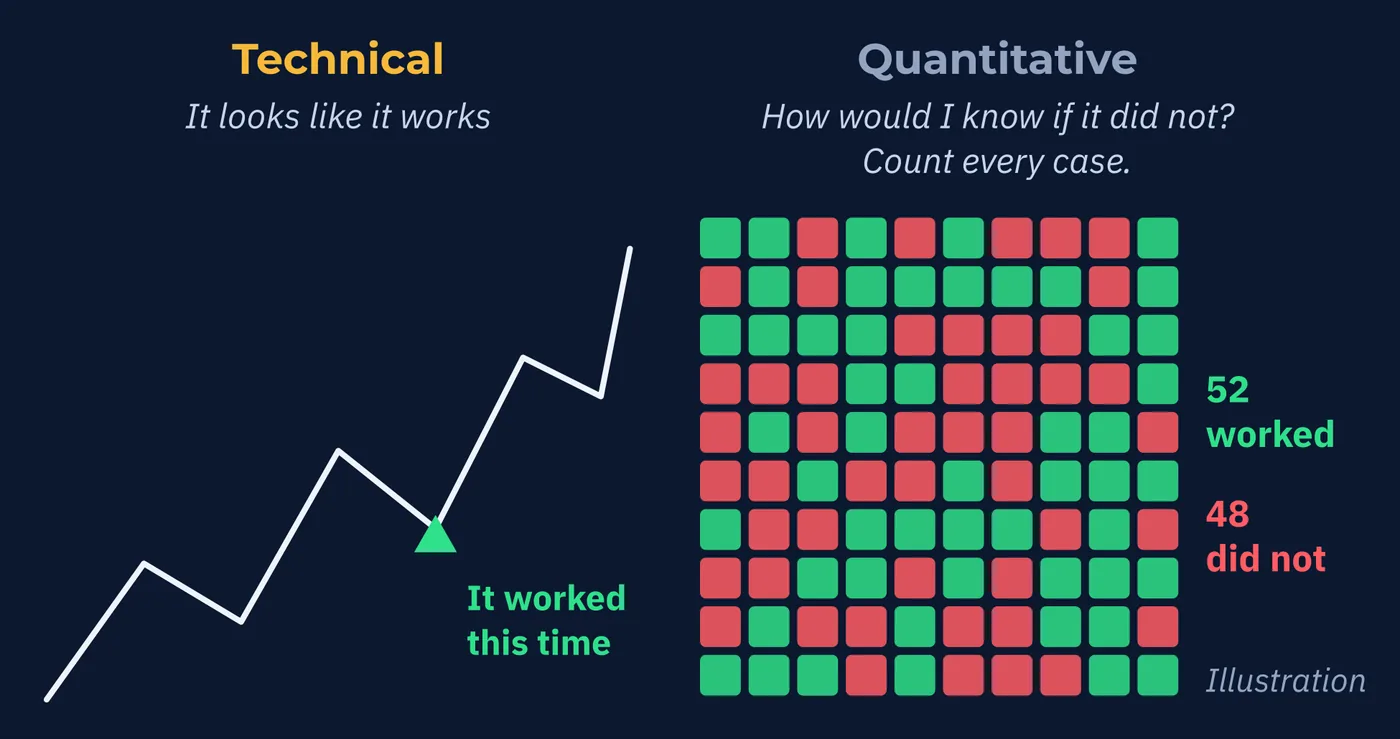
Series U covers how that checking is done, and the far larger problem of checking poorly.
7Hybrid Analysis
A hybrid trader uses more than one of the above, deliberately, with each one doing a job the others cannot.
The usual version runs fundamentals for direction and technicals for timing.
The economic picture suggests which currency should strengthen over the coming months. The chart decides where to enter, where the position is wrong, and where to take the money.
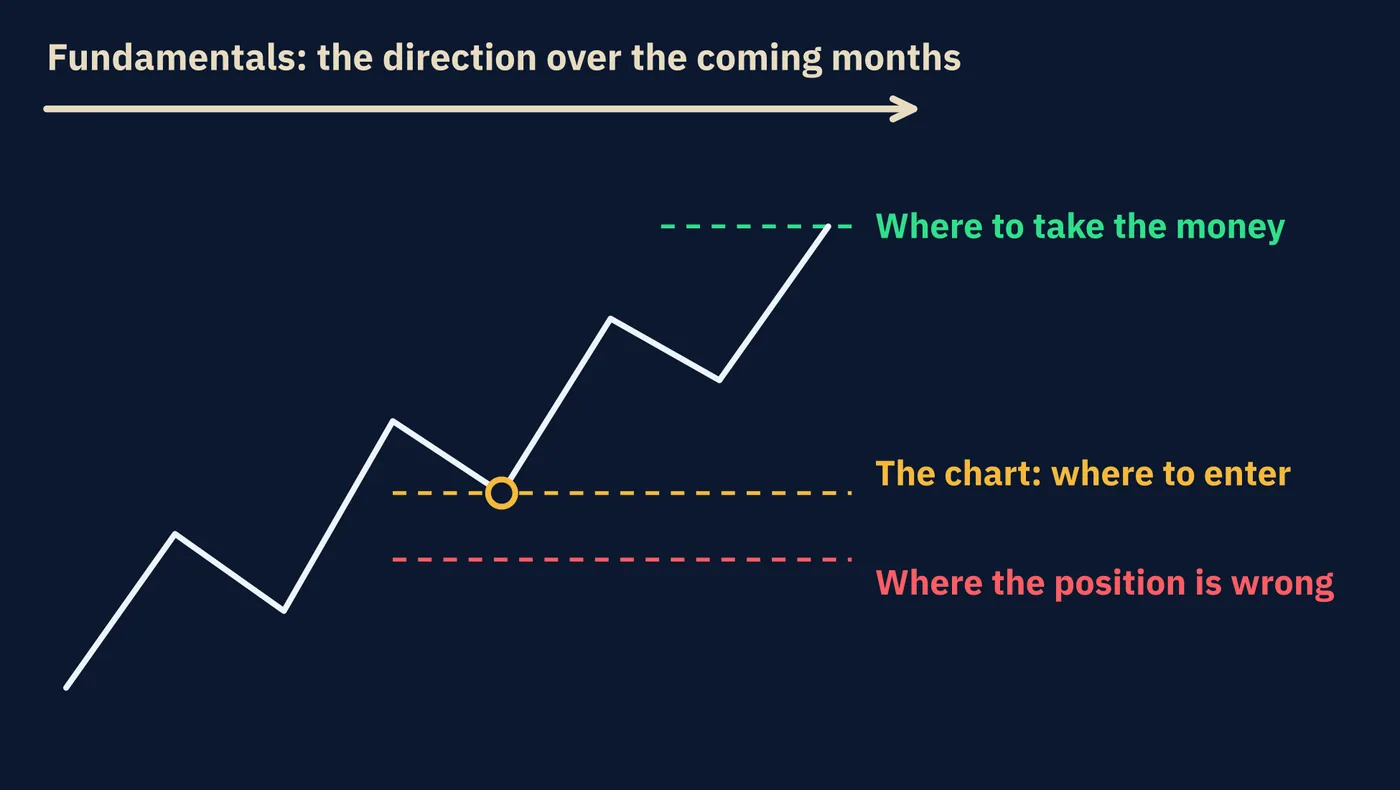
That is a reasonable division of labor, and most professional discretionary traders work something like this.
8Why the Map Matters
Here is the practical payoff, and it has nothing to do with picking the best approach.
Your approach decides what evidence would change your mind.
Go back to the two traders. The first one has a clear answer: if the price closes decisively below the level, the reason for the trade is gone and so is the trade. The second one also has a clear answer: if the next inflation reading undoes what the central bank said, the reason is gone.
Both of them know what they are waiting for. That is the whole benefit.
Now consider the trader who does not know which approach they are using. They enter on a chart level because it looked good. The level breaks. Rather than close, they go looking and find an article about the European economy, and they hold the losing position on the strength of an argument they had not heard an hour earlier and did not use to enter.
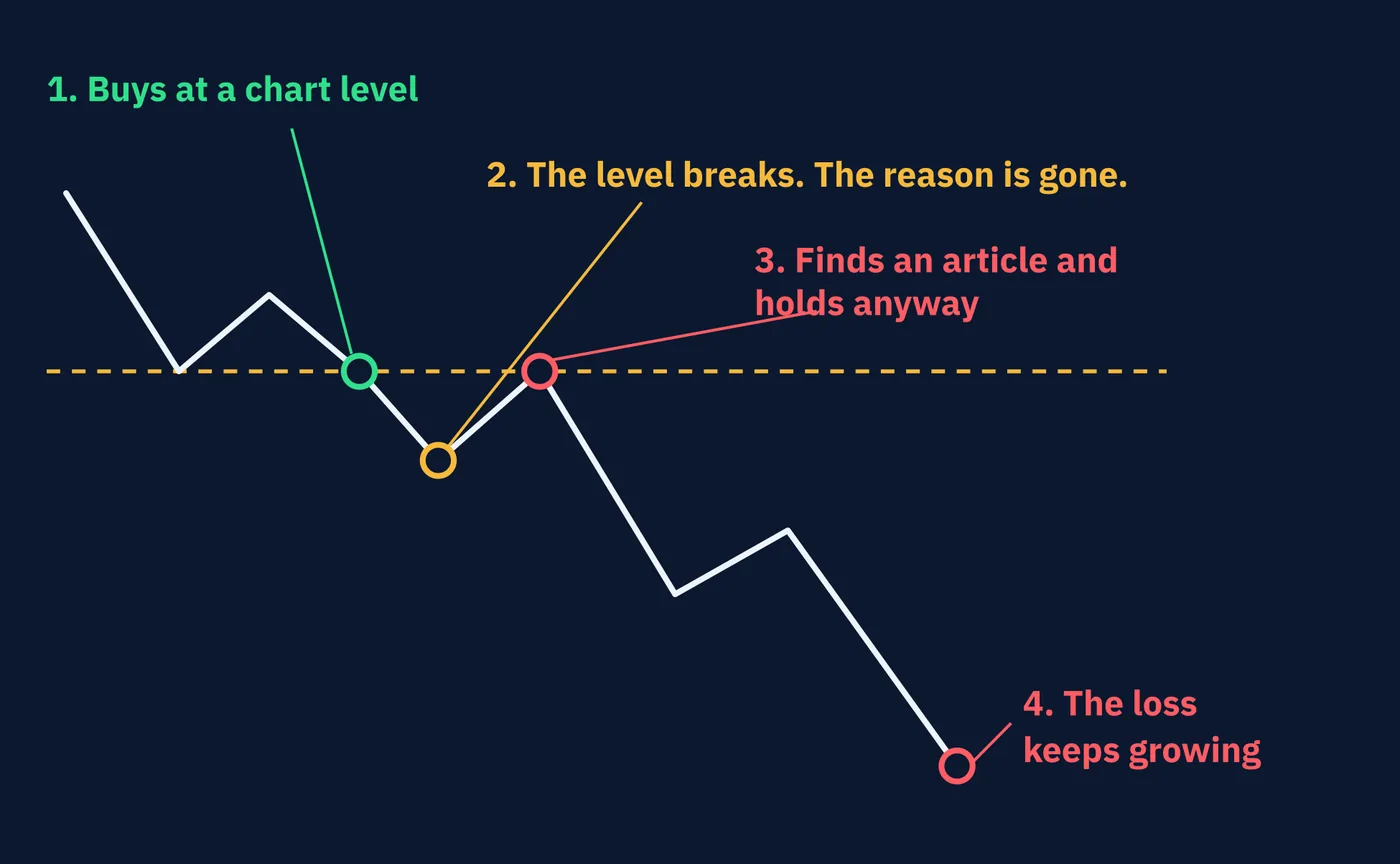
Changing your reason mid-trade is not analysis. It is the absence of a decision.
That is not hybrid analysis. Hybrid analysis is deciding in advance which approach answers which question. What that trader did was swap the reason to avoid taking the loss, and Series X is a catalogue of how expensive that habit becomes.
This series spends two more lessons on the map. Lesson 53 asks why one of the five dominates what beginners see, and Lesson 54 lays out what each one is genuinely good at and where each one fails. Then the course goes deep, one approach at a time.
Three Things to Remember
Try This
Thirty minutes, and the last step is the one that matters.
Words From This Lesson
| Term | What It Means |
|---|---|
| Approach | The kind of information a trader uses to decide, as distinct from style and strategy. |
| Technical analysis | Deciding from price itself: charts, levels, trends and indicators, on the basis that the price already reflects what participants know. |
| Fundamental analysis | Deciding from the economy behind a currency: inflation, employment, growth, interest rates and central bank policy. |
| Sentiment analysis | Deciding from how other participants are positioned, on the basis that a crowded position has less buying or selling left to come. |
| Quantitative analysis | Deciding from rules precise enough to be tested against historical data, and judged by whether the measured result holds up. |
| Hybrid analysis | Using more than one approach on purpose, with each assigned a question the others answer less well. |
Test Your Knowledge
Eight questions. Answer them all before checking the key on the following pages. If a question gives you trouble, the answer key tells you which section to revisit.
- A. Only one of the trades can be profitable
- B. The trades will have different costs
- C. They will exit on different evidence, because the reason defines what makes the trade wrong
- D. One of them is using the wrong approach
- A. How long to hold, what the rule is, and what information to read
- B. How much to risk, when to enter, and when to exit
- C. Which pair, which broker, and which platform
- D. Whether to go long, short, or stay out
- A. Charts are easier to learn than economics
- B. The economy does not affect exchange rates
- C. Price movements repeat in fixed patterns
- D. What participants know has already reached the price, so the price is the summary
- A. Large participants are usually wrong
- B. The buying that could push price higher has largely happened, and those holders are potential sellers
- C. Crowded positions attract deliberate attacks
- D. Positioning data is published with a delay
- A. Quantitative traders do not use charts
- B. Technical analysis is for beginners
- C. Quantitative analysis only works on long timeframes
- D. The burden of proof, not the raw material
- A. Deciding in advance which approach answers which question
- B. Using whichever approach has worked most recently
- C. Checking several approaches until one agrees with the trade you want
- D. Combining as many indicators as possible on one chart
- A. They have correctly combined two approaches
- B. They have changed the reason to avoid taking the loss
- C. They have upgraded from technical to fundamental analysis
- D. They have found genuine confluence
- A. It tells other traders how to interpret your trades
- B. It determines which pairs you are allowed to trade
- C. It decides what evidence would tell you the trade is wrong
- D. It makes your results easier to predict
Answer Key
Each answer explains why the correct choice is correct, why the others are not, and where to reread.
Question 1 · correct answer C
The reason for a trade defines the condition that makes it wrong. The trader who entered on a level exits when the level breaks. The trader who entered on a central bank read exits when that read is undone. Same position, different exit triggers, decided before either trade was placed.
A is wrong because both can profit or both can lose; the market does not care why anyone bought. B is wrong because identical trades at the same price and size carry identical costs. D is wrong because none of the five approaches is designated correct, in this lesson or anywhere in the course.
Review: Section 1, Two Traders, Same Trade
Question 2 · correct answer A
How long you hold is style, covered in Lesson 27. What your rule is is strategy, covered across Series N to Q. What information you read is approach, which is what this series introduces.
C names practical choices, not decision questions. B names execution details that sit inside a strategy rather than defining one. D is a single decision about one trade, not the structure behind all of them.
Review: Section 2, The Question Behind Every Trade
Question 3 · correct answer D
The claim is that acting on knowledge requires trading, and trading moves price, so price already summarizes what participants know. Reading the summary is therefore enough.
A is a practical observation about learning, not the claim the approach rests on. B overstates it; technical analysis does not deny the economy matters, it holds that the effect already shows in price. C describes one belief some technical traders hold, but it is not the foundation of the approach.
Review: Section 3, Technical Analysis
Question 4 · correct answer B
Every buyer is eventually a seller. If most participants have already bought, the buying that would drive price higher has mostly occurred, and the remaining holders are all potential supply.
A assumes large participants are unskilled, which the lesson does not claim and Lesson 42 contradicts. C describes an intention; the reasoning here is mechanical and needs nobody to intend anything. D is true of the published data and is covered in Lesson 99, but it is not why crowding carries information.
Review: Section 5, Sentiment Analysis
Question 5 · correct answer D
Both often work with the same raw material. The difference is that a quantitative trader has to be able to answer how they would know if the rule did not work, and then go and check.
A is wrong because quantitative traders frequently use price data and chart-derived rules. C invents a limitation that does not exist. B is a value judgment the course does not make about any approach.
Review: Section 6, Quantitative Analysis
Question 6 · correct answer A
Genuine hybrid analysis assigns each approach a job in advance. The common version uses fundamentals for direction and technicals for timing, with each question answered by the approach best suited to it.
C is the failure mode the lesson warns about, and it is the opposite of analysis. B is a performance-chasing habit, not a method. D is stacking tools inside a single approach, which Lesson 67 addresses separately.
Review: Section 7, Hybrid Analysis
Question 7 · correct answer B
The economic argument was not used to enter and was not known an hour earlier. It arrived to justify holding a position whose original reason had already failed. The reason was swapped to avoid closing.
A is wrong because combining approaches requires deciding the division of labor beforehand. C treats a rationalization as an upgrade. D misuses the word confluence; agreement found after the fact and specifically to avoid a loss is not confluence, as Lesson 108 covers in full.
Review: Section 8, Why the Map Matters
Question 8 · correct answer C
The approach defines what would tell you the trade is wrong. A trader who cannot name their approach cannot name that evidence, and will reach for whatever argument makes the loss easiest to postpone.
A is irrelevant; nobody else needs to interpret your trades. B is false, since any approach can be applied to any pair. D is wrong because none of the approaches makes outcomes predictable, which the whole course has been consistent about.
Review: Section 8, Why the Map Matters
Keep going
The Five Approaches is written by Kanin D. Alldredge for The Currency Classroom, and it is free to read. There is more free from CNS: start here.
Start free with CNS →