Why Pairs Move Together

1The Thing That Keeps Coming Up
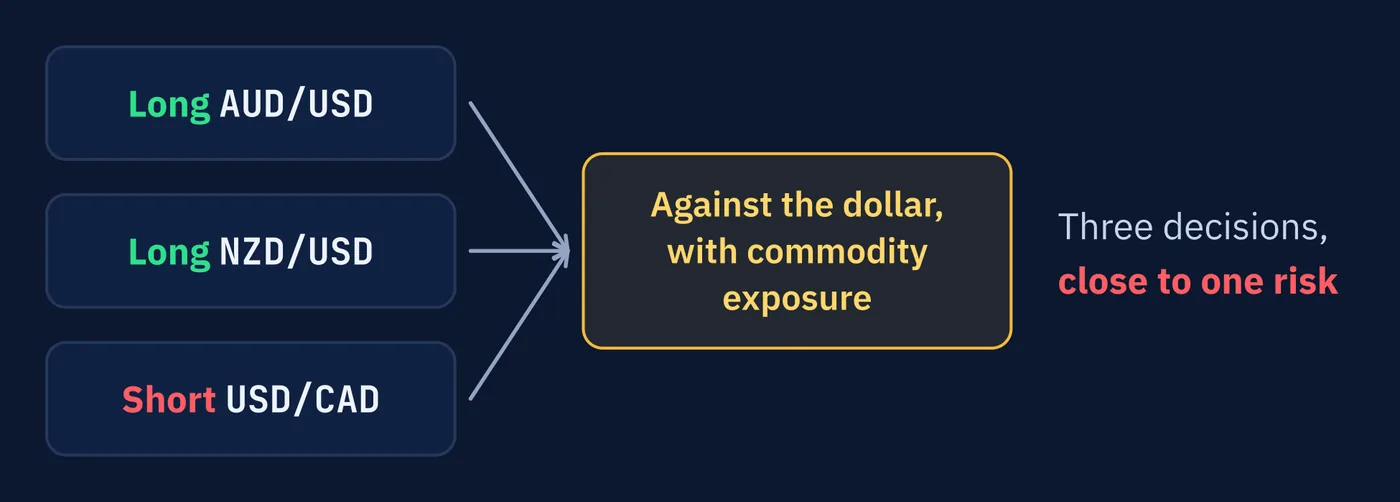
A trader opens three positions. Long AUD/USD, long NZD/USD, short USD/CAD. Three pairs, three decisions, three separate risks.
That last part is wrong, and it is the reason this series exists.
Lesson 7 raised it and did not explain it. Lesson 12 raised it again. Here is what is actually going on.
2Together, But Not Because of Each Other
Two pairs are correlated when they tend to move in a related way. In the same direction, or reliably in opposite directions.
The obvious assumption is that one is influencing the other. Almost always it is not.
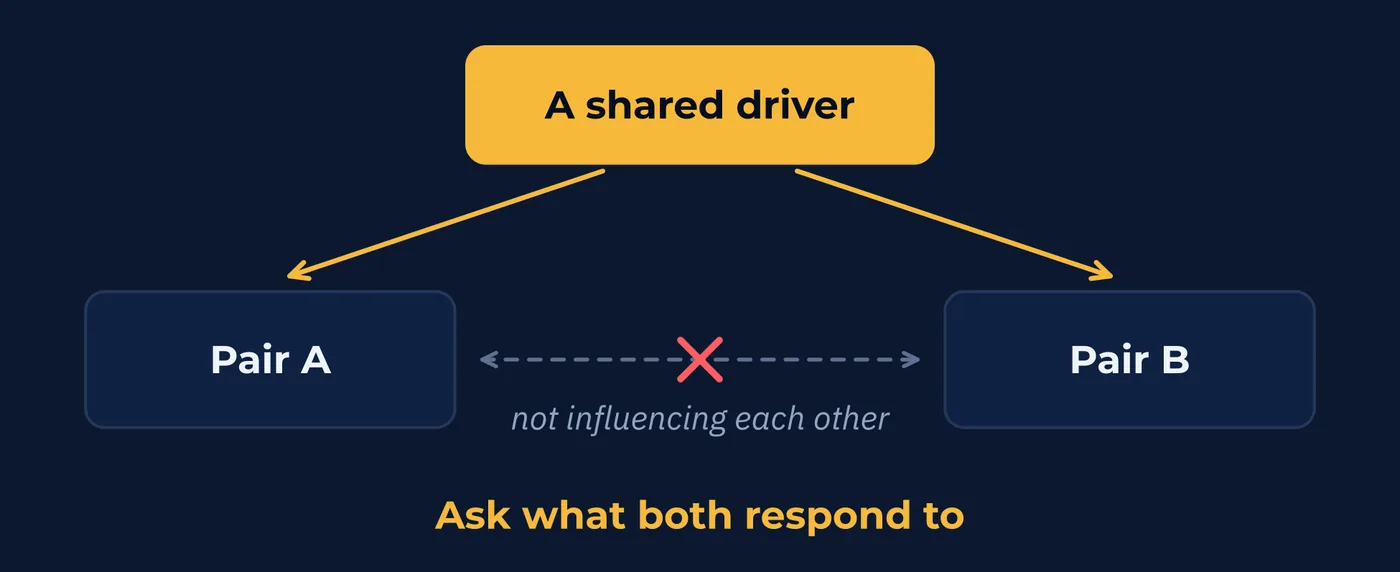
Pairs move together because something is moving both of them.
Two people carrying umbrellas are not influencing each other. It is raining on both.
When two pairs move as one, do not ask what connects them. Ask what they respond to.
There are three common answers, and the first is present almost everywhere.
3The Dollar Is in Almost Everything
Lesson 7 listed the seven majors and every one contained the dollar. Lesson 36 gave the figure behind it. The dollar sits on one side of 89.2 percent of all currency transactions.
Which produces an immediate consequence for correlation.
If two pairs both contain the dollar, they share a component. Anything that moves the dollar moves both, before either country's own situation counts for anything.
| If the Dollar Strengthens | Then |
|---|---|
| EUR/USD | Falls, because the dollar is the second currency |
| GBP/USD | Falls, for the same reason |
| AUD/USD | Falls, for the same reason |
| USD/JPY | Rises, because the dollar is the first currency |
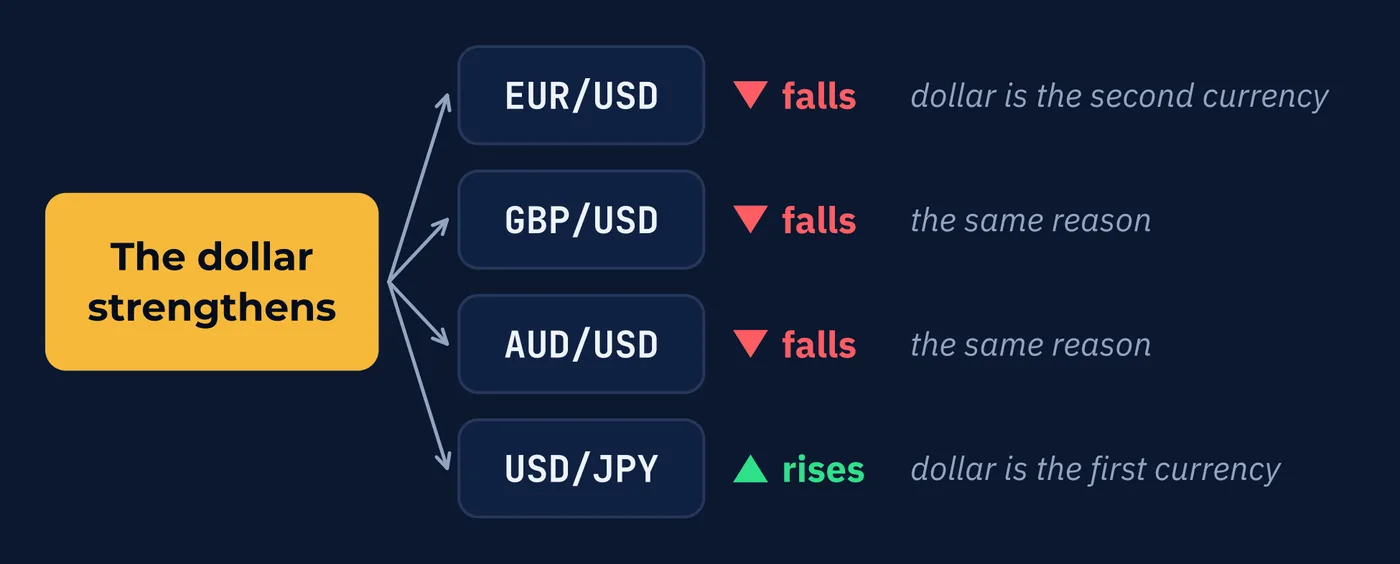
So much of the correlation between major pairs is not about those countries at all. It is the dollar, appearing in both, doing the same thing to each.
Which is why Lesson 7 said one dollar move produces seven reactions. This is the mechanism underneath that.
4Commodity Currencies
The second shared driver is what a country sells to the world.
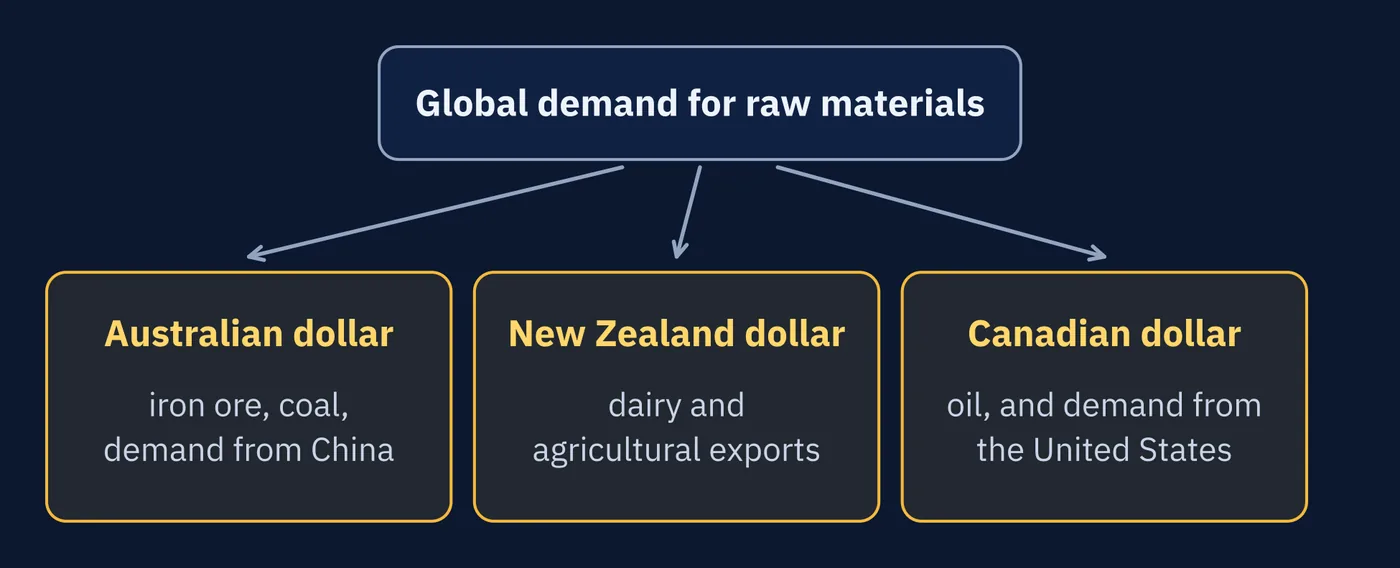
A commodity currency belongs to a country whose exports are dominated by raw materials, so its exchange rate responds to the price of what it digs up or grows.
| Currency | Sensitive To |
|---|---|
| Australian dollar | Iron ore, coal, and demand from China |
| New Zealand dollar | Dairy and agricultural exports |
| Canadian dollar | Oil, and demand from the United States |
Lesson 8 introduced these personalities. It did not say that the three are highly correlated with each other, or why.
It is not because their economies are linked. Australia and New Zealand do trade with each other, but nowhere near enough to explain it. Canada is on the other side of the world from both.
They move together because they answer to the same external conditions. When global demand for raw materials is strong, all three tend to strengthen. When it weakens, all three tend to fall.
5Two Channels, Compounding
Here is where it becomes practically important.
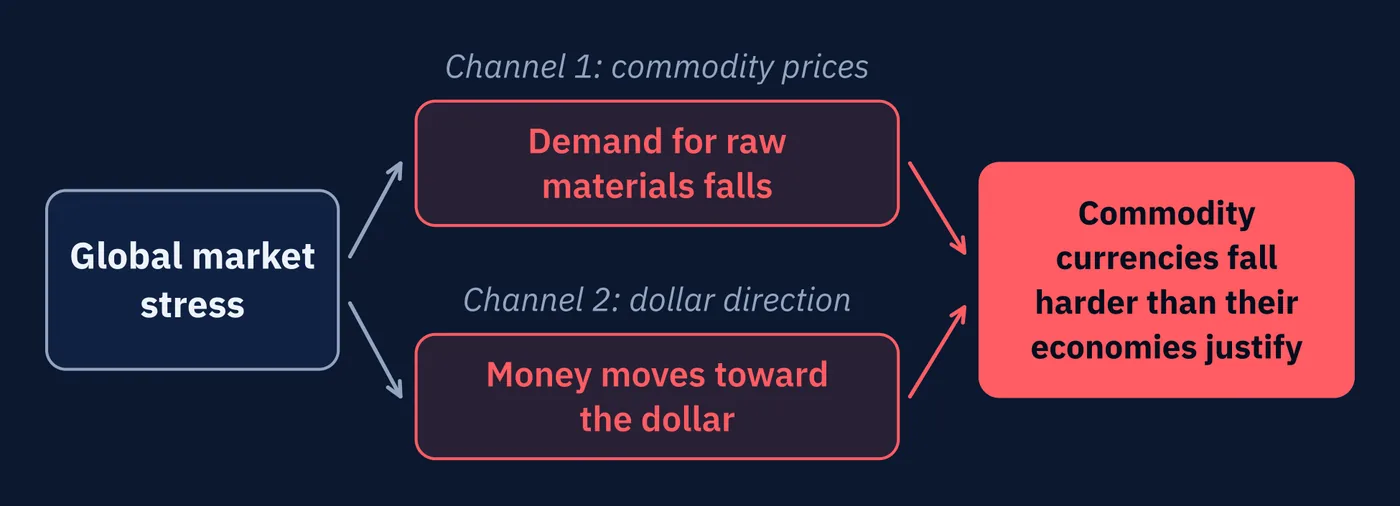
A commodity currency is exposed twice. Both exposures usually move the same way, at the same time.
commodity prices + dollar direction = two hits, one directionTake a period of global market stress. Demand for raw materials falls, which weakens commodity currencies through the first channel. Money moves toward the dollar, weakening them again through the second.
Both channels push the same way. That is why commodity currencies fall harder in risk-off periods than their own economies would justify.
6Canada Is Not Quite the Same
The Canadian dollar carries the commodity designation and adds something the other two do not have.
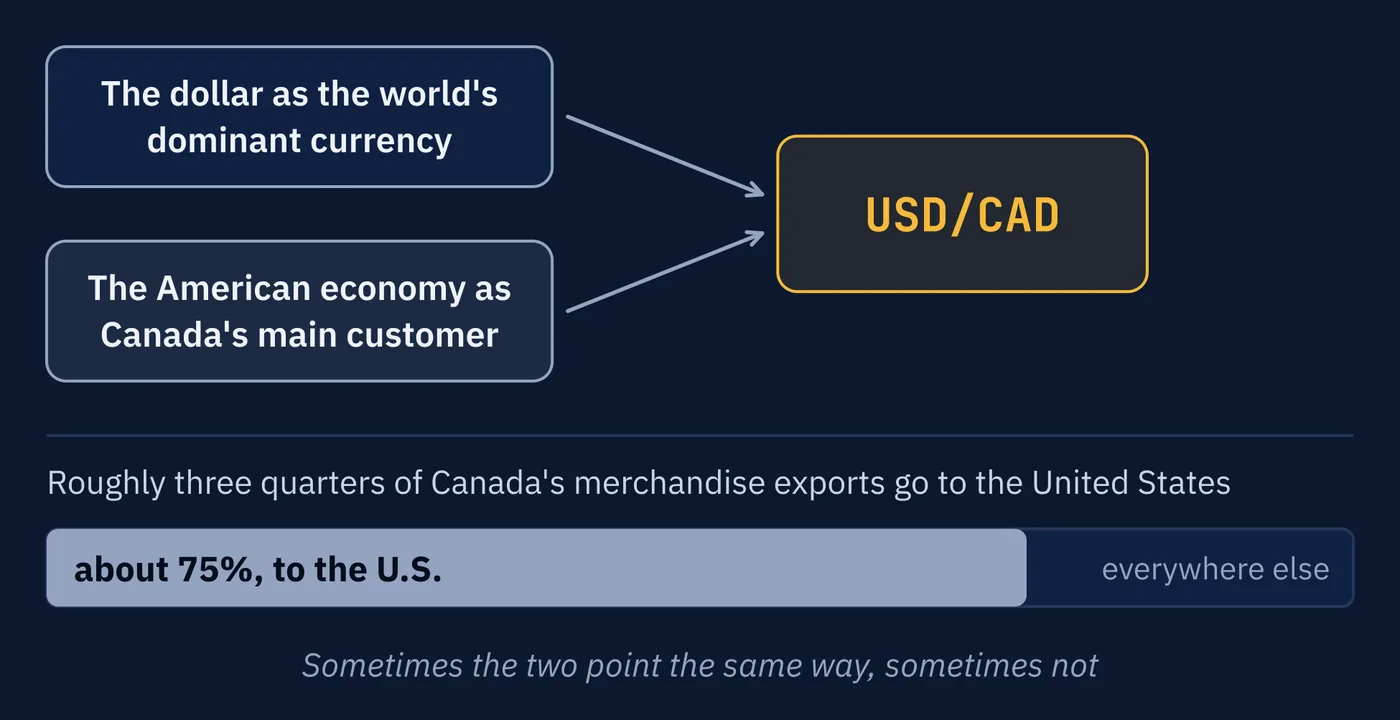
Roughly three quarters of Canada's merchandise exports go to a single country, the United States.
So the Canadian dollar responds to American economic conditions in a way Australia and New Zealand do not. American growth is Canadian export demand. That is a direct relationship, not a general risk signal.
So USD/CAD carries two dollar sensitivities at once. The dollar as the world's dominant currency, and the American economy as Canada's main customer. Sometimes those point the same way. Sometimes they do not. Which is why USD/CAD tracks the other commodity pairs less reliably than they track each other.
7Safe Havens, Two Different Reasons
The third shared driver is what happens when people become afraid.
A safe haven currency tends to strengthen during periods of market stress. Three are usually named: the US dollar, the Japanese yen, and the Swiss franc.
The designation is market convention rather than official status. Nobody awards it, and it is not permanent.
More interesting is that two of them earned it for completely different reasons.
| The Japanese Yen | The Swiss Franc | |
|---|---|---|
| Type of reason | Mechanical | Reputational |
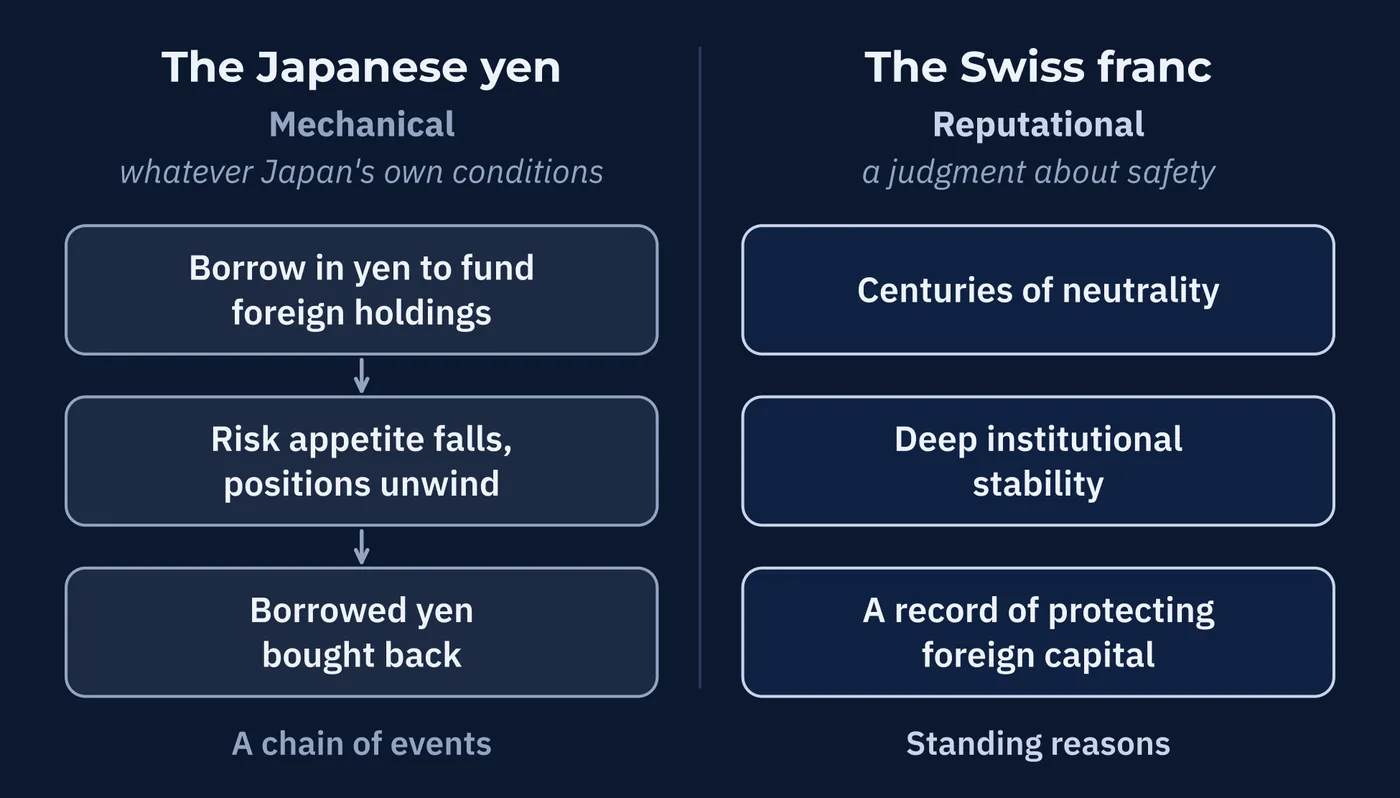
| What drives it | Japanese institutions fund large foreign holdings by borrowing in yen. When risk appetite falls, those positions unwind and the borrowed yen must be bought back. | Centuries of political neutrality, deep institutional stability, and a consistent record of protecting foreign capital. |
| So the demand is | A consequence of unwinding, regardless of Japan's own conditions | A judgment about where money is safest |
The yen column is worth revisiting. Its strengthening during a crisis has little to do with anyone forming a view about Japan. It is a mechanical consequence of positions being closed. It happens whether or not Japan's own economy is in good shape.
Lesson 8 noted that the yen strengthens in a crisis. This is the machinery behind that observation.
8The Dollar Does Both
Which leaves the complication. It is why blanket rules about risk-off behavior fail exactly when you need them.
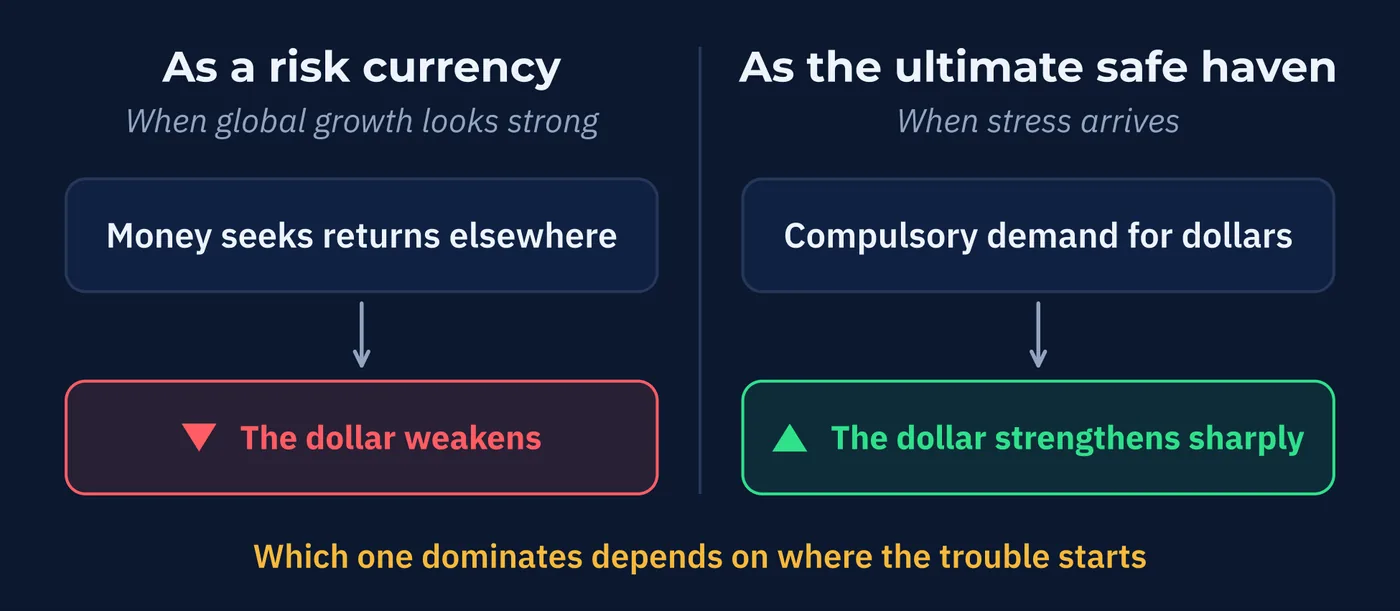
The dollar belongs to both groups at once.
| The Dollar as | Behaves Like |
|---|---|
| A risk currency | Weakening when global growth looks strong and money seeks returns elsewhere |
| The ultimate safe haven | Strengthening sharply when stress arrives, as Lesson 38 showed in 2008 |
Those two roles produce opposite directional behavior.
Which sets up the practical problem for the rest of this series.
Correlation is real. It is driven by identifiable shared factors. And those factors change. A relationship that held all last year can shift when a central bank changes course or a commodity price collapses.
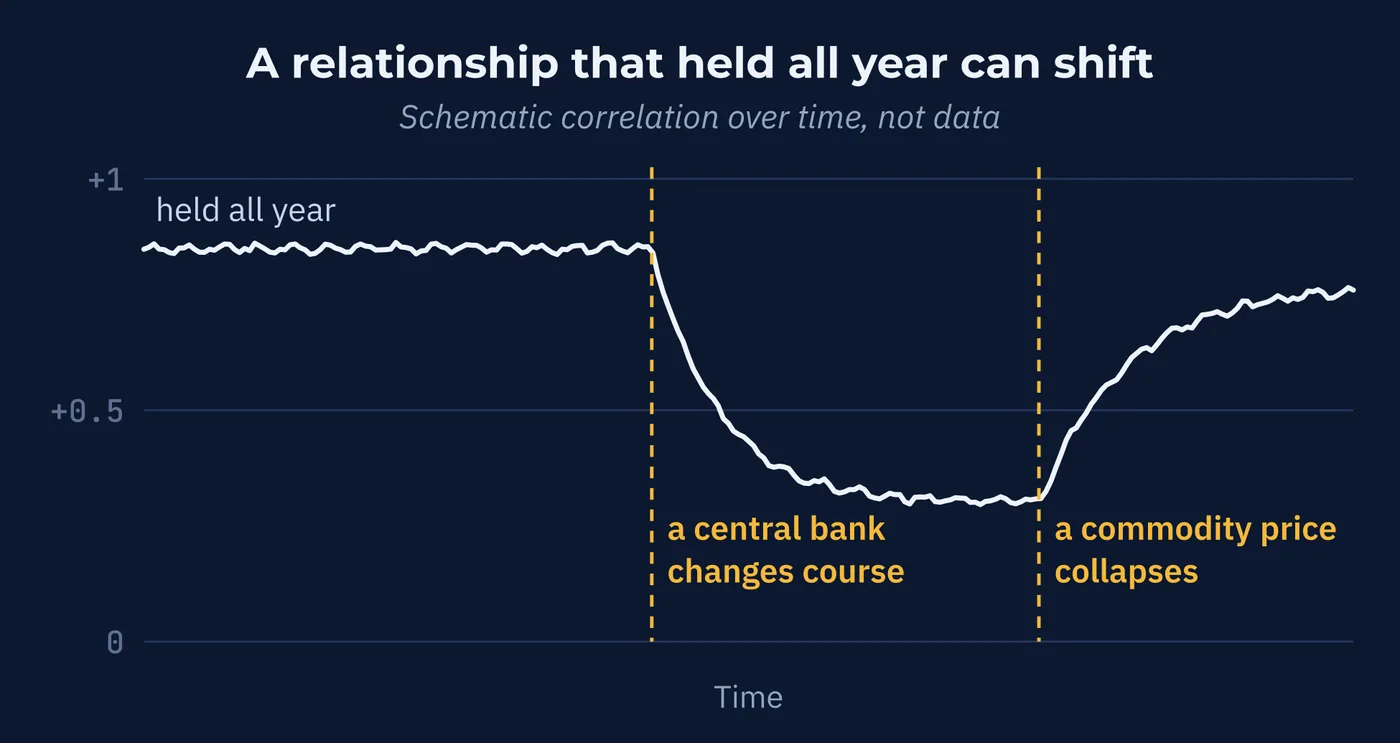
So the next question is how you actually measure it, and how much you should trust the number when you do.
Three Things to Remember
Try This
Fifteen minutes with three charts side by side.
Words From This Lesson
| Term | What It Means |
|---|---|
| Correlation | The tendency of two pairs to move in a related way, either together or reliably opposite. |
| Shared driver | The underlying factor that moves two pairs at once. The usual reason correlation exists. |
| Commodity currency | A currency whose value responds strongly to the raw materials its country exports. Chiefly AUD, NZD, and CAD. |
| Safe haven currency | A currency that tends to strengthen during market stress. Market convention rather than official status. |
| Risk-off | A period when participants reduce exposure to riskier assets and move toward perceived safety. |
| Risk currency | A currency that tends to strengthen when growth looks strong and appetite for risk is high. |
Test Your Knowledge
Eight questions. Answer them all before checking the key on the following pages. If a question gives you trouble, the answer key tells you which section to revisit.
- A. One pair causes the other to move
- B. Both are responding to the same underlying driver
- C. Platforms link their prices
- D. Traders arbitrage between them
- A. It is the strongest currency
- B. Central banks coordinate dollar pricing
- C. It appears in almost every heavily traded pair, so dollar moves affect all of them
- D. It has the tightest spreads
- A. AUD, NZD, CAD
- B. USD, EUR, GBP
- C. JPY, CHF, USD
- D. EUR, CHF, NZD
- A. Commodity demand falls and money moves toward the dollar, both pushing the same way
- B. They have wider spreads
- C. Their central banks always cut rates
- D. They are traded in thinner sessions
- A. It diversifies across two economies
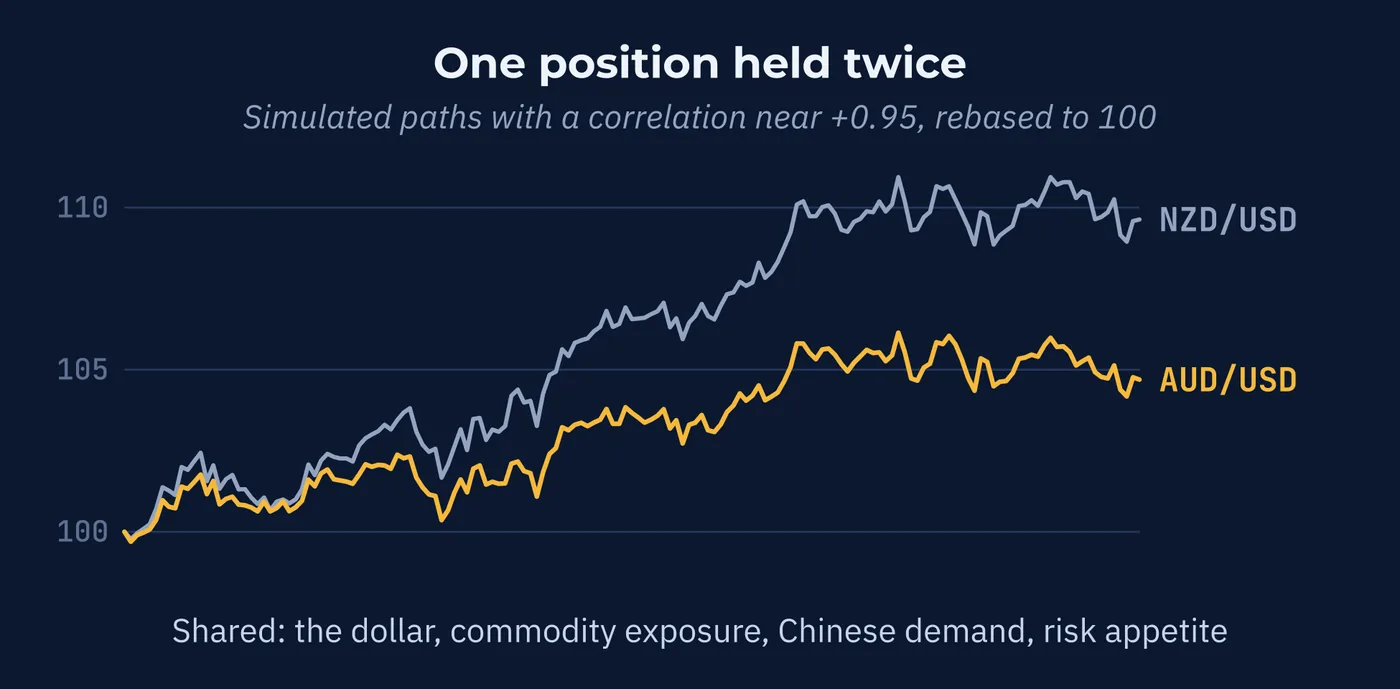
- B. It is close to a single position held twice
- C. It hedges commodity exposure
- D. The two positions offset each other
- A. It is not affected by oil prices
- B. It has no correlation with AUD
- C. It is a safe haven currency
- D. Roughly three quarters of Canada's merchandise exports go to the United States
- A. Investors judge Japan the safest economy
- B. The Bank of Japan buys yen aggressively
- C. Positions funded by borrowing in yen unwind, forcing the yen to be bought back
- D. Japan raises interest rates during stress
- A. The dollar rarely moves during crises
- B. Crises never affect currency markets
- C. Dollar data is published with a delay
- D. The dollar acts as both a risk currency and a safe haven, producing opposite behavior
Answer Key
Each answer explains why the correct choice is correct, why the others are not, and where to reread.
Question 1 · correct answer B
Correlated pairs are almost always responding to a common third factor rather than influencing each other. Two people carrying umbrellas are not affecting one another.
A assumes a causal link that rarely exists between pairs. C invents a mechanism, and Lesson 40 established there is no central price at all. D describes activity that removes small discrepancies rather than creating correlation.
Review: Section 2, Together, But Not Because of Each Other
Question 2 · correct answer C
The dollar is on one side of 89.2 percent of transactions, so it is a shared component of most pairs. Anything moving the dollar moves all of them before local conditions are considered.
A confuses strength with prevalence, and strength varies constantly. B describes coordination that does not occur. D is true of major pairs but is not what produces correlation.
Review: Section 3, The Dollar Is in Almost Everything
Question 3 · correct answer A
The Australian, New Zealand, and Canadian dollars all belong to economies whose exports are dominated by raw materials, so their currencies respond to commodity demand.
B lists major currencies of economies not defined by raw material exports. C lists the safe havens. D mixes categories.
Review: Section 4, Commodity Currencies
Question 4 · correct answer A
Falling commodity demand weakens them through the first channel, and money moving toward the dollar weakens them again through the second. Both push the same way at once.
B is a cost effect rather than a directional driver. C assumes a policy response that is not automatic. D describes when they trade, not why they fall further.
Review: Section 5, Two Channels, Compounding
Question 5 · correct answer B
The two share a currency, a commodity exposure, a sensitivity to Chinese demand, and a risk appetite driver. They regularly correlate above +0.90.
A is the assumption this section corrects, since the two are not independent ideas. C reverses it, as the exposure is doubled rather than hedged. D would require them to move oppositely, which they do not.
Review: Section 5, Two Channels, Compounding
Question 6 · correct answer D
That bilateral concentration means the Canadian dollar responds directly to American economic conditions, which the Antipodean currencies do not.
A is wrong because oil is a major Canadian export and a significant driver. C is wrong because Canada is not conventionally treated as a safe haven. B overstates it, since the correlation exists but is less consistent.
Review: Section 6, Canada Is Not Quite the Same
Question 7 · correct answer C
Japanese institutions have funded large foreign holdings by borrowing in yen. When risk appetite falls those positions unwind, and the borrowed yen must be bought back. The demand is mechanical.
A describes the reputational route, which is closer to the Swiss case. B is wrong because interventions have generally sought to weaken rather than strengthen the yen. D is wrong because policy is not tightened in response to stress.
Review: Section 7, Safe Havens, Two Different Reasons
Question 8 · correct answer D
It weakens as a risk currency when growth looks strong, and strengthens as a safe haven when stress arrives. Both roles are real, and which one dominates depends on where the trouble originates.
A is contradicted by 2008, when it moved sharply. C describes a reporting issue rather than a behavioral one. B is plainly false.
Review: Section 8, The Dollar Does Both
Keep going
How Markets Move Together is written by Kanin D. Alldredge for The Currency Classroom, and it is free to read. There is more free from CNS: start here.
Start free with CNS →