Gold, and Why It Stopped Working

1Why Exchange Rates Exist at All
Start with a question so basic it usually goes unasked. Why does an exchange rate need to exist?
Because trade crosses borders. A British firm selling to an American buyer gets paid in something, and it has costs in something else. Somewhere in that transaction a conversion has to happen.
Without a reliable conversion, trade becomes a bet on top of a bet. You wager that your goods sell, and you wager separately on what the money will be worth when it arrives. Most businesses do not want the second wager.
Lesson 29 gave the deeper version. An exchange rate compares two monetary systems continuously, weighing their credibility, their inflation, and the institutions behind them.
Which produces the observation that everything after this rests on.
Exchange rates do not move randomly. They move because that comparison changed.
Or because the market believes it is about to. But for roughly forty years, the comparison did not move at all.
2A Promise Made in Metal
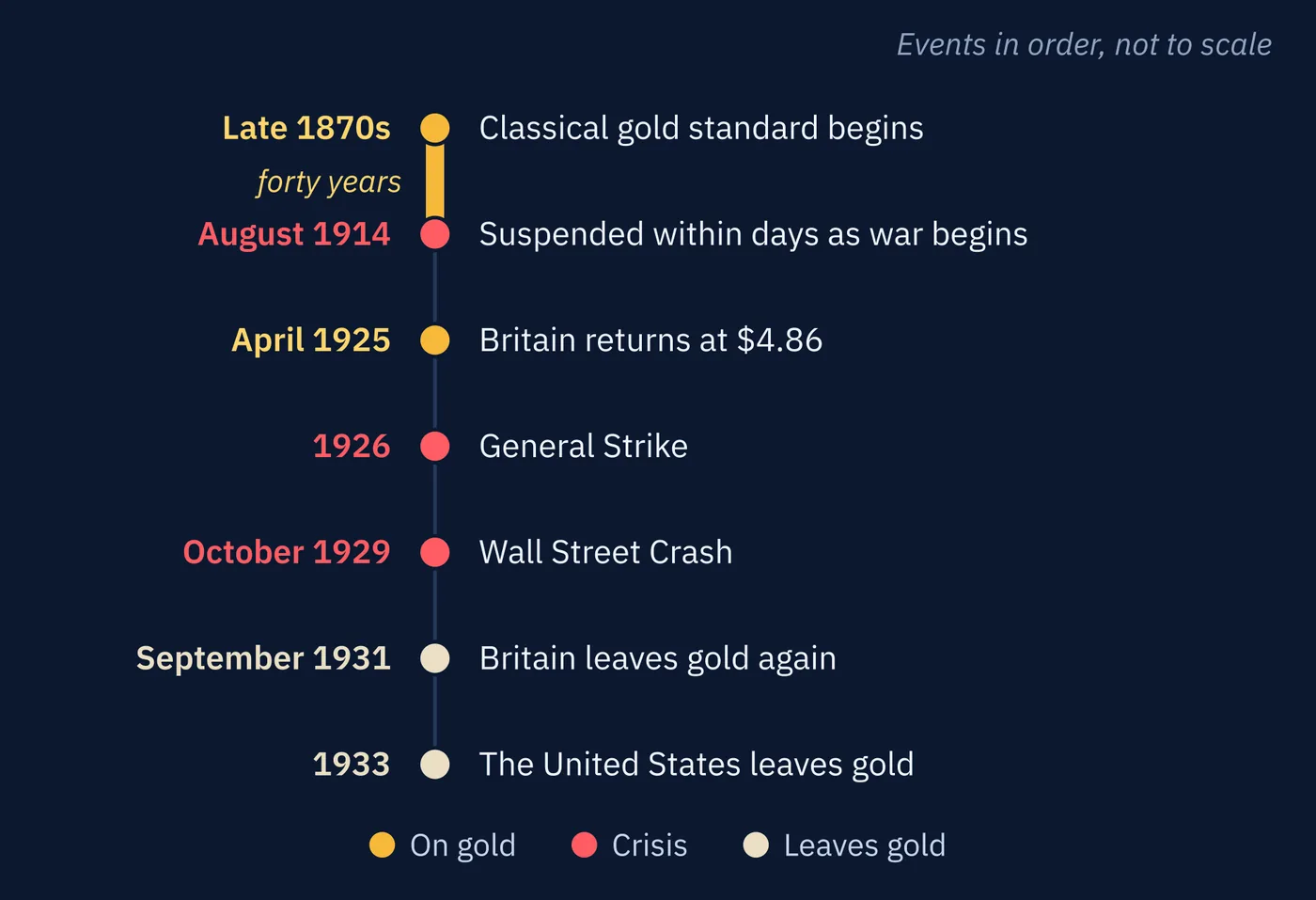
From the late 1870s until 1914, the major economies ran what became known as the classical gold standard.
The arrangement was a promise. Each country declared a fixed weight of gold that its currency could be exchanged for, guaranteed by its own treasury.
| Currency | Defined As |
|---|---|
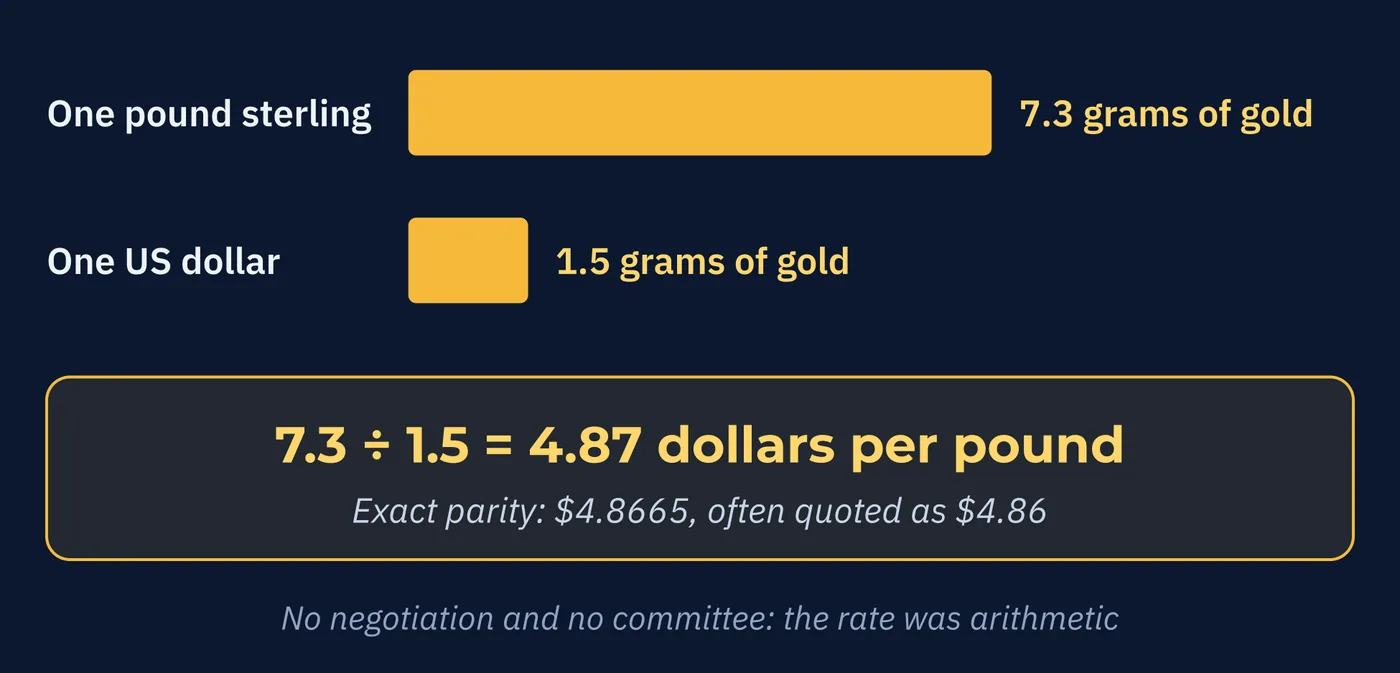
| One US dollar | 1.5 grams of gold |
| One pound sterling | 7.3 grams of gold |
Now do something with those two numbers. If a pound is 7.3 grams and a dollar is 1.5, then the pound is worth 7.3 divided by 1.5 dollars.
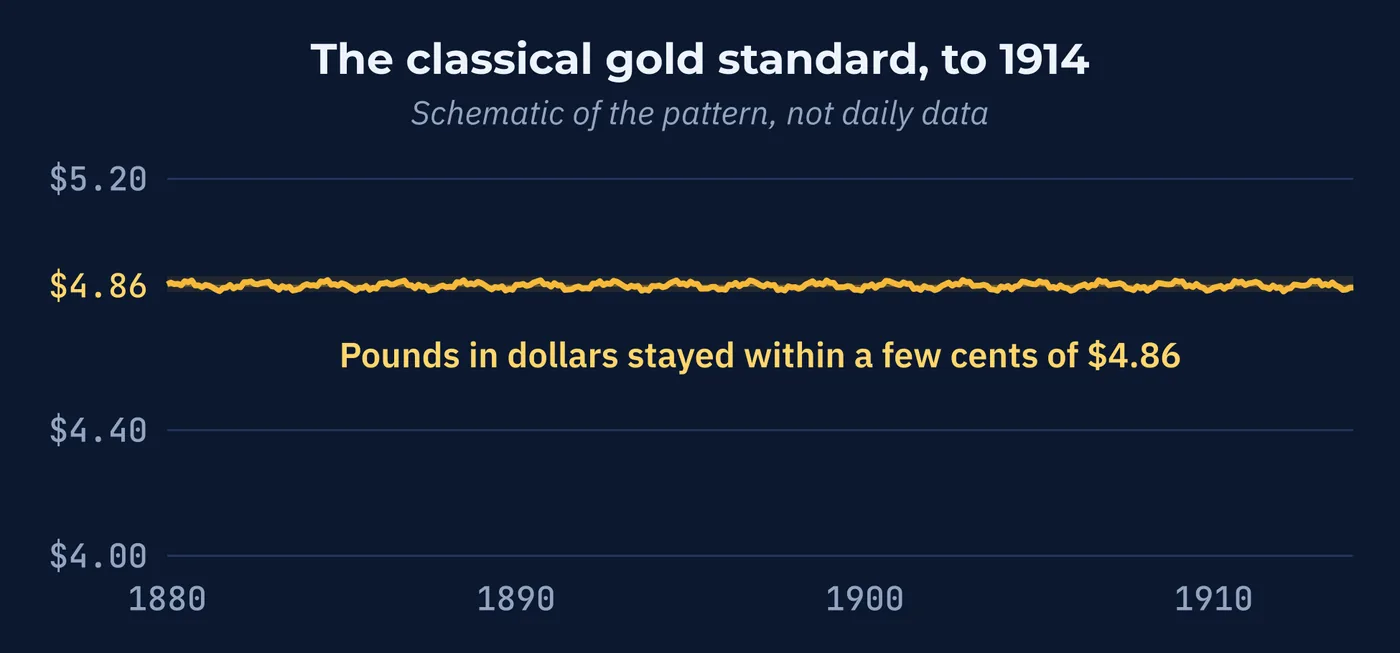
7.3 ÷ 1.5 = 4.87And the pound traded at about $4.87. The exact parity was $4.8665, which is why you will also see it quoted as $4.86.
That is the whole system in one division. The exchange rate was not negotiated, not set by a committee, and not subject to anyone's opinion.
If you knew the gold content of two currencies, you knew the rate between them.
The practical result was remarkable stability. A British exporter did not worry about the pound weakening before payment arrived. An investor financing a railway in Argentina did not hedge currency risk, because there was none worth hedging. Businesses planned across decades with a confidence no system since has matched.
3The Machine That Was Meant to Self-Correct
A fixed rate raises an obvious problem. What happens when one country buys far more than it sells?
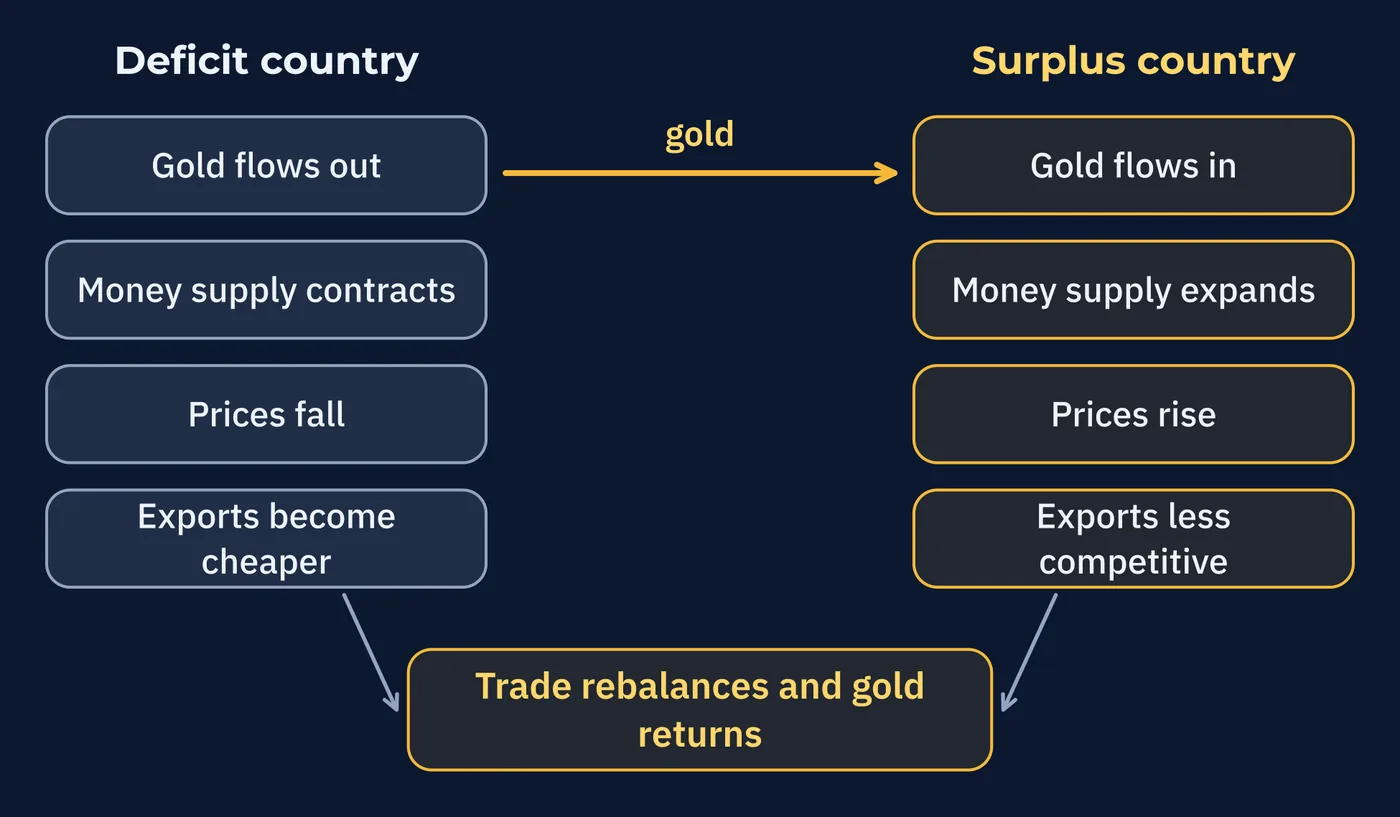
The gold standard had an answer, and it worked without anybody deciding anything. The Scottish philosopher David Hume described it in 1752.
| Step | In the Deficit Country | In the Surplus Country |
|---|---|---|
| 1 | Gold flows out to pay for imports | Gold flows in |
| 2 | The money supply contracts | The money supply expands |
| 3 | Prices fall | Prices rise |
| 4 | Exports become cheaper and more attractive | Exports become less competitive |
| 5 | Trade rebalances, and gold returns | Trade rebalances, and gold leaves |
Both sides move toward each other at once. No authority intervenes. The imbalance corrects itself, in theory, through nothing but the movement of metal.
It is an elegant design, and it depended on both sides actually doing their part.
4Three Cracks, Present From the Start
The system had three weaknesses. None of them appeared later as the arrangement aged. All three were there from the beginning.
| Weakness | What It Meant |
|---|---|
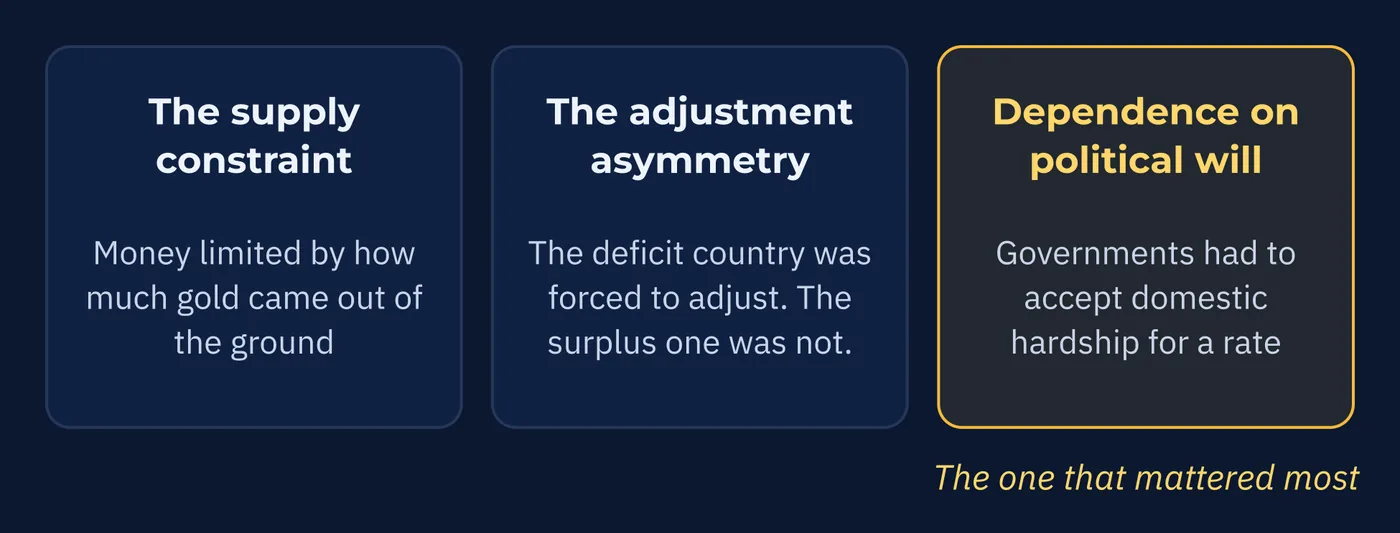
| The supply constraint | How much money could exist depended on how much gold came out of the ground. An economy could grow faster than the gold supply, and then money became scarce for no economic reason. |
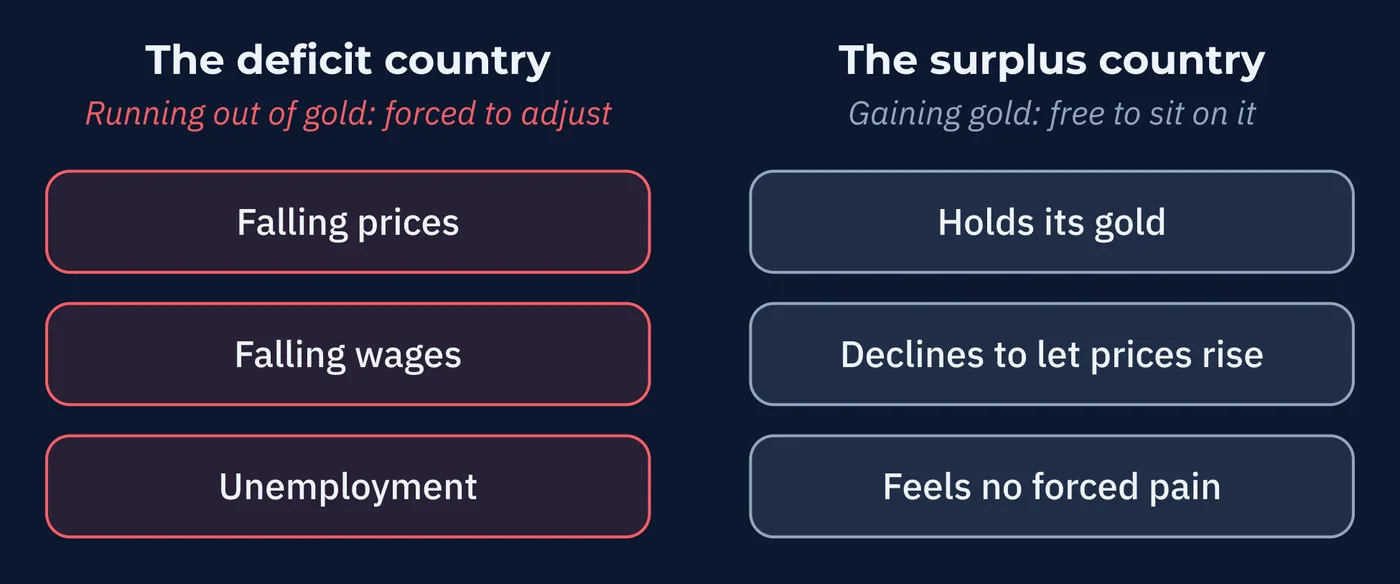
| The adjustment asymmetry | The deficit country was forced to adjust, because it was running out of gold. The surplus country could simply hold its gold and decline to inflate. Pain fell on one side. |
| Dependence on political will | The whole thing required governments to accept domestic hardship in defense of an exchange rate. That is easy in prosperity and very hard otherwise. |
The second one deserves a moment, because it explains much of what followed. The machine only self-corrected if both sides corrected. A country gaining gold had no forced reason to let its prices rise, and every domestic reason not to. So the deficit country absorbed the adjustment instead, through falling prices, falling wages, and unemployment.
The third is the one that eventually mattered most. A monetary rule is only as strong as the willingness to suffer for it.
5August 1914
The test came suddenly.
When war began in August 1914, every major combatant needed to spend on a scale the gold standard forbade. Industrial warfare required creating money far beyond what gold reserves allowed.
Faced with a choice between the monetary rule and national survival, every major belligerent suspended convertibility within days.
Not after years of deliberation. Days.
Forty years of stability, set aside almost at once when it collided with something governments cared about more. That is the third weakness, at full scale.
6The Wrong Rate
After the war, almost everyone assumed the gold standard would return. It had delivered four decades of stability, and its suspension had been a wartime emergency.
The problem was that the world it belonged to was gone. Britain had sold overseas investments to pay for the war. The United States had turned from a debtor into the world's largest creditor. Four years of fighting had rearranged the prices and trade flows that made the old arrangement work.
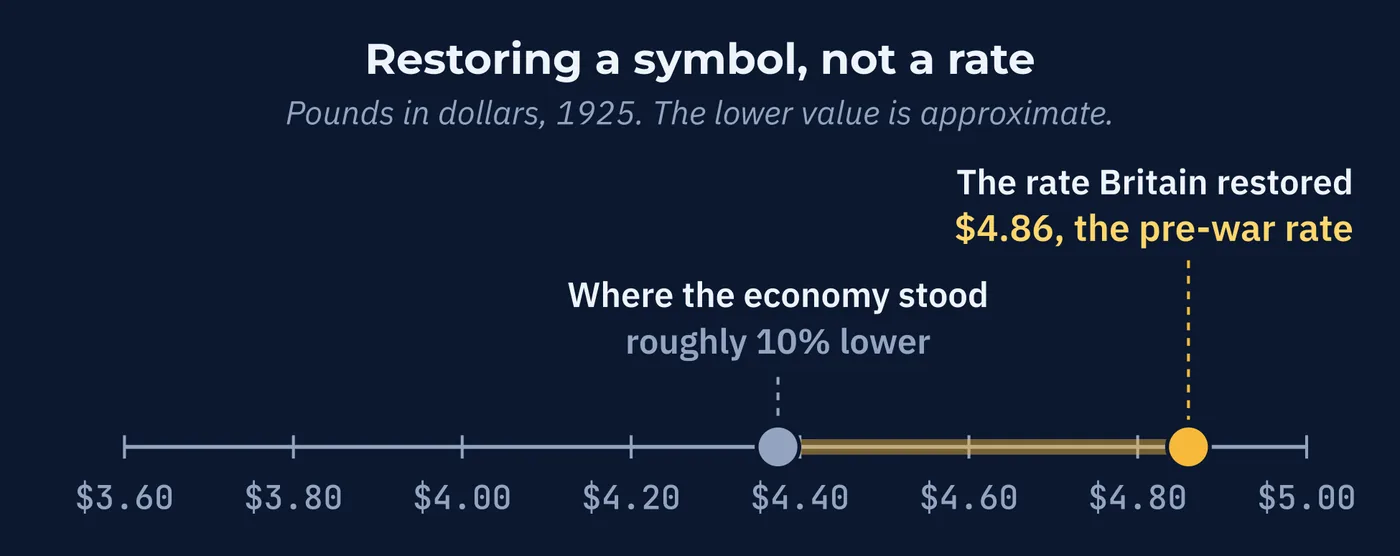
Britain restored it anyway. On April 28, 1925, Chancellor of the Exchequer Winston Churchill announced that sterling would return to gold at its pre-war rate of $4.86.
The economics said that rate was about ten percent too high for where the British economy actually stood.
Churchill was not restoring a rate. He was restoring a symbol.
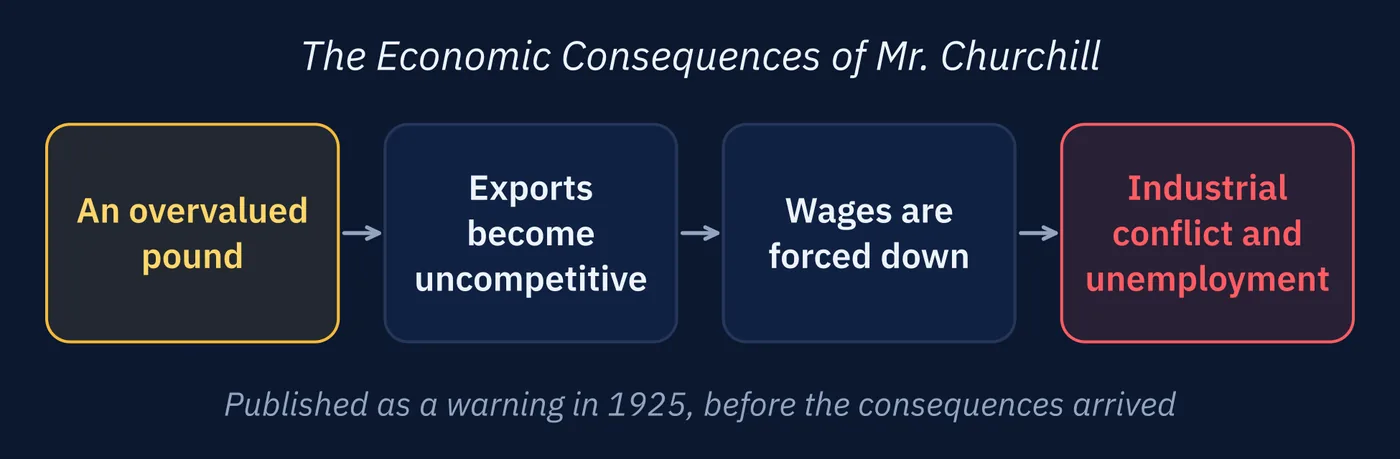
It is one of the clearest cases in economic history of a precise public prediction being made, ignored, and then vindicated in every particular.
7When Defending the Peg Made It Worse
The Wall Street Crash of October 1929 is where most people begin the story of the Great Depression. But a crash does not have to become a decade.
What turned a severe financial crisis into a catastrophe was a series of policy decisions, most of them made in defense of the gold standard.
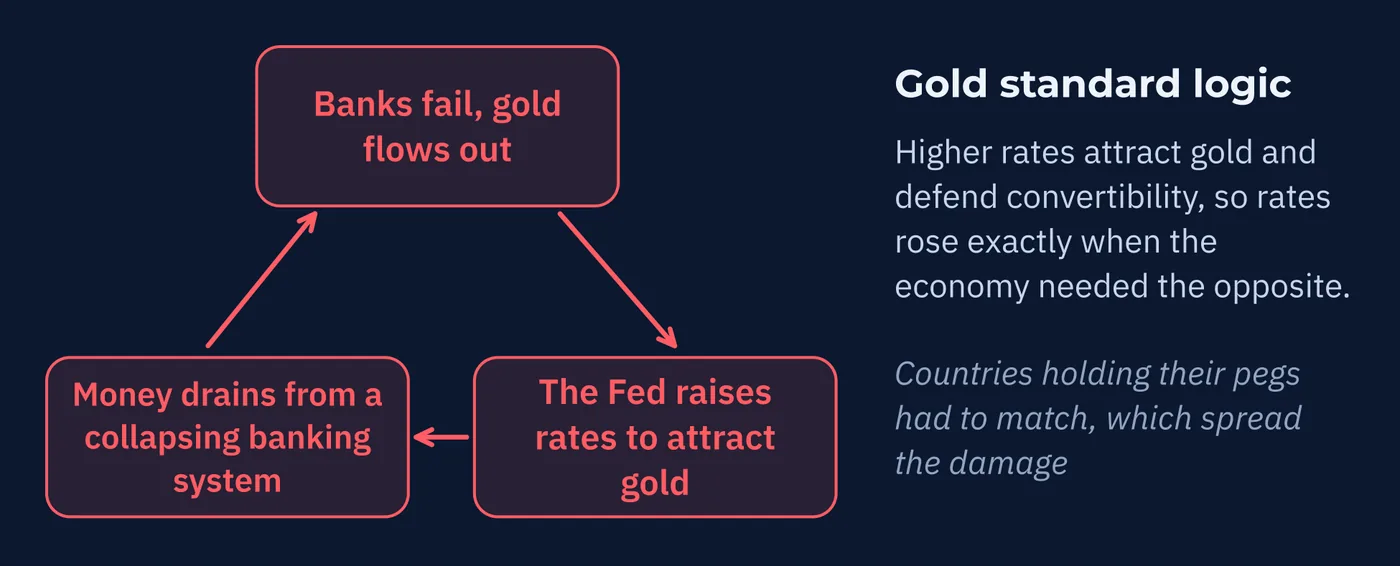
When gold began leaving after Britain's exit in September 1931, the Federal Reserve raised interest rates, with American banks already failing. The logic was gold standard logic. Higher rates attract gold, and attracting gold defends convertibility.
It also drained money from a banking system that was already collapsing.
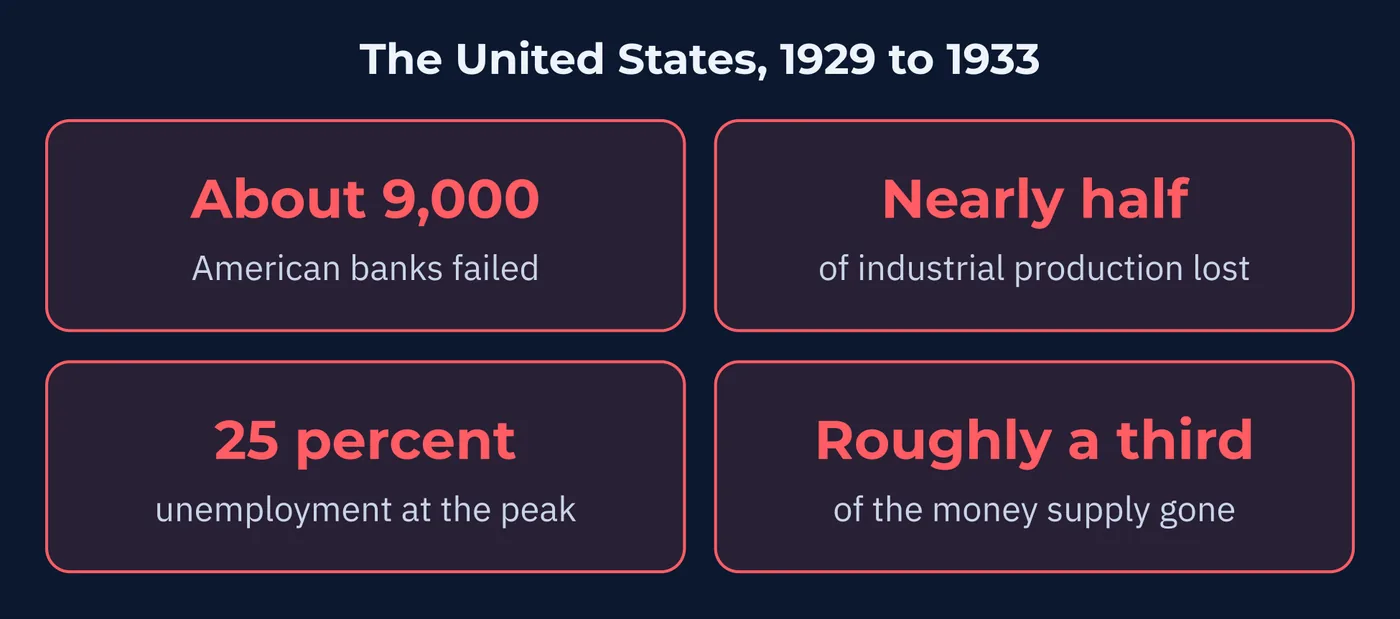
| In the United States, 1929 to 1933 | |
|---|---|
| American banks that failed | About 9,000 |
| Industrial production | Fell by nearly half |
| Unemployment | Reached 25 percent |
| The money supply | Contracted by roughly a third |
And the mechanism meant to stabilize the world spread the damage instead. Countries holding their pegs had to match American rate rises to stop gold flowing out. They tightened policy exactly when their economies needed the opposite.
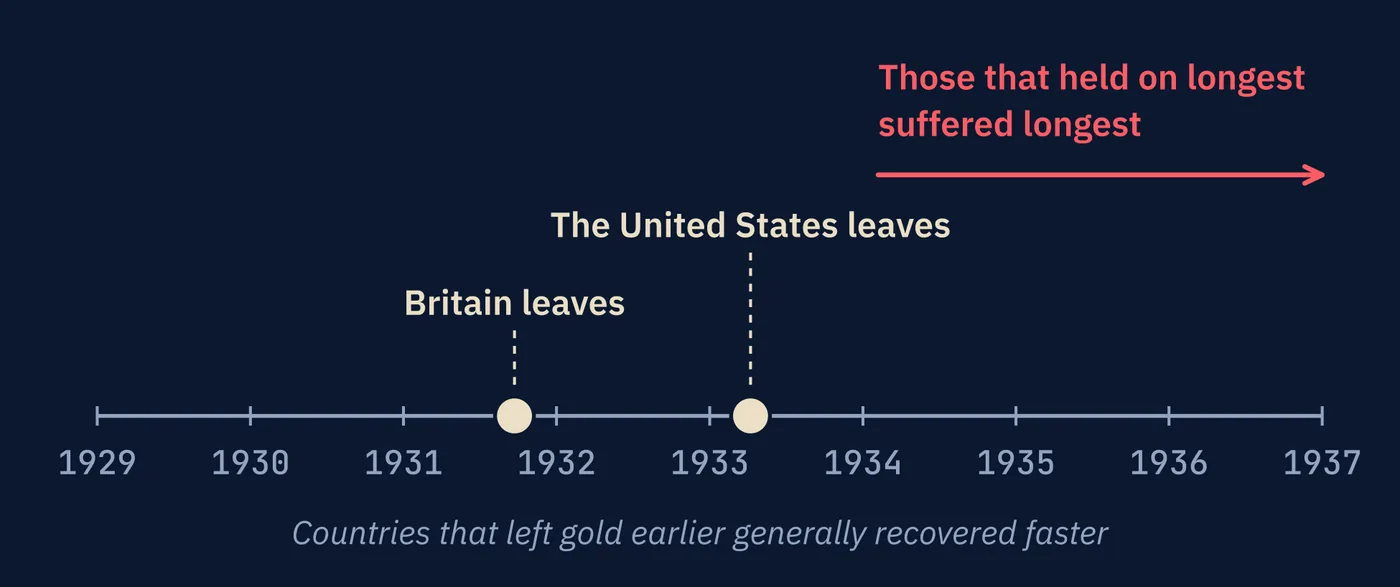
The recovery data is stark. Countries that left gold earlier generally recovered faster. Britain in 1931, the United States in 1933. Those that held on longest suffered longest.
8How Monetary Systems Fail
The interwar years produced something more useful than a set of dates. They produced a sequence, and it has repeated ever since.
| Step | What Happens |
|---|---|
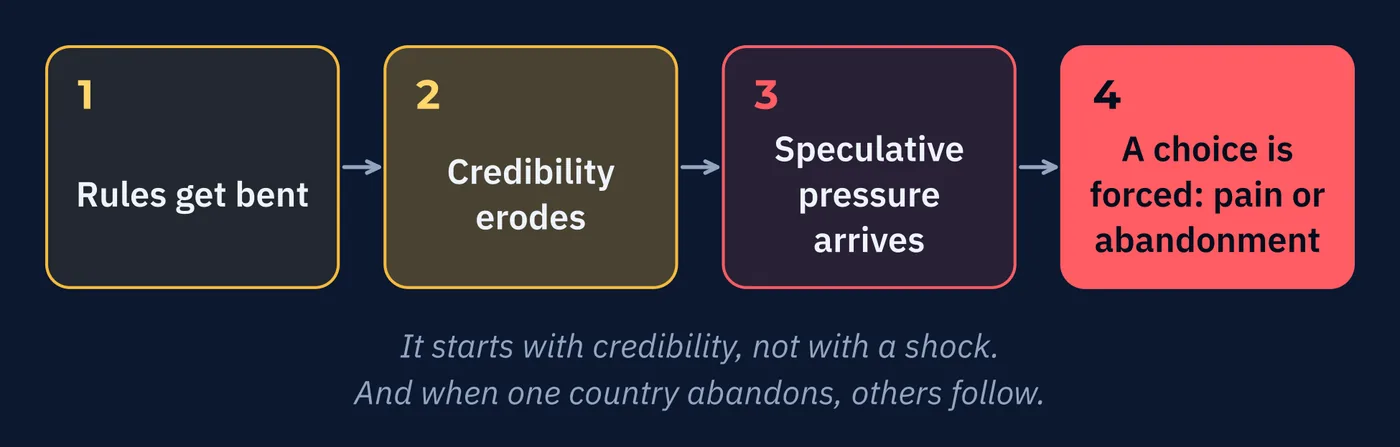
| 1 | Rules get bent. A country stops fully honoring the arrangement, usually for understandable domestic reasons. |
| 2 | Credibility erodes. Participants notice, and begin to doubt the commitment will hold. |
| 3 | Speculative pressure arrives. Money moves against the position, testing whether the commitment is real. |
| 4 | A choice is forced. Accept serious domestic pain to defend it, or abandon it. And when one country abandons, others follow. |
Look at where the sequence starts. Not with an economic shock. Not with a market. It starts with credibility, which is the fourth pillar from Lesson 29 and the one that moves fastest.
Which is why this is not history for its own sake. Two of the largest single-day moves in modern currency markets appear later in this series. Both are that four-step sequence reaching step four in front of a live market.
The next lesson picks up in 1944, when 44 nations met in a New Hampshire hotel to design a system that would prevent all of this from happening again.
Three Things to Remember
Try This
Fifteen minutes. Two of these steps are arithmetic and the rest is observation.
Words From This Lesson
| Term | What It Means |
|---|---|
| Gold standard | A system in which each currency is fixed to a specific weight of gold, making exchange rates a matter of arithmetic. |
| Convertibility | The guarantee that currency can be exchanged for gold at the declared rate. Suspending it means breaking that promise. |
| Price-specie flow | The self-correcting mechanism by which gold movements were meant to rebalance trade automatically. |
| Parity | The declared official rate at which a currency is fixed. |
| Deficit country | One importing more than it exports, and therefore losing gold under the old system. |
| Competitive devaluation | Deliberately weakening a currency to make exports cheaper. Self-defeating when several countries do it at once. |
| Speculative pressure | Money moving against a fixed rate to test whether the commitment behind it is real. |
Test Your Knowledge
Eight questions. Answer them all before checking the key on the following pages. If a question gives you trouble, the answer key tells you which section to revisit.
- A. By negotiation between central banks
- B. By international treaty, revised annually
- C. By supply and demand in an open market
- D. By dividing the gold weight of one currency by the other
- A. About $4.87
- B. About $2.05
- C. About $8.80
- D. About $10.95
- A. Set the gold price each year
- B. Correct trade imbalances automatically through gold movements
- C. Allow governments to devalue when needed
- D. Prevent gold from leaving the country
- A. The surplus country, which had to inflate
- B. Both equally, by design and in practice
- C. The deficit country, which was losing gold
- D. Whichever had the larger economy
- A. It was strengthened by wartime cooperation
- B. Major belligerents suspended convertibility within days
- C. It continued unchanged until 1918
- D. Only Britain suspended it
- A. Other countries refused to participate
- B. Gold reserves were insufficient
- C. The rate chosen was about ten percent too high for the economy
- D. It was announced without warning
- A. To fight inflation
- B. To fund government spending
- C. To support the stock market
- D. To attract gold and defend convertibility
- A. Rules get bent, and credibility begins to erode
- B. A speculative attack
- C. A recession begins
- D. Foreign reserves run out
Answer Key
Each answer explains why the correct choice is correct, why the others are not, and where to reread.
Question 1 · correct answer D
Each currency was defined as a fixed weight of gold, so the rate between any two followed by division. No discretion was involved.
A describes how some modern arrangements are managed. C describes floating rates, which came much later. B is wrong because the rates followed from the gold definitions rather than from periodic agreement.
Review: Section 2, A Promise Made in Metal
Question 2 · correct answer A
7.3 divided by 1.5 is about 4.87, which matches the rate sterling actually traded at.
B divides the wrong way round, which would give the dollar in pounds. C and D do not follow from either division.
Review: Section 2, A Promise Made in Metal
Question 3 · correct answer B
Gold leaving a deficit country contracted its money supply and lowered prices, making its exports more attractive. The surplus country experienced the reverse, and trade was meant to rebalance without intervention.
A describes a policy decision rather than an automatic mechanism. C is close to the opposite, since the system was designed to avoid discretionary devaluation. D describes an aim some governments had, not the mechanism.
Review: Section 3, The Machine That Was Meant to Self-Correct
Question 4 · correct answer C
The deficit country was forced to adjust because it was running out of gold. The surplus country could hold its gold and decline to let prices rise, so the pain fell on one side.
A describes what the theory required and practice did not deliver. B describes the design rather than the outcome, which is exactly the gap this section identifies. D is wrong because size did not determine who adjusted.
Review: Section 4, Three Cracks, Present From the Start
Question 5 · correct answer B
Financing industrial warfare required creating money far beyond gold reserves, so every major combatant suspended convertibility within days of the war beginning.
A reverses what happened. C overstates how long the rule survived, since it was set aside almost immediately. D is wrong because the suspension was general rather than British alone.
Review: Section 5, August 1914
Question 6 · correct answer C
Sterling returned at its pre-war parity of $4.86, which the economics said was roughly ten percent above where the British economy stood after the war.
B was not the binding problem, since the rate itself was the issue. A is wrong because other countries were also restoring pegs. D is wrong because the decision was announced in a Budget speech.
Review: Section 6, The Wrong Rate
Question 7 · correct answer D
Higher rates attract gold, and attracting gold defends convertibility. That was gold standard logic applied to a collapsing banking system, and it drained liquidity precisely when the system could least absorb it.
A is wrong because prices were falling rather than rising. C reverses the effect, since higher rates pressured asset prices. B describes fiscal policy rather than the rate decision.
Review: Section 7, When Defending the Peg Made It Worse
Question 8 · correct answer A
The sequence begins with rules being bent for understandable domestic reasons, which starts credibility eroding. Everything else follows from that.
B is the third step, and it arrives because credibility has already weakened. C and D can accompany the sequence without starting it, since the trigger is a loss of confidence in the commitment.
Review: Section 8, How Monetary Systems Fail
Keep going
Where Money Came From is written by Kanin D. Alldredge for The Currency Classroom, and it is free to read. There is more free from CNS: start here.
Start free with CNS →