How Much Do You Need?

1The Question Everyone Asks First
How much money do I need to start trading?
It is the first question almost everybody asks, and most of the answers are useless. Some say you can start with fifty dollars. Some say you need twenty thousand. Both sound confident. Neither explains itself.
The reason the answers conflict is that two different questions are being answered, and only one of them is about you.
There is the broker's minimum, and there is yours. They are not related.
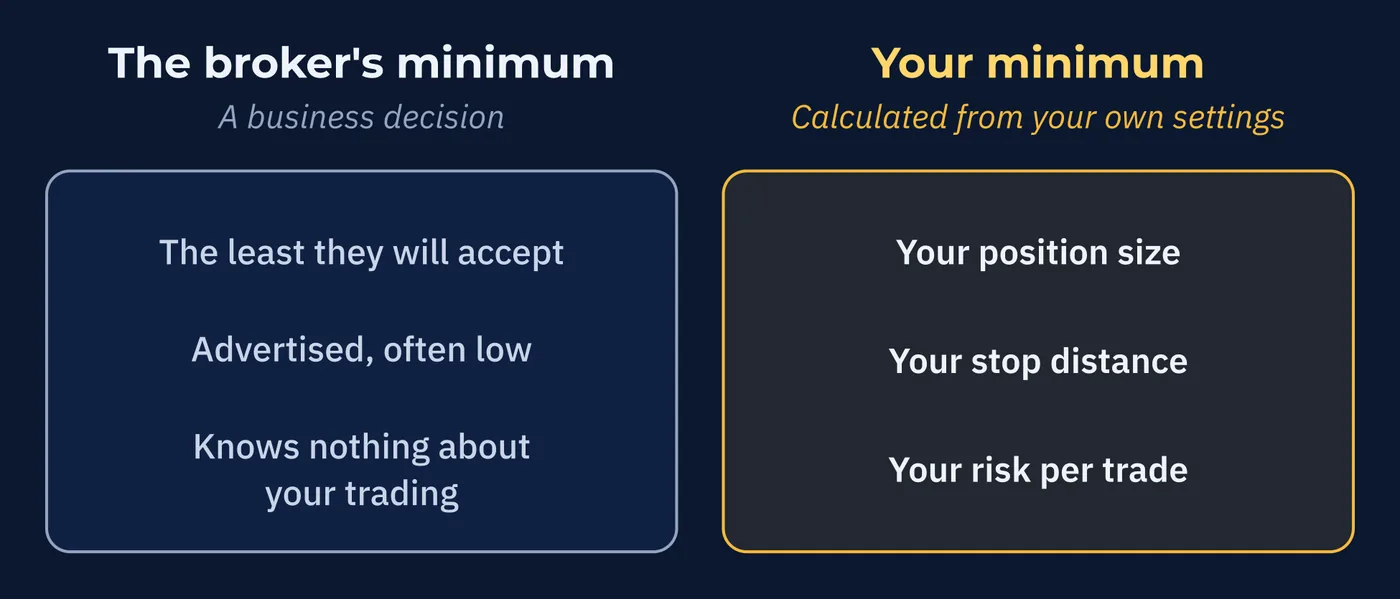
Once you can tell those apart, the question stops being confusing and becomes something you can calculate.
2The Broker's Answer
Brokers advertise a minimum deposit. Sometimes it is a few hundred dollars. Sometimes it is fifty. Sometimes there is no minimum at all.
It is worth being clear about what that number is.
It is a business decision. It marks the point below which an account is not worth the cost of maintaining, and the competitive pressure to advertise a low figure pushes it down over time.
Notice what it does not consider. It knows nothing about your position sizes, your stop distances, how much you intend to risk on a trade, or whether the account can absorb a normal run of losses.
It answers the question, what is the least we will accept? That is a real question, and it has nothing to do with what you should deposit.
3Your Answer Is Calculated
The figure that matters to you is derived, not advertised. Three things determine it, and you already understand all three.
| Input | Where It Came From |
|---|---|
| Pip value at your position size | Lesson 16. What one pip is worth on the size you intend to trade. |
| Your risk per trade | How much of the account you are willing to lose on one trade, as a percentage. |
| Your stop distance | Lesson 18. How far from entry you place the stop loss, in pips. |
Put those together and the account size falls out of them.
stop distance × pip value = money at risk on the trademoney at risk ÷ your risk percentage = account needed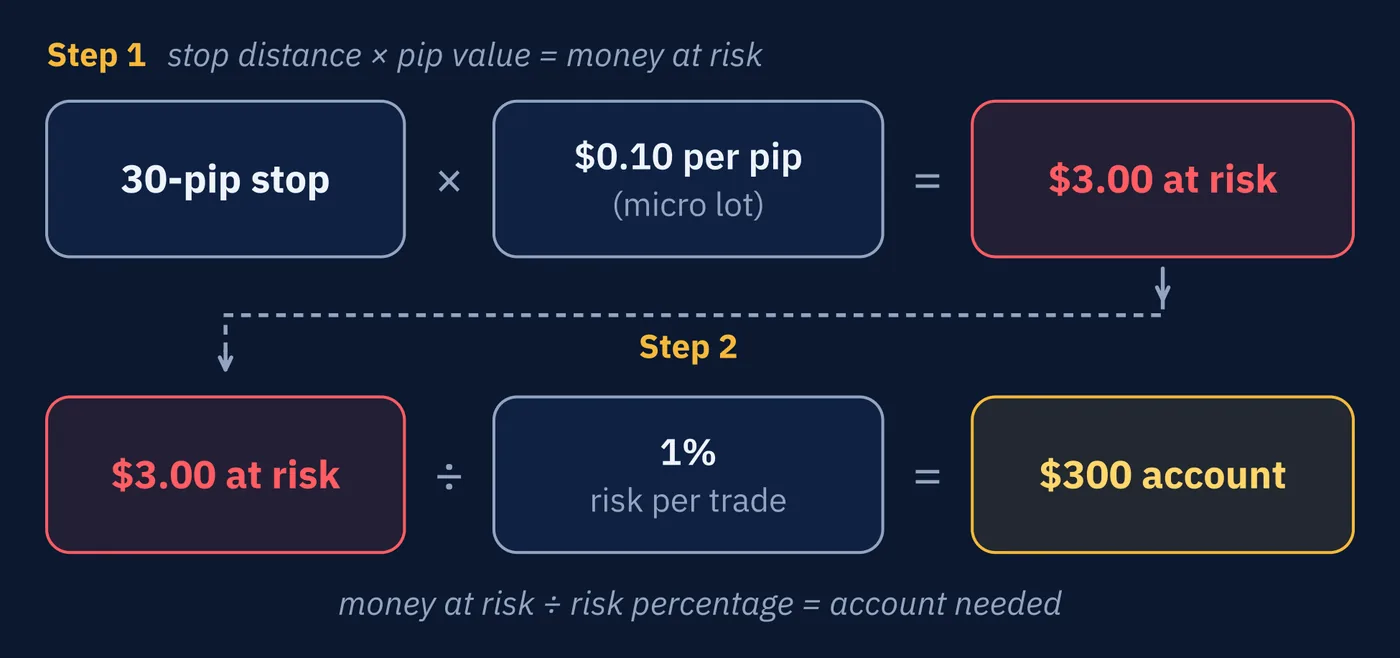
Which means the answer is not a fixed number that applies to everyone. It moves when any of the three inputs move. A trader using wider stops needs a larger account for the same position size. A trader risking less per trade needs a larger account again.
This is why the confident answers you see online are wrong. Not because their numbers are bad, but because a single number cannot answer a relational question.
4Working It Out
Take reasonable settings. You risk 1% of the account on a trade, and your approach uses a 30 pip stop. Now run each position size.
| Position Size | Pip Value | 30 Pips Risks | Account Needed for 1% |
|---|---|---|---|
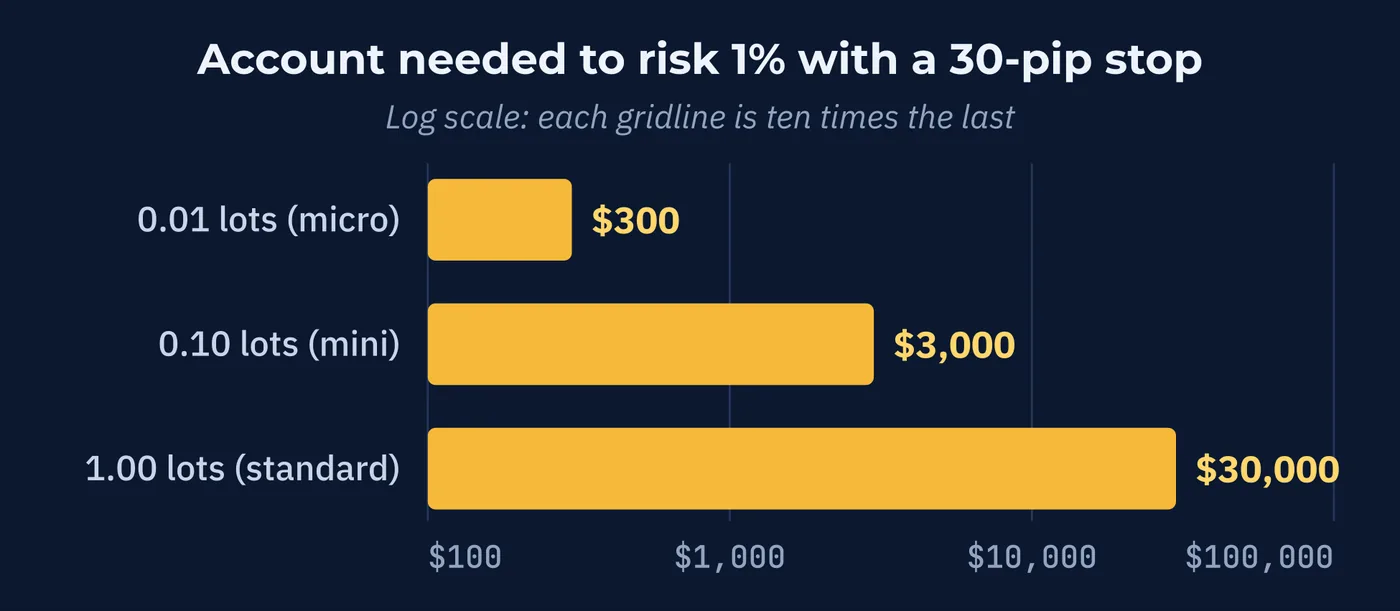
| 0.01 lots (micro) | $0.10 | $3.00 | $300 |
| 0.10 lots (mini) | $1.00 | $30.00 | $3,000 |
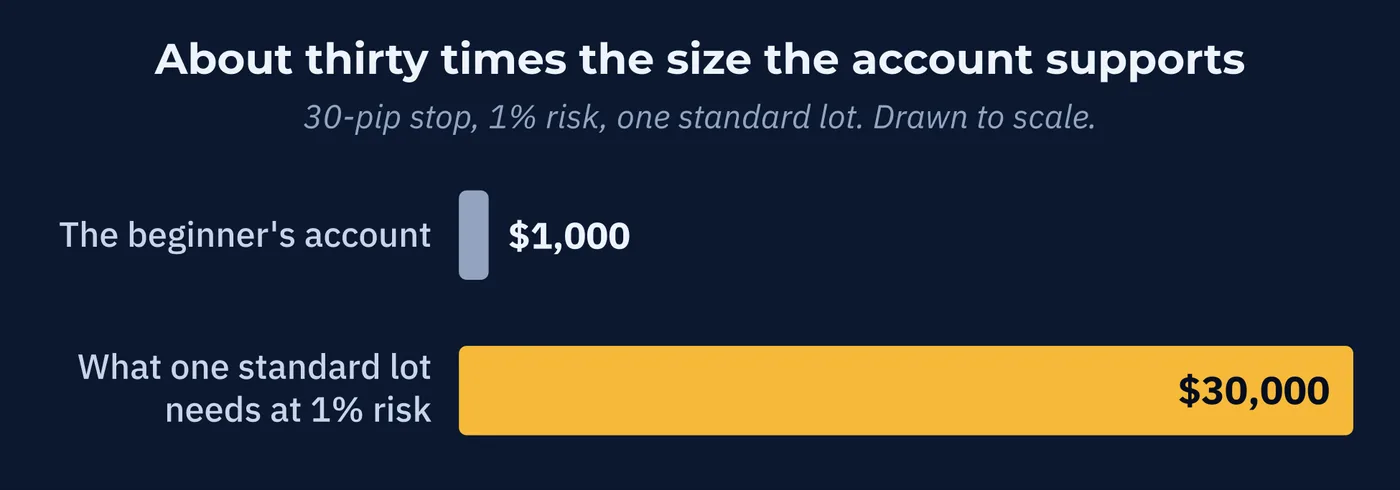
| 1.00 lots (standard) | $10.00 | $300.00 | $30,000 |
Read the bottom row. Trading a single standard lot with sensible risk and a modest stop calls for a thirty thousand dollar account.
That is worth pausing on, because a beginner opening a $1,000 account and trading one standard lot is not being slightly aggressive. They are running about thirty times the size their account supports.
Now widen the stop to 50 pips, which many approaches require.
| Position Size | 50 Pips Risks | Account Needed for 1% |
|---|---|---|
| 0.01 lots (micro) | $5.00 | $500 |
| 0.10 lots (mini) | $50.00 | $5,000 |
| 1.00 lots (standard) | $500.00 | $50,000 |
Same account, same risk percentage, wider stop. Every requirement rose by two thirds. Nothing about the market changed.
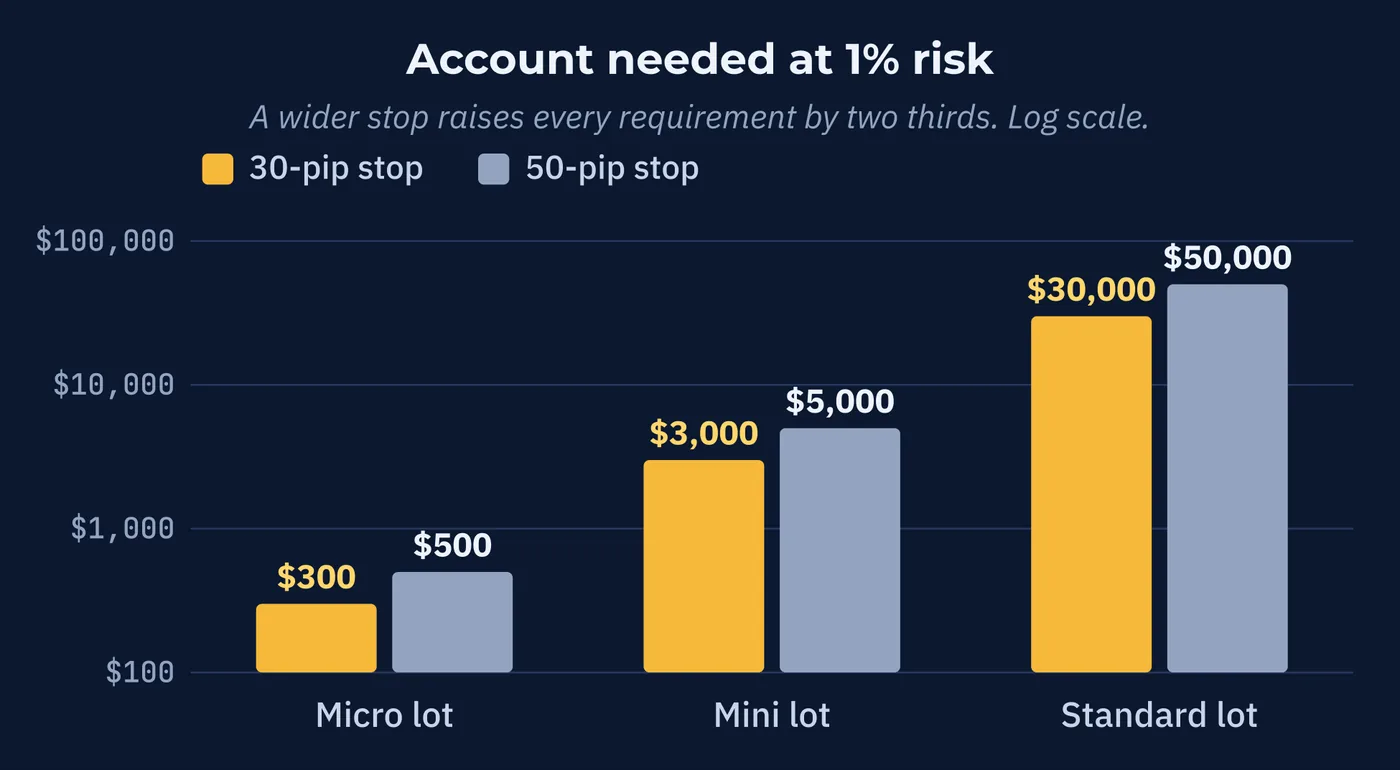
That is the relationship the advertised minimums cannot capture.
5The Floor Nobody Mentions
Now work the other direction, and something uncomfortable appears.
The smallest position most brokers offer is 0.01 lots, worth ten cents a pip. With a 30 pip stop, that position risks three dollars. That is the least you can lose on a trade, because there is no smaller position available.
So what does three dollars represent on different accounts?
| Account | Smallest Possible Risk | As a Share of the Account |
|---|---|---|
| $100 | $3.00 | 3.0% |
| $300 | $3.00 | 1.0% |
| $1,000 | $3.00 | 0.3% |
| $3,000 | $3.00 | 0.1% |
Look at the top row. On a hundred dollar account, the smallest trade you can physically place already risks 3% of everything you have. Wanting to risk 1% is not an option. The position does not exist.
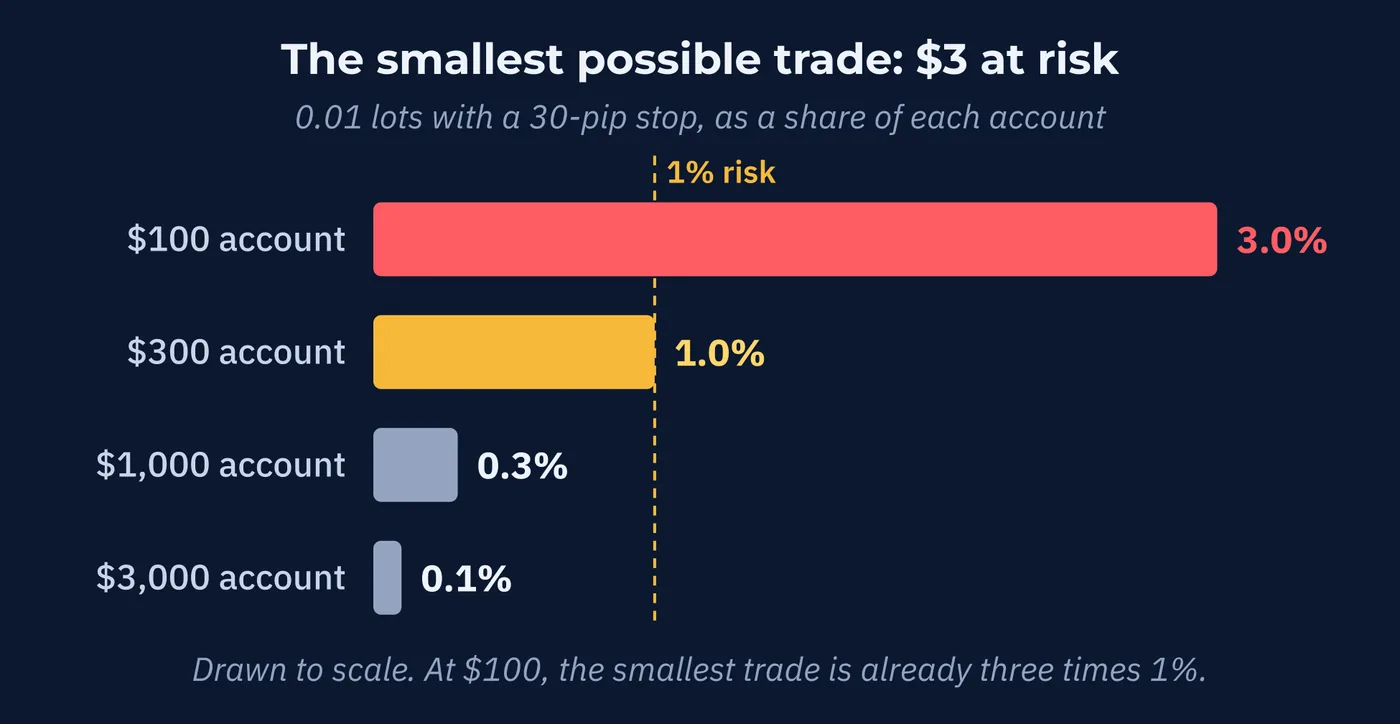
Below a certain size, the smallest available trade is already too large.
This is the part that low advertised minimums obscure completely. You can open the account. You cannot trade it sensibly, and no amount of discipline changes that, because the constraint is in the instrument rather than in you.
6The Trap That Follows
Undercapitalized accounts fail in a particular sequence, and it is worth recognizing before you are inside it.
It starts reasonably. The account is small, so the positions are small, so the results are small. A good week produces a few dollars. Progress feels invisible.
Then comes the thought. At this size it is not worth the effort. If I traded larger, the same accuracy would actually mean something.
That thought is arithmetically correct, which is what makes it dangerous. Larger positions do produce larger results. They also produce larger losses, at exactly the same rate, as Lesson 17 established.
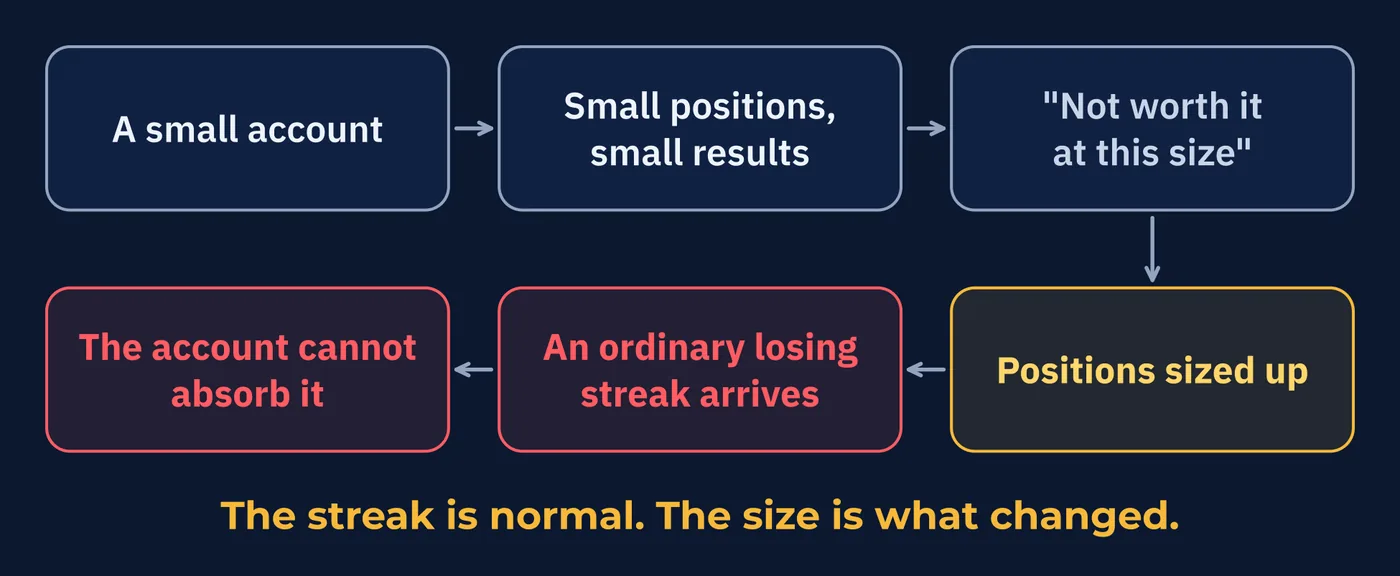
Which is the real cost of starting undercapitalized. Not that progress is slow. That the slowness creates pressure to do the one thing guaranteed to end it.
7What the Numbers Look Like
Putting the arithmetic together gives some honest ranges.
| Account | What It Realistically Supports |
|---|---|
| Under $500 | Micro lots only, and sensible risk is difficult or impossible. |
| $500 to $2,000 | Micro lots with workable risk. Results are small, and that is the point. |
| $2,000 to $5,000 | Comfortable micro lot trading, with room to grow into mini lots. |
| $5,000 and above | Mini lots with sensible risk and genuine room to absorb losing runs. |
These are not thresholds of seriousness or gates you must pass. They are what the arithmetic in Section 4 produces at ordinary settings.
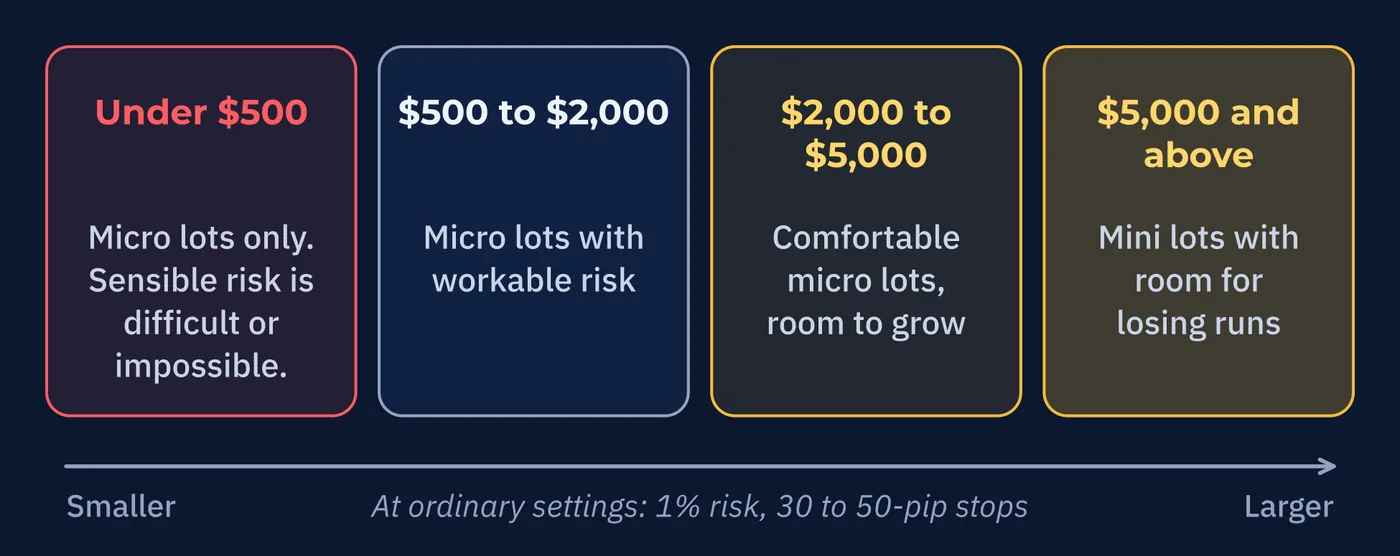
Note something about the middle rows. An account that supports micro lots properly is a real trading account. The results are small in dollars, and everything you would learn at a larger size is available at that one. The mechanics, the discipline, the way a losing streak feels. All of it transfers.
What does not transfer is the habit of over-sizing, which a too-small account teaches unavoidably.
8If You Do Not Have It Yet
A reasonable reaction to this lesson is that the number is higher than you hoped and further away than you would like.
That gap is not dead time, and treating it as dead time is a genuine mistake.
Everything in this course can be learned during it. A demo account costs nothing and can be opened today, at exactly the position sizes your future account will use. A journal can be started today. An approach can be tested, observed, and refined at no cost while you save.
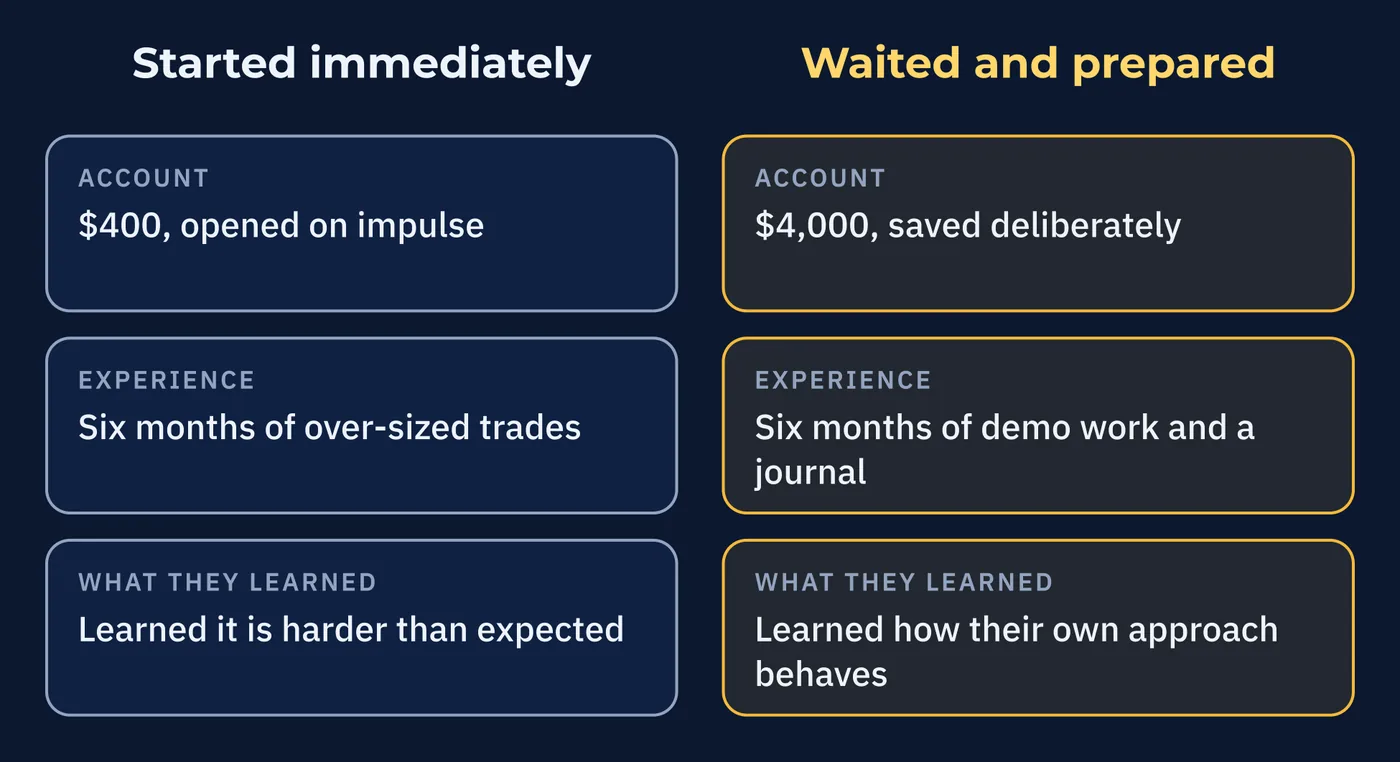
Compare two people six months from now.
| Started Immediately | Waited and Prepared | |
|---|---|---|
| Account | $400, opened on impulse | $4,000, saved deliberately |
| Experience | Six months of over-sized trades | Six months of demo work and journaling |
| Position sizing | Forced into over-risking | Sensible from the first live trade |
| What they learned | That it is harder than expected | How their own approach behaves |
Both spent the same six months. Only one of them spent it building something.
Saving toward a proper starting balance is not a delay or a compromise. It is the first capital decision a trader makes, and making it deliberately is a reasonable indication of how the rest will be handled.
For some traders, though, that starting balance can feel too far out of reach to make the process feel meaningful today. And demo trading does not work equally well for everyone. Some people can practice seriously with simulated money. Others find that they need a little skin in the game before the decisions carry enough weight to develop the discipline they are trying to build.
If that sounds familiar, there is another route worth understanding. Head over to the Currency News Source Library and download our free guide to proprietary trading firms, often called prop firms. It explains how they work, why some developing traders use them, and the benefits and tradeoffs to understand before deciding whether that path makes sense for you.
The next lesson takes the risk percentage this one assumed and examines it properly. How much to risk per trade, and how to find the number that is right for you rather than the one somebody published.
Three Things to Remember
Try This
Fifteen minutes and a calculator. Work out your own number rather than borrowing somebody else's.
Words From This Lesson
| Term | What It Means |
|---|---|
| Broker's minimum | The smallest deposit a broker will accept. A commercial threshold, not a guide to what you should deposit. |
| Trader's minimum | The account size your own position sizing, stop distance, and risk percentage actually require. |
| Risk per trade | How much of the account you are willing to lose on a single trade, usually expressed as a percentage. |
| Stop distance | How far your stop loss sits from your entry, measured in pips. |
| Undercapitalized | An account too small to trade its intended size at sensible risk. |
| Demo account | A no-cost practice account using live prices and no real money. |
Test Your Knowledge
Eight questions. Answer them all before checking the key on the following pages. If a question gives you trouble, the answer key tells you which section to revisit.
- A. How much you need to trade sensibly
- B. The amount most successful traders start with
- C. The least the broker will accept as a business matter
- D. How much risk you should take per trade
- A. Broker minimum, leverage ratio, and spread
- B. Account currency, pair choice, and session
- C. Pip value at your size, risk per trade, and stop distance
- D. Deposit, withdrawal fees, and commission
- A. $30.00
- B. $3.00
- C. $300.00
- D. $1.00
- A. $300
- B. $1,000
- C. $30,000
- D. $3,000
- A. It falls
- B. It rises
- C. It stays the same
- D. It depends on the broker
- A. Brokers prohibit it
- B. It can, using nano lots at every broker
- C. Risk percentages only apply above $1,000
- D. The smallest available position already risks more than 1%
- A. Pressure to increase size, which turns a normal losing streak into a lost account
- B. Brokers charge higher fees on small accounts
- C. Small accounts get worse prices
- D. The market targets smaller traders
- A. Wait until the money is available
- B. Demo trading, journaling, and testing an approach at no cost
- C. Open a small live account anyway to gain experience
- D. Borrow the difference to start sooner
Answer Key
Each answer explains why the correct choice is correct, why the others are not, and where to reread.
Question 1 · correct answer C
It marks the point below which an account is not commercially worth maintaining. Competition pushes the figure down over time.
A is what most people assume it means, which is why the two numbers get confused. B is wrong because the minimum reflects the broker's costs rather than anyone's results. D is unrelated, since risk per trade is your decision entirely.
Review: Section 2, The Broker's Answer
Question 2 · correct answer C
Stop distance multiplied by pip value gives the money at risk, and dividing by your risk percentage gives the account size required.
A names real concepts that do not determine this particular figure. B lists choices that affect other decisions but not the calculation. D describes account costs rather than position sizing.
Review: Section 3, Your Answer Is Calculated
Question 3 · correct answer A
Thirty pips at one dollar per pip is thirty dollars. That is the loss if the stop is reached.
B applies the micro lot pip value of ten cents. C applies the standard lot value of ten dollars. D confuses the pip value itself with the total risked across the stop distance.
Review: Section 4, Working It Out
Question 4 · correct answer D
Thirty dollars divided by one percent is three thousand dollars. The account has to be a hundred times the amount risked.
A would apply to a micro lot at the same settings. C would apply to a standard lot. B would mean risking three percent per trade rather than one.
Review: Section 4, Working It Out
Question 5 · correct answer B
A wider stop means more money at risk for the same position size, so a larger account is needed to keep that loss at the same percentage.
A reverses the relationship. C ignores that stop distance is one of the three inputs. D is wrong because the calculation depends on your own settings rather than on the broker.
Review: Section 4, Working It Out
Question 6 · correct answer D
The smallest position most brokers offer risks about three dollars on a 30 pip stop, which is three percent of a hundred dollar account. One percent would be one dollar, and no position that small exists.
A invents a prohibition. C is wrong because percentages apply at any size, which is exactly why the floor exists. B overstates nano lot availability, and even those do not solve the problem at every account size.
Review: Section 5, The Floor Nobody Mentions
Question 7 · correct answer A
Small positions produce small results, which creates pressure to size up. Larger positions turn an ordinary losing run into a much larger share of the account.
B is wrong because fee structures do not usually vary that way. C is wrong because pricing does not depend on account size. D attributes intent to a market with no knowledge of individual traders.
Review: Section 6, The Trap That Follows
Question 8 · correct answer B
Demo trading costs nothing, uses live prices, and can be run at the exact position sizes the future account will use. The approach and the journal habit can both be built during the wait.
A treats the period as dead time. C is the choice that leads directly to the trap in Section 6. D adds an obligation to an activity where losses are expected, which compounds the problem rather than solving it.
Review: Section 8, If You Do Not Have It Yet
Keep going
Building Your Trading Life is written by Kanin D. Alldredge for The Currency Classroom, and it is free to read. There is more free from CNS: start here.
Start free with CNS →