Swap

1The Cost That Runs on a Clock
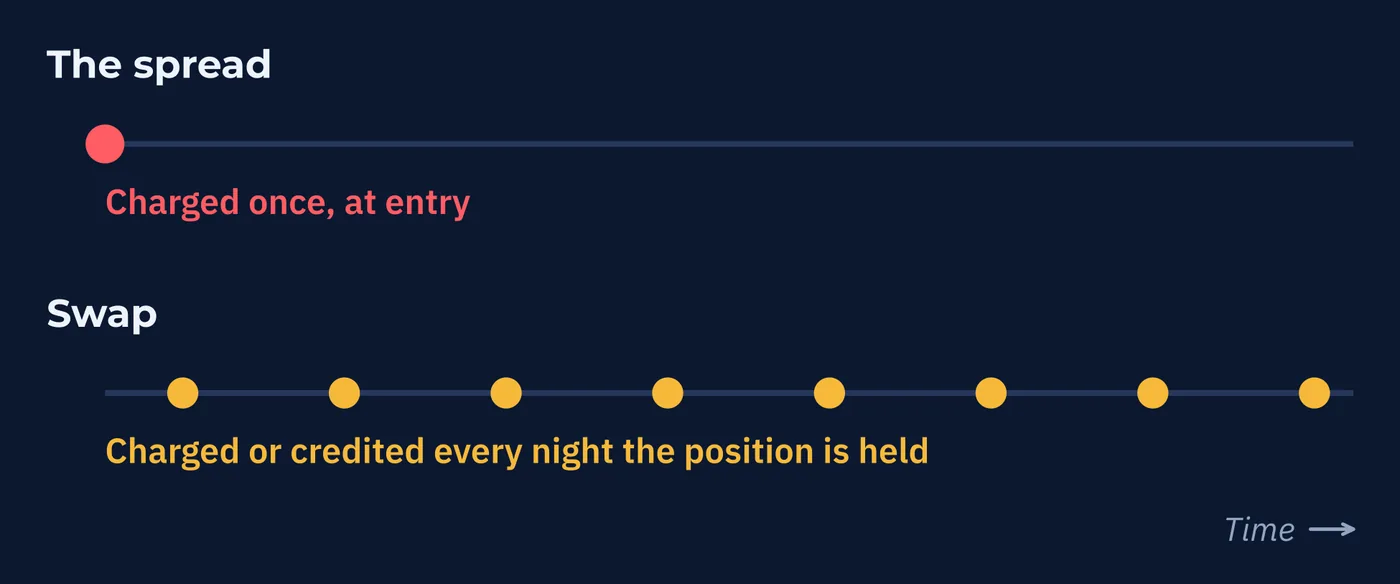
Lesson 14 established that the spread is charged once, at entry, and that after that it is done. You pay it, you move on.
There is a second cost, and it behaves completely differently. It is charged every night you hold the position, for as long as you hold it.
It is called the swap, or sometimes the rollover. It is an interest credit or charge applied to any position still open past the daily cut-off, which is usually five in the afternoon in New York.
The spread is what entry costs. Swap is what time costs.
And here is the part that makes it different from everything else in this series. Swap can run in your favor. It is the only cost covered so far that is sometimes not a cost at all, and is instead a small payment to you.
2Where It Comes From
The reason swap exists follows directly from something Lesson 4 established, and it is worth reconnecting to.
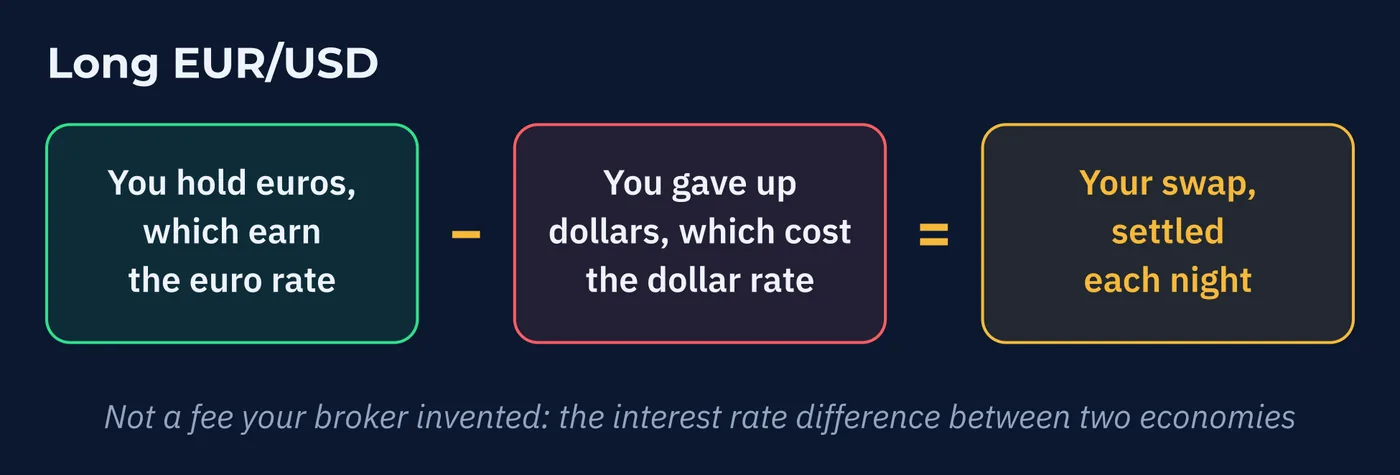
Every currency position holds two currencies at once. Going long EUR/USD means getting euros and giving up dollars.
Now add Lesson 1. Every currency has an interest rate behind it, set by its central bank. Holding a currency is a bit like holding a deposit in it, and deposits earn interest at the rate that currency pays.
So a position holds one currency that earns and gives up another that costs. The difference between those two rates is what gets settled each night.
rate on what you hold − rate on what you gave up = your swapThat is the entire mechanism. It is not a fee your broker invented. It is the interest rate difference between two economies, applied to the position you are holding, one night at a time.
3Which Way It Runs for You
Because it is a difference between two rates, the direction depends on which currency you are holding and which you gave up.
| If You Are | Then | You |
|---|---|---|
| Long the higher-rate currency | You hold the one that pays more | Earn a small credit each night |
| Long the lower-rate currency | You hold the one that pays less | Pay a small charge each night |
Note what this means. Swap is not a property of the pair. It is a property of the pair and your direction together.
The same pair pays one trader and charges another at the same moment, because they are positioned opposite ways. Long USD/JPY and short USD/JPY sit on opposite sides of the same rate difference.
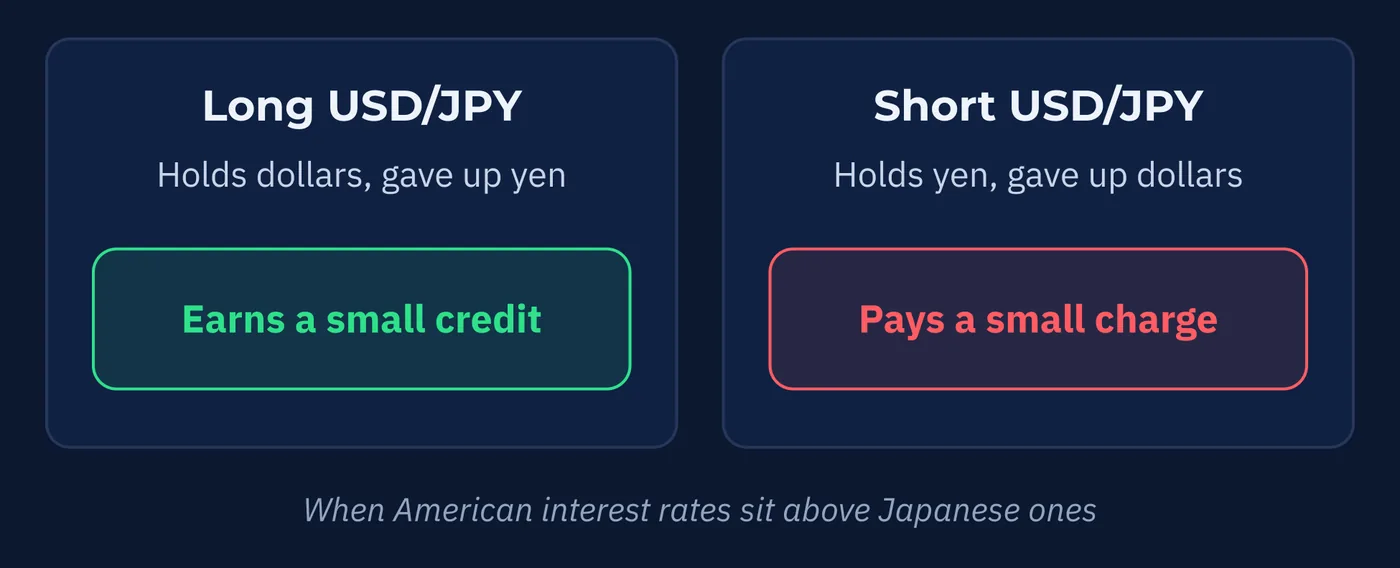
Which is why you cannot look up a single swap figure for a pair and be done. There are two, one for each direction, and they are published separately.
4Calendar Days, Not Trading Days
Here is the detail that surprises people, and it costs real money to discover late.
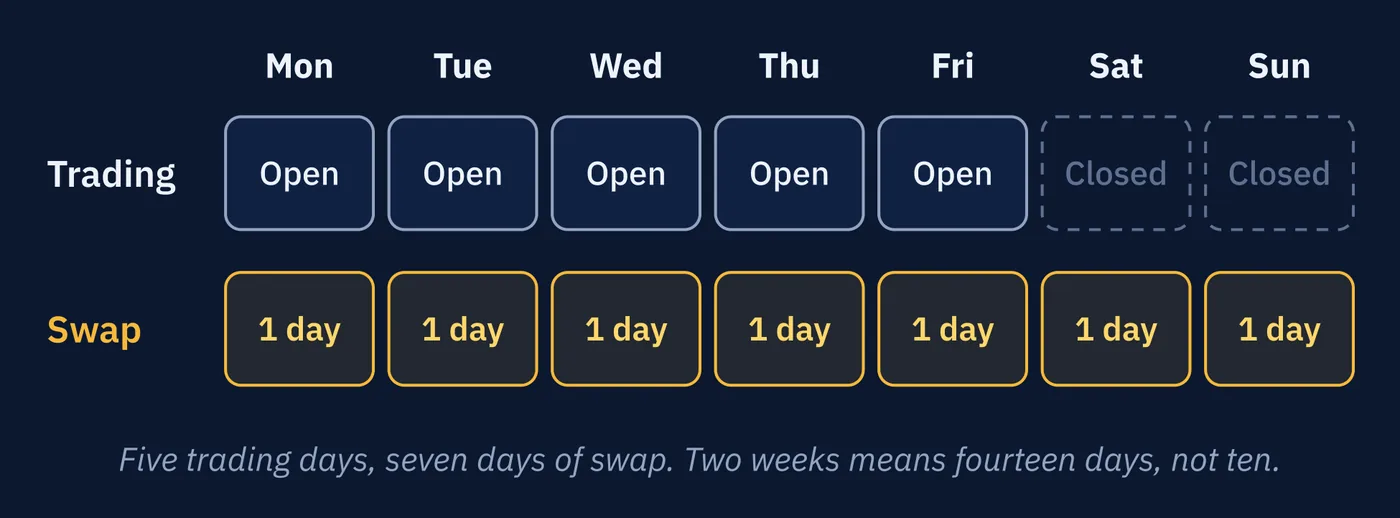
Swap accrues for every calendar day a position is held. Not every trading day. Every day.
Saturday and Sunday are included, even though the market is closed and nothing is trading. The reason is that currency transactions settle two business days after they are agreed, so the accounting continues across the weekend whether or not anyone can trade.
| If You Hold For | Trading Days | Days of Swap Charged |
|---|---|---|
| One night | 1 | 1 |
| One week | 5 | 7 |
| Two weeks | 10 | 14 |
| One month | About 22 | About 30 |
Fourteen days, not ten.
On a position earning swap, that is quietly good news. Two extra days of credit per week, for holding through a period when nothing could be traded anyway.
On a position paying swap, it is the reverse, and it is the more common way to meet this. A trader who budgets for ten days of cost on a two-week hold will find the real cost is forty percent higher than the budget.
5Why Wednesday Costs Triple
The weekend has to be charged at some point, and it cannot be charged on a Saturday because nothing is open.
So it is charged in advance, on Wednesday.
Most brokers apply the Wednesday rollover at three times the standard daily rate. One night, three days of interest. It covers Wednesday itself plus the coming Saturday and Sunday, because of how the two-day settlement lands.
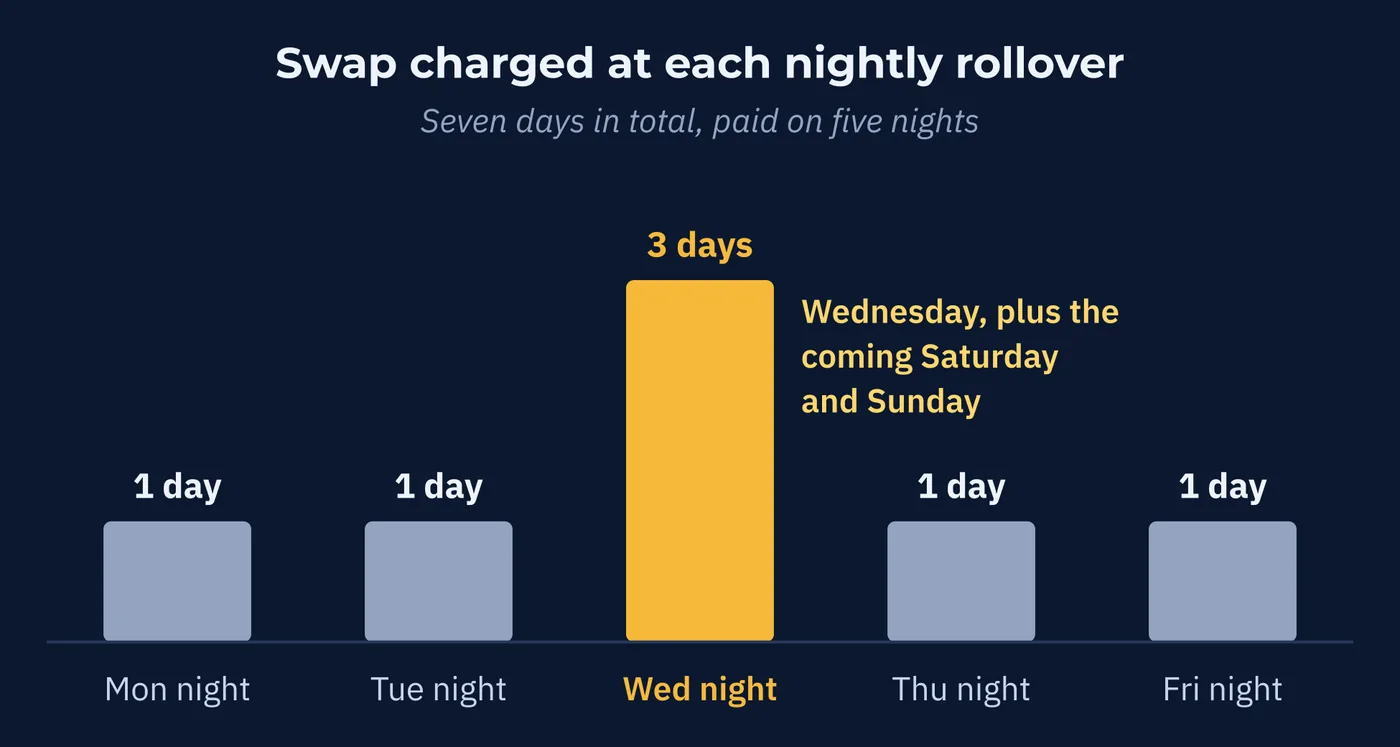
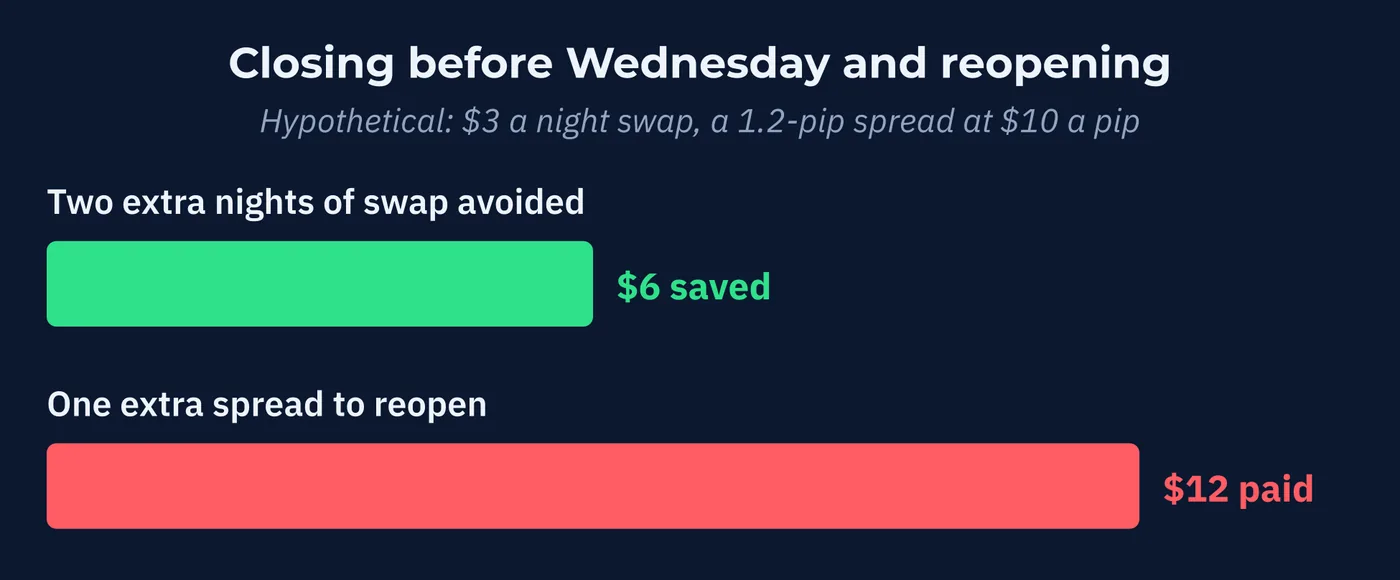
There is a small consequence some traders act on. Closing before the Wednesday rollover and reopening afterward avoids the triple charge entirely.
That is worth knowing and worth being careful with. You would pay the spread twice to save on swap, which on most pairs and most position sizes is a poor exchange. It is a detail to understand rather than a technique to adopt.
6What It Actually Adds Up To
Numbers make this concrete. Take a long USD/JPY position during a stretch when American interest rates sit well above Japanese ones, which has been the case for long periods.
On one standard lot, that might earn somewhere around two to five dollars a night. Call it three.
| Held For | Days Charged | At $3 a Night |
|---|---|---|
| One night | 1 | $3 |
| One week | 7 | $21 |
| Two weeks | 14 | $42 |
| One month | About 30 | About $90 |
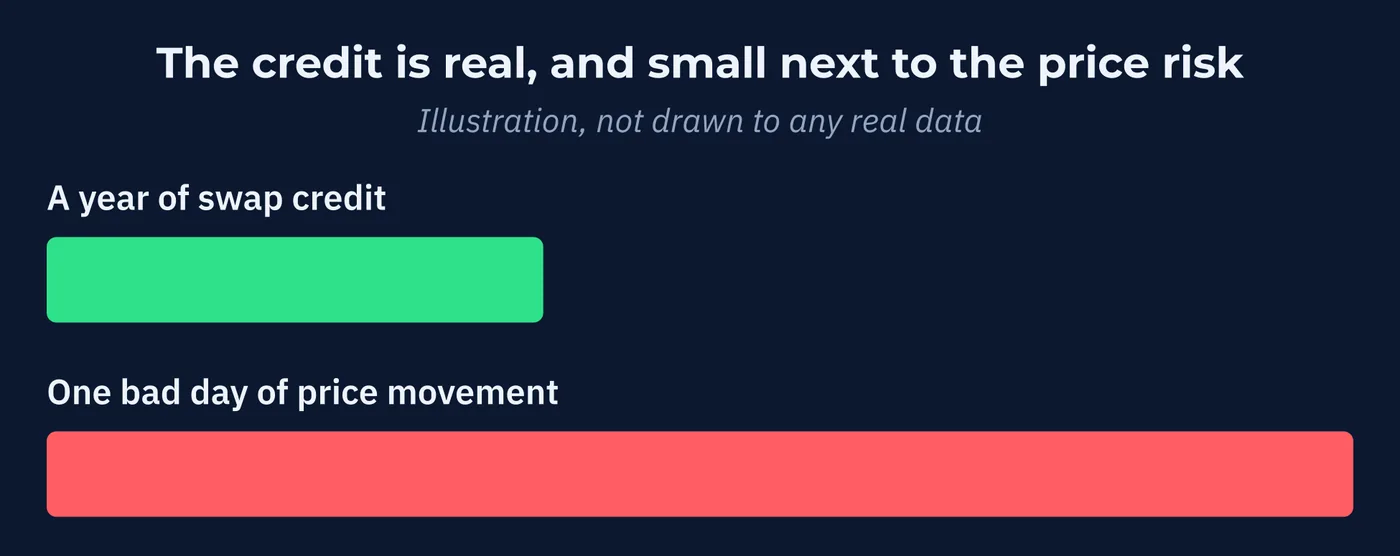
Three dollars is nothing. Ninety is not, particularly against the risk on a single position.
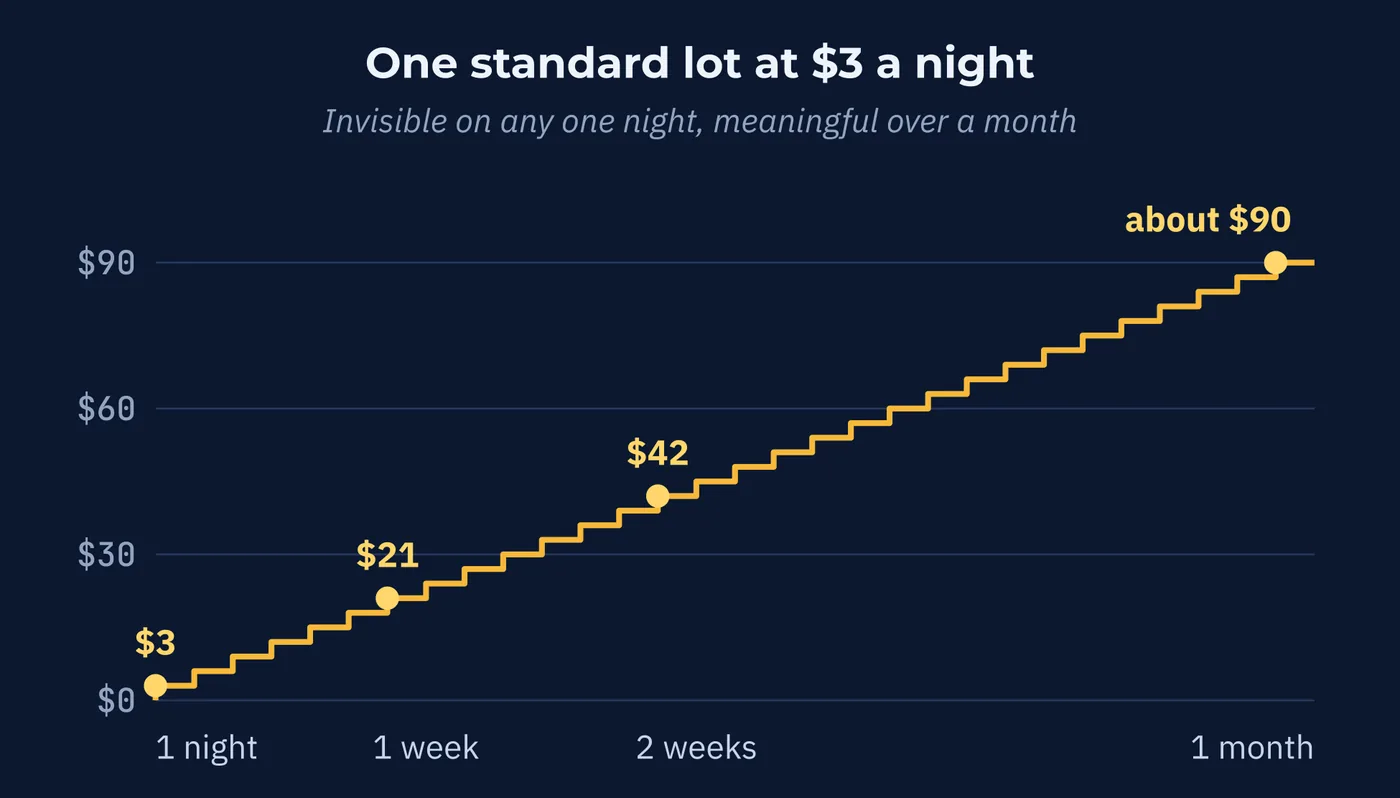
That is the character of this cost. It is invisible on any single night and meaningful over a month, which is exactly the shape of cost that people fail to account for.
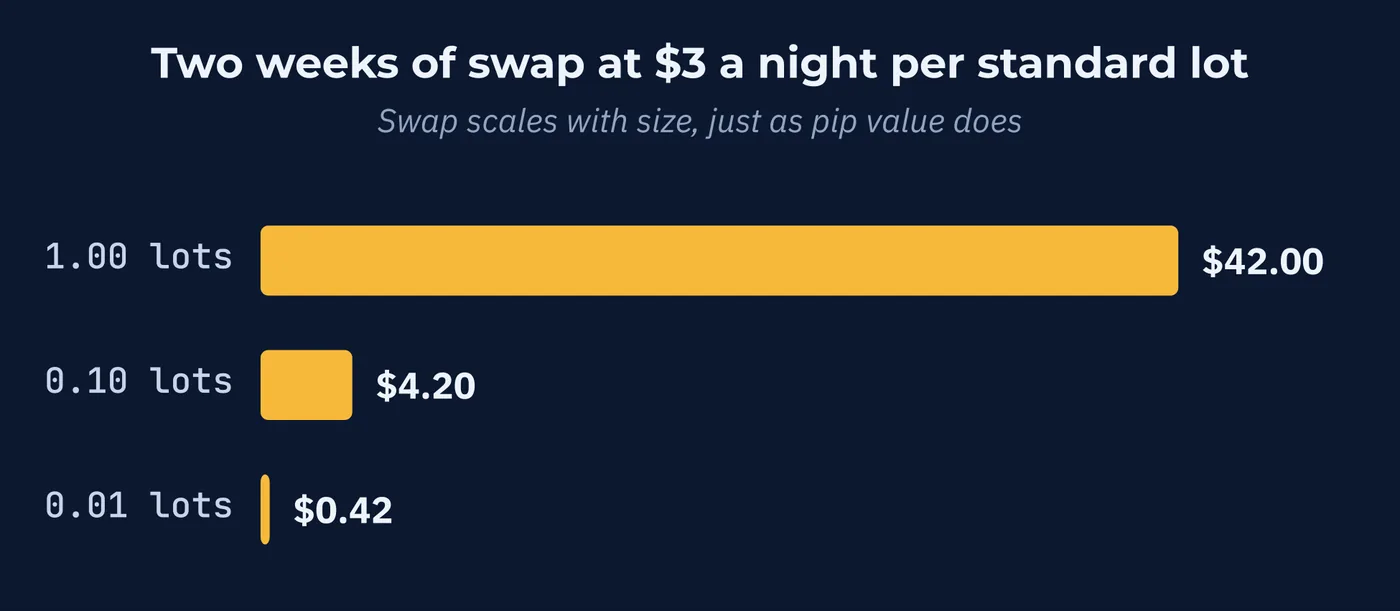
Now scale it by position size, because swap moves with size just as pip value does.
| Position Size | Per Night | Over Two Weeks |
|---|---|---|
| 1.00 lots | $3.00 | $42.00 |
| 0.10 lots | $0.30 | $4.20 |
| 0.01 lots | $0.03 | $0.42 |
On a micro lot, two weeks of swap is forty-two cents. For someone trading the sizes Lessons 20 and 21 will recommend, swap is genuinely small.
Which is honest and worth saying plainly. This lesson matters more later than it does at the beginning.
7When It Matters
Swap only applies to positions held past the daily cut-off. Everything follows from that.
| If You Hold Positions | Overnight? | Swap |
|---|---|---|
| Minutes to hours, closed same day | No | Never applies to you |
| Days to weeks | Yes | A running cost or credit worth checking |
| Weeks to months | Yes, many times | A real component of the result |
A trader who closes everything before the end of the session never encounters swap at all. It is not a small cost for them, it is no cost.
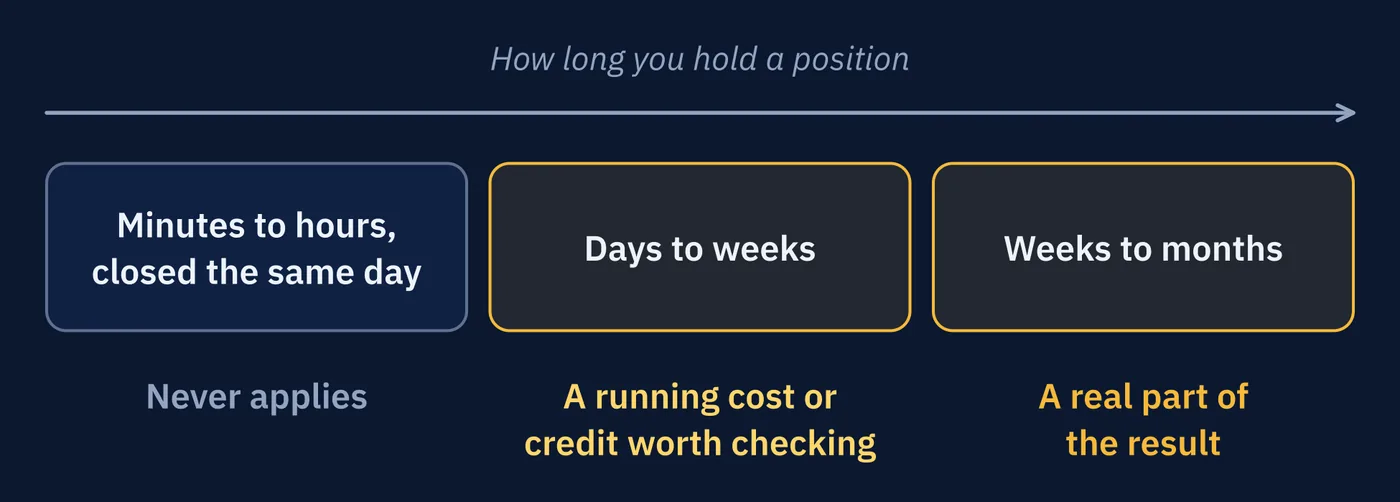
For anyone holding across days, it becomes a running number that either helps or hinders every night. And for a position held for months, it can quietly become one of the larger items in the final accounting.
8The Two-Minute Check
Swap rates are published, pair by pair and direction by direction, in the contract details on any platform. They are not hidden and they are not hard to find.
Before holding anything overnight, three things are worth knowing.
| Check | Why |
|---|---|
| Which direction pays on this pair | Long and short are different numbers, sometimes very different |
| What the nightly figure is at your size | Three dollars and three cents are different problems |
| How long you intend to hold | Multiply. That is the running cost of your plan |
One thing worth noting is that not every account applies swap. Swap-free accounts exist, designed for traders whose beliefs prohibit paying or receiving interest, and they replace the mechanism with a different fee arrangement. If you are unsure which kind you have, it is stated in your account documentation.
And that closes the series.
Seven lessons ago a pip was the smallest unit of price movement and nothing more. You can now say what a trade costs to enter, what its size means in money, what leverage you are running, how much room the position has before it is closed for you, and what holding it costs per night.
Entry has a price. Size has consequences. Time has a cost.
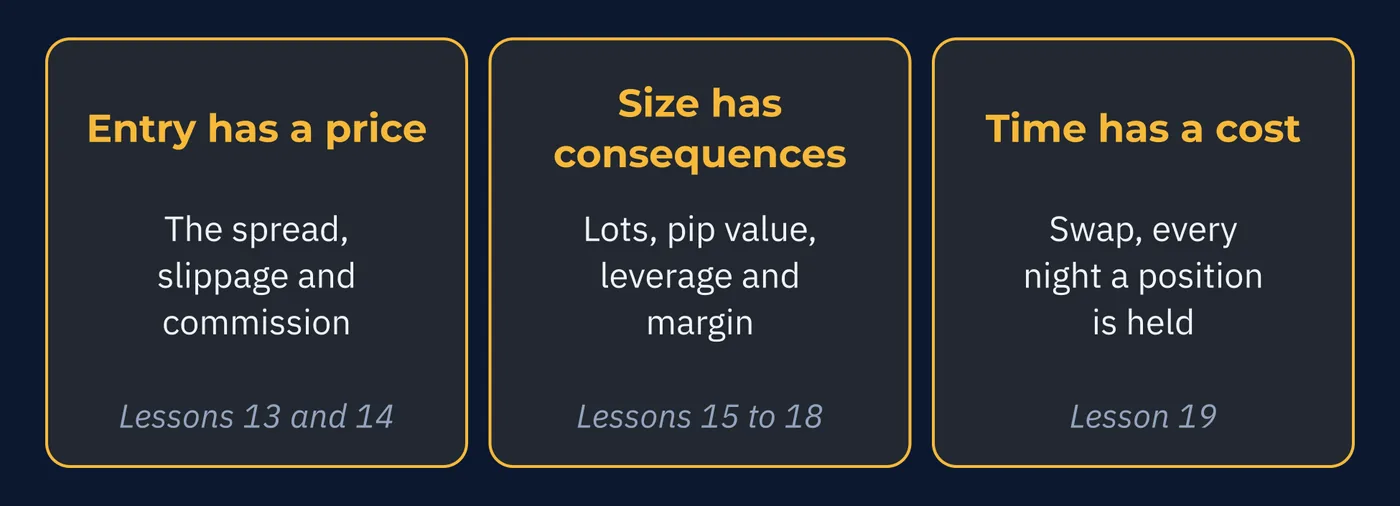
None of it predicts a single price. All of it is what stands between a trade that works and an account that survives long enough to find out.
What remains is everything around the trade. How much money you need before any of this applies. How much of it to put at risk at a time. When the market is actually worth your attention, and how the whole thing fits around a life that already has a job in it.
That is the next series, and it opens with the question almost everyone asks first.
Three Things to Remember
Try This
Ten minutes. Find the number before it finds you.
Words From This Lesson
| Term | What It Means |
|---|---|
| Swap | An interest credit or charge applied to a position held past the daily cut-off. Also called the rollover. |
| Rollover | Another name for swap, and also the moment each day when it is applied. |
| Interest rate differential | The gap between the interest rates behind the two currencies in a pair. What swap is calculated from. |
| Positive swap | A credit paid to you, earned by holding the higher-rate currency of the pair. |
| Negative swap | A charge applied to you, incurred by holding the lower-rate currency of the pair. |
| Triple rollover | The Wednesday charge, applied at three times the daily rate to cover the coming weekend. |
| Swap-free account | An account type that does not apply swap, replacing it with a different fee arrangement. |
Test Your Knowledge
Eight questions. Answer them all before checking the key on the following pages. If a question gives you trouble, the answer key tells you which section to revisit.
- A. A fee charged when you open a position
- B. The difference between the bid and the ask
- C. An interest credit or charge applied to a position held overnight
- D. A charge for closing a position early
- A. The interest rate difference between the two currencies in the pair
- B. The size of the spread
- C. How far the price has moved
- D. Your account balance
- A. You pay a small charge
- B. The spread widens
- C. Nothing until you close
- D. You earn a small credit
- A. Both pay it
- B. One earns and the other pays
- C. Both earn it
- D. Neither, since they cancel out
- A. 10
- B. 12
- C. 20
- D. 14
- A. Wednesday is the busiest trading day
- B. It covers the coming weekend, which cannot be charged when markets are closed
- C. Brokers apply a midweek surcharge
- D. It compensates for wider midweek spreads
- A. It applies at half the normal rate
- B. It applies only on Wednesdays
- C. It does not apply at all
- D. It applies when you next open a position
- A. $0.03
- B. $0.30
- C. $3.00
- D. $0.003
Answer Key
Each answer explains why the correct choice is correct, why the others are not, and where to reread.
Question 1 · correct answer C
Swap is applied to any position still open past the daily cut-off, and it can run in either direction depending on the pair and your position in it.
A describes the spread, which is charged once at entry and then finished. B is the definition of the spread itself. D describes an early closure fee, which is not standard.
Review: Section 1, The Cost That Runs on a Clock
Question 2 · correct answer A
Every position holds one currency and gives up another. Each has an interest rate behind it, and the difference between those two rates is settled nightly.
B confuses two separate costs, since the spread is charged at entry and has no bearing on the nightly figure. C is wrong because swap is unaffected by whether the trade is winning. D is wrong because swap follows position size rather than account size.
Review: Section 2, Where It Comes From
Question 3 · correct answer D
You are holding the currency that pays more and giving up the one that pays less, so the difference comes to you.
A describes the opposite position. C is wrong because swap is applied nightly rather than at closing. B confuses swap with spread behavior, and the two are unrelated.
Review: Section 3, Which Way It Runs for You
Question 4 · correct answer B
Swap depends on the pair and the direction together. Opposite positions sit on opposite sides of the same interest rate difference, so one earns and the other pays.
A and C assume swap is a property of the pair alone, which is the misconception this section exists to correct. D is wrong because the two traders are separate accounts and nothing offsets between them.
Review: Section 3, Which Way It Runs for You
Question 5 · correct answer D
Swap accrues on calendar days, so both weekends are included. Ten trading days across two weeks is fourteen calendar days.
A counts only trading days, so the real total is forty percent higher than that count. B counts one weekend rather than two. C is more days than two weeks contains.
Review: Section 4, Calendar Days, Not Trading Days
Question 6 · correct answer B
The weekend has to be charged somewhere, and it cannot be charged when markets are shut. Because of how two-day settlement lands, Wednesday is where it falls.
A is unrelated, since volume does not determine the charge. C treats a settlement convention as a broker decision. D confuses swap with the spread, which is a separate cost entirely.
Review: Section 5, Why Wednesday Costs Triple
Question 7 · correct answer C
Swap applies only to positions still open past the daily cut-off. A trader who closes everything within the session never encounters it.
A and B invent partial applications that do not exist. D is wrong because swap attaches to holding a position overnight, not to opening one.
Review: Section 7, When It Matters
Question 8 · correct answer A
Swap scales with position size exactly as pip value does. A micro lot is one hundredth of a standard lot, so three dollars becomes three cents.
C ignores size entirely. B is the figure for a mini lot, one tenth of a standard. D is off by a further factor of ten.
Review: Section 6, What It Actually Adds Up To
Keep going
The Real Cost & Mechanics of a Trade is written by Kanin D. Alldredge for The Currency Classroom, and it is free to read. There is more free from CNS: start here.
Start free with CNS →