Pip Value

1The Missing Number
Two lessons ago you learned that a pip is a distance. Last lesson you learned that a lot is a size. Put them together and you get money.
pips moved × what one pip is worth = resultThe left side you can read off a chart. The right side is the number this lesson supplies.
It is called pip value, and it is what one pip of movement is worth on your position, in your money.

Most beginners assume it is the same everywhere, or close enough not to matter. It is not, and the differences are large enough to change which trades are worth taking.
2The One Rule
Before any cases or exceptions, here is the rule that generates all of them.
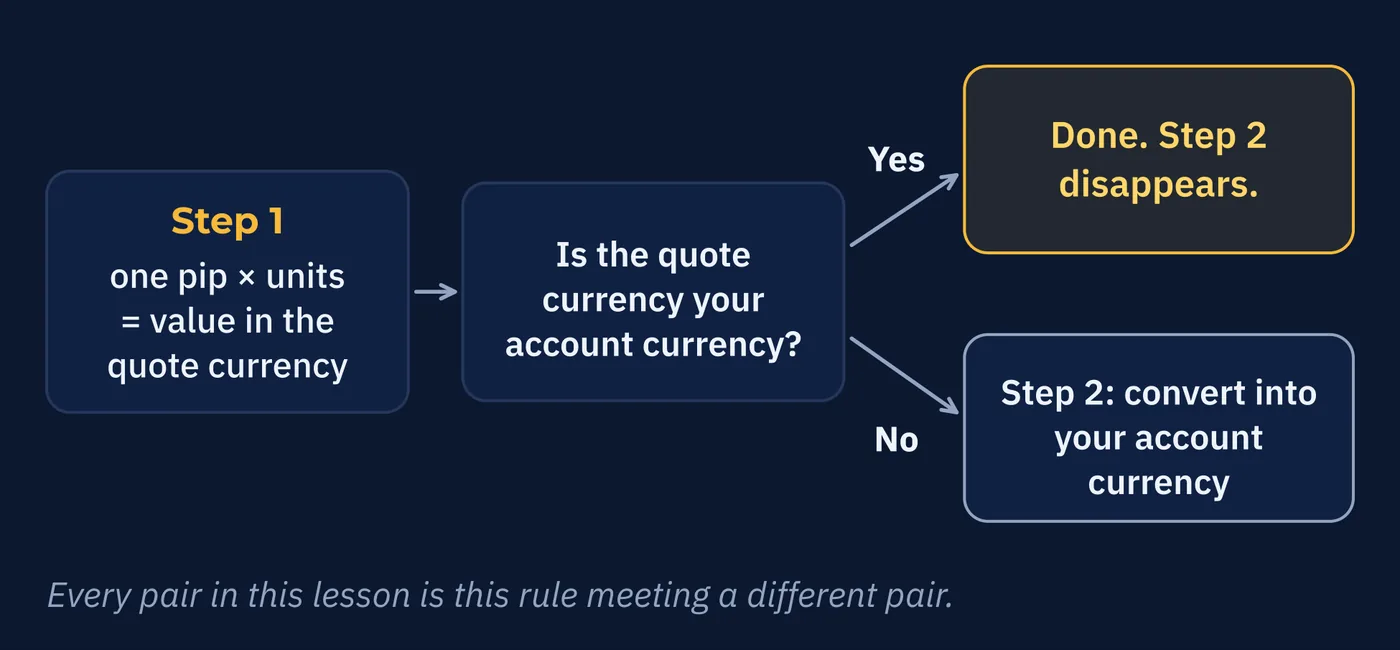
A pip is always worth something in the quote currency first.
Recall from Lesson 2 that the quote currency is the second one named, and it is what the price is denominated in. So a pip of movement is a movement in that currency.
one pip × units of base currency = value in the quote currencyThen, if the quote currency is not the currency your account is held in, you convert.
That is the whole method. Two steps, and the second one sometimes disappears. Everything that follows is just this rule meeting different pairs.
3When the Quote Currency Is Already Yours
Start with the easy case, which is most of the pairs a beginner will trade.
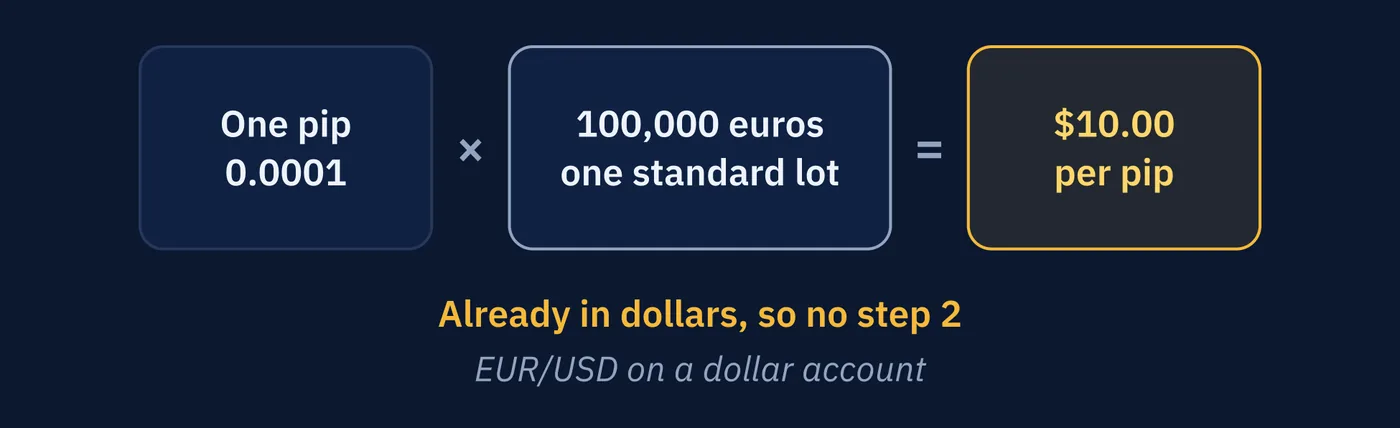
On EUR/USD, GBP/USD, AUD/USD, and NZD/USD, the quote currency is the U.S. dollar. If your account is in dollars, the second step vanishes.
0.0001 × 100,000 = $10.00 per pipOne standard lot, one pip, ten dollars. No conversion, because the answer already came out in dollars.
And since pip value scales directly with size, the smaller lots follow immediately.
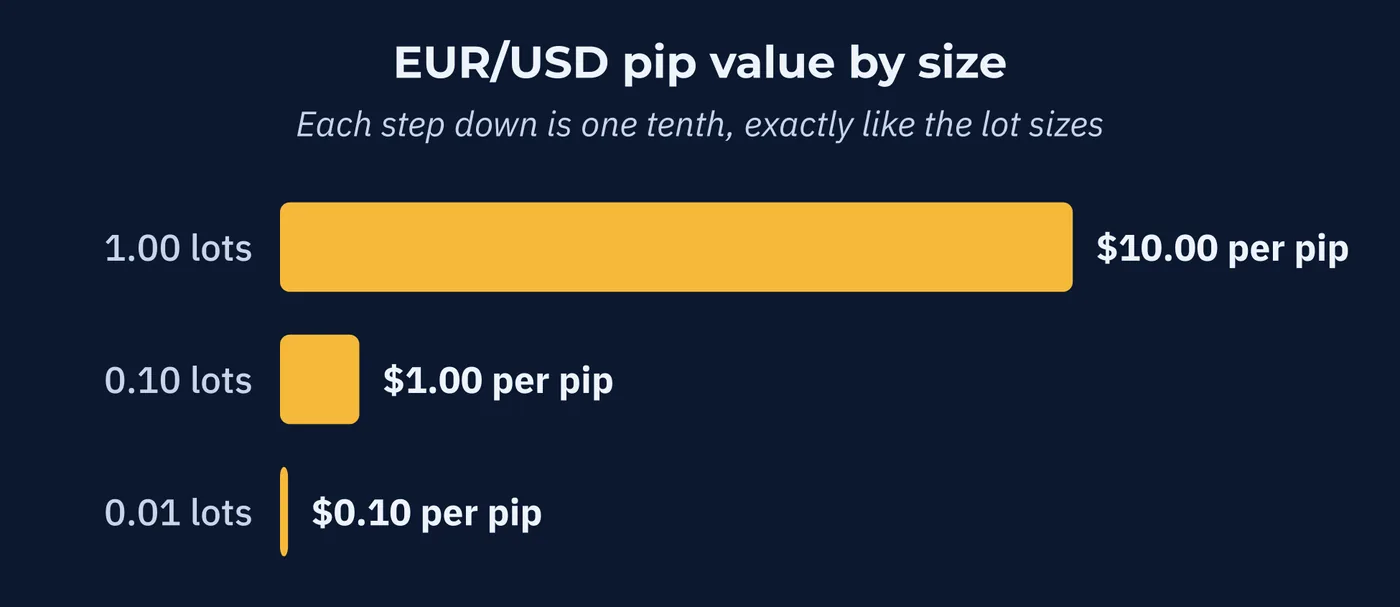
| Size | Units | Pip Value |
|---|---|---|
| 1.00 lots | 100,000 | $10.00 |
| 0.10 lots | 10,000 | $1.00 |
| 0.01 lots | 1,000 | $0.10 |
These figures are fixed. They do not change when the price moves, because the quote currency is the dollar whatever the rate happens to be.
This is why EUR/USD is such a comfortable place to learn. One less thing is moving.

4When the Quote Currency Is Not Yours
Now flip the dollar to the front. On USD/JPY, USD/CAD, and USD/CHF, the quote currency is something else, so the second step reappears.
Take USD/JPY with the price at 150.00. The pip on a yen pair is 0.01, from Lesson 13.
0.01 × 100,000 = ¥1,000 per pipThat is the first step, and the answer is in yen. Now convert it into dollars by dividing by the current rate.
¥1,000 ÷ 150.00 = $6.67 per pip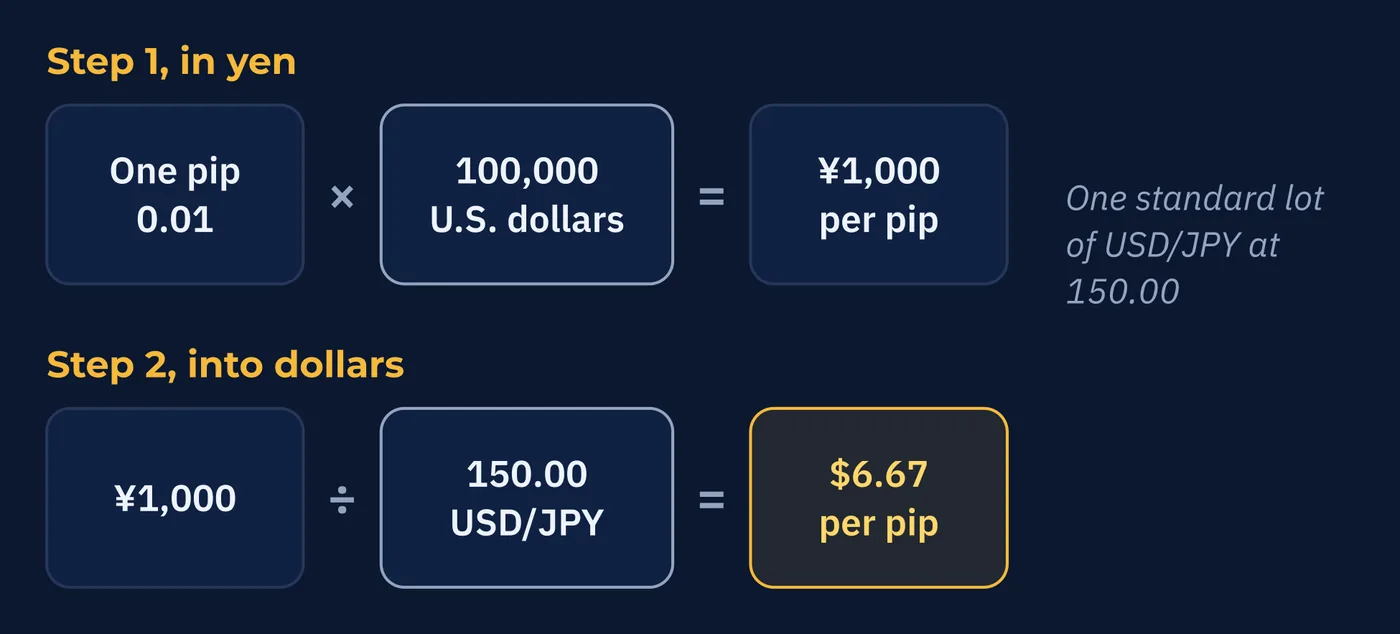
Two things follow, and both matter.
The first is that a pip on USD/JPY is worth substantially less than a pip on EUR/USD at the same position size. Six dollars and change against ten dollars. Identical lot, different money.
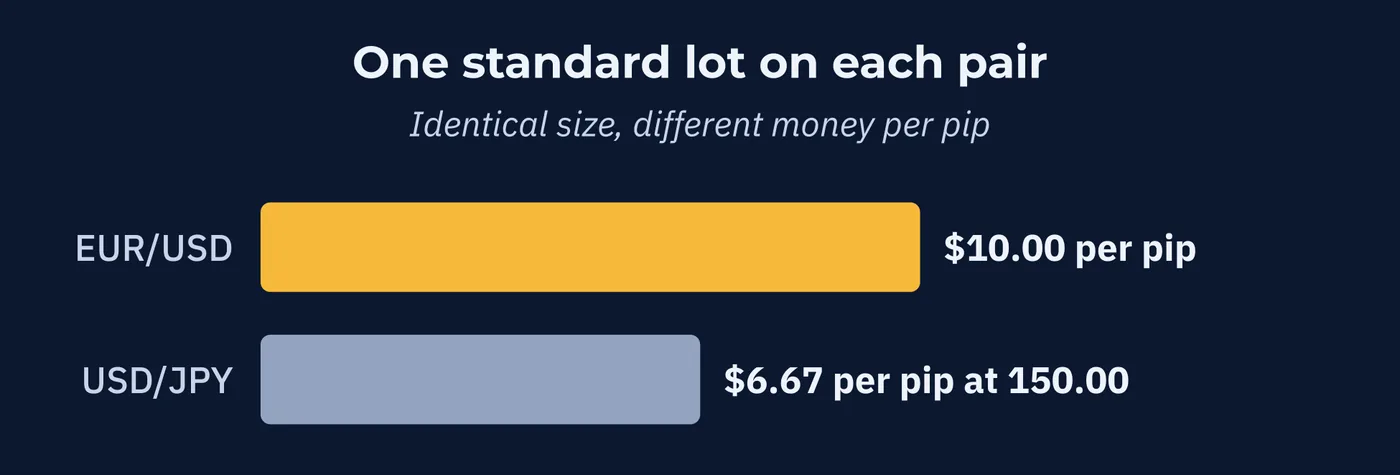
The second is that this number moves. It was calculated using the current rate, and the rate changes constantly. At 145.00 the same pip would be worth about $6.90. At 155.00 it would be about $6.45.
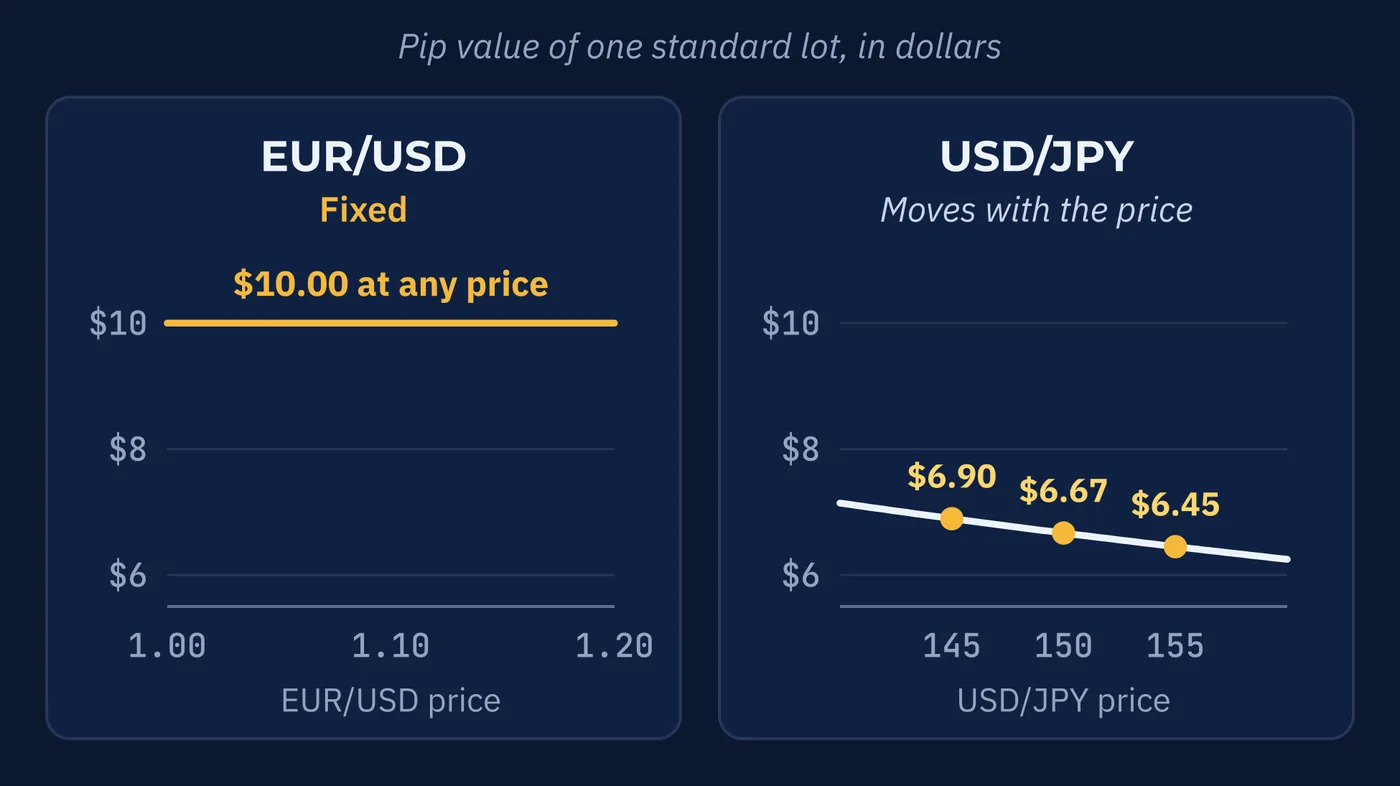
So on these pairs, pip value is not a fixed figure to memorize. It is something you calculate when you need it, using the price in front of you.
5Cross Pairs Take Two Steps
Cross pairs, from Lesson 9, have no dollar at all. So the conversion has further to travel.
Take EUR/GBP. The quote currency is the pound, so step one produces an answer in pounds.
0.0001 × 100,000 = £10.00 per pipNow convert pounds to dollars using GBP/USD. At 1.2700:
£10.00 × 1.2700 = $12.70 per pip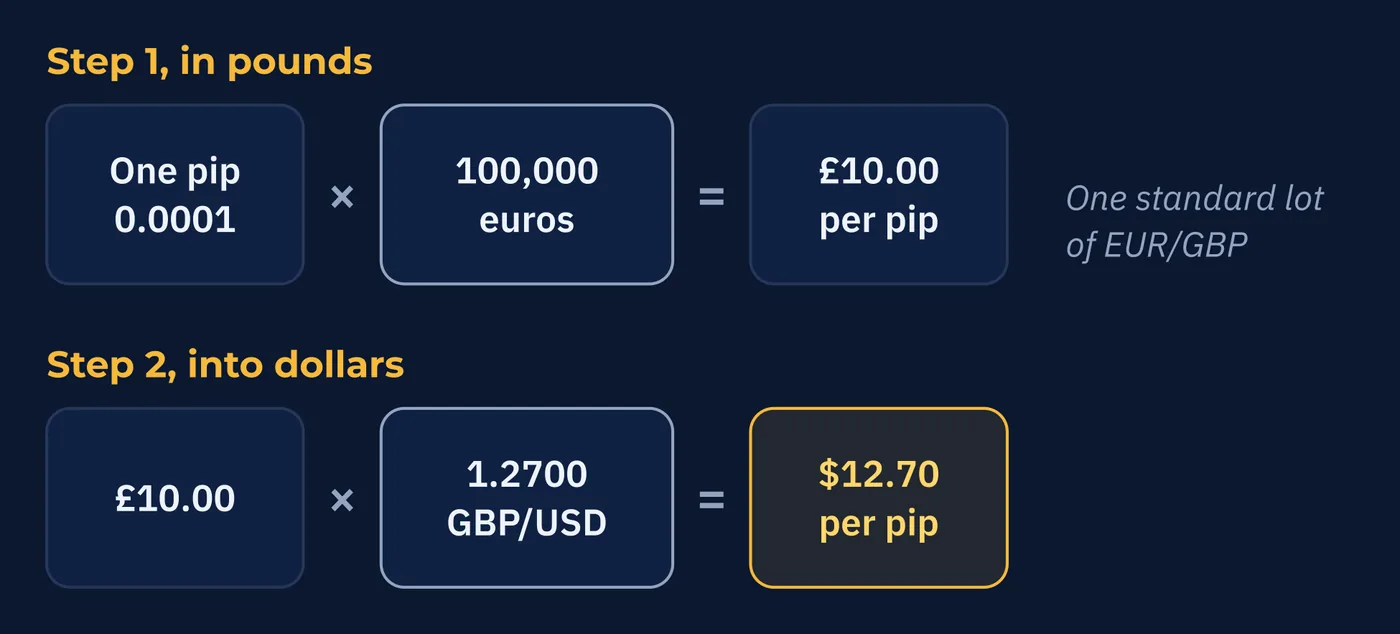
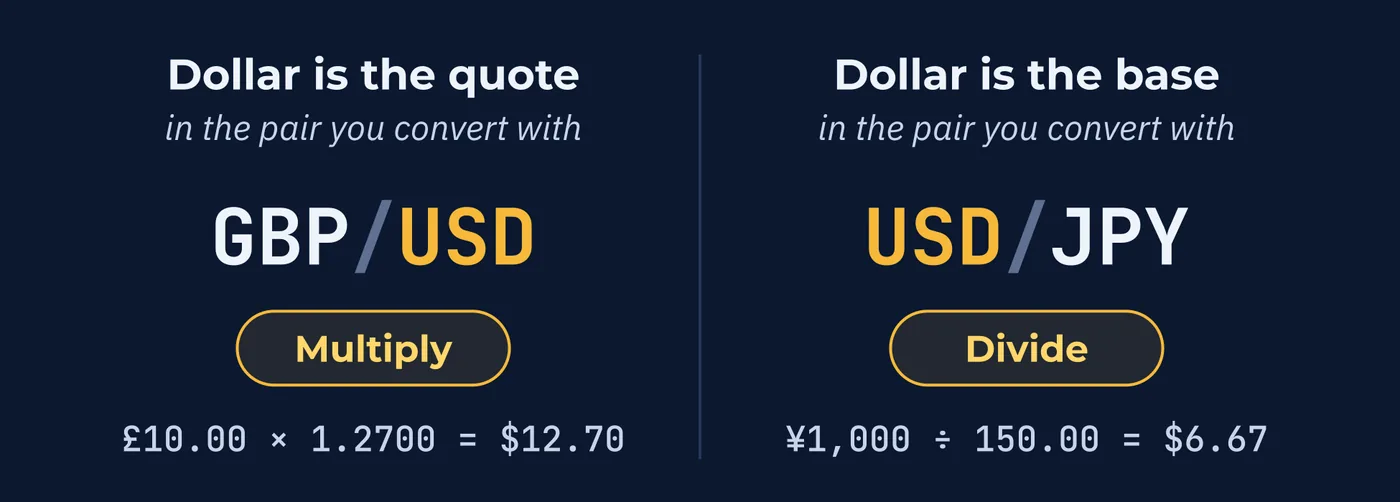
Notice this one multiplies where the yen example divided. The reason is the same one from Lesson 9, and it comes down to where the dollar sits in the pair doing the converting.
There is a shortcut worth knowing. If the conversion pair has the dollar as its quote currency, as GBP/USD does, you multiply. If the dollar is the base, as in USD/JPY, you divide.
6Same 100 Pips, Three Different Results
Here is the payoff. Three traders each take one standard lot. Each is right. Each catches exactly 100 pips.
| Pair | Pip Value | 100 Pips Is Worth |
|---|---|---|
| EUR/USD | $10.00 | $1,000 |
| USD/JPY at 150.00 | $6.67 | $667 |
| EUR/GBP at GBP/USD 1.2700 | $12.70 | $1,270 |
Same skill. Same size. Same pip count. The results differ by almost double from bottom to top.
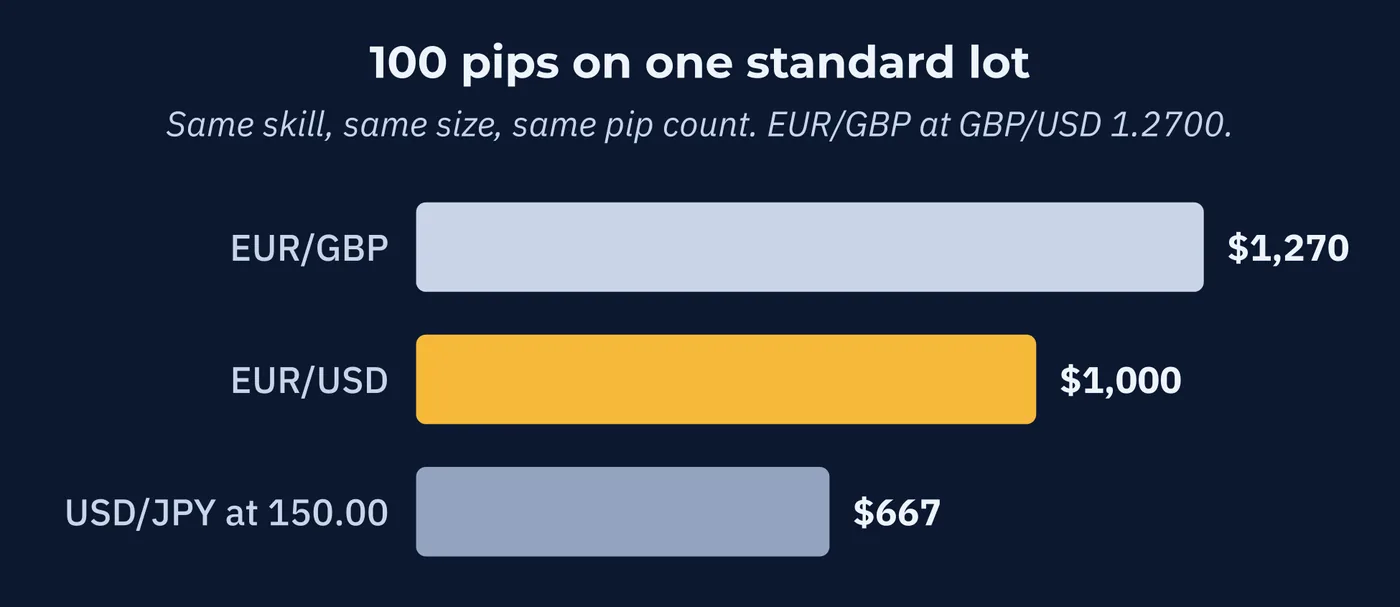
Pip count and money are not the same thing.
This is worth holding onto, because pips are how traders talk. Somebody says they made 80 pips this week and it sounds like a fact about their results. It is not. It is a fact about distance, and without the pair and the size it says nothing about money at all.
7If Your Account Is Not in Dollars
Everything so far assumed a dollar account. If yours is held in something else, one more step joins the end.
Work out the pip value in dollars exactly as above, then convert into your account currency using its rate against the dollar.
A trader with a pound account holding one standard lot of EUR/USD has a pip value of $10.00. With GBP/USD at 1.2700:
$10.00 ÷ 1.2700 = £7.87 per pip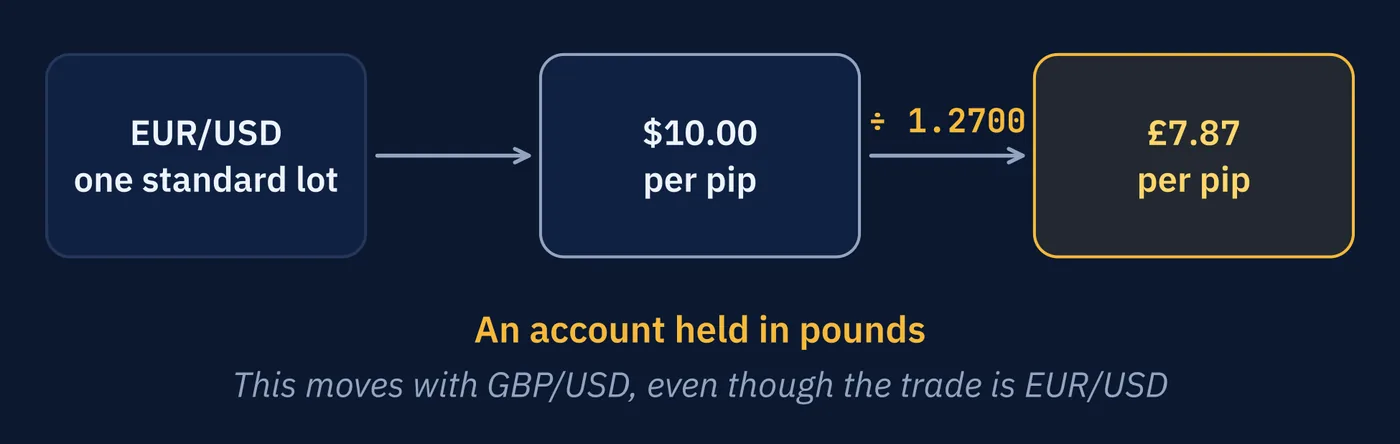
Which introduces a subtlety worth knowing. That figure moves with GBP/USD, even though the position is in EUR/USD and has nothing to do with the pound.
So an account held in a currency other than the pair's quote currency carries a small extra exposure, simply through the conversion. It is usually minor. It is not zero, and it is worth knowing it exists rather than being puzzled by it later.
8What This Changes
Three practical consequences follow from all of this.
The first is that you can now compare trades across different pairs properly. Lesson 14's viability test worked in pips because the pair was held constant, and pip value canceled out. Comparing across pairs needs dollars, and now you can produce them.
The second is that pip value is the bridge between a chart and an account. Everything you decide on a chart happens in pips. Everything that happens to your money happens in your account currency. Pip value is the only thing joining them, which is why it sits at the center of this series.

The third is the one to carry forward.
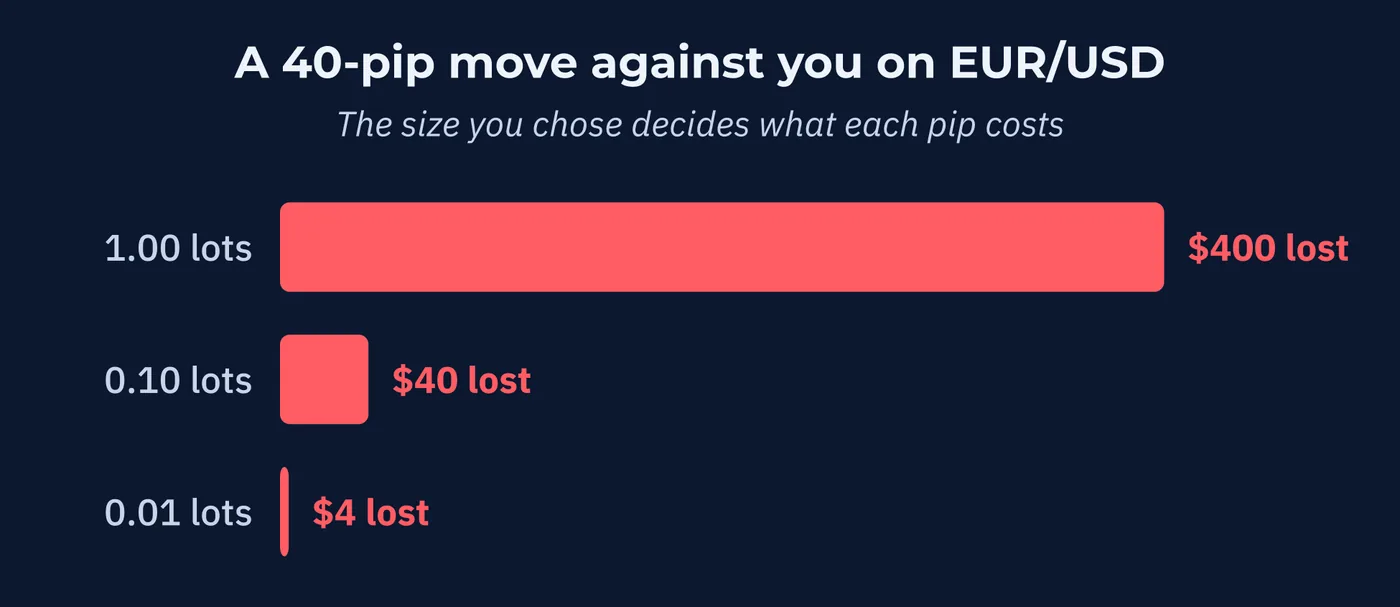
Which leads directly to the next question, the one Lesson 15 left hanging. A standard lot of EUR/USD is a position worth more than a hundred thousand dollars. Almost nobody learning to trade has that. Lesson 17 explains how the position happens anyway, and what it costs you to arrange.
Three Things to Remember
Try This
Fifteen minutes and a calculator. Do it by hand once, then check yourself against the platform.
Words From This Lesson
| Term | What It Means |
|---|---|
| Pip value | What one pip of movement is worth on your position, expressed in your account currency. |
| Quote currency | The second currency in a pair. Pip value is always calculated in this currency before any conversion. |
| Account currency | The currency your trading account is held in. Pip value is converted into this to be meaningful to you. |
| Conversion pair | The pair used to translate a pip value from the quote currency into your account currency. |
| Fixed pip value | A pip value that does not change as the price moves, which happens when the quote currency is your account currency. |
Test Your Knowledge
Eight questions. Answer them all before checking the key on the following pages. If a question gives you trouble, the answer key tells you which section to revisit.
- A. Your account currency
- B. The quote currency
- C. The base currency
- D. The U.S. dollar, always
- A. $10.00
- B. $1.00
- C. $100.00
- D. It changes with the price
- A. $0.01
- B. $1.00
- C. $0.10
- D. $10.00
- A. EUR/USD is more heavily traded
- B. USD/JPY uses a different lot size
- C. On EUR/USD the quote currency is already the dollar, so no conversion is needed
- D. Brokers set pip values differently by pair
- A. About $6.67
- B. $10.00
- C. About $15.00
- D. ¥1,000
- A. All three made the same amount
- B. Pip counts cannot be compared at all
- C. The EUR/USD trader made the most
- D. They made noticeably different amounts
- A. £12.70
- B. £1.27
- C. £10.00
- D. £7.87
- A. Platforms are frequently wrong
- B. So you can tell whether a displayed number is right and understand what it means
- C. Manual calculation is required by brokers
- D. It is faster than using the tool
Answer Key
Each answer explains why the correct choice is correct, why the others are not, and where to reread.
Question 1 · correct answer B
A pip is a movement in the quote currency, so that is where the value appears first. Any conversion happens afterward.
A is where you finish rather than where you start, and on many pairs a conversion is needed to get there. C names the currency you are holding units of, not the one the price is expressed in. D is true only for dollar-quoted pairs, which is a case rather than the rule.
Review: Section 2, The One Rule
Question 2 · correct answer A
0.0001 multiplied by 100,000 units is ten dollars, and because the quote currency is already the dollar there is nothing to convert.
B is a mini lot at the same pair. C is off by a factor of ten. D describes pairs where the quote currency is not the dollar, such as USD/JPY.
Review: Section 3, When the Quote Currency Is Already Yours
Question 3 · correct answer C
Pip value scales directly with size. A micro lot is one hundredth of a standard lot, so ten dollars becomes ten cents.
A is a nano lot. B is a mini lot. D is a standard lot. Since GBP/USD is dollar-quoted, the same fixed figures apply as on EUR/USD.
Review: Section 3, When the Quote Currency Is Already Yours
Question 4 · correct answer C
On EUR/USD the calculation already produces dollars, so no conversion is required and the figure never moves. On USD/JPY it produces yen, which must be converted at a rate that changes constantly.
A confuses trading volume with the arithmetic, and volume affects spreads rather than pip value. B is wrong because a standard lot is 100,000 units on both. D is wrong because pip value follows from the pair's structure, not from broker policy.
Review: Section 4, When the Quote Currency Is Not Yours
Question 5 · correct answer A
0.01 multiplied by 100,000 is 1,000 yen, and 1,000 divided by 150.00 gives about $6.67.
B applies the dollar-quoted figure to a pair where the dollar is the base. C multiplies by the rate instead of dividing. D gives the correct first step but stops before converting into dollars.
Review: Section 4, When the Quote Currency Is Not Yours
Question 6 · correct answer D
Pip value differs by pair, so 100 pips produces about $1,000, $667, and $1,270 respectively at the same lot size.
A assumes pip counts convert to money identically, which is the misconception this lesson exists to correct. C is wrong because the EUR/GBP result is the largest of the three. B overcorrects, since pip counts compare perfectly well once converted.
Review: Section 6, Same 100 Pips, Three Different Results
Question 7 · correct answer D
Ten dollars divided by 1.2700 gives about £7.87. A pound buys more than a dollar, so the figure in pounds is smaller.
A multiplies rather than divides, which would be correct going the other way. C ignores the conversion entirely. B divides the rate into one instead of into the pip value.
Review: Section 7, If Your Account Is Not in Dollars
Question 8 · correct answer B
A tool gives you a number with no explanation. The arithmetic is what lets you check it and understand why a position behaves as it does.
A overstates it, since platform calculators are generally reliable. C invents a requirement that does not exist. D is wrong because the tool is plainly faster, which is exactly why you use both.
Review: Section 5, Cross Pairs Take Two Steps
Keep going
The Real Cost & Mechanics of a Trade is written by Kanin D. Alldredge for The Currency Classroom, and it is free to read. There is more free from CNS: start here.
Start free with CNS →