Lots

1The Question Pips Cannot Answer
EUR/USD moved eighty pips today. Was that a good day?
You cannot say. Eighty pips is a distance, and a distance means nothing until you know how much was riding on it. The same eighty pips might be worth eight dollars or eight thousand, and nothing about the chart tells you which.
What decides it is position size. How much of the base currency you actually bought or sold.
The chart gives you the distance. You supply the size.
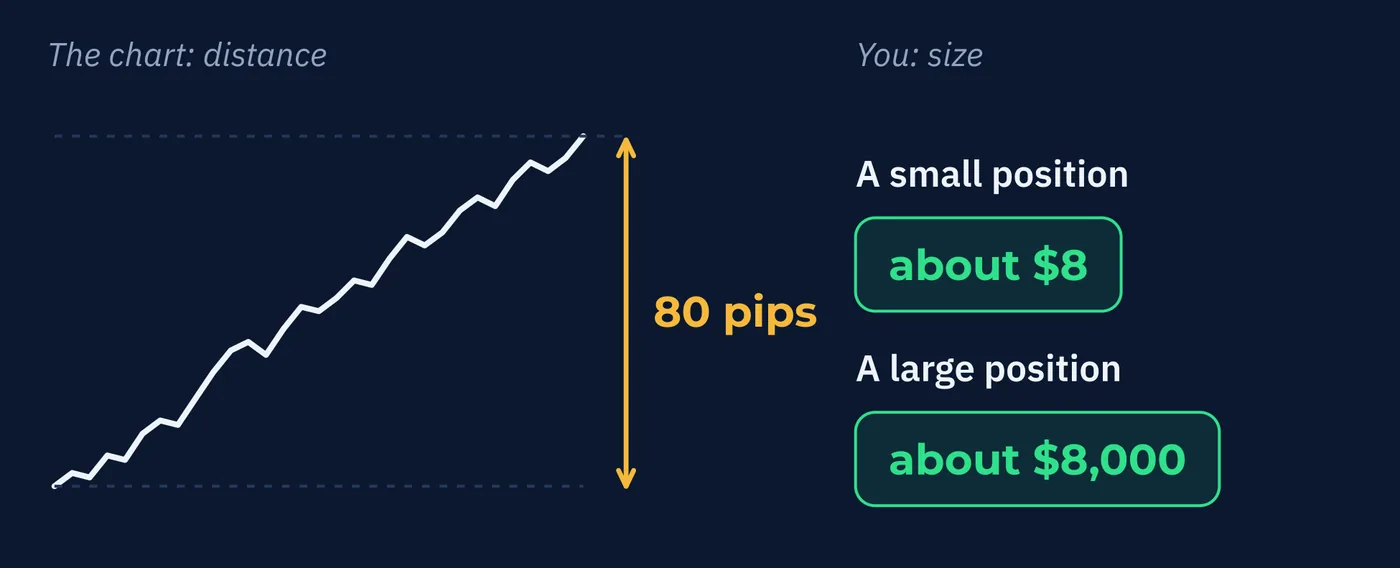
And because everyone needs to talk about size without describing it from scratch every time, the market standardized it. The unit is called a lot.
2The Standard Lot
A standard lot is 100,000 units of the base currency.
The base currency, from Lesson 2, is the first one named in the pair. That matters here more than anywhere else, because it determines what you are actually holding.
| Pair | One Standard Lot Is |
|---|---|
EUR/USD | 100,000 euros |
GBP/USD | 100,000 British pounds |
USD/JPY | 100,000 U.S. dollars |
AUD/USD | 100,000 Australian dollars |
Read that table carefully. A standard lot is not a fixed amount of money. It is a fixed number of units of whichever currency comes first.
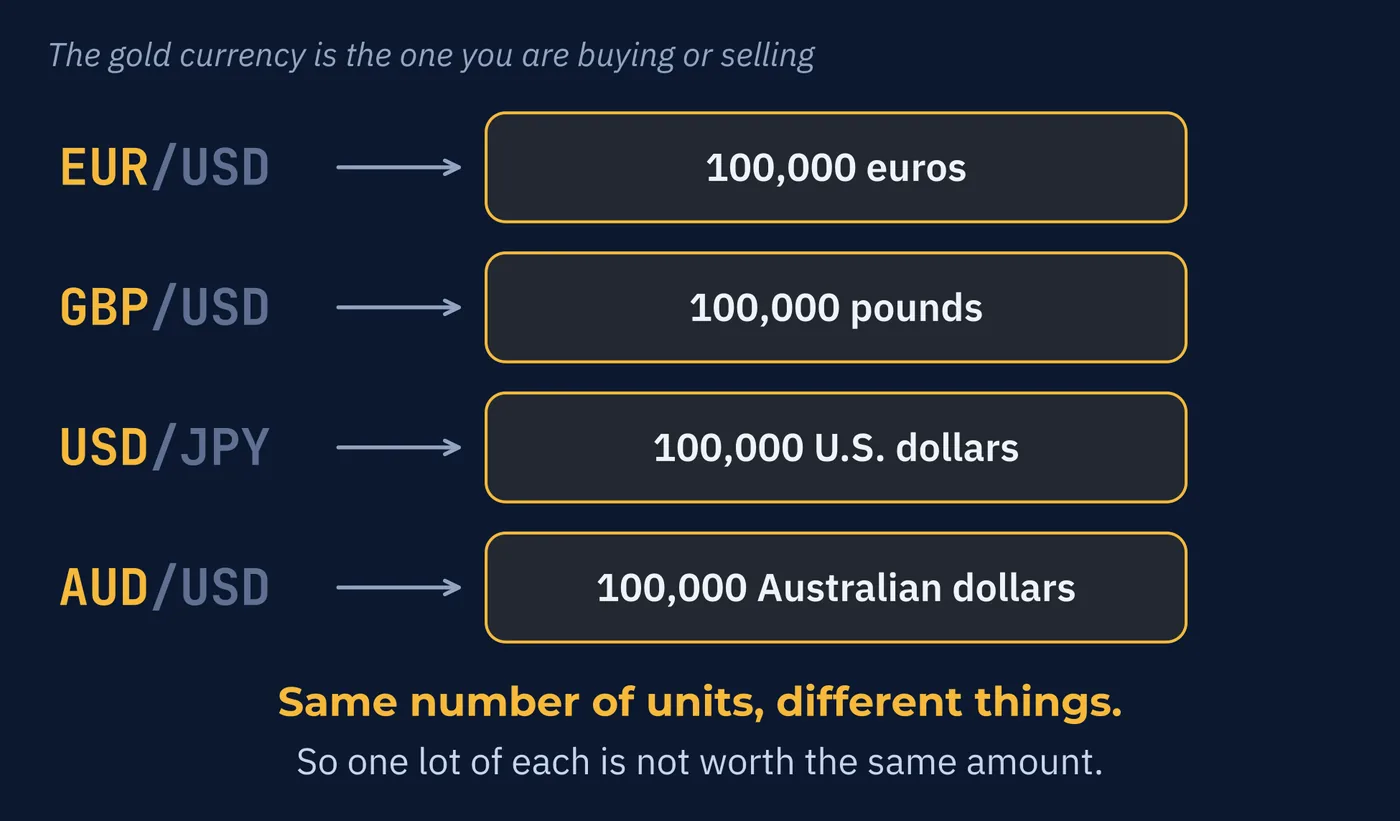
So one lot of EUR/USD and one lot of GBP/USD are the same quantity of different things, and they are not worth the same amount. That difference matters for the next lesson.
3Four Sizes, and Everything Between
Nobody expects a beginner to trade a hundred thousand euros. The system has smaller sizes, each a tenth of the one above it.
| Name | Units of Base Currency | Written As |
|---|---|---|
| Standard lot | 100,000 | 1.00 lots |
| Mini lot | 10,000 | 0.10 lots |
| Micro lot | 1,000 | 0.01 lots |
| Nano lot | 100 | 0.001 lots |
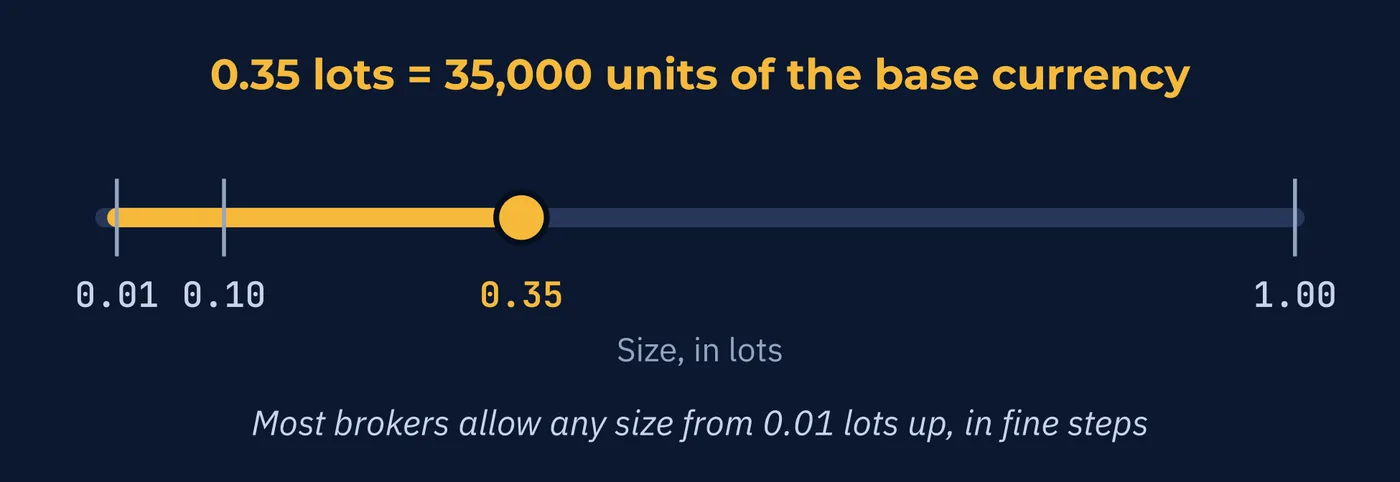
Most brokers let you size anywhere from 0.01 lots upward in fine increments, so you are not restricted to those four points. A position of 0.35 lots is simply 35,000 units of the base currency.
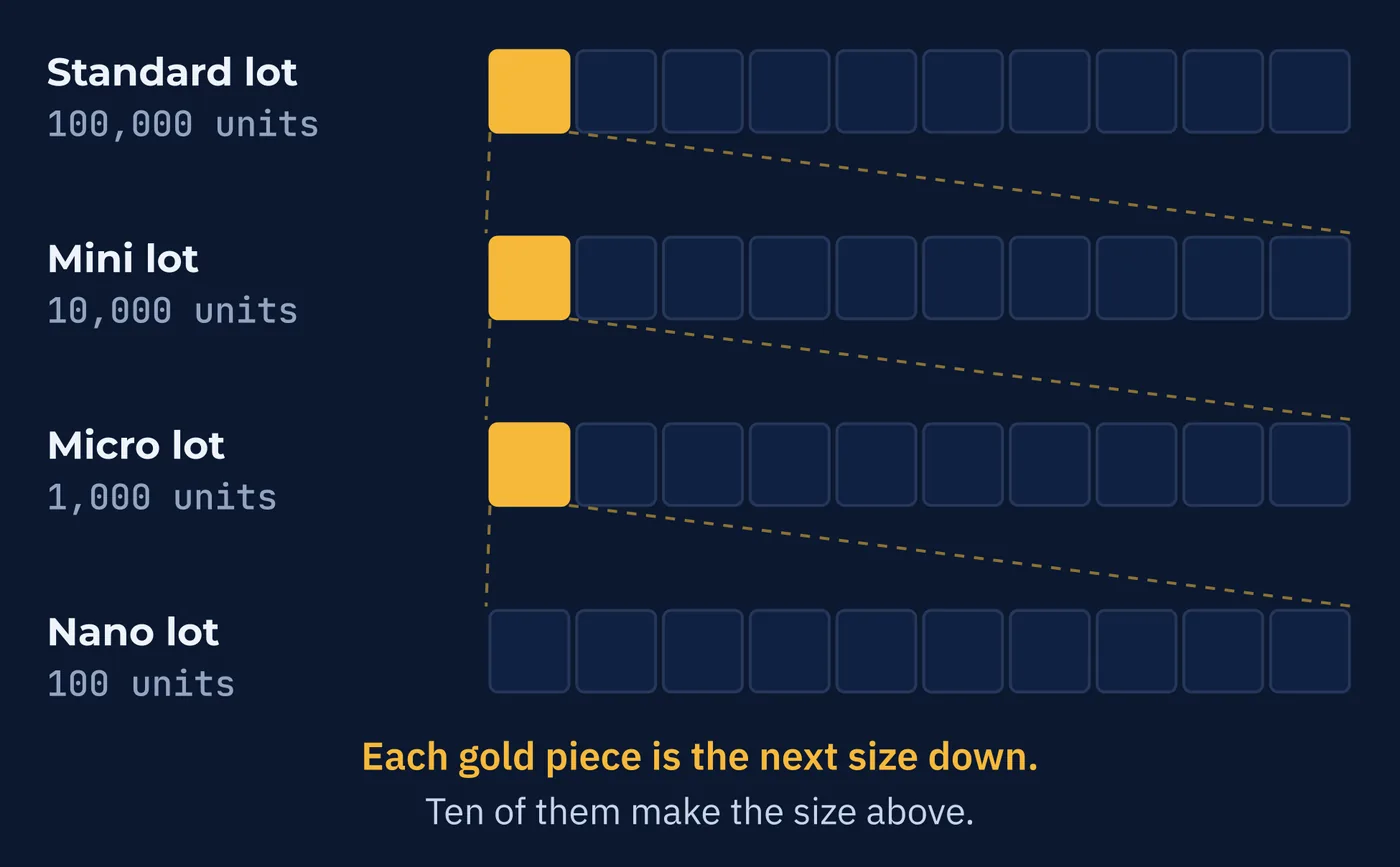
That flexibility is the entire point. Whatever your account holds, you can pick a size that fits it rather than being forced into a step that is too large.
4What a Position Is Actually Worth
A lot tells you how many units of the base currency you hold. To know what that is worth in dollars, multiply by the price.
units of base currency × current price = position valueTake EUR/USD at 1.0850. One standard lot is 100,000 euros, and each euro costs 1.0850 dollars.
100,000 × 1.0850 = $108,500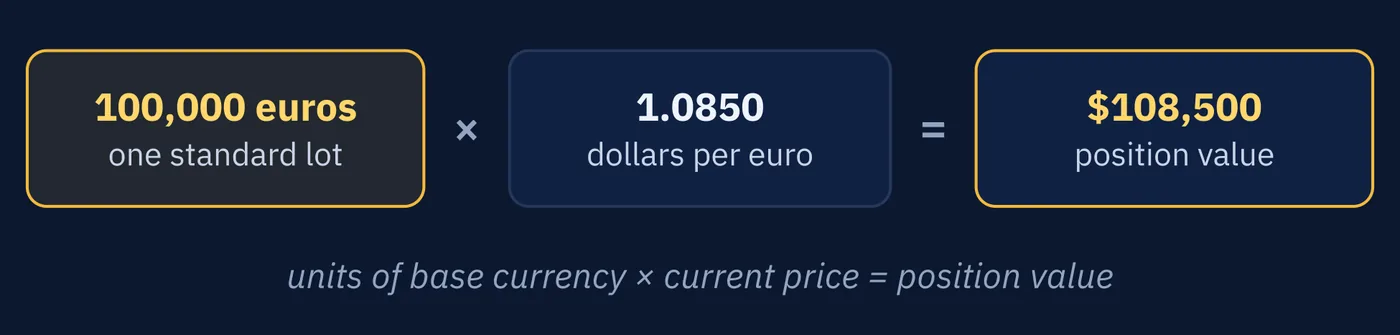
That is the value of the position you are holding. Here is the same pair at every size.
| Size | Units | Position Value at 1.0850 |
|---|---|---|
| 1.00 lots | 100,000 euros | $108,500 |
| 0.10 lots | 10,000 euros | $10,850 |
| 0.01 lots | 1,000 euros | $1,085 |
Two things are worth noticing here.
The first is that position value moves with the price. The same one lot position is worth a different dollar amount tomorrow, because the euro will be priced differently.
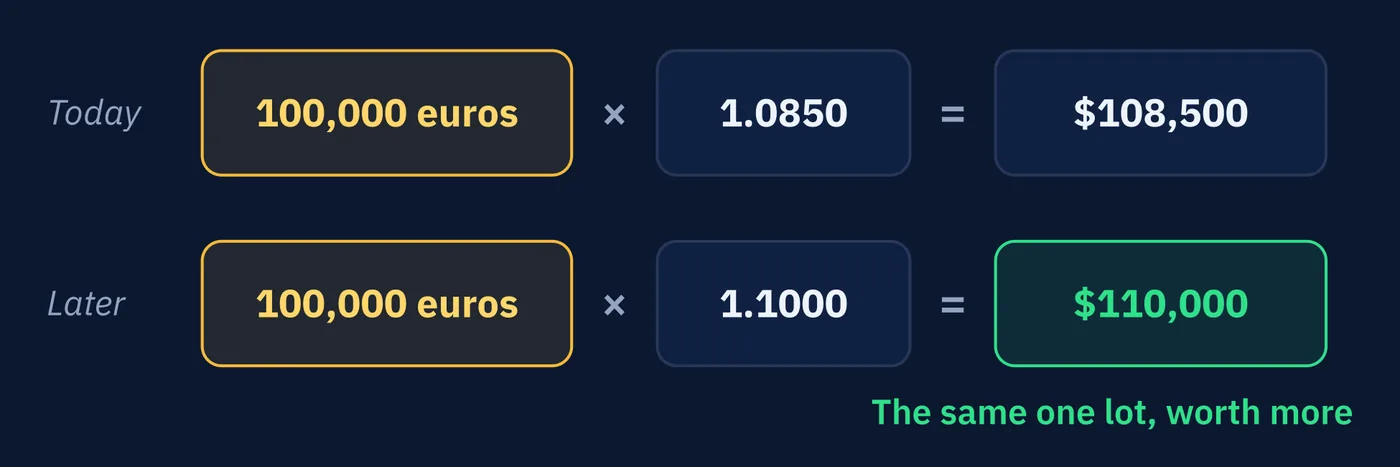
The second is that these numbers are large. A single standard lot of EUR/USD is a position worth more than a hundred thousand dollars, and very few people learning to trade have that sitting in an account.
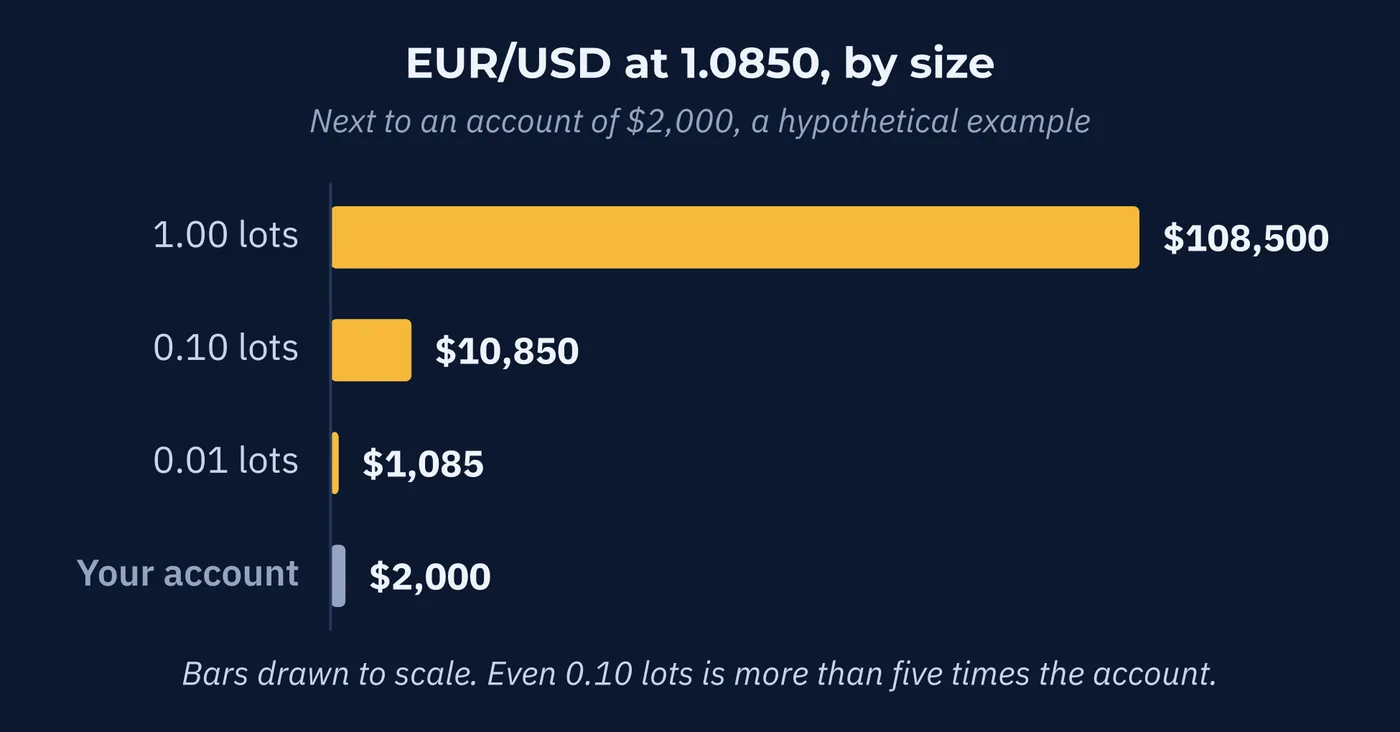
Which raises an obvious question: how does anybody hold a position worth more than they have? That is Lesson 17, and it is the most consequential lesson in this series.
5Why the Lot System Exists
It is worth understanding what problem the lot solves, because the alternative still exists and shows the difference clearly.
Currency futures, traded on an exchange, use fixed contract sizes. One British pound futures contract represents a set amount, and you either buy a whole contract or you do not participate. There is no partial option.
For a large institution that is fine. For someone with a modest account it is a wall. The contract is the size it is, and if that size is too big for your capital, the market is closed to you.
The lot system removes the wall. The unit scales to the account rather than the account having to reach the unit.
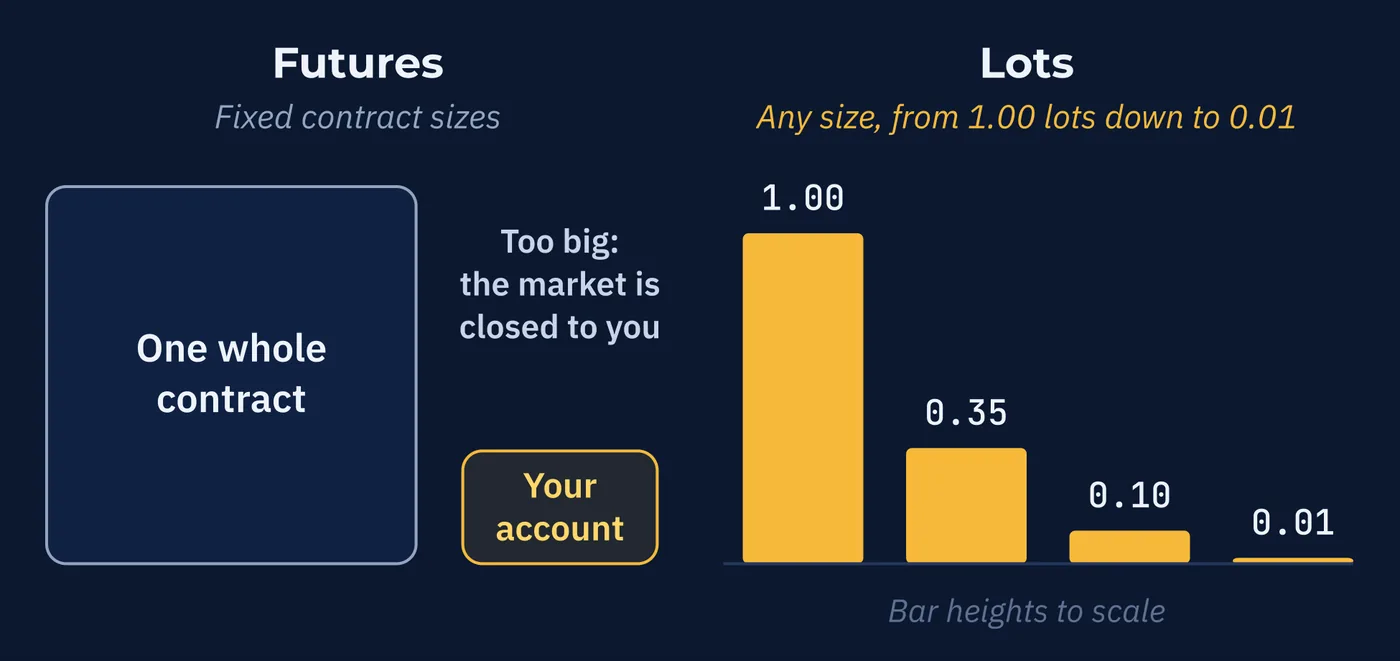
The size fits the trader, not the other way around.
Somebody with a small account can express exactly the same view on EUR/USD as somebody with a large one. Same pair, same analysis, same direction, sized proportionately. That is genuinely unusual among financial markets, and it is one of the real structural advantages retail currency trading has.
6Crypto Does Not Use Lots
Open a crypto exchange and you will not find a lot anywhere.
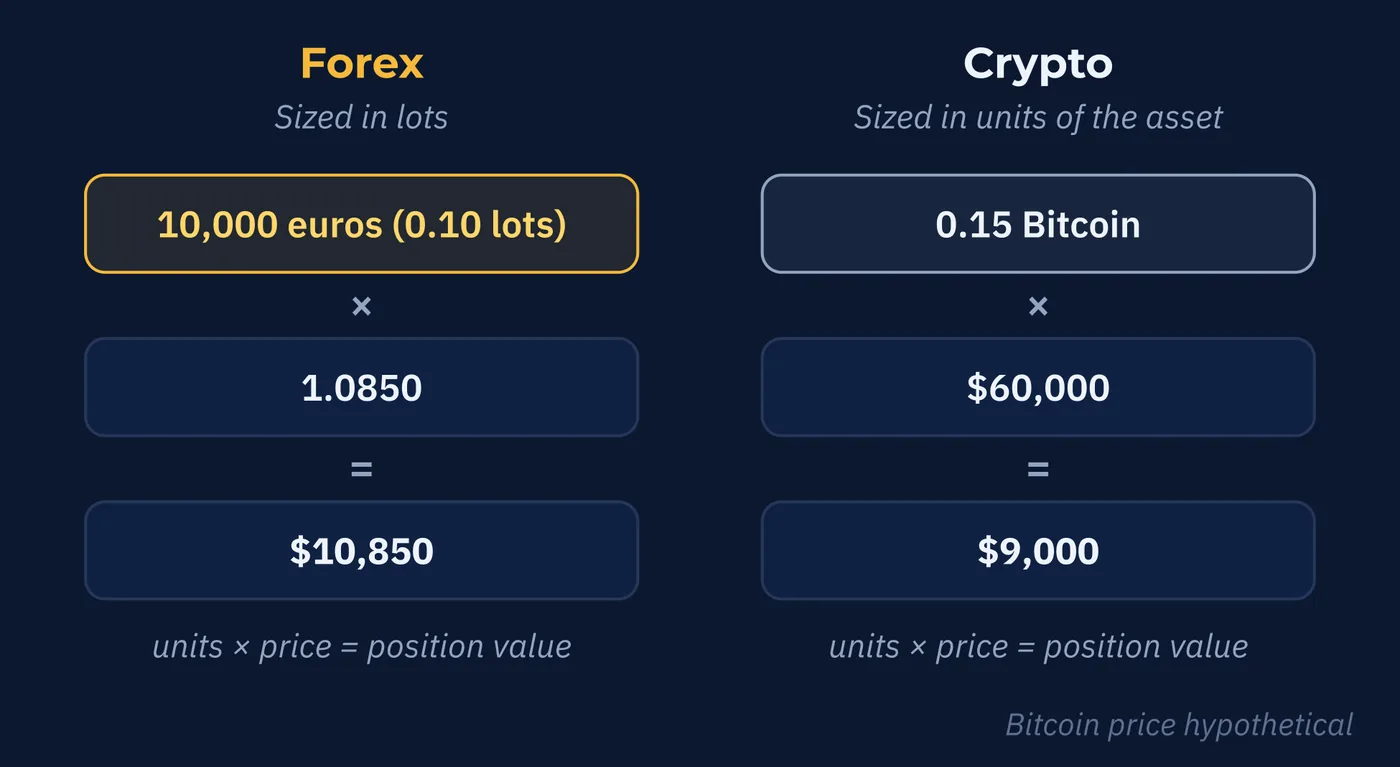
Positions are sized directly in units of the asset. You buy 0.15 Bitcoin, or 3 Ether, or 240 of something smaller. On derivatives platforms you may size in contract units denominated in the quote currency instead.
The reason is the one from Lesson 13. Standardizing a unit only works when prices sit in a comparable range. Crypto assets range from tens of thousands of dollars to fractions of a cent, so a fixed unit like 100,000 would be absurd at one end and meaningless at the other.
What does not change is the logic underneath.
| Forex | Crypto | |
|---|---|---|
| Sized in | Lots of the base currency | Units of the asset |
| Position value | Units × price | Units × price |
| Everything downstream | Scales with size | Scales with size |
Different units, identical arithmetic. Position value determines what a move is worth, and that is true in every market that has ever existed.
7Size Is the First Number That Matters
Here is why this lesson sits where it does in the series.
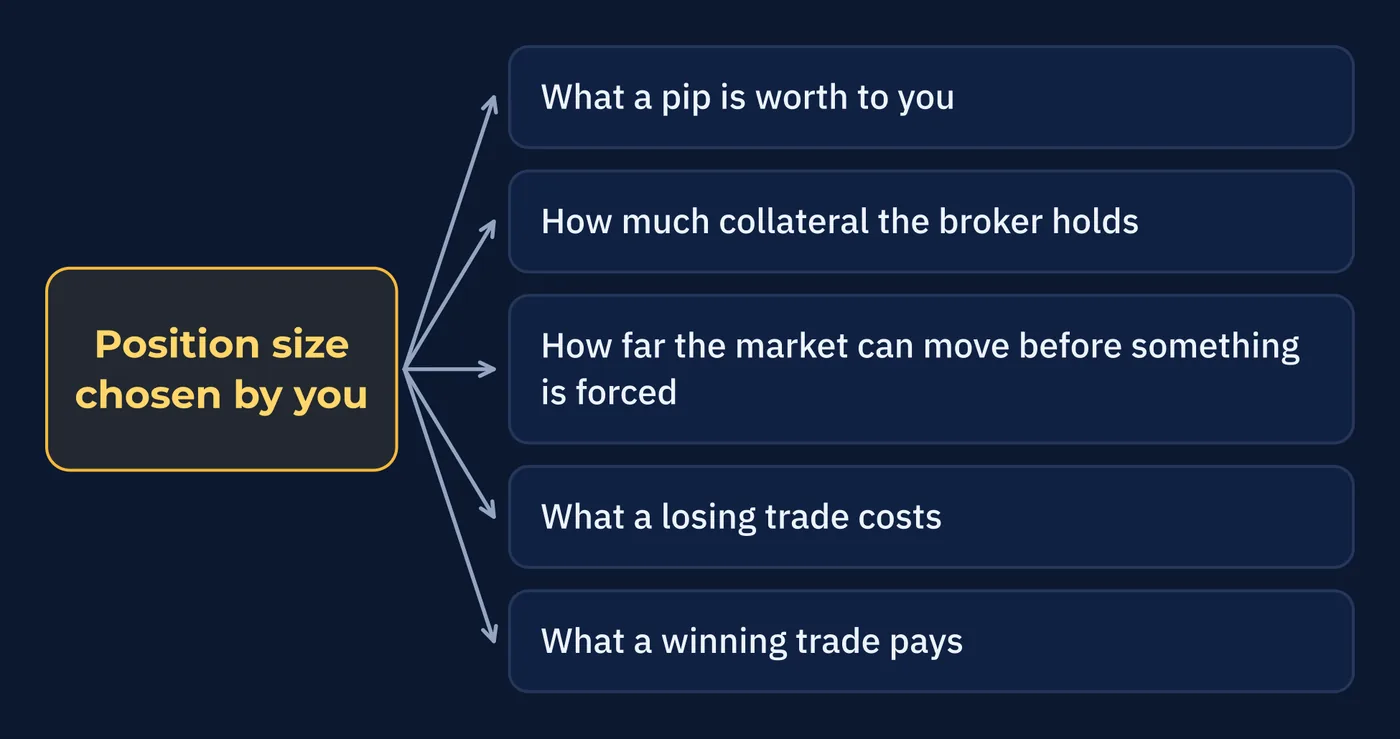
Almost everything ahead scales directly from position size. What a pip is worth to you. How much collateral a broker holds. How far the market can move against you before something is forced. How much a losing trade costs and how much a winning one pays.
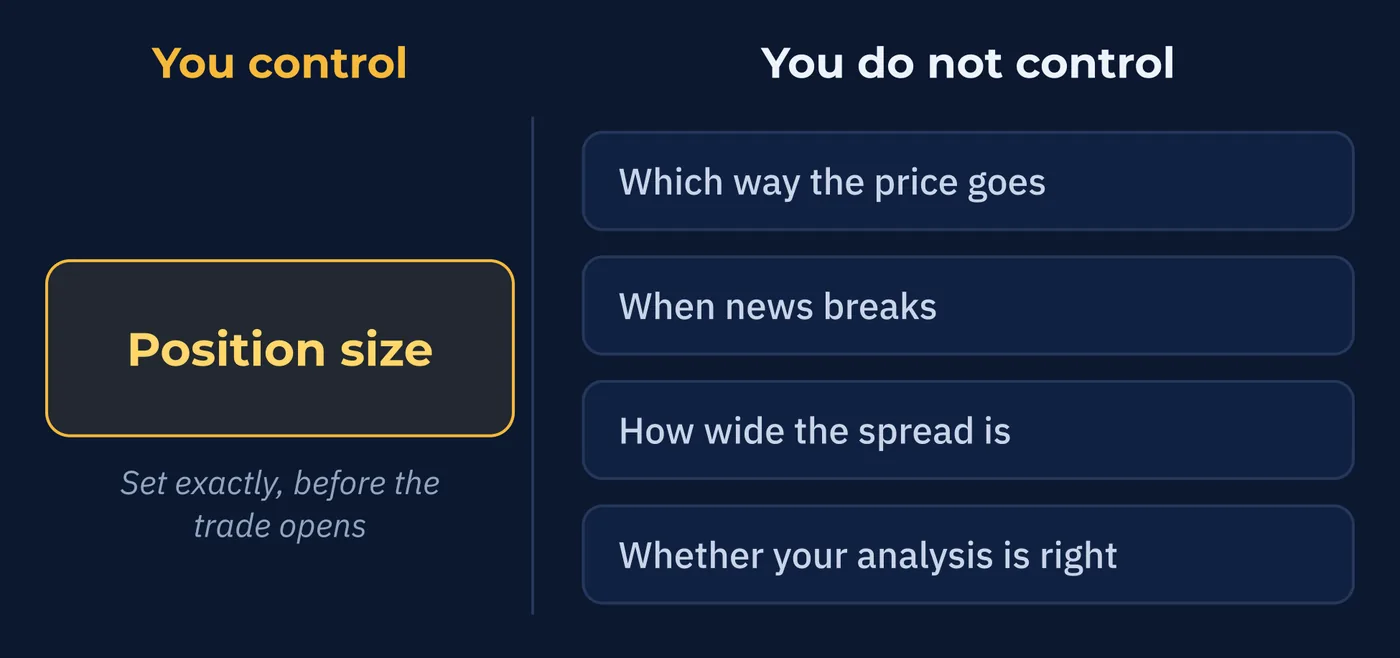
All of it flows from one number, and that number is chosen by you before anything else happens.
The next lesson gives you the arithmetic to make that decision with real numbers. What one pip is worth at each size, on each kind of pair, and why the answer is not the same everywhere.
Three Things to Remember
Try This
Ten minutes and a calculator. Get a feel for the sizes before they matter.
Words From This Lesson
| Term | What It Means |
|---|---|
| Lot | The standardized unit of position size in currency trading. A standard lot is 100,000 units of the base currency. |
| Mini lot | 10,000 units of the base currency. Written as 0.10 lots. |
| Micro lot | 1,000 units of the base currency. Written as 0.01 lots. The smallest size most brokers offer. |
| Nano lot | 100 units of the base currency. Offered by some brokers only. |
| Position size | How much of the base currency you hold in a trade. The one variable you set completely yourself. |
| Position value | What the position is worth in your account currency. Units multiplied by the current price. |
Test Your Knowledge
Eight questions. Answer them all before checking the key on the following pages. If a question gives you trouble, the answer key tells you which section to revisit.
- A. 100,000
- B. 10,000
- C. 1,000
- D. 1,000,000
- A. U.S. dollars
- B. British pounds
- C. Euros
- D. Whichever currency your account is held in
- A. 100
- B. 100,000
- C. 10,000
- D. 1,000
- A. 35,000 units
- B. 3,500 units
- C. 350 units
- D. 350,000 units
- A. $1,085
- B. $10,850
- C. $1,085,000
- D. $108,500
- A. Brokers revalue positions daily
- B. Lot sizes are recalculated each session
- C. The price moves, and value is units multiplied by price
- D. Position value is fixed once the trade opens
- A. Lots are cheaper to trade
- B. Lots can only be traded by professionals
- C. The size scales to the account rather than the account to the size
- D. Lots are guaranteed against loss
- A. In lots, exactly as in forex
- B. In units of the asset, or in exchange contract units
- C. In pips
- D. All positions are the same fixed size
Answer Key
Each answer explains why the correct choice is correct, why the others are not, and where to reread.
Question 1 · correct answer A
A standard lot is 100,000 units of the base currency. Every other size is a fraction of it.
C is a micro lot, B is a mini lot, and both are steps below the standard. D does not correspond to any standard size, though a trader could hold ten standard lots.
Review: Section 2, The Standard Lot
Question 2 · correct answer B
The lot is always measured in the base currency, which is the first one named. On GBP/USD that is the pound.
A takes the quote currency instead, which is the most common error here. C names a currency that does not appear in the pair at all. D confuses what you hold with what your account is denominated in, and those are separate things.
Review: Section 2, The Standard Lot
Question 3 · correct answer D
A micro lot is 1,000 units, written as 0.01 lots. It is the smallest size most brokers offer.
A is a nano lot, which not all brokers provide. C is a mini lot. B is a standard lot. The sizes step down by factors of ten, so keeping the order straight is what matters.
Review: Section 3, Four Sizes, and Everything Between
Question 4 · correct answer A
One lot is 100,000 units, so 0.35 lots is 35,000 units. Fractional sizing lets you land anywhere between the named sizes.
C and B are off by factors of a hundred and ten respectively. D would be 3.5 lots rather than 0.35, which is ten times the position.
Review: Section 3, Four Sizes, and Everything Between
Question 5 · correct answer D
100,000 euros multiplied by 1.0850 dollars per euro gives a position value of $108,500.
A is a micro lot and B is a mini lot at the same price. C is off by a factor of ten. The arithmetic is one multiplication, and the common slip is losing a decimal place.
Review: Section 4, What a Position Is Actually Worth
Question 6 · correct answer C
Position value is units multiplied by the current price. The unit count stays fixed while the price moves continuously, so the value moves with it.
A describes an administrative process rather than the underlying cause. B is wrong because lot sizes are fixed conventions that do not change. D contradicts how a ratio works, since one side of the multiplication is always in motion.
Review: Section 4, What a Position Is Actually Worth
Question 7 · correct answer C
Futures contracts come in fixed sizes, so a small account either buys a whole contract or stays out. Lots can be sized down to fit whatever capital exists.
A confuses flexibility with cost, and the two are unrelated. B reverses the situation, since the lot system exists precisely to open access. D is wrong because no position size protects against loss.
Review: Section 5, Why the Lot System Exists
Question 8 · correct answer B
Crypto sizes positions directly in units of the asset, or in contract units on derivatives platforms. A fixed unit could not span the range of crypto prices.
A is wrong because no crypto exchange uses lots. C confuses a unit of price movement with a unit of size, and crypto does not use pips either. D invents a restriction that does not exist.
Review: Section 6, Crypto Does Not Use Lots
Keep going
The Real Cost & Mechanics of a Trade is written by Kanin D. Alldredge for The Currency Classroom, and it is free to read. There is more free from CNS: start here.
Start free with CNS →