Risk Per Trade

1The Assumption Worth Examining
One percent. It gets repeated everywhere, usually without explanation, which makes it sound like a superstition.
It is not. It comes out of arithmetic, and once you see the arithmetic the number stops being a rule you follow and becomes one you understand.
The question it answers is this. On any one trade, how much of the account are you prepared to lose? That figure is your risk per trade, and it is the most consequential number you will set.
It matters more than which pair you choose, more than your entry, and more than whether any individual trade works. It is what decides whether you are still trading in a year.
2Why a Percentage
Risk could be set as a fixed dollar amount. Fifty dollars a trade, say. Most people's instinct is to think that way, and it is a worse system for one reason.
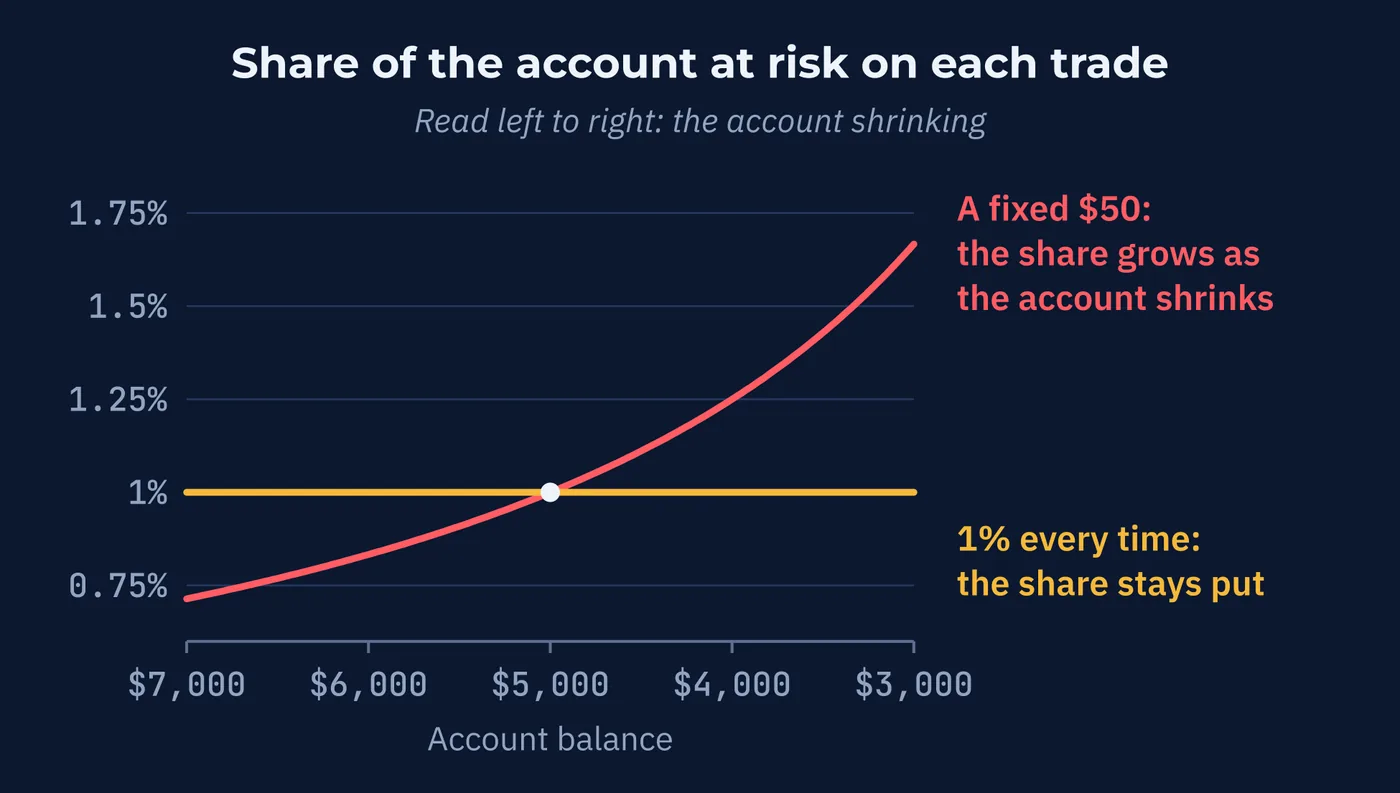
A percentage adjusts itself. A fixed amount does not.
Losing shrinks the account, and a percentage shrinks with it. Risking 1% of $5,000 is $50. After a bad run leaves $4,000, that same 1% is $40. The bets get smaller automatically, exactly when they should.
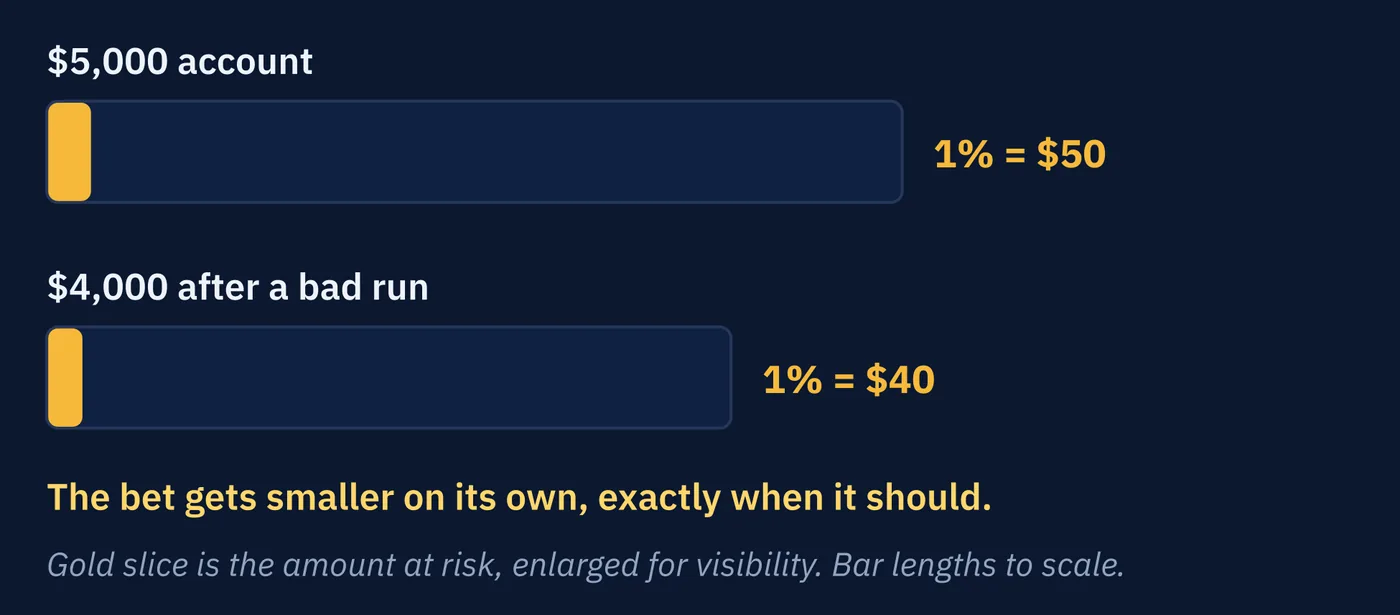
The reverse happens too. As the account grows, the same percentage puts more to work, which is how a small edge compounds instead of standing still.
A percentage protects you on the way down and works for you on the way up.
A fixed dollar amount does neither. It becomes a larger share of a shrinking account, which is precisely the wrong direction, and a smaller share of a growing one.
3What a Losing Streak Actually Does
Here is where the number gets chosen for you by the arithmetic.
Losing runs are normal. They happen to approaches that work well over a year. Five losses in a row is unremarkable, and any approach you trade will produce them.
So the useful question is not whether a streak arrives. It is what your account looks like afterward.
| Risk Per Trade | After Five Losses | Drawdown |
|---|---|---|
| 1% | $4,755 | 4.9% |
| 2% | $4,520 | 9.6% |
| 5% | $3,869 | 22.6% |
| 10% | $2,952 | 41.0% |
| 15% | $2,219 | 55.6% |
Starting from $5,000, and the same five losses in every row.
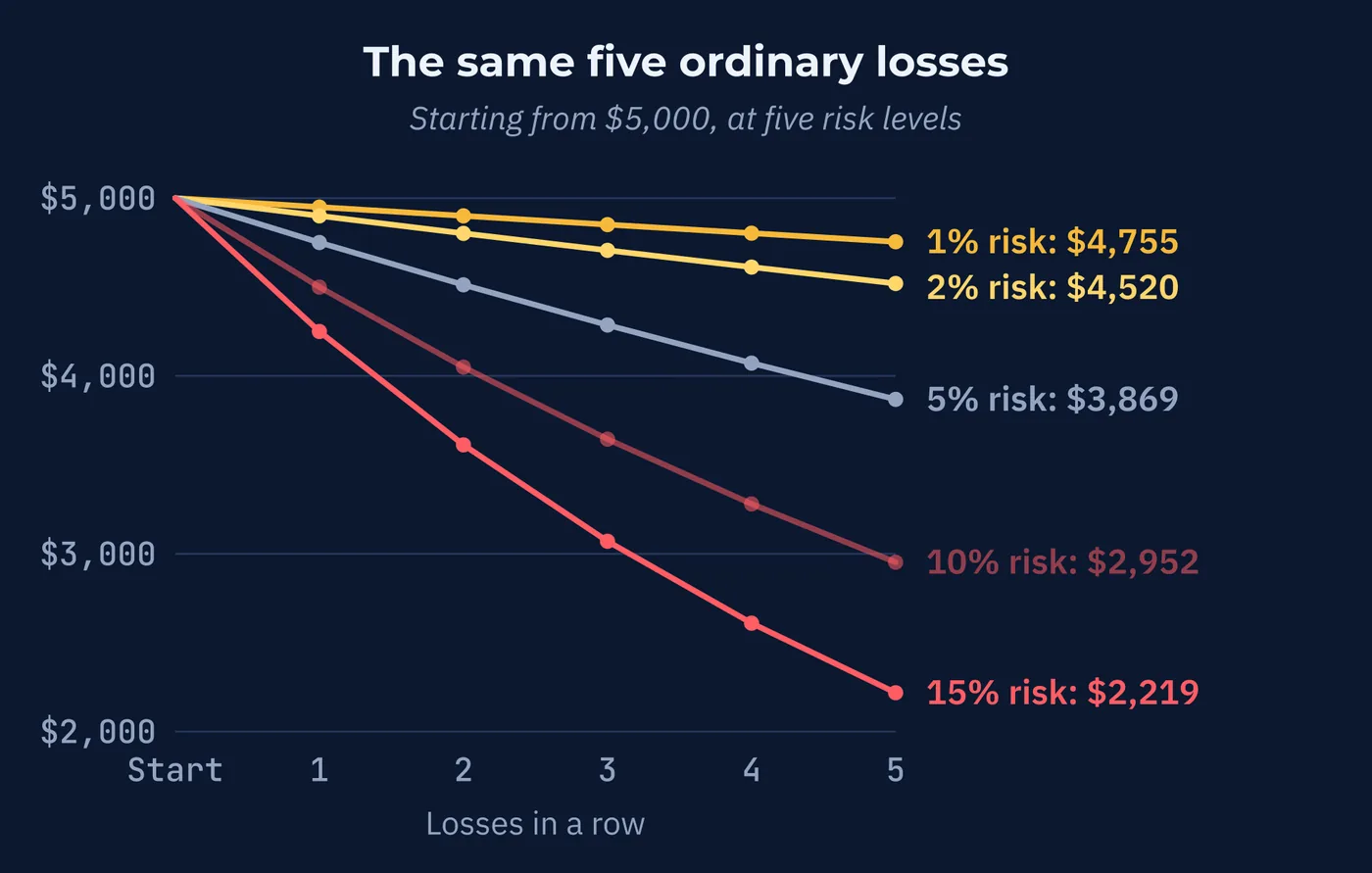
At 1%, the account barely notices. You are down under five percent and the next trade is placed exactly as planned.
At 15%, more than half the account is gone. And nothing unusual happened. The approach may be perfectly sound and simply having a normal week.
That is the whole case for a small percentage. Not caution as a personality trait, but staying in a position to keep trading when the streak ends.
4Getting Back Is Harder Than Falling
There is a second piece of arithmetic that makes large losses worse than they look, and most people meet it the hard way.
A loss and its recovery are not the same size.
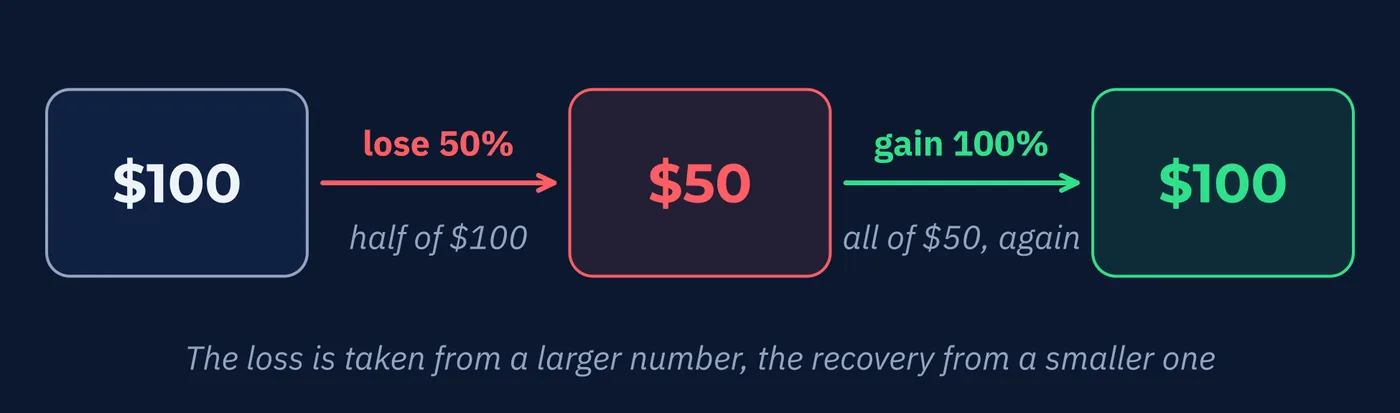
Lose half your account and you need to double what remains to get back to where you started. Not another fifty percent. A hundred.
| If You Lose | You Need to Gain | Just to Break Even |
|---|---|---|
| 5% | 5.3% | Barely different |
| 10% | 11.1% | Slightly harder |
| 25% | 33.3% | Noticeably harder |
| 50% | 100% | You must double |
| 75% | 300% | Four times what is left |
The reason is simple once stated. The loss is a percentage of a larger number and the recovery is a percentage of a smaller one.
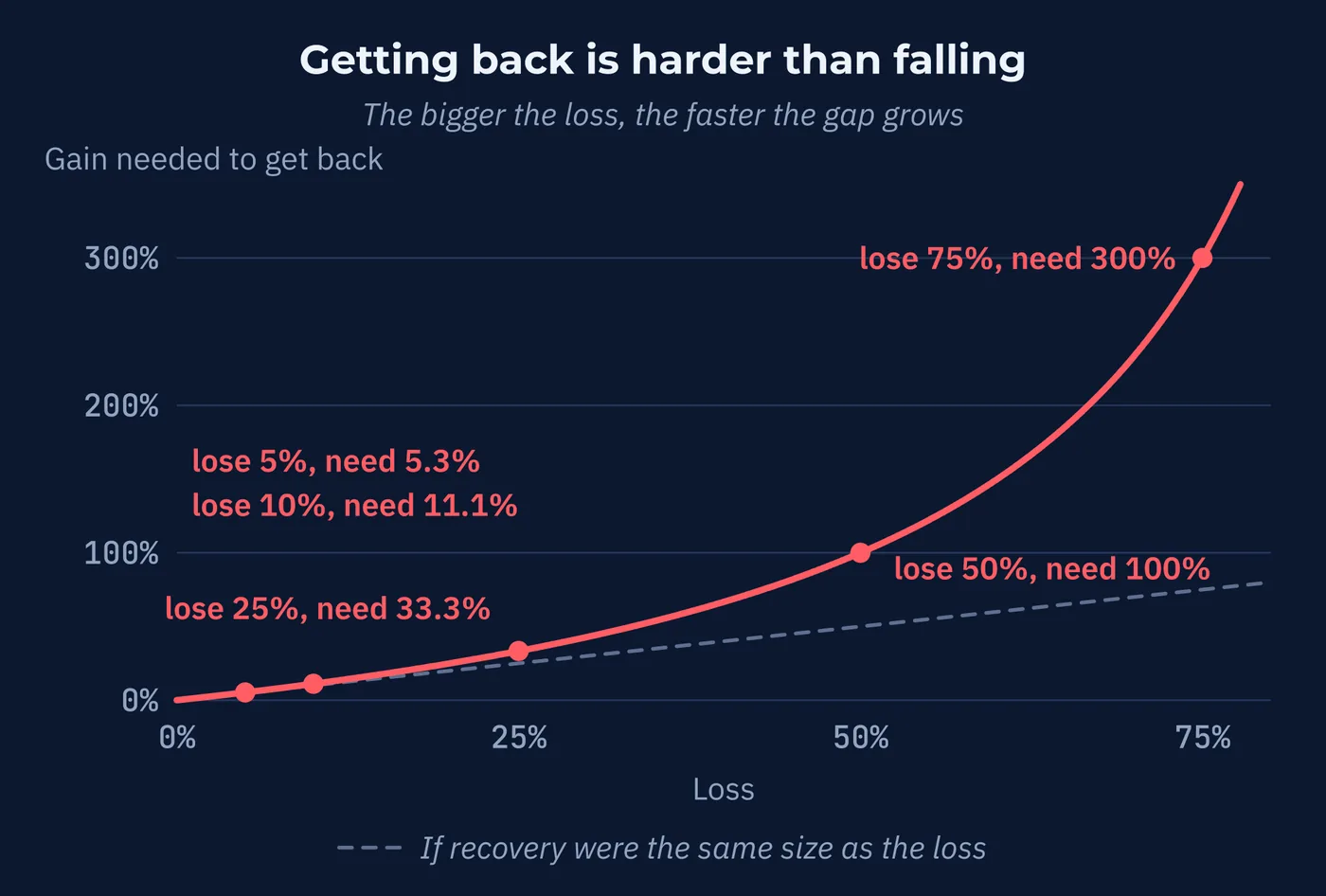
Losses take a percentage. Recovery needs a bigger one.
Now combine the two tables. Fifteen percent risk, five ordinary losses, and the account needs to gain about 125% just to return to where it began. From an approach that was working.
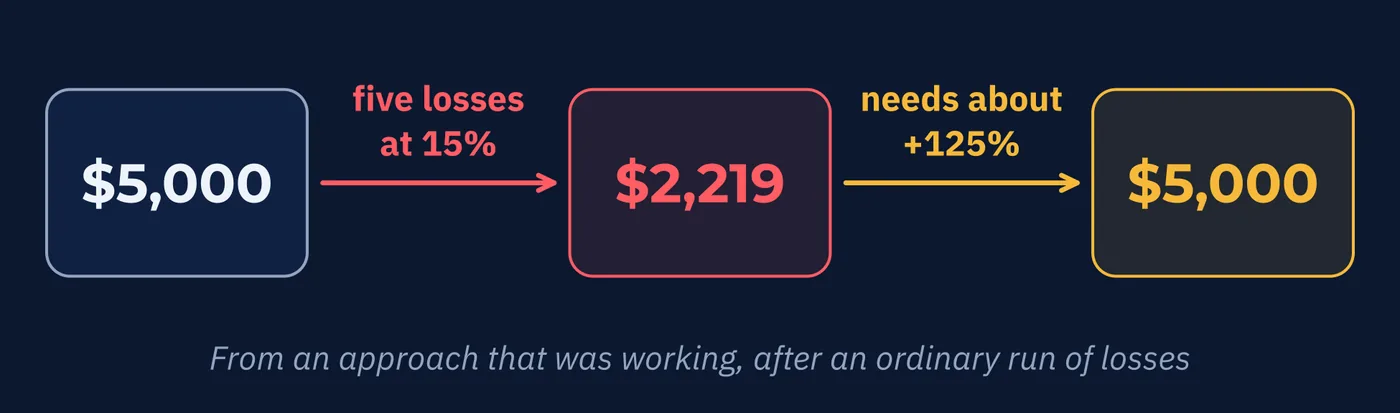
Small losses are recoverable in a way large ones are not. That asymmetry, more than anything else, is why the percentage is small.
5Turning a Percentage Into a Position
A percentage is not something you can type into a trading platform. It has to become a position size, and everything from Series C is what does the converting.
Three steps. Take a $5,000 account, 1% risk, and a 40-pip stop.
1% of $5,000 = $50 at risk$50 ÷ 40 pips = $1.25 per pip$1.25 ÷ $10 per pip per lot = 0.125 lotsThat is your position. Not a round number, and it does not need to be.
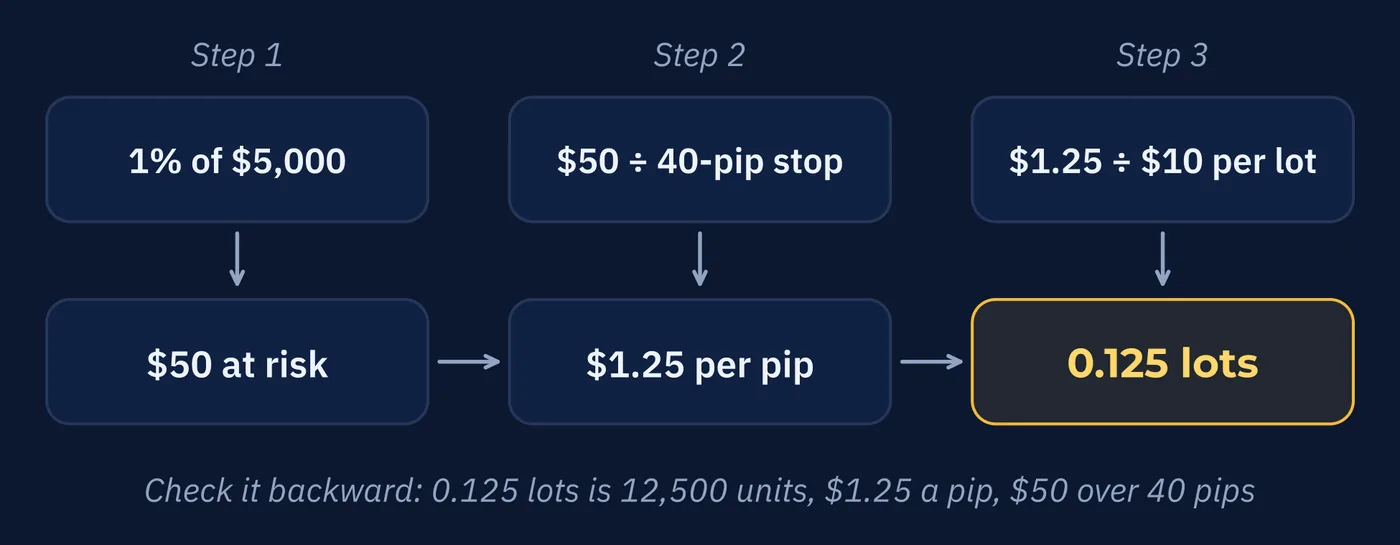
Check it backward if you like. A position of 0.125 lots is 12,500 units, which gives a pip value of $1.25. Forty pips at $1.25 is $50, which is one percent of $5,000. The chain holds.
6Recalculate Every Time
The account balance changes after every trade. Which means the correct position size changes after every trade too.
This is the step people skip, and it quietly breaks the system in both directions.
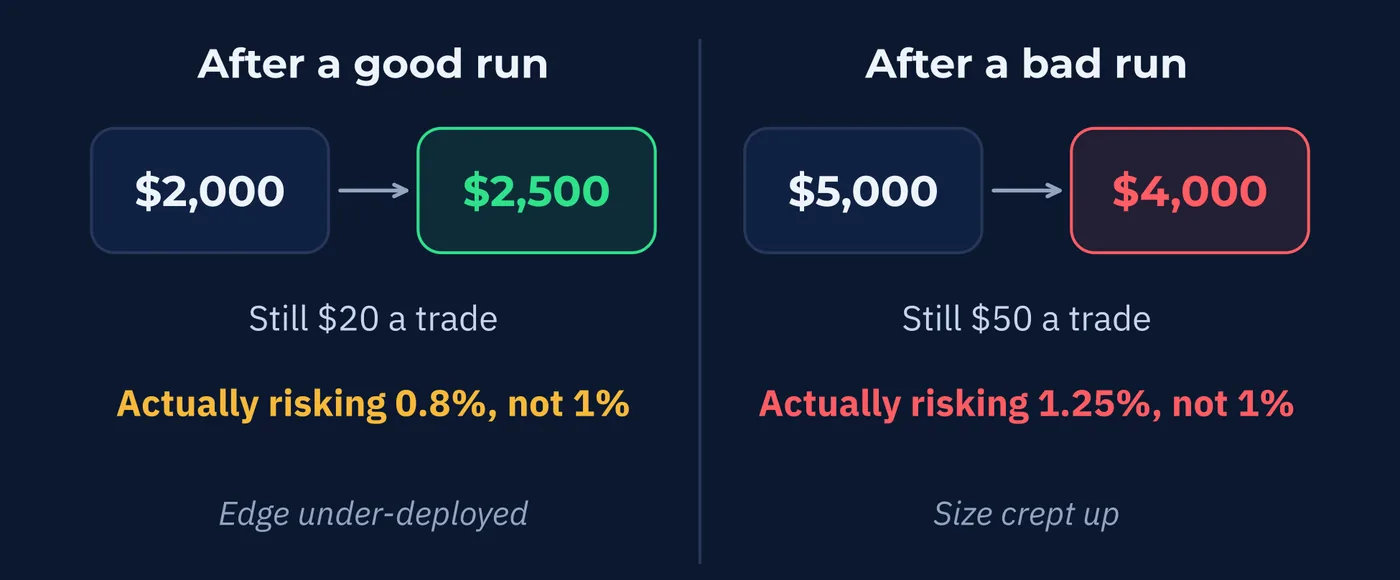
Suppose a $2,000 account grows to $2,500 over a good run. The trader keeps using the same position size out of habit, still risking $20 a trade.
$20 ÷ $2,500 = 0.8%The percentage drifted without any decision being made. The trader believes they are risking 1% and they are not. The edge is being under-deployed, and the compounding that a percentage system is supposed to deliver has quietly stopped.
The same drift runs the other way after losses, and there it is more dangerous. An account down from $5,000 to $4,000 with unchanged position sizing is now risking 1.25% while believing it is risking 1%. The size crept up exactly when the account could least support it.
The fix costs seconds. Recalculate before each trade, using the balance you actually have rather than the one you opened with.
7Finding Your Own Number
The arithmetic sets a range rather than a single answer. Most consistently profitable retail traders operate somewhere between 0.5% and 2%, and 1% is the common anchor.
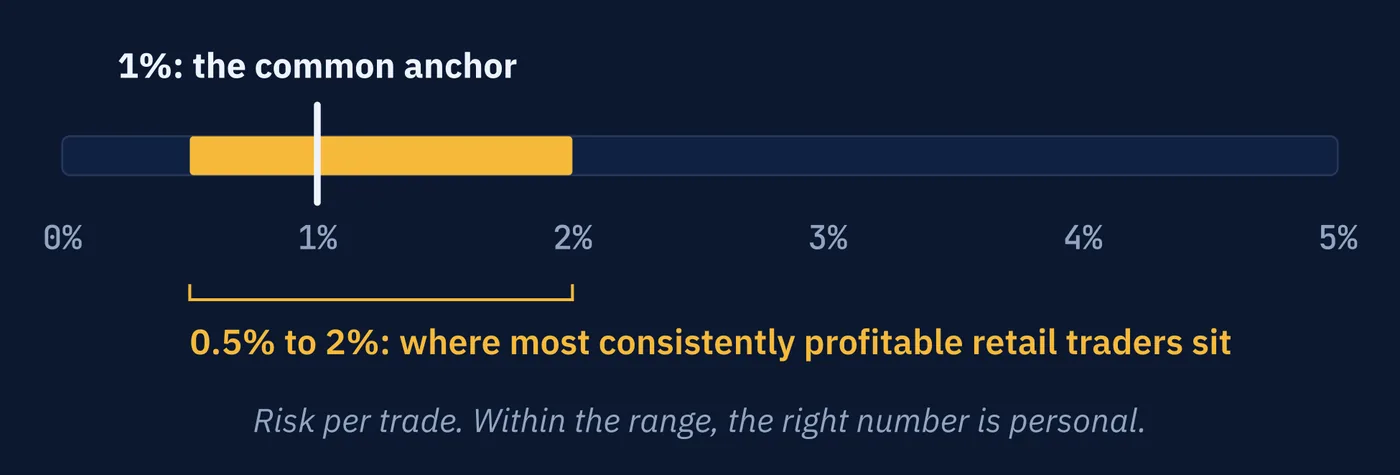
Within that range, the right number is personal, and it is found by observation rather than calculation.
Here is the test, and it requires honesty rather than cleverness. Trade the percentage on demo, then on a small live account, and pay attention to what a loss actually does to you.
| What You Notice | What It Suggests |
|---|---|
| The loss does not register at all and you barely remember it | Too small. The trades will not be taken seriously. |
| The loss stings, then you move on and place the next trade as planned | About right. |
| The loss stays with you and affects how you approach the next setup | Too large, whatever the arithmetic says about recovery. |
That middle row is the target, and it has a description worth remembering.
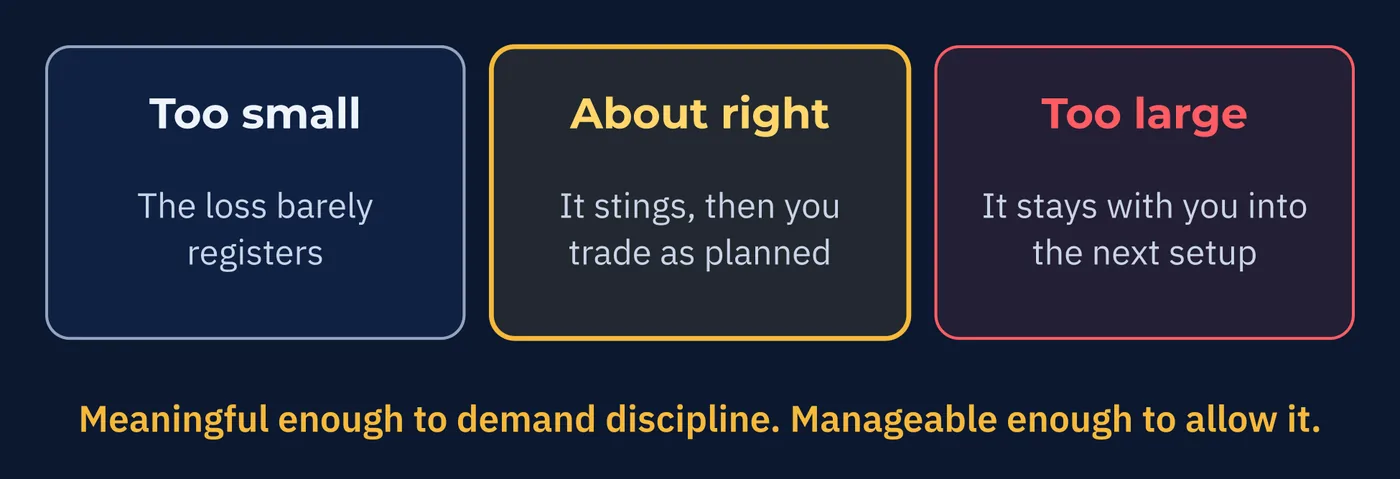
Meaningful enough to demand discipline. Manageable enough to allow it.
The number also does not need to be round. If 0.75% keeps you steady through a losing run in a way that 1% does not, then 0.75% is your number. Nothing is gained by conforming to a figure somebody published.

8Write It Down First
One practical instruction to close on.
Decide your percentage before you open a live account, and write it down somewhere you will see it.
The reason is that the decision becomes much harder later. In the middle of a losing run, raising the percentage looks like a route back. After a winning run, raising it feels earned. Both moments are terrible times to be deciding, and both arrive eventually.
A number chosen in advance, with the tables in this lesson in front of you, is a decision made calmly. A number chosen mid-streak is a reaction.
The next lesson moves from money to time. When the market is actually busy, and why the same pair behaves differently depending on who is awake.
Three Things to Remember
Try This
Fifteen minutes. Run the chain yourself, then decide your number.
Words From This Lesson
| Term | What It Means |
|---|---|
| Risk per trade | The share of your account you are prepared to lose on a single trade, set as a percentage. |
| Drawdown | How far the account has fallen from its recent high point, usually stated as a percentage. |
| Losing streak | A run of consecutive losing trades. Normal, and produced by every approach. |
| Position sizing | Converting a risk percentage and a stop distance into an actual lot size. |
| Percentage drift | Risking a different percentage than intended because the position size was not updated as the balance changed. |
| Compounding | Growth building on previous growth, which requires position size to rise with the account. |
Test Your Knowledge
Eight questions. Answer them all before checking the key on the following pages. If a question gives you trouble, the answer key tells you which section to revisit.
- A. It shrinks after losses and grows after gains automatically
- B. Percentages are easier to calculate
- C. Brokers require it
- D. Dollar amounts are not allowed on most platforms
- A. $4,500
- B. $4,750
- C. $3,900
- D. $2,200
- A. About 15%
- B. About 30%
- C. About 56%
- D. About 75%
- A. 50%
- B. 75%
- C. 150%
- D. 100%
- A. 0.05 lots
- B. 1.25 lots
- C. 0.50 lots
- D. 0.125 lots
- A. The stop distance
- B. The position size
- C. The risk percentage
- D. The account balance
- A. About 1.25%
- B. Still 1%
- C. About 0.8%
- D. It cannot be determined
- A. You should stop trading entirely
- B. Your risk percentage is too low
- C. Your risk percentage is too high for you
- D. The arithmetic is wrong
Answer Key
Each answer explains why the correct choice is correct, why the others are not, and where to reread.
Question 1 · correct answer A
A percentage adjusts to the balance. It reduces the amount risked after losses and increases it after gains, without any decision being needed.
B is not true, since a fixed amount requires no calculation at all. C is wrong because brokers do not set your risk. D is wrong because you can size positions however you choose.
Review: Section 2, Why a Percentage
Question 2 · correct answer B
Each loss takes one percent of what remains. Five in a row leaves about $4,755, a drawdown under five percent.
A corresponds to roughly 2% risk. C is closer to 5% risk. D is what 15% risk produces, which is a very different outcome from the same five trades.
Review: Section 3, What a Losing Streak Actually Does
Question 3 · correct answer C
Five losses at 15% leaves about $2,219 from $5,000, which is a drawdown of roughly 56%. More than half the account, from an ordinary streak.
A treats the five losses as a single one. B underestimates the compounding effect of consecutive losses. D overstates it, though not by as much as most people expect.
Review: Section 3, What a Losing Streak Actually Does
Question 4 · correct answer D
Half the account is gone, so what remains must double. A 50% gain on the remaining half only returns you to 75% of where you began.
A is the intuitive answer and the reason this asymmetry catches people. B and C are neither the intuitive answer nor the correct one.
Review: Section 4, Getting Back Is Harder Than Falling
Question 5 · correct answer D
One percent of $5,000 is $50. Divided by a 40-pip stop that is $1.25 per pip, and $1.25 divided by $10 per pip per lot gives 0.125 lots.
A and C do not follow from the chain. B is ten times too large and would risk $500, or ten percent of the account, on a single trade.
Review: Section 5, Turning a Percentage Into a Position
Question 6 · correct answer B
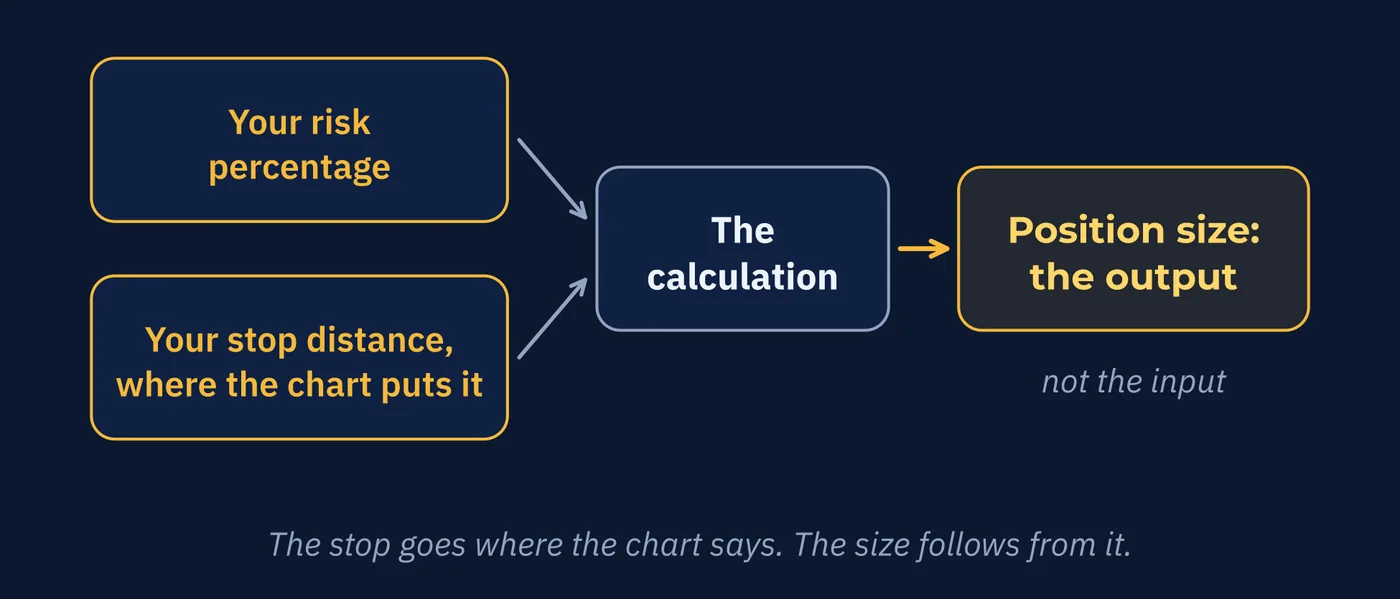
Risk percentage and stop distance are chosen first, and the position size falls out of them. The stop belongs where the chart says, not where a preferred size would put it.
A and C are inputs you decide before calculating. D is a fact about your account rather than something the calculation produces.
Review: Section 5, Turning a Percentage Into a Position
Question 7 · correct answer A
The dollar amount stayed the same while the balance fell. Fifty dollars is 1.25% of $4,000, so the risk rose without any decision being made.
B assumes the percentage holds automatically, which is only true if the size is recalculated. C describes what happens after a winning run rather than a losing one. D is wrong because the arithmetic is straightforward.
Review: Section 6, Recalculate Every Time
Question 8 · correct answer C
A loss that follows you into the next setup is interfering with execution. That is the signal to reduce, whatever the recovery arithmetic says is survivable.
B describes the opposite signal, which is a loss that does not register at all. A overreacts to a calibration problem with a simple fix. D is wrong because the arithmetic is sound and simply does not account for the person executing it.
Review: Section 7, Finding Your Own Number
Keep going
Building Your Trading Life is written by Kanin D. Alldredge for The Currency Classroom, and it is free to read. There is more free from CNS: start here.
Start free with CNS →