Leverage

1The Question From Lesson 15
One standard lot of EUR/USD is a position worth around $108,500. A beginner might be opening an account with two thousand dollars.
So how does the trade happen at all?
The answer is leverage, and the plain version is this. Your broker lets you control a position far larger than the money you put up, holding a fraction of its value as security.
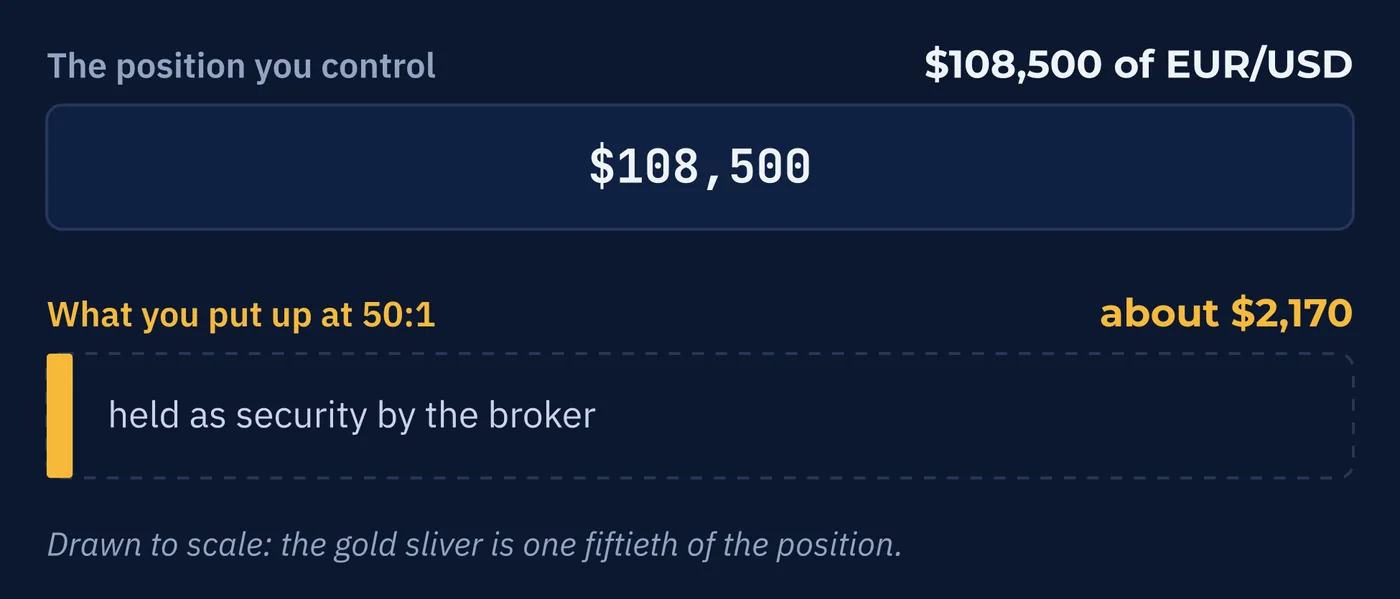
It is usually written as a ratio.
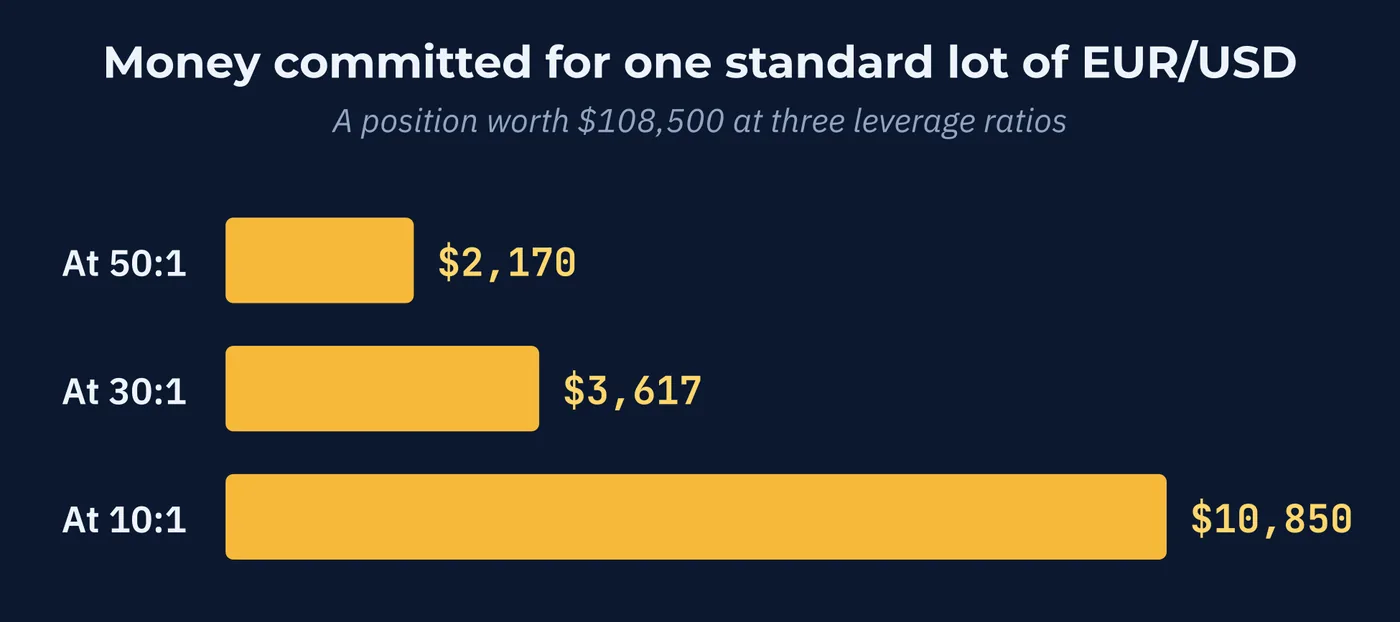
50:1 one dollar of yours controls fifty dollars of positionAt 50:1, a position worth $108,500 needs about $2,170 committed. At 30:1 it needs around $3,617. At 10:1, $10,850.
That money is not spent. It is held while the position is open and returned when it closes, adjusted for whatever the trade did. The mechanics of how it is held, and what happens when it runs short, are Lesson 18.
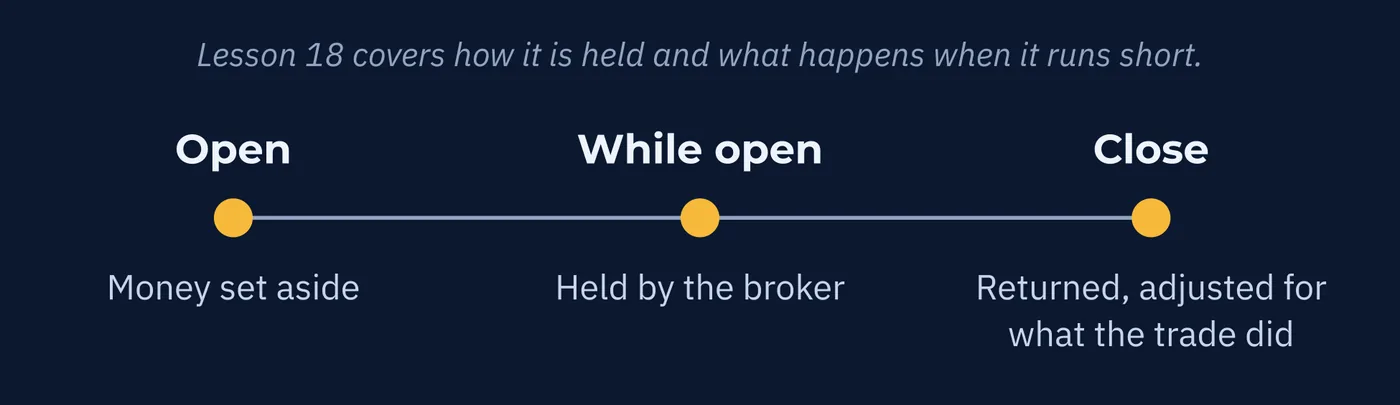
What matters here is the effect. Leverage is what makes a large position reachable from a small account.
2The Symmetry
Leverage is almost always described in terms of what it does to gains. That description is accurate and exactly half the story.
Work an example. You control a position worth $100,000 at 10:1, so around $10,000 of yours is committed.
price moves 10% in your favor → $10,000 gainthat is 100% of the money you committedNow the identical position, identical leverage, and the price goes the other way.
price moves 10% against you → $10,000 lossthat is 100% of the money you committedSame arithmetic, run backward. There is no version of leverage that magnifies one direction and not the other, and no setting that favors the outcome you were hoping for.
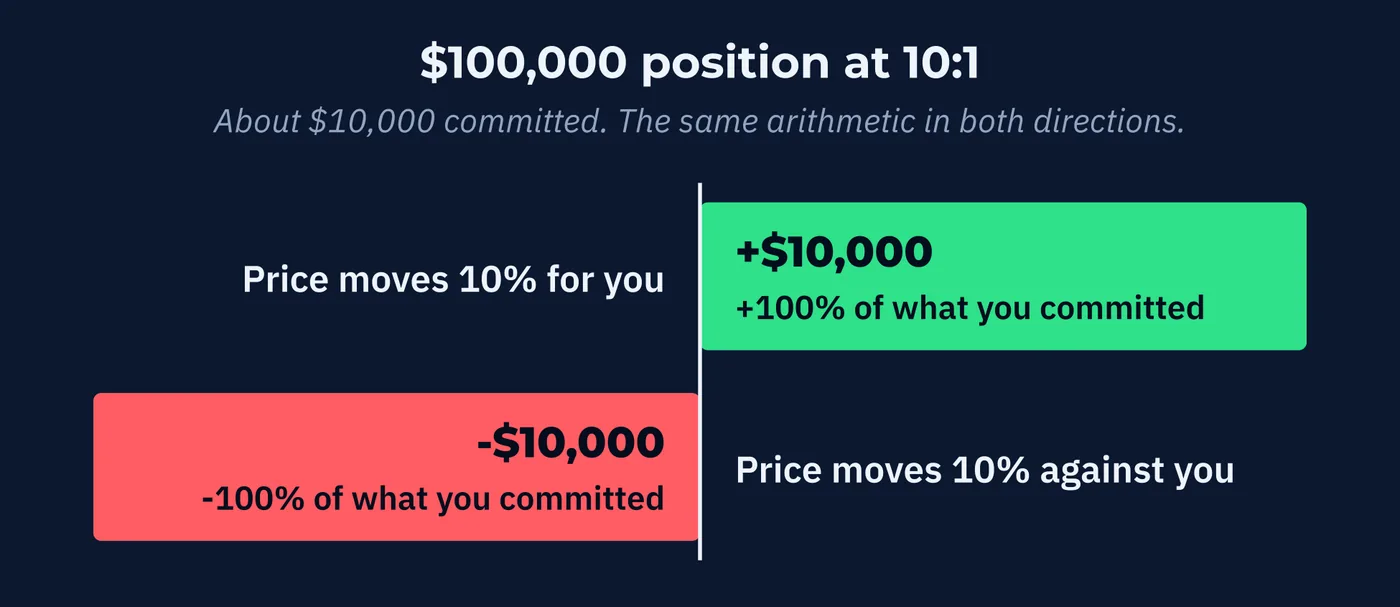
Leverage does not change your odds. It changes the size of everything.
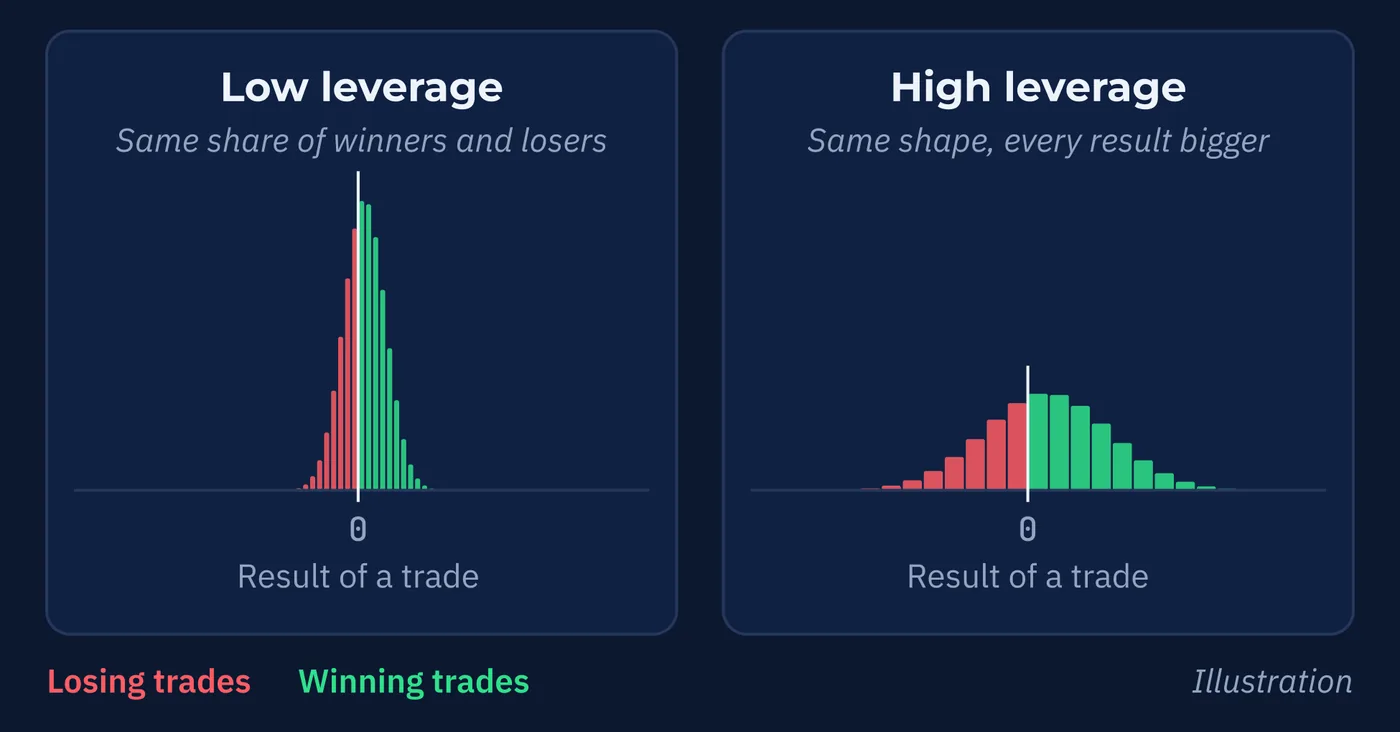
This matters because of how leverage is sold. High ratios are advertised as opportunity and access. They are called the thing that makes a small account workable. All of that is true. It is also, in equal measure, what makes a small account vanish.
3The Ceiling Is Not a Recommendation
Every broker advertises a maximum leverage ratio. It is worth understanding what that number is.
It is a legal limit. Regulators cap how much leverage a broker may offer retail clients, and the cap varies by where the broker is regulated.
| Jurisdiction | Typical Retail Cap on Major Pairs |
|---|---|
| United States | 50:1 |
| European Union, United Kingdom, Australia | 30:1 |
| Japan | 25:1 |
| Offshore, lightly regulated | 500:1 and higher |
Two things are worth drawing out of that table.
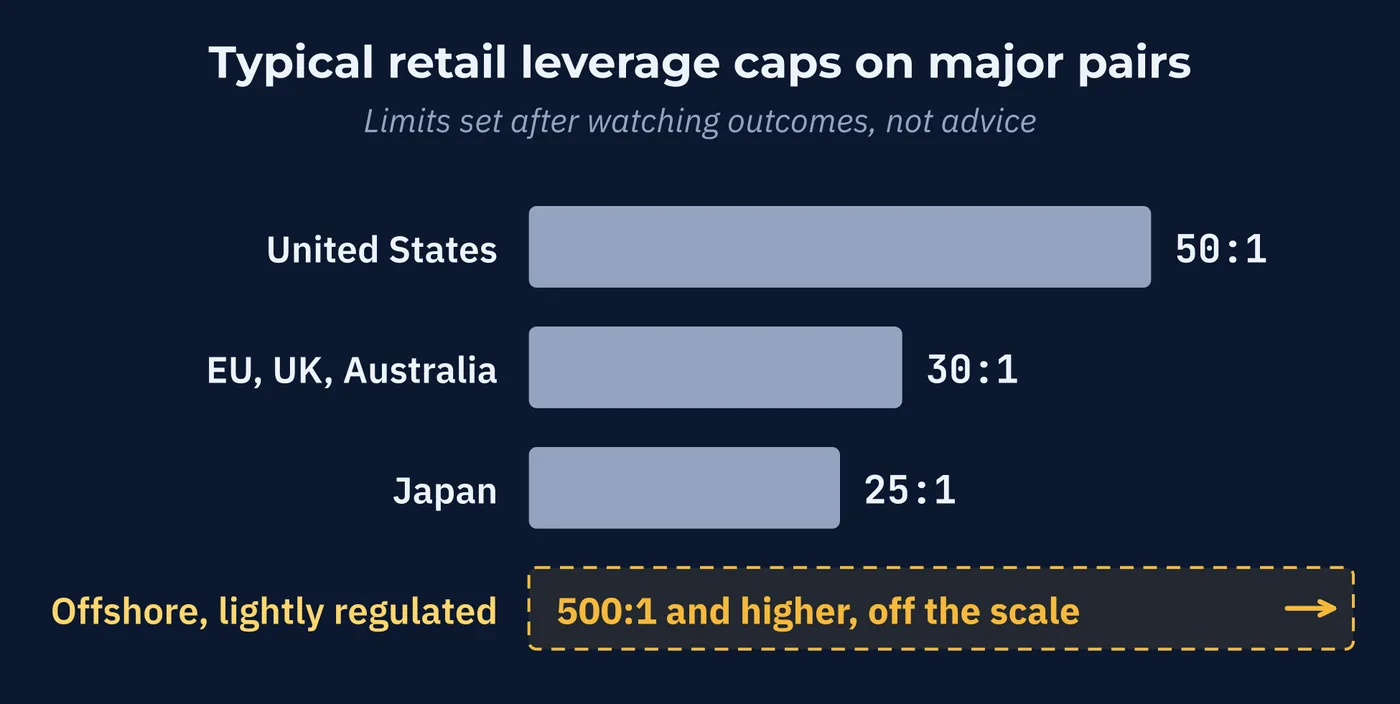
The first is why the caps exist. Regulators looked at what happened to ordinary accounts at higher ratios and stepped in. The number is a limit set after watching outcomes. It is not a hint about what works.
The second concerns the bottom row. A broker advertising 500:1 is not offering a better product. It is operating somewhere that allows it. That usually means somewhere without the safeguards the tighter caps come with. Those safeguards are the real difference. They matter most when something goes wrong.
The ceiling tells you what is allowed. It says nothing about what is wise.
4The Number That Actually Matters
Here is the idea that makes this lesson useful, and most beginners never encounter it.
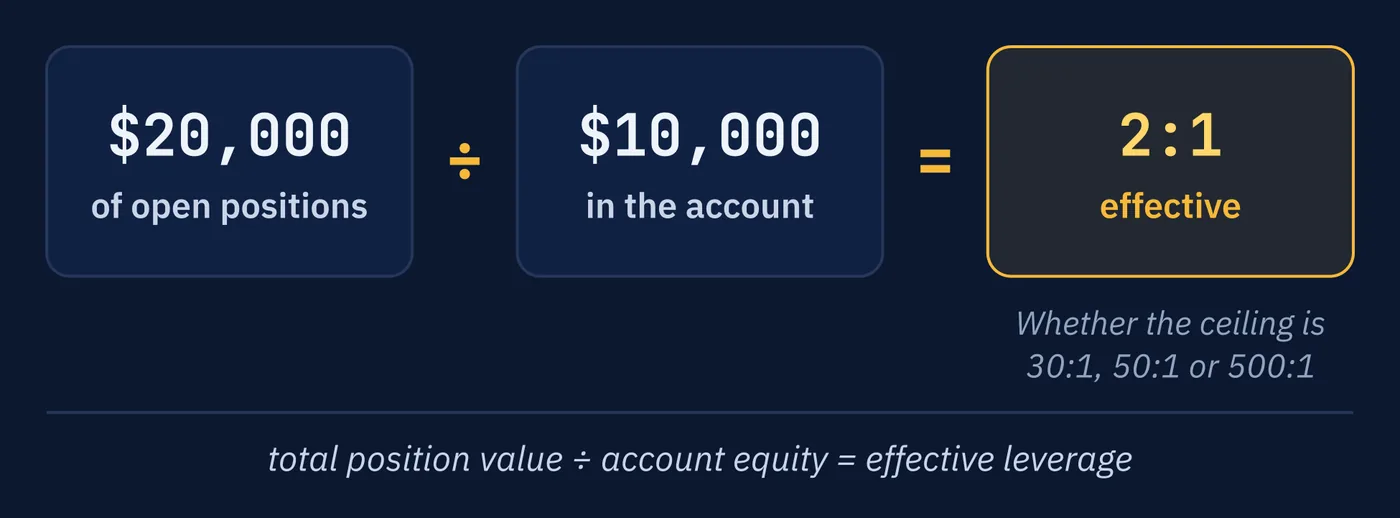
The ratio your broker offers is a ceiling. The leverage you are actually running is something else entirely, and you set it yourself through position size.
It is called effective leverage, and the calculation is one division.
total position value ÷ account equity = effective leverageA trader with $10,000 in the account and $20,000 of open positions is running 2:1. That is true whether the broker's ceiling is 30:1, 50:1, or 500:1. The ceiling was never reached and has no bearing on the risk being carried.
Watch what changes when only position size changes. Same account, same broker, same pair.
| Position | Position Value | Account Equity | Effective Leverage |
|---|---|---|---|
| 0.01 lots | $1,085 | $10,000 | 0.1:1 |
| 0.10 lots | $10,850 | $10,000 | 1.1:1 |
| 1.00 lots | $108,500 | $10,000 | 10.9:1 |
| 4.00 lots | $434,000 | $10,000 | 43.4:1 |
Four completely different risk exposures. Identical broker, identical advertised ratio, identical account. The only thing that changed was the number typed into the size box.
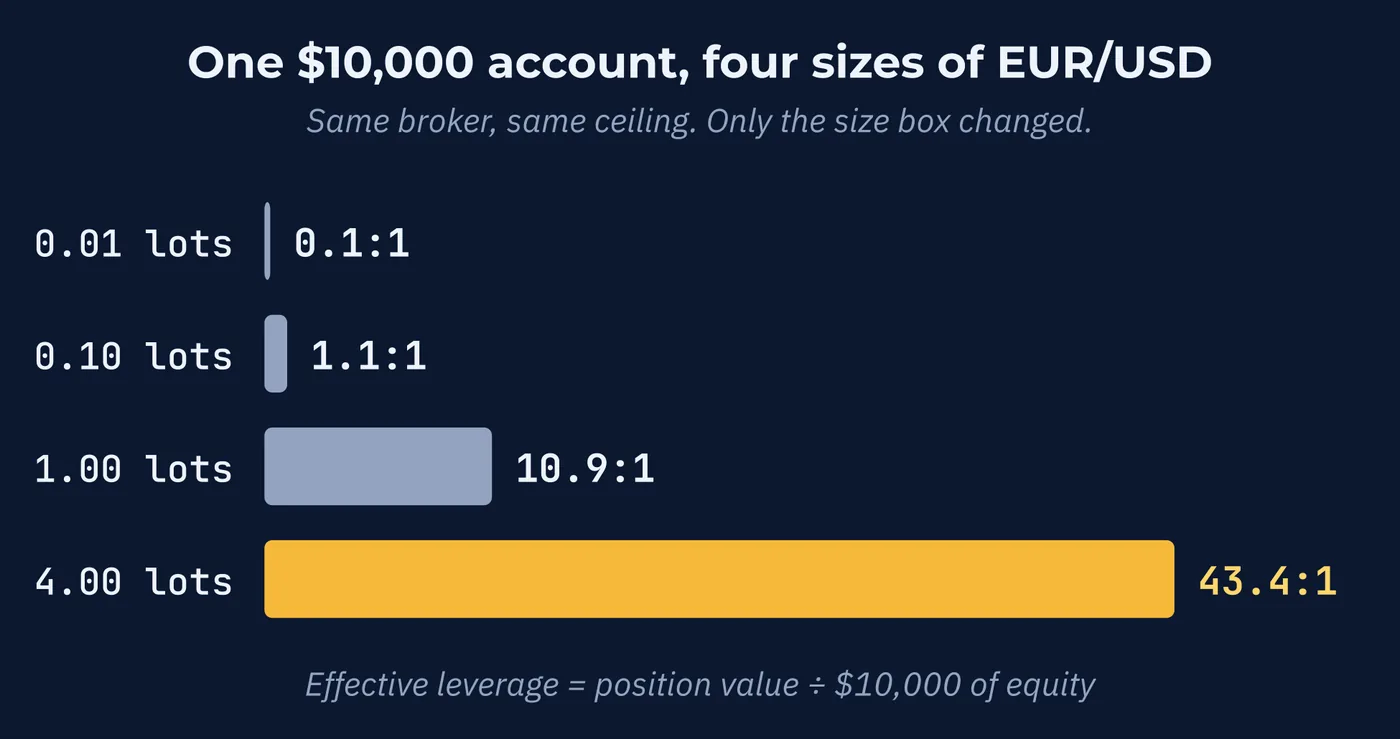
Which is the point. Leverage is not something your broker does to you. You choose it, one position at a time, and you choose it through size.
5What Experienced Traders Actually Run
Given that you choose it, a reasonable question is what to choose.
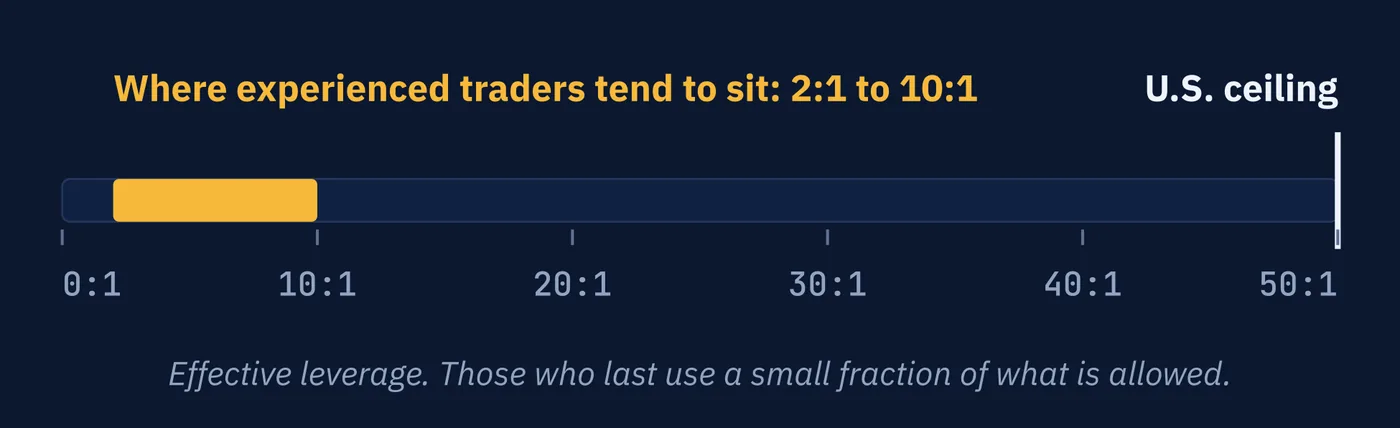
Among retail traders with track records long enough to mean anything, effective leverage tends to sit between 2:1 and 10:1. The more conservative end of that range is more common among those who have lasted the longest.
Compare that to a 50:1 ceiling and something becomes obvious. Traders who succeed over years are typically using a small fraction of what they are permitted to use.
The reason low leverage works is not moral, and it has nothing to do with caution being a virtue. It is arithmetic.
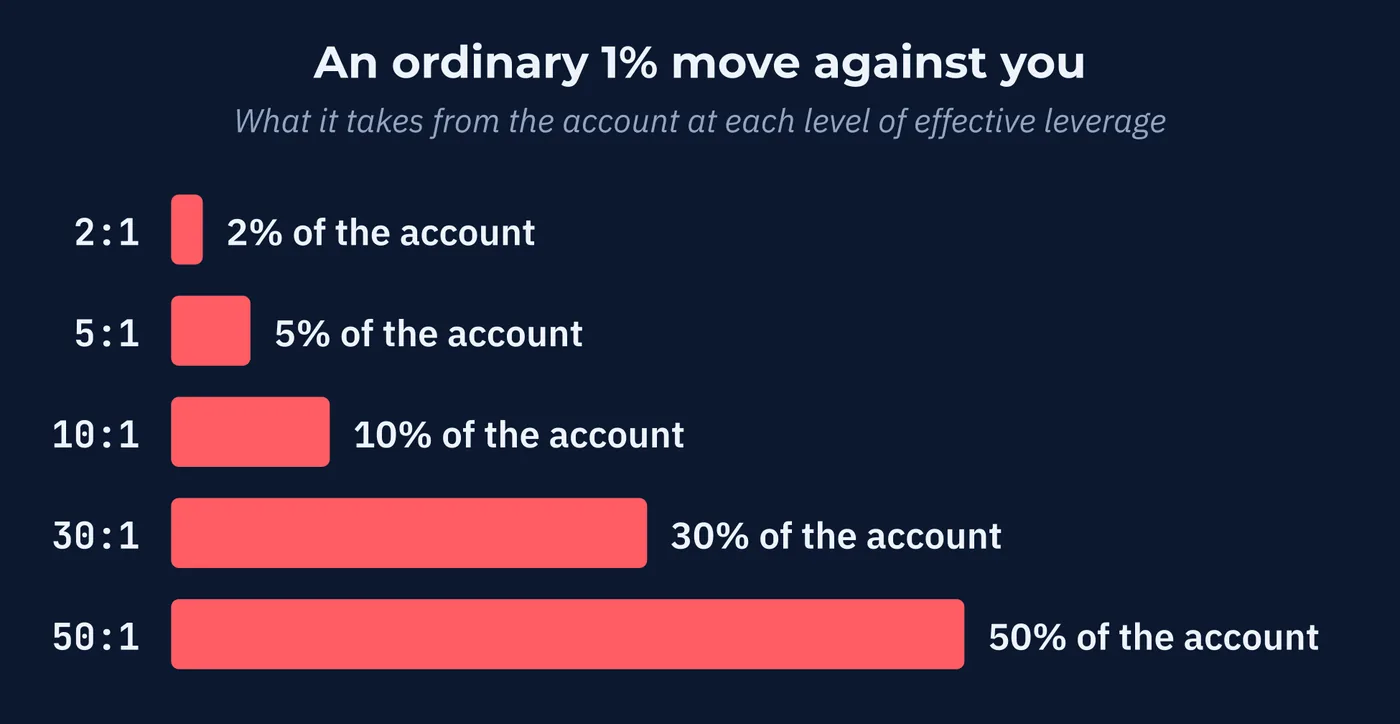
At high effective leverage, an ordinary move against you eats a large share of the account. Those moves happen constantly. They happen inside trades that go on to work. You have to survive them before anything else matters, and low leverage is what makes surviving them normal instead of lucky.
6Crypto Leverage
Crypto exchanges advertise leverage in a different form and at levels that dwarf anything in regulated currency markets. Fifty times. A hundred times. Sometimes more.
The arithmetic is unchanged, and that is exactly the problem.
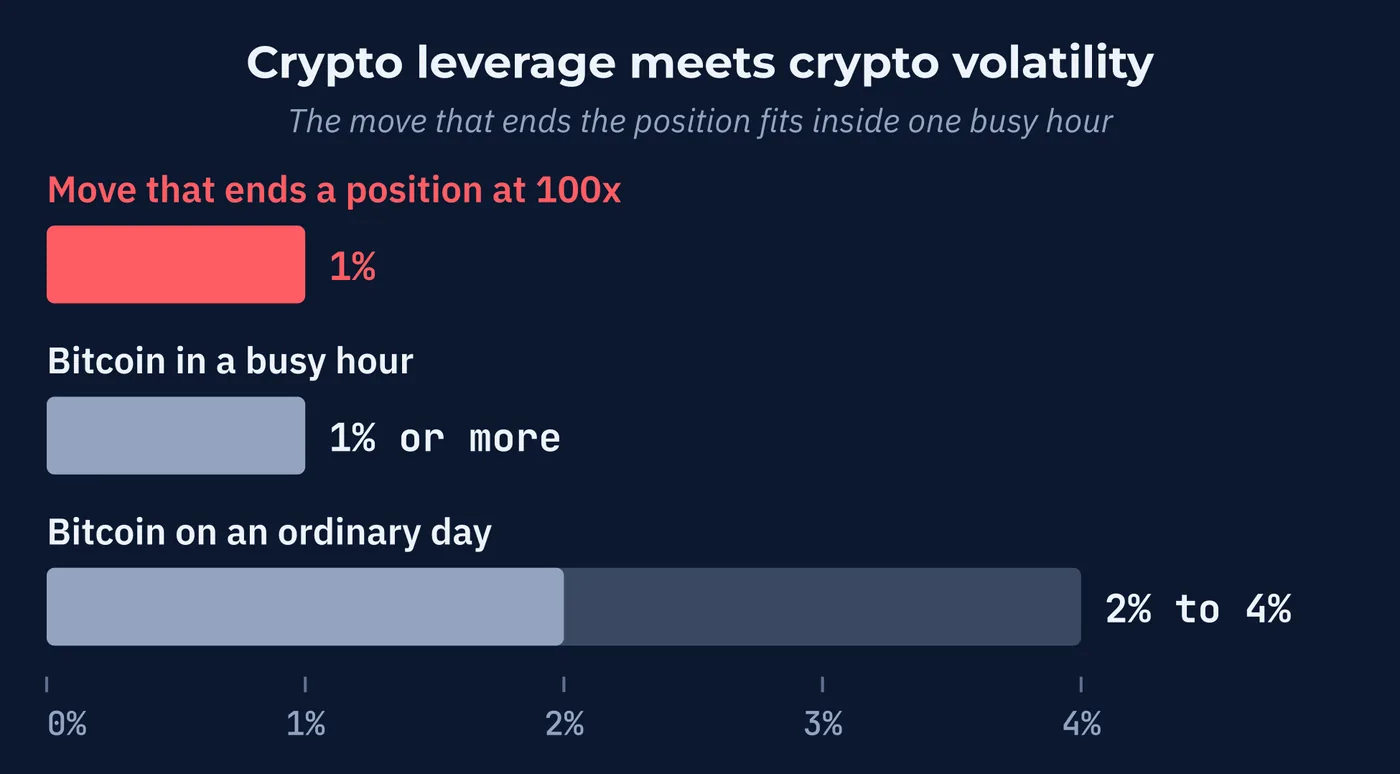
at 100x leverage, a 1% adverse move consumes your entire marginNow recall Lesson 6. Bitcoin moving two to four percent in a day is unremarkable, and it routinely moves one percent or more within a single hour during active periods.
Put those two facts side by side. At a hundred times leverage on Bitcoin, the move that ends the position is smaller than the move the asset can make in a single busy hour.
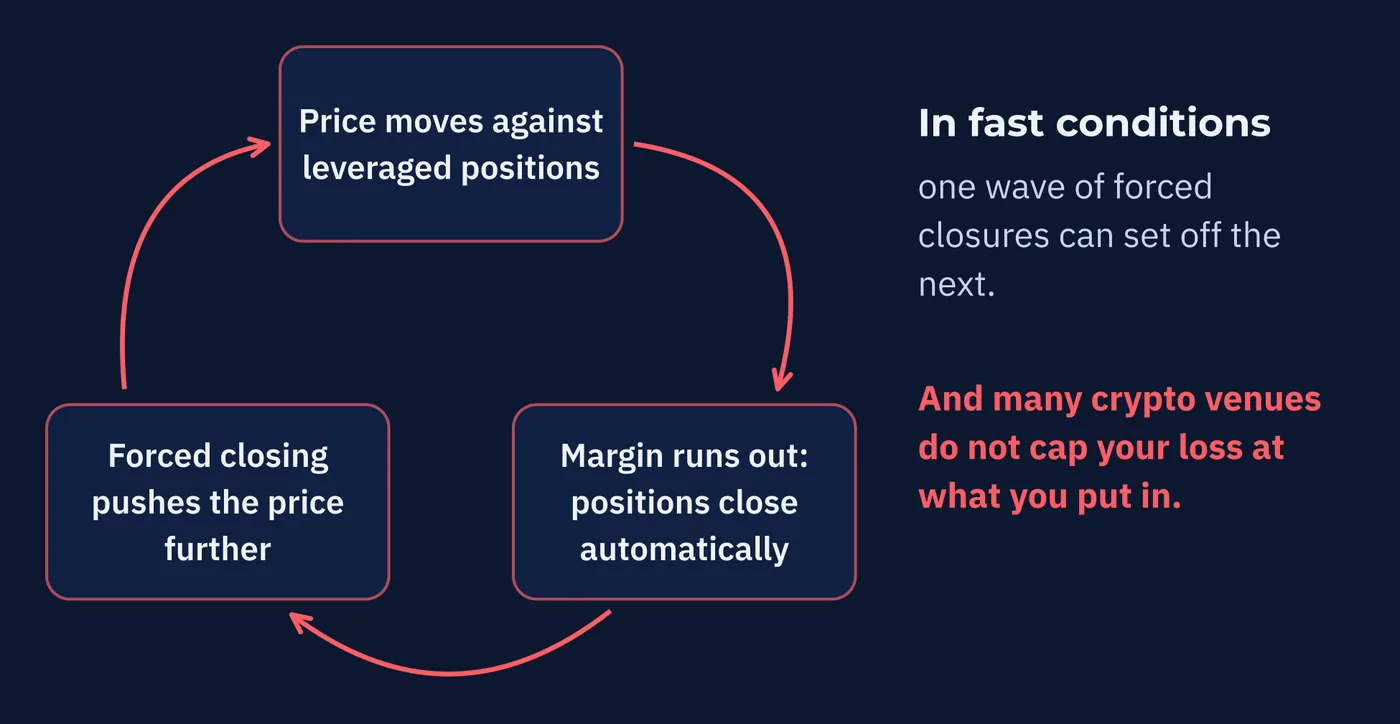
Two further things make crypto leverage harsher. Positions close automatically when the margin runs out. In fast conditions, those forced closures set off more of them. And many crypto venues lack the safeguard that caps your loss at what you put in. Regulated currency brokers provide it. Plenty of crypto platforms do not.
None of that says do not trade crypto. Lesson 11 covered how to read its pairs. It says that leverage and crypto volatility are a specific combination, and the combination is where accounts end rather than shrink.
7What Leverage Is Actually For
It would be easy to finish this lesson thinking leverage is simply a hazard. That is not right either.
Leverage is what makes this market accessible to people without institutional capital. Lesson 15 made the point that the lot system lets the size fit the trader. Leverage is the other half of that. Without it, a hundred thousand dollar position would require a hundred thousand dollars, and retail currency trading would not exist.
It also does something useful for a trader whose approach works. A small edge at a meaningful size produces meaningful results. Leverage is what provides the size without the capital.
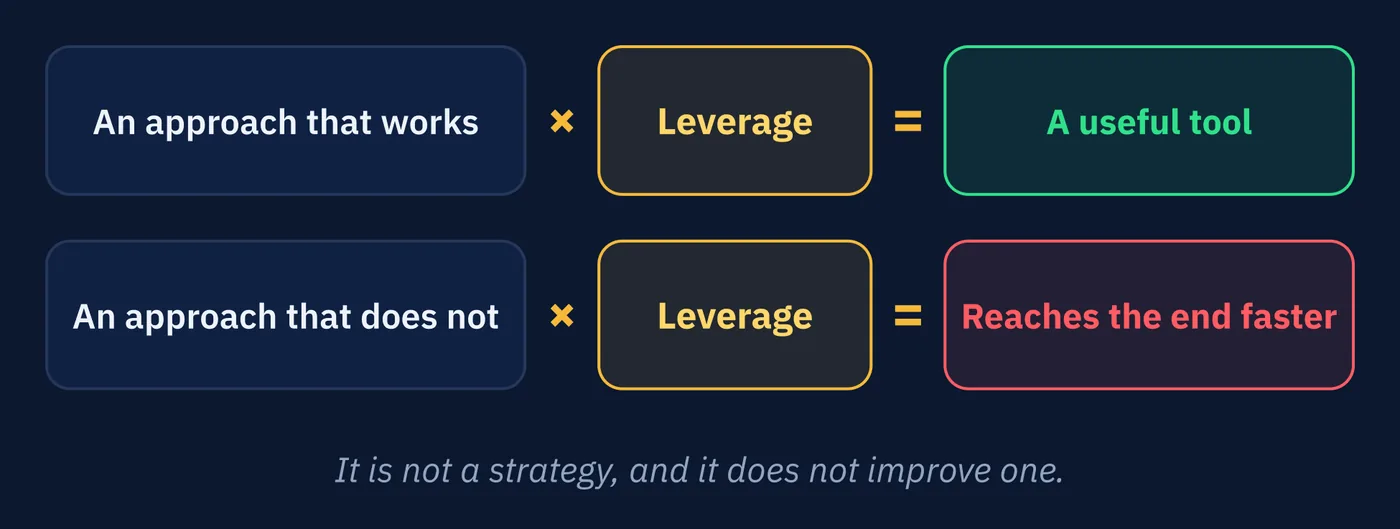
Which is why the advice is dull. Keep effective leverage low enough that a normal day cannot threaten the account. Learn what your approach does across a real run of trades. Raise the size later, on purpose, if there turns out to be something worth raising.
The next lesson covers what happens when leverage runs out of room. Margin, and the point at which the decision to close a position stops being yours.
Three Things to Remember
Try This
Ten minutes and a calculator. Find out what leverage you would actually be running.
Words From This Lesson
| Term | What It Means |
|---|---|
| Leverage | The ability to control a position larger than the money committed to it, expressed as a ratio such as 30:1. |
| Effective leverage | Total open position value divided by account equity. The leverage you are actually running, as opposed to the ceiling offered. |
| Account equity | What your account is currently worth, including the effect of any open positions. |
| Leverage cap | The maximum ratio a regulator permits a broker to offer retail clients in a given jurisdiction. |
| Negative balance protection | A safeguard, standard at regulated brokers, ensuring losses cannot exceed the money deposited. |
Test Your Knowledge
Eight questions. Answer them all before checking the key on the following pages. If a question gives you trouble, the answer key tells you which section to revisit.
- A. You can make fifty times your money
- B. The broker charges fifty percent interest
- C. One dollar of yours controls fifty dollars of position
- D. You must hold positions for fifty days
- A. You lose 10% of it
- B. You lose 1% of it
- C. You lose all of it
- D. Nothing until the position closes
- A. A legal ceiling set by regulators
- B. A recommendation for how much to use
- C. The amount most clients use
- D. A guarantee of available credit
- A. Total position value divided by account equity
- B. Broker ceiling divided by account equity
- C. Account equity divided by position value
- D. Position value multiplied by the broker ratio
- A. 50:1
- B. 2:1
- C. 20:1
- D. 0.5:1
- A. 30:1 to 50:1
- B. As close to the broker ceiling as possible
- C. 100:1 or more
- D. 2:1 to 10:1
- A. 10%
- B. 1%
- C. 0.1%
- D. 100%
- A. Improves a weak approach by increasing returns
- B. Guarantees larger profits on winning trades only
- C. Reduces risk by spreading it across more capital
- D. Multiplies whatever is already there, good or bad
Answer Key
Each answer explains why the correct choice is correct, why the others are not, and where to reread.
Question 1 · correct answer C
The ratio describes controlling power. At 50:1, every dollar committed controls fifty dollars of position value.
A confuses the ratio with an outcome, and no ratio predicts a return. B describes an interest charge, which is a separate matter from the leverage ratio itself. D invents a holding requirement that does not exist.
Review: Section 1, The Question From Lesson 15
Question 2 · correct answer C
At 10:1 you committed about $10,000 to control $100,000. A 10% adverse move is a $10,000 loss, which is all of it.
A applies the percentage to the committed money rather than the position, which is the error leverage creates. B divides where it should multiply. D is wrong because a position's value changes continuously whether or not it has been closed.
Review: Section 2, The Symmetry
Question 3 · correct answer A
It is a regulatory limit on what the broker may offer, set after examining how retail accounts actually performed at higher ratios.
B treats a legal maximum as guidance, which is precisely backward. C is wrong because most successful traders use a small fraction of the ceiling. D misdescribes the arrangement, since margin is collateral rather than credit extended to you.
Review: Section 3, The Ceiling Is Not a Recommendation
Question 4 · correct answer A
Divide what you are controlling by what you actually have. That ratio is the risk you are carrying right now.
B uses the ceiling, which has no bearing on your actual exposure. C inverts the division and would produce a fraction. D produces a figure with no meaning at all.
Review: Section 4, The Number That Actually Matters
Question 5 · correct answer B
Twenty thousand divided by ten thousand is two. The broker's 50:1 ceiling is irrelevant because it was never approached.
A quotes the ceiling instead of the actual exposure, which is the confusion this section addresses. C divides by the wrong figure. D inverts the calculation.
Review: Section 4, The Number That Actually Matters
Question 6 · correct answer D
Traders with long track records generally run between 2:1 and 10:1, with the lower end more common among those who have lasted longest.
A describes regulatory ceilings rather than practice. C describes crypto advertising rather than anything sustainable. B reverses the finding, since the ceiling is a limit rather than a target.
Review: Section 5, What Experienced Traders Actually Run
Question 7 · correct answer B
At a hundred times leverage, one percent of the position equals the whole of the margin committed. A 1% adverse move consumes it.
A would apply at 10x rather than 100x. C is off by a factor of ten. D would apply at 1:1, meaning no leverage at all.
Review: Section 6, Crypto Leverage
Question 8 · correct answer D
Leverage is a multiplier. It scales up whatever results the approach produces, including losses and including the effects of an approach nobody has tested yet.
A is the belief that ends accounts, since scaling a losing approach only reaches the end sooner. C describes diversification, which is a different idea and not what leverage does. B describes an asymmetry that does not exist, as Section 2 shows.
Review: Section 7, What Leverage Is Actually For
Keep going
The Real Cost & Mechanics of a Trade is written by Kanin D. Alldredge for The Currency Classroom, and it is free to read. There is more free from CNS: start here.
Start free with CNS →